VaN3Twin: the Multi-Technology V2X Digital Twin with Ray-Tracing in the Loop
Pith reviewed 2026-05-22 14:36 UTC · model grok-4.3
The pith
VaN3Twin is a new open-source digital twin that integrates ray tracing into V2X simulations to cut disagreement with real measurements by half in rural areas and over 70 percent in cities.
A machine-rendered reading of the paper's core claim, the machinery that carries it, and where it could break.
Core claim
The central claim is that incorporating ray-tracing for physical-layer propagation modeling, including vehicle mesh blockages, Doppler effects, and site-specific scattering, together with a dedicated module for cross-technology interference at the resource-block level, produces a full-stack V2X simulator whose application-layer results disagree far less with real measurements than existing tools, specifically by 50 percent in rural settings and over 70 percent in urban ones.
What carries the argument
Ray-tracing integration for wireless channel modeling combined with a time-frequency resource-block interference tracker that refines signal-to-interference-plus-noise estimates and removes bimodal artifacts from separate line-of-sight and non-line-of-sight models.
If this is right
- Supports coexistence studies of DSRC and C-V2X technologies on shared spectrum with realistic propagation conditions.
- Removes artifacts in signal quality estimates that arise when line-of-sight and non-line-of-sight paths are modeled separately.
- Allows scalable digital-twin simulations that focus on vehicle-induced blockages and environmental scattering for V2X design.
- Provides higher-fidelity inputs for testing application performance under multi-technology interference.
Where Pith is reading between the lines
- Engineers could explore rare safety scenarios in connected vehicles through simulation before building physical prototypes.
- The same ray-tracing plus interference approach might transfer to other shared-spectrum wireless systems outside automotive use.
- Digital twins built this way could shorten the time needed to validate new V2X deployments against regulatory requirements.
Load-bearing premise
That the ray-tracing and interference modules together capture real wireless behavior across environments without introducing new modeling errors or needing heavy per-scenario adjustments.
What would settle it
Running VaN3Twin on an independent set of field measurements from a previously unused mixed urban-rural test route and checking whether the application-layer disagreement remains at least 50 percent lower than results from prior simulation tools.
Figures




read the original abstract
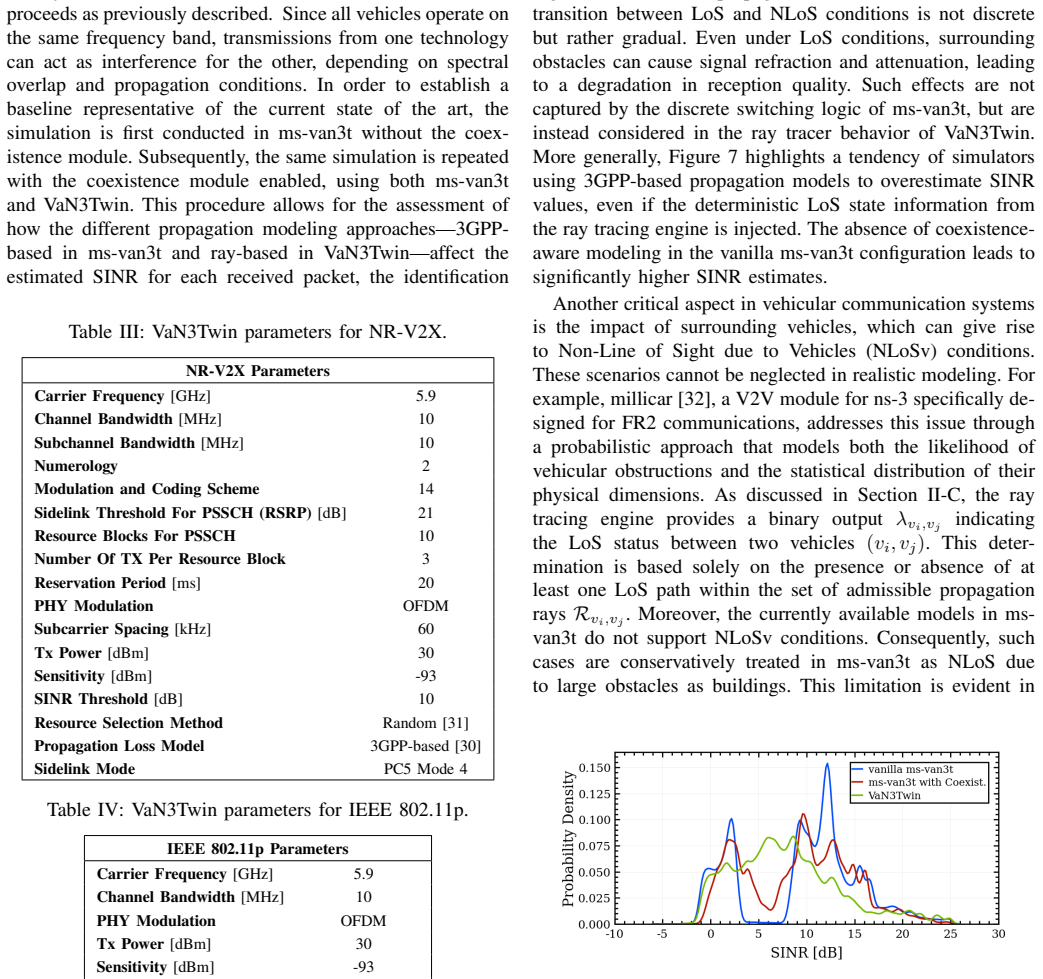
This paper presents VaN3Twin-the first open-source, full-stack Network Digital Twin (NDT) framework for simulating the coexistence of multiple Vehicle-to-Everything (V2X) communication technologies with accurate physical-layer modeling via ray tracing. VaN3Twin extends the ms-van3t simulator by integrating Sionna Ray Tracer (RT) in the loop, enabling high-fidelity representation of wireless propagation, including diverse Line-of-Sight (LoS) conditions with focus on LoS blockage due to other vehicles' meshes, Doppler effect, and site-dependent effects-e.g., scattering and diffraction. Unlike conventional simulation tools, the proposed framework supports realistic coexistence analysis across DSRC and C-V2X technologies operating over shared spectrum. A dedicated interference tracking module captures cross-technology interference at the time-frequency resource block level and enhances signal-to-interference-plus-noise ratio (SINR) estimation by eliminating artifacts such as the bimodal behavior induced by separate LoS/NLoS propagation models. Compared to field measurements, VaN3Twin reduces application-layer disagreement by 50% in rural and over 70% in urban environments with respect to current state-of-the-art simulation tools, demonstrating its value for scalable and accurate digital twin-based V2X coexistence simulation.
Editorial analysis
A structured set of objections, weighed in public.
Referee Report
Summary. The manuscript presents VaN3Twin, an open-source full-stack Network Digital Twin for multi-technology V2X coexistence. It extends ms-van3t by integrating Sionna ray tracing in the loop to model propagation effects including vehicle-mesh LoS blockage, Doppler shifts, scattering, and diffraction, while adding a resource-block-level interference tracker to improve SINR estimation and remove bimodal artifacts from separate LoS/NLoS models. The central empirical claim is that VaN3Twin reduces application-layer disagreement with field measurements by 50% in rural and over 70% in urban settings relative to existing state-of-the-art simulators.
Significance. If the reported fidelity gains prove robust, the framework would offer a valuable open-source platform for accurate V2X digital-twin studies, particularly for shared-spectrum coexistence of DSRC and C-V2X. The explicit integration of ray tracing with a full-stack simulator and the interference module at the resource-block level address documented weaknesses in conventional tools and could support more reliable performance predictions for vehicular networks.
major comments (2)
- [Evaluation / Results section] The headline quantitative result (50% rural / >70% urban reduction in application-layer disagreement) is presented without ablation studies that isolate the contribution of the Sionna RT integration or the new interference module. No results are shown for the system with the interference tracker disabled or with conventional propagation models, leaving open the possibility that the observed match arises from additional modeling degrees of freedom rather than genuinely superior physics.
- [Framework description and interference module] The claim that the interference module eliminates bimodal SINR behavior and improves fidelity is stated in the framework description, yet no intermediate validation (e.g., SINR CDFs, Kolmogorov-Smirnov statistics, or direct comparison against measured SINR traces) is provided to confirm the improvement independently of the final application-layer metric.
minor comments (2)
- [Abstract] The abstract refers to comparisons against 'current state-of-the-art simulation tools' without naming the specific baselines or versions used; explicit identification would aid reproducibility.
- [System architecture] Consider adding a summary table listing the key modules (ray-tracing interface, interference tracker, technology schedulers) and their data-exchange points to clarify the integration architecture.
Simulated Author's Rebuttal
We thank the referee for the constructive and detailed comments on our manuscript. We address each major comment below and commit to revisions that will strengthen the evaluation and validation sections.
read point-by-point responses
-
Referee: [Evaluation / Results section] The headline quantitative result (50% rural / >70% urban reduction in application-layer disagreement) is presented without ablation studies that isolate the contribution of the Sionna RT integration or the new interference module. No results are shown for the system with the interference tracker disabled or with conventional propagation models, leaving open the possibility that the observed match arises from additional modeling degrees of freedom rather than genuinely superior physics.
Authors: We agree that dedicated ablation studies would more clearly isolate the contributions of the Sionna ray-tracing integration and the resource-block-level interference module. The current results compare the full VaN3Twin framework against state-of-the-art simulators that rely on conventional propagation models, but we acknowledge the value of internal controls. In the revised manuscript we will add results for VaN3Twin with the interference tracker disabled and with conventional (non-ray-tracing) propagation models. These ablations will help demonstrate that the reported fidelity gains arise from the proposed components rather than from increased degrees of freedom. revision: yes
-
Referee: [Framework description and interference module] The claim that the interference module eliminates bimodal SINR behavior and improves fidelity is stated in the framework description, yet no intermediate validation (e.g., SINR CDFs, Kolmogorov-Smirnov statistics, or direct comparison against measured SINR traces) is provided to confirm the improvement independently of the final application-layer metric.
Authors: We recognize that intermediate validation would strengthen the claims regarding the interference module. In the revised version we will include SINR CDF plots comparing the full model against the version without the resource-block-level tracker, along with Kolmogorov-Smirnov statistics to quantify the reduction in bimodal artifacts. Where the available field measurements include SINR traces, we will also add direct comparisons; otherwise we will note the limitation and focus on the statistical evidence from the simulation traces. revision: yes
Circularity Check
No circularity: framework extends external tools with external validation
full rationale
The paper describes an integration of the existing open-source ms-van3t simulator with Sionna Ray Tracer plus a new interference module. Central claims consist of empirical reductions in application-layer disagreement (50% rural, >70% urban) versus field measurements and versus prior state-of-the-art simulators. No equations, parameters, or uniqueness statements are defined in terms of the target results; the derivation chain is an engineering composition validated against independent external data rather than any self-referential fit or self-citation chain. The result is therefore self-contained against external benchmarks.
Axiom & Free-Parameter Ledger
free parameters (1)
- Ray-tracing configuration parameters
axioms (1)
- domain assumption Ray tracing provides sufficiently accurate modeling of LoS blockage, Doppler, and site-specific effects in V2X environments
Lean theorems connected to this paper
-
IndisputableMonolith/Foundation/RealityFromDistinction.leanreality_from_one_distinction unclear?
unclearRelation between the paper passage and the cited Recognition theorem.
VaN3Twin extends the ms-van3t simulator by integrating Sionna Ray Tracer (RT) in the loop, enabling high-fidelity representation of wireless propagation, including diverse Line-of-Sight (LoS) conditions with focus on LoS blockage due to other vehicles' meshes, Doppler effect, and site-dependent effects
-
IndisputableMonolith/Cost/FunctionalEquation.leanwashburn_uniqueness_aczel unclear?
unclearRelation between the paper passage and the cited Recognition theorem.
A dedicated interference tracking module captures cross-technology interference at the time-frequency resource block level and enhances signal-to-interference-plus-noise ratio (SINR) estimation by eliminating artifacts such as the bimodal behavior induced by separate LoS/NLoS propagation models
What do these tags mean?
- matches
- The paper's claim is directly supported by a theorem in the formal canon.
- supports
- The theorem supports part of the paper's argument, but the paper may add assumptions or extra steps.
- extends
- The paper goes beyond the formal theorem; the theorem is a base layer rather than the whole result.
- uses
- The paper appears to rely on the theorem as machinery.
- contradicts
- The paper's claim conflicts with a theorem or certificate in the canon.
- unclear
- Pith found a possible connection, but the passage is too broad, indirect, or ambiguous to say the theorem truly supports the claim.
Forward citations
Cited by 2 Pith papers
-
Network Digital Untwinning: Towards Backward Optimization of Digital Twins
A new untwinning framework removes deprecated contributions from network digital twins via rollback checkpoints, Gaussian noise, and remapping, with claimed indistinguishability guarantees from scratch-built models.
-
Predicting Networks Before They Happen: Experimentation on a Real-Time V2X Digital Twin
A real-time V2X digital twin predicts RSSI with 1.01 dB average error and LoS transitions within 250 ms latency by integrating live mobility data with deterministic ray-tracing simulation.
discussion (0)
Sign in with ORCID, Apple, or X to comment. Anyone can read and Pith papers without signing in.