Notes on (-2)-form symmetries
Pith reviewed 2026-06-28 00:43 UTC · model grok-4.3
The pith
A (-2)-form symmetry modifies the SymTFT action to relate QFTs whose ordinary global symmetries differ by anomaly data or non-invertible associator data.
A machine-rendered reading of the paper's core claim, the machinery that carries it, and where it could break.
Core claim
A (-2)-form symmetry, realized via a non-genuine codimension-one defect in the SymTFT bulk attached to a spacetime-filling topological operator, modifies the SymTFT action and thereby relates theories whose ordinary global symmetries differ by anomaly data or by the associator data of a non-invertible symmetry.
What carries the argument
The non-genuine codimension-one defect in the SymTFT bulk attached to a spacetime-filling topological operator that realizes the (-2)-form symmetry and alters the SymTFT action.
If this is right
- The construction relates two-dimensional toy models whose global symmetries differ by anomaly data.
- It connects distinct phases of three-dimensional ABJM-type theories.
- It applies to four-dimensional generalized Yang-Mills theory.
- It supplies a fusion-categorical example relating the non-invertible symmetries Rep(D4) and Rep(Q8).
- Club-sandwich and nested discrete gauging realizations interface IR phases of distinct RG flows of a common UV theory.
Where Pith is reading between the lines
- The same mechanism may supply a systematic way to generate new dualities by shifting higher-form background fields that control anomaly coefficients.
- Nested discrete gauging offers a concrete computational route to enumerate equivalent theories on the lattice.
- The holographic identification suggests that other supergravity fluxes could be reinterpreted as (-2)-form backgrounds affecting boundary anomalies in higher-dimensional setups.
Load-bearing premise
The non-genuine codimension-one defect in the SymTFT bulk consistently realizes a (-2)-form symmetry that alters the SymTFT action without violating underlying QFT consistency conditions.
What would settle it
Explicit computation in the three-dimensional Chern-Simons-matter theory showing that a shift in the parameter identified with the (-2)-form background changes the boundary anomaly coefficients in the precise way predicted by the Romans-mass holographic realization.
Figures




read the original abstract
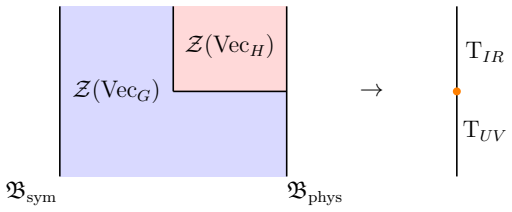
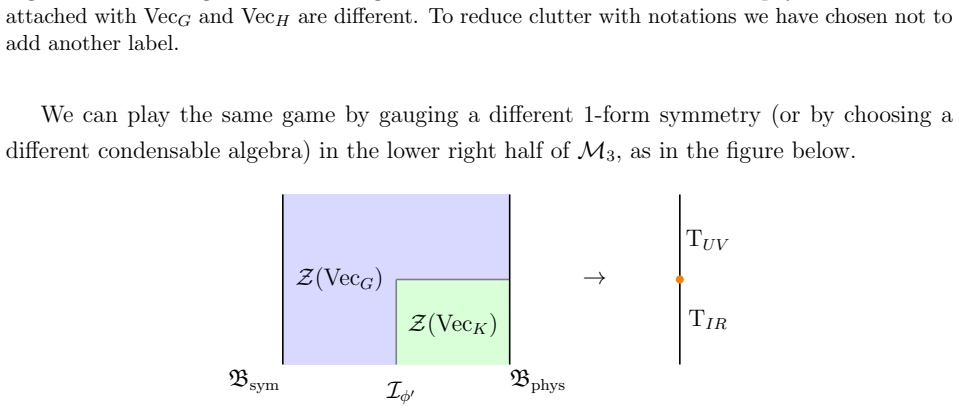
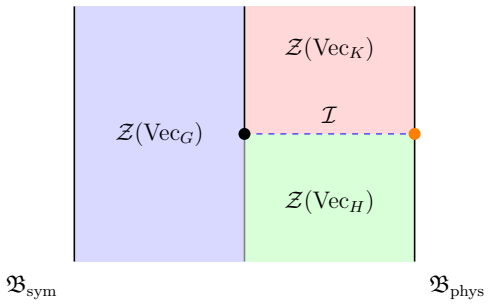
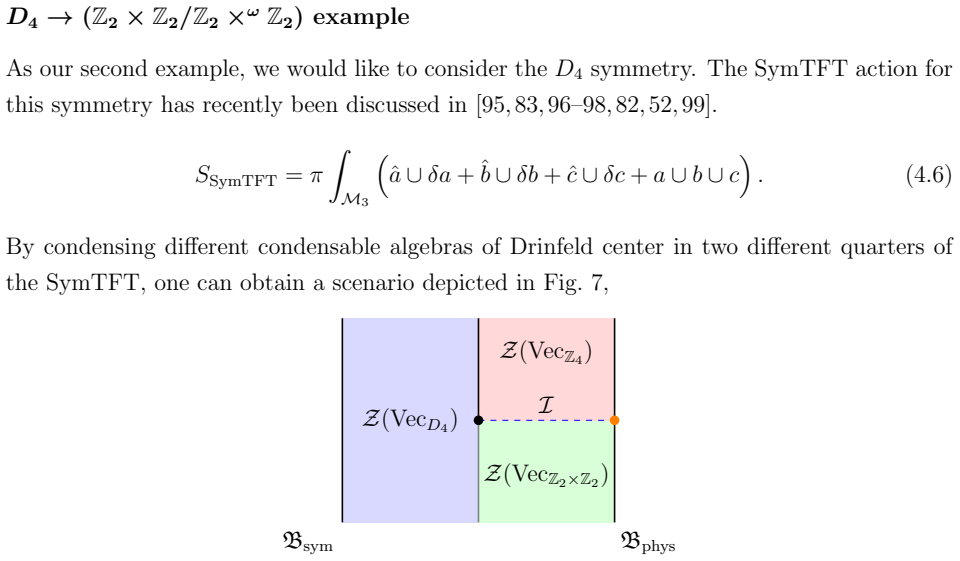
We study $(-2)$-form symmetries of a $d$-dimensional quantum field theory, via a $(-1)$-form symmetry of its $(d+1)$-dimensional Symmetry Topological Field Theory (SymTFT), realized by a non-genuine codimension-one defect in the SymTFT bulk attached to a spacetime-filling topological operator. Unlike a $(-1)$-form symmetry of a $d$-dimensional theory, which merely shifts a parameter of the absolute theory, a $(-2)$-form symmetry modifies the SymTFT action, and thereby relates theories whose ordinary global symmetries differ by anomaly data or by the associator data of a non-invertible symmetry. We illustrate the construction in two-dimensional toy models, three-dimensional ABJM-type theories, four-dimensional generalized Yang--Mills theory, and in a fusion-categorical example relating the non-invertible symmetries $\operatorname{Rep}(D_4)$ and $\operatorname{Rep}(Q_8)$. We then develop a club-sandwich realization, in which a quarter-gauging operation interfaces between IR phases of distinct RG flows of a common UV theory, and an alternative realization via nested discrete gauging. Finally, we present a holographic, top-down realization in which the type IIA Romans mass plays the role of a $(-2)$-form background for a three-dimensional Chern--Simons-matter theory, with shifts of the Romans mass realizing shifts of the boundary anomaly coefficients. We also discuss related constructions for coupled bulk--boundary systems.
Editorial analysis
A structured set of objections, weighed in public.
Referee Report
Summary. The manuscript introduces (-2)-form symmetries of a d-dimensional QFT, realized as a (-1)-form symmetry of its (d+1)-dimensional SymTFT via a non-genuine codimension-one defect in the SymTFT bulk attached to a spacetime-filling topological operator. This construction modifies the SymTFT action and thereby relates theories whose ordinary global symmetries differ by anomaly data or by the associator data of a non-invertible symmetry. Explicit illustrations are given in 2d toy models, 3d ABJM-type theories, 4d generalized Yang-Mills, the fusion categories Rep(D4) and Rep(Q8), club-sandwich and nested discrete gauging realizations, and a holographic top-down example in which the type IIA Romans mass acts as a (-2)-form background for 3d Chern-Simons-matter theories, with mass shifts corresponding to shifts in boundary anomaly coefficients.
Significance. If the constructions are internally consistent, the work provides a concrete extension of the SymTFT framework that unifies the treatment of anomaly shifts and non-invertible symmetry data through higher-codimension operators. The multiple low-dimensional examples, the club-sandwich and gauging constructions, and the explicit holographic realization using Romans mass constitute reproducible model-building tools that could be applied to other systems; these strengths are load-bearing for the paper's utility.
minor comments (2)
- [Introduction] The definition of the non-genuine codimension-one defect and its attachment to the spacetime-filling operator (abstract, paragraph 2) would benefit from an explicit local operator expression or a small diagram in the first section to make the modification of the SymTFT action fully transparent.
- [Holographic realization] In the holographic section, the precise dictionary between shifts of the Romans mass parameter and the resulting shifts in the boundary anomaly coefficients should be stated with the relevant Chern-Simons level or anomaly polynomial term.
Simulated Author's Rebuttal
We thank the referee for their careful reading of our manuscript and for the positive assessment, including the recommendation for minor revision. The referee summary accurately captures the scope of the work on (-2)-form symmetries and their realization via the SymTFT. No specific major comments were provided in the report.
Circularity Check
No significant circularity detected
full rationale
The paper introduces (-2)-form symmetries as a conceptual extension of the SymTFT framework, realized by a non-genuine codimension-one defect attached to a spacetime-filling operator. It illustrates the idea through explicit constructions in low-dimensional models (2d toys, 3d ABJM, 4d gYM, Rep(D4)/Rep(Q8)) and a holographic Romans-mass example, all within standard SymTFT consistency. No load-bearing steps reduce by definition, fitted parameters renamed as predictions, or self-citation chains; the derivations remain self-contained extensions of prior formalism without circular reductions.
Axiom & Free-Parameter Ledger
axioms (2)
- domain assumption Existence and consistency of Symmetry Topological Field Theory (SymTFT) as an auxiliary (d+1)-dimensional theory encoding d-dimensional global symmetries.
- domain assumption Well-defined non-genuine codimension-one defects can be attached to spacetime-filling operators without spoiling topological invariance.
invented entities (1)
-
(-2)-form symmetry
no independent evidence
Reference graph
Works this paper leans on
-
[1]
D. Gaiotto, A. Kapustin, N. Seiberg and B. Willett,Generalized global symmetries, JHEP02(2015) 172, [1412.5148]
Pith/arXiv arXiv 2015
-
[2]
Sharpe,Notes on generalized global symmetries in QFT,Fortsch
E. Sharpe,Notes on generalized global symmetries in QFT,Fortsch. Phys.63(2015) 659–682, [1508.04770]
Pith/arXiv arXiv 2015
-
[3]
C. Cordova, T. T. Dumitrescu, K. Intriligator and S.-H. Shao,Snowmass white paper: Generalized symmetries in quantum field theory and beyond, inSnowmass 2021, 5, 2022,2205.09545
Pith/arXiv arXiv 2021
-
[4]
Schafer-Nameki,ICTP lectures on (non-)invertible generalized symmetries,Phys
S. Schafer-Nameki,ICTP lectures on (non-)invertible generalized symmetries,Phys. Rept.1063(2024) 1–55, [2305.18296]
Pith/arXiv arXiv 2024
-
[5]
T. D. Brennan and S. Hong,Introduction to generalized global symmetries in QFT and particle physics,2306.00912
-
[6]
L. Bhardwaj and S. Schafer-Nameki,Generalized charges, part II: Non-invertible symmetries and the symmetry TFT,SciPost Phys.19(2025) 098, [2305.17159]
arXiv 2025
-
[7]
D. S. Freed,Introduction to topological symmetry in QFT,Proc. Symp. Pure Math. 107(2024) 93–106, [2212.00195]
arXiv 2024
-
[8]
I. Bah, D. Freed, G. W. Moore, N. Nekrasov, S. S. Razamat and S. Sch¨ afer-Nameki, Snowmass whitepaper: Physical mathematics 2021,2203.05078
arXiv 2021
-
[9]
L. Bhardwaj, L. E. Bottini, L. Fraser-Taliente, L. Gladden, D. S. W. Gould, A. Platschorre et al.,Lectures on generalized symmetries,Phys. Rept.1051(2024) 1–87, [2307.07547]
Pith/arXiv arXiv 2024
-
[10]
Shao,What’s done cannot be undone: TASI lectures on non-invertible symmetries,2308.00747
S.-H. Shao,What’s done cannot be undone: TASI lectures on non-invertible symmetries,2308.00747
-
[11]
P. R. S. Gomes,An introduction to higher-form symmetries,SciPost Phys. Lect. Notes 74(2023) 1, [2303.01817]
arXiv 2023
-
[12]
McGreevy,Generalized symmetries in condensed matter,Ann
J. McGreevy,Generalized symmetries in condensed matter,Ann. Rev. Condensed Matter Phys.14(2023) 57–82, [2204.03045]. 50
arXiv 2023
-
[13]
C.-M. Chang, Y.-H. Lin, S.-H. Shao, Y. Wang and X. Yin,Topological defect lines and renormalization group flows in two dimensions,JHEP01(2019) 026, [1802.04445]
Pith/arXiv arXiv 2019
-
[14]
L. Bhardwaj, L. E. Bottini, S. Schafer-Nameki and A. Tiwari,Non-invertible higher-categorical symmetries,SciPost Phys.14(2023) 007, [2204.06564]
arXiv 2023
-
[15]
N. Iqbal,Jena lectures on generalized global symmetries: principles and applications, 7, 2024,2407.20815
arXiv 2024
-
[16]
Costa et al.,Simons lectures on categorical symmetries, 11, 2024,2411.09082
D. Costa et al.,Simons lectures on categorical symmetries, 11, 2024,2411.09082
arXiv 2024
-
[17]
C. C´ ordova, D. S. Freed, H. T. Lam and N. Seiberg,Anomalies in the space of coupling constants and their dynamical applications I,SciPost Phys.8(2020) 001, [1905.09315]
arXiv 2020
-
[18]
C. C´ ordova, D. S. Freed, H. T. Lam and N. Seiberg,Anomalies in the space of coupling constants and their dynamical applications II,SciPost Phys.8(2020) 002, [1905.13361]
arXiv 2020
-
[19]
S. Hellerman, A. Henriques, T. Pantev, E. Sharpe and M. Ando,Cluster decomposition, T-duality, and gerby CFT’s,Adv. Theor. Math. Phys.11(2007) 751–818, [hep-th/0606034]
Pith/arXiv arXiv 2007
-
[20]
A. Caldararu, J. Distler, S. Hellerman, T. Pantev and E. Sharpe,Non-birational twisted derived equivalences in abelian GLSMs,Commun. Math. Phys.294(2010) 605–645, [0709.3855]
Pith/arXiv arXiv 2010
-
[21]
Sharpe,Decomposition in diverse dimensions,Phys
E. Sharpe,Decomposition in diverse dimensions,Phys. Rev. D90(2014) 025030, [1404.3986]
Pith/arXiv arXiv 2014
-
[22]
Sharpe,Undoing decomposition,Int
E. Sharpe,Undoing decomposition,Int. J. Mod. Phys. A34(2020) 1950233, [1911.05080]
arXiv 2020
-
[23]
Y. Tanizaki and M. ¨Unsal,Modified instanton sum in QCD and higher-groups,JHEP 03(2020) 123, [1912.01033]
arXiv 2020
- [24]
- [25]
-
[26]
Z. Komargodski, K. Ohmori, K. Roumpedakis and S. Seifnashri,Symmetries and strings of adjoint QCD 2,JHEP03(2021) 103, [2008.07567]. 51
arXiv 2021
-
[27]
A. Cherman and T. Jacobson,Lifetimes of near eternal false vacua,Phys. Rev. D103 (2021) 105012, [2012.10555]
arXiv 2021
-
[28]
D. Robbins, E. Sharpe and T. Vandermeulen,A generalization of decomposition in orbifolds,JHEP21(2020) 134, [2101.11619]
arXiv 2020
-
[29]
D. G. Robbins, E. Sharpe and T. Vandermeulen,Anomaly resolution via decomposition,Int. J. Mod. Phys. A36(2021) 2150220, [2107.13552]
arXiv 2021
-
[30]
Sharpe,Topological operators, noninvertible symmetries and decomposition,Adv
E. Sharpe,Topological operators, noninvertible symmetries and decomposition,Adv. Theor. Math. Phys.27(2023) 2319–2407, [2108.13423]
arXiv 2023
- [31]
-
[32]
T. Pantev and E. Sharpe,Decomposition in Chern-Simons theories in three dimensions,Int. J. Mod. Phys. A37(2022) 2250227, [2206.14824]
arXiv 2022
-
[33]
L. Lin, D. G. Robbins and E. Sharpe,Decomposition, condensation defects, and fusion,Fortsch. Phys.70(2022) 2200130, [2208.05982]
arXiv 2022
-
[34]
A. Perez-Lona and E. Sharpe,Three-dimensional orbifolds by 2-groups,JHEP08 (2023) 138, [2303.16220]
arXiv 2023
- [35]
-
[36]
T. Pantev and E. Sharpe,Decomposition and the Gross–Taylor string theory,Int. J. Mod. Phys. A38(2023) 2350156, [2307.08729]
arXiv 2023
-
[37]
L. Santilli and R. J. Szabo,Higher form symmetries and orbifolds of two-dimensional Yang–Mills theory,Lett. Math. Phys.115(2025) 15, [2403.03119]
arXiv 2025
-
[38]
Yu,Gauging in parameter space: A top-down perspective,Phys
X. Yu,Gauging in parameter space: A top-down perspective,Phys. Rev. D112(2025) 025020, [2411.14997]
arXiv 2025
- [39]
-
[40]
D. Robbins and S. Roy,(−1)-form symmetries and anomaly shifting from symmetry topological field theory,Phys. Rev. D112(2025) 105020, [2505.14807]
arXiv 2025
-
[41]
L. Lin, D. Robbins and S. Roy,Decomposition and (non-invertible) (−1)-form symmetries from the symmetry topological field theory,JHEP09(2025) 131, [2503.21862]. 52
arXiv 2025
-
[42]
A. Perez-Lona, E. Sharpe, X. Yu and H. Zhang,Total instanton restriction via multiverse interference: Noncompact gauge theories and (−1)-form symmetries,JHEP 05(2026) 214, [2508.00050]
Pith/arXiv arXiv 2026
-
[43]
Sharpe,An introduction to decomposition,2204.09117
E. Sharpe,An introduction to decomposition,2204.09117
- [44]
-
[45]
A. Kapustin and N. Seiberg,Coupling a QFT to a TQFT and duality,JHEP04 (2014) 001, [1401.0740]
Pith/arXiv arXiv 2014
-
[46]
J. J. Heckman, M. H¨ ubner and C. Murdia,On the holographic dual of a topological symmetry operator,Phys. Rev. D110(2024) 046007, [2401.09538]
arXiv 2024
-
[47]
A. Antinucci and F. Benini,Anomalies and gauging of U(1) symmetries,Phys. Rev. B 111(2025) 024110, [2401.10165]
arXiv 2025
-
[48]
M. Cvetiˇ c, R. Donagi, J. J. Heckman, M. H¨ ubner and E. Torres,Cornering relative symmetry theories,Phys. Rev. D111(2025) 085026, [2408.12600]
arXiv 2025
-
[49]
L. Borsten, D. Kanakaris and H. Kim,Symmetries beget symmetries: ghostly higher-form symmetries and the descent equation,JHEP05(2026) 200, [2509.15978]
Pith/arXiv arXiv 2026
- [50]
-
[51]
J. J. Heckman, R. J. Hicks and C. Murdia,Generalized complexity distances and non-invertible symmetries,2604.14275
-
[52]
O. Bergman, J. J. Heckman, M. H¨ ubner, D. Migliorati, X. Yu and H. Y. Zhang,On the SymTFTs of finite non-abelian symmetries,2603.12323
-
[53]
Perez-Lona,Higher-form symmetries as higher automorphism bundles,2509.15301
A. Perez-Lona,Higher-form symmetries as higher automorphism bundles,2509.15301
-
[54]
D. Teixeira and M. Yu,Mutual influence of symmetries and topological field theories, 2507.06304
-
[55]
Perez-Lona,Magnetic Higher-Form Symmetries as Dual Fundamental∞-Groupoids (to appear), 2026
A. Perez-Lona,Magnetic Higher-Form Symmetries as Dual Fundamental∞-Groupoids (to appear), 2026
2026
- [56]
-
[57]
L. Bhardwaj, L. E. Bottini, D. Pajer and S. Schafer-Nameki,The club sandwich: Gapless phases and phase transitions with non-invertible symmetries,SciPost Phys.18 (2025) 156, [2312.17322]
arXiv 2025
-
[58]
M. K. N. Balasubramanian, M. Buican, C. Delcamp and R. Radhakrishnan,Gauging non-invertible symmetries in (2+1)d topological orders,2507.01142
-
[59]
L. J. Romans,Massive N=2a supergravity in ten-dimensions,Phys. Lett. B169 (1986) 374
1986
-
[60]
L. Bhardwaj and S. Schafer-Nameki,Generalized charges, part I: Invertible symmetries and higher representations,SciPost Phys.16(2024) 093, [2304.02660]
arXiv 2024
-
[61]
A. Cherman, T. Jacobson and M. Neuzil,Universal deformations,SciPost Phys.12 (2022) 116, [2111.00078]
arXiv 2022
-
[62]
K. Roumpedakis, S. Seifnashri and S.-H. Shao,Higher gauging and non-invertible condensation defects,Commun. Math. Phys.401(2023) 3043–3107, [2204.02407]
Pith/arXiv arXiv 2023
-
[63]
Kong,Anyon condensation and tensor categories,Nucl
L. Kong,Anyon condensation and tensor categories,Nucl. Phys. B886(2014) 436–482, [1307.8244]
arXiv 2014
-
[64]
L. Kong and X.-G. Wen,Braided fusion categories, gravitational anomalies, and the mathematical framework for topological orders in any dimensions,1405.5858
-
[65]
D. V. Else and C. Nayak,Cheshire charge in (3+1)-dimensional topological phases, Phys. Rev. B96(2017) 045136, [1702.02148]
Pith/arXiv arXiv 2017
-
[66]
D. Gaiotto and T. Johnson-Freyd,Condensations in higher categories,1905.09566
arXiv 1905
- [67]
- [68]
- [69]
-
[70]
A. Arbalestrier, R. Argurio, G. Galati and E. Paznokas,4d Maxwell on the edge: global aspects of boundary conditions and duality,JHEP03(2026) 010, [2510.19551]
arXiv 2026
-
[71]
P. Niro, K. Roumpedakis and O. Sela,Exploring non-invertible symmetries in free theories,JHEP03(2023) 005, [2209.11166]. 54
arXiv 2023
-
[72]
M. van Beest, D. S. W. Gould, S. Schafer-Nameki and Y.-N. Wang,Symmetry TFTs for 3d QFTs from M-theory,JHEP02(2023) 226, [2210.03703]
arXiv 2023
-
[73]
O. Aharony, O. Bergman, D. L. Jafferis and J. Maldacena,N=6 superconformal Chern-Simons-matter theories, M2-branes and their gravity duals,JHEP10(2008) 091, [0806.1218]
Pith/arXiv arXiv 2008
-
[74]
O. Aharony, O. Bergman and D. L. Jafferis,Fractional M2-branes,JHEP11(2008) 043, [0807.4924]
Pith/arXiv arXiv 2008
-
[75]
O. Bergman, Y. Tachikawa and G. Zafrir,Generalized symmetries and holography in ABJM-type theories,JHEP07(2020) 077, [2004.05350]
arXiv 2020
-
[76]
C. C´ ordova, T. T. Dumitrescu and K. Intriligator,Exploring 2-Group Global Symmetries,JHEP02(2019) 184, [1802.04790]
Pith/arXiv arXiv 2019
-
[77]
F. Benini, C. C´ ordova and P.-S. Hsin,On 2-Group Global Symmetries and their Anomalies,JHEP03(2019) 118, [1803.09336]
Pith/arXiv arXiv 2019
- [78]
-
[79]
T. D. Brennan,Constraints on symmetry-preserving gapped phases from coupling constant anomalies,Phys. Rev. D110(2024) L041701, [2404.11660]
arXiv 2024
-
[80]
T. D. Brennan and K. Intriligator,Generalized families of QFTs,2602.09105
discussion (0)
Sign in with ORCID, Apple, or X to comment. Anyone can read and Pith papers without signing in.