REVIEW 4 major objections 4 minor 93 references
A Comprehensive Study of the Dust Declines in R Coronae Borealis Stars
T0 review · 4 major / 4 minor · reviewed 2026-08-11 · deepseek-v4-flash
Pith's one-line read The erratic dust declines of R Coronae Borealis stars are not one phenomenon: most follow a stochastic Poisson process, while RY Sgr's are locked to its pulsation period.
desk verdict A genuinely useful reference catalog, but the two-mechanism dust-production claim is under-analyzed and should be treated as a suggestion, not a result. read the letter →
The pith
A machine-rendered reading of the paper's core claim, the machinery that carries it, and where it could break.
The reading
What carries the argument
The central object is the waiting-time distribution: the cumulative distribution of time intervals between successive decline onsets, which for independent events occurring at a constant rate is exponential, $P(\Delta t)=\lambda e^{-\lambda\Delta t}$, with $\lambda$ the average decline frequency. The paper compares observed waiting-time distributions to this Poisson form for R CrB, SU Tau, and RY Sgr, fixing $\lambda$ to the measured decline frequency rather than fitting it, so the comparison is a direct test of stochasticity. For RY Sgr, integer multiples of the 38.46-day pulsation period are overlaid on the distribution to reveal periodic clustering. The complementary machinery is the spectral-class temperature proxy that sorts stars from warm class 0 to cool class 7 plus the DY Per stars as class 8, which exposes the cool/warm activity gradient.
What would settle it
Take the same light curves, inject synthetic declines of known onset times, and run the visual detection protocol: if detected waiting-time distributions no longer match exponential for R CrB and SU Tau and no longer show peaks at integer multiples of 38.46 days for RY Sgr once detection completeness and seasonal gaps are corrected, the two-mechanism claim fails.
Extended reading notes
Core claim
The paper's central discovery is that RCB dust declines are not produced by a single mechanism. When decline onsets are treated as events and the intervals between them are accumulated into waiting-time distributions, R CrB and SU Tau match the exponential form expected from a constant-rate Poisson process, with the rate taken equal to the measured average decline frequency. That agreement points to stochastic dust puffs, plausibly linked to surface convection. RY Sgr, by contrast, shows an excess of waiting times at 3, 14, and 32 times its 38.46-day pulsation period, the signature of shocks from high-amplitude pulsations periodically creating the conditions for carbon dust nucleation. The same analysis finds that cooler RCB stars have higher decline frequencies and spend a larger fraction of time in decline, while the cooler-but-slow DY Per stars deviate from this trend.
Load-bearing premise
The central conclusion assumes that every real decline was spotted and that gaps in the data did not hide or add false decline intervals, so the pattern of time gaps between declines is a true property of the stars and not of the observations.
Editorial extensions
If this is right
- If R CrB and SU Tau declines are truly Poisson, then no ephemeris can predict their next decline; the best forecast is a constant rate, and the trigger is likely stochastic convection rather than pulsation phase.
- If RY Sgr's pulsation-driven component is real, then high-amplitude RCB pulsators are the place to look for shock-triggered dust, and physical dust-formation models tied to shock passage gain a concrete observational counterpart.
- The cool/warm activity gradient means dust production is sensitive to stellar condensation temperature; any viable dust-formation model must explain why cooler RCBs produce more frequent and longer-lasting declines.
- DY Per variables, despite spectroscopic similarity, decline less often than their temperature would predict and recover more slowly, so they likely represent a distinct dust-production or evolutionary regime rather than simply cool RCBs.
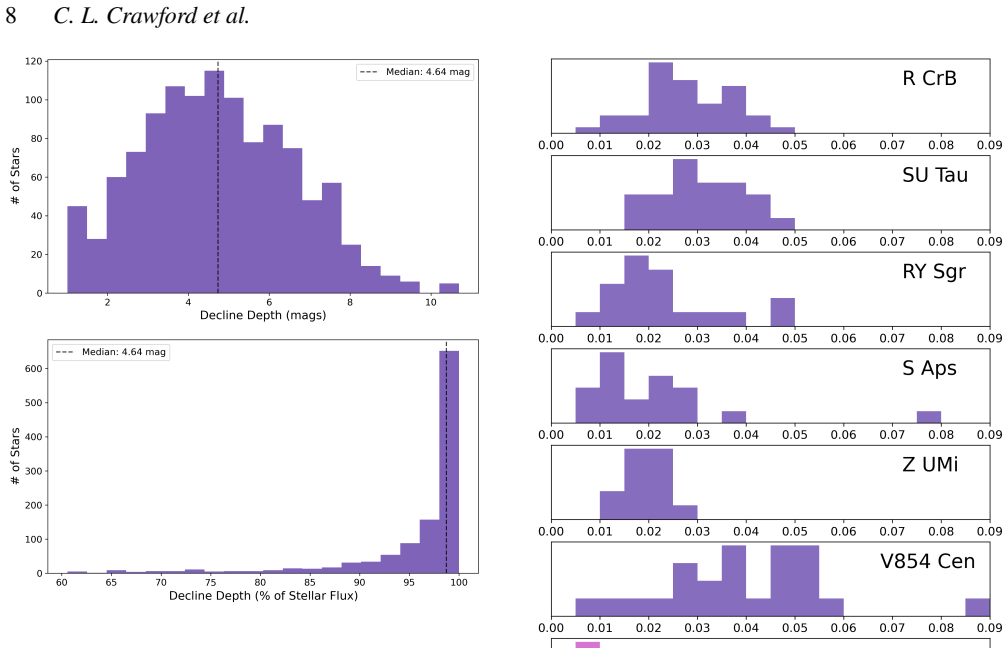
- Typical RCB declines last about one year, follow a log-normal distribution, and obscure more than 95% of the star's flux, so dust clouds must be large, optically thick, and roughly similar in geometry across the class.
Reading between the lines
- The paper's Poisson check uses a constant rate fixed to the average decline frequency, but its own Figure 5 shows activity varying on multi-year timescales; a time-dependent-rate Poisson model would test whether R CrB's agreement survives when bursts and quiet epochs are modeled separately.
- If pulsation-triggered dust is the rule for large-amplitude pulsators, then other RCBs with measured large pulsation amplitudes should show RY Sgr-like peaks in their waiting-time distributions; this is a testable prediction for future continuous photometry.
- The manual visual detection means the waiting-time comparison could be biased by seasonal gaps and faint limits; injecting synthetic declines into the real cadences and re-running the detection would reveal whether the Poisson and integer-multiple signals are artifacts of sampling.
- The DY Per result suggests that comparing decline shapes and time-resolved colors during minima could discriminate between different dust nucleation chemistries without waiting for new spectroscopy.
Signed reviews
Editorial analysis
A structured set of objections, weighed in public.
Referee Report
Summary. The manuscript assembles multi-survey light curves for 162 RCB stars and visually identifies 1536 declines with onset/end times, associated uncertainties, and quality flags. It derives per-star decline frequencies and percentages of time in decline, correlates these with spectral class, studies decline depths, onset slopes, and recoveries, and compares waiting-time distributions of decline onsets for R CrB, SU Tau, and RY Sgr. The headline results are: (i) cool RCB stars are more active than warm RCB stars; (ii) R CrB and SU Tau decline onsets are consistent with a Poisson process, while RY Sgr shows evidence of decline onsets at integer multiples of its 38.46-day pulsation period; and (iii) DY Per variables have different dust-production properties. The data products, including decline tables and activity metrics, are intended to be public.
Significance. If the two-mechanism claim holds, this paper would be a major step in RCB dust-formation studies, connecting stochastic convection-driven dust puffs in most stars to pulsation-shock-driven dust in high-amplitude pulsators. The catalog is the largest systematic RCB decline study to date, and the explicit error estimates and quality flags are a clear strength. The cool/warm activity trend is a useful confirmation of earlier Gaia-based suggestions with much longer baselines, and the log-normal decline-length distribution, the recovery model using published dust velocities, and the DY Per comparison are valuable contributions. However, the Poisson/pulsation dichotomy is currently supported only by a visual comparison in Figure 10, without goodness-of-fit tests, and it is in tension with the paper's own evidence for non-stationary activity (Section 4, Figure 5) and its negative Fourier result for RY Sgr (Section 6). The claim is plausible but not yet statistically secured.
major comments (4)
- [Section 6, Figure 10] The claim that R CrB and SU Tau onsets are 'consistent with a Poisson process' rests on a visual comparison: the exponential curve P(dt)=lambda*exp(-lambda*dt) is fixed to the sample mean decline frequency from Section 4 rather than fitted, and no goodness-of-fit statistic, confidence interval, or bootstrap is reported. This matters because Section 4 and Figure 5 show R CrB's activity varies strongly on roughly 5-year timescales, from near zero to more than 50% of time in decline; a time-dependent-rate point process can produce an approximately exponential-looking waiting-time distribution even when no stationary Poisson mechanism exists. Please add a formal test of the Poisson null (for example, a Kolmogorov-Smirnov or Anderson-Darling test against the exponential with the estimated rate) and investigate the effect of rate variability, either by fitting a time-dependent-rate model or by restricting the analysis to approximately stationary windows.
- [Section 6, waiting-time definition] The text defines a waiting time as 'the time interval between subsequent decline events' but then says it is 'calculated as the pairwise difference in onset times.' These are different statistics: pairwise differences among all onset times include non-successive intervals and are correlated, whereas the standard waiting-time distribution for a Poisson process uses successive inter-event times. Please state exactly which statistic is plotted in Figure 10, and if pairwise differences are used, explain why the exponential comparison is still valid or replace the plot with successive intervals. In addition, the text says the result is presented as a cumulative distribution, while the equation P(dt)=lambda*exp(-lambda*dt) is a density; please clarify which quantity is plotted. Please also state whether nested declines are included in the waiting times, since they are counted as separate events but occur within an ongoing decline.
- [Section 6, RY Sgr periodicity] The three 'build-up' times at 3T, 14T, and 32T in Figure 10 are selected after inspection of the data, and no null-hypothesis test or trials correction is provided, so chance alignments under a Poisson null are not excluded. This is especially problematic because the same section reports that Fourier spectra of RY Sgr's decline onsets show no significant periodic signal, even over the epoch used by Crause et al. (2007). Please test for periodicity directly on the onset times (for example, a Rayleigh test or epoch-folding with a bootstrap null and a trials correction for the number of multiples examined) and report the significance of the claimed build-ups.
- [Sections 3 and 4] The Poisson rate is taken from the same visually identified decline catalog (Section 4), whose completeness is not quantified. Section 3.1 acknowledges the subjective nature of visual detection, and Section 3 provides quality flags for detections during large gaps. Missing or spuriously split declines would bias both the rate and the waiting-time distribution in ways that could create false agreement or disagreement with the exponential model. Please assess robustness by, for example, excluding declines flagged as occurring in large gaps, varying the 1-magnitude threshold, or running a completeness simulation on synthetic decline light curves.
minor comments (4)
- [Section 3] The sentence 'We note that defining the end of a decline end is much more ambiguous' appears to contain a typo; it should read 'decline end is much more ambiguous.'
- [Section 6] The phrase 'declineonsetperiodicity' is missing a space; it should be 'decline onset periodicity.'
- [Section 5.3, Equation 1] The subscripts in A_va and A_vb should be formatted as A_{v,a} and A_{v,b}, and the quantity t = t_b - t_a should be defined before it is used in the equation.
- [Section 7 vs Section 5.2] The conclusion that DY Persei's declines take 'roughly twice as long' to reach their minima as RCB star declines is inconsistent with Section 5.2, where DY Per slopes are quoted as less than 0.01% of flux blocked per day versus roughly 1-6% for RCB stars; please reconcile the two statements or clarify what 'twice as long' refers to.
Circularity Check
No significant circularity: the Poisson and pulsation comparisons use plug-in or externally anchored rates, and the paper's self-citations are not load-bearing.
full rationale
The central Poisson claim is not circular: the paper explicitly sets the Poisson rate to the independently measured mean decline frequency and then tests the exponential shape of the waiting-time distribution, rather than fitting the rate to that distribution (Section 6 and Fig. 10 caption: 'the Poisson rates are adopted as the decline frequency calculated in Section 4, rather than fitted to the data'). Exponentiality is not implied by the rate alone, so the agreement is a falsifiable prediction, even though it is assessed visually and without a formal goodness-of-fit test. RY Sgr's pulsational interpretation uses an externally measured period (38.46 d from Clayton et al. 1994b; Lawson & Cottrell 1997), and the paper even reports that a Fourier spectrum of the decline onsets shows no significant periodicity, so this claim is not manufactured from its own inputs. The cool/warm confirmation and DY Per comparison rest on independent photometric and spectroscopic data, despite some overlap in authorship with Tisserand et al. (2024a) and Crawford et al. (2023); these are confirmations with new data, not self-referential reductions. The main weaknesses identified by the reader—visual comparison without goodness-of-fit, ambiguous 'pairwise difference' wording, post hoc selection of the 3T/14T/32T build-ups, and possible incompleteness of the manual decline catalog—are statistical validity concerns rather than circularity. No equation or fitted parameter in the paper is equivalent to a claimed result by construction.
Assumptions & free parameters
free parameters (4)
- decline depth threshold =
1 mag
- gap threshold subtracted from baseline =
1 year
- minimum AAVSO observations per observer =
5
- Poisson rate lambda =
average decline frequency per star
assumptions (6)
- standard math Poisson processes have exponential waiting time distributions.
- domain assumption RCB declines are caused by carbon dust extinction.
- domain assumption Dust grains move radially and extinction scales as inverse distance squared.
- domain assumption The HdC spectral class from Crawford et al. 2023 is a usable proxy for Teff.
- ad hoc to paper The decline onset process is stationary with constant rate equal to the average decline frequency.
- ad hoc to paper Manually identified decline onsets and ends are complete and unbiased across heterogeneous surveys.
Cite this review
Pith. "Pith review of A Comprehensive Study of the Dust Declines in R Coronae Borealis Stars." pith.science (2026). https://pith.science/paper/2ZD32BB3
@misc{pith2026241216393,
  author       = {Pith},
  title        = {Pith review of: A Comprehensive Study of the Dust Declines in R Coronae Borealis Stars},
  year         = {2026},
  howpublished = {\url{https://pith.science/paper/2ZD32BB3}},
  note         = {Machine review of arXiv:2412.16393}
}
abstract
The R Coronae Borealis (RCB) variables are rare, hydrogen-deficient, carbon-rich supergiants known for large, erratic declines in brightness due to dust formation. Recently, the number of known RCB stars in the Milky Way and Magellanic Clouds has increased from $\sim$30 to 162. We use all-sky and targeted photometric surveys to create the longest possible light curves for all known RCB stars and systematically study their declines. Our study, the largest of its kind, includes measurements of decline activity levels, morphologies, and periodicities for nearly all RCB stars. We confirm previous predictions that cool RCB stars exhibit more declines than warm RCBs, supporting a relationship between dust formation and condensation temperatures. We also find evidence for two distinct dust production mechanisms. R CrB and SU Tau show decline onsets consistent with a Poisson process, suggesting their dust production is driven by stochastic processes, such as convection. In contrast, RY Sgr's declines correlate with its pulsation period, suggesting that its dust production is driven by pulsationally-induced shocks. Finally, we show that the dust properties of the related class of DY~Per variables differ from those of the RCB stars, suggesting differences in their evolutionary status.
Figures


Figures from the paper (5 more)




Reference graph
Works this paper leans on
-
[1]
Alcock C., et al., 2001, @doi [ ] 10.1086/321369 , https://ui.adsabs.harvard.edu/abs/2001ApJ...554..298A 554, 298
-
[2]
L., Rao N
Asplund M., Gustafsson B., Lambert D. L., Rao N. K., 2000, , https://ui.adsabs.harvard.edu/abs/2000A&A...353..287A 353, 287
2000
-
[3]
Astropy Collaboration 2013, @doi [ ] 10.1051/0004-6361/201322068 , http://adsabs.harvard.edu/abs/2013A
-
[4]
Astropy Collaboration 2018, @doi [ ] 10.3847/1538-3881/aabc4f , https://ui.adsabs.harvard.edu/abs/2018AJ....156..123A 156, 123
-
[5]
Bauer F., de Kat J., 1997, @doi [Nuclear Instruments and Methods in Physics Research A] 10.1016/S0168-9002(96)01009-1 , https://ui.adsabs.harvard.edu/abs/1997NIMPA.387..286B 387, 286
-
[6]
Bergeat J., Lefevre J., Kandel R., Lunel M., Sibille F., 1976, , https://ui.adsabs.harvard.edu/abs/1976A&A....52..245B 52, 245
1976
-
[7]
Bhowmick A., Pandey G., Joshi V., Ashok N. M., 2018, @doi [ ] 10.3847/1538-4357/aaaae4 , https://ui.adsabs.harvard.edu/abs/2018ApJ...854..140B 854, 140
-
[8]
Bond H. E., Luck R. E., Newman M. J., 1979, @doi [ ] 10.1086/157382 , https://ui.adsabs.harvard.edu/abs/1979ApJ...233..205B 233, 205
Show all 93 references
-
[9]
C., 1996, @doi [ ] 10.1086/133715 , https://ui.adsabs.harvard.edu/abs/1996PASP..108..225C 108, 225
Clayton G. C., 1996, @doi [ ] 10.1086/133715 , https://ui.adsabs.harvard.edu/abs/1996PASP..108..225C 108, 225
1996 doi
- [10]
-
[11]
C., Whitney B
Clayton G. C., Whitney B. A., Stanford S. A., Drilling J. S., Judge P. G., 1992a, @doi [ ] 10.1086/186253 , https://ui.adsabs.harvard.edu/abs/1992ApJ...384L..19C 384, L19
-
[12]
C., Whitney B
Clayton G. C., Whitney B. A., Stanford S. A., Drilling J. S., 1992b, @doi [ ] 10.1086/171821 , https://ui.adsabs.harvard.edu/abs/1992ApJ...397..652C 397, 652
-
[13]
C., Whitney B
Clayton G. C., Whitney B. A., Mattei J. A., 1993, @doi [ ] 10.1086/133240 , https://ui.adsabs.harvard.edu/abs/1993PASP..105..832C 105, 832
1993 doi
-
[15]
C., Lawson W
Clayton G. C., Lawson W. A., Cottrell P. L., Whitney B. A., Stanford S. A., de Ruyter F., 1994b, @doi [ ] 10.1086/174616 , https://ui.adsabs.harvard.edu/abs/1994ApJ...432..785C 432, 785
-
[16]
C., Bjorkman K
Clayton G. C., Bjorkman K. S., Nordsieck K. H., Zellner N. E. B., Schulte-Ladbeck R. E., 1997, @doi [ ] 10.1086/303666 , https://ui.adsabs.harvard.edu/abs/1997ApJ...476..870C 476, 870
1997 doi
-
[17]
C., Geballe T
Clayton G. C., Geballe T. R., Zhang W., 2013, @doi [ ] 10.1088/0004-6256/146/2/23 , https://ui.adsabs.harvard.edu/abs/2013AJ....146...23C 146, 23
2013 doi
-
[18]
L., Lambert D
Cottrell P. L., Lambert D. L., 1982, The Observatory, https://ui.adsabs.harvard.edu/abs/1982Obs...102..149C 102, 149
1982
-
[20]
L., et al., 2023, @doi [ ] 10.1093/mnras/stad324 , https://ui.adsabs.harvard.edu/abs/2023MNRAS.521.1674C 521, 1674
Crawford C. L., et al., 2023, @doi [ ] 10.1093/mnras/stad324 , https://ui.adsabs.harvard.edu/abs/2023MNRAS.521.1674C 521, 1674
2023 doi
-
[21]
L., Nikultsev N., Clayton G
Crawford C. L., Nikultsev N., Clayton G. C., Tisserand P., Soon J., Pedersen M. G., 2024, @doi [ ] 10.1093/mnras/stae2149 , https://ui.adsabs.harvard.edu/abs/2024MNRAS.534.1018C 534, 1018
2024 doi
-
[22]
J., 1963, PhD thesis, -
Danziger I. J., 1963, PhD thesis, -
1963
-
[23]
C., Herwig F., Pollacco D
De Marco O., Clayton G. C., Herwig F., Pollacco D. L., Clark J. S., Kilkenny D., 2002, @doi [ ] 10.1086/340569 , https://ui.adsabs.harvard.edu/abs/2002AJ....123.3387D 123, 3387
2002 doi
-
[24]
W., 1986, IAU Colloq
Feast M. W., 1986, IAU Colloq. 87, http://adsabs.harvard.edu/abs/1986ASSL..128..151F 128, p. 151
1986
-
[25]
W., 1997, @doi [ ] 10.1093/mnras/285.2.339 , https://ui.adsabs.harvard.edu/abs/1997MNRAS.285..339F 285, 339
Feast M. W., 1997, @doi [ ] 10.1093/mnras/285.2.339 , https://ui.adsabs.harvard.edu/abs/1997MNRAS.285..339F 285, 339
1997 doi
-
[26]
W., Carter B
Feast M. W., Carter B. S., Roberts G., Marang F., Catchpole R. M., 1997, @doi [ ] 10.1093/mnras/285.2.317 , https://ui.adsabs.harvard.edu/abs/1997MNRAS.285..317F 285, 317
1997 doi
-
[27]
W., Whitelock P
Feast M. W., Whitelock P. A., Marang F., 2003, @doi [ ] 10.1111/j.1365-2966.2003.07136.x , https://ui.adsabs.harvard.edu/abs/2003MNRAS.346..878F 346, 878
2003
-
[28]
W., Griffin R
Feast M. W., Griffin R. F., Herbig G. H., Whitelock P. A., 2019, @doi [ ] 10.1093/mnras/sty2893 , https://ui.adsabs.harvard.edu/abs/2019MNRAS.482.4174F 482, 4174
2019 doi
-
[29]
Freytag B., H \"o fner S., 2023, @doi [ ] 10.1051/0004-6361/202244992 , https://ui.adsabs.harvard.edu/abs/2023A&A...669A.155F 669, A155
2023 doi
-
[30]
Gaia Collaboration et al., 2023, @doi [ ] 10.1051/0004-6361/202243940 , https://ui.adsabs.harvard.edu/abs/2023A&A...674A...1G 674, A1
2023 doi
-
[31]
P., Sedlmayr E., 1984, , https://ui.adsabs.harvard.edu/abs/1984A&A...132..163G 132, 163
Gail H. P., Sedlmayr E., 1984, , https://ui.adsabs.harvard.edu/abs/1984A&A...132..163G 132, 163
1984
-
[32]
A., Rao N
Garc \' a-Hern \'a ndez D. A., Rao N. K., Lambert D. L., Eriksson K., Reddy A. B. S., Masseron T., 2023, @doi [ ] 10.3847/1538-4357/acc574 , https://ui.adsabs.harvard.edu/abs/2023ApJ...948...15G 948, 15
2023 doi
-
[33]
A., Jiang Y.-F., Bildsten L., 2022, @doi [ ] 10.3847/1538-4357/ac5ab3 , https://ui.adsabs.harvard.edu/abs/2022ApJ...929..156G 929, 156
Goldberg J. A., Jiang Y.-F., Bildsten L., 2022, @doi [ ] 10.3847/1538-4357/ac5ab3 , https://ui.adsabs.harvard.edu/abs/2022ApJ...929..156G 929, 156
2022 doi
-
[34]
285, New Horizons in Time Domain Astronomy
Grindlay J., Tang S., Los E., Servillat M., 2012, in Griffin E., Hanisch R., Seaman R., eds, IAU Symposium Vol. 285, New Horizons in Time Domain Astronomy. pp 29--34 ( @eprint arXiv 1211.1051 ), @doi 10.1017/S1743921312000166
2012 arXiv
-
[35]
R., et al., 2020, @doi [Nature] 10.1038/s41586-020-2649-2 , 585, 357
Harris C. R., et al., 2020, @doi [Nature] 10.1038/s41586-020-2649-2 , 585, 357
2020 doi
-
[36]
P., Pandey G., Kamath D., Kameswara Rao N., Lambert D., Woolf V
Hema B. P., Pandey G., Kamath D., Kameswara Rao N., Lambert D., Woolf V. M., 2017, @doi [ ] 10.1088/1538-3873/aa7f25 , https://ui.adsabs.harvard.edu/abs/2017PASP..129j4202H 129, 104202
2017 doi
-
[37]
D., 2007, Computing in Science & Engineering, 9, 90
Hunter J. D., 2007, Computing in Science & Engineering, 9, 90
2007
-
[38]
Ivezi \'c Z ., et al., 2019, @doi [ ] 10.3847/1538-4357/ab042c , https://ui.adsabs.harvard.edu/abs/2019ApJ...873..111I 873, 111
2019 doi
-
[39]
Jayasinghe T., et al., 2018, @doi [ ] 10.1093/mnras/sty838 , https://ui.adsabs.harvard.edu/abs/2018MNRAS.477.3145J 477, 3145
2018 doi
-
[40]
Jayasinghe T., et al., 2019, @doi [ ] 10.1093/mnras/stz844 , https://ui.adsabs.harvard.edu/abs/2019MNRAS.486.1907J 486, 1907
2019 doi
-
[41]
Jurcsik J., 1996, , https://ui.adsabs.harvard.edu/abs/1996AcA....46..325J 46, 325
1996
-
[42]
M., Kulkarni P
Kameswara Rao I., Ashok N. M., Kulkarni P. V., 1980, @doi [Journal of Astrophysics and Astronomy] 10.1007/BF02727951 , https://ui.adsabs.harvard.edu/abs/1980JApA....1...71K 1, 71
1980 doi
-
[43]
L., Woolf V
Kameswara Rao N., Lambert D. L., Woolf V. M., Hema B. P., 2014, @doi [ ] 10.1086/678129 , https://ui.adsabs.harvard.edu/abs/2014PASP..126..813K 126, 813
2014 doi
-
[44]
R., et al., 2021, @doi [ ] 10.3847/1538-4357/abe5aa , https://ui.adsabs.harvard.edu/abs/2021ApJ...910..132K 910, 132
Karambelkar V. R., et al., 2021, @doi [ ] 10.3847/1538-4357/abe5aa , https://ui.adsabs.harvard.edu/abs/2021ApJ...910..132K 910, 132
2021 doi
-
[45]
M., Tisserand P., Clayton G
Karambelkar V., Kasliwal M. M., Tisserand P., Clayton G. C., Crawford C. L., Anand S. G., Geballe T. R., Montiel E., 2022, @doi [ ] 10.1051/0004-6361/202142918 , https://ui.adsabs.harvard.edu/abs/2022A&A...667A..84K 667, A84
2022 doi
-
[46]
R., et al., 2024, @doi [ ] 10.1088/1538-3873/ad6210 , https://ui.adsabs.harvard.edu/abs/2024PASP..136h4201K 136, 084201
Karambelkar V. R., et al., 2024, @doi [ ] 10.1088/1538-3873/ad6210 , https://ui.adsabs.harvard.edu/abs/2024PASP..136h4201K 136, 084201
2024 doi
-
[47]
Kim S.-L., et al., 2016, @doi [Journal of Korean Astronomical Society] 10.5303/JKAS.2016.49.1.37 , https://ui.adsabs.harvard.edu/abs/2016JKAS...49...37K 49, 37
2016 doi
-
[48]
G., 2005, Baltic Astronomy, https://ui.adsabs.harvard.edu/abs/2005BaltA..14..215K 14, 215
Kipper T., Klochkova V. G., 2005, Baltic Astronomy, https://ui.adsabs.harvard.edu/abs/2005BaltA..14..215K 14, 215
2005
-
[49]
G., 2008, in Werner A., Rauch T., eds, Astronomical Society of the Pacific Conference Series Vol
Kipper T., Klochkova V. G., 2008, in Werner A., Rauch T., eds, Astronomical Society of the Pacific Conference Series Vol. 391, Hydrogen-Deficient Stars. p. 43
2008
-
[51]
Kloppenborg B., 2023, https://www.aavso.org
2023
-
[52]
A., Cottrell P
Lawson W. A., Cottrell P. L., 1997, @doi [ ] 10.1093/mnras/285.2.266 , https://ui.adsabs.harvard.edu/abs/1997MNRAS.285..266L 285, 266
1997 doi
-
[53]
A., Cottrell P
Lawson W. A., Cottrell P. L., Clark M., 1991, @doi [ ] 10.1093/mnras/251.4.687 , https://ui.adsabs.harvard.edu/abs/1991MNRAS.251..687L 251, 687
1991 doi
-
[54]
A., et al., 1999, @doi [ ] 10.1086/300897 , https://ui.adsabs.harvard.edu/abs/1999AJ....117.3007L 117, 3007
Lawson W. A., et al., 1999, @doi [ ] 10.1086/300897 , https://ui.adsabs.harvard.edu/abs/1999AJ....117.3007L 117, 3007
1999 doi
-
[55]
M., Gilmozzi R., Hall H
Lee C.-U., Kim S.-L., Cha S.-M., Lee Y., Kim D.-J., Park B.-G., 2014, in Stepp L. M., Gilmozzi R., Hall H. J., eds, Society of Photo-Optical Instrumentation Engineers (SPIE) Conference Series Vol. 9145, Ground-based and Airborne Telescopes V. p. 91453T, @doi 10.1117/12.2055571
2014 doi
-
[56]
Loreta E., 1935, Astronomische Nachrichten, http://adsabs.harvard.edu/abs/1935AN....254..151L 254, 151
1935
-
[57]
A., 1976, @doi [ ] 10.1086/154111 , https://ui.adsabs.harvard.edu/abs/1976ApJ...203..552M 203, 552
Marsh K. A., 1976, @doi [ ] 10.1086/154111 , https://ui.adsabs.harvard.edu/abs/1976ApJ...203..552M 203, 552
1976 doi
-
[58]
J., et al., 2018, @doi [Publications of the Astronomical Society of the Pacific] 10.1088/1538-3873/aae8ac , 131, 018003
Masci F. J., et al., 2018, @doi [Publications of the Astronomical Society of the Pacific] 10.1088/1538-3873/aae8ac , 131, 018003
2018 doi
-
[59]
McNaught R., 1986, , https://ui.adsabs.harvard.edu/abs/1986IAUC.4245....2M 4245, 2
1986
-
[60]
H., Dawes G., 1986, , https://ui.adsabs.harvard.edu/abs/1986IAUC.4233....3M 4233, 3
McNaught R. H., Dawes G., 1986, , https://ui.adsabs.harvard.edu/abs/1986IAUC.4233....3M 4233, 3
1986
-
[61]
J., Clayton G
Montiel E. J., Clayton G. C., Sugerman B. E. K., Evans A., Garcia-Hern \'a ndez D. A., Kameswara Rao N., Matsuura M., Tisserand P., 2018, @doi [ ] 10.3847/1538-3881/aad772 , https://ui.adsabs.harvard.edu/abs/2018AJ....156..148M 156, 148
2018 doi
-
[62]
A., 1939, @doi [ ] 10.1086/144107 , http://adsabs.harvard.edu/abs/1939ApJ....90..294O 90, 294
O'Keefe J. A., 1939, @doi [ ] 10.1086/144107 , http://adsabs.harvard.edu/abs/1939ApJ....90..294O 90, 294
1939 doi
-
[63]
H., 1928, Harvard College Observatory Bulletin, https://ui.adsabs.harvard.edu/abs/1928BHarO.861...11P 861, 11
Payne C. H., 1928, Harvard College Observatory Bulletin, https://ui.adsabs.harvard.edu/abs/1928BHarO.861...11P 861, 11
1928
- [64]
-
[65]
R., Bandara K., Fernie J
Percy J. R., Bandara K., Fernie J. D., Cottrell P. L., Skuljan L., 2004, , https://ui.adsabs.harvard.edu/abs/2004JAVSO..33...27P 33, 27
2004
-
[66]
C., 1797, Royal Society of London Philosophical Transactions Series I, 87, 133
Pigott E., Englefield H. C., 1797, Royal Society of London Philosophical Transactions Series I, 87, 133
- [67]
-
[68]
F., 1977, Information Bulletin on Variable Stars, https://ui.adsabs.harvard.edu/abs/1977IBVS.1277....1P 1277, 1
Pugach A. F., 1977, Information Bulletin on Variable Stars, https://ui.adsabs.harvard.edu/abs/1977IBVS.1277....1P 1277, 1
1977
-
[69]
K., Lambert D
Rao N. K., Lambert D. L., 2003, @doi [ ] 10.1086/379205 , https://ui.adsabs.harvard.edu/abs/2003PASP..115.1304R 115, 1304
2003 doi
-
[70]
Rauer H., et al., 2014, @doi [Experimental Astronomy] 10.1007/s10686-014-9383-4 , https://ui.adsabs.harvard.edu/abs/2014ExA....38..249R 38, 249
2014 doi
- [71]
-
[72]
J., Ferrario L., Belczynski K., Seitenzahl I
Ruiter A. J., Ferrario L., Belczynski K., Seitenzahl I. R., Crocker R. M., Karakas A. I., 2019, @doi [ ] 10.1093/mnras/stz001 , https://ui.adsabs.harvard.edu/abs/2019MNRAS.484..698R 484, 698
2019 doi
-
[73]
E., 2016, @doi [ ] 10.1093/mnras/stw1065 , https://ui.adsabs.harvard.edu/abs/2016MNRAS.460.1233S 460, 1233
Schaefer B. E., 2016, @doi [ ] 10.1093/mnras/stw1065 , https://ui.adsabs.harvard.edu/abs/2016MNRAS.460.1233S 460, 1233
2016 doi
-
[74]
E., 2024, @doi [ ] 10.1093/mnras/stad3760 , https://ui.adsabs.harvard.edu/abs/2024MNRAS.527.9274S 527, 9274
Schaefer B. E., 2024, @doi [ ] 10.1093/mnras/stad3760 , https://ui.adsabs.harvard.edu/abs/2024MNRAS.527.9274S 527, 9274
2024 doi
-
[75]
Schwarzschild M., 1975, @doi [ ] 10.1086/153313 , https://ui.adsabs.harvard.edu/abs/1975ApJ...195..137S 195, 137
1975 doi
-
[76]
Tisserand P., 2012, @doi [ ] 10.1051/0004-6361/201117874 , https://ui.adsabs.harvard.edu/abs/2012A&A...539A..51T 539, A51
2012 doi
-
[77]
Tisserand P., et al., 2009, @doi [ ] 10.1051/0004-6361/200911808 , https://ui.adsabs.harvard.edu/abs/2009A&A...501..985T 501, 985
2009 doi
-
[78]
C., Welch D
Tisserand P., Clayton G. C., Welch D. L., Pilecki B., Wyrzykowski L., Kilkenny D., 2013, @doi [ ] 10.1051/0004-6361/201220713 , https://ui.adsabs.harvard.edu/abs/2013A&A...551A..77T 551, A77
2013 doi
-
[79]
Tisserand P., et al., 2020, @doi [ ] 10.1051/0004-6361/201834410 , https://ui.adsabs.harvard.edu/abs/2020A&A...635A..14T 635, A14
2020 doi
-
[80]
Tisserand P., et al., 2022, @doi [ ] 10.1051/0004-6361/202142916 , https://ui.adsabs.harvard.edu/abs/2022A&A...667A..83T 667, A83
2022 doi
-
[81]
L., Soon J., Clayton G
Tisserand P., Crawford C. L., Soon J., Clayton G. C., Ruiter A. J., Seitenzahl I. R., 2024a, @doi [ ] 10.1051/0004-6361/202348004 , https://ui.adsabs.harvard.edu/abs/2024A&A...684A.130T 684, A130
-
[82]
L., Soon J., Clayton G
Tisserand P., Crawford C. L., Soon J., Clayton G. C., Ruiter A. J., Seitenzahl I. R., 2024b, @doi [ ] 10.1051/0004-6361/202348005 , https://ui.adsabs.harvard.edu/abs/2024A&A...684A.131T 684, A131
-
[83]
L., et al., 2018, @doi [ ] 10.1088/1538-3873/aabadf , https://ui.adsabs.harvard.edu/abs/2018PASP..130f4505T 130, 064505
Tonry J. L., et al., 2018, @doi [ ] 10.1088/1538-3873/aabadf , https://ui.adsabs.harvard.edu/abs/2018PASP..130f4505T 130, 064505
2018 doi
- [84]
-
[85]
Virtanen P., et al., 2020, @doi [Nature Methods] 10.1038/s41592-019-0686-2 , https://rdcu.be/b08Wh 17, 261
2020 doi
-
[86]
H., 1986, , https://ui.adsabs.harvard.edu/abs/1986IAUC.4241....2W 4241, 2
Wenzel W., Hoffmeister C., McNaught R. H., 1986, , https://ui.adsabs.harvard.edu/abs/1986IAUC.4241....2W 4241, 2
1986
-
[87]
S., 2000, @doi [ ] 10.1086/312739 , https://ui.adsabs.harvard.edu/abs/2000ApJ...536L.109W 536, L109
Wheatland M. S., 2000, @doi [ ] 10.1086/312739 , https://ui.adsabs.harvard.edu/abs/2000ApJ...536L.109W 536, L109
2000 doi
-
[88]
A., Feast M
Whitelock P. A., Feast M. W., Marang F., Overbeek M. D., 1997, @doi [ ] 10.1093/mnras/288.2.512 , https://ui.adsabs.harvard.edu/abs/1997MNRAS.288..512W 288, 512
1997 doi
-
[89]
A., Feast M
Whitelock P. A., Feast M. W., Marang F., Groenewegen M. A. T., 2006, @doi [ ] 10.1111/j.1365-2966.2006.10322.x , https://ui.adsabs.harvard.edu/abs/2006MNRAS.369..751W 369, 751
2006
-
[90]
A., Clayton G
Whitney B. A., Clayton G. C., Schulte-Ladbeck R. E., Meade M. R., 1992, @doi [ ] 10.1086/116180 , https://ui.adsabs.harvard.edu/abs/1992AJ....103.1652W 103, 1652
1992 doi
-
[91]
A., Balm S
Whitney B. A., Balm S. P., Clayton G. C., 1993, in Sasselov D. D., ed., Astronomical Society of the Pacific Conference Series Vol. 45, Luminous High-Latitude Stars. p. 115
1993
-
[92]
Woitke P., Goeres A., Sedlmayr E., 1996, , https://ui.adsabs.harvard.edu/abs/1996A&A...313..217W 313, 217
1996
-
[93]
A., Pugach A
Yakovina L. A., Pugach A. F., Pavlenko Y. V., 2009, @doi [Astronomy Reports] 10.1134/S1063772909030019 , https://ui.adsabs.harvard.edu/abs/2009ARep...53..187Y 53, 187
2009 doi
-
[94]
Yuin C., 1948, @doi [ ] 10.1086/145028 , https://ui.adsabs.harvard.edu/abs/1948ApJ...107..413Y 107, 413
1948 doi
-
[95]
P., Pugach A
Za c s L., Mondal S., Chen W. P., Pugach A. F., Musaev F. A., Alksnis O., 2007, @doi [ ] 10.1051/0004-6361:20066923 , https://ui.adsabs.harvard.edu/abs/2007A&A...472..247Z 472, 247
2007 doi
-
[96]
write newline
" write newline "" before.all 'output.state := FUNCTION fin.entry write newline FUNCTION new.block output.state before.all = 'skip after.block 'output.state := if FUNCTION new.sentence output.state after.block = 'skip output.state before.all = 'skip after.sentence 'output.stat...
Reviewed August 11, 2026 · model on record in the stance chip above.
Discussion (0). Continue with ORCID to comment.