Khovanov complexes for bipartite links
Pith reviewed 2026-06-29 20:43 UTC · model grok-4.3
The pith
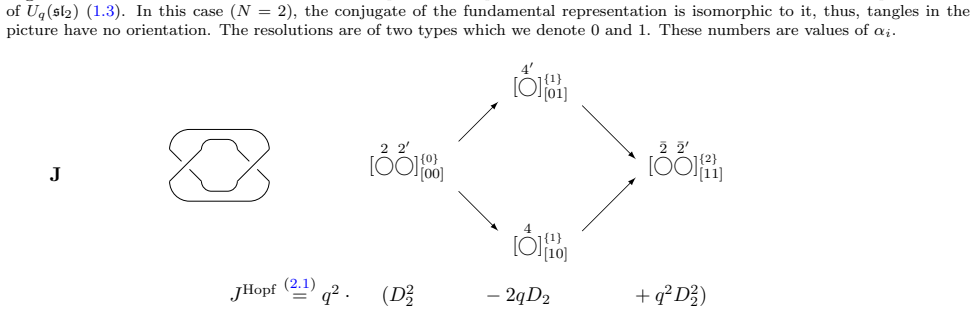
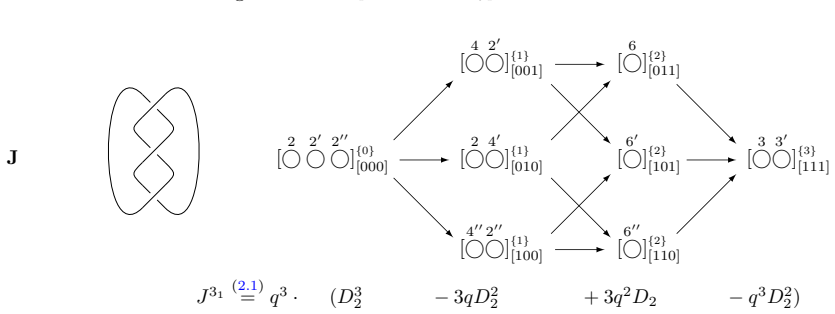
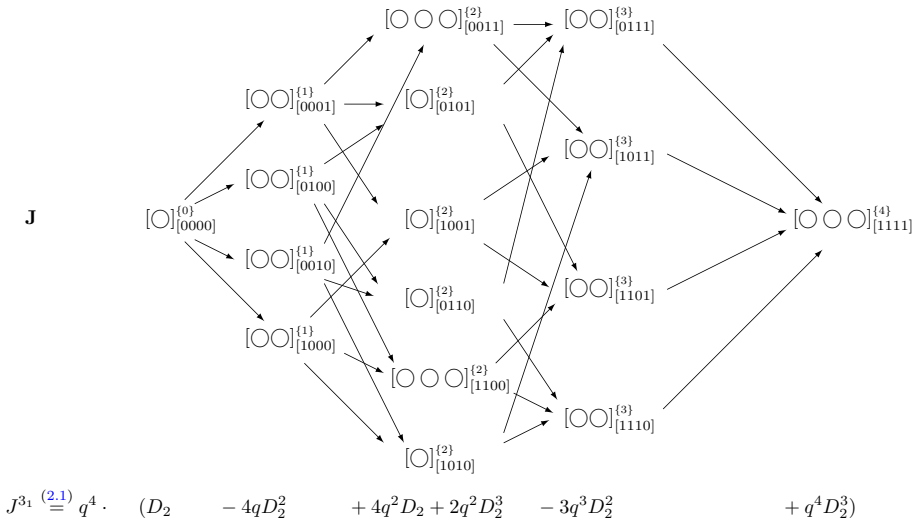
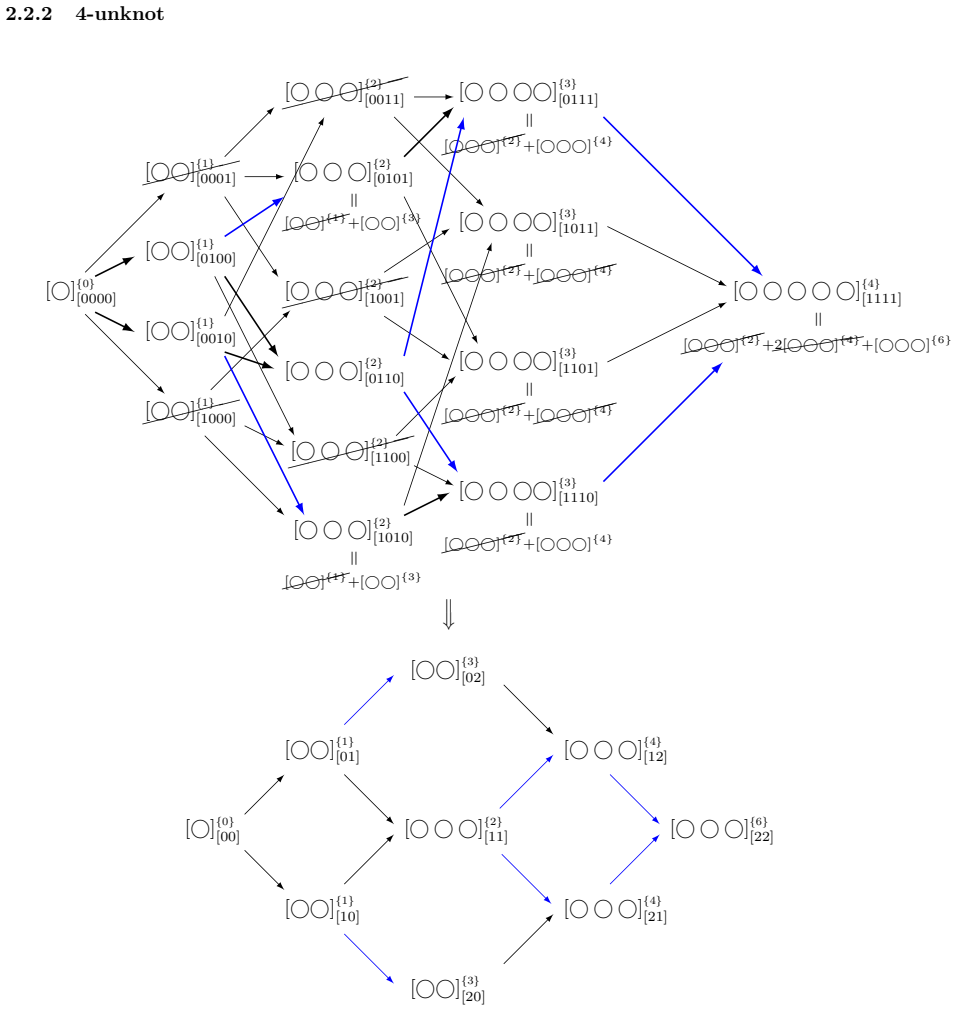
For N=2 the Kauffman-Khovanov 2²-hypercube shrinks to the bipartite 3-hypercube while preserving the Khovanov polynomials.
A machine-rendered reading of the paper's core claim, the machinery that carries it, and where it could break.
Core claim
The authors explain how the Kauffman-Khovanov 2²-hypercube is shrunk to the bipartite 3-hypercube, and this operation preserves the bipartite Khovanov polynomials for N=2, thereby confirming the consistency of the prior reduction from Khovanov-Rozansky matrix factorization to Kauffman-Khovanov cycle calculus for bipartite links.
What carries the argument
The hypercube shrinking operation that maps the 2²-hypercube onto the 3-hypercube for bipartite links at N=2.
If this is right
- The reduction is consistent for N=2 bipartite Khovanov polynomials.
- The Kauffman-Khovanov calculus can be used in place of matrix factorizations for these links at N=2.
- The shrinking preserves the polynomials exactly.
- Computations for bipartite links become simpler via the 3-hypercube.
Where Pith is reading between the lines
- If the shrinking works at N=2 it may extend to higher N for bipartite links.
- This could allow similar simplifications in other link homology theories.
- Testing on explicit bipartite links like the unlink or Hopf link would verify the match.
Load-bearing premise
The hypercube shrinking operation must preserve the polynomials exactly for the reduction to be valid.
What would settle it
A direct computation of the Khovanov polynomial for a simple bipartite link using both the original 2²-hypercube and the shrunk 3-hypercube that yields different results would falsify the claim.
Figures


read the original abstract
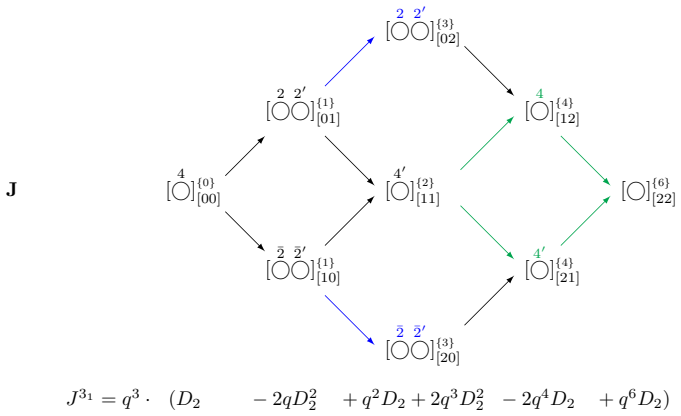
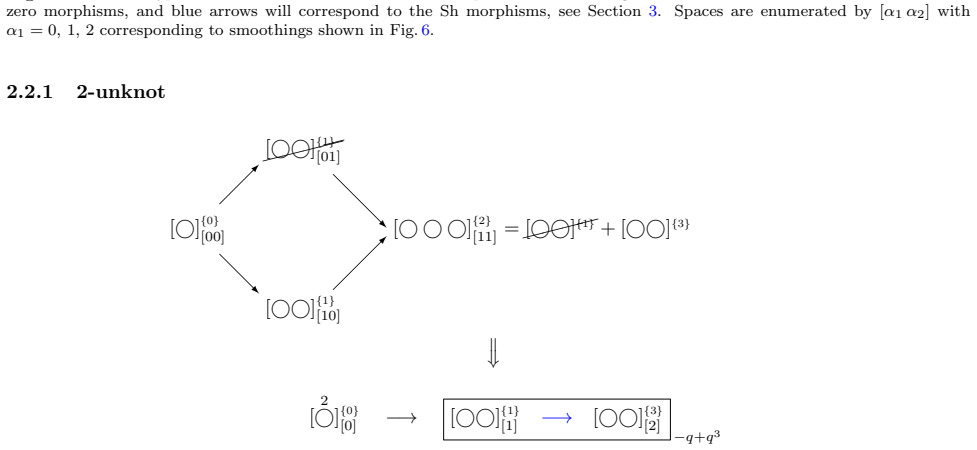
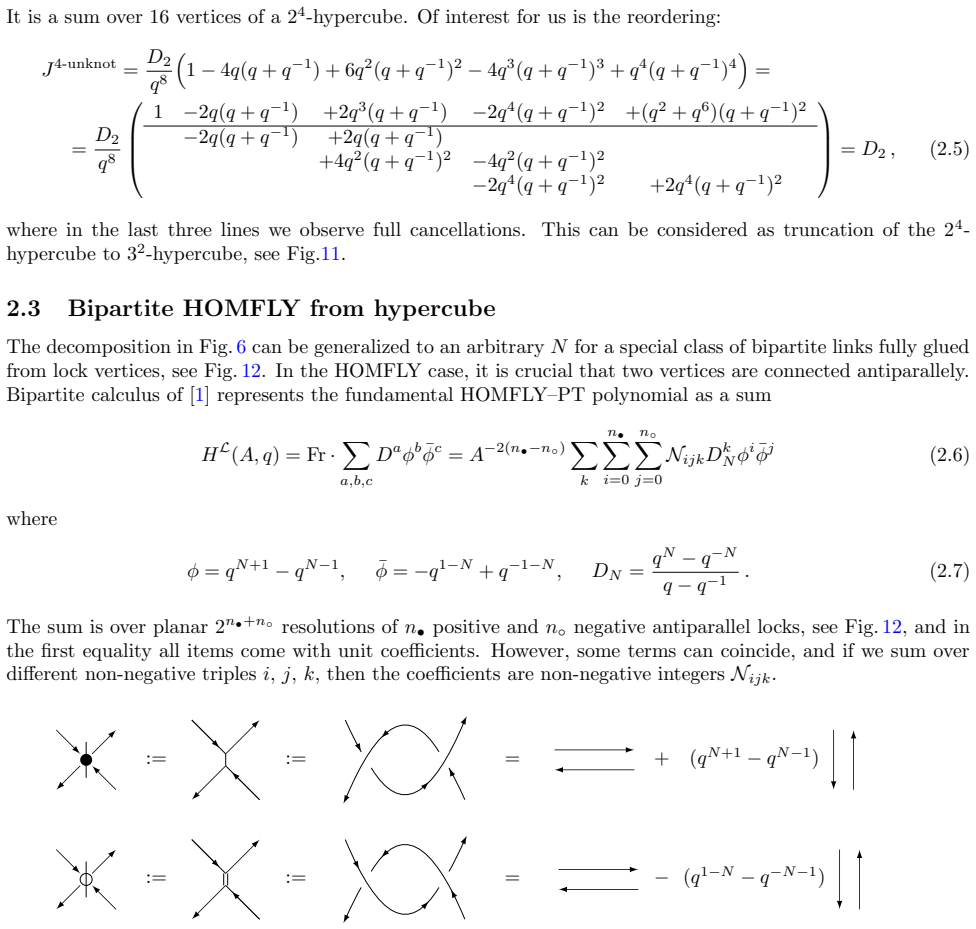
Recently, for a limited class for bipartite links, the complicated Khovanov-Rozansky matrix factorization technique was reduced to an analogue of elementary Kauffman-Khovanov cycle calculus for an arbitrary $N$. In this note, we demonstrate the consistency of such reduction with the computation of the bipartite Khovanov polynomials for $N=2$. Namely, we explain how the Kauffman-Khovanov $2^2$-hypercube is shrinked to the bipartite 3-hypercube.
Editorial analysis
A structured set of objections, weighed in public.
Referee Report
Summary. The manuscript is a short note claiming to demonstrate consistency of a prior reduction from Khovanov-Rozansky matrix factorizations to Kauffman-Khovanov cycle calculus for bipartite links, specifically for N=2, by explaining how the Kauffman-Khovanov 2²-hypercube is shrunk to the bipartite 3-hypercube.
Significance. If the shrinking map were shown to preserve the resulting polynomials exactly, the note would supply a concrete consistency verification for the N=2 case and thereby support the broader reduction claim for arbitrary N within the restricted class of bipartite links.
major comments (1)
- [Abstract / main text] The central claim (abstract) that the shrinking procedure demonstrates consistency is not supported by any explicit verification: the manuscript supplies neither a chain-map argument establishing that the induced map on complexes is a quasi-isomorphism nor a side-by-side computation of the bipartite Khovanov polynomial for any concrete link that would confirm exact preservation.
Simulated Author's Rebuttal
We thank the referee for their report and the opportunity to clarify the scope of our short note. We respond to the major comment below.
read point-by-point responses
-
Referee: [Abstract / main text] The central claim (abstract) that the shrinking procedure demonstrates consistency is not supported by any explicit verification: the manuscript supplies neither a chain-map argument establishing that the induced map on complexes is a quasi-isomorphism nor a side-by-side computation of the bipartite Khovanov polynomial for any concrete link that would confirm exact preservation.
Authors: The manuscript's purpose is to describe explicitly how the Kauffman-Khovanov 2²-hypercube shrinks to the bipartite 3-hypercube, thereby exhibiting the reduction of the underlying chain complexes for N=2. This structural identification is offered as the consistency verification. We acknowledge, however, that an explicit side-by-side polynomial computation for a concrete link would render the preservation more immediately verifiable. We will therefore add such a computation (for the unknot, which is bipartite) in the revised version. A full chain-map proof of quasi-isomorphism lies outside the intended scope of this brief note, which focuses on the hypercube reduction itself. revision: yes
Circularity Check
Minor self-citation to prior reduction; consistency shown via explicit shrinking description, not forced by construction
full rationale
The note references a 'recent' reduction of Khovanov-Rozansky to Kauffman-Khovanov calculus for bipartite links and then explains the 2²-to-3 hypercube shrinking for N=2. This is consistent with a self-citation (pattern 3) but the citation is not load-bearing for the central claim, which rests on the geometric explanation itself rather than reducing to a fitted parameter, self-definition, or unverified uniqueness theorem. No equations or steps equate the claimed consistency to its inputs by construction; the derivation remains an independent explanatory check.
Axiom & Free-Parameter Ledger
Reference graph
Works this paper leans on
-
[1]
Planar decomposition of the HOMFLY polynomial for bipartite knots and links
A. Anokhina, E. Lanina, and A. Morozov. “Planar decomposition of the HOMFLY polynomial for bipartite knots and links”. In:The European Physical Journal C84.9 (2024), p. 990. arXiv:2407.08724 [hep-th]
-
[2]
Planar decomposition of bipartite HOMFLY polynomials in symmetric representations
A. Anokhina, E. Lanina, and A. Morozov. “Planar decomposition of bipartite HOMFLY polynomials in symmetric representations”. In:Physical Review D111.4 (2025), p. 046018. arXiv:2410.18525 [hep-th]
-
[3]
Bipartite expansion beyond biparticity
A. Anokhina, E. Lanina, and A. Morozov. “Bipartite expansion beyond biparticity”. In:Nuclear Physics B1014 (2025), p. 116881. arXiv:2501.15467 [hep-th]
-
[4]
Khovanov–Rozansky cycle calculus for bipartite links
A. Anokhina, E. Lanina, and A. Morozov. “Khovanov–Rozansky cycle calculus for bipartite links”. In: The European Physical Journal C85.10 (2025), pp. 1–35. arXiv:2506.08721 [hep-th]
-
[5]
Operator lift of the Reshetikhin-Turaev formalism to Khovanov- Rozansky topological quantum field theory
D. Galakhov, E. Lanina, and A. Morozov. “Operator lift of the Reshetikhin-Turaev formalism to Khovanov- Rozansky topological quantum field theory”. In:Physical Review D113.2 (2026), p. 026013. arXiv:2508. 05191 [hep-th]
2026
-
[6]
Khovanov–Rozansky matrix factorization reduction for bipartite links
E. Lanina and R. Stepanov. “Khovanov–Rozansky matrix factorization reduction for bipartite links”. In: Nuclear Physics B(2026), p. 117301. arXiv:2511.08244 [hep-th]
-
[7]
Reductions in Khovanov-Rozansky operator formalism
D Galakhov, E Lanina, and A Morozov. “Reductions in Khovanov-Rozansky operator formalism”. In: arXiv preprint arXiv:2605.01584(2026). arXiv:2605.01584 [hep-th]
work page internal anchor Pith review Pith/arXiv arXiv 2026
-
[8]
Characteristic forms and geometric invariants
S.-S. Chern and J. Simons. “Characteristic forms and geometric invariants”. In:Annals Math.99 (1974), pp. 48–69
1974
-
[9]
Quantum field theory and the Jones polynomial
E. Witten. “Quantum field theory and the Jones polynomial”. In:Communications in mathematical physics121.3 (1989), pp. 351–399
1989
-
[10]
A new polynomial invariant of knots and links
P. Freyd, D. Yetter, J. Hoste, W.B.R. Lickorish, K. Millett, and A. Ocneanu. “A new polynomial invariant of knots and links”. In:Bulletin (new series) of the American mathematical society12.2 (1985), pp. 239– 246
1985
-
[11]
Invariants of links of Conway type
J.H. Przytycki and K.P. Traczyk. “Invariants of links of Conway type”. In:Kobe Journal of Mathematics 4.2 (1988), pp. 115–139. arXiv:1610.06679 [math.GT]
work page internal anchor Pith review Pith/arXiv arXiv 1988
-
[12]
Ribbon graphs and their invaraints derived from quantum groups
N. Reshetikhin and V. Turaev. “Ribbon graphs and their invaraints derived from quantum groups”. In: Communications in Mathematical Physics127.1 (1990), pp. 1–26
1990
-
[13]
Invariants of 3-manifolds via link polynomials and quantum groups
N. Reshetikhin and V. Turaev. “Invariants of 3-manifolds via link polynomials and quantum groups”. In: Inventiones mathematicae103.1 (1991), pp. 547–597
1991
-
[14]
The Yang–Baxter equation and invariants of links
V. Turaev. “The Yang–Baxter equation and invariants of links”. In:New Developments in the Theory of Knots11 (1990), p. 175. 16
1990
-
[15]
A polynomial invariant for knots via von Neumann algebras
V.F.R. Jones. “A polynomial invariant for knots via von Neumann algebras”. In:Bulletin of the American Mathematical Society12.1 (1985), pp. 103–111
1985
-
[16]
Hecke algebra representations of braid groups and link polynomials
V.F.R. Jones. “Hecke algebra representations of braid groups and link polynomials”. In:New developments in the theory of knots. World Scientific, 1987, pp. 20–73
1987
-
[17]
The Jones polynomial
V.F.R. Jones. “The Jones polynomial”. In:Discrete Math294 (2005), pp. 275–277
2005
-
[18]
A categorification of the Jones polynomial
M. Khovanov. “A categorification of the Jones polynomial”. In:Duke Mathematical Journal101.3 (2000), pp. 359–426. arXiv:math/9908171 [math.QA]
work page internal anchor Pith review Pith/arXiv arXiv 2000
-
[19]
Knot Homology from Refined Chern-Simons Theory
M. Aganagic and S. Shakirov. “Knot homology and refined Chern–Simons index”. In:Communications in Mathematical Physics333.1 (2015), pp. 187–228. arXiv:1105.5117 [hep-th]
work page internal anchor Pith review Pith/arXiv arXiv 2015
-
[20]
State models and the Jones polynomial
L.H. Kauffman. “State models and the Jones polynomial”. In:Topology26.3 (1987), pp. 395–407
1987
-
[21]
Introduction to Khovanov Homologies. I. Unreduced Jones superpolynomial
V. Dolotin and A. Morozov. “Introduction to Khovanov homologies I. Unreduced Jones superpolynomial”. In:Journal of High Energy Physics2013.1 (2013), pp. 1–48. arXiv:1208.4994 [hep-th]
work page internal anchor Pith review Pith/arXiv arXiv 2013
-
[22]
On Khovanov's categorification of the Jones polynomial
D. Bar-Natan. “On Khovanov’s categorification of the Jones polynomial”. In:Algebraic & Geometric Topology2.1 (2002), pp. 337–370. arXiv:math/0201043 [math.QA]
work page internal anchor Pith review Pith/arXiv arXiv 2002
-
[23]
Khovanov's homology for tangles and cobordisms
D. Bar-Natan. “Khovanov’s homology for tangles and cobordisms”. In:Geometry & Topology9.3 (2005), pp. 1443–1499. arXiv:math/0410495 [math.GT]
work page internal anchor Pith review Pith/arXiv arXiv 2005
-
[24]
Fast Khovanov Homology Computations
D. Bar-Natan. “Fast Khovanov homology computations”. In:Journal of Knot Theory and Its Ramifications 16.03 (2007), pp. 243–255. arXiv:math/0606318 [math.GT]. 17
work page internal anchor Pith review Pith/arXiv arXiv 2007
discussion (0)
Sign in with ORCID, Apple, or X to comment. Anyone can read and Pith papers without signing in.