Projection-Based Reconstruction for Achieving High-Order Accuracy from Low-Order DGSEM Simulations
Pith reviewed 2026-06-26 07:25 UTC · model grok-4.3
The pith
The cP_n P_m scheme achieves expected m+1 convergence order by recovering high-order accuracy from low-order DGSEM-LGL discretizations.
A machine-rendered reading of the paper's core claim, the machinery that carries it, and where it could break.
Core claim
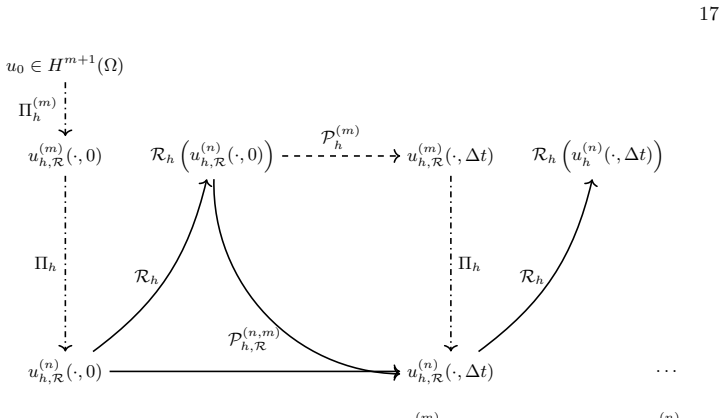
The resulting cP_n P_m scheme recovers the accuracy of an m-th order approximation while evolving only n-th order degrees of freedom, achieving m+1 order convergence for sufficiently smooth solutions through a projection-based reconstruction and a single correction term for the highest mode.
What carries the argument
The compact projection-based reconstruction operator that recovers high-order components without solving enlarged constrained least-squares systems, together with the correction term for the highest Legendre mode.
If this is right
- Computational cost, memory, and time-step restrictions decrease while maintaining high accuracy for conservation laws.
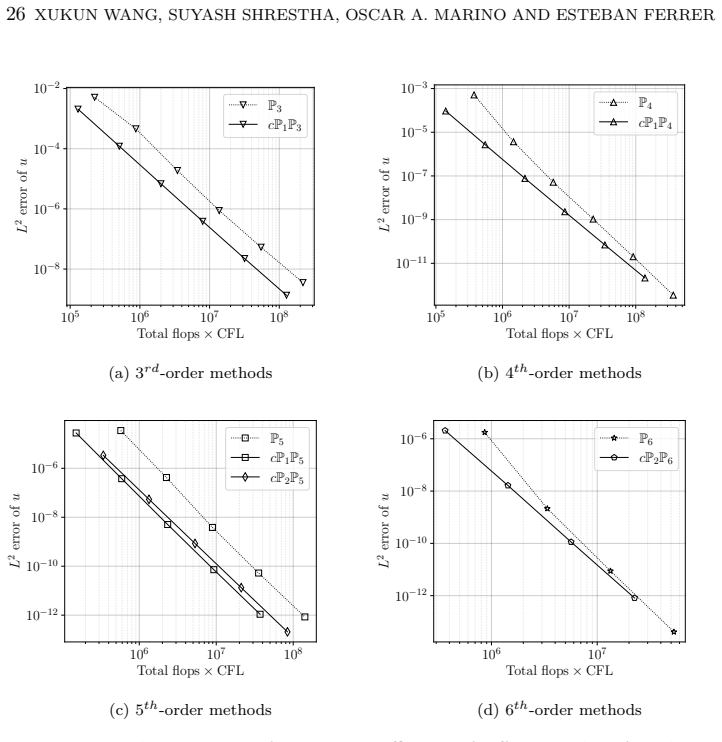
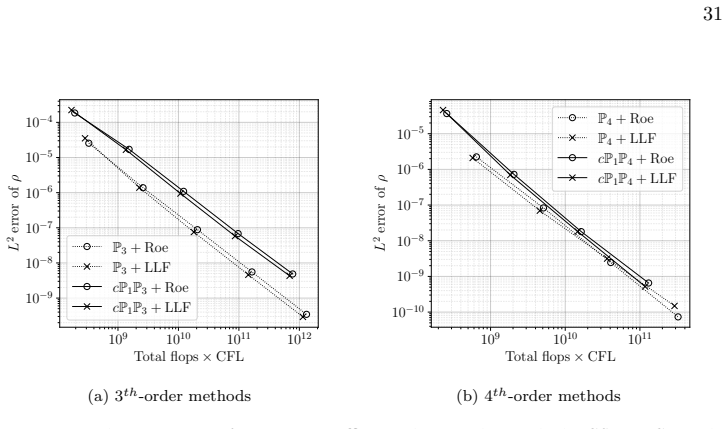
- The method demonstrates competitive accuracy relative to cost, with clear gains for viscous flows.
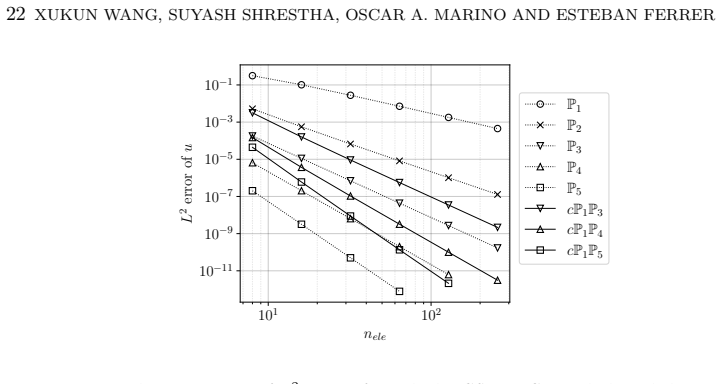
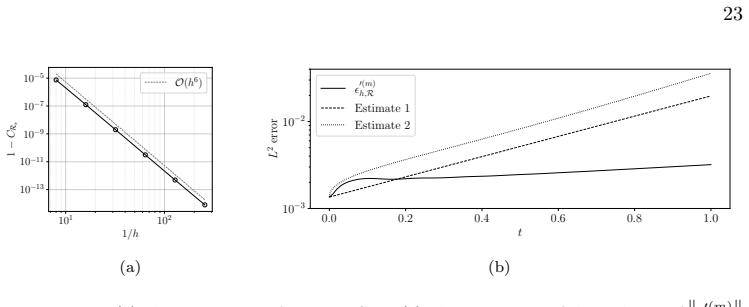
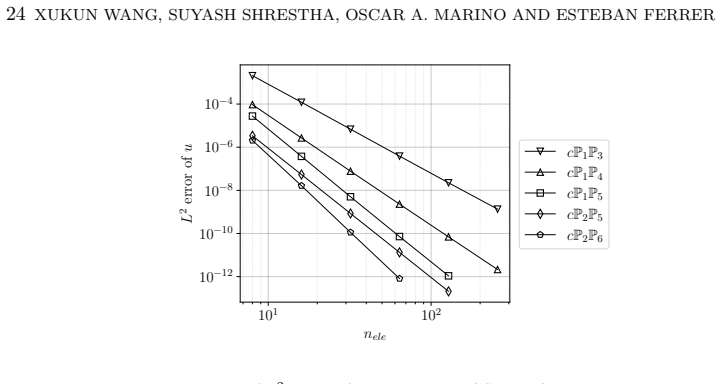
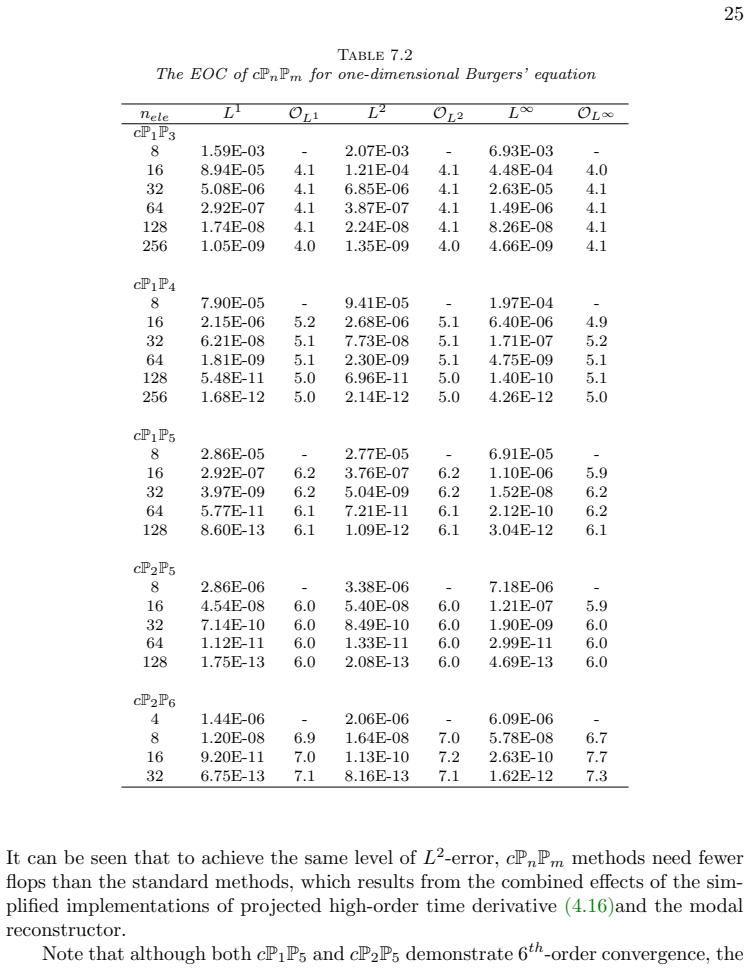
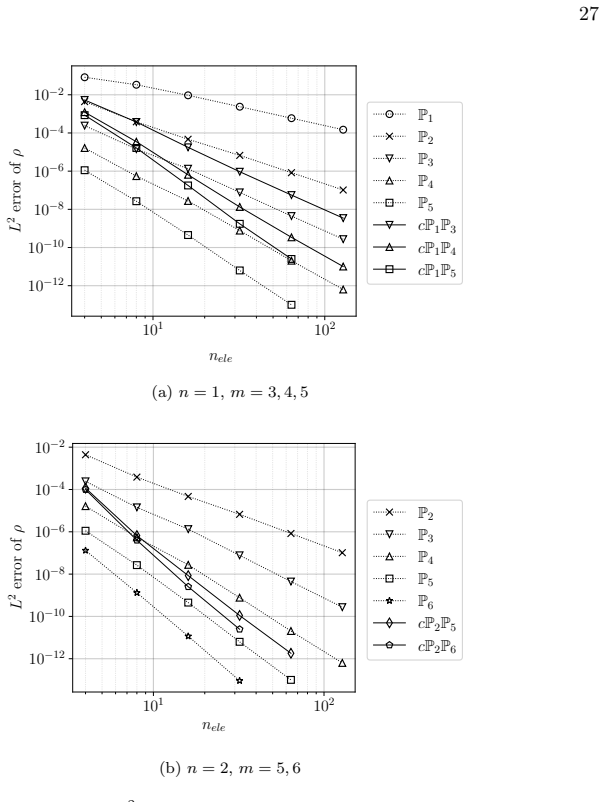
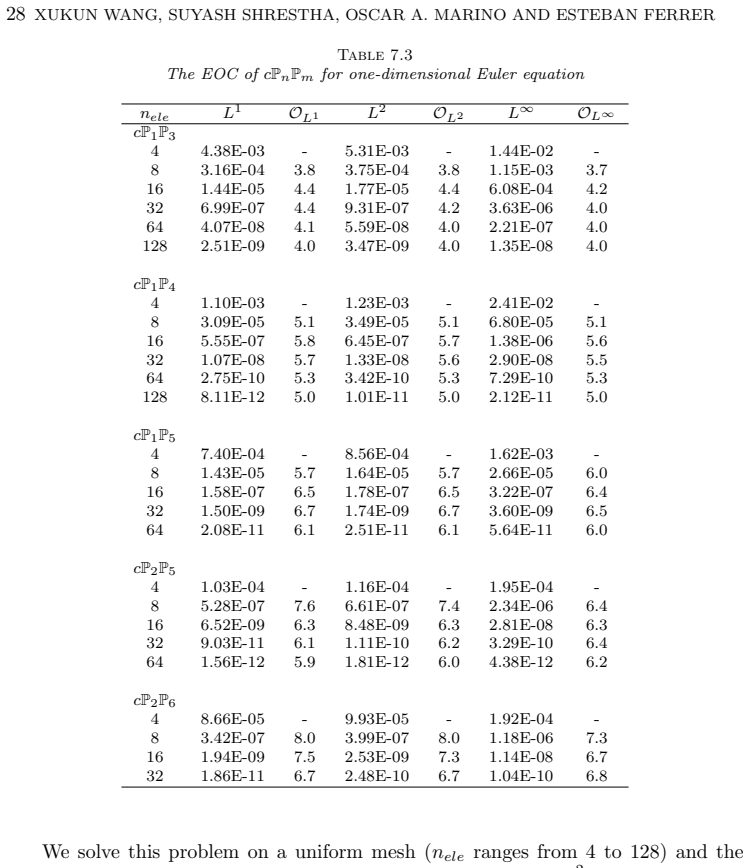
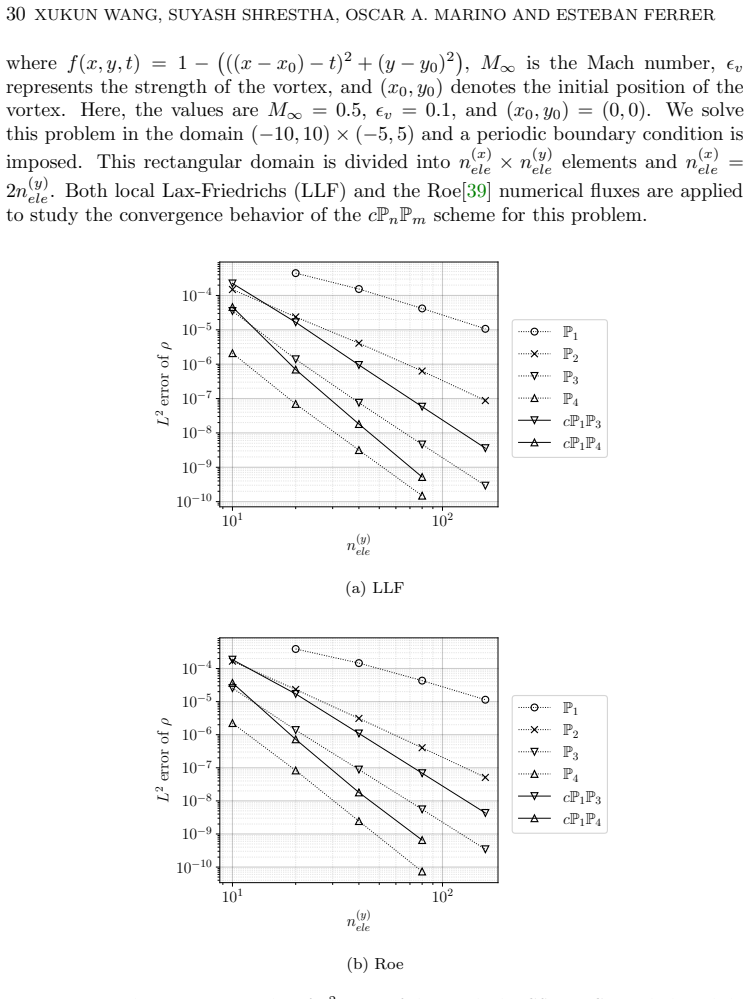
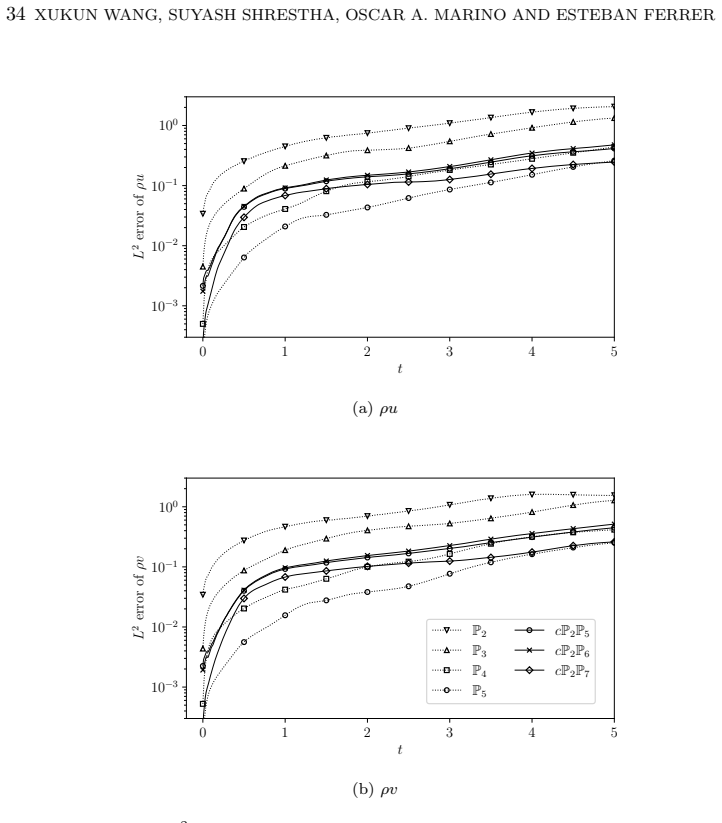
- Numerical experiments in 1D and 2D confirm the theoretical convergence order.
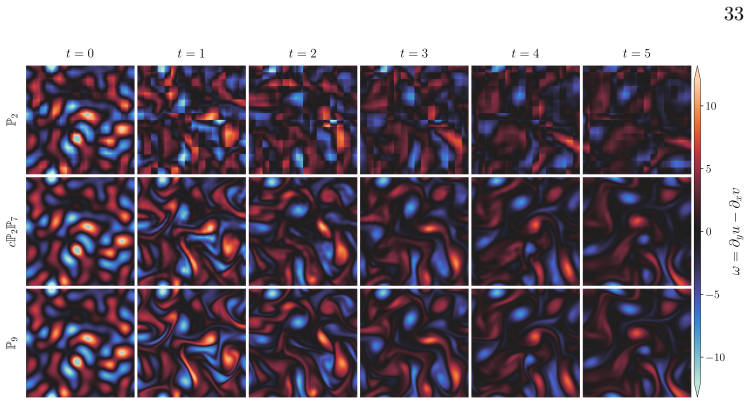
- It applies to Euler equations, viscous Burgers, and decaying isotropic turbulence.
Where Pith is reading between the lines
- Extending this to three-dimensional problems could yield even larger efficiency improvements in complex simulations.
- The compact operator might simplify implementation in existing DGSEM codes compared to traditional reconstruction.
- Testing on non-smooth solutions could reveal limitations or needed adaptations beyond the smooth case analyzed.
Load-bearing premise
A single correction term for the highest Legendre mode suffices to restore full convergence order without introducing degrading truncation errors in the discrete DGSEM-LGL setting.
What would settle it
Observing a convergence rate below m+1 in a numerical experiment with a sufficiently smooth solution when using the cP_n P_m scheme with n less than m.
Figures

read the original abstract
High-order discontinuous Galerkin spectral element methods (DGSEM) based on Legendre-Gauss-Lobatto (LGL) nodes provide accurate and efficient discretizations for conservation laws. However, their cost, memory footprint, and time-step restrictions increase rapidly when the degree of the polynomial increases. This paper develops a corrected $\mathbb{P}_n\mathbb{P}_m$ ($c\mathbb{P}_n\mathbb{P}_m$) approach for DGSEM-LGL discretizations that aims to recover the accuracy of an $m^{th}$-order approximation while evolving only the degrees of freedom associated with an $n^{th}$-order representation, with $n<m$. The projected evolution of the high-order components is derived first at the continuous level and then in the fully discrete DGSEM-LGL setting. The discrete analysis shows that because LGL quadrature is not exact for the highest Legendre mode, a correction term for that mode is required to preserve the order of convergence. A compact projection-based reconstruction operator is then introduced to recover high-order components without solving the enlarged constrained least-squares systems used in standard reconstruction procedures. For sufficiently smooth solutions, the resulting $c\mathbb{P}_n\mathbb{P}_m$ scheme is shown to achieve the expected $m+1^{th}$ convergence order. Numerical experiments for one- and two-dimensional conservation laws, including Euler, viscous Burgers, and 2D decaying homogeneous isotropic turbulence, confirm theoretical convergence behavior and demonstrate competitive accuracy relative to computational cost, with particularly clear efficiency gains for viscous flows.
Editorial analysis
A structured set of objections, weighed in public.
Referee Report
Summary. The manuscript develops a corrected ℙ_n ℙ_m (cℙ_n ℙ_m) scheme for DGSEM-LGL discretizations of conservation laws. It first derives the projected evolution of high-order components at the continuous level, then in the fully discrete DGSEM-LGL setting, where a correction term is required for the highest Legendre mode because LGL quadrature is inexact for that mode. A compact projection-based reconstruction operator is introduced to recover the high-order components without solving enlarged constrained least-squares systems. For sufficiently smooth solutions the resulting scheme is claimed to achieve the expected m+1 convergence order while evolving only the n-degree degrees of freedom (n < m). Numerical experiments on 1-D and 2-D conservation laws (Euler, viscous Burgers, 2-D decaying homogeneous isotropic turbulence) confirm the theoretical order and demonstrate competitive accuracy per computational cost, with clearest gains for viscous flows.
Significance. If the central claim holds, the approach offers a practical route to high-order accuracy at the cost and time-step restriction of a lower-degree DGSEM representation. The explicit identification of the quadrature-induced correction, the compact reconstruction operator, and the numerical confirmation across multiple conservation laws (including viscous cases) constitute concrete strengths that would make the method attractive for large-scale simulations where memory and CFL restrictions are limiting.
major comments (1)
- [Fully discrete DGSEM-LGL derivation] Fully discrete DGSEM-LGL derivation (as described after the continuous-level projection): the claim that a single correction term for the highest Legendre mode restores m+1 order rests on the assumption that this correction commutes with the compact projection operator and does not introduce new truncation errors of order ≤ m when the corrected mode is projected back into the n-degree space or interacts with the time integrator. This assumption is load-bearing for the convergence statement and requires an explicit truncation-error expansion showing that no additional O(h^k) terms with k ≤ m appear.
minor comments (1)
- [Abstract] Abstract: the convergence claim is stated without reference to the precise error bound or the smoothness assumption under which it holds; adding one sentence with the leading-order error term would make the central result easier to evaluate.
Simulated Author's Rebuttal
We thank the referee for the thorough review and positive overall assessment. The single major comment raises a valid point about rigorizing the fully discrete convergence analysis. We address it below and will revise the manuscript accordingly.
read point-by-point responses
-
Referee: [Fully discrete DGSEM-LGL derivation] Fully discrete DGSEM-LGL derivation (as described after the continuous-level projection): the claim that a single correction term for the highest Legendre mode restores m+1 order rests on the assumption that this correction commutes with the compact projection operator and does not introduce new truncation errors of order ≤ m when the corrected mode is projected back into the n-degree space or interacts with the time integrator. This assumption is load-bearing for the convergence statement and requires an explicit truncation-error expansion showing that no additional O(h^k) terms with k ≤ m appear.
Authors: We agree that an explicit truncation-error expansion is required to fully substantiate the order claim in the fully discrete setting. In the revised manuscript we will insert a dedicated subsection that performs the truncation-error analysis of the corrected scheme. The expansion will track the action of the single-mode correction through the compact projection operator, confirm that the correction commutes with the projection at the required order, and verify that no additional O(h^k) terms with k ≤ m are generated when the corrected mode is mapped back into the n-degree space or coupled to the time integrator. The analysis will be carried out under the same smoothness assumptions already stated in the paper. revision: yes
Circularity Check
No circularity: derivation from standard DGSEM-LGL quadrature inexactness with explicit correction term
full rationale
The paper starts from established DGSEM-LGL properties (LGL quadrature inexact for highest Legendre mode) and derives an explicit correction term at continuous then discrete level. It then introduces a compact projection operator and states that analysis shows m+1 order for smooth solutions, confirmed by numerics. No fitted parameters renamed as predictions, no self-definitional loops, and no load-bearing self-citation chains that reduce the central claim to unverified inputs. The assumption that one correction suffices is an explicit modeling choice, not a hidden reduction by construction. This matches the most common honest non-finding.
Axiom & Free-Parameter Ledger
axioms (1)
- domain assumption LGL quadrature is not exact for the highest Legendre mode
Reference graph
Works this paper leans on
-
[1]
F. Bassi and S. Rebay , A high-order accurate discontinuous finite element method for the numerical solution of the compressible navier-stokes equations , Journal of Compu- tational Physics, 131 (1997), https://doi.org/10.1006/jcph.1996.5572, https://www.osti. gov/biblio/494292
-
[2]
F. Bassi and S. Rebay , A High-Order Accurate Discontinuous Finite Element Method for the Numerical Solution of the Compressible Navier–Stokes Equations , Journal of Compu- tational Physics, 131 (1997), pp. 267–279, https://doi.org/https://doi.org/10.1006/jcph. 1996.5572
-
[3]
G. K. Batchelor , Computation of the Energy Spectrum in Homogeneous Two- Dimensional Turbulence , The Physics of Fluids, 12 (1969), pp. II–233–II– 239, https://doi.org/10.1063/1.1692443, https://pubs.aip.org/pfl/article/12/12/II-233/ 942977/Computation-of-the-Energy-Spectrum-in-Homogeneous (accessed 2025-10-07)
-
[4]
A. D. Beck, T. Bolemann, D. Flad, H. Frank, G. J. Gassner, F. Hindenlang, and C. Munz , High-order discontinuous Galerkin spectral element methods for transitional and turbulent flow simulations , International Journal for Numerical Methods in Fluids, 76 (2014), pp. 522–548, https://doi.org/10.1002/fld.3943, https://onlinelibrary.wiley.com/ doi/10.1002/fl...
-
[5]
Bradbury, R
J. Bradbury, R. Frostig, P. Hawkins, M. J. Johnson, C. Leary, D. Maclaurin, G. Nec- ula, A. Paszke, J. VanderPlas, S. Wanderman-Milne, and Q. Zhang , JAX: compos- able transformations of Python+NumPy programs , 2018, http://github.com/jax-ml/jax
2018
-
[6]
Carpenter and C
M. Carpenter and C. Kennedy, Fourth-order 2N-storage Runge-Kutta schemes, Nasa reports TM, 109112,, (1994)
1994
-
[7]
P. G. Ciarlet , The Finite Element Method for Elliptic Problems , Society for In- dustrial and Applied Mathematics, 2002, https://doi.org/10.1137/1.9780898719208, https://epubs.siam.org/doi/abs/10.1137/1.9780898719208, https://arxiv.org/abs/https:// epubs.siam.org/doi/pdf/10.1137/1.9780898719208
-
[8]
B. Cockburn and C. W. Shu , TVB Runge-Kutta Local Projection Discontinuous Galerkin Finite Element Method for Conservation Laws II:General Framework , Mathematics of Computation, 52 (1989), pp. 411–435, https://doi.org/10.2307/2008474
-
[9]
M. Dumbser , Arbitrary high order PNPM schemes on unstructured meshes for the com- pressible Navier–Stokes equations , Computers & Fluids, 39 (2010), pp. 60–76, https: //doi.org/10.1016/j.compfluid.2009.07.003, https://linkinghub.elsevier.com/retrieve/pii/ S0045793009001030 (accessed 2026-04-02)
-
[10]
M. Dumbser, D. S. Balsara, E. F. Toro, and C.-D. Munz , A unified framework for the construction of one-step finite volume and discontinuous Galerkin schemes on unstructured meshes , Journal of Computational Physics, 227 (2008), pp. 8209– 8253, https://doi.org/10.1016/j.jcp.2008.05.025, https://www.sciencedirect.com/science/ article/pii/S0021999108002829
-
[11]
M. Dumbser and M. K ¨aser, Arbitrary high order non-oscillatory finite volume schemes on unstructured meshes for linear hyperbolic systems , Journal of Computational Physics, 221 (2007), pp. 693–723, https://doi.org/10.1016/j.jcp.2006.06.043, https://www.sciencedirect. com/science/article/pii/S0021999106003123
-
[12]
M. Dumbser and O. Zanotti , Very high order PNPM schemes on unstructured meshes for the resistive relativistic MHD equations , Journal of Computational Physics, 228 (2009), pp. 6991–7006, https://doi.org/10.1016/j.jcp.2009.06.009, https://linkinghub. elsevier.com/retrieve/pii/S0021999109003350 (accessed 2026-04-02)
-
[13]
E. Ferrer, G. Rubio, G. Ntoukas, W. Laskowski, O. A. Mari˜no, S. Colombo, A. Mateo- Gab´ın, H. Marbona, F. Manrique de Lara, D. Huergo, J. Manzanero, A. M. Rueda-Ram´ırez, D. A. Kopriva, and E. Valero , HORSES3D: A high-order discon- tinuous Galerkin solver for flow simulations and multi-physics applications , Computer 37 Physics Communications, 287 (2023...
arXiv 2023
-
[14]
E. Ferrer and R. Willden , A high order Discontinuous Galerkin – Fourier incompressible 3D Navier–Stokes solver with rotating sliding meshes , Journal of Computational Physics, 231 (2012), pp. 7037–7056, https://doi.org/10.1016/j.jcp.2012.04.039
-
[15]
T. C. Fisher and M. H. Carpenter , High-order entropy stable finite difference schemes for nonlinear conservation laws: Finite domains , Journal of Computational Physics, 252 (2013), pp. 518–557, https://doi.org/10.1016/j.jcp.2013.06.014, https://www.sciencedirect. com/science/article/pii/S0021999113004385
-
[16]
L. Fu, A low-dissipation finite-volume method based on a new TENO shock-capturing scheme , Computer Physics Communications, 235 (2019), pp. 25–39, https://doi.org/https://doi. org/10.1016/j.cpc.2018.10.009
-
[17]
G. Gassner and D. A. Kopriva , A Comparison of the Dispersion and Dissipation Errors of Gauss and Gauss–Lobatto Discontinuous Galerkin Spectral Element Methods, SIAM Jour- nal on Scientific Computing, 33 (2011), pp. 2560–2579, https://doi.org/10.1137/100807211, http://epubs.siam.org/doi/10.1137/100807211 (accessed 2026-01-03)
-
[18]
G. J. Gassner , A Skew-Symmetric Discontinuous Galerkin Spectral Element Discretiza- tion and Its Relation to SBP-SAT Finite Difference Methods , SIAM Journal on Scien- tific Computing, 35 (2013), pp. A1233–A1253, https://doi.org/10.1137/120890144, http: //epubs.siam.org/doi/10.1137/120890144 (accessed 2025-04-24)
-
[19]
G. J. Gassner, A. R. Winters, and D. A. Kopriva, Split form nodal discontinuous Galerkin schemes with summation-by-parts property for the compressible Euler equations, Journal of Computational Physics, 327 (2016), pp. 39–66, https://doi.org/10.1016/j.jcp.2016.09.013, https://www.sciencedirect.com/science/article/pii/S0021999116304259
-
[20]
A. Harten, B. Engquist, S. Osher, and S. R. Chakravarthy, UNIFORMLY HIGH-ORDER ACCURATE ESSENTIALLY NONOSCILLATORY SCHEMES .3, Journal of Computa- tional Physics, 71 (1987), pp. 231–303, https://doi.org/10.1016/0021-9991(87)90031-3
-
[21]
J. S. Hesthaven and T. Warburton , Nodal discontinuous Galerkin methods: algorithms, analysis, and applications , Springer, 2008
2008
-
[22]
F. J. Hindenlang and G. J. Gassner , On the Order Reduction of Entropy Stable DGSEM for the Compressible Euler Equations , in Spectral and High Order Methods for Par- tial Differential Equations ICOSAHOM 2018, S. J. Sherwin, D. Moxey, J. Peir´ o, P. E. Vincent, and C. Schwab, eds., vol. 134, Springer International Publishing, Cham, 2020, pp. 21–44, https:...
-
[23]
T. J. Hughes, G. R. Feij ´oo, L. Mazzei, and J.-B. Quincy , The variational multiscale method—a paradigm for computational mechanics, Computer Methods in Applied Mechan- ics and Engineering, 166 (1998), pp. 3–24, https://doi.org/10.1016/S0045-7825(98)00079-6, https://linkinghub.elsevier.com/retrieve/pii/S0045782598000796 (accessed 2025-10-17)
-
[24]
H. T. Huynh , A Flux Reconstruction Approach to High-Order Schemes Including Discontin- uous Galerkin Methods , in 18th AIAA Computational Fluid Dynamics Conference, Fluid Dynamics and Co-located Conferences, American Institute of Aeronautics and Astronau- tics, 2007
2007
-
[25]
G. S. Jiang and C. W. Shu , Efficient implementation of weighted ENO schemes , Journal of Computational Physics, 126 (1996), pp. 202–228, https://doi.org/DOI10.1006/jcph.1996. 0130
1996
-
[26]
G. Karniadakis and S. Sherwin , Spectral/hp Element Methods for Computational Fluid Dynamics, Oxford University Press, June 2005, https://doi.org/10.1093/acprof:oso/ 9780198528692.001.0001, https://doi.org/10.1093/acprof:oso/9780198528692.001.0001 (ac- cessed 2025-04-22)
-
[27]
D. A. Kopriva, Implementing spectral methods for partial differential equations: Algorithms for scientists and engineers , Springer Science & Business Media, 2009
2009
-
[28]
D. A. Kopriva and G. Gassner , On the Quadrature and Weak Form Choices in Collocation Type Discontinuous Galerkin Spectral Element Methods , Journal of Scientific Computing, 44 (2010), pp. 136–155, https://doi.org/10.1007/s10915-010-9372-3, https://doi.org/10. 1007/s10915-010-9372-3
-
[29]
D. A. Kopriva and G. J. Gassner , An Energy Stable Discontinuous Galerkin Spectral Element Discretization for Variable Coefficient Advection Problems , SIAM Journal on Scientific Computing, 36 (2014), pp. A2076–A2099, https://doi.org/10.1137/130928650, http://epubs.siam.org/doi/10.1137/130928650 (accessed 2025-04-24)
-
[30]
R. H. Kraichnan , Inertial Ranges in Two-Dimensional Turbulence , The Physics of Flu- 38 XUKUN WANG, SUYASH SHRESTHA, OSCAR A. MARINO AND ESTEBAN FERRER ids, 10 (1967), pp. 1417–1423, https://doi.org/10.1063/1.1762301, https://pubs.aip.org/ pfl/article/10/7/1417/440889/Inertial-Ranges-in-Two-Dimensional-Turbulence (accessed 2025-10-07)
-
[31]
M. Kurz, D. Kempf, M. P. Blind, P. Kopper, P. Offenh ¨auser, A. Schwarz, S. Starr, J. Keim, and A. Beck , GALÆXI: Solving complex compressible flows with high-order discontinuous Galerkin methods on accelerator-based systems , Computer Physics Com- munications, 306 (2025), p. 109388, https://doi.org/10.1016/j.cpc.2024.109388, https: //www.sciencedirect.co...
-
[32]
C. E. Leith , Atmospheric Predictability and Two-Dimensional Turbulence , Journal of the Atmospheric Sciences, 28 (1971), pp. 145–161, https://doi.org/10.1175/1520-0469(1971) 028⟨0145:APATDT⟩2.0.CO;2, http://journals.ametsoc.org/doi/10.1175/1520-0469(1971) 028⟨0145:APATDT⟩2.0.CO;2 (accessed 2025-10-07)
-
[33]
L. Li, X. Liu, and H. Luo , A reconstructed discontinuous Galerkin method based on variational formulation for compressible flows , Journal of Computational Physics, 466 (2022), p. 111406, https://doi.org/10.1016/j.jcp.2022.111406, https://www.sciencedirect. com/science/article/pii/S0021999122004685
-
[34]
J. Lou, L. Li, H. Luo, and H. Nishikawa , Reconstructed discontinuous Galerkin methods for linear advection–diffusion equations based on first-order hyperbolic system , Journal of Computational Physics, 369 (2018), pp. 103–124, https://doi.org/10.1016/j.jcp.2018.04. 058, https://www.sciencedirect.com/science/article/pii/S0021999118302912
-
[35]
H. Luo, L. Luo, R. Nourgaliev, and V. Mousseau, A Reconstructed Discontinuous Galerkin Method for the Compressible Euler Equations on Arbitrary Grids, in 19th AIAA Computa- tional Fluid Dynamics, San Antonio, Texas, June 2009, American Institute of Aeronautics and Astronautics, https://doi.org/10.2514/6.2009-3788, https://arc.aiaa.org/doi/10.2514/ 6.2009-...
-
[36]
H. Luo, L. Luo, R. Nourgaliev, V. A. Mousseau, and N. Dinh , A reconstructed discon- tinuous Galerkin method for the compressible Navier–Stokes equations on arbitrary grids , Journal of Computational Physics, 229 (2010), pp. 6961–6978, https://doi.org/10.1016/j. jcp.2010.05.033, https://www.sciencedirect.com/science/article/pii/S0021999110002949
work page doi:10.1016/j 2010
-
[37]
An Entropy Stable High-Order Discontinuous Galerkin Method on Cut Meshes
J. Qiu and C.-W. Shu , Hermite WENO schemes and their application as limiters for Runge–Kutta discontinuous Galerkin method: one-dimensional case , Journal of Compu- tational Physics, 193 (2004), pp. 115–135, https://doi.org/https://doi.org/10.1016/j.jcp. 2003.07.026
-
[38]
W. H. Reed and T. R. Hill, Triangular mesh methods for the neutron transport equation, Los Alamos Scientific Lab., N.Mex. (USA), 10 1973, https://www.osti.gov/biblio/4491151
arXiv 1973
-
[39]
P. L. Roe , Approximate Riemann solvers, parameter vectors, and difference schemes , Jour- nal of Computational Physics, 43 (1981), pp. 357–372, https://doi.org/https://doi.org/10. 1016/0021-9991(81)90128-5
1981
-
[40]
O. San and A. E. Staples , High-order methods for decaying two-dimensional homoge- neous isotropic turbulence , Computers & Fluids, 63 (2012), pp. 105–127, https://doi. org/10.1016/j.compfluid.2012.04.006, https://www.sciencedirect.com/science/article/pii/ S0045793012001363
-
[41]
X. Wang, O. A. Marino, and E. Ferrer , Accelerating high-order energy-stable discon- tinuous Galerkin solver using auto-differentiation and neural networks , Chinese Jour- nal of Aeronautics, (2026), p. 104285, https://doi.org/10.1016/j.cja.2026.104285, https: //www.sciencedirect.com/science/article/pii/S1000936126002232
-
[42]
Z. Wang, L. Shi, S. Fu, H. Zhang, and L. Zhang , A PNPM-CPR Framework for Hyperbolic Conservation Laws, in 20th AIAA Computational Fluid Dynamics Conference, Honolulu, Hawaii, June 2011, American Institute of Aeronautics and Astronautics, https://doi.org/ 10.2514/6.2011-3227, https://arc.aiaa.org/doi/10.2514/6.2011-3227 (accessed 2025-12-22). 39 Appendix ...
discussion (0)
Sign in with ORCID, Apple, or X to comment. Anyone can read and Pith papers without signing in.