REVIEW 4 major objections 5 minor 73 references
Survival Concept-Based Learning Models
T0 review · 4 major / 5 minor · reviewed 2026-08-08 · deepseek-v4-flash
Pith's one-line read Survival prediction gains concept bottleneck models whose risk scores can be read off concept by concept.
desk verdict The first concept-bottleneck-plus-survival model is a real novelty, but its headline accuracy claim is an artifact of generating event times from the very concepts the model is supervised to predict. read the letter →
The pith
A machine-rendered reading of the paper's core claim, the machinery that carries it, and where it could break.
The reading
What carries the argument
The load-bearing object is the concatenated concept-logit vector $p$ formed from the outputs of $m$ concept CNNs; this vector is the input to the survival head, which is either the Cox model with hazard $H(t \mid x, b) = H_0(t)\exp(b^T p)$ or the Beran estimator with Gaussian-kernel weights computed on $p$. Training minimizes $L = -\alpha L_{\text{surv}} + (1-\alpha) L_{\text{CE}}$, where $L_{\text{surv}}$ is a differentiable smoothed C-index and $L_{\text{CE}}$ is cross-entropy for concept classification. The bottleneck forces all survival information to flow through the concepts, which is why the model can both produce survival functions and explain them by concept contributions.
What would settle it
Run SurvCBM against SurvRCM and SurvBase on a real censored dataset with concept annotations, such as a medical cohort with expert-defined risk factors and follow-up times, and measure the C-index difference; if the advantage shrinks to zero or reverses when event times are not generated from the concepts, the paper's central claim of concept-driven accuracy improvement is falsified.
Extended reading notes
Core claim
The central discovery claimed is that the concept bottleneck model, previously used for classification, can be adapted to censored time-to-event data by placing a survival head after the concept bottleneck. In SurvCBM the input images are mapped by separate CNNs to concept logits; these logits are concatenated and passed to either the Cox proportional hazards model or the Beran estimator, which outputs a survival function. Each concept contributes a linear term in the Cox log-risk, and the Beran estimator weights training instances by similarity of concept logits, so predictions stay interpretable in terms of concepts. Numerical experiments on synthetic MNIST and CIFAR-10 composites show SurvCBM achieving higher C-index than SurvRCM and SurvBase, with the largest gains when the Cox model is used on Weibull-generated event times.
Load-bearing premise
The quantitative case for SurvCBM depends on synthetic datasets in which the true event time is generated from a linear combination of the same predefined concepts the model is trained to predict; on real censored survival data, where event times may not be driven by those concepts, the claimed accuracy advantage may not hold.
Editorial extensions
If this is right
- If SurvCBM's reported advantage holds, then collecting concept labels can improve the accuracy of survival models, not just their interpretability, on tasks where concepts align with the drivers of event times.
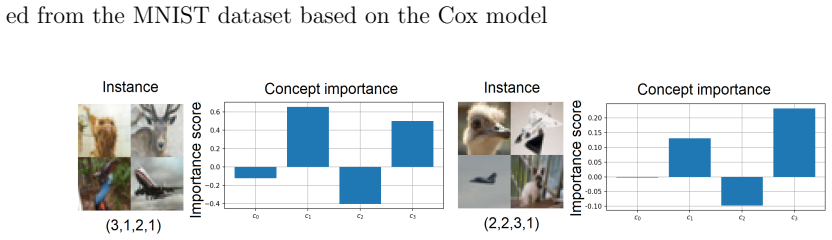
- The Cox-based SurvCBM yields concept relevance scores as products of learned coefficients and softmax concept probabilities, so a risk prediction can be audited concept by concept.
- The Beran-based SurvCBM offers example-based explanations: the training instances with survival functions closest to the explained instance show which concepts are doing the work.
- The paper's negative result for SurvRCM indicates that using concepts only as a regularizer is weaker than a true bottleneck for survival tasks, so future concept-based survival models should route predictions through concepts.
- The claim of being the first integration of concept-based learning with survival analysis establishes a baseline architecture against which later concept-based survival models can be compared.
Reading between the lines
- The reported superiority may depend on the generative match: in these synthetic datasets the event time is a function of the very concepts the model is trained to predict, so the advantage could shrink on real data where concepts are imperfectly correlated with event time.
- Because the paper uses only synthetic composite images, the most direct testable extension is to apply SurvCBM to a real medical or reliability dataset with expert-annotated concepts and compare its C-index against concept-free deep survival models.
- The Cox-based interpretation method inherits the proportional-hazards assumption; on datasets where hazards cross, the Beran-based nearest-neighbor explanation would likely be more dependable, a comparison the paper does not make.
- Continuous or time-varying concepts, which the paper names as future work, might be needed for reliability applications where system components degrade gradually rather than being described by categorical attributes.
Editorial analysis
A structured set of objections, weighed in public.
Referee Report
Summary. The paper proposes SurvCBM and SurvRCM, two neural architectures that combine concept-based learning with survival analysis. SurvCBM uses predicted concept logits as the input to a Cox proportional hazards head or a Beran estimator head; SurvRCM uses concept logits only as an auxiliary classification loss while the survival head is trained on a continuous embedding. Both models are trained end-to-end with a loss that balances a smoothed C-index term and a concept cross-entropy term. The paper also presents two interpretation methods: Cox-coefficient contributions and a nearest-instance concept-matching procedure for the Beran estimator. Experiments on synthetic MNIST, MNIST-sin, and CIFAR-10 image datasets compare C-index and concept F1 across sample sizes and censoring proportions, reporting that SurvCBM outperforms SurvRCM and the concept-free SurvBase baseline.
Significance. If the reported results hold, this is a useful and timely first integration of concept bottleneck models with censored survival data, and the public code is a concrete asset. The end-to-end training formulation and the two interpretability mechanisms are clearly relevant to medical and reliability applications. However, the central comparative claim is currently supported only by synthetic data in which the event time is generated from the same concept vector that supervises the concept predictor, and the survival loss is not fully specified because the expected event times are never defined. These two gaps are load-bearing for the abstract and Section 7 claims that concept information substantially improves survival prediction accuracy.
major comments (4)
- [4.2, Eq. (12)] The smoothed C-index loss in Eq. (12) uses estimated expected event times \hat T_i, but the paper never defines how \hat T_i is computed from the predicted survival function for either the Cox or Beran head. Since L_surv is the only survival term in Eq. (10), the training objective is underspecified. Please provide the exact formula (e.g., numerical integration of S(t), median survival, or restricted mean survival time) and state how it is made differentiable for end-to-end training.
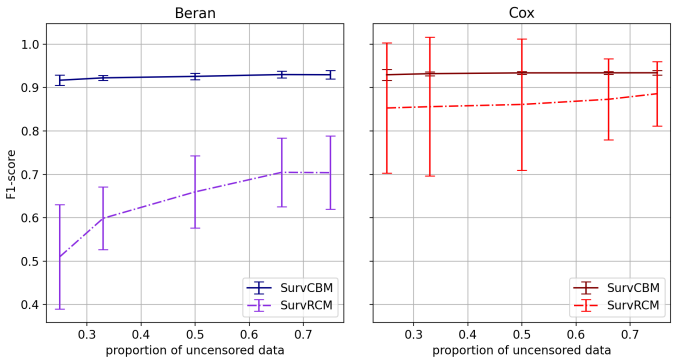
- [5.1, Eqs. (13)–(14), and Section 7] The synthetic event times are generated as deterministic functions of the same concept vector c that is supplied as supervision to the concept predictor. In the MNIST and CIFAR-10 settings, SurvCBM's Cox head is a linear function of concept logits and can in principle recover the exact data-generating risk, while SurvBase must discover the relevant information from raw pixels. The large C-index gaps in Figs. 6 and 8 may therefore reflect the experimental design rather than a general benefit of concept information. No real censored dataset is used, so the abstract and Section 7 claims about the crucial role of concept information are not established for data whose event times are not driven by predefined concepts; real-data validation or additional generative settings with event times depending on image features not fully captured by the concepts would be needed.
- [5, hyperparameter selection] The text states that different hyperparameter values are tested and those leading to the best results are chosen, and all reported metrics are computed on the test set. Selecting hyperparameters on the test set and then reporting test metrics on the same set, even with 100 repetitions, can produce optimistic estimates and may favor SurvCBM if it has more tunable components. Please use validation-based selection or nested cross-validation, and report the selected hyperparameter values for reproducibility.
- [4.3] The claim that LCE in SurvRCM 'does not directly influence the embeddings z' is questionable, because the concept logits p are produced from z by fully connected networks, so the gradient of LCE backpropagates through those networks into z. If a stop-gradient is applied before the concept heads, this should be stated explicitly; otherwise the description of SurvRCM as a regularized model with unaffected embeddings is inaccurate.
minor comments (5)
- [6] The first Beran-based explanation method is described inconsistently: it first says neighbors are selected by closeness in concept space, then defines closeness by the distance between predicted survival functions, and Eq. (15) uses distances between logits. Please state exactly which distance is used to select the nearest instances.
- [5.1 and 6] The MNIST generation vector b is given as (0.5, 1.5, −1, 0.001) in the experimental setup, but Section 6 uses b = (b_1, ..., b_4) with each b_i ∈ R^10. Please clarify whether concepts enter Eq. (13) as scalar digit values or as one-hot vectors, since this changes the data-generating model.
- [4.2, Eq. (12)] The denominator of Eq. (12) sums pairs with δ_j = 1 and T_j < T_i; for small batches or certain censoring patterns this set can be empty, leading to division by zero. Please specify the handling of empty pair sets and ties in event times.
- [Abstract and 7] The abstract says the models outperform 'traditional survival models', but the experiments compare only SurvBase and SurvRCM. Either add standard survival baselines (e.g., DeepSurv, random survival forests, or Cox on raw features) or temper the claim to 'the compared baselines'.
- [Throughout] There are several typos and inconsistencies to clean up: 'impove', 'significanlty', 'CIF AR-10' versus 'CIFAR-10', the phrase 'To implement We apply Lsurv' in Section 4.2, and the label 'Mixture model' used in Fig. 7 for what the text calls SurvRCM.
Circularity Check
No significant circularity: the model construction is direct, and the synthetic data generator favors SurvCBM by evaluation design rather than by derivation.
full rationale
I walked the derivation chain: SurvCBM is defined as S(t|x,A)=F(G(x)) with G outputting concept logits and F a Cox or Beran survival model; SurvRCM and SurvBase are distinct architectures sharing the same loss. No equation defines the target survival function in terms of the model's predictions or vice versa; the loss (10)-(12) is a standard combination of a smoothed C-index and concept cross-entropy. The interpretability methods re-read the model's own linear risk score or nearest-neighbor survival-function distances; these are explanations by definition, not validations, and no fitted parameter is relabeled as a prediction. The only potentially circular-looking element is the synthetic evaluation: Eqs. (13)-(14) generate event times T from the same concept vector c that supervises the concept predictor, so the benchmark is favorable to SurvCBM by construction. However, this is a data-generating choice, not a reduction of the model's derivation to its inputs; the C-index is computed on a held-out test set and the model could fail to learn the mapping. The paper's Section 7 acknowledges the real-world limitation that concepts must be predefined and no real censored dataset is used; that is an external-validity threat, not circular reasoning. Self-citations ([24], [26], [71], [72]) are contextual related-work citations and are not load-bearing for the architecture, loss, or benchmark. I find no step where a claimed prediction is equivalent to its input by construction.
Assumptions & free parameters
free parameters (5)
- alpha (loss balance) =
not reported, chosen by hyperparameter search
- omega (sigmoid temperature) =
not reported
- tau (Beran kernel width) =
scalar in Eq. (7); trainable per concept in Eq. (15)
- embedding dimension d =
not reported
- Beran background set size =
not reported
assumptions (5)
- domain assumption Cox proportional hazards assumption: log-risk is a linear combination of covariates (concept logits).
- standard math The Beran estimator consistently estimates the conditional survival function via kernel-weighted product-limit.
- domain assumption The smoothed C-index is a valid differentiable surrogate for the ranking loss.
- ad hoc to paper Synthetic data generation with event times driven by concepts is a representative proxy for real survival data.
- domain assumption Expected event times can be computed from predicted survival functions and are finite under censoring.
Cite this review
Pith. "Pith review of Survival Concept-Based Learning Models." pith.science (2026). https://pith.science/paper/35JWUCH5
@misc{pith2026250205950,
  author       = {Pith},
  title        = {Pith review of: Survival Concept-Based Learning Models},
  year         = {2026},
  howpublished = {\url{https://pith.science/paper/35JWUCH5}},
  note         = {Machine review of arXiv:2502.05950}
}
read the original abstract
Concept-based learning enhances prediction accuracy and interpretability by leveraging high-level, human-understandable concepts. However, existing CBL frameworks do not address survival analysis tasks, which involve predicting event times in the presence of censored data -- a common scenario in fields like medicine and reliability analysis. To bridge this gap, we propose two novel models: SurvCBM (Survival Concept-based Bottleneck Model) and SurvRCM (Survival Regularized Concept-based Model), which integrate concept-based learning with survival analysis to handle censored event time data. The models employ the Cox proportional hazards model and the Beran estimator. SurvCBM is based on the architecture of the well-known concept bottleneck model, offering interpretable predictions through concept-based explanations. SurvRCM uses concepts as regularization to enhance accuracy. Both models are trained end-to-end and provide interpretable predictions in terms of concepts. Two interpretability approaches are proposed: one leveraging the linear relationship in the Cox model and another using an instance-based explanation framework with the Beran estimator. Numerical experiments demonstrate that SurvCBM outperforms SurvRCM and traditional survival models, underscoring the importance and advantages of incorporating concept information. The code for the proposed algorithms is publicly available.
Figures


Figures from the paper (19 more)




Reference graph
Works this paper leans on
-
[1]
A survey on Concept-based Approaches For Model Improvement
A. Gupta and P.J. Narayanan. A survey on concept-based approaches for model improvement. arXiv:2403.14566, Mar 2024
work page Pith review arXiv 2024
-
[2]
Been Kim, M. Wattenberg, J. Gilmer, C. Cai, J. Wexler, F. Viegas, et al. Inter- pretability beyond feature attribution: Quantitative testing with concept activation vectors (tcav). In International conference on machine learning , pages 2668–2677. PMLR, 2018
work page 2018
-
[3]
Learning Interpretable Concept-Based Models with Human Feedback
I. Lage and F. Doshi-Velez. Learning interpretable concept-based models with human feedback. arXiv:2012.02898, Dec 2020
work page Pith review arXiv 2012
-
[4]
Bowen Wang, Liangzhi Li, Y. Nakashima, and H. Nagahara. Learning bottleneck concepts in image classification. In Proceedings of the IEEE/CVF Conference on Computer Vision and Pattern Recognition , pages 10962–10971, 2023. 27
work page 2023
-
[5]
Statistically signif- icant concept-based explanation of image classifiers via model knockoffs
Kaiwen Xu, Kazuto Fukuchi, Youhei Akimoto, and Jun Sakuma. Statistically signif- icant concept-based explanation of image classifiers via model knockoffs. InProceed- ings of the Thirty-Second International Joint Conference on Artificial Intelligence , pages 519–526, 2023
work page 2023
-
[6]
Chih-Kuan Yeh, Been Kim, S. Arik, Chun-Liang Li, T. Pfister, and P. Ravikumar. On completeness-aware concept-based explanations in deep neural networks. In Advances in neural information processing systems, volume 33, pages 20554–20565, 2020
work page 2020
-
[7]
R. Guidotti, A. Monreale, S. Ruggieri, F. Turini, F. Giannotti, and D. Pedreschi. A survey of methods for explaining black box models. ACM computing surveys , 51(5):93, 2019
work page 2019
- [8]
Show all 73 references
-
[9]
A survey on neural net- work interpretability
Yu Zhang, Peter Tiˇ no, Aleˇ s Leonardis, and Ke Tang. A survey on neural net- work interpretability. IEEE Transactions on Emerging Topics in Computational Intelligence, 5(5):726–742, 2021
2021
-
[10]
Poeta, G
E. Poeta, G. Ciravegna, E. Pastor, T. Cerquitelli, and E. Baralis. Concept-based explainable artificial intelligence: A survey. arXiv:2312.12936, May 2023
2023
-
[11]
Editable concept bottleneck models
Lijie Hu, Chenyang Ren, Zhengyu Hu, Cheng-Long Wang, and Di Wang. Editable concept bottleneck models. arXiv:2405.15476, May 2024
2024 arXiv
-
[12]
Mussmann, E
Pang Wei Koh, Thao Nguyen, Yew Siang Tang, S. Mussmann, E. Pierson, Been Kim, and Percy Liang. Concept bottleneck models. In International conference on machine learning, pages 5338–5348. PMLR, 2020
2020
-
[13]
Chauhan, R
K. Chauhan, R. Tiwari, J. Freyberg, P. Shenoy, and K. Dvijotham. Interactive concept bottleneck models. In Proceedings of the AAAI Conference on Artificial Intelligence, volume 37, pages 5948–5955, 2023
2023
-
[14]
Sarkar, D
A. Sarkar, D. Vijaykeerthy, A. Sarkar, and V.N. Balasubramanian. A framework for learning ante-hoc explainable models via concepts. InProceedings of the IEEE/CVF Conference on Computer Vision and Pattern Recognition (CVPR) , pages 10286– 10295, June 2022
2022
-
[15]
Probabilis- tic concept bottleneck models
Eunji Kim, Dahuin Jung, Sangha Park, Siwon Kim, and Sungroh Yoon. Probabilis- tic concept bottleneck models. In International Conference on Machine Learning , pages 16521–16540. PMLR, 2023. 28
2023
-
[16]
Ismail, J
A.A. Ismail, J. Adebayo, H.C. Bravo, S. Ra, and Kyunghyun Cho. Concept bottle- neck generative models. In Proceedings of ICML 2023. Workshop on Deployment Challenges for Generative AI , pages 1–10, 2023
2023
-
[17]
Kazmierczak, E
R. Kazmierczak, E. Berthier, G. Frehse, and G. Franchi. CLIP-QDA: An explain- able concept bottleneck model. Transactions on Machine Learning Research, 2024
2024
-
[18]
Marconato, A
E. Marconato, A. Passerini, and S. Teso. Glancenets: Interpretable, leak-proof concept-based models. In Advances in Neural Information Processing Systems , volume 35, pages 21212–21227, 2022
2022
-
[19]
Vandenhirtz, S
M. Vandenhirtz, S. Laguna, R. Marcinkeviˇ cs, and J.E. Vogt. Stochastic concept bottleneck models. In ICML 2024 Workshop on Structured Probabilistic Inference & Generative Modeling , 2024
2024
-
[20]
Zarlenga, Z
M.E. Zarlenga, Z. Shams, M.E. Nelson, B. Kim, and M. Jamnik. TabCBM: Concept- based interpretable neural networks for tabular data. Transactions on Machine Learning Research, 2023
2023
-
[21]
Hosmer, S
D. Hosmer, S. Lemeshow, and S. May. Applied Survival Analysis: Regression Mod- eling of Time to Event Data . John Wiley & Sons, New Jersey, 2008
2008
-
[22]
Forest, K
F. Forest, K. Rombach, and O. Fink. Interpretable prognostics with concept bot- tleneck models. arXiv:2405.17575, May 2024
2024 arXiv
-
[23]
D.R. Cox. Regression models and life-tables. Journal of the Royal Statistical Society, Series B (Methodological), 34(2):187–220, 1972
1972
-
[24]
Kovalev, L.V
M.S. Kovalev, L.V. Utkin, and E.M. Kasimov. SurvLIME: A method for explaining machine learning survival models. Knowledge-Based Systems, 203:106164, 2020
2020
-
[25]
R. Beran. Nonparametric regression with randomly censored survival data. Tech- nical report, University of California, Berkeley, 1981
1981
-
[26]
Utkin, D.Y
L.V. Utkin, D.Y. Eremenko, and A.V. Konstantinov. SurvBeX: an explanation method of the machine learning survival models based on the beran estimator. International Journal of Data Science and Analytics , pages 1–26, 2024
2024
-
[27]
Auxiliary losses for learning generalizable concept-based models
Ivaxi Sheth and Samira Ebrahimi Kahou. Auxiliary losses for learning generalizable concept-based models. Advances in Neural Information Processing Systems , 36, 2024
2024
-
[28]
Semi-supervised concept bottleneck models
Lijie Hu, Tianhao Huang, Huanyi Xie, Chenyang Ren, Zhengyu Hu, Lu Yu, and Di Wang. Semi-supervised concept bottleneck models. arXiv:2406.18992, Jun 2024. 29
2024 arXiv
-
[29]
Oikarinen, S
T. Oikarinen, S. Das, L.M. Nguyen, and Tsui-Wei Weng. Label-free concept bot- tleneck models. arXiv:2304.06129, Apr 2023
2023 arXiv
-
[30]
Concept complement bottleneck model for interpretable medical image diagnosis
Hongmei Wang, Junlin Hou, and Hao Chen. Concept complement bottleneck model for interpretable medical image diagnosis. arXiv:2410.15446, Oct 2024
2024 arXiv
-
[31]
Schrodi, J
S. Schrodi, J. Schur, M. Argus, and T. Brox. Concept bottleneck models without predefined concepts. arXiv:2407.03921, Jul 2024
2024 arXiv
-
[32]
Post-hoc concept bottleneck models
Mert Yuksekgonul, Maggie Wang, and James Zou. Post-hoc concept bottleneck models. In ICLR 2022 Workshop on PAIR {\textasciicircum} 2Struct: Privacy, Accountability, Interpretability, Robustness, Reasoning on Structured Data , 2022
2022
-
[33]
Incremental residual concept bottleneck models
Chenming Shang, Shiji Zhou, Hengyuan Zhang, Xinzhe Ni, Yujiu Yang, and Yuwang Wang. Incremental residual concept bottleneck models. In Proceedings of the IEEE/CVF Conference on Computer Vision and Pattern Recognition, pages 11030– 11040, 2024
2024
-
[34]
AnyCBMs: How to turn any black box into a concept bottleneck model
Gabriele Dominici, Pietro Barbiero, Francesco Giannini, Martin Gjoreski, and Marc Langhenirich. AnyCBMs: How to turn any black box into a concept bottleneck model. arXiv:2405.16508, May 2024
2024 arXiv
-
[35]
Aysel, Xiaohao Cai, and A
H.I. Aysel, Xiaohao Cai, and A. Prugel-Bennett. Concept-based explainable artifi- cial intelligence: Metrics and benchmarks. arXiv:2501.19271, Jan 2025
2025 arXiv
-
[36]
Lanza, and S
Jae Hee Lee, S. Lanza, and S. Wermter. From neural activations to concepts: A survey on explaining concepts in neural networks. arXiv:2310.11884, Oct 2023
2023 arXiv
-
[37]
Mahinpei, J
A. Mahinpei, J. Clark, I. Lage, F. Doshi-Velez, and Weiwei Pan. Promises and pitfalls of black-box concept learning models. arXiv:2106.13314, Jun 2021
2021 arXiv
-
[38]
P. Wang, Y. Li, and C.K. Reddy. Machine learning for survival analysis: A survey. ACM Computing Surveys (CSUR) , 51(6):1–36, 2019
2019
-
[39]
High-dimensional survival analysis: Methods and ap- plications
Stephen Salerno and Yi Li. High-dimensional survival analysis: Methods and ap- plications. Annual review of statistics and its application , 10:25–49, 2023
2023
-
[40]
Deep learning for survival analysis: a review
Simon Wiegrebe, Philipp Kopper, Raphael Sonabend, Bernd Bischl, and Andreas Bender. Deep learning for survival analysis: a review. Artificial Intelligence Review, 57(65):1–34, 2024
2024
-
[41]
G.H. Chen. An introduction to deep survival analysis models for predicting time-to- event outcomes. Foundations and Trends® in Machine Learning , 17(6):921–1100, 2024. 30
2024
-
[42]
Emmert-Streib and M
F. Emmert-Streib and M. Dehmer. Introduction to survival analysis in practice. Machine Learning & Knowledge Extraction , 1:1013–1038, 2019
2019
-
[43]
Katzman, U
J.L. Katzman, U. Shaham, A. Cloninger, J. Bates, T. Jiang, and Y. Kluger. Deep- surv: Personalized treatment recommender system using a Cox proportional haz- ards deep neural network. BMC medical research methodology, 18(24):1–12, 2018
2018
-
[44]
M. Luck, T. Sylvain, H. Cardinal, A. Lodi, and Y. Bengio. Deep learning for patient-specific kidney graft survival analysis. arXiv:1705.10245, May 2017
2017 arXiv
-
[45]
Nezhad, N
M.Z. Nezhad, N. Sadati, K. Yang, and D. Zhu. A deep active survival analysis approach for precision treatment recommendations: Application of prostate cancer. arXiv:1804.03280v1, April 2018
2018 arXiv
-
[46]
Deep recurrent survival analysis
Kan Ren, Jiarui Qin, Lei Zheng, Zhengyu Yang, Weinan Zhang, Lin Qiu, and Yong Yu. Deep recurrent survival analysis. In Proceedings of the AAAI conference on artificial intelligence , volume 33, pages 4798–4805, 2019
2019
-
[47]
Steingrimsson and S
J.A. Steingrimsson and S. Morrison. Deep learning for survival outcomes. Statistics in Medicine, 39(17):2339–2349, 2020
2020
-
[48]
Tarkhan, N
A. Tarkhan, N. Simon, T. Bengtsson, K. Nguyen, and J. Dai. Survival predic- tion using deep learning. In Proceedings of AAAI Spring Symposium on Survival Prediction-Algorithms, Challenges and Applications , volume 146, pages 207–214. PMLR, 2021
2021
-
[49]
J. Yao, X. Zhu, F. Zhu, and J. Huang. Deep correlational learning for survival prediction from multi-modality data. In Medical Image Computing and Computer– Assisted Intervention – MICCAI 2017 , volume 10434 of Lecture Notes in Computer Science, pages 406–414. Springer, Cham, 2017
2017
-
[50]
Mueller, and Jane-Ling Wang
Qixian Zhong, J.W. Mueller, and Jane-Ling Wang. Deep extended hazard mod- els for survival analysis. In Advances in Neural Information Processing Systems , volume 34, pages 15111–15124. Curran Associates, Inc., 2021
2021
-
[51]
Prayag Chatha, Yixin Wang, Zhenke Wu, and J. Regier. Dynamic survival trans- formers for causal inference with electronic health records. arXiv:2210.15417, Oct. 2022
2022 arXiv
-
[52]
Transformer- based deep survival analysis
Shi Hu, Egill Fridgeirsson, Guido van Wingen, and Max Welling. Transformer- based deep survival analysis. In Survival Prediction-Algorithms, Challenges and Applications, pages 132–148. PMLR, 2021. 31
2021
-
[53]
Hierarchical trans- former for survival prediction using multimodality whole slide images and genomics
Chunyuan Li, Xinliang Zhu, Jiawen Yao, and Junzhou Huang. Hierarchical trans- former for survival prediction using multimodality whole slide images and genomics. In The 26th International Conference on Pattern Recognition (ICPR) , pages 4256–
-
[54]
Transsurv: Transformer-based survival analysis model integrating histopathological images and genomic data for colorectal cancer
Zhilong Lv, Yuexiao Lin, Rui Yan, Ying Wang, and Fa Zhang. Transsurv: Transformer-based survival analysis model integrating histopathological images and genomic data for colorectal cancer. IEEE/ACM Transactions on Computational Bi- ology and Bioinformatics , pages 1–10, 2022
2022
-
[55]
Explainable survival analysis with convolution- involved vision transformer
Yifan Shen, Li liu, Zhihao Tang, Zongyi Chen, Guixiang Ma, Jiyan Dong, Xi Zhang, Lin Yang, and Qingfeng Zheng. Explainable survival analysis with convolution- involved vision transformer. In Proceedings of the AAAI Conference on Artificial Intelligence (AAAI-22) , volume 36, p...
2022
-
[56]
Explainable survival analysis with uncertainty using convolution-involved vision transformer
Zhihao Tang, Li Liu, Zongyi Chen, Guixiang Ma, Jiyan Dong, Xujie Sun, Xi Zhang, Chaozhuo Li, Qingfeng Zheng, Lin Yang, et al. Explainable survival analysis with uncertainty using convolution-involved vision transformer. Computerized Medical Imaging and Graphics , 110:102302, 2023
2023
-
[57]
Survtrace: Transformers for survival analysis with competing events
Zifeng Wang and Jimeng Sun. Survtrace: Transformers for survival analysis with competing events. In Proceedings of the 13th ACM International Conference on Bioinformatics, Computational Biology and Health Informatics , pages 1–9, 2022
2022
-
[58]
Krivtsov, and K
Xingyu Li, V. Krivtsov, and K. Arora. Attention-based deep survival model for time series data. Reliability Engineering and System Safety , 217(108033):1–12, 2022
2022
-
[59]
Attention-based deep recurrent model for survival prediction
Zhaohong Sun, Wei Dong, Jinlong Shi, Kunlun He, and Zhengxing Huang. Attention-based deep recurrent model for survival prediction. ACM Transactions on Computing for Healthcare , 2(4):1–18, 2021
2021
-
[60]
Ibrahim, A
N.A. Ibrahim, A. Kudus, I. Daud, and M.R. Abu Bakar. Decision tree for competing risks survival probability in breast cancer study.International Journal Of Biological and Medical Research, 3(1):25–29, 2008
2008
-
[61]
Wright, T
M.N. Wright, T. Dankowski, and A. Ziegler. Unbiased split variable selection for random survival forests using maximally selected rank statistics. Statistics in Medicine, 36(8):1272–1284, 2017
2017
-
[62]
Haarburger, P
C. Haarburger, P. Weitz, O. Rippel, and D. Merhof. Image-based survival analysis for lung cancer patients using CNNs. arXiv:1808.09679v1, Aug 2018. 32
2018 arXiv
-
[63]
Widodo and B.-S
A. Widodo and B.-S. Yang. Machine health prognostics using survival probability and support vector machine. Expert Systems with Applications , 38(7):8430–8437, 2011
2011
-
[64]
Witten and R
D.M. Witten and R. Tibshirani. Survival analysis with high-dimensional covariates. Statistical Methods in Medical Research, 19(1):29–51, 2010
2010
-
[65]
Harrell, R
F. Harrell, R. Califf, D. Pryor, K. Lee, and R. Rosati. Evaluating the yield of medical tests. Journal of the American Medical Association , 247:2543–2546, 1982
1982
-
[66]
Uno, Tianxi Cai, M.J
H. Uno, Tianxi Cai, M.J. Pencina, R.B. D’Agostino, and Lee-Jen Wei. On the c- statistics for evaluating overall adequacy of risk prediction procedures with censored survival data. Statistics in medicine , 30(10):1105–1117, 2011
2011
-
[67]
LeCun, L
Y. LeCun, L. Bottou, Y. Bengio, and P. Haffner. Gradient-based learning applied to document recognition. Proceedings of the IEEE, 86(11):2278–2324, 1998
1998
-
[68]
Krizhevsky and G
A. Krizhevsky and G. Hinton. Learning multiple layers of features from tiny images. Technical Report 1, Computer Science Department, University of Toronto, 2009
2009
-
[69]
Poch´ e, L
A. Poch´ e, L. Hervier, and M.-C. Bakkay. Natural example-based explainability: a survey. In World Conference on eXplainable Artificial Intelligence , pages 24–47. Springer, 2023
2023
-
[70]
S.S. Rao, S. Mahajan, M. B¨ ohle, and B. Schiele. Discover-then-name: Task-agnostic concept bottlenecks via automated concept discovery. In 18th European Conference on Computer Vision , pages 444–461. Springer, 2024
2024
-
[71]
Konstantinov and L.V
A.V. Konstantinov and L.V. Utkin. An explicit concept-based approach for incor- porating expert rules into machine learning models. In Proceedings of the Eighth International Scientific Conference Intelligent Information Technologies for Indus- try (IITI’24), volume 1 of Lectu...
2024
-
[72]
Konstantinov and L.V
A.V. Konstantinov and L.V. Utkin. Incorporating expert rules into neural networks in the framework of concept-based learning. arXiv:2402.14726, Feb 2024. 33
2024 arXiv
-
[4262]
IEEE Computer Society, 2022
2022
Reviewed August 8, 2026 · model on record in the stance chip above.
Discussion (0). Continue with ORCID to comment.