REVIEW 2 major objections 6 minor 45 references
Geometrical Distances of Extragalactic Binaries through Spectroastrometry
T0 review · 2 major / 6 minor · reviewed 2026-08-11 · deepseek-v4-flash
Pith's one-line read This paper demonstrates a purely geometric method to measure distances to extragalactic binary stars by jointly fitting spectroastrometric phase curves, radial velocities, and eclipsing light curves, recovering the distance to a typical…
desk verdict A coherent joint SA+RV+LC framework for extragalactic binary distances; the ~6% precision forecast is real but rests on a closed-loop simulation, so accuracy under real stellar physics is not yet demonstrated. read the letter →
The pith
A machine-rendered reading of the paper's core claim, the machinery that carries it, and where it could break.
The reading
What carries the argument
The load-bearing observable is the spectroastrometric differential phase curve, Δφ(λ): the wavelength-resolved shift of the binary photocenter, measured as interferometric phase differences between a line wavelength and a continuum reference. Because the two stars' absorption lines are Doppler-shifted in opposite directions, the photocenter traces an S-shaped curve whose amplitude encodes the binary's angular semimajor axis a/D. The model couples this to the Keplerian orbit (Thiele-Innes projection), Gaussian rotation-plus-thermal line profiles, uniform-disk eclipses, and a Gaussian likelihood; the posterior is explored with diffusive nested sampling. The distance emerges from matching the angular orbit from spectroastrometry to the physical orbit from radial velocities.
What would settle it
Observe an eclipsing binary whose distance is already known independently (for example a Galactic system with a parallax or a cluster member with a geometric cluster distance), run the spectroastrometry-plus-radial-velocity-plus-light-curve pipeline on it, and compare the recovered distance with the known value; a discrepancy larger than the reported ~6% statistical error would show the model assumptions are biased. Alternatively, detect a spectroastrometric phase curve with clear asymmetry from wind emission and show that the symmetric model fit shifts the inferred distance.
Extended reading notes
Core claim
The central claim is that the distance D to an extragalactic binary can be measured geometrically because the spectroastrometric differential phase curve carries the angular scale of the orbit, while radial velocities carry the same orbit in physical units, and the light curve pins down the component radii and luminosity ratio. In the model, the angular photocenter offset across a line is ε(λ), and the observed differential phase is Δφ(λ) = −(2π/λ) B·[ε(λ) − ε(λ_r)], so the measured phase amplitude is proportional to angular separation a/D. The joint likelihood then constrains D, a, inclination, mass ratio, flux ratio, and stellar parameters; for the fiducial LMC binary the recovered distance is log D = 3.$940^{{+0.064}}$_{−0.065}, i.e. about 6.5% at 1σ. The paper emphasizes this is purely geometric: it uses only Keplerian dynamics and the comparison of angular and physical scales, with no empirical period-luminosity or surface brightness-color calibration.
Load-bearing premise
The load-bearing premise is that a real binary's surface brightness and line profiles follow the same uniform-disk, Gaussian-line model used to generate and fit the mock data; if limb darkening, wind emission, or line asymmetries shift the photocenter differently than the model assumes, the recovered distance carries a systematic error that this paper does not quantify.
Editorial extensions
If this is right
- A single LMC eclipsing binary observed at 0.1-degree phase precision and R = 10,000 yields a ~6.5% geometric distance; averaging several systems would shrink the statistical error roughly as 1/√N.
- The method is independent of Cepheid period-luminosity and surface brightness-color calibrations, offering a cross-check on the distance ladder where the Hubble tension is debated.
- Because distance precision is set mainly by interferometric phase and line-flux errors and by spectral resolution, improvements in long-baseline optical interferometry translate directly into sharper extragalactic distances.
- The same joint spectroastrometry-plus-radial-velocity-plus-light-curve pipeline can be applied to binaries in other nearby galaxies, not just the LMC, whenever their eclipses and lines are observable.
- Repeated monitoring of one binary over many orbits, or measuring multiple binaries, turns individual ~6% measurements into a galaxy distance with substantially higher precision.
Reading between the lines
- Beyond the paper's stated results: if the statistical floor holds, the dominant obstacle to sub-percent galaxy distances shifts from calibration to stellar astrophysics—limb darkening, line asymmetries, and wind contamination—so tests on nearby binaries of known distance become the natural next step.
- Because D and the flux ratio ℓ are only weakly correlated in the fiducial fit, spectroastrometry itself can supply much of the angular information; this suggests the method could extend to non-eclipsing binaries if ℓ is constrained by spectral energy distribution fitting instead of eclipses.
- The paper's sensitivity scaling implies that observational campaigns should prioritize phase precision and spectral resolution over radial-velocity or light-curve cadence, since the latter have little effect on the distance error.
- A straightforward validation strategy, implied but not detailed in the paper, is to run the same pipeline on Galactic binaries with independent distances to measure the real-world systematic floor before committing to LMC targets.
Editorial analysis
A structured set of objections, weighed in public.
Referee Report
Summary. The paper proposes a purely geometric method for measuring distances to extragalactic eclipsing binaries by jointly fitting spectroastrometry (SA), radial velocities (RV), and light curves (LC). A parameterized binary model is constructed with Keplerian orbits projected via Thiele-Innes elements, uniform-disk stellar surfaces with Gaussian absorption lines, and analytic eclipse light-curve formulae. The authors simulate mock SA/RV/LC data for a fiducial LMC-like binary (a=2 au, P=300 d, i=87.13 deg, D=50 kpc) and fit them with a Bayesian nested-sampling algorithm, recovering the input distance with roughly 6.5% uncertainty. They then systematically vary data-quality parameters and binary parameters to map the dependence of the distance uncertainty, and they discuss the feasibility of the method with VLTI/GRAVITY+. The central claim is that, within a specified range of data quality and input parameters, individual binary systems can yield distance measurements better than 10%.
Significance. If the claimed precision is realized on real systems, this method would provide a calibration-free geometric distance anchor for the LMC and other nearby galaxies, complementing the existing SBCR-based eclipsing-binary distances and offering a new probe of the Hubble tension. The paper's strengths are the internally consistent derivation of the differential-phase observable (Eqs. 1-9), a transparent Bayesian recovery test in the fiducial case, and a broad parameter study that identifies the key sensitivities. The main limitation is that the mock data are generated from exactly the same parameterized model that is used in the likelihood, so the reported precision is statistical under an assumed model; the magnitude of model-mismatch systematics is asserted but not quantified. This gap is the principal obstacle between the demonstration and the claimed real-world capability.
major comments (2)
- [§3.1, §4.1] The headline result of ~6.5% distance precision is obtained from a closed-loop simulation: the mock SA, RV, and LC data in §3.1 are generated with the same uniform-disk surface-brightness model (Eq. 17), Gaussian thermal-plus-rotation line profiles (Eqs. 18-19), and analytic eclipse formulae (Eq. 21) that the likelihood (Eq. 24) assumes. This tests internal consistency, but it does not test fidelity to real binaries. The discussion of systematic errors in §4.1 quotes a ~6% difference between uniform-disk and limb-darkened angular diameters and argues this translates to <0.6% in distance because the stellar diameter is only ~10% of the orbital separation. That argument applies to the angular diameter, not to the differential-phase curve (Eq. 9), which is sensitive to the line-weighted photocenter and its variation across the line; limb darkening, line asymmetry, and wind emission can bias the measured differential phases without changing the total stellar diameter by 6%. No injection test with a different generative model is performed. Because the paper's central claim is that real LMC binaries can be measured to ~6% precision, this gap is load-bearing; please add a mismatched-model recovery test or provide a quantitative propagation of model uncertainties to D.
- [§4.1 and Fig. 6] The paper argues that the distance measurement is not highly reliant on the line-profile model because the projected rotational velocities, rotation-axis angles, and thermal broadenings are poorly constrained in the fiducial fit (Fig. 6). This inference is not valid: the posterior shows that these parameters are degenerate within the assumed Gaussian profile family, but a different line-profile model (e.g., non-Gaussian or asymmetric, as from winds) could shift the photocenter curve and bias D even while the parameters of the Gaussian model remain unconstrained. The breadth of the posteriors within one model family does not bound the bias from model mismatch. Please either demonstrate insensitivity to the line-profile family directly, or temper the claim that line-profile systematics are negligible.
minor comments (6)
- [§2.1, Eq. (12)] In the sentence after Eq. (12), "αx and αx point to the direction" should read "αx and αy point to the direction."
- [§2.5, Eq. (24) text] The phrase "ecplipsing light curve" in the description of Fc,i is a typo and should be "eclipsing light curve."
- [§3.2, Eq. (25)] The symbol σℓ is used both for the line-flux measurement error in Fig. 7 and for the uncertainty of the luminosity ratio ℓ in the text around Eq. (25); please disambiguate these two quantities.
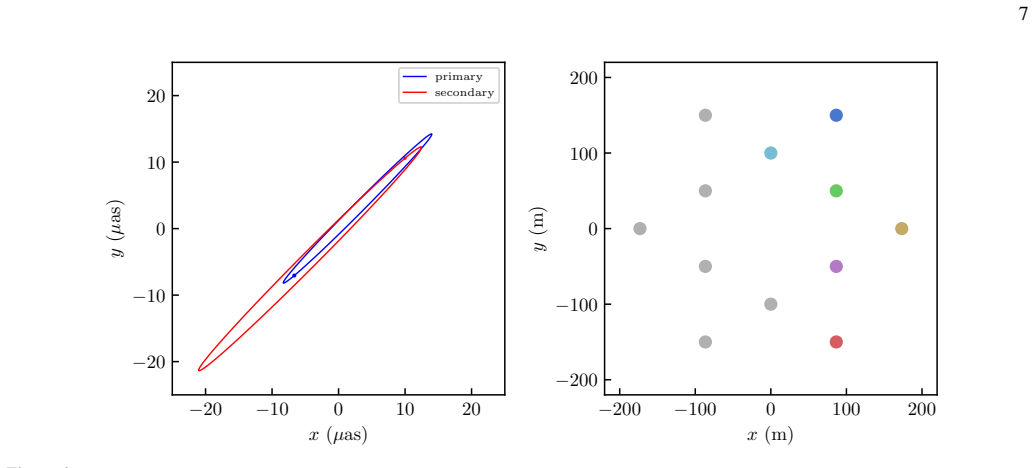
- [§3.1 and §4.3] The term "UV plane" (Fig. 2 right panel and §3.1) should be "u–v plane" to avoid confusion with ultraviolet; the same applies to the abstract and Fig. 2 caption.
- [§4.3] The word "bightest" should be "brightest" in the paragraph following Eq. (27).
- [§1] The name "Paczynski" should be written "Paczyński" throughout, including the reference list.
Circularity Check
No circularity: distance is a free parameter recovered from mock observables, and the unquantified model-mismatch systematics are an external-validity concern, not a circular step.
full rationale
The central claim is a parameter-recovery forecast. Mock SA, RV, and LC data are generated with a fixed input distance (50 kpc, Table 1) and then fitted with a likelihood in which D is a free parameter with a log-uniform prior; the posterior recovers the input within 1 sigma. D enters the forward model through Eq. 12 as the conversion from physical orbital scale a to angular separation, and the differential phase in Eq. 9 depends on that angular scale, while a is independently constrained by the RV equations (Eqs. 14-16). No equation fixes D to its input value, and no fitted parameter is renamed as a prediction. The use of the same parameterized model for simulation and likelihood is a closed-loop self-consistency test, not a derivation that assumes its conclusion. The paper explicitly acknowledges that real binaries violate the uniform-disk and Gaussian-line assumptions and states in Section 4.1 that systematic errors are outlined rather than accurately quantified; this is a limitation in external validity, and the proposed calibration against nearby binaries is a test, not a circular justification. The only self-citation (Wang et al. 2020) appears in background context and is not load-bearing. Therefore no circular step is identified.
Assumptions & free parameters
free parameters (6)
- Differential phase noise sigma_phi =
0.1 deg
- Spectral resolution R =
10,000
- Line flux noise sigma_ell =
1% per spectral channel
- Radial velocity noise sigma_v =
2 km/s
- Light curve noise sigma_c =
0.2%
- Fiducial binary parameters (a, e, i, q, ell, r1, r2) =
a=2 au, P=300 d, e=0.3, i=87.13 deg, q=1.5, ell=3, r1=0.1, r2=0.08
assumptions (5)
- standard math Binary orbits follow Kepler's equations with Thiele-Innes sky projection (Eqs. 10-15).
- domain assumption Stellar surfaces are uniform disks in both the mock data and the fitted model (Eq. 17), with eclipses computed from geometric overlap (Eqs. 20-21).
- domain assumption Absorption lines have Gaussian thermal profiles with rigid rotation (Eqs. 18-19) and the same profile model is used for generation and fitting.
- domain assumption All measurements are independent and Gaussian, with the product likelihood of Eq. 24.
- ad hoc to paper The fiducial model is exactly the true model for the simulated binaries (closed-loop recovery).
Cite this review
Pith. "Pith review of Geometrical Distances of Extragalactic Binaries through Spectroastrometry." pith.science (2026). https://pith.science/paper/37DU6GNH
@misc{pith2026241208889,
  author       = {Pith},
  title        = {Pith review of: Geometrical Distances of Extragalactic Binaries through Spectroastrometry},
  year         = {2026},
  howpublished = {\url{https://pith.science/paper/37DU6GNH}},
  note         = {Machine review of arXiv:2412.08889}
}
read the original abstract
The growing ``Hubble tension'' has prompted the need for precise measurements of cosmological distances. This paper demonstrates a purely geometric approach for determining the distance to extragalactic binaries through a joint analysis of spectroastrometry (SA), radial velocity (RV), and light curve (LC) observations. A parameterized model for the binary system is outlined, and simulated SA, RV, and LC data are computed to infer the probability distribution of model parameters based on the mock data. The impact of data quality and binary parameters on distance uncertainties is comprehensively analyzed, showcasing the method's potential for high-precision distance measurements. For a typical eclipsing binary in the Large Magellanic Cloud (LMC), the distance uncertainty is approximately 6% under reasonable observational conditions. Within a specific range of data quality and input parameters, the distance measurement precision of individual binary star systems is generally better than 10%. As a geometric method based on the simplest dynamics, it is independent of empirical calibration and the systematics caused by model selections can be tested using nearby binaries with known distances. By measuring multiple binary star systems or monitoring one binary system repeatedly, geometric distance measurements of nearby galaxies can be achieved, providing valuable insights into the Hubble tension and advancing our understanding of the universe's structure and evolution.
Figures


Figures from the paper (6 more)


Reference graph
Works this paper leans on
-
[1]
, " * write output.state after.block = add.period write newline
ENTRY address archivePrefix author booktitle chapter doi edition editor eprint howpublished institution journal key month number organization pages publisher school series title misctitle type volume year version url label extra.label sort.label short.list INTEGERS output.state before.all mid.sentence after.sentence after.block FUNCTION init.state.consts ...
-
[2]
write newline
" write newline "" before.all 'output.state := FUNCTION format.url url empty "" new.block "" url * "" * if FUNCTION format.eprint eprint empty "" archivePrefix empty "" archivePrefix "arXiv" = new.block " " eprint * " " * new.block " " eprint * " " * if if if FUNCTION format.doi doi empty "" " " doi * " " * if FUNCTION format.pid doi empty eprint empty ur...
-
[3]
V*Md yDCE vJ G( 9 NHPߞ* [bY pXzbO0y M3ж?O :/G
thebibliography [1] 20pt to REFERENCES 6pt =0pt -12pt 10pt plus 3pt =0pt =0pt =1pt plus 1pt =0pt =0pt -12pt =13pt plus 1pt =20pt =13pt plus 1pt \@M =10000 =-1.0em =0pt =0pt 0pt =0pt =1.0em @enumiv\@empty 10000 10000 `\.\@m \@noitemerr \@latex@warning Empty `thebibliography' environment \@ifnextchar \@reference \@latexerr Missing key on reference command E...
arXiv 2021
-
[4]
Brewer, B. J., Partay, L. B., & Csanyi, G. 2011, STATISTICS AND COMPUTING, 21, 649, 10.1007/s11222-010-9198-8
-
[5]
Campins , H., Rieke , G. H., & Lebofsky , M. J. 1985, , 90, 896, 10.1086/113799
-
[6]
2021, Classical and Quantum Gravity, 38, 153001, 10.1088/1361-6382/ac086d
Di Valentino , E., Mena , O., Pan , S., et al. 2021, Classical and Quantum Gravity, 38, 153001, 10.1088/1361-6382/ac086d
-
[7]
Duvert , G. 2016, VizieR Online Data Catalog: JMDC : JMMC Measured Stellar Diameters Catalogue (Duvert, 2016) , VizieR On-line Data Catalog: II/345. Originally published in: JMMC center (2016)
work page 2016
-
[8]
2007, , 476, 73, 10.1051/0004-6361:20078187
Fouqu \'e , P., Arriagada , P., Storm , J., et al. 2007, , 476, 73, 10.1051/0004-6361:20078187
Show all 45 references
- [9]
-
[10]
2010, , 48, 673, 10.1146/annurev-astro-082708-101829
---. 2010, , 48, 673, 10.1146/annurev-astro-082708-101829
2010 doi
-
[11]
Gaia Collaboration , Brown , A. G. A., Vallenari , A., et al. 2021, , 649, A1, 10.1051/0004-6361/202039657
2021 doi
-
[12]
2023, , 672, A119, 10.1051/0004-6361/202245712
Gallenne , A., M \'e rand , A., Kervella , P., et al. 2023, , 672, A119, 10.1051/0004-6361/202245712
2023 doi
-
[13]
2018, , 616, A68, 10.1051/0004-6361/201833341
Gallenne , A., Pietrzy \'n ski , G., Graczyk , D., et al. 2018, , 616, A68, 10.1051/0004-6361/201833341
2018 doi
-
[14]
B., et al
Graczyk , D., Pietrzy \'n ski , G., Thompson , I. B., et al. 2018, , 860, 1, 10.3847/1538-4357/aac2bf
2018 doi
-
[15]
2017, , 602, A94, 10.1051/0004-6361/201730838
GRAVITY Collaboration , Abuter , R., Accardo , M., et al. 2017, , 602, A94, 10.1051/0004-6361/201730838
2017 doi
-
[16]
2021, , 654, A85, 10.1051/0004-6361/202141426
GRAVITY Collaboration , Amorim , A., Baub \"o ck , M., et al. 2021, , 654, A85, 10.1051/0004-6361/202141426
2021 doi
-
[17]
2022, The Messenger, 189, 17, 10.18727/0722-6691/5285
Gravity+ Collaboration , Abuter , R., Alarcon , P., et al. 2022, The Messenger, 189, 17, 10.18727/0722-6691/5285
2022 doi
-
[18]
Heintz , W. D. 1978, Double stars (D. Reidel Publishing Company, Dordrecht, Holland), 31--35
1978
-
[19]
F., Watson , D., Kishimoto , M., & Hjorth , J
H \"o nig , S. F., Watson , D., Kishimoto , M., & Hjorth , J. 2014, , 515, 528, 10.1038/nature13914
2014 doi
-
[20]
O zdarcan , O., & C ak rl , \
Hoyman , B., Bulut , S., \"O zdarcan , O., & C ak rl , \"O . 2020, , 496, 550, 10.1093/mnras/staa1476
2020 doi
-
[21]
V., Pandey , S., Subramaniam , A., & Sagar , R
Jadhav , V. V., Pandey , S., Subramaniam , A., & Sagar , R. 2021, Journal of Astrophysics and Astronomy, 42, 89, 10.1007/s12036-021-09746-y
2021 doi
-
[22]
2023, , 669, A91, 10.1051/0004-6361/202244601
Jim \'e nez-Arranz , \'O ., Romero-G \'o mez , M., Luri , X., et al. 2023, , 669, A91, 10.1051/0004-6361/202244601
2023 doi
-
[23]
2003, , 400, 795, 10.1051/0004-6361:20030072
Lachaume , R. 2003, , 400, 795, 10.1051/0004-6361:20030072
2003 doi
-
[24]
2002, , 580, L171, 10.1086/345520
Mandel , K., & Agol , E. 2002, , 580, L171, 10.1086/345520
2002 doi
- [25]
-
[26]
2013, , 495, 76, 10.1038/nature11878
Pietrzy \'n ski , G., Graczyk , D., Gieren , W., et al. 2013, , 495, 76, 10.1038/nature11878
2013 doi
-
[27]
2019, , 567, 200, 10.1038/s41586-019-0999-4
Pietrzy \'n ski , G., Graczyk , D., Gallenne , A., et al. 2019, , 567, 200, 10.1038/s41586-019-0999-4
2019 doi
-
[28]
2020 a , , 641, A6, 10.1051/0004-6361/201833910
Planck Collaboration , Aghanim , N., Akrami , Y., et al. 2020 a , , 641, A6, 10.1051/0004-6361/201833910
2020 doi
-
[29]
2020 b , , 641, A1, 10.1051/0004-6361/201833880
---. 2020 b , , 641, A1, 10.1051/0004-6361/201833880
2020 doi
-
[30]
G., Meilland , A., & H \"o nig , S
Rakshit , S., Petrov , R. G., Meilland , A., & H \"o nig , S. F. 2015, , 447, 2420, 10.1093/mnras/stu2613
2015 doi
-
[31]
J., Pesce , D
Reid , M. J., Pesce , D. W., & Riess , A. G. 2019, , 886, L27, 10.3847/2041-8213/ab552d
2019 doi
-
[32]
2005, , 635, L37, 10.1086/499161
Ribas , I., Jordi , C., Vilardell , F., et al. 2005, , 635, L37, 10.1086/499161
2005 doi
-
[33]
G., Casertano , S., Yuan , W., et al
Riess , A. G., Casertano , S., Yuan , W., et al. 2021, , 908, L6, 10.3847/2041-8213/abdbaf
2021 doi
-
[34]
G., Yuan , W., Macri , L
Riess , A. G., Yuan , W., Macri , L. M., et al. 2022, , 934, L7, 10.3847/2041-8213/ac5c5b
2022 doi
-
[35]
2004, , 608, 42, 10.1086/386540
Sakai , S., Ferrarese , L., Kennicutt , Robert C., J., & Saha , A. 2004, , 608, 42, 10.1086/386540
2004 doi
-
[36]
2022, , 662, A120, 10.1051/0004-6361/202142133
Salsi , A., Nardetto , N., Plez , B., & Mourard , D. 2022, , 662, A120, 10.1051/0004-6361/202142133
2022 doi
-
[37]
M., Hines , B
Shao , M., Colavita , M. M., Hines , B. E., et al. 1988, , 193, 357
1988
-
[38]
2017, , 55, 213, 10.1146/annurev-astro-082214-122339
Sharma , S. 2017, , 55, 213, 10.1146/annurev-astro-082214-122339
2017 doi
-
[39]
F., Cutri , R
Skrutskie , M. F., Cutri , R. M., Stiening , R., et al. 2006, , 131, 1163, 10.1086/498708
2006 doi
-
[40]
2019, , 886, 111, 10.3847/1538-4357/ab4b57
Taormina , M., Pietrzy \'n ski , G., Pilecki , B., et al. 2019, , 886, 111, 10.3847/1538-4357/ab4b57
2019 doi
-
[41]
A., Frinchaboy , P
Thompson , B. A., Frinchaboy , P. M., Spoo , T., & Donor , J. 2021, , 161, 160, 10.3847/1538-3881/abde4c
2021 doi
- [42]
-
[43]
L., & Guinan , E
Vilardell , F., Ribas , I., Jordi , C., Fitzpatrick , E. L., & Guinan , E. F. 2010, , 509, A70, 10.1051/0004-6361/200913299
2010 doi
-
[44]
2017, , 844, 72, 10.3847/1538-4357/aa79f1
Waisberg , I., Dexter , J., Pfuhl , O., et al. 2017, , 844, 72, 10.3847/1538-4357/aa79f1
2017 doi
-
[45]
2020, Nature Astronomy, 4, 517, 10.1038/s41550-019-0979-5
Wang , J.-M., Songsheng , Y.-Y., Li , Y.-R., Du , P., & Zhang , Z.-X. 2020, Nature Astronomy, 4, 517, 10.1038/s41550-019-0979-5
2020 doi
Reviewed August 11, 2026 · model on record in the stance chip above.
Discussion (0). Continue with ORCID to comment.