REVIEW 3 major objections 6 minor 1 cited by
Two-Stage Distributionally Robust Optimization: Intuitive Understanding and Algorithm Development from the Primal Perspective
T0 review · 3 major / 6 minor · reviewed 2026-08-10 · deepseek-v4-flash
Pith's one-line read The paper argues that two-stage distributionally robust optimization can be solved exactly from the primal side by embedding a column-generation oracle for the worst-case expected value inside a column-and-constraint generation loop.
desk verdict The primal-perspective algorithm is genuinely fresh and the numerics are impressive, but the theoretical convergence guarantee is not proven for the paper's own test instances. read the letter →
The pith
A machine-rendered reading of the paper's core claim, the machinery that carries it, and where it could break.
The reading
What carries the argument
The load-bearing object is the worst-case expected value (WCEV) oracle built from two coupled problems. The pricing master problem (PMP) is a small LP that maximizes expected recourse cost over probabilities on a finite scenario set; the pricing subproblem (PSP) maximizes the reduced cost $f(\xi) - \alpha - \sum_i \psi_i(\xi)\beta_i$ over the support. Adding the optimal PSP scenario is exactly column generation for an infinite LP, and Proposition 7 bounds the gap between the PMP value and the true WCEV by the PSP value. The paper wraps this oracle in C&CG with a main master problem (MMP) that carries both optimality cuts and feasibility cuts, using artificial slack variables to certify feasibility. The same oracle, with a second expected-value computation WCEV(F), detects whether a first-stage solution leaves some scenario with positive worst-case probability infeasible.
What would settle it
Run Oracle-2 on a compact-support instance with one or two moment constraints and record the scenarios produced by PSP in successive iterations. If two generated scenarios ever fall closer than the packing radius claimed in Theorem 9 while the master objective has not reached the WCEV, or if the scenario sequence accumulates without termination, the finite-iteration conclusion is false. A direct construction would use a recourse value function that is continuous for each fixed $\beta$ but not equicontinuous as $\beta$ grows, e.g., $f(\xi)=\xi^2$ on $[0,1]$ with an unbounded dual multiplier.
Extended reading notes
Core claim
The paper's central claim is that the two-stage DRO value can be computed exactly by a primal decomposition: the worst-case expected recourse cost over ambiguity sets of the form (3) is the limit of a column-generation procedure in which a pricing master problem assigns probabilities to a growing scenario pool and a pricing subproblem finds the scenario with largest reduced cost. Because the extreme optimal distributions have at most $A+1$ support points, the procedure terminates or reaches $\varepsilon$-optimality finitely; when the reduced-cost family is uniformly continuous in the scenario variable, the number of iterations is bounded by a volume-ratio packing argument. Wrapped in C&CG, this yields finite termination for the full two-stage problem, with an explicit feasibility oracle that certifies almost-sure recourse feasibility and a variant for mixed-integer ambiguity sets. The paper supports the method with convergence and iteration-complexity theorems and with facility-location experiments where the new algorithm solves previously intractable instances.
Load-bearing premise
The finite-termination guarantee (Theorem 9) hinges on the reduced-cost function being uniformly continuous in the scenario whenever the dual multipliers are nonnegative; those multipliers are not shown to be bounded for moment-based ambiguity sets, so the packing argument that caps the number of oracle iterations may fail there.
Editorial extensions
If this is right
- For ambiguity sets covered by (3)—moment, Wasserstein, and piecewise-linear $\phi$-divergence sets—C&CG-DRO terminates finitely at an optimal or $\varepsilon$-optimal solution under the stated uniform-continuity condition.
- The method supplies a general treatment of recourse infeasibility in two-stage DRO: it returns almost-surely feasible first-stage decisions or certifies infeasibility, instead of assuming every scenario is always feasible.
- Non-convex ambiguity sets, represented as mixed-integer sets, become solvable through the mixed-integer oracle variant, a class no duality-based method handles.
- When the recourse problem is linear and the support is a polytope, the algorithm converges exactly within the number of extreme points of the support (Proposition 18).
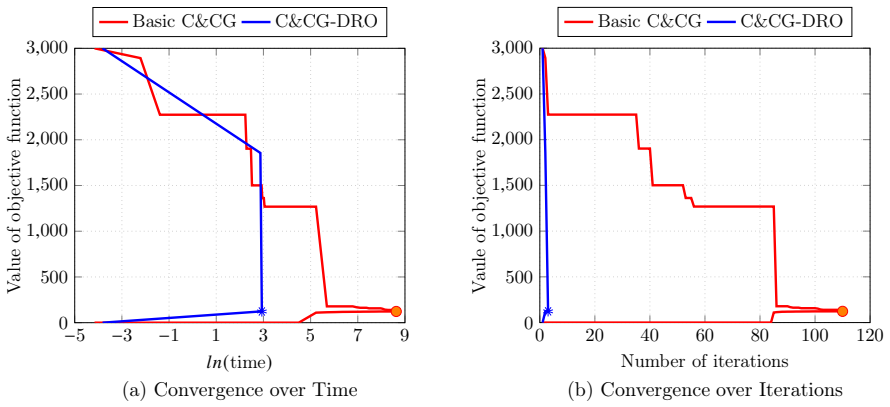
- On the tested facility-location instances, C&CG-DRO solves problems one to several orders of magnitude faster than basic C&CG and Benders, and solves instances those methods cannot finish within the time limit.
Reading between the lines
- Beyond the paper: the warm-started scenario sets used in the default implementation mean the oracle's column pool persists across C&CG iterations; proving a bound on the total number of pricing calls could yield sharper complexity statements than the current per-iteration bounds.
- Beyond the paper: if a uniform bound on the dual multipliers $\beta$ can be established for a given ambiguity set, the equicontinuity assumption would follow automatically for many recourse functions; the paper leaves such boundedness unproven for moment sets.
- Beyond the paper: the same primal oracle could be adapted to other risk functionals, such as conditional value-at-risk, by replacing the expectation in the ambiguity-set constraints; the authors list risk-measure extensions only as future work.
- Beyond the paper: for Wasserstein ambiguity sets with many empirical samples, the PSP decomposes per sample and can be solved in parallel; the paper notes this structure but does not report parallel scaling experiments.
Editorial analysis
A structured set of objections, weighed in public.
Referee Report
Summary. The paper develops a primal-perspective method for two-stage distributionally robust optimization. It represents the worst-case expected value (WCEV) over a general moment-type ambiguity set as an infinite linear program, proposes a column-generation oracle (Oracle-2) and a finite nonlinear program (Oracle-1), and embeds the oracle in a C&CG master/subproblem framework (C&CG-DRO) that also handles almost-sure recourse feasibility. The authors prove lower-bound dominance over basic C&CG, claim finite termination and iteration bounds, extend the scheme to Wasserstein and mixed-integer ambiguity sets, and report large speedups on distributionally robust facility location instances.
Significance. The paper is potentially significant: the primal oracle is transparent, it addresses recourse infeasibility and nonconvex ambiguity sets that dual-based methods exclude, and the experiments show consistent, often order-of-magnitude, speedups over the C&CG/Benders baselines on a standard testbed. The conceptual contribution—decoupling scenario generation from the master and using the WCEV oracle as a scenario-pool generator—is a useful addition. However, the central finite-termination theorem is conditioned on an equicontinuity assumption that is not verified for the moment ambiguity sets used in the experiments, so the theoretical contribution is currently conditional. The numerical findings are extensive, but the manuscript is not self-contained because the referenced appendices are missing.
major comments (3)
- [§3.3, Theorem 9; §4.3, Theorem 15; Remark 5(ii)] The hypothesis of Theorem 9—that the reduced cost F(ξ;α,β)=f(ξ)−α−Σ_i ψ_i(ξ)β_i is continuous uniformly in ξ over Ξ for all β≥0—is not a mild extension of continuity of ψ_i; it fails for the moment ambiguity set in Eq. (40). For ψ_1(ξ)=ξ_1 and f≡0, F=−α−β·ξ, and |F(δe_1)−F(0)|=β_1δ, so any prescribed δ can be defeated by choosing β_1 large enough. In the facility-location recourse, f is Lipschitz, but the Lipschitz constant of F grows with ||β||_1, and no uniform bound on β from the pricing master problem is proved. Hence the packing argument in Theorem 9 has no available δ, and Theorem 15, which is stated under the same assumption, does not follow for the general case. I note that Corollary 10 and Proposition 18 give finite termination for the convex-f/linear-ψ polytope case that includes the moment-based experiments, but the manuscript does not restrict Theorem 15 to that case, and Remark 5(ii)'s assertion that continuity of ψ_i suffices is incorrect. The authors should prove boundedness of β under their assumptions, add verifiable equicontinuity conditions, or restate the convergence claims with the convex/linear restrictions made explicit.
- [Appendices A.1/A.2 (referenced in §3.1 and §4.1.2)] The manuscript cites Appendix A.1 for the proof of Theorem 1 and Appendix A.2 for the dual reformulation of MMP (Eq. (21)), for solving the bilevel formulations (22) and (23), and for the bilevel pricing subproblem PSP_M in Section 5.2. None of these appendices appears in the arXiv:2412.20708v1 text. Since Oracle-2's Step 3 requires solving PSP(O) exactly, the algorithmic description is incomplete without that material. Please include the appendices or move the required derivations into the main text.
- [§5.2, Remark 14(i)] For the mixed-integer ambiguity set P_M, the paper states that convergence and iteration-complexity analyses 'can be developed in a way similar' to Sections 3.3 and 4.3, but no such analysis is provided. Section 6.5 reports numerical results for P_u^{M,I} and claims to handle new types of instances, so the absence of a convergence statement for C&CG-DRO(P_M) should be either filled or explicitly identified as an open theoretical question; otherwise the claim to have addressed the mixed-integer ambiguity-set issue overreaches.
minor comments (6)
- [Theorem 3 proof] The proof contains garbled symbol fragments (e.g., '/u1D443/u\i∈∞A6.e\dl→' and similar strings) that should be cleaned up before publication.
- [Figure 3 caption] The caption says 'FL − DRO(u) with P^M_d', but the surrounding text and Table 2 concern FL-DRO(d) with the moment ambiguity set P^M_d; the caption does not match the content.
- [Table 2] In the Benders-DRO average row for |C|=15, the reported average gap is 34% while some individual rows are timeouts with gaps of 68% and 100%; clarify whether the average includes timed-out instances and how those gaps are computed.
- [Notation] The symbol \hat ξ is used both for the union \hat ξ_C∪\hat ξ_F and as a generic scenario subset, and \hat Z_F, \hat Z_C are introduced only in Section 5.2; a notation table would help the reader.
- [Section 6.2] The empirical distributions for the Wasserstein experiments are described only by sample size; specify how the samples were drawn (seeds, distributional assumptions) to make the numerical study reproducible.
- [References] Reference [30] lacks a year and complete bibliographic details; complete this entry.
Circularity Check
No significant circularity: the derivation chain is self-contained and the central results are proved from stated assumptions rather than assumed into existence.
full rationale
The paper's claimed derivation chain does not, at any load-bearing point, define an output quantity in terms of the quantity it purports to predict. The WCEV oracle is a column-generation algorithm whose finite-termination theorem (Theorem 9) posits a uniform-continuity condition on the reduced cost and then proves a packing bound; the assumption does not encode convergence or the WCEV value itself. Likewise, the C&CG-DRO master--subproblem framework in Section 4 is supported by independent arguments (Propositions 13--14 and Theorem 15), and Proposition 7 is a genuine duality bound rather than a tautology. The self-citations [22, 34, 36] supply the C&CG and bilevel-decomposition scaffolding, but the decisive equivalences and convergence proofs are either given in the paper or rest on external results such as Shapiro's duality theory and the Richter--Rogosinski theorem. The numerical claims are benchmarked against independent solver-based implementations of basic C&CG and Benders methods, not against the paper's own fitted values or renamed outputs. The skeptic's concern about Theorem 9 -- that uniform continuity over all beta >= 0 may fail for moment ambiguity sets with unbounded dual variables -- is a correctness and assumption gap, not a circular reduction, because it questions whether a hypothesis is satisfied rather than showing that a conclusion is identical to an input by construction. Under the hard rule requiring an exhibited reduction (Eq. X = Eq. Y by construction, or a fitted parameter renamed as a prediction), no circular step can be identified.
Assumptions & free parameters
free parameters (1)
- Big-M coefficient in MMP1 =
sufficiently large (unspecified)
assumptions (10)
- domain assumption Support Xi is a closed and bounded set (Assumption 1(i)).
- domain assumption The recourse value f(x,xi) > -inf for all x in X and xi in Xi (Assumption 1(ii)).
- domain assumption f is upper semicontinuous and psi_i are lower semicontinuous (Theorem 3).
- domain assumption f is upper semicontinuous and psi_i are continuous (Proposition 5).
- ad hoc to paper Reduced cost function f(xi) - alpha - sum psi_i(xi) beta_i is uniformly continuous in xi over Xi for all beta >= 0 (Theorem 9).
- domain assumption P has an interior point and the value function r(t) is continuous at t=0 (Theorem 3).
- standard math Strong duality for the infinite-column linear program (4) (from Shapiro [20]).
- standard math Richter-Rogosinski theorem: a linear program with A+1 moment constraints has an optimal distribution supported on at most A+1 points (Proposition 5).
- standard math Portmanteau theorem and Weierstrass theorem (Theorem 3 proof).
- domain assumption For the feasibility result in Theorem 15, Xi is a polytope, tilde f_F is convex, f is uniformly continuous on the feasible sample space, and psi_i are concave.
Cite this review
Pith. "Pith review of Two-Stage Distributionally Robust Optimization: Intuitive Understanding and Algorithm Development from the Primal Perspective." pith.science (2026). https://pith.science/paper/3A3UENZ2
@misc{pith2026241220708,
  author       = {Pith},
  title        = {Pith review of: Two-Stage Distributionally Robust Optimization: Intuitive Understanding and Algorithm Development from the Primal Perspective},
  year         = {2026},
  howpublished = {\url{https://pith.science/paper/3A3UENZ2}},
  note         = {Machine review of arXiv:2412.20708}
}
read the original abstract
In this paper, we study the two-stage distributionally robust optimization (DRO) problem from the primal perspective. Unlike existing approaches, this perspective allows us to build a deeper and more intuitive understanding on DRO, to leverage classical and well-established solution methods and to develop a general and fast decomposition algorithm (and its variants), and to address a couple of unsolved issues that are critical for modeling and computation. Theoretical analyses regarding the strength, convergence, and iteration complexity of the developed algorithm are also presented. A numerical study on different types of instances of the distributionally robust facility location problem demonstrates that the proposed solution algorithm (and its variants) significantly outperforms existing methods. It solves instances up to several orders of magnitude faster, and successfully addresses new types of practical instances that previously could not be handled. We believe these results will significantly enhance the accessibility of DRO, break down barriers, and unleash its potential to solve real world challenges.
Figures


Figures from the paper (1 more)

Forward citations
Cited by 1 Pith paper
-
Distributionally Robust Planning of Hydrogen-Electrical Microgrids for Sea Islands
A two-stage distributionally robust optimization model for hydrogen-electrical sea-island microgrid planning with decision-dependent uncertainty, solved by a customized C&CG algorithm that handles missing complete recourse.
Reference graph
Works this paper leans on
-
[1]
A min max solution of an inventory problem
Herbert Scarf. A min max solution of an inventory problem . Studies in the Mathematical Theory of Inventory and Production , 1958
work page 1958
-
[2]
Frameworks and resu lts in distributionally robust optimization
Hamed Rahimian and Sanjay Mehrotra. Frameworks and resu lts in distributionally robust optimization. Open Journal of Mathematical Optimization , 3:1–85, 2022
work page 2022
-
[3]
Erick Delage and Yinyu Ye. Distributionally robust opti mization under moment uncer- tainty with application to data-driven problems. Operations Research, 58(3):595–612, 2010
work page 2010
-
[4]
Distrib utionally robust convex optimization
Wolfram Wiesemann, Daniel Kuhn, and Melvyn Sim. Distrib utionally robust convex optimization. Operations Research, 62(6):1358–1376, 2014
work page 2014
-
[5]
Robust solutions of optimization problems affected by uncertain probabilities
Aharon Ben-Tal, Dick Den Hertog, Anja De Waegenaere, Ber trand Melenberg, and Gijs Rennen. Robust solutions of optimization problems affected by uncertain probabilities. Management Science, 59(2):341–357, 2013
work page 2013
-
[6]
Henry Lam. Recovering best statistical guarantees via t he empirical divergence-based distributionally robust optimization. Operations Research, 67(4):1090–1105, 2019
work page 2019
-
[7]
Distributionally robust sto chastic optimization with wasserstein distance
Rui Gao and Anton Kleywegt. Distributionally robust sto chastic optimization with wasserstein distance. Mathematics of Operations Research , 48(2):603–655, 2023
work page 2023
-
[8]
Peyman Mohajerin Esfahani and Daniel Kuhn. Data-driven distributionally robust optimization using the wasserstein metric: Performance gu arantees and tractable re- formulations. Mathematical Programming, 171(1):115–166, 2018
work page 2018
Show all 37 references
-
[9]
Data-driven risk-averse stochastic optimization with wasserstein metric
Chaoyue Zhao and Yongpei Guan. Data-driven risk-averse stochastic optimization with wasserstein metric. Operations Research Letters, 46(2):262–267, 2018
2018
-
[10]
Ad- justable robust solutions of uncertain linear programs
Aharon Ben-Tal, Alexander Goryashko, Elana Guslitzer , and Arkadi Nemirovski. Ad- justable robust solutions of uncertain linear programs. Mathematical programming, 99(2):351–376, 2004. 49
2004
-
[11]
Models for minimax stochastic linear optimization problems with r isk aversion
Dimitris Bertsimas, Xuan Vinh Doan, Karthik Natarajan , and Chung-Piaw Teo. Models for minimax stochastic linear optimization problems with r isk aversion. Mathematics of Operations Research, 35(3):580–602, 2010
2010
-
[12]
Conic programming reformulations of two- stage distributionally robust linear programs over wasser stein balls
Grani A Hanasusanto and Daniel Kuhn. Conic programming reformulations of two- stage distributionally robust linear programs over wasser stein balls. Operations Re- search, 66(3):849–869, 2018
2018
-
[13]
Tractable reformulations of two-stage dis tributionally robust linear pro- grams over the type- ∞ wasserstein ball
Weijun Xie. Tractable reformulations of two-stage dis tributionally robust linear pro- grams over the type- ∞ wasserstein ball. Operations Research Letters , 48(4):513–523, 2020
2020
-
[14]
R esilient transmission hard- ening planning in a high renewable penetration era
Ali Bagheri, Chaoyue Zhao, Feng Qiu, and Jianhui Wang. R esilient transmission hard- ening planning in a high renewable penetration era. IEEE Transactions on Power Systems, 34(2):873–882, 2018
2018
-
[15]
De composition algorithms for two-stage distributionally robust mixed binary programs
Manish Bansal, Kuo-Ling Huang, and Sanjay Mehrotra. De composition algorithms for two-stage distributionally robust mixed binary programs. SIAM Journal on Optimiza- tion, 28(3):2360–2383, 2018
2018
-
[16]
Data-driven distribution ally robust capacitated facility location problem
Ahmed Saif and Erick Delage. Data-driven distribution ally robust capacitated facility location problem. European Journal of Operational Research , 291(3):995–1007, 2021
2021
-
[17]
Decomposition methods for wasserstein-based dat a-driven distributionally robust problems
Carlos Andrés Gamboa, Davi Michel Valladão, Alexandre Street, and Tito Homem- de Mello. Decomposition methods for wasserstein-based dat a-driven distributionally robust problems. Operations Research Letters, 49(5):696–702, 2021
2021
-
[18]
Stochastic de composition method for two-stage distributionally robust linear optimization
Harsha Gangammanavar and Manish Bansal. Stochastic de composition method for two-stage distributionally robust linear optimization. SIAM Journal on Optimization , 32(3):1901–1930, 2022
1901
-
[19]
Dist ributionally robust two- stage stochastic programming
Daniel Duque, Sanjay Mehrotra, and David P Morton. Dist ributionally robust two- stage stochastic programming. SIAM Journal on Optimization , 32(3):1499–1522, 2022
2022
-
[20]
On Duality Theory of Conic Linear Problems , pages 135–165
Alexander Shapiro. On Duality Theory of Conic Linear Problems , pages 135–165. Springer US, Boston, MA, 2001
2001
-
[21]
Quantifying distri butional model risk via optimal transport
Jose Blanchet and Karthyek Murthy. Quantifying distri butional model risk via optimal transport. Mathematics of Operations Research , 44(2):565–600, 2019
2019
-
[22]
Solving two-stage robust optimiz ation problems using a column-and-constraint generation method
Bo Zeng and Long Zhao. Solving two-stage robust optimiz ation problems using a column-and-constraint generation method. Operations Research Letters, 41(5):457–461, 2013. 50
2013
-
[23]
A decomposition meth od for distributionally- robust two-stage stochastic mixed-integer conic programs
Fengqiao Luo and Sanjay Mehrotra. A decomposition meth od for distributionally- robust two-stage stochastic mixed-integer conic programs . Mathematical Programming, 196(1):673–717, 2022
2022
-
[24]
Distributionally robust disaster relief planning under the wasserstein set
Mohamed El Tonbari, George Nemhauser, and Alejandro To riello. Distributionally robust disaster relief planning under the wasserstein set. Computers & Operations Research, page 106689, 2024
2024
-
[25]
Supermodula rity in two-stage distribu- tionally robust optimization
Daniel Zhuoyu Long, Jin Qi, and Aiqi Zhang. Supermodula rity in two-stage distribu- tionally robust optimization. Management Science, 70(3):1394–1409, 2024
2024
-
[26]
Risk-averse two-stage s tochastic program with dis- tributional ambiguity
Ruiwei Jiang and Yongpei Guan. Risk-averse two-stage s tochastic program with dis- tributional ambiguity. Operations Research, 66(5):1390–1405, 2018
2018
-
[27]
Adap tive distributionally robust optimization
Dimitris Bertsimas, Melvyn Sim, and Meilin Zhang. Adap tive distributionally robust optimization. Management Science, 65(2):604–618, 2019
2019
-
[28]
On the optimality of affine decision rules in robust and distributionally robus t optimization
Angelos Georghiou, Angelos Tsoukalas, and Wolfram Wie semann. On the optimality of affine decision rules in robust and distributionally robus t optimization. Available at Optimization Online , 2021
2021
-
[29]
A simple and gen eral duality proof for wasserstein distributionally robust optimization
Luhao Zhang, Jincheng Yang, and Rui Gao. A simple and gen eral duality proof for wasserstein distributionally robust optimization. arXiv preprint arXiv:2205.00362 , 2022
2022 arXiv
-
[30]
Kantorovic and V.A
L.V. Kantorovic and V.A. Zalgaller. Rational cutting of industrial materials
-
[31]
A sugge sted computation for max- imal multi-commodity network flows
Lester Randolph Ford Jr and Delbert R Fulkerson. A sugge sted computation for max- imal multi-commodity network flows. Management Science , 5(1):97–101, 1958
1958
-
[32]
Decomposition princ iple for linear programs
George B Dantzig and Philip Wolfe. Decomposition princ iple for linear programs. Operations research, 8(1):101–111, 1960
1960
-
[33]
A linear programming a pproach to the cutting stock problem
Paul C Gilmore and Ralph E Gomory. A linear programming a pproach to the cutting stock problem. Operations research, 9(6):849–859, 1961
1961
-
[34]
Two-stage robust optimization wit h decision dependent un- certainty
Bo Zeng and Wei Wang. Two-stage robust optimization wit h decision dependent un- certainty. arXiv preprint arXiv:2203.16484 , 2022
2022 arXiv
-
[35]
Branch-and-price: Column generation fo r solving huge integer programs
Cynthia Barnhart, Ellis L Johnson, George L Nemhauser, Martin WP Savelsbergh, and Pamela H Vance. Branch-and-price: Column generation fo r solving huge integer programs. Operations research, 46(3):316–329, 1998
1998
-
[36]
Solving bilevel mixed integer program by reformulations and decomposition
Bo Zeng and Yu An. Solving bilevel mixed integer program by reformulations and decomposition. Optimization online , pages 1–34, 2014. 51
2014
-
[37]
Reliability models for facility location: the expected failure cost case
Lawrence V Snyder and Mark S Daskin. Reliability models for facility location: the expected failure cost case. Transportation science, 39(3):400–416, 2005. Oracle-2 Oracle-2 /u1D43F/u1D435= −∞,/u1D448/u1D435= +∞,/u1D461= 1, and ˆξ = ˆξ/u1D45C= ˆξ/u1D453= ∅ Solve MMP Is MMP fea...
2005
Reviewed August 10, 2026 · model on record in the stance chip above.
Discussion (0). Continue with ORCID to comment.