Measure Once, Model Everywhere: Model-Based Per-Request Resource Consumption for HTTP
Pith reviewed 2026-07-04 00:48 UTC · model grok-4.3
The pith
Models from offline benchmarks estimate per-request energy and CO2e for HTTP endpoints at runtime.
A machine-rendered reading of the paper's core claim, the machinery that carries it, and where it could break.
Core claim
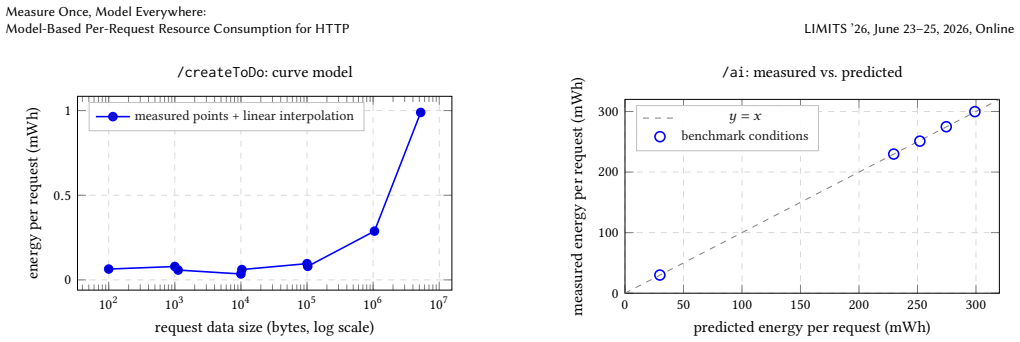
We present a model-based approach for estimating resource consumption and CO2e per HTTP request without requiring fine-grained production power telemetry. The approach benchmarks endpoints offline under controlled conditions, derives compact endpoint-specific energy models from observable request features, and evaluates these models online at the HTTP server boundary. We show that heterogeneous request classes can be represented with constant, linear, and piecewise models, and that the same approach extends to endpoints whose dominant cost driver is only visible at the application layer through inputs such as token counts. Our evaluation indicates that the approach is operationally feasible
What carries the argument
Endpoint-specific energy models (constant, linear, or piecewise) built from offline benchmarks of request features, stored in a JSON registry, and evaluated at the nginx server boundary to produce energy, grid intensity, embodied emissions, and total impact metadata.
If this is right
- Heterogeneous request classes can be represented with constant, linear, and piecewise models derived from request features.
- The modeling approach extends to endpoints where the dominant cost driver appears only at the application layer, such as through token counts.
- An nginx extension can load the JSON model registry and emit per-request metadata for energy, grid intensity, embodied emissions, and total impact.
- The method remains operationally feasible while introducing only low runtime overhead.
Where Pith is reading between the lines
- Services could attach these per-request estimates to HTTP response headers to meet emerging sustainability disclosure requirements without new hardware.
- Models would likely require periodic re-benchmarking after hardware upgrades or major software changes to maintain accuracy.
- The same offline-to-online pattern could apply to other measurable resources such as memory bandwidth or network bytes beyond energy.
- Request-level granularity might allow finer carbon accounting for multi-tenant or serverless deployments.
Load-bearing premise
Resource consumption measured in controlled offline benchmarks will produce models that accurately predict consumption for the same request features when deployed in production environments with varying loads and hardware.
What would settle it
Compare model predictions against direct power measurements collected on a production server under varying load for the same request feature values; systematic large errors would show the models do not transfer.
Figures
read the original abstract
Recent proposals for HTTP-based sustainability disclosure focus on \textbf{what} environmental information should be transmitted at the protocol boundary, for example through response headers, but leave open the practical question of \textbf{how} such per-request values can be generated in realistic deployments. This paper addresses that implementation gap. We present a model-based approach for estimating resource consumption and $CO_2e$ per HTTP request without requiring fine-grained production power telemetry. The approach benchmarks endpoints offline under controlled conditions, derives compact endpoint-specific energy models from observable request features, and evaluates these models online at the HTTP server boundary. We implement this mechanism as an nginx extension that loads a JSON model registry and emits per-request metadata for energy, grid intensity, embodied emissions, and total request-level impact. We show that heterogeneous request classes can be represented with constant, linear, and piecewise models, and that the same approach extends to endpoints whose dominant cost driver is only visible at the application layer through inputs such as token counts. Our evaluation indicates that the approach is operationally feasible and introduces only low runtime overhead.
Editorial analysis
A structured set of objections, weighed in public.
Referee Report
Summary. The paper claims to address the implementation gap in HTTP-based sustainability disclosure by presenting a model-based approach for estimating per-request resource consumption and CO2e. Endpoints are benchmarked offline under controlled conditions to derive compact endpoint-specific energy models (constant, linear, and piecewise) from observable request features, including application-layer inputs such as token counts. These models are then evaluated online at the HTTP server boundary using an nginx extension that loads a JSON model registry and emits per-request metadata for energy, grid intensity, embodied emissions, and total impact. The authors state that heterogeneous request classes can be represented with these models and that the approach is operationally feasible with low runtime overhead.
Significance. If the offline-derived models prove accurate in production environments, this approach could enable practical, low-overhead per-request environmental impact disclosure at the protocol level without requiring continuous power telemetry in production. This directly tackles a key practical barrier in recent sustainability proposals for HTTP.
major comments (2)
- [Abstract] The statement that 'our evaluation indicates that the approach is operationally feasible and introduces only low runtime overhead' is not supported by any quantitative data, error metrics, model equations, or details on benchmark conditions in the provided abstract. This absence undermines assessment of the central feasibility claim.
- [Evaluation] There is no reported direct validation of the models' prediction accuracy against ground-truth measurements under production variability, such as concurrent load, hardware differences, thermal throttling, or background processes. This is critical because offline benchmark models may not transfer to production, which is load-bearing for the sustainability disclosure use case.
minor comments (1)
- The abstract mentions 'piecewise models' but does not specify the breakpoints or how they are determined from the data.
Simulated Author's Rebuttal
We thank the referee for their constructive comments on our manuscript. We address each of the major comments point by point below, indicating where revisions will be made.
read point-by-point responses
-
Referee: [Abstract] The statement that 'our evaluation indicates that the approach is operationally feasible and introduces only low runtime overhead' is not supported by any quantitative data, error metrics, model equations, or details on benchmark conditions in the provided abstract. This absence undermines assessment of the central feasibility claim.
Authors: We agree that the abstract lacks quantitative support for the feasibility claim. We will revise the abstract to include key quantitative findings from the evaluation, such as the reported runtime overhead and any error metrics or benchmark details, to substantiate the statement. revision: yes
-
Referee: [Evaluation] There is no reported direct validation of the models' prediction accuracy against ground-truth measurements under production variability, such as concurrent load, hardware differences, thermal throttling, or background processes. This is critical because offline benchmark models may not transfer to production, which is load-bearing for the sustainability disclosure use case.
Authors: We acknowledge the absence of production-environment validation in the current manuscript. Our evaluation focuses on controlled offline benchmarking to derive and test the models, demonstrating low overhead in the implementation. We will add a dedicated limitations paragraph in the revised manuscript to discuss the potential effects of production variability and the need for further validation studies. This addresses the concern without overclaiming the current results. revision: partial
Circularity Check
No circularity: explicit fitting to benchmarks is the stated method, not a hidden reduction
full rationale
The paper's core mechanism is to run controlled offline benchmarks on endpoints, fit compact constant/linear/piecewise models to observable request features (including application-layer inputs such as token counts), and then evaluate the resulting models at runtime inside an nginx extension. This fitting step is presented as the intended engineering process rather than a derivation that reduces to its own inputs by construction. No self-citation load-bearing steps, uniqueness theorems, or ansatzes imported from prior author work appear in the provided text; the evaluation of runtime overhead is reported separately from the model construction. The central claim therefore remains self-contained against external benchmarks and does not collapse into any of the enumerated circularity patterns.
Axiom & Free-Parameter Ledger
free parameters (1)
- endpoint-specific model coefficients
axioms (2)
- domain assumption Resource consumption of an endpoint can be adequately captured by a function of observable request features
- domain assumption Offline controlled benchmarks produce models representative of production behavior
Reference graph
Works this paper leans on
-
[1]
2023.Insolvent: How to Reorient Computing for Just Sustain- ability
Christoph Becker. 2023.Insolvent: How to Reorient Computing for Just Sustain- ability. MIT Press
work page 2023
-
[2]
2026.The Sustainability HTTP Response Header Field
Andrei Nicolae Besleaga. 2026.The Sustainability HTTP Response Header Field. Internet-Draft draft-besleaga-green-sustainability-header-00. Internet Engineer- ing Task Force. https://datatracker.ietf .org/doc/draft-besleaga- green- sustainability-header/00/ Work in Progress
work page 2026
-
[3]
Francisco Caravaca, Ángel Cuevas, and Rubén Cuevas. 2025. From Prompts to Power: Measuring the Energy Footprint of LLM Inference.arXiv preprint arXiv:2511.05597(2025). doi:10.48550/arXiv.2511.05597
-
[4]
Kris De Decker. 2018. How to build a low-tech website? Low-tech Magazine. https://solar.lowtechmagazine.com/2018/09/how-to-build-a-low-tech-website/ Accessed 2026-05-25
work page 2018
-
[5]
Radosvet Desislavov, Fernando Martínez-Plumed, and José Hernández-Orallo
-
[6]
doi:10.1016/j.suscom.2023.100857
Trends in AI inference energy consumption: Beyond the performance-vs- parameter laws of deep learning.Sustainable Computing: Informatics and Systems 38 (2023), 100857. doi:10.1016/j.suscom.2023.100857
-
[7]
Electricity Maps. [n. d.]. Electricity Maps: Live and historical electricity carbon intensity by region. Online service. https://www.electricitymaps.com/ Accessed 2026-05-25
work page 2026
-
[8]
Green Coding Solutions. 2026. Best Practices – Green Metrics Tool Documenta- tion. Online documentation. https://docs.green-coding.io/docs/measuring/best- practices/ Accessed 2026-04-01
work page 2026
-
[9]
Green Software Foundation Standards Working Group. 2024. Software Carbon Intensity (SCI) Specification. Specification. https://sci.greensoftware.foundation/ Version 1.1.0; accessed 2026-04-01
work page 2024
-
[10]
Fernando, Markus Funke, Jens Gröger, Lorenz M
Achim Guldner, Rabea Bender, Coral Calero, Giovanni S. Fernando, Markus Funke, Jens Gröger, Lorenz M. Hilty, Julian Hörnschemeyer, Geerd-Dietger Hoffmann, Dennis Junger, Tom Kennes, Sandro Kreten, Patricia Lago, Franziska Mai, Ivano Malavolta, Julien Murach, Kira Obergöker, Benno Schmidt, Arne Tarara, Joseph P. De Veaugh-Geiss, Max Westing, Volker Wohlgem...
-
[11]
Leo Han, Jash Kakadia, Benjamin C. Lee, and Udit Gupta. 2025. Fair-CO2: Fair Attribution for Cloud Carbon Emissions. InProceedings of the 52nd Annual Interna- tional Symposium on Computer Architecture (ISCA ’25). Association for Computing Machinery, New York, NY, USA, 646–663. doi:10.1145/3695053.3731023
-
[12]
Geerd-Dietger Hoffmann. 2026. Green Metrics Tool run comparison: per-endpoint benchmarking measurements for per-request energy labels. Green Metrics Tool measurement run. https://metrics.green-coding.io/compare.html?ids=4d0b0afa- a994-446e-b10c-a9afdcd0cfb4,22947267-6714-4fd2-9261-e86f2e17dea6,6 9192a65-366f-4298-ae44-2a3dbd1913d2,b73289cb-c090-4190-ab2e-...
work page 2026
-
[13]
Geerd-Dietger Hoffmann. 2026. Green Metrics Tool run comparison: runtime overhead measurements with nginx module disabled. Green Metrics Tool mea- surement run. https://metrics.green-coding.io/compare.html?ids=87d1724b- 81ec- 44d7- a400- 444f 663b76e3, 4d0b0af a- a994- 446e- b10c- a9af dcd0cf b4, 22947267- 6714- 4f d2- 9261- e86f 2e17dea6, 69192a65- 366f ...
work page 2026
-
[14]
Geerd-Dietger Hoffmann. 2026. Green Metrics Tool run comparison: runtime overhead measurements with nginx module enabled. Green Metrics Tool mea- surement run. https://metrics.green-coding.io/compare.html?ids=37223dd2- 9481- 4009- a9cc- 25944c40f677, 328f8dc3- b7ed- 44be- 91d6- 6db2a8962d 88,c243bddb-3224-400e-b77f -5099c6bc2b1b,0c64123d-3649-47b7-aeb3- 4...
work page 2026
-
[15]
Geerd-Dietger Hoffmann. 2026. Green Metrics Tool run comparison: ten-run reference energy for click-through validation. Green Metrics Tool measurement run. https://metrics.green-coding.io/compare.html?ids=30ed795e-04ff-4555-82 a3-863cbbdac0c3,072645a6-0dac-4952-a7f1-0f191cfbfa6e,17fee139-3d17-4610- 8d46-449e7c500914,64c35e72-d728-42cb-a342-3e7807a6c006,97...
work page 2026
-
[16]
Geerd-Dietger Hoffmann. 2026. Green Metrics Tool run: no-header user click- through validation walkthrough. Green Metrics Tool measurement run. https:// metrics.green-coding.io/stats.html?id=fca8c396-7591-4f16-9fd5-c3f87c2a424f Accessed 2026-05-25
work page 2026
-
[17]
Geerd-Dietger Hoffmann. 2026. Green Metrics Tool run:/login workload-scaling benchmark (1–1000 calls). Green Metrics Tool measurement run. https://me trics.green-coding.io/stats.html?id=6c40a5b8-79b7-4372-a1c4-3ae7185451d2 Accessed 2026-05-25
work page 2026
-
[18]
International Organization for Standardization. 2006. ISO 14040:2006 Environ- mental management — Life cycle assessment — Principles and framework. Inter- national Standard. https://www.iso.org/standard/37456.html Edition 2; official standard page accessed 2026-04-01
work page 2006
-
[19]
International Organization for Standardization. 2006. ISO 14044:2006 Environ- mental management — Life cycle assessment — Requirements and guidelines. International Standard. https://www.iso.org/standard/38498.html Edition 1; official standard page accessed 2026-04-01
work page 2006
-
[20]
2023.HTTP Response Header Field: Carbon-Emissions-Scope-2
Bertrand Martin. 2023.HTTP Response Header Field: Carbon-Emissions-Scope-2. Internet-Draft draft-martin-http-carbon-emissions-scope-2-00. Internet Engi- neering Task Force. https://datatracker.ietf.org/doc/draft-martin-http-carbon- emissions-scope-2/00/ Work in Progress
work page 2023
-
[21]
David Mytton. 2020. Hiding greenhouse gas emissions in the cloud.Nature Climate Change10, 8 (2020), 701. doi:10.1038/s41558-020-0837-6
-
[22]
Patterson, Jay Chen, Daniel Pargman, Barath Raghavan, and Birgit Penzenstadler
Bonnie Nardi, Bill Tomlinson, Donald J. Patterson, Jay Chen, Daniel Pargman, Barath Raghavan, and Birgit Penzenstadler. 2018. Computing Within Limits. Commun. ACM(Oct. 2018). https://cacm.acm.org/research/computing-within- limits/ Accessed 2026-04-01
work page 2018
-
[23]
Mark Nottingham. 2023. Communicating carbon emissions. GitHub issue #52 in httpwg/admin. https://github.com/httpwg/admin/issues/52 Opened 2023-04-12; accessed 2026-04-01
work page 2023
-
[24]
Lucas Pardue. 2023. Re: Introducing a new HTTP response header for Carbon Emissions calculation. IETF HTTP Working Group mailing list archive. https: //lists.w3.org/Archives/Public/ietf-http-wg/2023AprJun/0020.html Message dated 2023-04-11; part of the thread initiated by Bertrand Martin; accessed 2026- 04-01
work page 2023
-
[25]
Daniel Pargman and Barath Raghavan. 2014. Rethinking sustainability in com- puting: From buzzword to non-negotiable limit. InProceedings of the 8th Nordic Conference on Human-Computer Interaction (NordiCHI ’14). Association for Com- puting Machinery, 638–647. doi:10.1145/2639189.2639228
-
[26]
Matti Pärssinen, Marko Kotila, Rubén Cuevas, Akshay Phansalkar, and Jukka Man- ner. 2018. Environmental impact assessment of online advertising.Environmental Impact Assessment Review73 (2018), 177–200. doi:10.1016/j.eiar.2018.08.004
-
[27]
Soham Poddar, Paramita Koley, Janardan Misra, Niloy Ganguly, and Saptarshi Ghosh. 2025. Towards Sustainable NLP: Insights from Benchmarking Infer- ence Energy in Large Language Models. InProceedings of the 2025 Conference of the Nations of the Americas Chapter of the Association for Computational Linguistics: Human Language Technologies (Volume 1: Long Pa...
-
[28]
Barath Raghavan and Justin Ma. 2011. The energy and emergy of the Internet. InProceedings of the 10th ACM Workshop on Hot Topics in Networks (HotNets-X). Association for Computing Machinery. doi:10.1145/2070562.2070571
-
[29]
ribalba. 2026. easytodo: A simple ToDo REST API benchmark application. GitHub repository. https://github.com/ribalba/Limits-2026/tree/main/code/todoapp
work page 2026
-
[30]
Antonello Sala, Lorenzo Barbetti, and Andrea Rosini. 2024. Green Web Meter: Structuring and Implementing a Real-Time Digital Sustainability Monitoring System.Sustainability16, 17 (2024), 7627. doi:10.3390/su16177627
-
[31]
Arne Tarara, Dan Mateas, and Geerd-Dietger Hoffmann. 2026. Green Metrics Tool. GitHub repository. https://github.com/green-coding-solutions/green- metrics-tool
work page 2026
-
[32]
WattTime. [n. d.]. WattTime: Marginal emissions and grid carbon intensity data. Online service. https://www.watttime.org/ Accessed 2026-05-25
work page 2026
-
[33]
World Resources Institute (WRI) and World Business Council for Sustainable Development (WBCSD). 2011. Product Life Cycle Accounting and Reporting Standard. Standard. https://ghgprotocol.org/product-standard
work page 2011
-
[34]
Yuqing Yang, Yuedong Xu, and Lei Jiao. 2024. A Queueing Theoretic Perspective on Low-Latency LLM Inference with Variable Token Length.arXiv preprint arXiv:2407.05347(2024). doi:10.48550/arXiv.2407.05347
discussion (0)
Sign in with ORCID, Apple, or X to comment. Anyone can read and Pith papers without signing in.