A Formal Basis for Quantum Cryptographic Exposure Measurement under HNDL Threat
Pith reviewed 2026-05-22 04:54 UTC · model grok-4.3
The pith
The probability of future quantum decryption of stored encrypted traffic factorizes into temporal hazard, vulnerability-exposure product and saturation term under three assumptions on adversary behavior.
A machine-rendered reading of the paper's core claim, the machinery that carries it, and where it could break.
Core claim
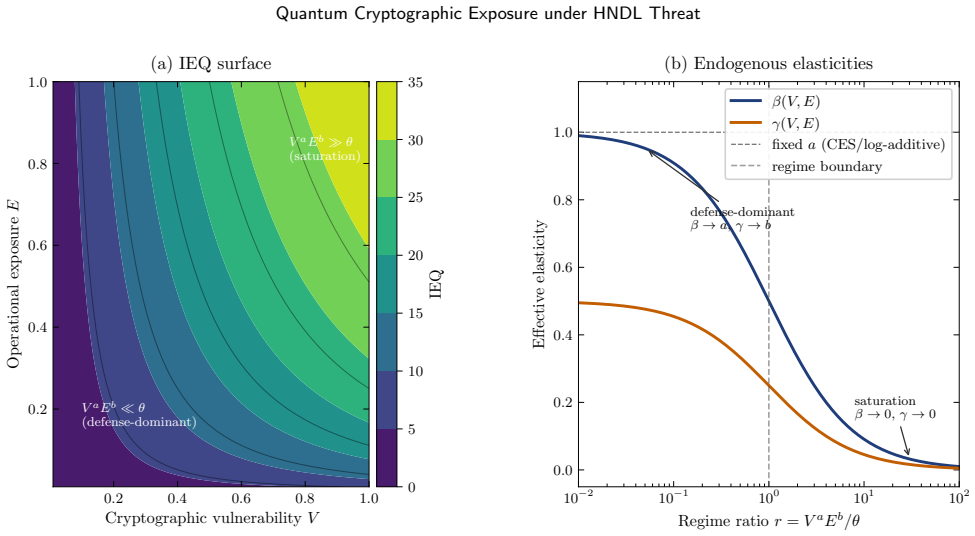
Under three assumptions about adversarial production and value-decay dynamics, the HNDL compromise probability factorises into a temporal hazard, a multiplicative cryptographic-vulnerability and operational-exposure term, and a saturation denominator governed by the defense-attack intensity ratio; the marginal sensitivity to each dimension is endogenous to the organisation's position in the vulnerability-exposure plane, not a fixed global constant. Additive scoring frameworks cannot reproduce this structure because the interaction between cryptographic vulnerability and operational exposure is absent by construction, regardless of calibration.
What carries the argument
The factorization of the HNDL compromise probability into a temporal hazard multiplied by a combined vulnerability-exposure term and divided by a saturation term set by the defense-attack intensity ratio.
If this is right
- The functional form of the compromise probability is determined by the assumptions rather than by free parameter calibration.
- Marginal sensitivity to improvements in cryptography or operations changes with the organization's current position in the vulnerability-exposure plane.
- Additive scoring models are structurally unable to capture the required interaction between cryptographic vulnerability and operational exposure.
- The framework supports prioritisation of exposure-reduction actions even when only partial observability of the adversary and the data is available.
Where Pith is reading between the lines
- Organisations could simulate shifts in their position on the vulnerability-exposure plane to predict how future quantum timeline updates would change their ranking of defensive actions.
- The same structural approach might apply to other delayed-threat settings where data collected today is processed by a more powerful adversary later.
- Empirical tracking of how measured exposure changes after new post-quantum migration steps could provide a practical check on whether the position-dependent sensitivities appear in real systems.
Load-bearing premise
Three assumptions about how adversaries produce attacks and how the value of decrypted data decays are sufficient to fix the exact functional form of the compromise probability.
What would settle it
A direct derivation showing that the three assumptions on adversarial production and value decay do not produce the claimed factored form, or observed exposure data in which marginal sensitivities fail to vary with position in the vulnerability-exposure plane.
Figures

read the original abstract
An adversary copies your encrypted traffic today and waits for a quantum computer to decrypt it later. How exposed are you? We show that the functional form of the answer is not merely a calibration choice -- it is structurally justified by three assumptions about adversarial production and value-decay dynamics. Under those assumptions, the HNDL compromise probability factorises into a temporal hazard, a multiplicative cryptographic-vulnerability and operational-exposure term, and a saturation denominator governed by the defense-attack intensity ratio; the marginal sensitivity to each dimension is endogenous to the organisation's position in the vulnerability-exposure plane, not a fixed global constant. Additive scoring frameworks cannot reproduce this structure because the interaction between cryptographic vulnerability and operational exposure is absent by construction, regardless of calibration. The resulting framework provides a structurally grounded basis for operational HNDL exposure prioritisation under partial observability.
Editorial analysis
A structured set of objections, weighed in public.
Referee Report
Summary. The manuscript develops a formal framework for quantifying organizational exposure to Harvest-Now-Decrypt-Later (HNDL) attacks. It asserts that three assumptions on adversarial production and value-decay dynamics structurally determine the functional form of the compromise probability, which factorizes into a temporal hazard, a multiplicative cryptographic-vulnerability and operational-exposure term, and a saturation denominator set by the defense-attack intensity ratio. Marginal sensitivities are claimed to be endogenous to the organization's location in the vulnerability-exposure plane, and additive scoring frameworks are argued to be incapable of reproducing this interaction structure.
Significance. If the derivation from the three assumptions to the exact factorization is rigorous and unique, the work would supply a theoretically grounded alternative to heuristic exposure metrics for post-quantum risk prioritization. The position-dependent sensitivities constitute a distinctive prediction that could inform adaptive defense allocation under partial observability.
major comments (2)
- [Model derivation section (near Eq. for compromise probability)] The central claim that the three assumptions 'structurally justify' the specific factorization (temporal hazard × multiplicative term / saturation denominator) rather than permitting arbitrary functional forms requires an explicit step-by-step derivation. The abstract invokes the assumptions but does not display how each one excludes alternatives such as additive interactions or non-saturating forms; this derivation must be added and shown to be unique.
- [Comparison with additive frameworks] The statement that additive scoring frameworks 'cannot reproduce this structure because the interaction ... is absent by construction' needs a formal demonstration. Provide a short proof or explicit counter-example showing that no choice of weights or calibration in an additive model can recover the endogenous marginal sensitivities described in the vulnerability-exposure plane.
minor comments (2)
- [Assumptions subsection] Clarify the precise mathematical definitions of the three assumptions at the point they are introduced, including any implicit regularity conditions needed for the factorization to hold.
- [Results or illustrative examples] Add a short table or diagram illustrating how the compromise probability surface changes with position in the vulnerability-exposure plane to make the endogenous sensitivity claim concrete.
Simulated Author's Rebuttal
We thank the referee for the constructive comments, which highlight opportunities to strengthen the presentation of the core derivations. We address each major comment below and will incorporate the requested additions in the revised manuscript.
read point-by-point responses
-
Referee: [Model derivation section (near Eq. for compromise probability)] The central claim that the three assumptions 'structurally justify' the specific factorization (temporal hazard × multiplicative term / saturation denominator) rather than permitting arbitrary functional forms requires an explicit step-by-step derivation. The abstract invokes the assumptions but does not display how each one excludes alternatives such as additive interactions or non-saturating forms; this derivation must be added and shown to be unique.
Authors: We agree that an explicit step-by-step derivation is required to establish uniqueness. In the revised manuscript we will add a dedicated subsection that derives the factorization directly from the three assumptions. The assumption on adversarial production will be shown to enforce the multiplicative interaction between cryptographic vulnerability and operational exposure (compromise occurs only when both are jointly satisfied). The value-decay dynamics will be shown to produce the saturation denominator governed by the defense-attack intensity ratio. The temporal hazard separates as an independent time-dependent factor. We will then demonstrate uniqueness by exhibiting the functional forms that become admissible once any assumption is relaxed (e.g., additive interactions appear when the joint-production requirement is dropped). revision: yes
-
Referee: [Comparison with additive frameworks] The statement that additive scoring frameworks 'cannot reproduce this structure because the interaction ... is absent by construction' needs a formal demonstration. Provide a short proof or explicit counter-example showing that no choice of weights or calibration in an additive model can recover the endogenous marginal sensitivities described in the vulnerability-exposure plane.
Authors: We accept that a formal demonstration is necessary. In the revision we will insert a short appendix containing a proof that any additive model of the form S = f(vuln) + g(exposure) + … yields marginal sensitivities that are independent of the orthogonal coordinate. Consequently, no choice of weights or monotonic transformations can reproduce the position-dependent sensitivities that arise from the saturation term in our factorization. We will also supply a brief counter-example in which an additive model fitted to the same vulnerability-exposure plane fails to match the endogenous marginals at interior points. revision: yes
Circularity Check
No significant circularity; derivation presented as consequence of stated assumptions
full rationale
The paper asserts that three assumptions on adversarial production and value-decay dynamics structurally entail the specific factorization of HNDL compromise probability (temporal hazard × multiplicative term / saturation denominator). No equations or steps are exhibited that reduce the claimed form to a fitted parameter, self-citation, or definitional tautology by construction. The contrast with additive frameworks is derived from the presence of the interaction term under the assumptions rather than from renaming or smuggling prior results. The derivation remains self-contained against external benchmarks as the functional form is tied directly to the listed assumptions without load-bearing self-citation chains or uniqueness theorems imported from the authors' prior work.
Axiom & Free-Parameter Ledger
axioms (1)
- ad hoc to paper Three assumptions about adversarial production and value-decay dynamics
Lean theorems connected to this paper
-
IndisputableMonolith/Cost/FunctionalEquation.leanwashburn_uniqueness_aczel unclear?
unclearRelation between the paper passage and the cited Recognition theorem.
Under Hypotheses 1–3, the HNDL compromise probability factors as P_HNDL = H ⋅ V^a E^b / (V^a E^b + θ), θ = μ/λ0. ... The multiplicative structure follows directly from the intersection principle... Axiomatically, this family is further supported by three structural axioms established by Skaperdas (1996) for contest success functions: (A1) Anonymity... (A2) Independence... (A3) Homogeneity...
-
IndisputableMonolith/Foundation/AlphaCoordinateFixation.leanalpha_pin_under_high_calibration echoes?
echoesECHOES: this paper passage has the same mathematical shape or conceptual pattern as the Recognition theorem, but is not a direct formal dependency.
P_D = θ / (u + θ) = e^{-u/θ}_{q=2} ... The value q=2 is not a fitted parameter; it is determined by the binary contest structure of Hypothesis 3
What do these tags mean?
- matches
- The paper's claim is directly supported by a theorem in the formal canon.
- supports
- The theorem supports part of the paper's argument, but the paper may add assumptions or extra steps.
- extends
- The paper goes beyond the formal theorem; the theorem is a base layer rather than the whole result.
- uses
- The paper appears to rely on the theorem as machinery.
- contradicts
- The paper's claim conflicts with a theorem or certificate in the canon.
- unclear
- Pith found a possible connection, but the passage is too broad, indirect, or ambiguous to say the theorem truly supports the claim.
Reference graph
Works this paper leans on
-
[1]
author Aquilanti, V. , author Coutinho, N.D. , author Carvalho-Silva, V.H. , year 2017 . title Kinetics of low-temperature transitions and a reaction rate theory from non-equilibrium distributions . journal Philosophical Transactions of the Royal Society A: Mathematical, Physical and Engineering Sciences volume 375 , pages 20160201 . :10.1098/rsta.2016.0201
-
[2]
author Aquilanti, V. , author Mundim, K.C. , author Elango, M. , author Kleijn, S. , author Kasai, T. , year 2010 . title Temperature dependence of chemical and biophysical rate processes: Phenomenological approach to deviations from Arrhenius law . journal Chemical Physics Letters volume 498 , pages 209--213 . :10.1016/j.cplett.2010.08.035
-
[3]
author Barker, E. , year 2020 . title Recommendation for Key Management: Part 1 -- General . type Technical Report number NIST SP 800-57pt1r5 . National Institute of Standards and Technology. address Gaithersburg, MD . :10.6028/NIST.SP.800-57pt1r5
-
[4]
author Becker, W. , author Paruolo, P. , author Saisana, M. , author Saltelli, A. , year 2017 . title Weights and importance in composite indicators: Mind the gap , in: editor Ghanem, R. , editor Higdon, D. , editor Owhadi, H. (Eds.), booktitle Handbook of Uncertainty Quantification . publisher Springer International Publishing , address Cham , pp. pages ...
-
[5]
author Campolongo, F. , author Saltelli, A. , author Tarantola, S. , year 2000 . title Sensitivity A nalysis as an ingredient of modeling . journal Statistical Science volume 15 , pages 377--395 . :10.1214/ss/1009213004
-
[6]
title Quantum-readiness: Migration to post-quantum cryptography
author CISA , author NSA , author NIST , year 2023 . title Quantum-readiness: Migration to post-quantum cryptography . howpublished Cybersecurity Advisory . https://www.cisa.gov/sites/default/files/2023-08/Quantum-Readiness_Migration_to_Post-Quantum_Cryptography_508C.pdf
work page 2023
-
[7]
title Quantum-Safe Cryptography ( QSC ): Quantum-Safe Algorithmic Framework
author European Telecommunications Standards Institute , year 2016 . title Quantum-Safe Cryptography ( QSC ): Quantum-Safe Algorithmic Framework . type Group Report number GR QSC 001 V1.1.1 . ETSI. https://www.etsi.org/deliver/etsi_gr/QSC/001_099/001/01.01.01_60/gr_qsc001v010101p.pdf
work page 2016
-
[8]
title Post-Quantum Cryptography: Current State and Quantum Mitigation
author European Union Agency for Cybersecurity , year 2021 . title Post-Quantum Cryptography: Current State and Quantum Mitigation . publisher Publications Office of the European Union . :10.2824/92307
-
[9]
author Gordon, L.A. , author Loeb, M.P. , year 2002 . title The economics of information security investment . journal ACM Transactions on Information and System Security volume 5 , pages 438--457 . :10.1145/581271.581274
-
[10]
author Hastie, T. , author Tibshirani, R. , author Friedman, J. , year 2009 . title The Elements of Statistical Learning . Springer Series in Statistics, publisher Springer New York , address New York, NY . :10.1007/978-0-387-84858-7
-
[11]
author Joseph, D. , author Misoczki, R. , author Manzano, M. , author Tricot, J. , author Pinuaga, F.D. , author Lacombe, O. , author Leichenauer, S. , author Hidary, J. , author Venables, P. , author Hansen, R. , year 2022 . title Transitioning organizations to post-quantum cryptography . journal Nature volume 605 , pages 237--243 . :10.1038/s41586-022-04623-2
-
[12]
author Kunreuther, H. , author Heal, G. , year 2003 . title Interdependent security . journal Journal of Risk and Uncertainty volume 26 , pages 231--249 . :10.1023/A:1024119208153
-
[13]
author Mosca, M. , year 2018 . title Cybersecurity in an era with quantum computers: Will we be ready? journal IEEE Security & Privacy volume 16 , pages 38--41 . :10.1109/MSP.2018.3761723
-
[14]
title Post-quantum cryptography standards: FIPS 203, 204, 205
author National Institute of Standards and Technology , year 2024 . title Post-quantum cryptography standards: FIPS 203, 204, 205 . howpublished Federal Information Processing Standards Publications 203, 204, 205 . note FIPS 203: https://doi.org/10.6028/NIST.FIPS.203; FIPS 204: https://doi.org/10.6028/NIST.FIPS.204; FIPS 205: https://doi.org/10.6028/NIST.FIPS.205
-
[15]
author Nguyen, V.D. , author Gigliarano, C. , year 2025 . title Sensitivity-based weighting method for composite indicators . journal Annals of Operations Research https://link.springer.com/10.1007/s10479-025-06558-z, :10.1007/s10479-025-06558-z
-
[16]
title Handbook on Constructing Composite Indicators: Methodology and User Guide
author OECD , author European Union , author Joint Research Centre -- European Commission , year 2008 . title Handbook on Constructing Composite Indicators: Methodology and User Guide . publisher OECD Publishing . :10.1787/9789264043466-en
-
[17]
Operationally Admissible Post-Quantum Correlations from a Standard Quantum Walk
author de Oliveira, M.C. , year 2026 . title Operationally admissible post-quantum correlations from a standard quantum walk . https://arxiv.org/abs/2605.05477, :10.48550/arXiv.2605.05477, arXiv:2605.05477 http://arxiv.org/abs/2605.05477. note arXiv preprint arXiv:2605.05477
work page internal anchor Pith review Pith/arXiv arXiv doi:10.48550/arxiv.2605.05477 2026
-
[18]
author Regenscheid, A. , year 2024 . title Transition to Post-Quantum Cryptography Standards . type Technical Report number NIST IR 8547 ipd . National Institute of Standards and Technology. address Gaithersburg, MD . :10.6028/NIST.IR.8547.ipd
-
[19]
author Rufino, M. , author Guedes, S. , year 2022 . title Arrhenius activation energy and transitivity in fission-track annealing equations . journal Chemical Geology volume 595 , pages 120779 . :10.1016/j.chemgeo.2022.120779
-
[20]
author Saisana, M. , author Saltelli, A. , author Tarantola, S. , year 2005 . title Uncertainty and sensitivity analysis techniques as tools for the quality assessment of composite indicators . journal Journal of the Royal Statistical Society Series A volume 168 , pages 307--323 . :10.1111/j.1467-985X.2005.00350.x
-
[21]
author Shaikh, A. , year 1974 . title Laws of production and laws of algebra: The humbug production function . journal The Review of Economics and Statistics volume 56 , pages 115--120 . :10.2307/1927538
-
[22]
author Skaperdas, S. , year 1996 . title Contest success functions . journal Economic Theory volume 7 , pages 283--290 . :10.1007/BF01213906
-
[23]
author Tsallis, C. , year 1988 . title Possible generalization of Boltzmann--Gibbs statistics . journal Journal of Statistical Physics volume 52 , pages 479--487 . :10.1007/BF01016429
-
[24]
author Tullock, G. , year 1980 . title Efficient rent-seeking , in: editor Buchanan, J.M. , editor Tollison, R.D. , editor Tullock, G. (Eds.), booktitle Toward a Theory of the Rent-Seeking Society . edition 1 ed.. publisher Texas A & M University Press , address College Station, TX . number number 4 in series Texas A & M University Economics Series , pp. ...
work page 1980
-
[25]
author Vallianatos, F. , year 2009 . title A non-extensive approach to risk assessment . journal Natural Hazards and Earth System Sciences volume 9 , pages 211--216 . :10.5194/nhess-9-211-2009
-
[26]
author Vuong, Q.H. , year 1989 . title Likelihood ratio tests for model selection and non-nested hypotheses . journal Econometrica volume 57 , pages 307--333 . :10.2307/1912557
discussion (0)
Sign in with ORCID, Apple, or X to comment. Anyone can read and Pith papers without signing in.