Cylinder-like Pappus's hexagon theorem in Nil geometry
Pith reviewed 2026-06-29 02:37 UTC · model grok-4.3
The pith
Relations among geodesic cylinders in Nil geometry produce an analogue of Pappus's hexagon theorem.
A machine-rendered reading of the paper's core claim, the machinery that carries it, and where it could break.
Core claim
In the projective model of Nil geometry, relations for geodesic cylinders and the helix-like geodesics they contain lead to an analogous result to Pappus's hexagon theorem.
What carries the argument
Geodesic Nil cylinders of revolution with fibrum axes, which carry the helix-like geodesic curves.
If this is right
- The incidence structure of Nil geometry contains a Pappus configuration realized entirely by geodesic cylinders.
- Geodesic curves inherit the same combinatorial relations as the lines in the classical Pappus theorem.
- The cylinder relations yield further structural facts about how geodesics interact in Nil space.
Where Pith is reading between the lines
- The same cylinder-based method could be tested for other classical theorems such as Desargues in Nil geometry.
- Coordinate formulas for the cylinders in the projective model would make the theorem computable for specific point sets.
- If the result extends to other Thurston geometries possessing analogous cylinders, it would indicate a broader pattern in homogeneous 3-spaces.
Load-bearing premise
Geodesic curves in the projective model of Nil geometry are helix-like and lie on geodesic Nil cylinders of revolution with fibrum axes.
What would settle it
An explicit choice of six points lying on three distinct geodesic cylinders in the projective Nil model whose connecting geodesics violate the Pappus incidence relation.
Figures

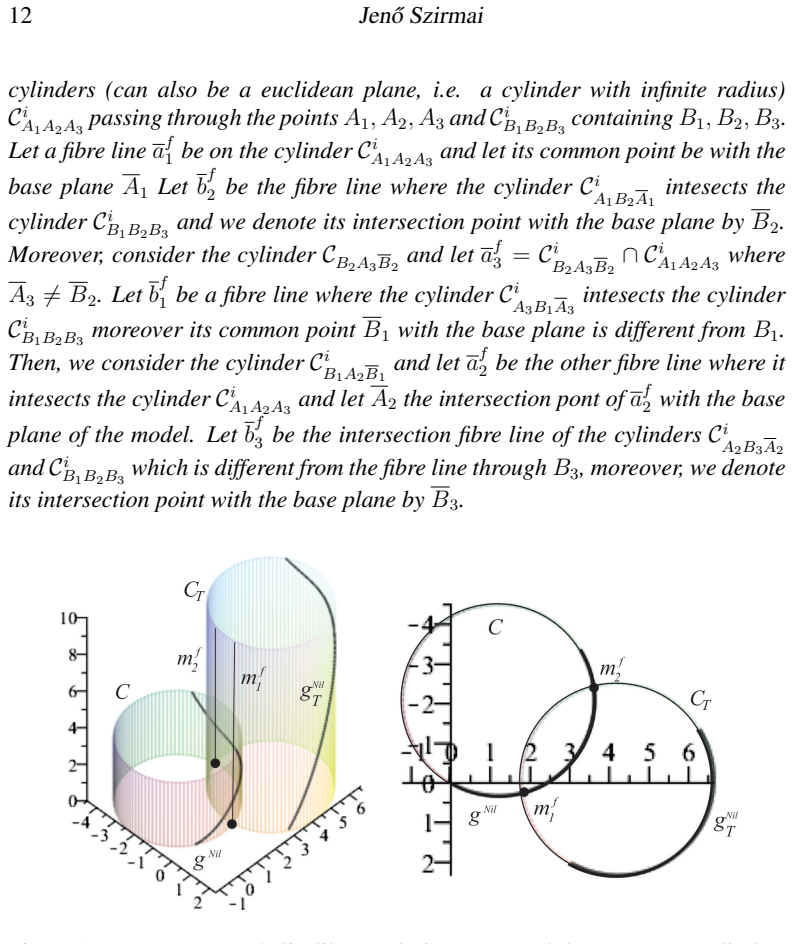
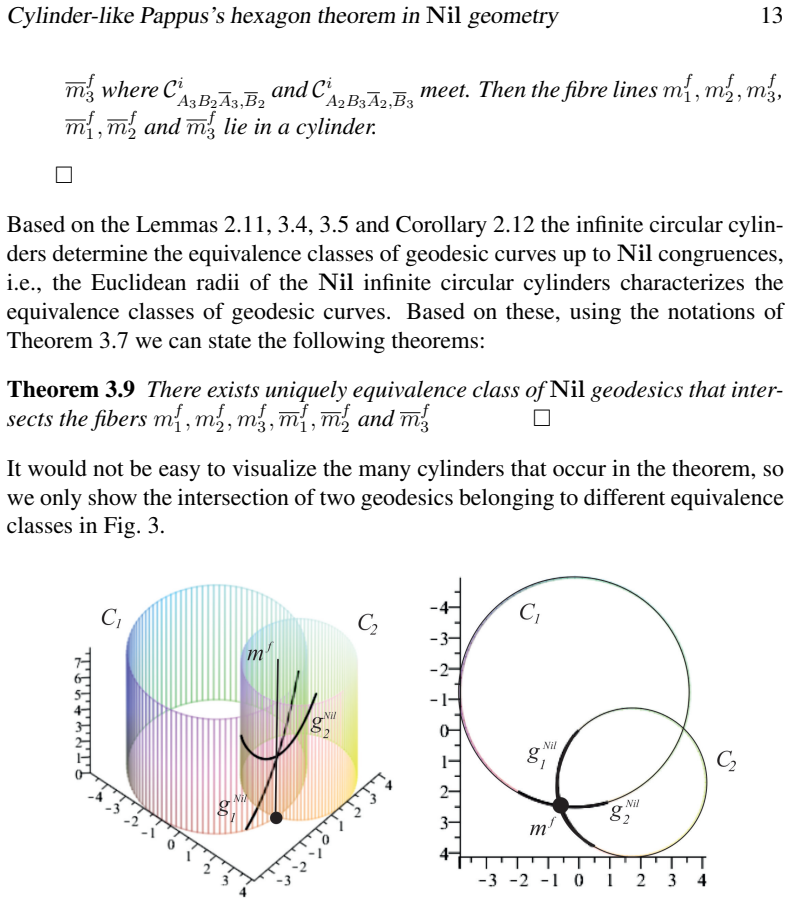
read the original abstract
In this paper we deal with Nil geometry, in whose projective model the geodesic curves are helix-like and fit onto geodesic Nil cylinders of revolution with fibrum axes. In this paper we investigate relations for geodesic cylinders and thus also geodesic curves, which lead to an analogous result to Pappus's hexagon theorem and provide important information about the structure of the considered space.
Editorial analysis
A structured set of objections, weighed in public.
Referee Report
Summary. The paper claims that in the projective model of Nil geometry, geodesic curves are helix-like and lie on geodesic Nil cylinders of revolution with fibrum axes; relations among these cylinders (and thus the geodesics) yield an analogue of Pappus's hexagon theorem, supplying structural information about the space.
Significance. If the derivation is correct, the result extends a classical projective theorem to Nil geometry via its standard cylinder structure for geodesics. This could be useful for researchers studying sub-Riemannian geometries or the Heisenberg group, as it links cylinder relations directly to a Pappus-type configuration.
major comments (1)
- Abstract: the central claim states that the Pappus analogue 'follows from relations on cylinders,' but no explicit relations, coordinate setup, or derivation steps are supplied even in the full manuscript description; without these the load-bearing steps cannot be verified for hidden assumptions or algebraic errors.
Simulated Author's Rebuttal
We thank the referee for the careful reading and for identifying the need for greater explicitness in the central derivations. We agree that the load-bearing algebraic steps must be presented with full coordinate details to permit verification.
read point-by-point responses
-
Referee: Abstract: the central claim states that the Pappus analogue 'follows from relations on cylinders,' but no explicit relations, coordinate setup, or derivation steps are supplied even in the full manuscript description; without these the load-bearing steps cannot be verified for hidden assumptions or algebraic errors.
Authors: We accept the observation. The original manuscript presented the cylinder relations and the resulting Pappus configuration at a level of generality that omitted the intermediate coordinate calculations. In the revised version we will add: (i) the explicit projective coordinates for the Nil model, (ii) the parametric equations of the geodesic cylinders of revolution with fibrum axes, (iii) the algebraic relations among three such cylinders that generate the six geodesic arcs of the Pappus hexagon, and (iv) the direct verification that these relations reproduce the classical Pappus incidence. These additions will make every algebraic step and every modeling assumption inspectable. revision: yes
Circularity Check
No significant circularity
full rationale
The paper takes the helix-like character of geodesics and their containment in fibrum-axis cylinders as given background properties of the projective model of Nil geometry. From these it derives relations among cylinders that yield a Pappus-analogue theorem. No equation is shown to be definitionally equivalent to its input, no fitted parameter is relabeled as a prediction, and no load-bearing step reduces to a self-citation whose content is itself unverified. The derivation therefore remains independent of the target result.
Axiom & Free-Parameter Ledger
axioms (1)
- domain assumption Nil geometry is realized as a 3-dimensional Lie group with left-invariant Riemannian metric whose geodesics project to helices in the standard projective model.
Reference graph
Works this paper leans on
-
[1]
– Moln ´ar, E
Cavichioli, A. – Moln ´ar, E. – Spaggiari, F. – Szirmai, J., Some tetrahedron manifolds withSolgeometry.J. Geom.,105/3, 601-614 (2014)
2014
-
[2]
– Szirmai, J., Interior angle sum of translation and geodesic trian- gles in ^SL2Rspace.Filomat,32/14, (2018) 5023–5036
Csima, G. – Szirmai, J., Interior angle sum of translation and geodesic trian- gles in ^SL2Rspace.Filomat,32/14, (2018) 5023–5036
2018
-
[3]
Csima, G. – Szirmai, J., Translation-like isoptic surfaces and angle sums of translation triangles inNilgeometry.Results Math., (2023) 78:194, DOI: 10.1007/s00025-023-01961-z
-
[4]
Csima, G. – Szirmai, J., Translation-like Apollonius and triangular surfaces in non-constant curvature Thurston geometries.Results Math.,80, article number 190, (2025), DOI: 10.1007/s00025-025-02503-5
-
[5]
Algebra Geom.,38No
Moln ´ar, E., The projective interpretation of the eight 3-dimensional homo- geneous geometries.Beitr. Algebra Geom.,38No. 2, 261–288, (1997)
1997
-
[6]
Electron
Moln ´ar, E.: On projective models of Thurston geometries, some relevant notes onNilorbifolds and manifolds.Sib. Electron. Math. Izv.,7(2010), 491–498, http://mi.mathnet.ru/semr267
2010
-
[7]
– Szirmai, J., OnNilcrystallography,Symmetry Cult
Moln ´ar, E. – Szirmai, J., OnNilcrystallography,Symmetry Cult. Sci.,17/1-2 (2006), 55–74. Cylinder-like Pappus’s hexagon theorem inNilgeometry15
2006
-
[8]
– Szirmai, J
Moln ´ar, E. – Szirmai, J. – Vesnin, A., Projective metric realizations of cone- manifolds with singularities along 2-bridge knots and links.J. Geom.,95, 91-133 (2009)
2009
-
[9]
– Szirmai, J., Symmetries in the 8 homogeneous 3-geometries
Moln ´ar, E. – Szirmai, J., Symmetries in the 8 homogeneous 3-geometries. Symmetry Cult. Sci.,21/1-3, 87-117 (2010)
2010
-
[10]
– Szirmai, J., Classification ofSollattices.Geom
Moln ´ar, E. – Szirmai, J., Classification ofSollattices.Geom. Dedicata, 161/1, 251-275 (2012)
2012
-
[11]
– Schultz B
Pallagi, J. – Schultz B. – Szirmai, J., Equidistant surfaces inNilspace,Stud. Univ. Zilina, Math. Ser.,25, 31–40 (2011)
2011
-
[12]
– Su, W., On hyperbolic analogues of some classical the- orems in spherical geometry
Papadopoulos, A. – Su, W., On hyperbolic analogues of some classical the- orems in spherical geometry. (2014), hal-01064449
2014
-
[13]
London Math
Scott, P., The geometries of 3-manifolds.Bull. London Math. Soc.15, 401– 487 (1983)
1983
-
[14]
Algebra Geom.48(2) (2007), 383–398
Szirmai, J., The densest geodesic ball packing by a type ofNillattices.Beitr. Algebra Geom.48(2) (2007), 383–398
2007
-
[15]
Algebra Geom.,55(2) (2014), 441–452
Szirmai, J., A candidate to the densest packing with equal balls in the Thurston geometries.Beitr. Algebra Geom.,55(2) (2014), 441–452
2014
-
[16]
Szirmai, J., Simply transitive geodesic ball packings toS 2 ×Rspace groups generated by glide reflections,Ann. Mat. Pur. Appl.,193/4(2014), 1201- 1211, DOI: 10.1007/s10231-013-0324-z
-
[17]
Szirmai, J.,Nilgeodesic triangles and their interior angle sums,Bull. Braz. Math. Soc. (N.S.),49(2018) 761–773, DOI: 10.1007/s00574-018-0077-9
-
[18]
Math.,25, 107–122 (2019)
Szirmai, J., Bisector surfaces and circumscribed spheres of tetrahedra de- rived by translation curves inSolgeometry.New York J. Math.,25, 107–122 (2019)
2019
-
[19]
Szirmai, J., Apollonius surfaces, circumscribed spheres of tetrahedra, Menelaus’ and Ceva’s theorems inS 2 ×RandH 2 ×Rgeometries.Q. J. Math.,73, (2022), 477-494, DOI: 10.1093/qmath/haab038
-
[20]
Sapientiae Math.,15/ 1, (2023) 123–141, DOI: 10.2478/ausm-2023-0008
Szirmai, J., On Menelaus’ and Ceva’s theorem inNilgeometry.Acta Univ. Sapientiae Math.,15/ 1, (2023) 123–141, DOI: 10.2478/ausm-2023-0008. 16Jen ˝o Szirmai
-
[21]
Szirmai, J., Classical Notions and Problems in Thurston Geometries,Inter- national Electronic Journal of Geometry,16No.2 (2023), 608–643, doi: 10.36890/IEJG.1221802
-
[22]
Szirmai, J., Fibre-like cylinders, their packings and coverings in ^SL2R space,Results Math.,79article number 123 (2024), doi: 10.1007/s00025- 024-02152-0
-
[23]
Szirmai, J., Menelaus’ and Ceva’s theorems for translation triangles in Thurston geometries,Results Math., (2026) (to appear), arXiv: 2506.01354
arXiv 2026
-
[24]
Szirmai, J., Desargues’s and Pappus’s hexagon theorems on translation- type surfaces in Thurston geometries,Submitted manuscript, (2026), arXiv: 2603.00019
arXiv 2026
-
[25]
Thurston, W. P. (and Levy, S. editor),Three-Dimensional Geometry and Topology. Princeton University Press, Princeton, New Jersey, vol.1(1997)
1997
-
[26]
– Szirmai, J., Lattice coverings by congruent translation balls us- ing translation-like bisector surfaces in Nil Geometry.KoG,23, 6-17 (2019)
Vr ´anics, A. – Szirmai, J., Lattice coverings by congruent translation balls us- ing translation-like bisector surfaces in Nil Geometry.KoG,23, 6-17 (2019)
2019
-
[27]
Yahya, A. – Szirmai, J., Geodesic ball packings generated by rotations and monotonicity behavior of their densities inH 2×Rspace.Results Math.,80, 123 (2025), doi: 10.1007/s00025-025-02430-5
discussion (0)
Sign in with ORCID, Apple, or X to comment. Anyone can read and Pith papers without signing in.