REVIEW 2 major objections 2 minor 2 cited by
Dynamic adversarial fine-tuning relocates the refusal-control carrier from late to early layers while trading robustness for utility.
Reviewed by Pith at T0; open to challenge. T0 means a machine referee read the full paper against a public rubric. the ladder, T0–T4 →
T0 review · grok-4.3
2026-07-01 08:09 UTC pith:3EUUJX67
load-bearing objection The abstract sketches a layer-relocation story for refusal control under R2D2 but supplies no methods or stats to check whether the interventions actually isolate the claimed carrier. the 2 major comments →
Dynamic Adversarial Fine-Tuning Reorganizes Refusal Geometry
The pith
A machine-rendered reading of the paper's core claim, the machinery that carries it, and where it could break.
Core claim
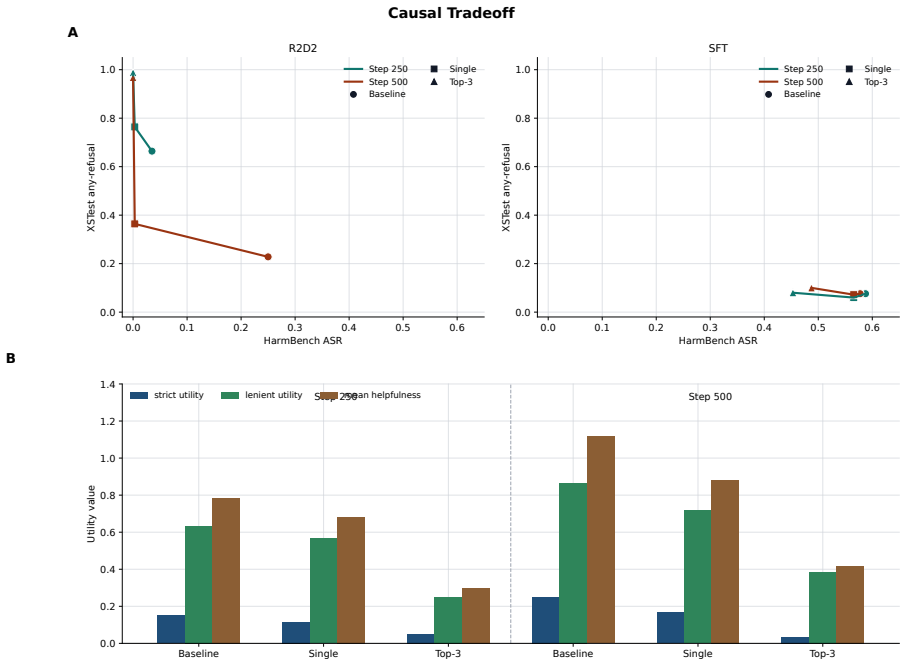
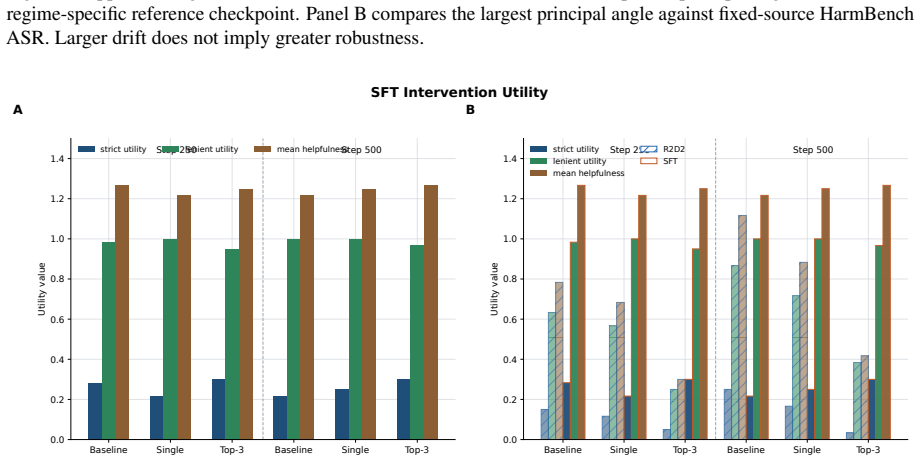
R2D2 drives fixed-source HarmBench attack success to zero at early checkpoints while producing maximal XSTest refusal and failing benign-utility audits; later checkpoints recover some utility-facing behavior but reopen attack success, with adaptive GCG success reaching 0.415 at step 250 and 0.613 at step 500. R2D2 preserves a late-layer admissible refusal-control carrier through step 100 and then relocates the best admissible carrier to an early layer; SFT relocates earlier yet remains less robust. Effective rank stays near 1.24, SFT shows larger principal-angle drift, and causal interventions support a low-dimensional but utility-coupled carrier. These results support a geometry-reorganizat
What carries the argument
The refusal-control carrier: a low-dimensional KL-constrained direction or small subspace that causally modulates refusal without large safe-prompt distribution shifts.
Load-bearing premise
The five-anchor geometry measurements and causal interventions isolate the causally relevant refusal-control carrier rather than a correlated but non-causal activation pattern that changes with training.
What would settle it
An experiment in which targeted interventions on the identified early-layer carrier after step 100 produce no measurable change in refusal rates on held-out harmful prompts would falsify the relocation claim.
If this is right
- R2D2 produces temporary robustness gains that peak early and then decline as utility recovers.
- The optimal refusal-control carrier shifts from late layers to early layers between step 100 and later checkpoints.
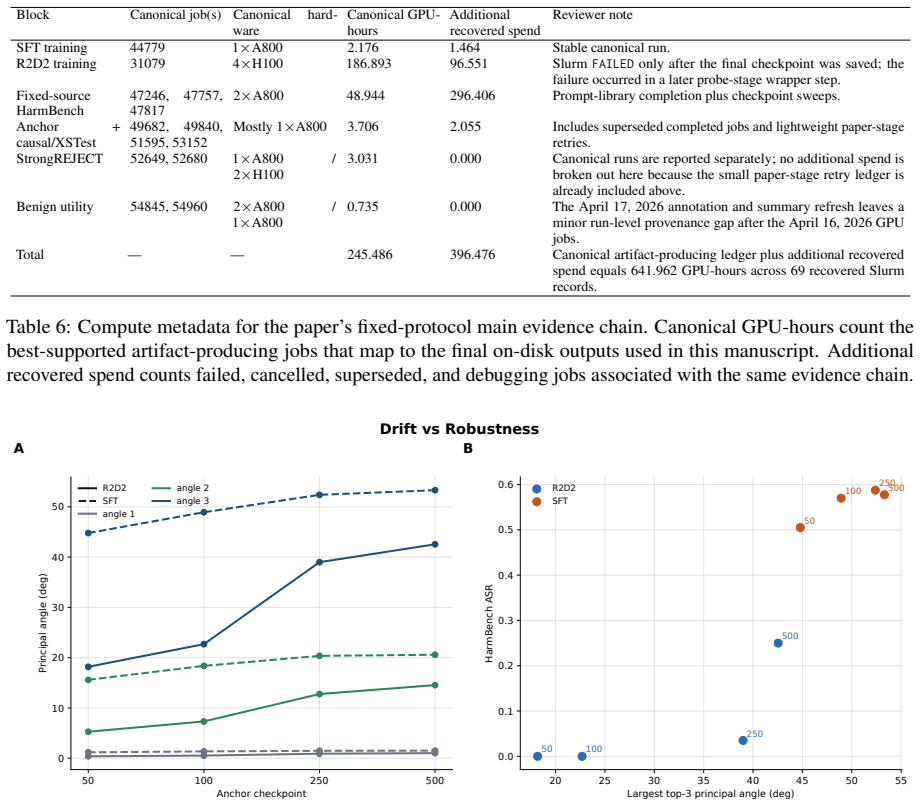
- Low effective rank near 1.24 persists across training, indicating that robustness changes do not require expansion of the carrier's dimensionality.
- SFT produces earlier relocation of the carrier than R2D2 but achieves lower overall robustness.
- Adaptive attack success rises steadily after the initial robustness peak, reaching over 0.6 by step 500.
Where Pith is reading between the lines
- Layer-specific monitoring of carrier location during training could serve as an early warning for when robustness begins to degrade.
- Interventions that explicitly strengthen early-layer carriers might extend the robustness phase beyond what R2D2 achieves.
- The observed tradeoff suggests that further gains may require changes to model architecture rather than fine-tuning alone.
- Similar carrier relocation patterns could appear in other alignment procedures that balance safety and capability.
Editorial analysis
A structured set of objections, weighed in public.
Referee Report
Summary. The manuscript examines the effects of Robust Refusal Dynamic Defense (R2D2) dynamic adversarial fine-tuning on refusal-control carriers in a 7B language model using supervised fine-tuning comparisons. It reports that R2D2 initially eliminates fixed-source attack success on HarmBench but at the cost of maximal XSTest refusal and utility issues, with later checkpoints recovering utility while increasing adaptive attack success. Internally, it preserves a late-layer admissible refusal-control carrier through step 100 before relocating the best carrier to an early layer, with effective rank remaining low at approximately 1.24, supporting a geometry-reorganization account along a robustness-utility frontier without claiming adaptive robustness.
Significance. If the five-anchor geometry measurements and causal interventions accurately identify the causally relevant refusal-control carriers, the findings would provide valuable mechanistic insights into how adversarial fine-tuning reorganizes internal safety representations in LLMs, potentially informing the design of alignment techniques that better navigate the robustness-utility trade-off.
major comments (2)
- [Abstract] Abstract: The central claim that R2D2 relocates the best admissible refusal-control carrier from late to early layers relies on five-anchor geometry measurements and causal interventions, but the abstract provides no details on how these measurements are implemented, how the admissible carrier is defined and selected across checkpoints, or the design of the causal interventions and controls. This makes it impossible to verify whether the interventions isolate the causally relevant carrier rather than a correlated pattern.
- [Abstract] Abstract: No error bars, statistical tests, or details on the sparse adaptive stress tests are reported, which is load-bearing for claims about attack success rates rising to 0.415 at step 250 and 0.613 at step 500, and the comparison between R2D2 and SFT.
minor comments (2)
- [Abstract] Abstract: The term 'five-anchor geometry measurements' is introduced without definition or reference, which may confuse readers unfamiliar with the method.
- [Abstract] Abstract: The effective rank value of 1.24 is stated without specifying the measurement method or baseline for comparison.
Simulated Author's Rebuttal
We thank the referee for the careful reading and specific suggestions regarding the abstract. We agree that the abstract requires additional methodological detail and statistical context to support the central claims, and we will revise it in the next version of the manuscript.
read point-by-point responses
-
Referee: [Abstract] Abstract: The central claim that R2D2 relocates the best admissible refusal-control carrier from late to early layers relies on five-anchor geometry measurements and causal interventions, but the abstract provides no details on how these measurements are implemented, how the admissible carrier is defined and selected across checkpoints, or the design of the causal interventions and controls. This makes it impossible to verify whether the interventions isolate the causally relevant carrier rather than a correlated pattern.
Authors: We agree that the abstract is insufficiently informative on these points. The main text defines the admissible carrier via the five-anchor geometry procedure (Section 3.2), specifies the selection rule across checkpoints (Section 4.3), and details the causal intervention protocol with controls (Section 5). To address the concern, we will expand the abstract with a concise description of the measurement pipeline, carrier selection criterion, and intervention design so that the relocation claim can be evaluated from the abstract alone. revision: yes
-
Referee: [Abstract] Abstract: No error bars, statistical tests, or details on the sparse adaptive stress tests are reported, which is load-bearing for claims about attack success rates rising to 0.415 at step 250 and 0.613 at step 500, and the comparison between R2D2 and SFT.
Authors: We accept this criticism. The reported attack-success figures are means over multiple random seeds and prompt sets; the abstract currently omits both the variability and the test protocol. In revision we will add parenthetical error bars (standard deviation across seeds) and a brief clause summarizing the sparse adaptive stress-test procedure and number of trials, allowing direct assessment of the numerical claims and the R2D2–SFT comparison. revision: yes
Circularity Check
No circularity: empirical claims rest on measurements, not self-referential equations
full rationale
The provided abstract contains no equations, derivations, or parameter-fitting steps. All load-bearing claims (geometry reorganization, carrier relocation, causal interventions) are presented as outcomes of five-anchor measurements and interventions on external benchmarks (HarmBench, XSTest). No self-definitional loops, fitted inputs renamed as predictions, or load-bearing self-citations appear. The derivation chain is therefore self-contained against external data and does not reduce to its own inputs by construction.
Axiom & Free-Parameter Ledger
invented entities (1)
-
refusal-control carrier
no independent evidence
read the original abstract
Safety-aligned language models must refuse harmful requests without broad over-refusal, but it remains unclear how dynamic adversarial fine-tuning changes refusal-control carriers: Kullback--Leibler (KL)-constrained directions or small subspaces that causally modulate refusal without large safe-prompt distribution shifts. We study a 7B backbone under supervised fine-tuning (SFT) and Robust Refusal Dynamic Defense (R2D2), aligning HarmBench, StrongREJECT, and XSTest evaluations with five-anchor geometry measurements, causal interventions, and sparse adaptive stress tests. R2D2 drives fixed-source HarmBench attack success to zero at early checkpoints; however, these checkpoints also exhibit maximal XSTest refusal and fail a benign-utility audit. Later checkpoints partially recover utility-facing behavior while reopening attack success, with adaptive GCG attack success rate rising to 0.415 at step 250 and 0.613 at step 500. Internally, R2D2 preserves a late-layer admissible refusal-control carrier through step 100 and then relocates the best admissible carrier to an early layer; SFT relocates earlier yet remains less robust. Effective rank stays near 1.24, and SFT shows larger principal-angle drift, arguing against both dimensional expansion and drift magnitude as sufficient explanations. Causal interventions support a low-dimensional but utility-coupled carrier. These results support a geometry-reorganization account of R2D2 along a robustness--utility frontier, without establishing adaptive robustness.
Figures


Forward citations
Cited by 2 Pith papers
-
From Refusal Geometry to Safety Geometry: Harmfulness--Refusal Coupling under Dynamic Adversarial Fine-Tuning
Harmfulness-refusal coupling is high early in R2D2 training (strong fixed-source robustness, low utility) then drops (partial utility recovery, reopened attacks), while SFT reaches low coupling with weaker robustness;...
-
From Refusal Geometry to Safety Geometry: Harmfulness--Refusal Coupling under Dynamic Adversarial Fine-Tuning
R2D2 fine-tuning of Mistral-7B transitions from high harmfulness–refusal coupling with collapsed utility to lower coupling with partial utility recovery and reopened jailbreaks; low coupling alone is not safety.
discussion (0)
Sign in with ORCID, Apple, or X to comment. Anyone can read and Pith papers without signing in.