DREAM-R: Multimodal Speculative Reasoning with RL-Based Refined Drafting, Precise Verification, and Fully Parallel Execution
Pith reviewed 2026-06-29 12:24 UTC · model grok-4.3
The pith
DREAM-R trains draft models with reinforcement learning to produce concise, target-aligned reasoning steps, then verifies and executes them in parallel for faster multimodal inference.
A machine-rendered reading of the paper's core claim, the machinery that carries it, and where it could break.
Core claim
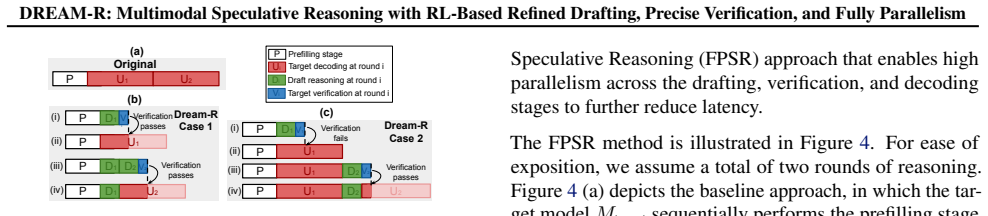
DREAM-R employs Speculative Alignment Policy Optimization (SAPO), a reinforcement-learning objective that trains draft models to generate reasoning steps that are both faithful to target trajectories and concise; it pairs this with a Threshold-based Verification Mechanism (TBVM) that accepts speculative steps only when positive evidence clearly dominates, and a Fully Parallel Speculative Reasoning (FPSR) framework that parallelizes draft generation, target-side reasoning, and verification across multi-step chains, enabling early stopping and clean fallback.
What carries the argument
Speculative Alignment Policy Optimization (SAPO), a reinforcement-learning objective that trains draft models to generate reasoning steps faithful to target trajectories and concise.
If this is right
- Draft models produce reasoning steps that require fewer rejections during verification.
- The ratio-based acceptance rule prevents error propagation through the reasoning chain.
- Parallel execution of draft, target, and verification steps allows early stopping on successful paths.
- Overall inference time on multimodal reasoning tasks decreases while final accuracy matches the target model.
Where Pith is reading between the lines
- The same alignment and verification pattern could be tested on text-only or non-reasoning generation tasks.
- Different reward formulations inside SAPO might further trade off conciseness against faithfulness.
- The parallel framework's scaling behavior on very long reasoning sequences is left open for measurement.
Load-bearing premise
The reinforcement-learning objective will successfully train draft models to generate steps that are both faithful to target trajectories and concise enough to resolve the misalignment.
What would settle it
Experiments on the reasoning-heavy benchmarks showing no measurable speedup or a drop in target-model accuracy would falsify the claim that DREAM-R delivers efficiency gains without compromising quality.
Figures

read the original abstract
Speculative reasoning has recently been proposed as a means to accelerate reasoning-intensive generation in large multimodal models, but its effectiveness is often constrained by misalignment between speculative drafts and target-verified reasoning. In this work, we introduce DREAM-R, a framework that substantially improves the performance of speculative reasoning. At its core, DREAM-R employs Speculative Alignment Policy Optimization (SAPO), a reinforcement-learning objective that trains draft models to generate reasoning steps that are both faithful to target trajectories and concise. We further propose a Threshold-based Verification Mechanism (TBVM) that uses a ratio-based criterion to provide stable and interpretable acceptance of speculative steps only when positive evidence clearly dominates, thereby preventing error propagation. Building on these components, we develop a Fully Parallel Speculative Reasoning (FPSR) framework that parallelizes draft generation, target-side reasoning, and verification across multi-step reasoning, enabling early stopping and clean fallback. Experiments on reasoning-heavy benchmarks demonstrate up to speedup while preserving target-model accuracy, yielding substantial efficiency gains without compromising reasoning quality.
Editorial analysis
A structured set of objections, weighed in public.
Referee Report
Summary. The manuscript introduces DREAM-R, a framework for accelerating speculative reasoning in large multimodal models. Its core components are Speculative Alignment Policy Optimization (SAPO), a reinforcement-learning objective that trains draft models to produce reasoning steps faithful to target trajectories while remaining concise; Threshold-based Verification Mechanism (TBVM), a ratio-based acceptance criterion intended to ensure stable verification and prevent error propagation; and Fully Parallel Speculative Reasoning (FPSR), which parallelizes draft generation, target reasoning, and verification to enable early stopping. The central claim is that these elements together resolve draft-target misalignment, yielding substantial efficiency gains on reasoning-heavy benchmarks without loss of target-model accuracy.
Significance. If the experimental claims are substantiated, the work would provide a concrete integration of RL-based draft alignment with parallel verification for speculative decoding, addressing a recognized limitation in reasoning-intensive multimodal generation. The explicit use of an RL objective (SAPO) to target faithfulness and conciseness, together with the parallel execution framework, represents a coherent engineering contribution that could be adopted in inference pipelines if the quantitative gains are reproducible.
major comments (2)
- [Abstract] Abstract: the statement that experiments 'demonstrate up to speedup while preserving target-model accuracy' supplies neither the numerical speedup factor, the specific benchmarks, baseline comparisons, error bars, nor any quantitative results. This absence is load-bearing for the central claim of 'substantial efficiency gains' and prevents any assessment of whether the claimed improvements actually materialize.
- [Abstract] Abstract (SAPO description): the claim that SAPO 'trains draft models to generate reasoning steps that are both faithful to target trajectories and concise' is presented without the actual RL objective, reward formulation, or training details. Because this is the mechanism asserted to resolve the stated misalignment, the lack of the objective function makes it impossible to evaluate whether the weakest assumption (that the RL objective will produce the desired alignment) holds.
minor comments (1)
- [Abstract] Abstract: the phrase 'up to speedup' appears to be a placeholder; the numerical value and units should be supplied.
Simulated Author's Rebuttal
We thank the referee for highlighting these issues in the abstract. We agree that the abstract must be strengthened with concrete quantitative results and a brief indication of the SAPO objective to support the central claims. We will revise the abstract accordingly.
read point-by-point responses
-
Referee: [Abstract] Abstract: the statement that experiments 'demonstrate up to speedup while preserving target-model accuracy' supplies neither the numerical speedup factor, the specific benchmarks, baseline comparisons, error bars, nor any quantitative results. This absence is load-bearing for the central claim of 'substantial efficiency gains' and prevents any assessment of whether the claimed improvements actually materialize.
Authors: We accept this criticism. The submitted abstract contains a placeholder ('up to speedup'). In the revision we will replace it with the actual peak speedup, the specific reasoning-heavy benchmarks used, the baselines, and error bars drawn directly from the experimental results in Section 4, thereby making the efficiency claim verifiable. revision: yes
-
Referee: [Abstract] Abstract (SAPO description): the claim that SAPO 'trains draft models to generate reasoning steps that are both faithful to target trajectories and concise' is presented without the actual RL objective, reward formulation, or training details. Because this is the mechanism asserted to resolve the stated misalignment, the lack of the objective function makes it impossible to evaluate whether the weakest assumption (that the RL objective will produce the desired alignment) holds.
Authors: We agree the abstract should indicate the core of the SAPO objective. While the full formulation, reward terms (faithfulness and conciseness), and training procedure appear in Section 3, we will add a concise clause to the abstract that names the key reward components and the policy-optimization target, allowing readers to understand the alignment mechanism at a high level without needing to read the body first. revision: yes
Circularity Check
No significant circularity in derivation chain
full rationale
The provided abstract and framework description introduce DREAM-R with components SAPO (RL objective), TBVM (verification), and FPSR (parallelism) to address draft-target misalignment. No equations, mathematical derivations, parameter-fitting steps, or self-citations appear in the text. Without any load-bearing technical steps or claimed predictions that could reduce to inputs by construction, the presentation is self-contained and exhibits none of the enumerated circularity patterns.
Axiom & Free-Parameter Ledger
Reference graph
Works this paper leans on
-
[1]
URL https://api.semanticscholar. org/CorpusID:276107672. Elhoushi, M., Shrivastava, A., Liskovich, D., Hosmer, B., Wasti, B., Lai, L., Mahmoud, A., Acun, B., Agarwal, S., Roman, A., et al. Layer skip: Enabling early exit inference and self-speculative decoding.arXiv preprint arXiv:2404.16710, 2024. Ethayarajh, K., Xu, W., Muennighoff, N., Jurafsky, D., an...
-
[2]
DeepSeek-R1: Incentivizing Reasoning Capability in LLMs via Reinforcement Learning
URL https://api.semanticscholar. org/CorpusID:275357888. 10 DREAM-R: Multimodal Speculative Reasoning with RL-Based Refined Drafting, Precise Verification, and Fully Parallelism Guo, D., Yang, D., Zhang, H., Song, J., Zhang, R., Xu, R., Zhu, Q., Ma, S., Wang, P., Bi, X., et al. Deepseek-r1: In- centivizing reasoning capability in llms via reinforcement le...
work page internal anchor Pith review Pith/arXiv arXiv 2025
-
[3]
URL https://api.semanticscholar. org/CorpusID:221665105. Sun, H., Chen, Z., Yang, X., Tian, Y ., and Chen, B. Tri- force: Lossless acceleration of long sequence generation with hierarchical speculative decoding.arXiv preprint arXiv:2404.11912, 2024. Sun, Z., Shen, S., Cao, S., Liu, H., Li, C., Shen, Y ., Gan, C., Gui, L., Wang, Y .-X., Yang, Y ., Keutzer,...
-
[4]
InternVL3.5: Advancing Open-Source Multimodal Models in Versatility, Reasoning, and Efficiency
URL https://api.semanticscholar. org/CorpusID:262824780. Wang, W., Gao, Z., Gu, L., Pu, H., Cui, L., Wei, X., Liu, Z., Jing, L., Ye, S., Shao, J., et al. Internvl3. 5: Advancing open-source multimodal models in versatility, reasoning, and efficiency.arXiv preprint arXiv:2508.18265, 2025a. Wang, Y ., Yang, Q., Zeng, Z., Ren, L., Liu, L., Peng, B., Cheng, H...
work page internal anchor Pith review Pith/arXiv arXiv 2022
-
[5]
SimpleRL-Zoo: Investigating and Taming Zero Reinforcement Learning for Open Base Models in the Wild
URL https://api.semanticscholar. org/CorpusID:277104124. Yue, X., Ni, Y ., Zhang, K., Zheng, T., Liu, R., Zhang, G., Stevens, S., Jiang, D., Ren, W., Sun, Y ., et al. Mmmu: A massive multi-discipline multimodal understanding and reasoning benchmark for expert agi. InProceedings of the IEEE/CVF Conference on Computer Vision and Pattern Recognition, pp. 955...
work page internal anchor Pith review Pith/arXiv arXiv 2024
-
[6]
URL https://api.semanticscholar. org/CorpusID:277940848. Zhang, J., Wang, J., Li, H., Shou, L., Chen, K., Chen, G., and Mehrotra, S. Draft & verify: Lossless large language model acceleration via self-speculative decoding.arXiv preprint arXiv:2309.08168, 2023. Zhang, R., Jiang, D., Zhang, Y ., Lin, H., Guo, Z., Qiu, P., Zhou, A., Lu, P., Chang, K.-W., Qia...
discussion (0)
Sign in with ORCID, Apple, or X to comment. Anyone can read and Pith papers without signing in.