Holographic Integrated Sensing and Communication With Limited Radiation Amplitudes: How Many Quantization Bits Are Enough?
Pith reviewed 2026-06-26 22:06 UTC · model grok-4.3
The pith
Closed-form lower bounds prove only a few quantization bits suffice for radiation amplitudes in holographic ISAC.
A machine-rendered reading of the paper's core claim, the machinery that carries it, and where it could break.
Core claim
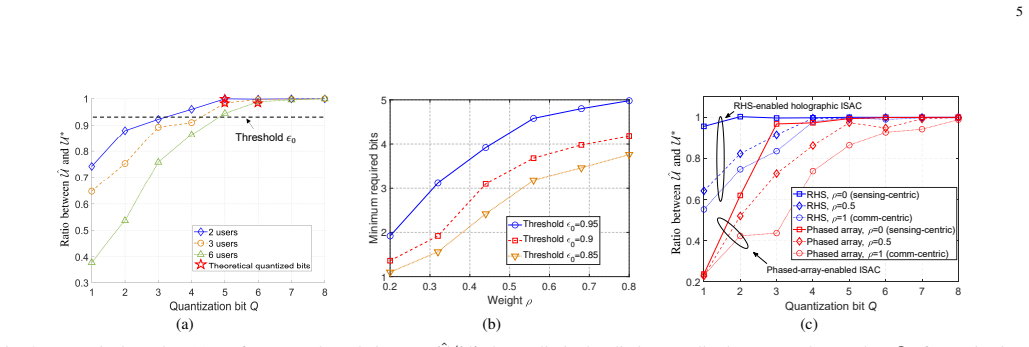
By deriving closed-form lower bounds for the communication rate and sensing SINR when radiation amplitudes are restricted to discrete quantized levels, the paper establishes a tight upper bound on the minimum number of quantization bits needed. This bound indicates that limited discrete levels can still support near-optimal ISAC performance, with the precise bit count depending on the target communication-sensing tradeoff.
What carries the argument
Closed-form lower bounds on communication rate and sensing SINR that upper-bound the minimum quantization bits required for radiation amplitudes.
If this is right
- The minimum quantization bits needed is given by an explicit upper bound derived from the rate and SINR expressions.
- The communication-sensing performance tradeoff directly determines how many bits are required.
- Numerical results confirm that the bounds remain tight once amplitudes are discretized.
- Only a small number of bits is needed to approach the performance of continuous amplitude control.
Where Pith is reading between the lines
- Hardware designs for holographic surfaces in ISAC can therefore adopt low-resolution amplitude control with limited loss.
- The bounding technique may apply to other surface-based or array-based ISAC systems that face amplitude constraints.
- One could next optimize the exact placement of the discrete amplitude levels rather than only their count.
Load-bearing premise
The closed-form lower bounds on rate and SINR derived for continuous amplitudes remain valid and reasonably tight when amplitudes are instead restricted to discrete quantized levels.
What would settle it
A simulation or hardware measurement in which the achieved rate and SINR with the number of bits given by the upper bound fall substantially below the predicted lower bounds would falsify the claimed tightness.
Figures

read the original abstract
As a promising solution for extremely large-scale arrays, reconfigurable holographic surfaces (RHS) can be integrated with integrated sensing and communication (ISAC) to form the holographic ISAC paradigm, where significant beamforming gains provided by RHS can improve both communication and sensing performance. However, most existing works on holographic ISAC assume that RHS elements can control the amplitudes of radiated ISAC signals in a continuous manner, which is hard to implement in practice. In this paper, we investigate how the limited radiation amplitudes of the RHS influence ISAC system performance. Specifically, we first derive closed-form lower bounds for both communication rate and sensing SINR to establish a tight upper bound on the minimum radiation amplitude quantization bits. Based on this, we further explore how the communication-sensing performance tradeoff impacts the quantization bits. Numerical results validate our theoretical analysis.
Editorial analysis
A structured set of objections, weighed in public.
Referee Report
Summary. The paper studies reconfigurable holographic surfaces (RHS) in integrated sensing and communication (ISAC) systems under the practical constraint of discrete quantized radiation amplitudes. It derives closed-form lower bounds on the achievable communication rate and sensing SINR directly under the quantized-amplitude model, uses these bounds to obtain an upper bound on the minimum number of quantization bits required, analyzes how the communication-sensing performance tradeoff affects the required bits, and validates the analysis with numerical results.
Significance. If the closed-form lower bounds hold and remain reasonably tight under quantization, the work supplies practical design guidelines for hardware-limited holographic ISAC implementations, quantifying the bit precision needed to approach continuous-amplitude performance. The explicit derivation under the discrete model (rather than post-hoc application of continuous bounds) and the numerical validation are clear strengths.
minor comments (2)
- [Numerical Results] The abstract states that the bounds 'establish a tight upper bound' on quantization bits; the numerical-results section should include explicit plots or tables quantifying the gap between the derived lower bounds and the exact (simulated) rate/SINR to substantiate the tightness claim.
- [System Model] Notation for the quantized amplitude set and the associated beamforming vectors should be introduced once in the system model and used consistently thereafter to avoid minor ambiguity when the tradeoff analysis is presented.
Simulated Author's Rebuttal
We thank the referee for the positive summary and recommendation of minor revision. No specific major comments were provided in the report, so we have no point-by-point responses at this time. We are happy to address any additional points the referee may wish to raise.
Circularity Check
No significant circularity; derivation self-contained
full rationale
The paper derives closed-form lower bounds on rate and sensing SINR explicitly under the discrete quantized-amplitude model (as stated in the abstract and confirmed by the skeptic analysis). These bounds are then used to obtain an upper bound on the required quantization bits. No step reduces by construction to a fitted parameter, self-definition, or load-bearing self-citation chain; the central claim remains independent of its inputs.
Axiom & Free-Parameter Ledger
Reference graph
Works this paper leans on
-
[1]
6G Wireless Communications: Vision and Potential Techniques,
P. Yang, Y . Xiao, M. Xiao, and S. Li, “6G Wireless Communications: Vision and Potential Techniques,”IEEE Netw., vol. 33, no. 4, pp. 70–75, Jul. 2019
2019
-
[2]
Generative Artificial Intelligence Assisted Wireless Sensing: Human Flow Detection in Practical Communication Environments,
J. Wang, H. Du, D. Niyato, Z. Xiong, J. Kang, B. Ai, Z. Han, and D. I. Kim, “Generative Artificial Intelligence Assisted Wireless Sensing: Human Flow Detection in Practical Communication Environments,” IEEE J. Sel. Areas Commun., vol. 42, no. 10, pp. 2737–2753, Jun. 2024
2024
-
[3]
Holographic Integrated Sensing and Communication,
H. Zhang, H. Zhang, B. Di, M. D. Renzo, Z. Han, H. V . Poor, and L. Song, “Holographic Integrated Sensing and Communication,”IEEE J. Sel. Areas Commun., vol. 40, no. 7, pp. 2114–2130, Jul. 2022
2022
-
[4]
Holographic Beam- forming for Ultra Massive MIMO With Limited Radiation Amplitudes: How Many Quantized Bits Do We Need?
X. Hu, R. Deng, B. Di, H. Zhang, and L. Song, “Holographic Beam- forming for Ultra Massive MIMO With Limited Radiation Amplitudes: How Many Quantized Bits Do We Need?”IEEE Commun. Lett., vol. 26, no. 6, pp. 1403–1407, Jun. 2022
2022
-
[5]
Holographic Beamforming for Integrated Sensing and Communication With Mutual Coupling Effects,
S. Zeng, H. Zhang, B. Di, H. Zhang, Z. Shao, Z. Han, H. Vincent Poor, and L. Song, “Holographic Beamforming for Integrated Sensing and Communication With Mutual Coupling Effects,”IEEE J. Sel. Areas Commun., early access, 2025
2025
-
[6]
Joint Transmit and Receive Beamforming for Holographic ISAC With Leakage Power Constraint,
J. Yu, H. Zhang, B. Di, and L. Song, “Joint Transmit and Receive Beamforming for Holographic ISAC With Leakage Power Constraint,” inProc. IEEE Veh. Technol. Conf. (VTC-Fall), Chengdu, China, Oct. 2025
2025
-
[7]
Covert Beam- forming Design for Holographic Integrated Sensing and Communication With Imperfect CSI,
W. Gao, Z. Xie, Y . Wang, Y . Yao, H. Jiang, and F. Shu, “Covert Beam- forming Design for Holographic Integrated Sensing and Communication With Imperfect CSI,”IEEE Internet Things J., early access, 2025
2025
-
[8]
On the Coverage Performance of Reconfigurable Holographic Surfaces-Aided LEO Satellite Communica- tion Networks,
Y . Peng, S. Zeng, S. Fu, and B. Di, “On the Coverage Performance of Reconfigurable Holographic Surfaces-Aided LEO Satellite Communica- tion Networks,”IEEE Trans. Veh. Technol., early access
-
[9]
CamEdit: Continuous Camera Parameter Control for Photorealistic Image Editing,
X. Qin, Z. Wang, F. Li, H. Chen, R. Pei, W. Li, and X. Cao, “CamEdit: Continuous Camera Parameter Control for Photorealistic Image Editing,” inProc. 39th Annu. Conf. Neural Inf. Process. Syst. (NeurIPS), San Diego, CA, USA, 2025
2025
-
[10]
Joint Waveform and Filter Designs for STAP-SLP-Based MIMO-DFRC Systems,
R. Liu, M. Li, Q. Liu, and A. Lee Swindlehurst, “Joint Waveform and Filter Designs for STAP-SLP-Based MIMO-DFRC Systems,”IEEE J. Sel. Areas Commun., vol. 40, no. 6, pp. 1918–1931, Jun. 2022
1918
-
[11]
Siamese Cooperative Learning for Unsupervised Image Reconstruction From Incomplete Measurements,
Y . Quan, X. Qin, T. Pang, and H. Ji, “Siamese Cooperative Learning for Unsupervised Image Reconstruction From Incomplete Measurements,” IEEE Trans. Pattern Anal. Mach. Intell., vol. 46, no. 7, pp. 4866–4879, 2024
2024
-
[12]
NOMA Empowered Integrated Sensing and Communication,
Z. Wang, Y . Liu, X. Mu, Z. Ding, and O. A. Dobre, “NOMA Empowered Integrated Sensing and Communication,”IEEE Commun. Lett., vol. 26, no. 3, pp. 677–681, Mar. 2022
2022
-
[13]
Intelligent Omni-Surfaces: Reflection-Refraction Circuit Model, Full-Dimensional Beamforming, and System Implementation,
S. Zeng, H. Zhang, B. Di, Y . Liu, M. Di Renzo, Z. Han, H. V . Poor, and L. Song, “Intelligent Omni-Surfaces: Reflection-Refraction Circuit Model, Full-Dimensional Beamforming, and System Implementation,” IEEE Trans. Commun., vol. 70, no. 11, pp. 7711–7727, Nov. 2022
2022
-
[14]
SecDiff: Diffusion-Aided Secure Deep Joint Source-Channel Coding Against Adversarial Attacks,
C. Zhao, J. Wang, R. Zhang, D. Niyato, H. Du, Z. Xiong, D. I. Kim, and P. Zhang, “SecDiff: Diffusion-Aided Secure Deep Joint Source-Channel Coding Against Adversarial Attacks,” arXiv:2511.01466, 2025
arXiv 2025
-
[15]
Dual- Function Radar Communication Systems: A Solution to the Spectrum Congestion Problem,
A. Hassanien, M. G. Amin, E. Aboutanios, and B. Himed, “Dual- Function Radar Communication Systems: A Solution to the Spectrum Congestion Problem,”IEEE Signal Process. Mag., vol. 36, no. 5, pp. 115-126, Sep. 2019
2019
discussion (0)
Sign in with ORCID, Apple, or X to comment. Anyone can read and Pith papers without signing in.