Anti-Hyperspectral Anomaly Detection: A First Study on Stealthy Lipschitz-Forcing Perturbations Against Unknown Detectors
Pith reviewed 2026-06-28 03:16 UTC · model grok-4.3
The pith
A single perturbation signal can simultaneously evade nearly all hyperspectral anomaly detectors without knowing the detector type.
A machine-rendered reading of the paper's core claim, the machinery that carries it, and where it could break.
Core claim
The paper claims to develop the first AHAD technique that renders key objects undetected by optimizing an energy-efficient stealthy perturbation signal via ARAB regularization, which is interpretable as Lipschitz-forcing perturbations that flatten topology-enhanced anomaly/background structures in feature space, combined with a robust criterion using matrix-shifting misalignment to handle imperfect CSI, such that one signal evades almost all benchmark detectors simultaneously.
What carries the argument
ARAB regularization for assimilating real anomalies into backgrounds and fooling detectors with pseudo-anomalies, mathematically interpreted as Lipschitz-forcing perturbations that flatten anomaly/background structures in feature space, together with matrix-shifting misalignment to generate robust perturbations under imperfect coordinate information.
If this is right
- One perturbation signal suffices to defend against reconnaissance by unknown detector types.
- The method applies generally to both data-driven and model-driven HAD benchmarks.
- A new index called ArmCBA quantifies the robustness of any HAD method against such perturbations.
Where Pith is reading between the lines
- Future detectors could be designed specifically to detect or resist these Lipschitz-forcing signals.
- The same regularization approach might extend to other remote-sensing modalities beyond hyperspectral imagery.
Load-bearing premise
Regularizers can assimilate anomalies into backgrounds and generate perturbations that stay stealthy and energy-efficient across unknown detector types even without perfect position information.
What would settle it
An experiment applying the generated perturbation to a held-out or modified HAD detector that shows no significant drop in detection rate or requires non-stealthy energy levels to achieve any evasion.
Figures




read the original abstract
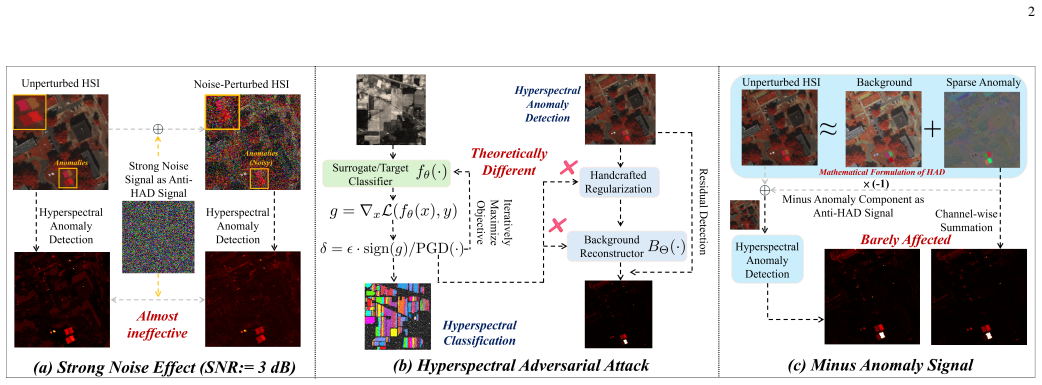
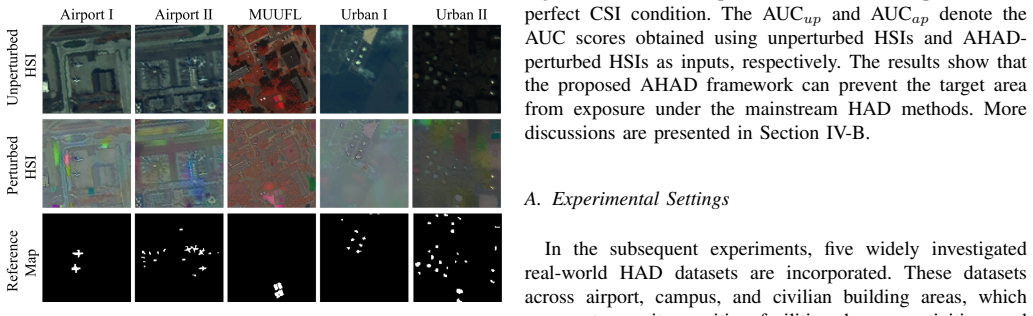
Hyperspectral imagery represents the best contemporary technology to remotely detect anomalous objects. Nevertheless, hyperspectral anomaly detection (HAD) technique makes ground facilities/situations completely exposed. For the first time, we develop the first anti-HAD (AHAD) technique rendering the key objects undetected, without perfect coordinate/position state information (CSI) of the detectors (e.g., reconnaissance aircraft). Our AHAD algorithm is generally applicable to defend against almost all the existing benchmark data-driven and model-driven HAD methods. AHAD is fundamentally different from conventional adversarial attacks, so novel theory is needed. We customize novel regularizers for assimilating real anomalies into the backgrounds (ARAB) and fooling the detectors with pseudo-anomalies, thereby optimizing an energy-efficient stealthy perturbation signal for AHAD. The ARAB regularization is mathematically interpretable as flattening the topology-enhanced anomaly/background structures in the feature space, hence termed Lipschitz-forcing perturbations. Considering the imperfect CSI, we further develop a robust AHAD criterion, where the uncertainty is mathematically described as matrix-shifting misalignment for statistically generating the robust perturbation. Comprehensive experiments demonstrate the effectiveness and robustness of our AHAD algorithm across diverse real-world datasets. Remarkably, our algorithm generates a single AHAD perturbation signal that can simultaneously evade almost all benchmark detectors, greatly enhancing its practicality, given that the reconnaissance detector type is usually unknown. To the best of our knowledge, this is the first formal AHAD study. As a side contribution, we propose a new quantitative performance index, ArmCBA, to evaluate the robustness of an HAD method against our AHAD signal.
Editorial analysis
A structured set of objections, weighed in public.
Referee Report
Summary. The paper claims to present the first anti-hyperspectral anomaly detection (AHAD) technique that generates a single energy-efficient stealthy perturbation via ARAB regularization (assimilating real anomalies into backgrounds by flattening topology-enhanced structures in feature space) and matrix-shifting misalignment (to handle imperfect CSI), enabling simultaneous evasion of almost all benchmark data-driven and model-driven HAD detectors without detector-specific parameters; it also introduces the ArmCBA index to quantify HAD robustness against such perturbations.
Significance. If the central construction holds, the work would be significant as the first formal study of anti-HAD, demonstrating a detector-agnostic perturbation that enhances practicality when the reconnaissance detector type is unknown, while the new ArmCBA metric provides a quantitative tool for evaluating robustness in hyperspectral anomaly detection.
major comments (2)
- [Abstract] Abstract: the headline claim that a single AHAD perturbation simultaneously evades almost all benchmark detectors is presented without any derivation, loss-function statement, or ablation showing that the ARAB regularizer plus matrix-shifting contains no detector-model term and produces detector-independent flattening of anomaly/background structures; the optimization could still embed implicit assumptions about separation that only certain detector families exploit.
- [Abstract] Abstract: the assertion that ARAB regularization is 'mathematically interpretable as flattening the topology-enhanced anomaly/background structures' and yields Lipschitz-forcing perturbations is stated without an explicit equation or proof that this flattening is independent of downstream detector type, leaving the generality claim as an empirical observation rather than a consequence of the stated construction.
minor comments (1)
- The abstract refers to 'comprehensive experiments' and 'diverse real-world datasets' but supplies no protocol details, baseline detectors, quantitative tables, or ablation results that would allow verification of the single-perturbation claim.
Simulated Author's Rebuttal
We thank the referee for the constructive comments on our manuscript. We address each major comment point by point below, clarifying the support provided in the full paper while noting that abstracts are high-level summaries by design.
read point-by-point responses
-
Referee: [Abstract] Abstract: the headline claim that a single AHAD perturbation simultaneously evades almost all benchmark detectors is presented without any derivation, loss-function statement, or ablation showing that the ARAB regularizer plus matrix-shifting contains no detector-model term and produces detector-independent flattening of anomaly/background structures; the optimization could still embed implicit assumptions about separation that only certain detector families exploit.
Authors: The abstract summarizes results; the full loss function appears in Section III as a sum of the ARAB regularizer (assimilating anomalies into background via topology flattening) and the matrix-shifting term (for CSI uncertainty). Neither term contains a detector-model component or output. The optimization is therefore detector-agnostic by construction. Section V provides ablations across data-driven and model-driven benchmarks confirming simultaneous evasion without per-detector tuning. We disagree that implicit assumptions remain, as the formulation operates solely on data geometry. revision: no
-
Referee: [Abstract] Abstract: the assertion that ARAB regularization is 'mathematically interpretable as flattening the topology-enhanced anomaly/background structures' and yields Lipschitz-forcing perturbations is stated without an explicit equation or proof that this flattening is independent of downstream detector type, leaving the generality claim as an empirical observation rather than a consequence of the stated construction.
Authors: Section III-B derives the ARAB term explicitly and shows it reduces topological complexity in feature space, yielding a Lipschitz-forcing effect on the anomaly/background mapping. The derivation depends only on the data manifold and regularization, not on any detector. The independence therefore follows from the construction rather than solely from experiments, although the latter provide supporting validation across detector families. We can expand the derivation section if requested but maintain that the abstract claim is grounded in the stated mathematics. revision: no
Circularity Check
No circularity in derivation chain
full rationale
The abstract supplies descriptive claims about novel regularizers (ARAB) and matrix-shifting misalignment but contains no equations, derivations, fitted parameters, or self-citations. No load-bearing step can be exhibited that reduces by construction to its own inputs, as required by the analysis rules. The generality claim is presented as an empirical outcome of experiments rather than a mathematical identity or self-referential definition. This matches the default expectation that most papers are not circular when no reduction is quotable.
Axiom & Free-Parameter Ledger
Reference graph
Works this paper leans on
-
[1]
Hyperspectral anomaly de- tection using Einstein fuzzy computing and quantum neural network,
C.-H. Lin, S.-S. Young, and R. Langari, “Hyperspectral anomaly de- tection using Einstein fuzzy computing and quantum neural network,” IEEE Transactions on Geoscience and Remote Sensing, vol. 64, pp. 5 513 220–5 513 220, 2026
2026
-
[2]
Hyperspectral imaging,
D. Hong, C. Li, N. Yokoya, B. Zhang, X. Jia, A. Plaza, P. Gamba, J. A. Benediktsson, and J. Chanussot, “Hyperspectral imaging,”Nature Reviews Methods Primers, vol. 6, no. 1, p. 19, 2026
2026
-
[3]
Deep learning for hyperspectral image classification: An overview,
S. Li, W. Song, L. Fang, Y . Chen, P. Ghamisi, and J. A. Benediktsson, “Deep learning for hyperspectral image classification: An overview,” IEEE Transactions on Geoscience and Remote Sensing, vol. 57, no. 9, pp. 6690–6709, 2019
2019
-
[4]
Unsupervised abundance matrix reconstruction transformer-guided fractional attention mechanism for hyperspectral anomaly detection,
S.-S. Young, C.-H. Lin, and Z.-C. Leng, “Unsupervised abundance matrix reconstruction transformer-guided fractional attention mechanism for hyperspectral anomaly detection,”IEEE Transactions on Neural Networks and Learning Systems, vol. 36, no. 5, pp. 9150–9164, 2025
2025
-
[5]
SuperRPCA: A collaborative superpixel representation prior-aided RPCA for hyperspectral anomaly detection,
J.-T. Lin and C.-H. Lin, “SuperRPCA: A collaborative superpixel representation prior-aided RPCA for hyperspectral anomaly detection,” IEEE Transactions on Geoscience and Remote Sensing, vol. 62, pp. 1– 16, 2024
2024
-
[6]
Auto-AD: Autonomous hyperspectral anomaly detection network based on fully convolutional autoencoder,
S. Wang, X. Wang, L. Zhang, and Y . Zhong, “Auto-AD: Autonomous hyperspectral anomaly detection network based on fully convolutional autoencoder,”IEEE Transactions on Geoscience and Remote Sensing, vol. 60, pp. 1–14, 2021
2021
-
[7]
Nonlocal and local feature-coupled self-supervised network for hyperspectral anomaly de- tection,
D. Wang, L. Ren, X. Sun, L. Gao, and J. Chanussot, “Nonlocal and local feature-coupled self-supervised network for hyperspectral anomaly de- tection,”IEEE Journal of Selected Topics in Applied Earth Observations and Remote Sensing, vol. 18, pp. 6981–6993, 2025
2025
-
[8]
BockNet: Blind-block reconstruction network with a guard window for hyperspectral anomaly detection,
D. Wang, L. Zhuang, L. Gao, X. Sun, M. Huang, and A. Plaza, “BockNet: Blind-block reconstruction network with a guard window for hyperspectral anomaly detection,”IEEE Transactions on Geoscience and Remote Sensing, vol. 61, pp. 1–16, 2023
2023
-
[9]
Efficient black-box attack with surrogate models and multiple universal adversarial perturbations,
T. Ma, H. Zhao, L. Tang, M. Xue, and J. Liu, “Efficient black-box attack with surrogate models and multiple universal adversarial perturbations,” Scientific Reports, vol. 15, no. 1, p. 17372, 2025
2025
-
[10]
Hyperspectral remote sensing image synthe- sis based on implicit neural spectral mixing models,
L. Liu, Z. Zou, and Z. Shi, “Hyperspectral remote sensing image synthe- sis based on implicit neural spectral mixing models,”IEEE Transactions on Geoscience and Remote Sensing, vol. 61, pp. 1–14, 2023
2023
-
[11]
The HyMapTM airborne hyperspectral sensor: The system, calibration and performance,
T. Cocks, R. Jenssen, A. Stewart, I. Wilson, and T. Shields, “The HyMapTM airborne hyperspectral sensor: The system, calibration and performance,” inProc. The 1st EARSeL Workshop on Imaging Spec- troscopy. EARSeL, 1998, pp. 37–42
1998
-
[12]
A VIRIS USA hyperspectral data cube,
“A VIRIS USA hyperspectral data cube,” [Online]. Available: http:// aviris.jpl.nasa.gov/
-
[13]
UA V pose estimation using cross-view geolocalization with satellite imagery,
A. Shetty and G. X. Gao, “UA V pose estimation using cross-view geolocalization with satellite imagery,” inProc. IEEE International Conference on Robotics and Automation (ICRA), Montreal, Canada, 2019, pp. 1827–1833
2019
-
[14]
A practical cross-view image matching method between UA V and satellite for UA V-based geo- localization,
L. Ding, J. Zhou, L. Meng, and Z. Long, “A practical cross-view image matching method between UA V and satellite for UA V-based geo- localization,”Remote Sensing, vol. 13, no. 1, p. 47, 2020
2020
-
[15]
Unifying UA V cross-view geo-localization via 3D geometric perception,
H. Li, W. Yang, F. Xu, H. Tan, H. Zhang, S. Li, and G.-S. Xia, “Unifying UA V cross-view geo-localization via 3D geometric perception,”arXiv preprint arXiv:2604.01747, 2026
arXiv 2026
-
[16]
AerialMegaDepth: Learning aerial-ground reconstruction and view synthesis,
K. Vuong, A. Ghosh, D. Ramanan, S. Narasimhan, and S. Tulsiani, “AerialMegaDepth: Learning aerial-ground reconstruction and view synthesis,” inProc. IEEE/CVF Conference on Computer Vision and Pattern Recognition, Nashville TN, USA, 2025, pp. 21 674–21 684
2025
-
[17]
Georegistration of airborne hyperspectral image data,
C. Lee and J. Bethel, “Georegistration of airborne hyperspectral image data,”IEEE Transactions on Geoscience and Remote Sensing, vol. 39, no. 7, pp. 1347–1351, 2001
2001
-
[18]
Airborne hyperspectral image georeferencing aided by high-resolution satellite images,
C. Toth, J. Oh, and D. Grejner-Brzezinska, “Airborne hyperspectral image georeferencing aided by high-resolution satellite images,” inProc. ISPRS TC VII Symposium, vol. 38, 2010
2010
-
[19]
CODE-IF: A convex/deep image fusion algorithm for efficient hyperspectral super-resolution,
C.-H. Lin, C.-Y . Hsieh, and J.-T. Lin, “CODE-IF: A convex/deep image fusion algorithm for efficient hyperspectral super-resolution,”IEEE Transactions on Geoscience and Remote Sensing, vol. 62, pp. 1–18, 2024
2024
-
[20]
A convex optimization- based coupled nonnegative matrix factorization algorithm for hyperspec- tral and multispectral data fusion,
C.-H. Lin, F. Ma, C.-Y . Chi, and C.-H. Hsieh, “A convex optimization- based coupled nonnegative matrix factorization algorithm for hyperspec- tral and multispectral data fusion,”IEEE Transactions on Geoscience and Remote Sensing, vol. 56, no. 3, pp. 1652–1667, 2018
2018
-
[21]
Improving sensor fusion: A parametric method for the geometric coalignment of air- borne hyperspectral and Lidar data,
M. Brell, C. Rogass, K. Segl, B. Bookhagen, and L. Guanter, “Improving sensor fusion: A parametric method for the geometric coalignment of air- borne hyperspectral and Lidar data,”IEEE Transactions on Geoscience and Remote Sensing, vol. 54, no. 6, pp. 3460–3474, 2016
2016
-
[22]
QR- CODE: Quasi-residual convex deep network for fusing misaligned hy- perspectral and multispectral images,
C.-H. Lin, C.-C. Hsu, S.-S. Young, C.-Y . Hsieh, and S.-C. Tai, “QR- CODE: Quasi-residual convex deep network for fusing misaligned hy- perspectral and multispectral images,”IEEE Transactions on Geoscience and Remote Sensing, vol. 62, pp. 1–15, 2024
2024
-
[23]
Hyperspectral anomaly detection with robust graph autoencoders,
G. Fan, Y . Ma, X. Mei, F. Fan, J. Huang, and J. Ma, “Hyperspectral anomaly detection with robust graph autoencoders,”IEEE Transactions on Geoscience and Remote Sensing, vol. 60, pp. 1–14, 2021
2021
-
[24]
HyperKING: Quantum-classical generative adversarial networks for hyperspectral image restoration,
C.-H. Lin and S.-S. Young, “HyperKING: Quantum-classical generative adversarial networks for hyperspectral image restoration,”IEEE Trans- actions on Geoscience and Remote Sensing, vol. 63, pp. 1–19, 2025
2025
-
[25]
HyperQUEEN: Hyperspectral quantum deep network for image restoration,
C.-H. Lin and Y .-Y . Chen, “HyperQUEEN: Hyperspectral quantum deep network for image restoration,”IEEE Transactions on Geoscience and Remote Sensing, vol. 61, pp. 1–20, 2023
2023
-
[26]
Hyperspectral image denoising using a 3-D attention denoising network,
Q. Shi, X. Tang, T. Yang, R. Liu, and L. Zhang, “Hyperspectral image denoising using a 3-D attention denoising network,”IEEE Transactions on Geoscience and Remote Sensing, vol. 59, no. 12, pp. 10 348–10 363, 2021
2021
-
[27]
Signal subspace identification for incom- plete hyperspectral image with applications to various inverse problems,
C.-H. Lin and S.-S. Young, “Signal subspace identification for incom- plete hyperspectral image with applications to various inverse problems,” IEEE Transactions on Geoscience and Remote Sensing, vol. 62, pp. 1– 16, 2024
2024
-
[28]
Chiet al.,Convex Optimization for Signal Processing and Com- munications: From Fundamentals to Applications
C.-Y . Chiet al.,Convex Optimization for Signal Processing and Com- munications: From Fundamentals to Applications. CRC Press, Boca Raton, FL, 2017
2017
-
[29]
Robust principal component analysis?
E. J. Cand `es, X. Li, Y . Ma, and J. Wright, “Robust principal component analysis?”Journal of the ACM (JACM), vol. 58, no. 3, pp. 1–37, 2011
2011
-
[30]
Hyperspectral anomaly detection based on improved RPCA with non-convex regularization,
W. Yao, L. Li, H. Ni, W. Li, and R. Tao, “Hyperspectral anomaly detection based on improved RPCA with non-convex regularization,” Remote Sensing, vol. 14, no. 6, p. 1343, 2022
2022
-
[31]
Confidence-weighted prior-guided RPCA for hyperspectral anomaly detection,
J. Xu, W. Jiang, L. Chen, C. Zhang, M. Wildgruber, X. Yang, and X. Ma, “Confidence-weighted prior-guided RPCA for hyperspectral anomaly detection,”IEEE Signal Processing Letters, pp. 1–5, 2026
2026
-
[32]
Joint reconstruction and anomaly detection from compressive hyperspectral images using Ma- halanobis distance-regularized tensor RPCA,
Y . Xu, Z. Wu, J. Chanussot, and Z. Wei, “Joint reconstruction and anomaly detection from compressive hyperspectral images using Ma- halanobis distance-regularized tensor RPCA,”IEEE Transactions on Geoscience and Remote Sensing, vol. 56, no. 5, pp. 2919–2930, 2018
2018
-
[33]
ADMM-ADAM: A new inverse imaging framework blending the advantages of convex optimization and deep learning,
C.-H. Lin, Y .-C. Lin, and P.-W. Tang, “ADMM-ADAM: A new inverse imaging framework blending the advantages of convex optimization and deep learning,”IEEE Transactions on Geoscience and Remote Sensing, pp. 1–16, Sep. 2021
2021
-
[34]
Anomaly detection in hyperspectral images based on low-rank and sparse representation,
Y . Xu, Z. Wu, J. Li, A. Plaza, and Z. Wei, “Anomaly detection in hyperspectral images based on low-rank and sparse representation,” IEEE Transactions on Geoscience and Remote Sensing, vol. 54, no. 4, pp. 1990–2000, 2016
1990
-
[35]
Graph and total variation regularized low-rank representation for hyperspectral anomaly detection,
T. Cheng and B. Wang, “Graph and total variation regularized low-rank representation for hyperspectral anomaly detection,”IEEE Transactions on Geoscience and Remote Sensing, vol. 58, no. 1, pp. 391–406, 2020
2020
-
[36]
Hyperspectral anomaly detection via deep plug-and-play denoising CNN regulariza- tion,
X. Fu, S. Jia, L. Zhuang, M. Xu, J. Zhou, and Q. Li, “Hyperspectral anomaly detection via deep plug-and-play denoising CNN regulariza- tion,”IEEE Transactions on Geoscience and Remote Sensing, vol. 59, no. 11, pp. 9553–9568, 2021
2021
-
[37]
Hy- perspectral anomaly detection through spectral unmixing and dictionary- based low-rank decomposition,
Y . Qu, W. Wang, R. Guo, B. Ayhan, C. Kwan, S. Vance, and H. Qi, “Hy- perspectral anomaly detection through spectral unmixing and dictionary- based low-rank decomposition,”IEEE Transactions on Geoscience and Remote Sensing, vol. 56, no. 8, pp. 4391–4405, 2018
2018
-
[38]
Hyperspectral anomaly de- tection via background and potential anomaly dictionaries construction,
N. Huyan, X. Zhang, H. Zhou, and L. Jiao, “Hyperspectral anomaly de- tection via background and potential anomaly dictionaries construction,” IEEE Transactions on Geoscience and Remote Sensing, vol. 57, no. 4, pp. 2263–2276, 2019
2019
-
[39]
Prior-based tensor approximation for anomaly detection in hyperspectral imagery,
L. Li, W. Li, Y . Qu, C. Zhao, R. Tao, and Q. Du, “Prior-based tensor approximation for anomaly detection in hyperspectral imagery,”IEEE Transactions on Neural Networks and Learning Systems, vol. 33, no. 3, pp. 1037–1050, 2022
2022
-
[40]
Hyperspectral anomaly de- tection with tensor average rank and piecewise smoothness constraints,
S. Sun, J. Liu, X. Chen, W. Li, and H. Li, “Hyperspectral anomaly de- tection with tensor average rank and piecewise smoothness constraints,” IEEE Transactions on Neural Networks and Learning Systems, vol. 34, no. 11, pp. 8679–8692, 2023
2023
-
[41]
A fast hyperplane- based minimum-volume enclosing simplex algorithm for blind hyper- spectral unmixing,
C.-H. Lin, C.-Y . Chi, Y .-H. Wang, and T.-H. Chan, “A fast hyperplane- based minimum-volume enclosing simplex algorithm for blind hyper- spectral unmixing,”IEEE Transactions on Signal Processing, vol. 64, no. 8, pp. 1946–1961, Apr. 2016
1946
-
[42]
Quantum feature-empowered deep classification for fast mangrove mapping,
C.-H. Lin, P.-W. Tang, and A. R. Huete, “Quantum feature-empowered deep classification for fast mangrove mapping,”IEEE Transactions on Geoscience and Remote Sensing, vol. 63, pp. 1–13, 2025
2025
-
[43]
Quantum information- empowered graph neural network for hyperspectral change detection,
C.-H. Lin, T.-H. Lin, and J. Chanussot, “Quantum information- empowered graph neural network for hyperspectral change detection,” 18 IEEE Transactions on Geoscience and Remote Sensing, vol. 62, pp. 1– 15, 2024
2024
-
[44]
Hyperspectral image super-resolution via deep spatiospectral at- tention convolutional neural networks,
J.-F. Hu, T.-Z. Huang, L.-J. Deng, T.-X. Jiang, G. Vivone, and J. Chanus- sot, “Hyperspectral image super-resolution via deep spatiospectral at- tention convolutional neural networks,”IEEE Transactions on Neural Networks and Learning Systems, vol. 33, no. 12, pp. 7251–7265, 2022
2022
-
[45]
SpectralGPT: Spectral remote sensing foundation model,
D. Hong, B. Zhang, X. Li, Y . Li, C. Li, J. Yao, N. Yokoya, H. Li, P. Ghamisi, X. Jia, A. Plaza, P. Gamba, J. A. Benediktsson, and J. Chanussot, “SpectralGPT: Spectral remote sensing foundation model,” IEEE Transactions on Pattern Analysis and Machine Intelligence, vol. 46, no. 8, pp. 5227–5244, 2024
2024
-
[46]
Deep image prior,
D. Ulyanov, A. Vedaldi, and V . Lempitsky, “Deep image prior,” inProc. IEEE Conference on Computer Vision and Pattern Recognition, 2018, pp. 9446–9454
2018
-
[47]
PRIME: Unsupervised multispectral unmixing using virtual quantum prism and convex geometry,
C.-H. Lin and J.-T. Lin, “PRIME: Unsupervised multispectral unmixing using virtual quantum prism and convex geometry,”IEEE Transactions on Geoscience and Remote Sensing, vol. 63, pp. 1–15, 2025
2025
-
[48]
Underdetermined blind source separation via weighted simplex shrinkage regularization and quantum deep image prior,
C.-H. Lin and S.-S. Young, “Underdetermined blind source separation via weighted simplex shrinkage regularization and quantum deep image prior,”IEEE Transactions on Image Processing, vol. 35, no. 99, pp. 1–1, 2026
2026
-
[49]
Global feature- injected blind-spot network for hyperspectral anomaly detection,
D. Wang, L. Zhuang, L. Gao, X. Sun, and X. Zhao, “Global feature- injected blind-spot network for hyperspectral anomaly detection,”IEEE Geoscience and Remote Sensing Letters, vol. 21, pp. 1–5, 2024
2024
-
[50]
Parseval networks: Improving robustness to adversarial examples,
M. Cisse, P. Bojanowski, E. Grave, Y . Dauphin, and N. Usunier, “Parseval networks: Improving robustness to adversarial examples,” in Proc. International Conference on Machine Learning. PMLR, 2017, pp. 854–863
2017
-
[51]
Advances in adversarial attacks and defenses in computer vision: A survey,
N. Akhtar, A. Mian, N. Kardan, and M. Shah, “Advances in adversarial attacks and defenses in computer vision: A survey,”IEEE access, vol. 9, pp. 155 161–155 196, 2021
2021
-
[52]
Meta gradient adversarial attack,
Z. Yuan, J. Zhang, Y . Jia, C. Tan, T. Xue, and S. Shan, “Meta gradient adversarial attack,” inProc. IEEE/CVF International Conference on Computer Vision, 2021, pp. 7748–7757
2021
-
[53]
Explaining and harnessing adversarial examples,
I. J. Goodfellow, J. Shlens, and C. Szegedy, “Explaining and harnessing adversarial examples,”arXiv preprint arXiv:1412.6572, 2014
Pith/arXiv arXiv 2014
-
[54]
Adversarial machine learning at scale,
A. Kurakin, I. Goodfellow, and S. Bengio, “Adversarial machine learning at scale,”arXiv preprint arXiv:1611.01236, 2016
Pith/arXiv arXiv 2016
-
[55]
Towards deep learning models resistant to adversarial attacks,
A. Madry, A. Makelov, L. Schmidt, D. Tsipras, and A. Vladu, “Towards deep learning models resistant to adversarial attacks,”arXiv preprint arXiv:1706.06083, 2017
Pith/arXiv arXiv 2017
-
[56]
Delving into transfer- able adversarial examples and black-box attacks,
Y . Liu, X. Chen, C. Liu, and D. Song, “Delving into transfer- able adversarial examples and black-box attacks,”arXiv preprint arXiv:1611.02770, 2016
Pith/arXiv arXiv 2016
-
[57]
N. Papernot, P. McDaniel, and I. Goodfellow, “Transferability in ma- chine learning: From phenomena to black-box attacks using adversarial samples,”arXiv preprint arXiv:1605.07277, 2016
Pith/arXiv arXiv 2016
-
[58]
Hyperspectral image classification with adversarial attack,
C. Shi, Y . Dang, L. Fang, Z. Lv, and M. Zhao, “Hyperspectral image classification with adversarial attack,”IEEE Geoscience and Remote Sensing Letters, vol. 19, pp. 1–5, 2022
2022
-
[59]
Universal object- level adversarial attack in hyperspectral image classification,
C. Shi, M. Zhang, Z. Lv, Q. Miao, and C.-M. Pun, “Universal object- level adversarial attack in hyperspectral image classification,”IEEE Transactions on Geoscience and Remote Sensing, vol. 61, pp. 1–14, 2023
2023
-
[60]
Boosting adversarial attacks with momentum,
Y . Dong, F. Liao, T. Pang, H. Su, J. Zhu, X. Hu, and J. Li, “Boosting adversarial attacks with momentum,” inProc. IEEE Conference on Computer Vision and Pattern Recognition, 2018, pp. 9185–9193
2018
-
[61]
Enhancing the transferability of adversarial attacks through variance tuning,
X. Wang and K. He, “Enhancing the transferability of adversarial attacks through variance tuning,” inProc. IEEE/CVF Conference on Computer Vision and Pattern Recognition, 2021, pp. 1924–1933
2021
-
[62]
Sparse unmixing guided adversarial attack for hyperspectral image classification,
H. Li, K. Dang, M. Gong, A. K. Qin, Y . Zhou, Y . Wu, and L. Xing, “Sparse unmixing guided adversarial attack for hyperspectral image classification,”IEEE Transactions on Circuits and Systems for Video Technology, vol. 36, no. 2, pp. 2318–2331, 2026
2026
-
[63]
Nonnegative blind source separation for ill-conditioned mixtures via John ellipsoid,
C.-H. Lin and J. M. Bioucas-Dias, “Nonnegative blind source separation for ill-conditioned mixtures via John ellipsoid,”IEEE Transactions on Neural Networks and Learning Systems, vol. 32, no. 5, pp. 2209–2223, 2020
2020
-
[64]
Identifiability of the simplex volume minimization criterion for blind hyperspectral unmixing: The no-pure-pixel case,
C.-H. Lin, W.-K. Ma, W.-C. Li, C.-Y . Chi, and A. Ambikapathi, “Identifiability of the simplex volume minimization criterion for blind hyperspectral unmixing: The no-pure-pixel case,”IEEE Transactions on Geoscience and Remote Sensing, vol. 53, no. 10, pp. 5530–5546, 2015
2015
-
[65]
All-addition hyperspectral compressed sensing for metasurface-driven miniaturized satellite,
C.-H. Lin and T.-H. Lin, “All-addition hyperspectral compressed sensing for metasurface-driven miniaturized satellite,”IEEE Transactions on Geoscience and Remote Sensing, vol. 60, pp. 1–15, 2022
2022
-
[66]
Deep power control: Transmit power control scheme based on convolutional neural network,
W. Lee, M. Kim, and D.-H. Cho, “Deep power control: Transmit power control scheme based on convolutional neural network,”IEEE Communications Letters, vol. 22, no. 6, pp. 1276–1279, 2018
2018
-
[67]
Interference analysis and transmit power control in IEEE 802.11 a/h wireless LANs,
D. Qiao, S. Choi, and K. G. Shin, “Interference analysis and transmit power control in IEEE 802.11 a/h wireless LANs,”IEEE/ACM Trans- actions On Networking, vol. 15, no. 5, pp. 1007–1020, 2007
2007
-
[68]
Real noise decoupling for hyperspectral image denoising,
Y . Zhang, T. Zhang, J. Nie, and Y . Fu, “Real noise decoupling for hyperspectral image denoising,” inProc. AAAI Conference on Artificial Intelligence, vol. 40, no. 15, 2026, pp. 12 925–12 933
2026
-
[69]
Methods, datasets, and prospects for hyperspectral image denoising: A compre- hensive survey,
Z. Zhao, N. Xu, S. Jin, P. Li, Y . Zhang, Z. Yang, and Z. Li, “Methods, datasets, and prospects for hyperspectral image denoising: A compre- hensive survey,”IEEE Journal of Selected Topics in Applied Earth Observations and Remote Sensing, vol. 19, pp. 6013–6037, 2026
2026
-
[70]
A Gaussian process model for UA V localization using millimetre wave Radar,
J. A. Paredes, F. J. ´Alvarez, M. Hansard, and K. Z. Rajab, “A Gaussian process model for UA V localization using millimetre wave Radar,” Expert Systems with Applications, vol. 185, p. 115563, 2021
2021
-
[71]
COS2A: Conversion from Sentinel-2 to A VIRIS hyperspectral data using interpretable algo- rithm with spectral–spatial duality,
C.-H. Lin, J.-T. Chen, Z.-C. Leng, and J.-T. Lin, “COS2A: Conversion from Sentinel-2 to A VIRIS hyperspectral data using interpretable algo- rithm with spectral–spatial duality,”IEEE Transactions on Geoscience and Remote Sensing, vol. 63, pp. 1–16, 2025
2025
-
[72]
Spectral super-resolution via adversarial unfolding and data-driven spectrum regularization: From multispectral satellite data to NASA hyperspectral image,
S.-S. Young and C.-H. Lin, “Spectral super-resolution via adversarial unfolding and data-driven spectrum regularization: From multispectral satellite data to NASA hyperspectral image,” inProc. IEEE/CVF Con- ference on Computer Vision and Pattern Recognition, Denver, Colorado, USA, Jun. 3-7, 2026
2026
-
[73]
ExplainS2A: Explainable spectral-spatial duality model for fast transforming Sentinel-2 image to A VIRIS-level hyperspectral image,
C.-H. Lin and Z.-C. Leng, “ExplainS2A: Explainable spectral-spatial duality model for fast transforming Sentinel-2 image to A VIRIS-level hyperspectral image,”IEEE Transactions on Geoscience and Remote Sensing, 2026
2026
-
[74]
A convex analysis framework for blind separation of non-negative sources,
T.-H. Chan, W.-K. Ma, C.-Y . Chi, and Y . Wang, “A convex analysis framework for blind separation of non-negative sources,”IEEE Trans- actions on Signal Processing, vol. 56, no. 10, pp. 5120–5134, 2008
2008
-
[75]
Burago, Y
D. Burago, Y . Burago, S. Ivanovet al.,A Course in Metric Geometry. American Mathematical Society Providence, 2001, vol. 33
2001
-
[76]
Training robust neural networks using Lipschitz bounds,
P. Pauli, A. Koch, J. Berberich, P. Kohler, and F. Allg ¨ower, “Training robust neural networks using Lipschitz bounds,”IEEE Control Systems Letters, vol. 6, pp. 121–126, 2022
2022
-
[77]
A generalization of the Eckart-Young-Mirsky matrix approximation theorem,
G. H. Golub, A. Hoffman, and G. W. Stewart, “A generalization of the Eckart-Young-Mirsky matrix approximation theorem,”Linear Algebra and its applications, vol. 88, pp. 317–327, 1987
1987
-
[78]
Imaging spectroscopy and the airborne visible/infrared imaging spectrometer (A VIRIS),
R. O. Green, M. L. Eastwood, C. M. Sarture, T. G. Chrien, M. Aronsson, B. J. Chippendale, J. A. Faust, B. E. Pavri, C. J. Chovit, M. Solis et al., “Imaging spectroscopy and the airborne visible/infrared imaging spectrometer (A VIRIS),”Remote sensing of environment, vol. 65, no. 3, pp. 227–248, 1998
1998
-
[79]
Hybrid pixel-wise registration learning for robust fusion-based hyperspectral image super- resolution,
J. Nie, W. Wei, L. Zhang, C. Ding, and Y . Zhang, “Hybrid pixel-wise registration learning for robust fusion-based hyperspectral image super- resolution,”IEEE Transactions on Computational Imaging, vol. 10, pp. 915–927, 2024
2024
-
[80]
Blind hyperspectral–multispectral image fusion robust to spatial mis- registration and spectral range nonoverlap,
Y . Gao, L. Zhang, X. Sun, Y . Zhang, Q. Li, Y . Cen, and D. Zhang, “Blind hyperspectral–multispectral image fusion robust to spatial mis- registration and spectral range nonoverlap,”IEEE Journal of Selected Topics in Applied Earth Observations and Remote Sensing, vol. 19, pp. 10 804–10 824, 2026
2026
discussion (0)
Sign in with ORCID, Apple, or X to comment. Anyone can read and Pith papers without signing in.