REVIEW 2 major objections 1 minor 33 references
Experimentally-determined performance limits for joint imaging and wavefront sensing with a photonic lantern
T0 review · 2 major / 1 minor · reviewed 2026-06-29 · grok-4.3
Pith's one-line read Photonic lanterns set photon-noise sensitivity limits when splitting ports between wavefront sensing and image reconstruction.
desk verdict The paper supplies measured PL photon-noise sensitivity curves and port-subset trade-offs from muirSEAL, but the testbed-to-telescope match remains the main open question. read the letter →
The pith
A machine-rendered reading of the paper's core claim, the machinery that carries it, and where it could break.
The reading
What carries the argument
Photonic lantern, whose multiple single-mode output ports encode focal-plane wavefront information through intensity measurements, with sensitivity derived per spatial frequency mode.
What would settle it
On-sky measurement of wavefront reconstruction error in an extreme adaptive optics system, compared directly against the photon-noise-limited sensitivity curves predicted from the testbed data, would confirm or refute the claimed performance limits.
Extended reading notes
Core claim
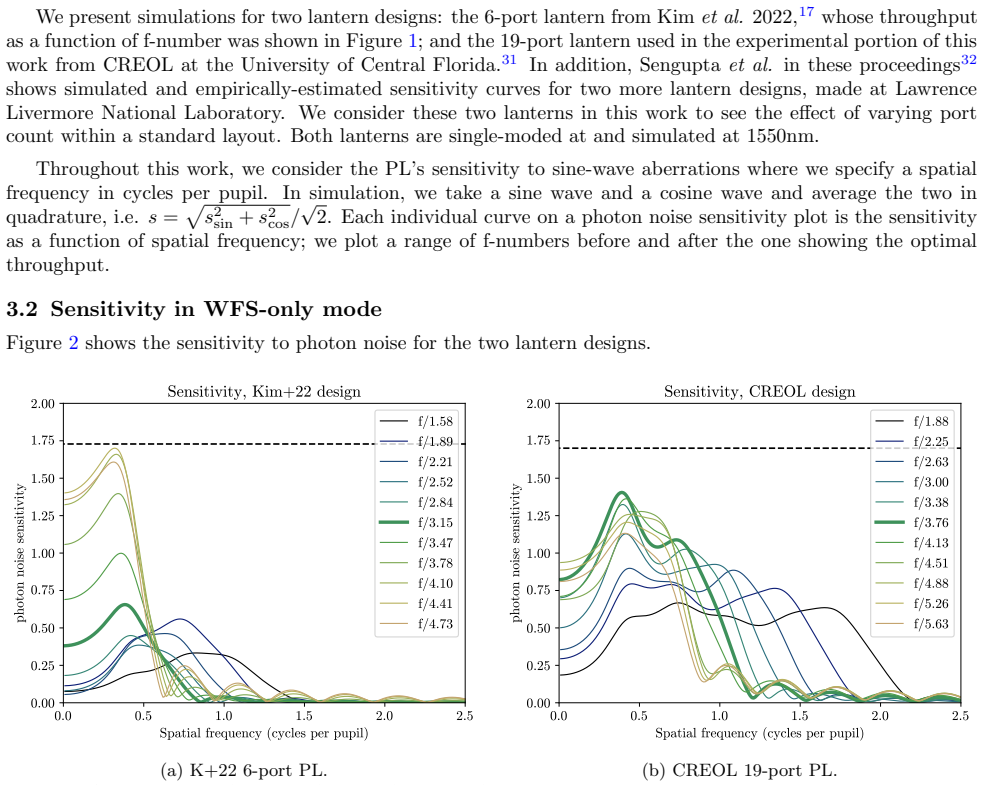
The photonic lantern's sensitivity to photon noise is computed as a function of spatial frequency and compared to existing wavefront sensors using simulations as well as experiments on the muirSEAL testbed. When only a subset of ports are available for wavefront sensing, the remaining ports support spatial and spectral scene reconstruction, enabling a trade-off between greater aberration sensitivity with fewer samples and larger aberrations with more samples for imaging.
Load-bearing premise
The laboratory testbed configuration and the assumption that photon noise dominates measurement error match the noise budget and conditions of real extreme adaptive optics systems on telescopes.
Editorial extensions
If this is right
- Allocating more ports to wavefront sensing increases sensitivity to aberrations but leaves fewer ports for spatial and spectral image reconstruction.
- Using fewer ports for sensing permits correction of larger aberrations while retaining more ports for detailed scene imaging.
- The derived sensitivity metrics versus spatial frequency provide design targets for adaptive optics systems that integrate the photonic lantern for joint sensing and imaging.
Reading between the lines
- If photon noise is not the dominant error term on real telescopes, the reported sensitivities would overestimate achievable performance.
- Combining the lantern with a separate low-order sensor could relax the port-allocation trade-off by handling large aberrations separately.
- Extending the analysis to include detector read noise or other non-photon errors would show how the trade-off shifts under more complete noise budgets.
Signed reviews
Editorial analysis
A structured set of objections, weighed in public.
Referee Report
Summary. The manuscript claims that simulations and experiments on the muirSEAL testbed can be used to determine the photonic lantern's sensitivity to photon noise as a function of spatial frequency for wavefront sensing in extreme AO, with direct comparisons to other WFSs; it further quantifies the trade-off when only a subset of PL ports are allocated to sensing (with the remainder used for SPADE-based scene reconstruction), enabling a balance between aberration correction and imaging performance.
Significance. If the reported sensitivities hold under photon-noise-limited conditions, the work supplies concrete performance metrics and a port-allocation framework that could guide the integration of photonic lanterns into second-stage extreme AO systems as joint sensors and imagers. The combination of simulation and testbed data, together with the explicit treatment of the subset-port case, represents a practical contribution to AO instrumentation design.
major comments (2)
- [§4] §4 (muirSEAL Experiments): No quantitative error budget or separate measurements of read noise, background, vibration, or residual turbulence are presented to substantiate the assumption that photon noise is the dominant term on the testbed. Without this verification, the reported sensitivity curves versus spatial frequency and the comparisons to other WFSs cannot be directly extrapolated to the photon-noise-limited regime of on-sky extreme AO systems.
- [Results] Results section and associated figures (e.g., sensitivity curves): The quantitative sensitivity values and port-subset trade-off metrics are given without accompanying data tables, raw measurement statistics, or exclusion criteria for the experimental runs, preventing independent assessment of the claimed performance limits.
minor comments (1)
- [Methods] The manuscript would benefit from a short table summarizing the exact flux levels, spatial-frequency sampling, and number of frames used in both the simulations and muirSEAL runs to facilitate reproducibility.
Simulated Author's Rebuttal
We thank the referee for their constructive comments, which highlight important aspects of experimental validation. We address each major comment below and will revise the manuscript to strengthen the presentation of our results.
read point-by-point responses
-
Referee: [§4] §4 (muirSEAL Experiments): No quantitative error budget or separate measurements of read noise, background, vibration, or residual turbulence are presented to substantiate the assumption that photon noise is the dominant term on the testbed. Without this verification, the reported sensitivity curves versus spatial frequency and the comparisons to other WFSs cannot be directly extrapolated to the photon-noise-limited regime of on-sky extreme AO systems.
Authors: We agree that an explicit quantitative error budget would better support the photon-noise-limited assumption and aid extrapolation. In revision we will add a dedicated subsection in §4 that tabulates estimated contributions from read noise, background, vibration, and residual turbulence based on muirSEAL instrument specifications and separate calibration measurements. We will also note that the close match between simulation and experiment already provides indirect evidence that photon noise dominates under the reported conditions, while acknowledging that on-sky validation would require additional testing. revision: yes
-
Referee: [Results] Results section and associated figures (e.g., sensitivity curves): The quantitative sensitivity values and port-subset trade-off metrics are given without accompanying data tables, raw measurement statistics, or exclusion criteria for the experimental runs, preventing independent assessment of the claimed performance limits.
Authors: We acknowledge that the current manuscript lacks tabulated statistics and explicit exclusion criteria. In the revised version we will insert a new table in the Results section that reports mean sensitivity values together with standard deviations from repeated runs, and we will add a paragraph in the Methods describing the run-selection criteria. Raw data files will be made available as supplementary material. revision: yes
Circularity Check
No circularity: results are direct experimental measurements and simulations
full rationale
The paper reports sensitivities derived from simulations and direct measurements on the muirSEAL testbed, with comparisons to other WFSs performed on the same data. No equations, self-citations, or fitted parameters are shown to reduce the reported photon-noise sensitivities or port-allocation trade-offs to quantities defined by the same inputs. The derivation chain is self-contained against external benchmarks.
Assumptions & free parameters
assumptions (1)
- domain assumption Photon noise dominates the measurement error budget for wavefront reconstruction.
Cite this review
Pith. "Pith review of Experimentally-determined performance limits for joint imaging and wavefront sensing with a photonic lantern." pith.science (2026). https://pith.science/paper/3PCBFPVF
@misc{pith2026260627585,
  author       = {Pith},
  title        = {Pith review of: Experimentally-determined performance limits for joint imaging and wavefront sensing with a photonic lantern},
  year         = {2026},
  howpublished = {\url{https://pith.science/paper/3PCBFPVF}},
  note         = {Machine review of arXiv:2606.27585}
}
read the original abstract
The photonic lantern (PL) is a focal-plane wavefront sensor (WFS) that can be used for second-stage control of extreme adaptive optics (AO) systems. While the number of sensed modes and the dynamic range with respect to each mode have been relatively well characterized, little attention has been paid to the PL's sensitivity, i.e. how measurement noise impacts the accuracy of PL wavefront reconstruction. We compute the PL's sensitivity to photon noise as a function of spatial frequency, and compare it to existing WFSs, using simulations as well as experiments on the muirSEAL testbed. We further assess these metrics in the case where only a subset of PL ports are available for wavefront sensing. In this configuration, the remaining ports are used to spatially and spectrally reconstruct the observed scene using algorithms such as SPADE. Using more ports for wavefront sensing enables greater aberration sensitivity but leaves less spatial information for image reconstruction. This allows us to trade off between fewer samples with smaller aberrations and more samples with larger aberrations. This work sets the stage for AO system design incorporating the PL as a joint WFS and imager.
Figures


Figures from the paper (4 more)


Reference graph
Works this paper leans on
-
[1]
An all-photonic focal-plane wavefront sensor,
Norris, B. R. M., Wei, J., Betters, C. H., Wong, A., and Leon-Saval, S. G., “An all-photonic focal-plane wavefront sensor,”Nature Communications11, 5335 (Oct. 2020)
2020
-
[2]
Focal-plane wavefront sensing with photonic lanterns: theoretical framework,
Lin, J., Fitzgerald, M. P., Xin, Y., Guyon, O., Leon-Saval, S., Norris, B., and Jovanovic, N., “Focal-plane wavefront sensing with photonic lanterns: theoretical framework,”Journal of the Optical Society of America B Optical Physics39, 2643 (Oct. 2022)
2022
-
[3]
Experimental and on-sky demonstration of spectrally dispersed wavefront sensing using a photonic lantern,
Lin, J., Fitzgerald, M. P., Xin, Y., Jung Kim, Y., Guyon, O., Norris, B., Betters, C., Leon-Saval, S., Ahn, K., Deo, V., Lozi, J., Vievard, S., Levinstein, D., Sallum, S., and Jovanovic, N., “Experimental and on-sky demonstration of spectrally dispersed wavefront sensing using a photonic lantern,”Optics Letters50, 2780 (Apr. 2025)
2025
-
[4]
On-sky Demonstration of Second-stage Wave-front Control with a Photonic Lantern,
Sengupta, A. R., Diaz, J., DeMartino, M., Jensen-Clem, R., Cetre, S., Gates, E., Bundy, K., Dillon, D., Hinz, P., Salama, M., and et al., “On-sky Demonstration of Second-stage Wave-front Control with a Photonic Lantern,”Astronomical Journal171, 65 (Feb. 2026)
2026
-
[5]
Demonstration of a photonic lantern focal-plane wavefront sensor: measurement of atmospheric wavefront error modes and low wind effect in the nonlinear regime,
Wei, J., Norris, B., Betters, C., and Leon-Saval, S., “Demonstration of a photonic lantern focal-plane wavefront sensor: measurement of atmospheric wavefront error modes and low wind effect in the nonlinear regime,”Journal of Astronomical Telescopes, Instruments, and Systems10, 049001 (Oct. 2024)
2024
-
[6]
Exploring the capabilities of astrophotonics for the precise alignment of segmented telescopes,
Cuevas, M., Sengupta, A. R., Chambouleyron, V., Jensen-Clem, R., Dillon, D., Cetre, S., Salama, M., Do- bias, C., Crowe, T., Eikenberry, S. S., Amezcua-Correa, R., and Yerolatsitis, S., “Exploring the capabilities of astrophotonics for the precise alignment of segmented telescopes,” in [Techniques and Instrumentation for Detection of Exoplanets XII], Ruan...
2025
-
[7]
Spectroscopy using a visible photonic lantern at the Subaru Telescope: Laboratory characterization and the first on-sky demonstration on Ikiiki (αLeo) and ’Aua (αOri),
Vievard, S., Lallement, M., Leon-Saval, S., Guyon, O., Jovanovic, N., Huby, E., Lacour, S., Lozi, J., Deo, V., Ahn, K., and et al., “Spectroscopy using a visible photonic lantern at the Subaru Telescope: Laboratory characterization and the first on-sky demonstration on Ikiiki (αLeo) and ’Aua (αOri),”Astronomy & Astrophysics691, A140 (Nov. 2024)
2024
-
[8]
On-sky Demonstration of Subdiffraction-limited Astronomical Measurement Using a Photonic Lantern,
Kim, Y. J., Fitzgerald, M. P., Vievard, S., Lin, J., Xin, Y., Lucas, M., Guyon, O., Lozi, J., Deo, V., Huby, E., and et al., “On-sky Demonstration of Subdiffraction-limited Astronomical Measurement Using a Photonic Lantern,”Astrophysical Journal Letters993, L3 (Nov. 2025)
2025
Show all 33 references
-
[9]
Wavefront sensing and control for a photonic lantern nuller for exoplanet characterization,
Xin, Y., Echeverri, D., Jovanovic, N., Mawet, D., Leon-Saval, S., Amezcua-Correa, R., Yerolatsitis, S., Fitzgerald, M. P., Gatkine, P., Kim, Y. J., Lin, J., Norris, B., Ruane, G., and Sallum, S., “Wavefront sensing and control for a photonic lantern nuller for exoplanet charac...
2024
-
[10]
(Laboratory demonstration of a photonic lantern-fed all-fiber nulling interferometer),
Diaz, J., Jensen-Clem, R., Hinz, P. M., Dillon, D., Gatkine, P., Sengupta, A. R., Sirbu, D., Tedder, S., Bundy, K., Vyhnalek, B., Sallum, S., DeMartino, M. C., Eikenberry, S., Delfyett, P., and Amezcua- Correa, R., “(Laboratory demonstration of a photonic lantern-fed all-fiber...
2026
-
[11]
Neural-network spectral reconstruction with photonic lanterns,
DeMartino, M., Bundy, K., Eikenberry, S. S., Sengupta, A., Gagnebin, A., Patel, A., Crowe, T., Dobias, C., Amezcua-Correa, R., Yerolatsitis, S., and Schmidt, H., “Neural-network spectral reconstruction with photonic lanterns,” in [These proceedings],SPIE14154-89(2026)
2026
-
[12]
Characterizing spectral reconstruction performance of a photonic lantern,
Gagnebin, A., Bundy, K., Sengupta, A. R., Demartino, M., Dillon, D., Crowe, T. R., Dobias, C., Eikenberry, S. S., Amezcua-Correa, R., Yerolatsitis, S., Schmidt, H., Patel, A., and Bradshaw, A., “Characterizing spectral reconstruction performance of a photonic lantern,” in [The...
2026
-
[13]
Quantum Theory of Superresolution for Two Incoherent Optical Point Sources,
Tsang, M., Nair, R., and Lu, X.-M., “Quantum Theory of Superresolution for Two Incoherent Optical Point Sources,”Physical Review X6, 031033 (July 2016)
2016
-
[14]
Quantum hypothesis testing for exoplanet detection,
Huang, Z. and Lupo, C., “Quantum hypothesis testing for exoplanet detection,”Phys. Rev. Lett.127, 130502 (Sep 2021)
2021
-
[15]
Identifying objects at the quantum limit for superresolution imaging,
Grace, M. R. and Guha, S., “Identifying objects at the quantum limit for superresolution imaging,”Phys. Rev. Lett.129, 180502 (Oct 2022)
2022
-
[16]
Focal-plane wavefront sensing with photonic lanterns II: numerical characterization and optimization,
Lin, J., Fitzgerald, M. P., Xin, Y., Kim, Y. J., Guyon, O., Leon-Saval, S. G., Norris, B., and Jovanovic, N., “Focal-plane wavefront sensing with photonic lanterns II: numerical characterization and optimization,” Journal of the Optical Society of America B Optical Physics40, ...
2023
-
[17]
Spectroastrometry with photonic lanterns,
Kim, Y. J., Sallum, S., Lin, J., Xin, Y., Norris, B., Betters, C., Leon-Saval, S., Lozi, J., Vievard, S., Gatkine, P., and et al., “Spectroastrometry with photonic lanterns,” in [Ground-based and Airborne Instru- mentation for Astronomy IX], Evans, C. J., Bryant, J. J., and Mo...
2022
-
[18]
Photonic lantern wavefront reconstruction in a multi-wavefront sensor single- conjugate adaptive optics system,
Sengupta, A. R., Diaz, J., Gerard, B. L., Jensen-Clem, R., Dillon, D., DeMartino, M., Bundy, K., Cetre, S., and Chambouleyron, V., “Photonic lantern wavefront reconstruction in a multi-wavefront sensor single- conjugate adaptive optics system,” in [Adaptive Optics Systems IX],...
2024
-
[19]
Experimental validation of photonic lantern imaging and wavefront sensing performance,
Sengupta, A. R., Chambouleyron, V., Diaz, J., DeMartino, M., Jensen-Clem, R., Gerard, B. L., Messerly, M. J., Pax, P., Dillon, D., Bundy, K., Cuevas, M., Cetre, S., Macintosh, B., Dobias, C., Crowe, T., Eiken- berry, S. S., Amezcua-Correa, R., and Yerolatsitis, S., “Experiment...
2025
-
[20]
Nonlinear techniques for few-mode wavefront sensors,
Lin, J. and Fitzgerald, M. P., “Nonlinear techniques for few-mode wavefront sensors,”Applied Optics63, 8748 (Dec. 2024)
2024
-
[21]
WaveDriver: a laser guide star AO system for HWO,
Gerard, B. L., Geringer-Sameth, A., Sengupta, A. R., Perloff, A. S., Sanchez, D. F., Waswa, P. M. B., Laguna, C., Jensen-Clem, R., Poyneer, L. A., and Eckart, M. E., “WaveDriver: a laser guide star AO system for HWO,”Journal of Astronomical Telescopes, Instruments, and Systems...
2026
-
[22]
Variation on a Zernike wavefront sensor theme: Optimal use of photons,
Chambouleyron, V., Fauvarque, O., Sauvage, J.-F., Dohlen, K., Levraud, N., Vigan, A., N’Diaye, M., Neichel, B., and Fusco, T., “Variation on a Zernike wavefront sensor theme: Optimal use of photons,” Astronomy & Astrophysics650, L8 (June 2021)
2021
-
[23]
Spectral characterization of a three-port photonic lantern for application to spectroastrometry,
Kim, Y. J., Fitzgerald, M. P., Lin, J., Lozi, J., Vievard, S., Xin, Y., Levinstein, D., Jovanovic, N., Leon- Saval, S., Betters, C., and et al., “Spectral characterization of a three-port photonic lantern for application to spectroastrometry,”Journal of Astronomical Telescopes...
2024
-
[24]
Choice of optical transformation for photonic circuit wavefront sensors,
Lin, J., “Choice of optical transformation for photonic circuit wavefront sensors,”Applied Optics65, 4377 (May 2026)
2026
-
[25]
Limits of Adaptive Optics for High-Contrast Imaging,
Guyon, O., “Limits of Adaptive Optics for High-Contrast Imaging,”Astrophysical Journal629, 592–614 (Aug. 2005)
2005
-
[26]
Modeling noise propagation in Fourier-filtering wavefront sensing, fundamental limits, and quantitative comparison,
Chambouleyron, V., Fauvarque, O., Plantet, C., Sauvage, J.-F., Levraud, N., Ciss´ e, M., Neichel, B., and Fusco, T., “Modeling noise propagation in Fourier-filtering wavefront sensing, fundamental limits, and quantitative comparison,”Astronomy & Astrophysics670, A153 (Feb. 2023)
2023
-
[27]
Towards practical wavefront sensing at the fundamental information limit,
Paterson, C., “Towards practical wavefront sensing at the fundamental information limit,” in [Journal of Physics Conference Series],Journal of Physics Conference Series139, 012021, IOP (Nov. 2008)
2008
-
[28]
General formalism for fourier-based wave front sensing,
Fauvarque, O., Neichel, B., Fusco, T., Sauvage, J.-F., and Girault, O., “General formalism for fourier-based wave front sensing,”Optica3, 1440–1452 (Dec 2016)
2016
-
[29]
Lightbeam: Simulate light through weakly-guiding waveguides
Lin, J., “Lightbeam: Simulate light through weakly-guiding waveguides.” Astrophysics Source Code Library, record ascl:2102.006 (Feb. 2021). 14
2021
-
[30]
High Contrast Imaging for Python (HCIPy): an open-source adaptive optics and coronagraph simulator,
Por, E. H., Haffert, S. Y., Radhakrishnan, V. M., Doelman, D. S., van Kooten, M., and Bos, S. P., “High Contrast Imaging for Python (HCIPy): an open-source adaptive optics and coronagraph simulator,” in [Adaptive Optics Systems VI], Close, L. M., Schreiber, L., and Schmidt, D....
2018
-
[31]
Demon- stration of high-efficiency photonic lantern couplers for PolyOculus,
Moraitis, C. D., Alvarado-Zacarias, J. C., Amezcua-Correa, R., Jeram, S., and Eikenberry, S. S., “Demon- stration of high-efficiency photonic lantern couplers for PolyOculus,”Applied Optics60, D93 (July 2021)
2021
-
[32]
Laboratory characterization of a multi-photonic lantern optical waveguide using off-axis holography,
Sengupta, A. R., Gerard, B. L., Sanchez, D., DeMartino, M., Jensen-Clem, R., Bundy, K., Messerly, M. J., Pax, P., Dillon, D., and Strang, E., “Laboratory characterization of a multi-photonic lantern optical waveguide using off-axis holography,” in [These proceedings],SPIE14150...
2026
-
[33]
Laboratory demonstration of an all-fiber-based focal plane nulling interfer- ometer,
Diaz, J., Jensen-Clem, R., Dillon, D., Hinz, P. M., DeMartino, M. C., Bundy, K., Eikenberry, S., Delfyett, P., and Amezcua-Correa, R., “Laboratory demonstration of an all-fiber-based focal plane nulling interfer- ometer,” in [Optical and Infrared Interferometry and Imaging IX]...
2024
Reviewed June 29, 2026 · model on record in the stance chip above.
Discussion (0). Continue with ORCID to comment.