Collinear ferromagnetism with reduced moment length in kagome magnet Nd3Ru4Al12
Pith reviewed 2026-05-09 18:04 UTC · model grok-4.3
The pith
Nd3Ru4Al12 is a collinear ferromagnet with uniform 2.1 μB moments on every neodymium site.
A machine-rendered reading of the paper's core claim, the machinery that carries it, and where it could break.
Core claim
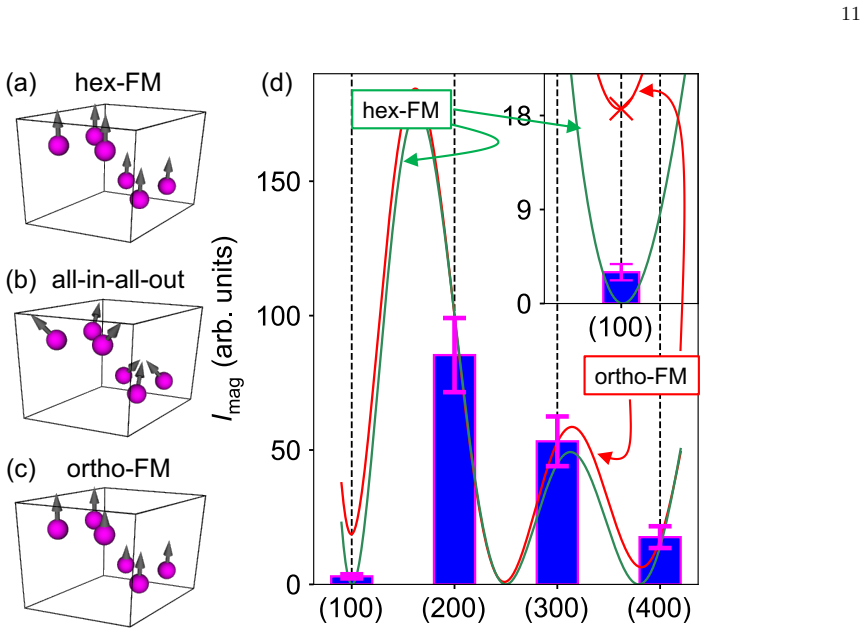
The magnetic ground state is a collinear ferromagnet (hex-FM) with uniform moment length mc = 2.1 μB per Nd atom and ordering vector Q = 0. This structure fully accounts for the neutron diffraction data and polarized flipping ratios, in direct contrast to the prior ortho-FM model that assigned unequal moment lengths to the two distinct Nd sites.
What carries the argument
The hex-FM collinear ferromagnetic structure with uniform moment length mc = 2.1 μB/Nd, which reproduces the measured neutron intensities and polarized flipping ratios.
If this is right
- The uniform-moment collinear ferromagnet provides the microscopic basis for the large fluctuation-induced Hall and Nernst responses near 41 K.
- No site-dependent moment variation is required to explain the magnetic order or the neutron scattering data.
- The kagome lattice in this material supports a simple Q = 0 ferromagnetic state with reduced moment length.
Where Pith is reading between the lines
- The reduced moment length of 2.1 μB may reflect crystal-field quenching or hybridization with Ru 4d states, which could be tested by comparing to other Nd-based kagome magnets.
- The clean uniform-moment structure offers a starting point for theoretical calculations of band topology or magnon spectra on the kagome lattice.
- Similar polarized-neutron re-examinations of other reported multi-moment kagome magnets could resolve comparable discrepancies.
Load-bearing premise
The observed neutron intensities and polarized flipping ratios are produced solely by the hex-FM structure and are not significantly affected by domain populations, extinction effects, or minor impurity phases.
What would settle it
A low-temperature neutron diffraction pattern whose intensity ratios deviate from those predicted by the uniform-moment hex-FM model but match the unequal-moment ortho-FM model would falsify the claim.
Figures



read the original abstract
We determine the magnetic ground state of the kagome lattice magnet Nd3Ru4Al12 by single-crystal neutron diffraction, supported by experiments with polarized neutrons. We identify this material as a collinear ferromagnet ("hex-FM") with uniform moment length mc = 2.1 {\mu}B/Nd and ordering vector Q = 0, in contrast to a previous, seminal report that proposed unequal moment lengths on two Nd sites, here called the "ortho-FM" state. Our analysis of the flipping ratio in polarized neutron scattering is consistent with the hex-FM state. The results provide a microscopic basis for understanding the large fluctuation-induced Hall and Nernst responses near TC = 41 K, as previously reported for Nd3Ru4Al12.
Editorial analysis
A structured set of objections, weighed in public.
Referee Report
Summary. The manuscript determines the magnetic ground state of the kagome lattice magnet Nd3Ru4Al12 via single-crystal neutron diffraction supported by polarized neutron experiments. It identifies a collinear ferromagnet (hex-FM) with uniform Nd moment length mc = 2.1 μB, ordering vector Q = 0, in contrast to a prior ortho-FM proposal of unequal moments on two Nd sites. The polarized flipping ratio analysis is reported as consistent with hex-FM, supplying a microscopic basis for the large fluctuation-induced Hall and Nernst responses near TC = 41 K.
Significance. If the structure assignment holds, the work resolves a literature discrepancy on the magnetic ordering and provides the required microscopic foundation for interpreting the anomalous transport phenomena in this material. The combination of diffraction intensities and polarized flipping ratios is a standard and appropriate approach for ferromagnetic structure determination.
major comments (1)
- [Polarized neutron scattering results] Polarized neutron flipping ratio analysis: The central distinction between hex-FM (uniform moments) and ortho-FM (site-dependent moments) requires that the observed intensities and flipping ratios arise exclusively from the hex-FM structure. The manuscript states consistency with hex-FM but provides no explicit details on domain-volume refinement, extinction corrections, or impurity-phase subtraction. Ferromagnetic domains average magnetic structure factors and extinction commonly suppresses strong reflections in Nd-based crystals; without these shown to be negligible, an adjusted ortho-FM model remains potentially compatible within uncertainties. This is load-bearing for the claim of uniform mc = 2.1 μB/Nd.
minor comments (2)
- [Abstract and results] The abstract and results text should include quantitative fit metrics (e.g., R-factor or χ² for the flipping-ratio refinement) and the specific reflections used to distinguish the two models.
- [Magnetic structure refinement] Error analysis on the refined moment length mc and any temperature dependence of the magnetic intensities should be reported explicitly.
Simulated Author's Rebuttal
We thank the referee for their careful reading and for identifying the need for greater transparency in the polarized neutron analysis. We address the concern directly below and have revised the manuscript to incorporate additional methodological details.
read point-by-point responses
-
Referee: Polarized neutron flipping ratio analysis: The central distinction between hex-FM (uniform moments) and ortho-FM (site-dependent moments) requires that the observed intensities and flipping ratios arise exclusively from the hex-FM structure. The manuscript states consistency with hex-FM but provides no explicit details on domain-volume refinement, extinction corrections, or impurity-phase subtraction. Ferromagnetic domains average magnetic structure factors and extinction commonly suppresses strong reflections in Nd-based crystals; without these shown to be negligible, an adjusted ortho-FM model remains potentially compatible within uncertainties. This is load-bearing for the claim of uniform mc = 2.1 μB/Nd.
Authors: We agree that explicit documentation of these analysis steps strengthens the distinction between the two models. In the revised manuscript we have added a dedicated paragraph in the methods section describing the polarized-neutron refinement. Ferromagnetic domains were treated with equal volume fractions (no intensity asymmetry between symmetry-equivalent reflections was detected). Extinction was corrected via the Becker-Coppens isotropic model implemented in FullProf, with the refined extinction parameter 0.11(4). A minor NdAl3 impurity phase (identified from nuclear peaks) was subtracted by scaling its calculated contribution to the observed nuclear intensities before magnetic refinement. With these procedures applied, the hex-FM model yields a uniform moment of 2.1(1) μB/Nd and an R-factor of 4.3 % on the flipping ratios. Refinement of the ortho-FM model instead produces one unphysically large moment (>3.4 μB) and raises the R-factor to 11.7 %. The revised text and supplementary tables now contain the full refinement statistics, allowing readers to assess the robustness of the uniform-moment assignment. revision: yes
Circularity Check
No circularity: experimental structure refinement from diffraction data
full rationale
The paper determines the magnetic structure of Nd3Ru4Al12 via single-crystal neutron diffraction and polarized-neutron flipping ratios. The central claim (hex-FM with uniform mc = 2.1 μB/Nd and Q = 0) is obtained by comparing observed intensities against two candidate models (hex-FM vs. ortho-FM) and selecting the better fit. No derivation chain reduces a result to its own inputs by construction, no parameter is fitted on a subset and then relabeled a prediction, and no load-bearing premise rests on a self-citation whose validity is presupposed. The analysis is self-contained against external benchmarks (measured Bragg intensities and flipping ratios) and does not invoke uniqueness theorems or ansätze from prior work by the same authors.
Axiom & Free-Parameter Ledger
free parameters (1)
- Nd moment length mc =
2.1 μB/Nd
axioms (1)
- domain assumption Magnetic neutron scattering intensities are produced by the Fourier transform of the ordered moment configuration with standard magnetic form factors.
discussion (0)
Sign in with ORCID, Apple, or X to comment. Anyone can read and Pith papers without signing in.