Decentralized Operations of Decarbonized Chemical Plants with Renewable-driven Transmission Systems
Pith reviewed 2026-07-01 06:50 UTC · model grok-4.3
The pith
A privacy-preserving decentralized framework using ADMM jointly optimizes power system unit commitment and electrified chemical plant scheduling with small optimality gaps.
A machine-rendered reading of the paper's core claim, the machinery that carries it, and where it could break.
Core claim
The framework employs the Alternating Direction Method of Multipliers, augmented with an auxiliary system-level penalty that accelerates convergence, allowing each subsystem to solve its local subproblem and share only minimal coordination signals. Numerical experiments on the ACTIVSg2000 test case with 26 chemical plants show that data isolation results in consistently small optimality gaps, and that its emissions consequences are load-dependent and non-monotone.
What carries the argument
Alternating Direction Method of Multipliers (ADMM) augmented with an auxiliary system-level penalty for decentralized joint optimization of power unit commitment and chemical microgrid scheduling.
If this is right
- Each subsystem solves its local subproblem independently.
- Only minimal coordination signals are shared between subsystems.
- Optimality gaps remain consistently small across the test cases.
- Emissions consequences of the decomposition are load-dependent and non-monotone.
Where Pith is reading between the lines
- The approach could scale to larger networks if convergence remains fast with more plants.
- Similar frameworks might apply to other energy-intensive industries like steel or cement production.
- Real-time implementation would require testing communication delays in the coordination signals.
Load-bearing premise
The synthetic ACTIVSg2000 test case with 26 mapped chemical plants accurately represents real-world conditions for joint optimization.
What would settle it
Running the decentralized framework on actual operational data from Texas power grid and chemical plants and measuring if the optimality gaps exceed those seen in the synthetic tests.
Figures

read the original abstract
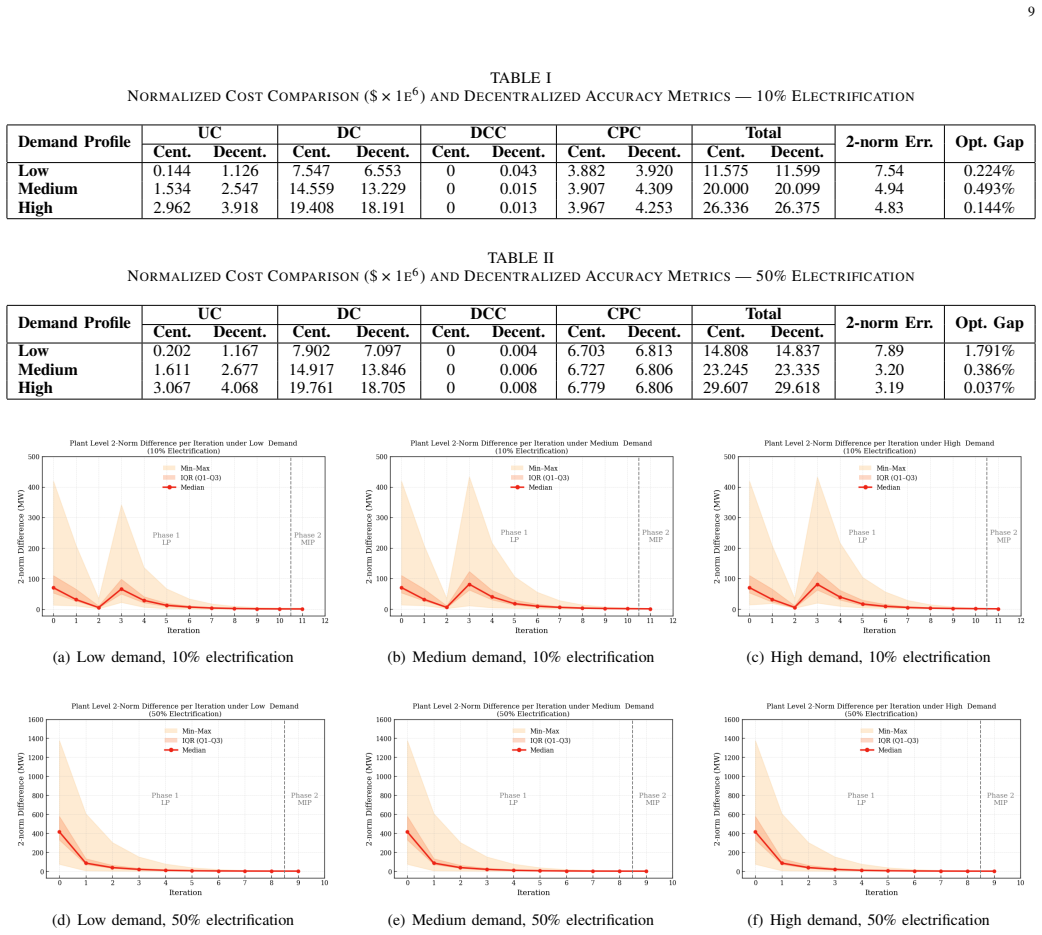
Electrification of ethane cracking offers a promising pathway to industrial decarbonization, provided that the electricity is sourced from renewable energy. However, integrating electrified chemical plant microgrids with a decarbonized power grid requires joint operations planning between Independent System Operators and chemical plants, which is hindered by the highly confidential nature of plant operational data. In this paper, we propose a privacy-friendly decentralized framework based on data isolation that jointly optimizes the Unit Commitment problem in the power system and microgrid scheduling in electrified ethane cracker plants. The framework employs the Alternating Direction Method of Multipliers, augmented with an auxiliary system-level penalty that accelerates convergence, allowing each subsystem to solve its local subproblem and share only minimal coordination signals. To reflect real-world conditions, numerical experiments are conducted on the ACTIVSg2000 test case, a synthetic model of the Texas transmission network, with 26 chemical plants identified from Texas mapped to their nearest grid connection points. In doing so, we characterize the cost of privacy-friendly decomposition on joint power and chemical system decisions, showing that data isolation results in consistently small optimality gaps, and that its emissions consequences are load-dependent and non-monotone.
Editorial analysis
A structured set of objections, weighed in public.
Referee Report
Summary. The paper proposes a privacy-preserving decentralized framework that applies ADMM augmented by an auxiliary system-level penalty to jointly solve the unit commitment problem on a transmission network and microgrid scheduling for electrified ethane-cracking plants. Each subsystem solves its local problem and exchanges only coordination signals. Experiments on the ACTIVSg2000 synthetic Texas model with 26 plants mapped to nearest buses are used to quantify the optimality gap induced by data isolation and to report load-dependent, non-monotone emissions effects.
Significance. A working privacy-friendly decomposition for power-chemical co-optimization would be valuable for industrial decarbonization. The reported small gaps and the non-monotone emissions observation are potentially useful, but both rest entirely on a single synthetic test case whose representativeness is not demonstrated.
major comments (1)
- [Numerical Experiments / abstract] The central claim that the ADMM+auxiliary-penalty method produces 'consistently small optimality gaps' is supported only by experiments on the ACTIVSg2000 model with 26 mapped plants (abstract and numerical-experiments section). No sensitivity analysis to plant mapping errors, different transmission topologies, altered renewable/load profiles, or real plant scheduling constraints is provided; this directly undermines the generality of the gap and emissions results.
Simulated Author's Rebuttal
We thank the referee for the constructive comments on the numerical experiments. We respond to the major comment below.
read point-by-point responses
-
Referee: [Numerical Experiments / abstract] The central claim that the ADMM+auxiliary-penalty method produces 'consistently small optimality gaps' is supported only by experiments on the ACTIVSg2000 model with 26 mapped plants (abstract and numerical-experiments section). No sensitivity analysis to plant mapping errors, different transmission topologies, altered renewable/load profiles, or real plant scheduling constraints is provided; this directly undermines the generality of the gap and emissions results.
Authors: We selected the ACTIVSg2000 synthetic Texas model because it is a standard, publicly available large-scale benchmark representing the ERCOT region, with the 26 plants positioned at nearest buses according to documented Texas chemical plant locations. This setup enables evaluation of the decentralized framework on a realistic instance size. We agree that the current manuscript does not include explicit sensitivity studies on mapping perturbations, alternative topologies, or modified profiles. In the revision we will add a dedicated paragraph in the numerical-experiments section that (i) justifies the choice of ACTIVSg2000, (ii) discusses the implications of nearest-bus mapping, and (iii) explicitly states the limitations regarding broader sensitivity. Full multi-topology experiments remain outside the scope of the present work but are noted as valuable future directions. revision: partial
Circularity Check
No circularity: standard ADMM application with empirical results on synthetic test case
full rationale
The paper applies the existing Alternating Direction Method of Multipliers (ADMM), augmented with an auxiliary penalty, to jointly optimize power-system unit commitment and chemical-plant microgrid scheduling under privacy constraints. The claim of consistently small optimality gaps is an empirical outcome from experiments on the ACTIVSg2000 synthetic Texas model with 26 mapped plants; these gaps are not derived by construction from fitted parameters or self-referential definitions. No load-bearing self-citations, uniqueness theorems, or ansatzes imported from prior author work appear in the derivation chain. The framework is presented as a new application of established methods, with the test-case results serving as external validation rather than tautological inputs.
Axiom & Free-Parameter Ledger
Reference graph
Works this paper leans on
-
[1]
Department of Energy, Manufacturing Energy and Carbon Footprints, [On- line],https://www.energy.gov/eere/iedo/manufacturing-energy-and-carbo n-footprints-2018-mecs, Accessed: May
U.S. Department of Energy, Manufacturing Energy and Carbon Footprints, [On- line],https://www.energy.gov/eere/iedo/manufacturing-energy-and-carbo n-footprints-2018-mecs, Accessed: May. 12, 2026. (2021). 24
2018
-
[2]
D. S. Mallapragada, Y. Dvorkin, M. A. Modestino, D. V. Esposito, W. A. S. et al., Decarbonization of the chemical industry through electrification: Barriers and opportunities, Joule 7 (1) (2023) 23–41.doi:10.1016/j.joule.2022.12.008
-
[3]
Agrawal, J
R. Agrawal, J. Siirola, Decarbonization of chemical process industries via electri- fication, The Bridge: The National Academy of Engineering 53 (2023) 32–40
2023
-
[4]
D. Apostolopoulou, S. Bahramirad, A. Khodaei, The interface of power: Moving toward distribution system operators, IEEE Power and Energy Magazine 14 (3) (2016) 46–51.doi:10.1109/MPE.2016.2524960
-
[5]
O. Inderwildi, C. Zhang, X. Wang, M. Kraft, The impact of intelligent cyber- physical systems on the decarbonization of energy, Energy Environ. Sci. 13 (2020) 744–771.doi:10.1039/C9EE01919G
-
[6]
S. G. Naraghi, T. Kareck, L. Xiao, R. Reed, P. Ramanan, Z. Jiang, Decarboniza- tion of Steam Cracking for Clean Olefins Production: Microgrid Planning and Operation, John Wiley & Sons, Inc., 2026, Ch. 10
2026
-
[7]
EIA, Annual Energy Outlook 2023, [Online],https://www.eia.gov/outloo ks/aeo/, Accessed: Mar
U.S. EIA, Annual Energy Outlook 2023, [Online],https://www.eia.gov/outloo ks/aeo/, Accessed: Mar. 12, 2023. (March 2023)
2023
-
[8]
S. Ghasemi Naraghi, T. Kareck, Z. Jiang, Multi-objective optimization of steam cracking microgrid for clean olefins production, Systems & Control Transactions 4 (2025) 837–843.doi:10.69997/sct.185984
-
[9]
N. P. Johnson, M. L. Bell, N. Perez, R. Dubrow, N. C. Deziel, Steam cracker fa- cilities in the united states: operations, emissions, and sociodemographic patterns of surrounding populations, Environmental Research: Health 1 (3) (2023) 035003. doi:10.1088/2752-5309/acdcb2
-
[10]
N. P. Padhy, Unit commitment-a bibliographical survey, IEEE Transactions on Power Systems 19 (2) (2004) 1196–1205.doi:10.1109/TPWRS.2003.821611
-
[11]
A. Papavasiliou, S. S. Oren, B. Rountree, Applying high performance comput- ing to transmission-constrained stochastic unit commitment for renewable en- ergy integration, IEEE Transactions on Power Systems 30 (3) (2015) 1109–1120. doi:10.1109/TPWRS.2014.2341354
-
[12]
J. Ostrowski, M. F. Anjos, A. Vannelli, Tight mixed integer linear programming formulations for the unit commitment problem, IEEE Transactions on Power Sys- tems 27 (1) (2011) 39–46.doi:10.1109/TPWRS.2011.2162008
-
[13]
Department of Energy, Industrial Decarbonization Roadmap, [Online],ht tps://www.energy.gov/eere/doe-industrial-decarbonization-roadmap, Accessed: May 12, 2026
U.S. Department of Energy, Industrial Decarbonization Roadmap, [Online],ht tps://www.energy.gov/eere/doe-industrial-decarbonization-roadmap, Accessed: May 12, 2026. (September 2022). 25
2026
-
[14]
M. E. H. Tijani, H. Zondag, Y. Van Delft, Review of electric cracking of hydro- carbons, ACS Sustainable Chemistry & Engineering 10 (49) (2022) 16070–16089. doi:10.1021/acssuschemeng.2c03427
-
[15]
V.Balakotaiah, R.R.Ratnakar, Modularreactorswithelectricalresistanceheating for hydrocarbon cracking and other endothermic reactions, AIChE Journal 68 (2) (2022) e17542.doi:10.1002/aic.17542
-
[16]
E. A. Rodriguez-Gil, R. Agrawal, Electric reaction-towers for flexible operation of endothermic reactions under variable power and feed supply rates, Cell Reports Physical Science 6 (8) (2025) 102771.doi:10.1016/j.xcrp.2025.102771
-
[17]
Cybersecurity & Infrastructure Agency, Chemical Sector Profile, [Online],https: //www.cisa.gov/sites/default/files/2023-02/chemical_sector_profile_ final_508_2022_0.pdf, Accessed: May 12, 2026. (2022)
2023
-
[18]
A. Kargarian, Y. Fu, Z. Li, Distributed security-constrained unit commitment for large-scale power systems, IEEE Transactions on Power Systems 30 (4) (2015) 1925–1936.doi:10.1109/TPWRS.2014.2360063
-
[19]
P. Ramanan, M. Yildirim, E. Chow, N. Gebraeel, Asynchronous decentralized framework for unit commitment in power systems, Procedia Computer Science 108 (2017) 665–674.doi:10.1016/j.procs.2017.05.038
-
[20]
P. Ramanan, M. Yildirim, E. Chow, N. Gebraeel, An asynchronous, decentralized solution framework for the large scale unit commitment problem, IEEE Transac- tions on Power Systems 34 (5) (2019) 3677–3686.doi:10.1109/TPWRS.2019.290 9664
-
[21]
P. Ramanan, M. Yildirim, N. Gebraeel, E. Chow, Large-scale maintenance and unit commitment: A decentralized subgradient approach, IEEE Transactions on Power Systems 37 (1) (2021) 237–248.doi:10.1109/TPWRS.2021.3085493
-
[22]
M. J. Feizollahi, M. Costley, S. Ahmed, S. Grijalva, Large-scale decentralized unit commitment, International Journal of Electrical Power & Energy Systems 73 (2015) 97 – 106.doi:10.1016/j.ijepes.2015.04.009
-
[23]
Á. S. Xavier, F. Qiu, S. S. Dey, Decomposable formulation of transmission con- straints for decentralized power systems optimization, INFORMS Journal on Com- puting 36 (6) (2024) 1562–1578.doi:10.1287/ijoc.2022.0326
-
[24]
J. Wang, M. Shahidehpour, Z. Li, Security-constrained unit commitment with volatile wind power generation, IEEE Transactions on Power Systems 23 (3) (2008) 1319–1327.doi:10.1109/TPWRS.2008.926719. 26
-
[25]
N. Yang, et al., A comprehensive review of security-constrained unit commitment, Journal of Modern Power Systems and Clean Energy 10 (3) (2022) 562–576.doi: 10.35833/MPCE.2021.000255
-
[26]
S. Boyd, N. Parikh, E. Chu, B. Peleato, J. Eckstein, Distributed optimization and statistical learning via the alternating direction method of multipliers, Foundations and Trends in Machine Learning 3 (1) (2011) 1–122.doi:10.1561/2200000016
-
[27]
E. Wei, A. Ozdaglar, Distributed alternating direction method of multipliers, in: 51st IEEE Conference on Decision and Control (CDC), 2012, pp. 5445–5450.doi: 10.1109/CDC.2012.6425904
-
[28]
B. D. Biswas, M. S. Hasan, S. Kamalasadan, Decentralized distributed convex optimal power flow model for power distribution system based on alternating di- rection method of multipliers, IEEE Transactions on Industry Applications 59 (1) (2023) 627–640.doi:10.1109/TIA.2022.3217023
-
[29]
T. Erseghe, Distributed optimal power flow using admm, IEEE Transactions on Power Systems 29 (5) (2014) 2370–2380.doi:10.1109/TPWRS.2014.2306495
-
[30]
world’s most important chemical
AFPM Communications, Ethylene: the “world’s most important chemical”,https: //www.afpm.org/newsroom/blog/ethylene-worlds-most-important-chemica l, [Online; accessed November 21, 2025] (2017)
2025
-
[31]
Precedence Research, Ethylene market size, share, and trends 2024 to 2033, [On- line],https://www.precedenceresearch.com/ethylene-market, Accessed: September 16, 2024. (2024)
2024
-
[32]
Zimmermann, R
H. Zimmermann, R. Walzl, Ethylene, John Wiley & Sons, Ltd, 2009.doi:10.100 2/14356007.a10_313.pub2
2009
-
[33]
T. Ren, M. Patel, K. Blok, Olefins from conventional and heavy feedstocks: Energy use in steam cracking and alternative processes, Energy 31 (4) (2006) 425–451. doi:10.1016/j.energy.2005.04.001
-
[34]
S. G. Naraghi, R. Reed, T. Kareck, P. Ramanan, Z. Jiang, Toward decarbonization of chemical manufacturing: Joint optimization of unit commitment and microgrid operations (2026).arXiv:2606.23400
work page internal anchor Pith review Pith/arXiv arXiv 2026
-
[35]
Texas A&M University, Electric Grid Test Case: Activsg2000, [Online],https: //electricgrids.engr.tamu.edu/electric-grid-test-cases/activsg2000/, Accessed: May 12, 2026. (2024)
2026
-
[36]
R. D. Zimmerman, C. E. Murillo-Sanchez, R. J. Thomas, Matpower: Steady-state operations, planning, and analysis tools for power systems research and education, IEEE Transactions on Power Systems 26 (1) (2011) 12–19.doi:10.1109/TPWRS. 2010.2051168. 27
-
[37]
SABIC, BASF, SABIC, and Linde celebrate the start-up of the world’s first large- scale electrically heated steam cracking furnace, [Online],https://www.basf.com /global/en/media/news-releases/2024/04/p-24-177, Accessed: September 16, 2025. (2024)
2024
-
[38]
L. Dalcin, R. Paz, M. Storti, J. D’Elia, Mpi for python: Performance improvements and mpi-2 extensions, Journal of Parallel and Distributed Computing 68 (5) (2008) 655–662.doi:10.1016/j.jpdc.2007.09.005. 28
discussion (0)
Sign in with ORCID, Apple, or X to comment. Anyone can read and Pith papers without signing in.