Spin polarization enhancement in a single-layer Bi(1-x)Sb(x) alloy on Ag(111) via isovalent substitution
Pith reviewed 2026-05-20 03:35 UTC · model grok-4.3
The pith
Substituting Sb for Bi in a single-layer alloy on Ag(111) induces in-plane and out-of-plane potential asymmetries that produce sizable spin splitting and polarization in the surface bands.
A machine-rendered reading of the paper's core claim, the machinery that carries it, and where it could break.
Core claim
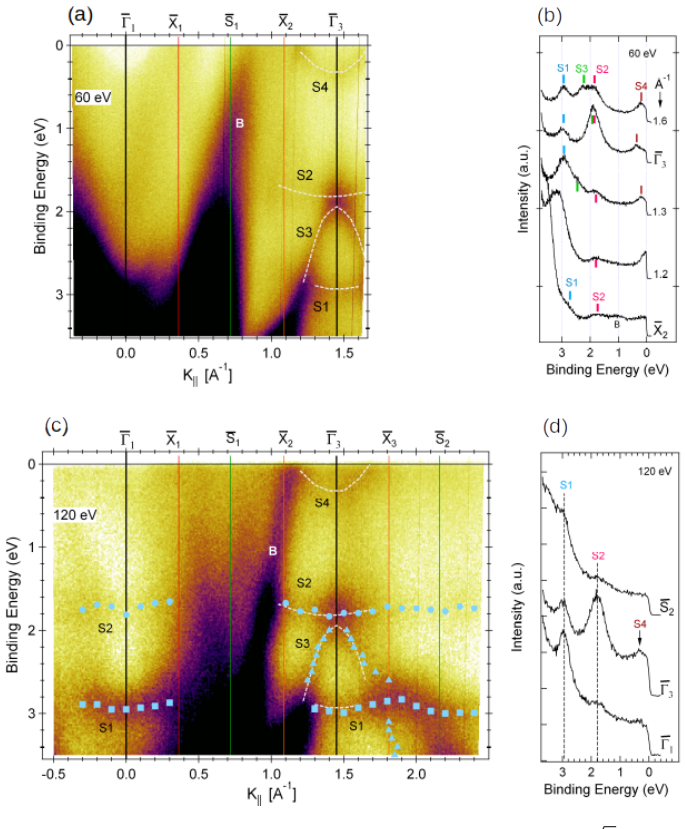
Co-adsorption of Bi and Sb on Ag(111) at room temperature yields a single-layer alloy with a rectangular 3xsqrt(3) structure containing four atoms per unit cell and lacking long-range chemical order. ARPES reveals four surface-state bands in good agreement with DFT calculations based on a rectangular four-atom overlayer unit cell. DFT further shows that Sb incorporation induces both in-plane and out-of-plane asymmetries in the electronic potential, leading to sizable spin splitting and spin polarization of the overlayer bands. Although these effects are partially reduced by interaction with the substrate, they remain significant. The work illustrates the general principle that incorporating
What carries the argument
Sb-induced in-plane and out-of-plane asymmetries in the electronic potential inside the rectangular four-atom overlayer unit cell
If this is right
- Four surface-state bands appear in ARPES and match the bands calculated for the rectangular four-atom cell.
- Both in-plane and out-of-plane potential asymmetries arise from Sb substitution within the fixed crystallographic framework.
- Sizable spin splitting and spin polarization are produced even though substrate interaction reduces their magnitude.
- Incorporating a lighter isovalent element supplies a useful design guideline for Rashba-related systems.
Where Pith is reading between the lines
- The same substitution strategy could be tested on other heavy-metal surface alloys to tune spin-orbit splitting without altering the lattice constant.
- Systematic variation of Sb concentration in the alloy would reveal how the degree of spin polarization scales with the strength of the induced asymmetry.
- The robustness of the effect despite absent long-range chemical order suggests it may persist in other disordered two-dimensional alloys.
Load-bearing premise
The rectangular four-atom overlayer unit cell model used in DFT accurately represents the actual atomic arrangement and chemical disorder in the Bi-rich alloy.
What would settle it
Spin-resolved ARPES measurements on the same Bi-rich alloy that show spin polarization much smaller than the DFT prediction would indicate that substrate-induced modifications suppress the calculated asymmetries beyond what the model already includes.
Figures




read the original abstract
Co-adsorption of Bi and Sb on Ag(111) at room temperature yields a single-layer Bi(1-x)Sb(x) alloy with a rectangular 3xsqrt(3) structure containing four atoms per unit cell (2/3 ML total coverage) and lacking long-range chemical order. We present an electronic structure study of this system combining angle-resolved photoemission spectroscopy (ARPES) and density functional theory (DFT) calculations. To investigate the effect of inversion symmetry breaking induced by substituting a heavier atom (Bi) with a lighter isoelectronic one (Sb) within a fixed crystallographic framework, we focused on a Bi-rich composition. ARPES measurements reveal four surface-state bands, in good agreement with DFT calculations based on a rectangular four-atom overlayer unit cell. DFT calculations further show that Sb incorporation induces both in-plane and out-of-plane asymmetries in the electronic potential, leading to sizable spin splitting and spin polarization of the overlayer bands. Although these effects are partially reduced by interaction with the substrate, they remain significant. Our work illustrates, through a concrete model system, a general principle: incorporating a lighter isovalent element can significantly enhance spin polarization, potentially offering a useful design guideline for understanding and engineering Rashba-related systems.
Editorial analysis
A structured set of objections, weighed in public.
Referee Report
Summary. The paper reports ARPES measurements and DFT calculations on a single-layer Bi-rich Bi(1-x)Sb(x) alloy on Ag(111) with a rectangular 3x√3 structure (four atoms per unit cell, 2/3 ML coverage) lacking long-range chemical order. The central claim is that isovalent Sb substitution induces in-plane and out-of-plane electronic potential asymmetries that produce sizable spin splitting and polarization in the overlayer bands; these effects are partially reduced by substrate interaction but remain significant. ARPES bands are stated to agree with DFT results based on the ordered four-atom cell model, and the work is presented as illustrating a general design principle for enhancing spin polarization in Rashba-related systems via lighter isovalent substitution.
Significance. If the central claim holds, the result provides a concrete experimental-theoretical example of how isovalent substitution can be used to break inversion symmetry and enhance spin polarization in surface alloys, offering a potentially useful guideline for engineering Rashba systems. The combination of ARPES data with DFT calculations on a specific model system is a strength, as is the focus on a Bi-rich composition to isolate the substitution effect.
major comments (1)
- [DFT calculations and model description] The DFT calculations rely on a fixed rectangular four-atom overlayer unit cell with specific Bi/Sb atomic placements (noted as lacking long-range chemical order). This ordered supercell necessarily imposes deterministic symmetry breaking that may not survive configurational averaging in the actual disordered alloy; without explicit disorder averaging, larger random supercells, or a demonstration that the net asymmetry remains sizable after averaging, it is unclear whether the reported spin splitting and polarization are representative of the experimental system or partly an artifact of the imposed periodicity. This directly bears on the central claim that Sb incorporation leads to significant spin effects.
minor comments (2)
- [Abstract] The abstract states that ARPES data are 'in good agreement' with DFT but provides no quantitative polarization values, error bars, or details on data exclusion criteria, which limits independent verification of the claimed agreement.
- [Abstract and introduction] Clarify the precise coverage and structure notation (abstract refers to 'rectangular 3x√3' while the title mentions 'single-layer'); ensure consistent description of the unit cell throughout.
Simulated Author's Rebuttal
We are grateful to the referee for their thorough review and for highlighting an important aspect of our computational modeling. Below we address the major comment in detail.
read point-by-point responses
-
Referee: [DFT calculations and model description] The DFT calculations rely on a fixed rectangular four-atom overlayer unit cell with specific Bi/Sb atomic placements (noted as lacking long-range chemical order). This ordered supercell necessarily imposes deterministic symmetry breaking that may not survive configurational averaging in the actual disordered alloy; without explicit disorder averaging, larger random supercells, or a demonstration that the net asymmetry remains sizable after averaging, it is unclear whether the reported spin splitting and polarization are representative of the experimental system or partly an artifact of the imposed periodicity. This directly bears on the central claim that Sb incorporation leads to significant spin effects.
Authors: We thank the referee for this important observation. The manuscript states that the alloy lacks long-range chemical order, and our DFT calculations employ an ordered four-atom cell as a simplified model to represent the average composition and to compute the electronic structure. We chose specific Bi/Sb placements to reflect a Bi-rich alloy. While we did not perform explicit configurational averaging over large supercells, the potential asymmetries induced by the isovalent substitution are local in nature and lead to spin splitting that is consistent with the experimental ARPES results. In the revised manuscript, we will add a paragraph in the discussion section addressing this point, explaining the model choice and noting that the observed agreement with experiment supports the relevance of the calculated spin effects. We will also include a supplementary figure showing the spin polarization for an alternative atomic configuration within the same cell size to illustrate robustness. revision: partial
Circularity Check
No significant circularity; derivation rests on explicit DFT model cross-validated by ARPES
full rationale
The paper computes electronic structure via DFT on a rectangular four-atom unit cell for the Bi-rich alloy, identifies in-plane/out-of-plane potential asymmetries from Sb substitution, and reports sizable spin splitting/polarization (partially reduced by substrate). These results are directly compared to independent ARPES data showing four surface-state bands in good agreement. No equations reduce a prediction to a fitted input by construction, no self-definitional loops appear, and no load-bearing self-citations or uniqueness theorems are invoked in the provided text. The ordered-cell modeling choice is stated explicitly as an approximation lacking long-range order; agreement with experiment supplies external validation rather than internal redefinition. The derivation is therefore self-contained against the stated benchmarks.
Axiom & Free-Parameter Ledger
axioms (2)
- domain assumption DFT calculations with spin-orbit coupling correctly capture the electronic potential asymmetries induced by Sb substitution in the overlayer.
- domain assumption The substrate interaction reduces but does not eliminate the spin effects predicted for the free-standing alloy.
Lean theorems connected to this paper
-
IndisputableMonolith/Foundation/AlexanderDuality.leanalexander_duality_circle_linking unclear?
unclearRelation between the paper passage and the cited Recognition theorem.
DFT calculations further show that Sb incorporation induces both in-plane and out-of-plane asymmetries in the electronic potential, leading to sizable spin splitting and spin polarization of the overlayer bands.
-
IndisputableMonolith/Foundation/ArithmeticFromLogic.leanLogicNat unclear?
unclearRelation between the paper passage and the cited Recognition theorem.
rectangular four-atom overlayer unit cell model
What do these tags mean?
- matches
- The paper's claim is directly supported by a theorem in the formal canon.
- supports
- The theorem supports part of the paper's argument, but the paper may add assumptions or extra steps.
- extends
- The paper goes beyond the formal theorem; the theorem is a base layer rather than the whole result.
- uses
- The paper appears to rely on the theorem as machinery.
- contradicts
- The paper's claim conflicts with a theorem or certificate in the canon.
- unclear
- Pith found a possible connection, but the passage is too broad, indirect, or ambiguous to say the theorem truly supports the claim.
Reference graph
Works this paper leans on
-
[1]
Hsieh, D. and Qian, D. and Wray, L. and Xia, Y. and Hor, Y. S. and Cava, R. J. and Hasan, M. Z. , title=. Nature , year=. doi:10.1038/nature06843 , url=
-
[2]
Topological surface states in ultrathin
Baringthon, La. Topological surface states in ultrathin. Phys. Rev. Mater. , volume =. 2022 , month =. doi:10.1103/PhysRevMaterials.6.074204 , url =
-
[3]
Sobhit Singh and Aldo H. Romero , title =. Phys. Rev. B , volume =. 2017 , doi =
work page 2017
-
[4]
G Bihlmayer and Yu M Koroteev and E. V. Chulkov and S. Bl. Surface- and edge-states in ultrathin Bi–Sb films , journal =. 2010 , doi =
work page 2010
-
[5]
Ch. R. Ast and J. Henk and A. Ernst and L. Moreschini and M. C. Falub and D. Pacil. Giant Spin Splitting through Surface Alloying , journal =. 2007 , doi =
work page 2007
-
[6]
Observation of a surface alloying-to-dealloying transition during growth of Bi on Ag(111) , author =. Phys. Rev. B , volume =. 2011 , month =. doi:10.1103/PhysRevB.83.235418 , url =
-
[7]
G. Bian and X. Wang and T. Miller and and T.-C. Chiang , title =. Phys. Rev. B , volume =. 2011 , doi =
work page 2011
-
[8]
I. Gierz and F. Meier and J. H. Dil and K. Kern and Ch. R. Ast , title =. Phys. Rev. B , volume =. 2011 , doi =
work page 2011
-
[9]
Shao, Yan and Liu, Zhong-Liu and Cheng, Cai and Wu, Xu and Liu, Hang and Liu, Chen and Wang, Jia-Ou and Zhu, Shi-Yu and Wang, Yu-Qi and Shi, Dong-Xia and Ibrahim, Kurash and Sun, Jia-Tao and Wang, Ye-Liang and Gao, Hong-Jun , title=. Nano Letters , year=. doi:10.1021/acs.nanolett.8b00429 , url=
-
[10]
Y.-H. Mao and L.-F. Zhang and H.-L. Wang and H. Shan and X.-Fa. Zhai and Z.-P. Hu and A.-D. Zhao and B. Wang , title =. Front. Phys. , volume =. 2018 , doi =
work page 2018
-
[11]
Zhang, Ping and Ma, Chen and Sheng, Shaoxiang and Liu, Huiru and Gao, Jisong and Liu, Zijia and Cheng, Peng and Feng, Baojie and Chen, Lan and Wu, Kehui , journal =. Absence of topological. 2022 , month =. doi:10.1103/PhysRevMaterials.6.074002 , url =
-
[12]
Cantero, Esteban D. and Mart. Synthesis and Characterization of a Pure 2D Antimony Film on Au(111) , journal=. 2021 , month=. doi:10.1021/acs.jpcc.1c01104 , url=
-
[13]
Paolo Giannozzi and Stefano Baroni and Nicola Bonini and Matteo Calandra and Roberto Car and Carlo Cavazzoni and Davide Ceresoli and Guido L Chiarotti and Matteo Cococcioni and Ismaila Dabo and Andrea Dal Corso and Stefano de Gironcoli and Stefano Fabris and Guido Fratesi and Ralph Gebauer and Uwe Gerstmann and Christos Gougoussis and Anton Kokalj and Mic...
-
[14]
van der Waals density functional made accurate , author =. Phys. Rev. B , volume =. 2014 , month =. doi:10.1103/PhysRevB.89.121103 , url =
-
[15]
Higher-accuracy van der Waals density functional , author =. Phys. Rev. B , volume =. 2010 , month =. doi:10.1103/PhysRevB.82.081101 , url =
-
[16]
Generalized Gradient Approximation Made Simple , author =. Phys. Rev. Lett. , volume =. 1996 , month =. doi:10.1103/PhysRevLett.77.3865 , url =
-
[17]
Journal of Computational Chemistry , volume =
Grimme, Stefan , title =. Journal of Computational Chemistry , volume =. doi:https://doi.org/10.1002/jcc.20495 , url =. https://onlinelibrary.wiley.com/doi/pdf/10.1002/jcc.20495 , abstract =
-
[18]
Properties of a 2D electron gas with lefted spectral degeneracy , author =. JETP Lett , volume =. 1984 , month =. doi:, url =
work page 1984
-
[19]
Orbital-Angular-Momentum Based Origin of Rashba-Type Surface Band Splitting , author =. Phys. Rev. Lett. , volume =. 2011 , month =. doi:10.1103/PhysRevLett.107.156803 , url =
-
[20]
Microscopic mechanism for asymmetric charge distribution in Rashba-type surface states and the origin of the energy splitting scale , author =. Phys. Rev. B , volume =. 2013 , month =. doi:10.1103/PhysRevB.88.205408 , url =
-
[21]
Spin-orbit splitting in an anisotropic two-dimensional electron gas , author =. Phys. Rev. B , volume =. 2007 , month =. doi:10.1103/PhysRevB.76.073310 , url =
-
[22]
G. Bihlmayer and P. No. Rashba-like physics in condensed matter , journal =. 2022 , doi =
work page 2022
-
[23]
A. Manchon and H. C. Koo and J. Nitta and S. M. Frolov and R. A. Duine , title =. Nature , volume =. 2015 , doi =
work page 2015
-
[24]
J.C. Rojas S. Spin-to-charge conversion using Rashba coupling at the interface between non-magnetic materials , journal =. 2013 , doi =
work page 2013
-
[25]
D. Pacil. Electronic structure of an ordered Pb/Ag(111) surface alloy: Theory and experiment , journal =. 2006 , doi =
work page 2006
-
[26]
F. Meier and V. Petrov and S. Guerrero and Ch. Mudry and L. Patthey and J. Osterwalder and J. Hugo Dil , title =. Phys. Rev. B , volume =. 2009 , doi =
work page 2009
-
[27]
L. Moreschini and A. Bendounan and I. Gierz and C. R. Ast and H. Mirhosseini and H. H. Assessing the atomic contribution to the Rashba spin-orbit splitting in surface alloys: Sb/Ag(111) , journal =. 2009 , doi =
work page 2009
-
[28]
H. L. Zhang and Wei Chen and X. S. Wang and J. Yuhara and A. T. Shen Wee , title =. Applied Surface Science , volume =. 2009 , doi =
work page 2009
-
[29]
Quantum-Well-Induced Giant Spin-Orbit Splitting , author =. Phys. Rev. Lett. , volume =. 2010 , month =. doi:10.1103/PhysRevLett.104.066802 , url =
-
[30]
Giant and Tunable Out-of-Plane Spin Polarization of Topological Antimonene , author =. NanoLett. , volume =. 2023 , month =. doi:10.1021/acs.nanolett.3c00153 , url =
-
[31]
One-dimensional Rashba states with unconventional spin texture in Bi chains , author =. Phys. Rev. B , volume =. 2022 , month =. doi:10.1103/PhysRevB.106.045108 , url =
-
[32]
Giant Rashba-splitting of one-dimensional metallic states in Bi dimer lines on InAs(100) , author =. Nanoscale , volume =. 2023 , month =. doi:10.1039/d4nr01591f , url =
-
[33]
Hu, Jinbang and Wang, Xiansi and. Unconventional broadening of Rashba spin splitting in a Au2Sb surface alloy with periodic structural defects , journal=. 2025 , month=. doi:10.1038/s41535-024-00724-5 , url=
-
[34]
Fuhr, Javier D. and Gayone, J. Esteban and Ascolani, Hugo , title=. The Journal of Physical Chemistry C , year=. doi:10.1021/acs.jpcc.4c05672 , url=
-
[35]
Joco, V. Electronic structure of bulk and low dimensional systems analyzed by Angle-Resolved Photoemission Spectroscopy , school =. 2008 , OPTkey =
work page 2008
-
[36]
F. Reis and G. Li and L. Dudy and et al. , title =. Science , volume =. 2017 , doi =
work page 2017
- [37]
- [38]
discussion (0)
Sign in with ORCID, Apple, or X to comment. Anyone can read and Pith papers without signing in.