Optothermal Actuation of Unidirectional Thermo-osmotic Flows
Pith reviewed 2026-06-29 03:23 UTC · model grok-4.3
The pith
Off-center laser irradiation on an immobilized microparticle produces unidirectional thermo-osmotic flows.
A machine-rendered reading of the paper's core claim, the machinery that carries it, and where it could break.
Core claim
The off-center laser irradiation on an immobilized light-absorbing microparticle generates a nonuniform, asymmetric heat source that produces unidirectional thermo-osmotic flows whose characteristics can be modulated by ionic strength and surface molecular coating. The flows are measured using optically trapped particle tracking velocimetry, and the role of ionic strength is linked to changes in substrate surface potential observed via frequency-modulated atomic force microscopy.
What carries the argument
Off-center focused-laser heating of an immobilized light-absorbing microparticle that creates an asymmetric heat source driving thermo-osmotic flow.
If this is right
- Positioning the laser beam off-center controls the direction of the resulting flow.
- Varying the ionic strength of the solution alters the flow characteristics through changes in surface potential.
- Applying different molecular coatings to the substrate modulates the thermo-osmotic flows.
- The ot-PTV technique enables evaluation of these microscale flows.
Where Pith is reading between the lines
- Such control could allow light to act as a remote switch for fluid motion in microfluidic setups.
- Combining this with different particle sizes or materials might extend the range of achievable flow rates.
- If the surface potential measurement correlates strongly, it suggests thermo-osmosis here is dominated by electrical double layer effects rather than pure thermal gradients.
Load-bearing premise
The optically trapped particle tracking velocimetry accurately measures the flow field without interference from the trapping laser or the particle immobilization method.
What would settle it
Direct measurement showing that the flow remains symmetric or bidirectional when the laser is deliberately offset from the particle center would falsify the claim that asymmetric heating produces unidirectional flow.
Figures


read the original abstract
In this paper, we experimentally demonstrate the microscale direction control of thermoosmotic flows using a focused-laser heating. The key is the off-center laser irradiation on an immobilized light-absorbing microparticle, which generates a nonuniform, asymmetric heat source. The resulting thermo-osmotic flows are evaluated using the optically trapped particle tracking velocimetry (ot-PTV), presented in our preceding paper (T. Tsuji, et al., Physical Review Fluids 11, 034901 (2026)). It is shown that the flow characteristics can be modulated by the ionic strength of a sample solution and/or the surface molecular coating of the substrate. In particular, the significance of ionic strength on thermo-osmotic flows are discussed based on the surface potential of the substrate measured by frequency-modulated atomic force microscopy.
Editorial analysis
A structured set of objections, weighed in public.
Referee Report
Summary. The manuscript experimentally demonstrates microscale directional control of thermo-osmotic flows via off-center focused-laser irradiation of an immobilized light-absorbing microparticle, which creates a nonuniform asymmetric heat source. Flow fields are quantified using optically trapped particle tracking velocimetry (ot-PTV) imported from a preceding 2026 paper; the resulting unidirectional flows are shown to be tunable by solution ionic strength and substrate surface molecular coating, with ionic-strength effects interpreted through frequency-modulated AFM measurements of substrate surface potential.
Significance. If the reported velocity fields are free of measurement artifacts, the work supplies a practical optothermal route to unidirectional microscale flow actuation whose direction and strength can be modulated externally. This could enable new microfluidic pumping and particle-transport schemes that avoid moving parts, while the ionic-strength and surface-coating results add mechanistic insight into thermo-osmosis at solid-liquid interfaces.
major comments (1)
- [Abstract/Methods] Abstract and Methods (ot-PTV implementation): the central claim that off-center laser heating produces unidirectional thermo-osmotic flows rests entirely on velocity fields obtained with the ot-PTV technique from the preceding paper. No new controls (symmetric-heating baselines, laser-off reference fields, or cross-validation against an independent velocimetry method) are described for the specific geometry of an immobilized particle under off-center irradiation. Without such checks, trapping-laser-induced flows or immobilization-induced surface perturbations cannot be ruled out as contributors to the reported directionality and ionic-strength dependence.
Simulated Author's Rebuttal
We thank the referee for the detailed and constructive report. The concern regarding validation of the ot-PTV measurements in the specific off-center heating geometry is well taken. We address it point-by-point below and will revise the manuscript to incorporate additional controls.
read point-by-point responses
-
Referee: [Abstract/Methods] Abstract and Methods (ot-PTV implementation): the central claim that off-center laser heating produces unidirectional thermo-osmotic flows rests entirely on velocity fields obtained with the ot-PTV technique from the preceding paper. No new controls (symmetric-heating baselines, laser-off reference fields, or cross-validation against an independent velocimetry method) are described for the specific geometry of an immobilized particle under off-center irradiation. Without such checks, trapping-laser-induced flows or immobilization-induced surface perturbations cannot be ruled out as contributors to the reported directionality and ionic-strength dependence.
Authors: We agree that the manuscript applies the ot-PTV method from the preceding 2026 paper without describing new controls tailored to the immobilized-particle, off-center-irradiation geometry. The prior validation covered a range of conditions but did not explicitly include this asymmetric heating configuration. To rule out possible artifacts from the trapping laser or immobilization, we will add symmetric-heating baselines, laser-off reference fields, and a brief cross-check against an independent method (e.g., standard micro-PIV) in the revised Methods and Results sections. These additions will be presented as new figures or supplementary data. revision: yes
Circularity Check
No significant circularity in experimental demonstration
full rationale
This is an experimental paper whose central claims rest on direct measurements of thermo-osmotic flows generated by off-center laser heating of an immobilized particle. The only self-citation is to the ot-PTV velocimetry method introduced in a preceding paper by the same group; that citation references an independent experimental technique rather than supplying the physical result itself. No equations, fitted parameters, ansatzes, or derivations appear that could reduce a claimed prediction to its own inputs by construction. The observations are presented as measured data modulated by ionic strength and surface coating, with no load-bearing step that collapses to self-reference.
Axiom & Free-Parameter Ledger
axioms (1)
- domain assumption Thermo-osmotic flow arises from temperature gradients interacting with surface charges in electrolyte solutions.
Reference graph
Works this paper leans on
-
[1]
2(b,c,d,e) where no tracer is ob- 4 served near the heating position)
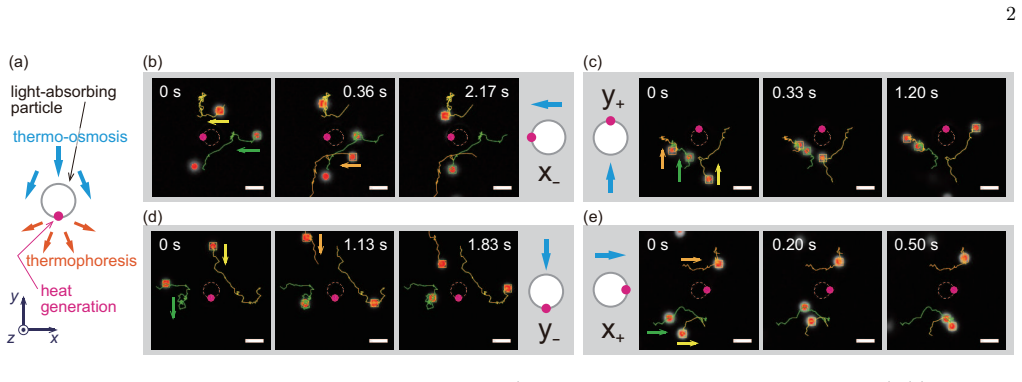
Thexy position of measurement can be set even at a tracer-sparse region which is created due to ther- mophoresis pushing tracers away from the heating position (see Fig. 2(b,c,d,e) where no tracer is ob- 4 served near the heating position)
-
[2]
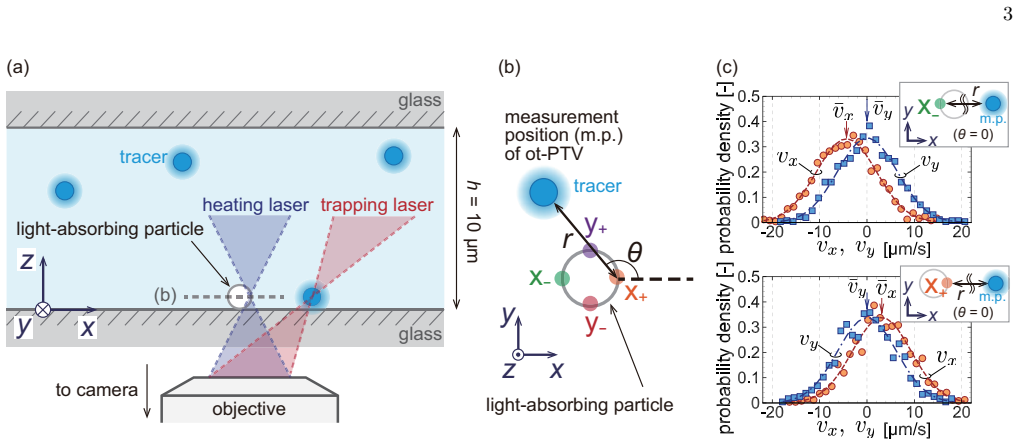
The z position of the measurement can be the same for all runs and all tracer displacements, thereby enabling the evaluation of thermo-osmotic flow which decays immediately as the distance from the wall increases. We may carry out usual par- ticle image velocimetry (PIV) or PTV instead of ot-PTV, but in this case we cannot control the z position which is e...
-
[3]
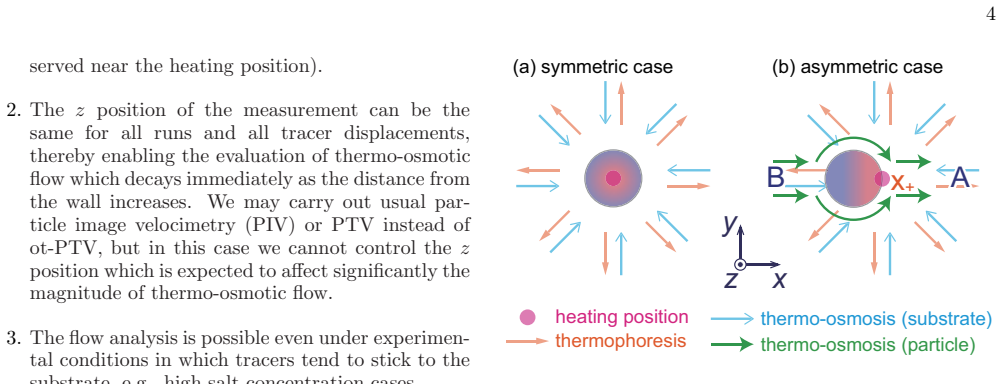
The flow analysis is possible even under experimen- tal conditions in which tracers tend to stick to the substrate, e.g., high salt concentration cases. III. RESULTS A. Competition between thermo-osmosis and thermophoresis Figure 4 schematically shows possible contributions to the tracer motion driven by local heating, namely, ther- mophoresis and thermo-o...
-
[4]
4) is opposite
while the thermo-osmotic flow over the substrate (cyan arrows in Fig. 4) is opposite. Then, the tracers tend to stay at a specific radial position at which the thermophoretic force and the drag force by thermo-osmotic flow counterbalance. Next, let us consider the asymmetric case, where the heating laser is focused at the off-center position x+. Now, in addit...
-
[5]
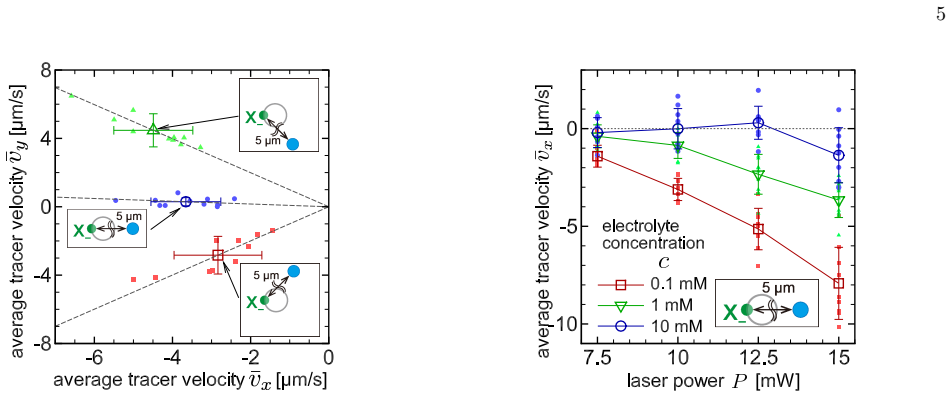
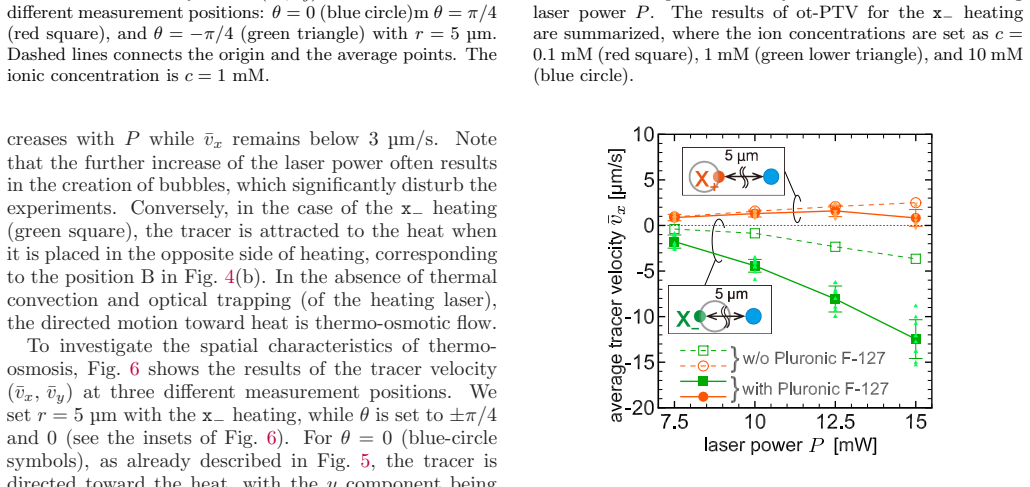
1 mM (red square), 1 mM (green lower triangle), and 10 mM (blue circle). FIG. 8. Effect of the surface coating of the substrate by a nonionic surfactant Pluronic F-127. The average velocitie s ¯vx for various heating laser power P and for the x− and x+ heating are summarized, where filled and empty symbols rep- resent the cases with Pluronic coating and wit...
-
[6]
32 mC/m 2 for glass [ 40] and the exper- imental condition n0 = cNA with c = 0
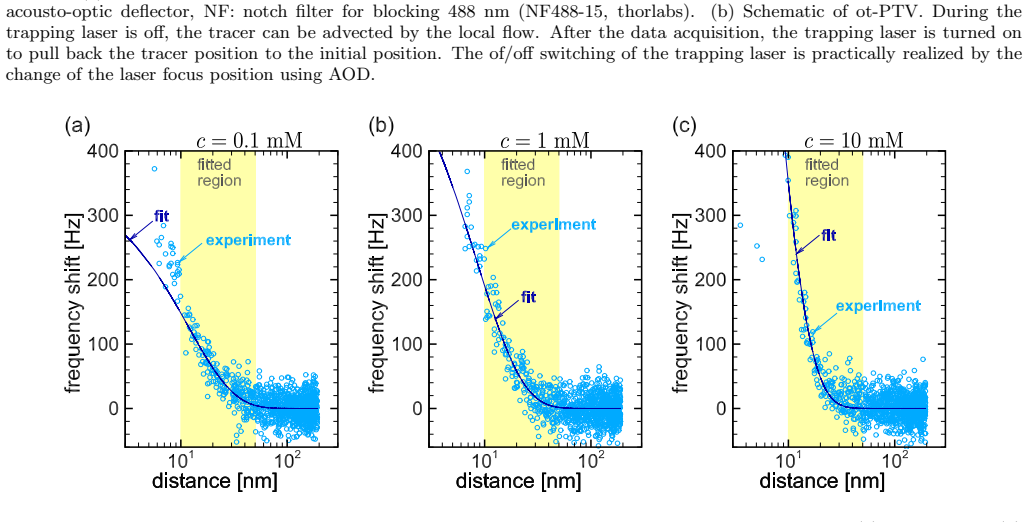
and ( 2), we use the typical literature value of σ = − 0. 32 mC/m 2 for glass [ 40] and the exper- imental condition n0 = cNA with c = 0. 1, 1, 10 mM to compute the surface potential ψ 0 and the Debye length λ D, which are shown in Table I using Eq. ( 2) with charge- constant setting. Although qualitative, the FM-AFM ex- perimental results in Table I are ...
-
[7]
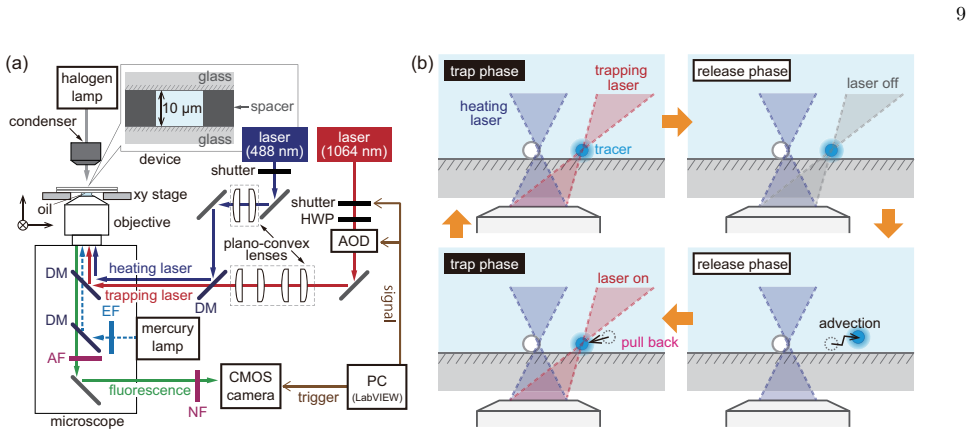
Flow analysis using ot-PTV Optical setup : A trapping laser (wavelength 1064 ± 1 nm; PowerWave 1064, NPI Laser) and a heating laser (wave- length 488 ± 5 nm; 06-MLD, Cobolt) are both guided to an inverted microscope (IX-73, Olympus), as shown in Fig. 9(a). The microscope integrates two dichroic mir- ror units: one for the lasers and the other for fluoresce...
-
[8]
1 9 . 0 ± 1. 3 12 . 5 ± 1. 8 0 . 49 ± 0. 02 − 13. 6 30 . 4 1 8 . 1 ± 0. 8 8 . 9 ± 1. 0 0 . 62 ± 0. 04 − 4. 4 9 . 6 10 5 . 6 ± 0. 7 6 . 2 ± 1. 3 0 . 63 ± 0. 09 − 1. 4 3 . 0 a florescence filter unit (U-FUW, Olympus) which is de- signed for excitation at a wavelength of 340–390 nm and emission at a wavelength of > 420 nm. For ot-PTV, an acousto-optic deflector...
-
[9]
Some details of the light- absorbing particles, such as the scanning electron micro- scope images and the absorption spectral, can be found in Ref
31 µm is diluted 4000 folds using ethanol and dripped onto the cleaned substrates. Some details of the light- absorbing particles, such as the scanning electron micro- scope images and the absorption spectral, can be found in Ref. [ 23]. Waiting for 90 minutes to evaporate ethanol, finally we get the substrates with the light-absorbing particles being fixed...
-
[10]
The measurements are per- formed using an AFM system (SPM-8100FM, Shimadzu Corp.) equipped with a spherical AFM probe (Biosphere B300-NCH, Nanotools)
Surface potential analysis using AFM Surface potentials of the substrates in tris-HCl aqueous solutions are estimated by frequency-modulation atomic force microscopy (FM-AFM). The measurements are per- formed using an AFM system (SPM-8100FM, Shimadzu Corp.) equipped with a spherical AFM probe (Biosphere B300-NCH, Nanotools). FM mode provides higher force ...
-
[11]
The electric double-layer interaction is analyzed us- ing a charge-regulation model based on the Poisson- Boltzmann theory [ 44]
4 N/m, respectively. The electric double-layer interaction is analyzed us- ing a charge-regulation model based on the Poisson- Boltzmann theory [ 44]. The regulation parameter is fixed at p = 0. 5, corresponding to an intermediate condi- tion between the constant-potential and constant-charge limits. The frequency shift ∆ f (hd) due to the electric double-...
-
[12]
B. V. Derjaguin, N. V. Churaev, and M. M. Muller, Sur- face Forces (Springer, 1987)
1987
-
[13]
A. P. Bregulla, A. W¨ urger, K. G¨ unther, M. Mer- tig, and F. Cichos, Thermo-osmotic flow in thin films, Physical Review Letters 116, 188303 (2016)
2016
-
[14]
Sone, Molecular Gas Dynamics: Theory, Techniques, and Applications (Birkh¨ auser Boston, 2007)
Y. Sone, Molecular Gas Dynamics: Theory, Techniques, and Applications (Birkh¨ auser Boston, 2007)
2007
-
[15]
X. Wang, T. Su, W. Zhang, Z. Zhang, and S. Zhang, Knudsen pumps: a review, Microsystems & Nanoengineering 6, 26 (2020)
2020
-
[16]
Cortes, C
J. Cortes, C. Stanczak, M. Azadi, M. Narula, S. M. Nicaise, H. Hu, and I. Bargatin, Pho- tophoretic levitation of macroscopic nanocardboard plates, Advanced Materials 32, 1906878 (2020)
2020
-
[17]
B. C. Schafer, J.-h. Kim, F. Sharipov, G.-S. Hwang, J. J. Vlassak, and D. W. Keith, Photophoretic flight of perforated structures in near-space conditions, Nature 644, 362 (2025)
2025
-
[18]
H. Han, X. Li, H. Zhu, H. Yu, L. Liu, Z. Wang, J. He, B. He, and R. Li, Photophoretic lift for carbon-nanotube-coated polyester film: A com- bined numerical and experimental approach, Physical Review Applied 24, 054008 (2025)
2025
-
[19]
Tsuji, S
T. Tsuji, S. Saito, and S. Taguchi, Semianalyti- cal model of optothermal fluidics in a confinement, Physical Review Fluids 9, 124202 (2024)
2024
-
[20]
L. Fu, S. Merabia, and L. Joly, What controls thermo-osmosis? Molecular simulations show the critical role of interfacial hydrodynamics, Physical Review Letters 119, 214501 (2017)
2017
-
[21]
X. Wang, M. Liu, D. Jing, A. Mohamad, and O. Prezhdo, Net unidirectional fluid transport in locally heated nanochannel by thermo-osmosis, Nano Letters 20, 8965 (2020)
2020
-
[22]
K. Qi, Z. Li, J. Wang, and G. Xia, Direction reverse of the thermo-osmosis for a liquid in a nanochannel, Physics of Fluids 36, 112028 (2024)
2024
-
[23]
Anzini, Z
P. Anzini, Z. Filiberti, and A. Parola, Temperature- driven flows in nanochannels: Theory and simulations, The Journal of Chemical Physics 162, 094501 (2025)
2025
-
[24]
Tsuji, K
T. Tsuji, K. Takita, and S. Taguchi, Slip-flow theory for thermo-osmosis based on a kinetic model with near-wall potential, Physical Review Fluids 10, 114202 (2025)
2025
-
[25]
Ganti, Y
R. Ganti, Y. Liu, and D. Frenkel, Molec- ular simulation of thermo-osmotic slip, Physical Review Letters 119, 038002 (2017)
2017
-
[26]
Tsuji, S
T. Tsuji, S. Mei, and S. Taguchi, Thermo-osmotic slip flows around a thermophoretic microparti- cle characterized by optical trapping of tracers, Physical Review Applied 20, 054061 (2023)
2023
-
[27]
Duhr and D
S. Duhr and D. Braun, Why molecules move along a temperature gradient, 9 shutter shutter PC (LabVIEW) laser (1064 nm) laser (488 nm) CMOS camera HWP mercury lamp EF NF AF plano-convex lenses xy stage DM DM DM objective microscope halogen lamp condenser (a) (b) device trigger oil trapping laser AOD 10 µm glass glass spacer heating laser fluorescence heatin...
2006
-
[28]
Baffou, Thermoplasmonics (Cambridge University Press, 2017)
G. Baffou, Thermoplasmonics (Cambridge University Press, 2017)
2017
-
[29]
Namura, S
K. Namura, S. Imafuku, S. Kumar, K. Nakajima, M. Sakakura, and M. Suzuki, Direction control of quasi- stokeslet induced by thermoplasmonic heating of a water vapor microbubble, Scientific Reports 9, 4770 (2019)
2019
-
[30]
Yamada, H
T. Yamada, H. Ishikawa, K. Namura, and M. Suzuki, Liquid pumping in a microchannel driven by a vapor-rich bubble, Applied Physics Letters 127, 222702 (2025)
2025
-
[31]
Z. Jing, C. Ma, P. Li, P. Yu, A. Neogi, and Z. Wang, Asymmetric thermal optofluidics based on plasmonic multilayered nanostructures, Applied Physics Letters 124, 171701 (2024)
2024
-
[32]
Tamura, T
M. Tamura, T. Iida, and K. Setoura, Plasmonic nanoscale temperature shaping on a single titanium nitride nanos- tructure, Nanoscale 14, 12589 (2022)
2022
-
[33]
Setoura, T
K. Setoura, T. Oshikiri, M. Tamura, K. Morita, H. Fuji- wara, S. Ishii, Y. Fujii, Y. Matsuo, T. Iida, and K. Imura, Chiral plasmonic surface temperature switching by sev- eral tens of kelvins in titanium nitride nanostructures, Nano Letters 26, 351 (2025)
2025
-
[34]
D. Paul, R. Chand, and G. V. P. Kumar, Optothermal evolution of active colloidal matter in a defocused laser trap, ACS Photonics 9, 3440 (2022)
2022
-
[35]
Rohde, D
L. Rohde, D. J. Quinn, D. Paul, and F. Cichos, Regulated polarization of active particles in local osmotic flow fields , Communications Physics 8, 213 (2025) . 10
2025
- [36]
-
[37]
Di Leonardo, J
R. Di Leonardo, J. Leach, H. Mushfique, J. M. Cooper, G. Ruocco, and M. J. Padgett, Multipoint holographic optical velocimetry in microfluidic systems, Physical Review Letters 96, 134502 (2006)
2006
-
[38]
Tsuji, S
T. Tsuji, S. Hashimoto, and S. Taguchi, Optically-trapped particle tracking velocimetry, Physical Review Fluids 11, 034901 (2026)
2026
-
[39]
Vigolo, S
D. Vigolo, S. Buzzaccaro, and R. Piazza, Ther- mophoresis and thermoelectricity in surfactant solutions , Langmuir 26, 7792 (2010)
2010
-
[40]
K. A. Eslahian, A. Majee, M. Maskos, and A. W¨ urger, Specific salt effects on thermophoresis of charged colloids, Soft Matter 10, 1931 (2014)
1931
-
[41]
Syshchyk, D
O. Syshchyk, D. Afanasenkau, Z. Wang, H. Kriegs, J. Buitenhuis, and S. Wiegand, Influence of temperature and charge ef- fects on thermophoresis of polystyrene beads, The European Physical Journal E 39, 129 (2016)
2016
-
[42]
Herrero, M
C. Herrero, M. D. S. F´ eliciano, S. Merabia, and L. Joly, Fast and versatile thermo-osmotic flows with a pinch of salt, Nanoscale 14, 626 (2022)
2022
-
[43]
Ouadfel, M
M. Ouadfel, M. D. S. F´ eliciano, C. Herrero, S. Mer- abia, and L. Joly, Complex coupling between surface charge and thermo-osmotic phenomena, Physical Chemistry Chemical Physics 25, 24321 (2023)
2023
-
[44]
D. B. Mayer, D. Braun, and T. Franosch, Ther- mophoretic motion of a charged single colloidal particle, Physical Review E 107, 044602 (2023)
2023
-
[45]
Pandey and S
D. Pandey and S. Hardt, Thermo-osmotic flow in slit channels with boundary slip: giant flow amplification between polarized graphene surfaces, Journal of Fluid Mechanics 967, R5 (2023)
2023
-
[46]
W. Q. Chen, A. P. Jivkov, and M. Sedighi, Thermo-osmosis in charged nanochannels: Ef- fects of surface charge and ionic strength, ACS Applied Materials & Interfaces 15, 34159 (2023)
2023
-
[47]
Tsuji, S
T. Tsuji, S. Suzuki, S. Taguchi, H. Ishida, and H. Teshima, Supplemental Material (2026)
2026
-
[48]
Tsuji, S
T. Tsuji, S. Taguchi, and H. Takamatsu, Switching be- tween laser-induced thermophoresis and thermal convec- tion of liquid suspension in a microgap with variable di- mension, Electrophoresis 42, 2401 (2021)
2021
-
[49]
S. Ito, T. Sugiyama, N. Toitani, G. Katayama, and H. Miyasaka, Application of fluorescence correlation spectroscopy to the measurement of local tempera- ture in solutions under optical trapping condition, The Journal of Physical Chemistry B 111, 2365 (2007)
2007
-
[50]
Fayolle, T
S. Fayolle, T. Bickel, and A. W¨ urger, Ther- mophoresis of charged colloidal particles, Physical Review E 77, 041404 (2008)
2008
-
[51]
S. H. Behrens and D. G. Grier, The charge of glass and silica surfaces, The Journal of Chemical Physics 115, 6716 (2001)
2001
-
[52]
Fr¨ anzl and F
M. Fr¨ anzl and F. Cichos, Hydrodynamic manipulation of nano-objects by optically induced thermo-osmotic flows, Nature Communications 13, 656 (2022)
2022
-
[53]
Gavish and K
N. Gavish and K. Promislow, Dependence of the dielectric constant of electrolyte solutions on ionic concentration: A microfield approach, Physical Review E 94, 012611 (2016)
2016
-
[54]
Ishida, K
H. Ishida, K. Takahashi, V. Ganesan, N. Miljkovic, and H. Teshima, Hydrophobicity does not affect water slip: Insights from slip length mapping, Nano Letters 26, 6698 (2026)
2026
-
[55]
Trefalt, S
G. Trefalt, S. H. Behrens, and M. Borkovec, Charge reg- ulation in the electrical double layer: Ion adsorption and surface interactions, Langmuir 32, 380 (2016)
2016
-
[56]
excess” value, and thus is denoted by δh in some references, but we omit “ δ
The Kyoto University Research Information Repository (KUR ENAI) (2026), https://doi.org/***. 1 Supplemental Material on Optothermal Actuation of Unidirectional Thermo-osmotic F lows Tetsuro Tsuji†,♯,∗ , Shota Suzuki †, Satoshi Taguchi † , Haruya Ishida ‡ , and Hideaki Teshima ‡,§ † Department of Informatics, Kyoto University, Kyoto 606-85 01, Japan ‡Depar...
2026
discussion (0)
Sign in with ORCID, Apple, or X to comment. Anyone can read and Pith papers without signing in.