A novel accelerating structure based on a tapered parallel-plate waveguide with an integrated dielectric terahertz-driven accelerator
Pith reviewed 2026-05-20 01:36 UTC · model grok-4.3
The pith
Integrating a dual-pillar grating into a tapered parallel-plate waveguide enables net THz-driven acceleration at 120 MeV/m gradients.
A machine-rendered reading of the paper's core claim, the machinery that carries it, and where it could break.
Core claim
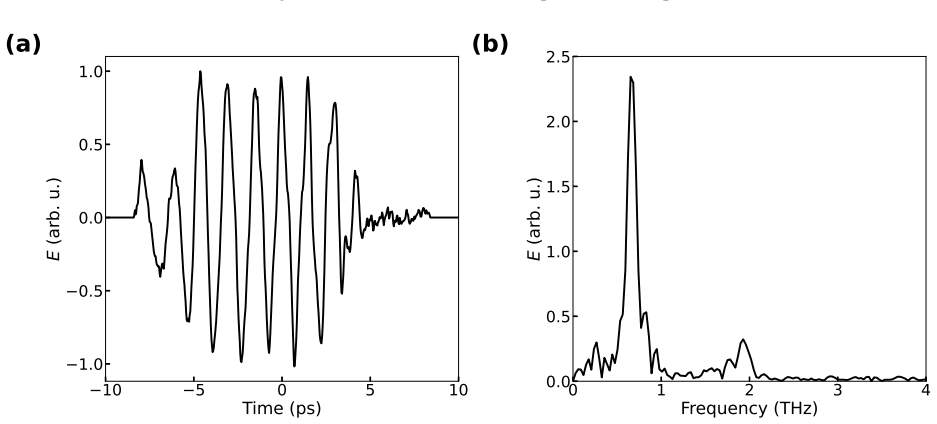
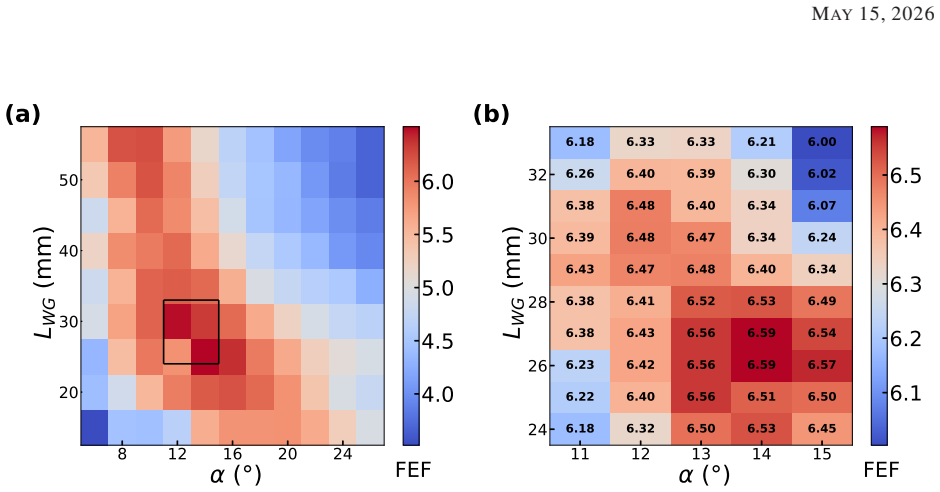
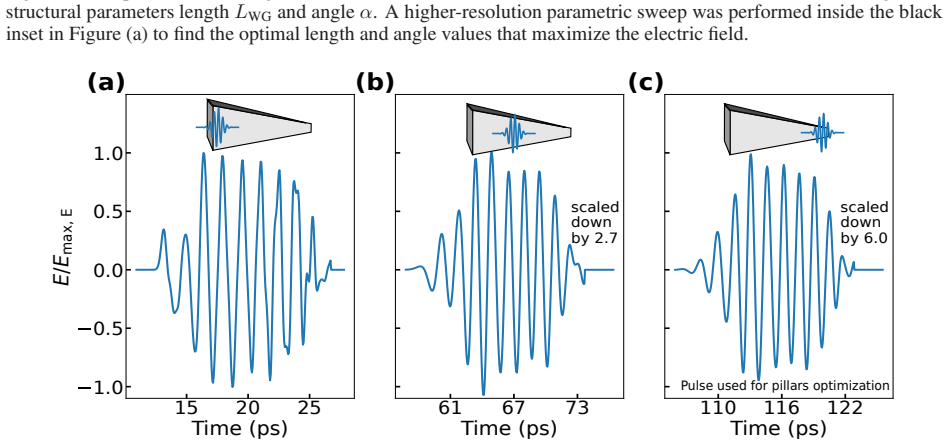
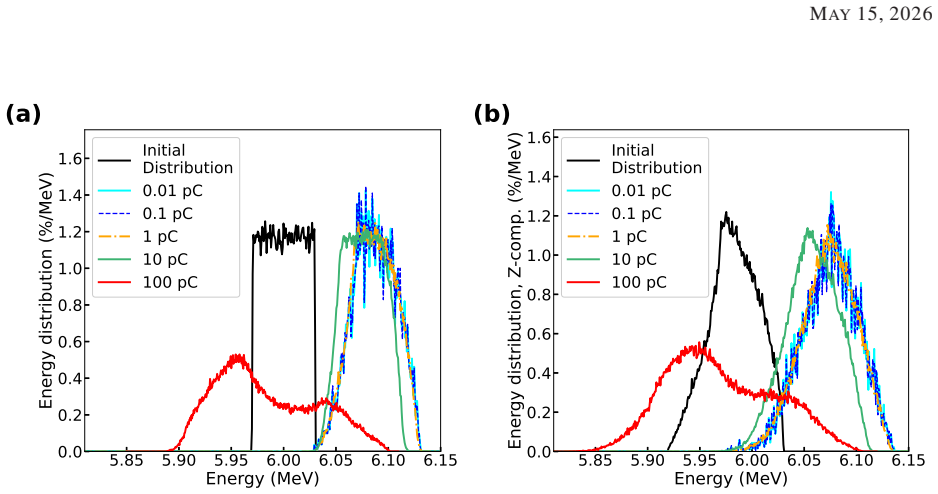
The integrated TPPWG-DTA structure supports net acceleration with gradients up to 120 MeV per m for 0.1 GV per m field strengths, and can accommodate bunch charges up to 10 pC with minimal degradation. Time-domain simulations reveal a sixfold peak electric field amplification at the end of the waveguide. The dielectric accelerator is tailored for maximum acceleration by adjusting the DTA pillar radius and vacuum channel gap for relativistic electron beams. Experimental validation of the THz field inside the waveguide is conducted using electro-optic sampling.
What carries the argument
The tapered parallel-plate waveguide (TPPWG) that provides sixfold geometric field amplification and efficient coupling to the integrated dual-pillar grating dielectric terahertz-driven accelerator (DTA).
If this is right
- The structure produces net acceleration gradients up to 120 MeV/m at 0.1 GV/m drive fields.
- Bunch charges up to 10 pC experience only minimal degradation in energy spread.
- Phase slippage and bunch-length effects can be managed by the chosen pillar and gap dimensions.
- Simple fabrication and compatibility with existing electron sources are retained.
- The platform scales toward practical tabletop THz accelerators for scientific use.
Where Pith is reading between the lines
- Staging several such modules could reach higher total energies while preserving the compact footprint.
- Pairing the structure with laser-generated THz sources would remove the need for external THz drivers.
- The same geometry may suit other charged particles or lower-energy beams after modest re-optimization.
- Direct measurement of acceleration in a real beamline would test whether fabrication tolerances preserve the simulated performance.
Load-bearing premise
Time-domain simulations of the tapered parallel-plate waveguide accurately predict a sixfold peak electric field amplification and efficient coupling to the dielectric structure for relativistic beams without major unmodeled losses or fabrication effects.
What would settle it
Laboratory measurement of the electric field at the waveguide exit showing substantially less than sixfold amplification, or a beam test that finds no net energy gain or far larger energy spread than the PIC simulations predict.
Figures




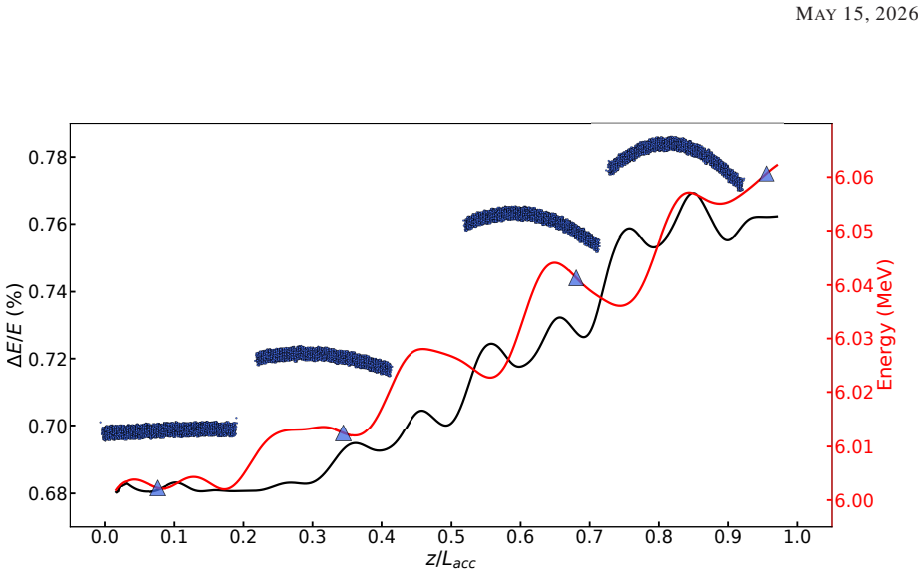
read the original abstract
We present a novel dielectric terahertz-driven accelerator (DTA) that integrates a dual-pillar grating structure within a tapered parallel-plate waveguide (TPPWG). This compact setup enables efficient particle acceleration using multi-cycle, narrowband terahertz (THz) pulses. The TPPWG serves a dual role: it enhances the THz field via geometric tapering and delivers it to the dielectric structure by efficient coupling. Experimental validation of the THz field inside the waveguide is conducted using electro-optic sampling. Optimization of waveguide parameters through time-domain simulations reveals a sixfold peak electric field amplification at the end of the waveguide. The dielectric accelerator is tailored for maximum acceleration by adjusting the DTA pillar radius and vacuum channel gap for relativistic electron beams. Particle-in-cell (PIC) simulations demonstrate that the structure supports net acceleration with gradients up to 120 MeV per m for 0.1 GV per m field strengths, and can accommodate bunch charges up to 10 pC with minimal degradation. Energy spread evolution and beam dynamics are discussed in detail, including the role of phase slippage and bunch length. This work establishes the DTA-integrated TPPWG as a compact and scalable platform for high-gradient THz-driven acceleration, combining simple fabrication and design, strong field enhancement, and compatibility with existing electron sources. It opens new pathways toward practical, tabletop accelerators for scientific and industrial applications.
Editorial analysis
A structured set of objections, weighed in public.
Referee Report
Summary. The manuscript presents a novel dielectric terahertz-driven accelerator (DTA) that integrates a dual-pillar grating structure within a tapered parallel-plate waveguide (TPPWG). The TPPWG provides geometric field enhancement and coupling to the dielectric structure. Time-domain simulations optimize parameters to achieve sixfold peak electric field amplification. Experimental validation uses electro-optic sampling of the THz field inside the waveguide. Particle-in-cell (PIC) simulations then report net acceleration gradients up to 120 MeV/m for 0.1 GV/m drive fields, with support for bunch charges up to 10 pC and discussion of energy spread, phase slippage, and beam dynamics.
Significance. If the simulated field enhancement and coupling are accurate and the experimental measurements confirm the modeled fields in the integrated structure, the work offers a compact, scalable platform for high-gradient THz-driven acceleration with relatively simple fabrication. The dual-role waveguide and parameter optimization for relativistic beams are strengths, but the performance claims rest primarily on simulations whose input fields lack full experimental corroboration for the complete DTA-integrated system.
major comments (2)
- [Time-domain simulations and experimental validation] The sixfold peak electric field amplification is obtained from time-domain simulations of the tapered waveguide; however, the electro-optic sampling validation is described only for the waveguide interior without the dielectric pillars present. A quantitative comparison of simulated versus measured peak amplitude, spatial uniformity, and coupling efficiency in the full integrated structure is required to support the input field strength used in the PIC simulations.
- [PIC simulations] The headline performance figures (120 MeV/m net gradient at 0.1 GV/m and 10 pC charge capacity with minimal degradation) are derived from PIC simulations that directly ingest the enhanced field from the time-domain model. No error bars, sensitivity analysis to fabrication tolerances on pillar radius or vacuum channel gap, or baseline comparisons without the taper are provided, making it difficult to assess robustness of the central acceleration claims.
minor comments (2)
- [Abstract and simulation setup] The abstract and methods sections should specify the THz center frequency, bandwidth, and exact pulse parameters used in both the time-domain and PIC simulations to allow reproducibility.
- [Figures] Figure captions for the field plots and beam dynamics results should include the exact simulation parameters (e.g., mesh resolution, boundary conditions) and any assumed material losses.
Simulated Author's Rebuttal
We thank the referee for their constructive and detailed comments, which help improve the clarity and robustness of our work. We address each major comment point by point below, indicating the revisions we will incorporate.
read point-by-point responses
-
Referee: [Time-domain simulations and experimental validation] The sixfold peak electric field amplification is obtained from time-domain simulations of the tapered waveguide; however, the electro-optic sampling validation is described only for the waveguide interior without the dielectric pillars present. A quantitative comparison of simulated versus measured peak amplitude, spatial uniformity, and coupling efficiency in the full integrated structure is required to support the input field strength used in the PIC simulations.
Authors: We agree that experimental validation of the complete integrated structure would strengthen the manuscript. The electro-optic sampling measurements confirm the field enhancement and spatial distribution within the TPPWG alone, which is the dominant contributor to the sixfold amplification. The coupling and interaction with the dielectric pillars are modeled via time-domain simulations. In the revision, we will add a dedicated subsection presenting quantitative comparisons between the waveguide-only experimental data and corresponding simulations, as well as full-structure simulations (with pillars) to estimate peak amplitude, uniformity, and coupling efficiency. We will explicitly note that direct experimental measurements of the full DTA-integrated structure were not performed in this study. revision: partial
-
Referee: [PIC simulations] The headline performance figures (120 MeV/m net gradient at 0.1 GV/m and 10 pC charge capacity with minimal degradation) are derived from PIC simulations that directly ingest the enhanced field from the time-domain model. No error bars, sensitivity analysis to fabrication tolerances on pillar radius or vacuum channel gap, or baseline comparisons without the taper are provided, making it difficult to assess robustness of the central acceleration claims.
Authors: We acknowledge that these supporting analyses were omitted from the original submission. In the revised manuscript, we will include error bars on the reported net gradients and charge capacities, based on uncertainties in the input THz field amplitude. We will add a sensitivity study varying pillar radius and vacuum gap within realistic fabrication tolerances (e.g., ±5 μm and ±2 μm, respectively) and present the resulting variation in acceleration performance. We will also include a direct baseline comparison of PIC results for the dielectric structure driven by the same input field with and without the tapered waveguide, to quantify the enhancement provided by the TPPWG. revision: yes
- Direct experimental measurements of the THz field inside the full integrated structure (TPPWG with dielectric pillars) are not available from the current study and cannot be provided without additional fabrication and measurements.
Circularity Check
Simulation results and experimental validation are independent of self-referential fitting or definitional equivalence
full rationale
The paper obtains its headline performance metrics (sixfold field amplification via time-domain simulations of the TPPWG, and 120 MeV/m net gradients plus 10 pC charge capacity via PIC simulations of the integrated DTA) from separate computational models that take the simulated THz field as input. Electro-optic sampling supplies an external experimental datum for the waveguide field. No quoted step reduces the reported acceleration or amplification to a parameter fitted from the same target data, a self-citation chain, or an ansatz smuggled in by prior work; the derivation chain therefore remains self-contained against external benchmarks.
Axiom & Free-Parameter Ledger
free parameters (2)
- DTA pillar radius
- vacuum channel gap
axioms (1)
- standard math Standard Maxwell equations and Lorentz force govern THz field propagation and particle motion in the structure
Lean theorems connected to this paper
-
IndisputableMonolith/Foundation/RealityFromDistinction.leanreality_from_one_distinction unclear?
unclearRelation between the paper passage and the cited Recognition theorem.
Optimization of waveguide parameters through time-domain simulations reveals a sixfold peak electric field amplification... Particle-in-cell (PIC) simulations demonstrate that the structure supports net acceleration with gradients up to 120 MeV per m
-
IndisputableMonolith/Cost/FunctionalEquation.leanwashburn_uniqueness_aczel unclear?
unclearRelation between the paper passage and the cited Recognition theorem.
The dielectric accelerator is tailored for maximum acceleration by adjusting the DTA pillar radius and vacuum channel gap
What do these tags mean?
- matches
- The paper's claim is directly supported by a theorem in the formal canon.
- supports
- The theorem supports part of the paper's argument, but the paper may add assumptions or extra steps.
- extends
- The paper goes beyond the formal theorem; the theorem is a base layer rather than the whole result.
- uses
- The paper appears to rely on the theorem as machinery.
- contradicts
- The paper's claim conflicts with a theorem or certificate in the canon.
- unclear
- Pith found a possible connection, but the passage is too broad, indirect, or ambiguous to say the theorem truly supports the claim.
Reference graph
Works this paper leans on
-
[1]
Applications of particle accelerators
Oscar Barbalat. Applications of particle accelerators . Technical report, CERN, 1990
work page 1990
-
[2]
Advanced technologies for applied particle accelerators and examples of their use
SV Kutsaev. Advanced technologies for applied particle accelerators and examples of their use. T echnical Physics, 66:161–195, 2021
work page 2021
-
[3]
Effects of surface damage on rf cavity operation
A Hassanein, Z Insepov, J Norem, A Moretti, Z Qian, A Bross , Y Torun, R Rimmer, D Li, M Zisman, et al. Effects of surface damage on rf cavity operation. Physical Review Special T opics-Accelerators and Beams , 9(6):062001, 2006
work page 2006
-
[4]
R Joel England, Robert J Noble, Karl Bane, David H Dowell, Cho-Kuen Ng, James E Spencer, Sami Tantawi, Zi- ran Wu, Robert L Byer, Edgar Peralta, et al. Dielectric laser accelerators. Reviews of Modern Physics, 86(4):1337, 2014
work page 2014
-
[5]
Demonstration of electron acceleration in a laser-dr iven dielectric microstructure
EA Peralta, K Soong, RJ England, ER Colby, Z Wu, B Montazer i, C McGuinness, J McNeur, KJ Leedle, D Walz, et al. Demonstration of electron acceleration in a laser-dr iven dielectric microstructure. Nature, 503(7474), 2013
work page 2013
-
[6]
Terahertz-driven lin ear electron acceleration
Emilio A Nanni, Wenqian R Huang, Kyung-Han Hong, Koustub an Ravi, Arya Fallahi, Gustavo Moriena, RJ Dwayne Miller, and Franz X Kärtner. Terahertz-driven lin ear electron acceleration. Nature communications, 6(1):8486, 2015
work page 2015
-
[7]
Short electron bunch generation using single-cycle ultrafast electron guns
Arya Fallahi, Moein Fakhari, Alireza Y ahaghi, Miguel Ar rieta, and Franz X Kärtner. Short electron bunch generation using single-cycle ultrafast electron guns. Physical Review Accelerators and Beams , 19(8):081302, 2016
work page 2016
-
[8]
Thz cav ities and injectors for compact electron acceleration using laser-driven thz sources
Moein Fakhari, Arya Fallahi, and Franz X Kärtner. Thz cav ities and injectors for compact electron acceleration using laser-driven thz sources. Physical Review Accelerators and Beams , 20(4):041302, 2017
work page 2017
-
[9]
Guilhem Gallot, SP Jamison, RW McGowan, and D Grischkows ky. Terahertz waveguides. JOSA B, 17(5):851– 863, 2000. 11 MAY 15, 2026
work page 2000
-
[10]
Terahertz dielectric waveguides
Shaghik Atakaramians, Shahraam Afshar V , Tanya M Monro, and Derek Abbott. Terahertz dielectric waveguides. Advances in Optics and Photonics , 5(2):169–215, 2013
work page 2013
-
[11]
Microstructured terahertz waveguid es
Steven R Andrews. Microstructured terahertz waveguid es. Journal of Physics D: Applied Physics , 47(37):374004, 2014
work page 2014
-
[12]
Y e-Qing Wu, Ming-Y ang Chen, and Zi-Jie Dai. Review on th e terahertz transmission devices and their applica- tions: From metal waveguides to terahertz fibers. Optics & Laser T echnology, 183:112339, 2025
work page 2025
-
[13]
Cascaded multicycle terahertz-driven ultrafast electron acceleration and manipulation
Dongfang Zhang, Moein Fakhari, Huseyin Cankaya, Anne- Laure Calendron, Nicholas H Matlis, and Franz X Kärtner. Cascaded multicycle terahertz-driven ultrafast electron acceleration and manipulation. Physical Review X, 10(1):011067, 2020
work page 2020
-
[14]
Demonstration of sub-luminal propagation of single-cycle terahertz pulses for particle acceleration
DA Walsh, DS Lake, EW Snedden, MJ Cliffe, DM Graham, and S P Jamison. Demonstration of sub-luminal propagation of single-cycle terahertz pulses for particle acceleration. Nature communications, 8(1):421, 2017
work page 2017
-
[15]
Femtosecond relativistic electron b eam with reduced timing jitter from thz driven beam compression
Lingrong Zhao, Heng Tang, Chao Lu, Tao Jiang, Pengfei Zh u, Long Hu, Wei Song, Huida Wang, Jiaqi Qiu, Chunguang Jing, et al. Femtosecond relativistic electron b eam with reduced timing jitter from thz driven beam compression. Physical review letters, 124(5):054802, 2020
work page 2020
-
[16]
Meter-scale terahertz-driven acceleration of a relativistic beam
Emma Curry, Siara Fabbri, Jared Maxson, Pietro Musumec i, and Avraham Gover. Meter-scale terahertz-driven acceleration of a relativistic beam. Physical review letters, 120(9):094801, 2018
work page 2018
-
[17]
Compa ct electron acceleration and bunch compression in thz waveguides
Liang Jie Wong, Arya Fallahi, and Franz X Kärtner. Compa ct electron acceleration and bunch compression in thz waveguides. Optics express, 21(8):9792–9806, 2013
work page 2013
-
[18]
Waveguide struc ture based electron accelera- tion using terahertz pulses
Szabolcs Turnár, Gerg ˝o Krizsán, János Hebling, and Zoltán Tibai. Waveguide struc ture based electron accelera- tion using terahertz pulses. Optics Express, 30(15):27602–27608, 2022
work page 2022
-
[19]
Seg mented terahertz electron accelerator and manipu- lator (steam)
Dongfang Zhang, Arya Fallahi, Michael Hemmer, Xiaojun Wu, Moein Fakhari, Yi Hua, Huseyin Cankaya, Anne- Laure Calendron, Luis E Zapata, Nicholas H Matlis, et al. Seg mented terahertz electron accelerator and manipu- lator (steam). Nature photonics, 12(6):336–342, 2018
work page 2018
-
[20]
Öznur Apsimon, Graeme Burt, Robert B Appleby, Robert J A psimon, Darren M Graham, and Steven P Jamison. Six-dimensional phase space preservation in a terahertz-d riven multistage dielectric-lined rectangular waveguide accelerator. Physical Review Accelerators and Beams , 24(12):121303, 2021
work page 2021
-
[21]
Terahertz-driven, all-optical electron gun
W Ronny Huang, Arya Fallahi, Xiaojun Wu, Huseyin Cankay a, Anne-Laure Calendron, Koustuban Ravi, Dong- fang Zhang, Emilio A Nanni, Kyung-Han Hong, and Franz X Kärtn er. Terahertz-driven, all-optical electron gun. Optica, 3(11):1209–1212, 2016
work page 2016
-
[22]
Megaelectronvolt electron accel eration driven by terahertz surface waves
Xie-Qiu Y u, Y u-Shan Zeng, Li-Wei Song, De-Yin Kong, Si- Bo Hao, Jia-Y an Gui, Xiao-Jun Y ang, Yi Xu, Xiao- Jun Wu, Y u-Xin Leng, et al. Megaelectronvolt electron accel eration driven by terahertz surface waves. Nature Photonics, 17(11):957–963, 2023
work page 2023
-
[23]
High gradient terahertz-drivenultrafast photogun
Jianwei Ying, Xie He, Dace Su, Lingbin Zheng, Tobias Kro h, Timm Rohwer, Moein Fakhari, Günther H Kassier, Jingui Ma, Peng Y uan, et al. High gradient terahertz-drivenultrafast photogun. Nature Photonics, 18(7):758–765, 2024
work page 2024
-
[24]
Laurence JR Nix, Joseph T Bradbury, Christopher T Shaw, Morgan T Hibberd, Darren M Graham, Robert B Appleby, Graeme Burt, Rosa Letizia, and Steven P Jamison. Te rahertz-driven acceleration of subrelativistic electron beams using tapered rectangular dielectric-line d waveguides. Physical Review Accelerators and Beams , 27(4):041302, 2024
work page 2024
-
[25]
Investigations into dual-grating thz-dri ven accelerators
Y Wei, R Ischebeck, M Dehler, E Ferrari, N Hiller, S Jamis on, Guoxing Xia, Kieran Hanahoe, Y angmei Li, JDA Smith, et al. Investigations into dual-grating thz-dri ven accelerators. Nuclear Instruments and Methods in Physics Research Section A: Accelerators, Spectrometers, Detectors and Associated Equipment , 877:173–177, 2018
work page 2018
-
[26]
Numerica l investigations into a thz-driven dielectric accel- erator with a bragg reflector
M Xiriai, Baifei Shen, P Zhang, and A Aimidula. Numerica l investigations into a thz-driven dielectric accel- erator with a bragg reflector. Nuclear Instruments and Methods in Physics Research Sectio n A: Accelerators, Spectrometers, Detectors and Associated Equipment , 942:162362, 2019
work page 2019
-
[27]
Thz-driven dielectric particle accelerator on chip
Weihao Liu, Li Sun, Zijia Y u, Y ucheng Liu, Qika Jia, Baog en Sun, and Hongliang Xu. Thz-driven dielectric particle accelerator on chip. Optics Letters, 46(17):4398–4401, 2021
work page 2021
-
[28]
M Xiriai, Aimierding Aimidula, Mamat Ali Bake, and Ping Zhang. Numerical investigation of a thz-driven dielectric accelerator with a bragg-reflector for accelera ting sub-relativistic electron beams. Physica Scripta , 2024
work page 2024
-
[29]
CST Microwave Studio. Cst studio suite. Computer Simulation, 2010. 12 MAY 15, 2026
work page 2010
-
[30]
Improvement of thz coupling using a tapered parallel-plate waveguide
Sang-Hoon Kim, Eui Su Lee, Y oung Bin Ji, and Tae-In Jeon. Improvement of thz coupling using a tapered parallel-plate waveguide. Optics Express, 18(2):1289–1295, 2010
work page 2010
-
[31]
Stu dy of the impedance mismatch at the output end of a thz parallel-plate waveguide
Marx Mbonye, Rajind Mendis, and Daniel M Mittleman. Stu dy of the impedance mismatch at the output end of a thz parallel-plate waveguide. Applied Physics Letters, 100(11), 2012
work page 2012
-
[32]
Mo de interference and radiation leakage in a tapered parallel plate waveguide for terahertz waves
R Mueckstein, Miguel Navarro-Cia, and O Mitrofanov. Mo de interference and radiation leakage in a tapered parallel plate waveguide for terahertz waves. Applied Physics Letters, 102(14), 2013
work page 2013
-
[33]
Parallel-plate waveguides for terahertz-driven mev elect ron bunch compression
Mohamed AK Othman, Matthias C Hoffmann, Michael E Kozin a, XJ Wang, Renkai K Li, and Emilio A Nanni. Parallel-plate waveguides for terahertz-driven mev elect ron bunch compression. Optics express, 27(17):23791– 23800, 2019
work page 2019
-
[34]
Terahertz field enhancement to the mv/cm regime in a tapered parallel pl ate waveguide
Krzysztof Iwaszczuk, Andrei Andryieuski, Andrei Lavr inenko, X-C Zhang, and Peter Uhd Jepsen. Terahertz field enhancement to the mv/cm regime in a tapered parallel pl ate waveguide. Optics express, 20(8):8344–8355, 2012
work page 2012
-
[35]
Photonic band gap fiber accelerator
Xintian Eddie Lin. Photonic band gap fiber accelerator. Physical Review Special T opics-Accelerators and Beams, 4(5):051301, 2001
work page 2001
-
[36]
Photonic band gap structures for accelera tor applications
EI Smirnova. Photonic band gap structures for accelera tor applications. In AIP Conference Proceedings, volume 737, pages 309–319. American Institute of Physics, 2004
work page 2004
-
[37]
Photonic crystal waveguides for particle acceleration
A Locatelli, G Sorbello, G Torrisi, L Celona, and C De Ang elis. Photonic crystal waveguides for particle acceleration. In 2017 Progress In Electromagnetics Research Symposium-Spr ing (PIERS) , pages 1008–1013. IEEE, 2017
work page 2017
-
[38]
Amit Mizrahi and Levi Schächter. Optical bragg acceler ators. Phys. Rev. E, 70:016505, Jul 2004
work page 2004
-
[39]
T. Plettner, P . P . Lu, and R. L. Byer. Proposed few-optic al cycle laser-driven particle accelerator structure. Phys. Rev. ST Accel. Beams, 9:111301, Nov 2006
work page 2006
-
[40]
Microscale laser-driven particle accelerator using the inverse cherenkov effect
Weihao Liu, Zijia Y u, Li Sun, Y ucheng Liu, Qika Jia, Hong liang Xu, and Baogen Sun. Microscale laser-driven particle accelerator using the inverse cherenkov effect. Physical Review Applied, 14(1):014018, 2020
work page 2020
-
[41]
Evanescent-wave proton postaccelerator driven by intense thz pulse
László Pálfalvi, József András Fülöp, Gy Tóth, and Jáno s Hebling. Evanescent-wave proton postaccelerator driven by intense thz pulse. Physical Review Special T opics-Accelerators and Beams, 17(3):031301, 2014
work page 2014
-
[42]
Dielectric laser acceleration of sub-100 kev elect rons with silicon dual-pillar grating structures
Kenneth J Leedle, Andrew Ceballos, Huiyang Deng, Olav S olgaard, R Fabian Pease, Robert L Byer, and James S Harris. Dielectric laser acceleration of sub-100 kev elect rons with silicon dual-pillar grating structures. Optics letters, 40(18):4344–4347, 2015
work page 2015
-
[43]
John Breuer, Joshua McNeur, and Peter Hommelhoff. Diel ectric laser acceleration of electrons in the vicinity of single and double grating structures—theory and simulat ions. Journal of Physics B: Atomic, Molecular and Optical Physics, 47(23):234004, 2014
work page 2014
-
[44]
Alternating-phase focus- ing for dielectric-laser acceleration
Uwe Niedermayer, Thilo Egenolf, Oliver Boine-Franken heim, and Peter Hommelhoff. Alternating-phase focus- ing for dielectric-laser acceleration. Physical review letters, 121(21):214801, 2018
work page 2018
-
[45]
Coherent nanophotonic electron accelerator
Tomáš Chlouba, Roy Shiloh, Stefanie Kraus, Leon Brúckn er, Julian Litzel, and Peter Hommelhoff. Coherent nanophotonic electron accelerator. Nature, 622(7983):476–480, 2023
work page 2023
-
[46]
Peyman Y ousefi, Joshua McNeur, Martin Kozák, Uwe Nieder mayer, Florentina Gannott, Olga Lohse, Oliver Boine-Frankenheim, and Peter Hommelhoff. Silicon dual pil lar structure with a distributed bragg reflector for dielectric laser accelerators: Design and fabrication. Nuclear Instruments and Methods in Physics Research Section A: Accelerators, Spectrometers...
work page 2018
-
[47]
Jianming Dai, Jiangquan Zhang, Weili Zhang, and Daniel Grischkowsky. Terahertz time-domain spectroscopy characterization of the far-infrared absorption and index of refraction of high-resistivity, float-zone silicon. JOSA B, 21(7):1379–1386, 2004
work page 2004
-
[48]
Beam quality study for a grating-based dielectric laser-driven accelerator
Y Wei, S Jamison, Guoxing Xia, Kieran Hanahoe, Y Li, JDA S mith, and CP Welsch. Beam quality study for a grating-based dielectric laser-driven accelerator. Physics of Plasmas, 24(2), 2017
work page 2017
-
[49]
Edgar A Peralta. Accelerator on a chip: Design, fabrication, and demonstrat ion of grating-based dielectric microstructures for laser-driven acceleration of electrons. Stanford University, 2015
work page 2015
-
[50]
D. Angal-Kalinin, A. Bainbridge, A. D. Brynes, R. K. Buc kley, S. R. Buckley, G. C. Burt, R. J. Cash, H. M. Castaneda Cortes, D. Christie, J. A. Clarke, R. Clarke, L. S. Cowie, P . A. Corlett, G. Cox, K. D. Dumbell, D. J. Dunning, B. D. Fell, K. Gleave, P . Goudket, A. R. Goulden , S. A. Griffiths, M. D. Hancock, A. Hannah, T. Hartnett, P . W . Heath, J. R...
work page 2026
-
[51]
E. W . Snedden, D. Angal-Kalinin, A. R. Bainbridge, A. D. Brynes, S. R. Buckley, D. J. Dunning, J. R. Henderson, J. K. Jones, K. J. Middleman, T. J. Overton, T. H. Pacey, A. E. P ollard, Y . M. Saveliev, B. J. A. Shepherd, P . H. Williams, M. I. Colling, B. D. Fell, and G. Marshall. Specific ation and design for full energy beam exploitation of the compact...
work page 2023
-
[52]
Frederike Ahr, Spencer W Jolly, Nicholas H Matlis, Serg io Carbajo, Tobias Kroh, Koustuban Ravi, Damian N Schimpf, Jan Schulte, Hideki Ishizuki, Takunori Taira, et a l. Narrowband terahertz generation with chirped-and- delayed laser pulses in periodically poled lithium niobate . Optics letters, 42(11):2118–2121, 2017
work page 2017
-
[53]
Highly s calable multicycle thz production with a home- made periodically poled macrocrystal
François Lemery, Thomas Vinatier, Frank Mayet, Ralph A ßmann, Elsa Baynard, Julien Demailly, Ulrich Dorda, Bruno Lucas, Alok-Kumar Pandey, and Moana Pittman. Highly s calable multicycle thz production with a home- made periodically poled macrocrystal. Communications Physics, 3(1):150, 2020
work page 2020
-
[54]
Connor DW Mosley, Daniel S Lake, Darren M Graham, Steven P Jamison, Robert B Appleby, Graeme Burt, and Morgan T Hibberd. Large-area periodically-poled lithi um niobate wafer stacks optimized for high-energy narrowband terahertz generation. Optics Express, 31(3):4041–4054, 2023
work page 2023
-
[55]
Christian Rentschler, NH Matlis, U Demirbas, Z Zhang, M Pergament, Andrius Zukauskas, Carlota Canalias, H Ishizuki, V aldas Pasiskevicius, Fredrik Laurell, et al. Parameter dependencies in multicycle thz generation with tunable high-energy pulse trains in large-aperture crysta ls. In Nonlinear Frequency Generation and Conversion: Materials and Devices XXI...
work page 2024
-
[56]
PJ Dalton, CT Shaw, JT Bradbury, CDW Mosley, A Sharma, V G upta, J Bohus, A Gupta, J-G Son, JA Fülöp, et al. Cryogenically cooled periodically poled lithium niobate w afer stacks for multi-cycle terahertz pulses. Applied Physics Letters, 125(14), 2024
work page 2024
-
[57]
Breakdown limits on gigavolt-per-m eter electron-beam-driven wakefields in dielectric structures
MC Thompson, H Badakov, AM Cook, JB Rosenzweig, R Tikhop lav, G Travish, I Blumenfeld, MJ Hogan, R Is- chebeck, N Kirby, et al. Breakdown limits on gigavolt-per-m eter electron-beam-driven wakefields in dielectric structures. Physical review letters, 100(21):214801, 2008
work page 2008
-
[58]
Giant self-induced transparency of intense few-cycle terahertz pulses in n-doped silicon
OV Chefonov, A V Ovchinnikov, SA Romashevskiy, X Chai, T Ozaki, AB Savel’ev, MB Agranat, and VE For- tov. Giant self-induced transparency of intense few-cycle terahertz pulses in n-doped silicon. Optics Letters , 42(23):4889–4892, 2017
work page 2017
-
[59]
Impact ionization dynamics in silicon by mv/cm thz fields
Abebe T Tarekegne, Hideki Hirori, Koichiro Tanaka, Krzysztof Iwaszczuk, and Peter U Jepsen. Impact ionization dynamics in silicon by mv/cm thz fields. New Journal of Physics , 19(12):123018, 2017
work page 2017
-
[60]
Conductivity induced by high-field terahertz waves in dielectric material
Brendan D O’Shea, Gerard Andonian, Samuel K Barber, Chr istine Isabel Clarke, Phuc D Hoang, Mark J Hogan, Brian Naranjo, Oliver Brian Williams, Vitaly Y akimenko, an d James B Rosenzweig. Conductivity induced by high-field terahertz waves in dielectric material. Physical review letters, 123(13):134801, 2019
work page 2019
-
[61]
Robustness of various metals against high thz field induced damage
Jianfei Zhu, Krzysztof Iwaszczuk, Abebe T Tarekegne, Y ungui Ma, and Peter U Jepsen. Robustness of various metals against high thz field induced damage. In 2016 41st International Conference on Infrared, Millimeter , and T erahertz waves (IRMMW-THz), pages 1–2. IEEE, 2016
work page 2016
-
[62]
In- teraction of high-power terahertz radiation with metallic films
OV Chefonov, A V Ovchinnikov, SI Ashitkov, SA Evlashin, PS Kondratenko, MB Agranat, and VE Fortov. In- teraction of high-power terahertz radiation with metallic films. In EPJ W eb of Conferences, volume 195, page 07001. EDP Sciences, 2018
work page 2018
-
[63]
O V . Chefonov, A V . Ovchinnikov, S A. Evlashin, and M B. Ag ranat. Damage threshold of ni thin film by terahertz pulses. Journal of Infrared, Millimeter , and T erahertz W aves, 39(11):1047–1054, 2018
work page 2018
-
[64]
Damage in a thin metal film by high-power terahertz radiation
MB Agranat, OV Chefonov, A V Ovchinnikov, SI Ashitkov, V E Fortov, and PS Kondratenko. Damage in a thin metal film by high-power terahertz radiation. Physical Review Letters, 120(8):085704, 2018. 14
work page 2018
discussion (0)
Sign in with ORCID, Apple, or X to comment. Anyone can read and Pith papers without signing in.