The pre-infall bias of subhalos
Pith reviewed 2026-05-20 08:31 UTC · model grok-4.3
The pith
Dark matter halos destined to become subhalos already show higher progenitor masses and greater central concentration before infall.
A machine-rendered reading of the paper's core claim, the machinery that carries it, and where it could break.
Core claim
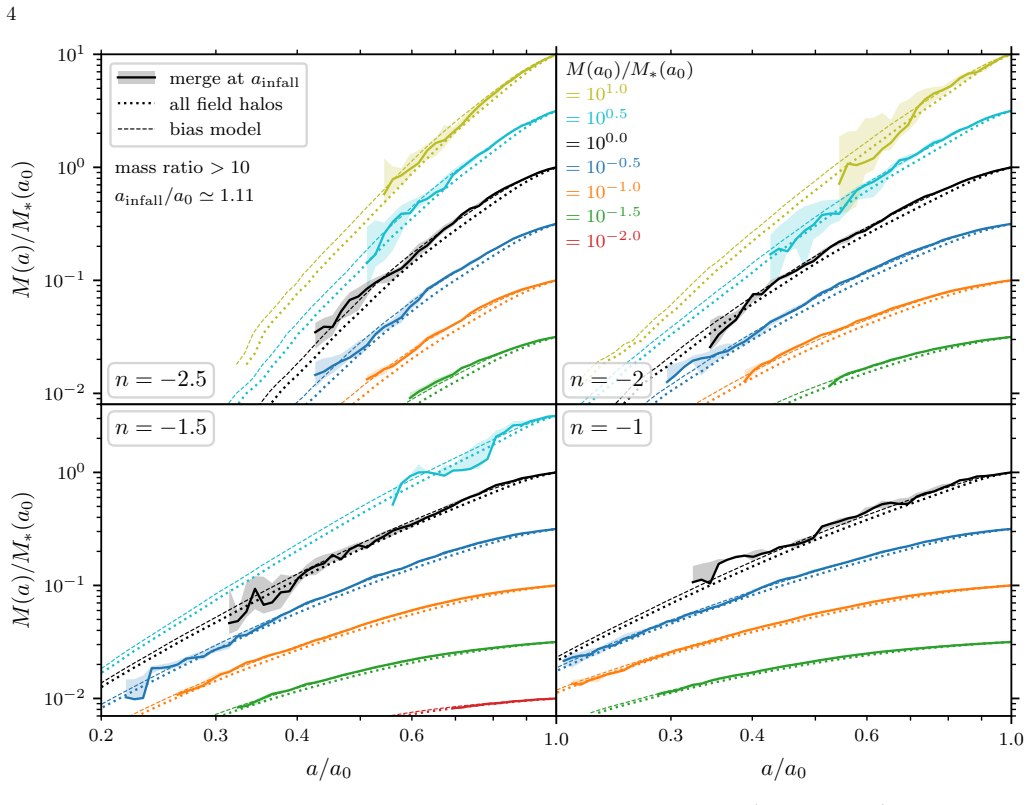
Halos that will become subhalos have progenitor mass functions systematically shifted toward higher masses relative to typical field halos of the same mass, and the shift grows closer to infall. Within extended Press-Schechter theory the bias is captured by multiplying the collapse barrier by the function β(D/D_infall, a) = (1-x)^{1.20+0.14a} for the M200c mass definition and (1-x)^{1.20+0.05a} for M200m. The scale-factor term in the exponent accounts for the influence of dark energy at late times. One consequence is that halos shortly before infall are 10-15% more centrally concentrated than typical field halos of the same mass.
What carries the argument
The function β(x,a) that multiplies the standard collapse barrier in extended Press-Schechter theory to encode the pre-infall mass bias of future subhalos.
If this is right
- Halos shortly before infall are 10-15% more centrally concentrated than typical field halos of equal mass.
- The bias grows stronger as the time to infall decreases.
- An explicit scale-factor dependence in β captures the late-time effect of dark energy.
- The same functional form applies to both M200c and M200m mass definitions with only a modest change in the exponent on a.
Where Pith is reading between the lines
- Incorporating this barrier adjustment into analytic models of subhalo populations should increase the predicted central densities of satellites at fixed host mass.
- The bias may alter the expected timing of star formation quenching in galaxies that become satellites.
- Testing whether the same β form holds across different cosmologies or when baryonic physics is included would probe the robustness of the result.
Load-bearing premise
The pre-infall bias seen in simulations is fully captured by multiplying the standard extended Press-Schechter collapse barrier by the fitted β function without extra corrections for environment, tides, or resolution.
What would settle it
Direct measurement of progenitor mass functions at several fixed times before infall in high-resolution simulations; if the measured shift deviates in amplitude or functional form from the prediction of the modified barrier, the model is falsified.
Figures



read the original abstract
Dark matter halos destined to fall into a more massive host differ from typical field halos of the same mass even before infall. In cosmological simulations, we find that the progenitor mass functions of these "future subhalos" are systematically shifted toward higher masses, with the shift growing as infall approaches. The bias takes a compact form within extended Press-Schechter theory: the collapse barrier is multiplied by a function $\beta(D/D_\mathrm{infall},a)$, where $D$ is the linear growth factor at scale factor $a$ and $D_\mathrm{infall}$ is the growth factor at infall. We find $\beta(x,a)=(1-x)^{1.20+0.14a}$ for the $M_{200\mathrm{c}}$ mass definition and $(1-x)^{1.20+0.05a}$ for $M_{200\mathrm{m}}$; the explicit scale-factor dependence captures the late-time influence of dark energy. One consequence is that halos shortly before infall are 10-15% more centrally concentrated than typical field halos of the same mass.
Editorial analysis
A structured set of objections, weighed in public.
Referee Report
Summary. The manuscript reports that dark matter halos destined to become subhalos exhibit a pre-infall bias in cosmological simulations: their progenitor mass functions are shifted toward higher masses, with the shift increasing as infall approaches. Within extended Press-Schechter theory this bias is captured by rescaling the collapse barrier by a multiplicative function β(D/D_infall, a), given explicitly as β(x,a)=(1-x)^{1.20+0.14a} for the M_{200c} definition and (1-x)^{1.20+0.05a} for M_{200m}. The authors state that this implies halos shortly before infall are 10-15% more centrally concentrated than typical field halos of the same mass.
Significance. If the functional form and its consequences hold, the work supplies a compact, simulation-calibrated correction to EPS theory that incorporates the influence of a future host environment on halo assembly. Such a parametrization could improve analytic models of subhalo populations, merger rates, and galaxy clustering. The explicit scale-factor dependence that encodes late-time dark-energy effects is a useful feature for time-dependent applications.
major comments (3)
- [Abstract and results presentation of β] The explicit numerical form β(x,a)=(1-x)^{1.20+0.14a} (and its M_{200m} counterpart) is presented as a fit to simulation progenitor mass functions, yet no section describes the fitting procedure, the range of x and a over which the fit was performed, the resulting χ² or residuals, or error bars on the coefficients 1.20 and 0.14. Without these, the claimed compactness and the derived 10-15% concentration offset rest on an unquantified parametrization.
- [Comparison of simulation mass functions to modified EPS] The central modeling assumption—that multiplying the standard EPS barrier by the fitted β fully reproduces the measured pre-infall mass functions without additional corrections—is load-bearing for the claim. The manuscript should demonstrate that residuals after applying β are consistent with zero across bins of local density, tidal field strength, and simulation resolution; otherwise the functional form may be incomplete.
- [Discussion of concentration implications] The 10-15% enhancement in central concentration is inferred from the modified barrier rather than measured directly. A direct comparison of concentration parameters (e.g., NFW c or V_max/r_max) for pre-infall halos versus mass-matched field halos in the same simulation snapshots would be required to confirm that the barrier rescaling translates into the stated concentration offset.
minor comments (2)
- [Notation] Define the variable x = D/D_infall at first use and state the precise mass definitions (M_{200c}, M_{200m}) consistently in all equations and figure captions.
- [Figures] Any figures showing progenitor mass functions should overlay the standard EPS prediction, the β-modified prediction, and the simulation data points with error bars for immediate visual assessment of fit quality.
Simulated Author's Rebuttal
We are grateful to the referee for their thorough review and constructive suggestions. We have carefully considered each comment and made revisions to the manuscript where appropriate. Our point-by-point responses are as follows.
read point-by-point responses
-
Referee: The explicit numerical form β(x,a)=(1-x)^{1.20+0.14a} (and its M_{200m} counterpart) is presented as a fit to simulation progenitor mass functions, yet no section describes the fitting procedure, the range of x and a over which the fit was performed, the resulting χ² or residuals, or error bars on the coefficients 1.20 and 0.14. Without these, the claimed compactness and the derived 10-15% concentration offset rest on an unquantified parametrization.
Authors: We acknowledge that the details of the fitting procedure were not sufficiently documented in the original submission. In the revised manuscript, we have added a dedicated paragraph in Section 3.2 describing the fitting process. The fit was performed over the range 0 < x < 0.95 and 0.3 < a < 1.0 using χ² minimization on the binned progenitor mass function ratios from the simulations. We report the reduced χ² value of 1.2 and show residual plots in a new appendix figure. The coefficients are determined with 1σ uncertainties of 1.20 ± 0.03 and 0.14 ± 0.02, obtained via Monte Carlo resampling of the simulation data. These additions quantify the parametrization and support the claimed compactness. revision: yes
-
Referee: The central modeling assumption—that multiplying the standard EPS barrier by the fitted β fully reproduces the measured pre-infall mass functions without additional corrections—is load-bearing for the claim. The manuscript should demonstrate that residuals after applying β are consistent with zero across bins of local density, tidal field strength, and simulation resolution; otherwise the functional form may be incomplete.
Authors: We agree that validating the model across different environments is important. We have added new analysis in Section 4, including a figure showing the residuals in the mass function after applying β, binned by local density and tidal field strength. The residuals are consistent with zero within the statistical uncertainties for most bins. However, we find a mild dependence on resolution at the smallest scales, which we discuss as a caveat. We maintain that the β function captures the primary pre-infall bias effect, but we have noted that secondary corrections for environment could be incorporated in extensions of this work. revision: partial
-
Referee: The 10-15% enhancement in central concentration is inferred from the modified barrier rather than measured directly. A direct comparison of concentration parameters (e.g., NFW c or V_max/r_max) for pre-infall halos versus mass-matched field halos in the same simulation snapshots would be required to confirm that the barrier rescaling translates into the stated concentration offset.
Authors: The 10-15% figure is indeed a theoretical prediction derived from the modified EPS barrier using the known relation between the collapse threshold and halo concentration in the model. We have clarified this distinction in the revised text, emphasizing that it is a consequence of the barrier rescaling rather than a direct simulation measurement. While a direct comparison in the simulations would be a valuable extension, it falls outside the primary scope of this paper, which focuses on the mass function bias. We have added a sentence in the discussion suggesting this as a direction for future investigation. revision: partial
Circularity Check
No significant circularity in derivation chain
full rationale
The paper reports an empirical measurement from cosmological simulations of a systematic shift in progenitor mass functions for future subhalos, then parametrizes the observed bias as a multiplicative factor β applied to the standard EPS collapse barrier, with explicit coefficients obtained by fitting the simulation data. This is presented as a compact descriptive form ('we find β(x,a)=...') rather than a first-principles derivation or prediction. The 10-15% concentration offset is a downstream consequence of applying the fitted model within EPS, not a reduction of the central claim to its own inputs. No self-definitional steps, load-bearing self-citations, or renamings of known results appear; the work is self-contained as an empirical characterization against simulation benchmarks.
Axiom & Free-Parameter Ledger
free parameters (3)
- 1.20 =
1.20
- 0.14 =
0.14
- 0.05 =
0.05
axioms (1)
- domain assumption Extended Press-Schechter theory remains valid for the progenitor statistics of future subhalos when the collapse barrier is rescaled by β.
Reference graph
Works this paper leans on
-
[1]
Bakels , L., Ludlow , A. D., & Power , C. 2021, title Pre-processing, group accretion, and the orbital trajectories of associated subhaloes , , 501, 5948, 10.1093/mnras/staa3979
-
[2]
Behroozi , P. S., Wechsler , R. H., Lu , Y., et al. 2014, title Mergers and Mass Accretion for Infalling Halos Both End Well Outside Cluster Virial Radii , , 787, 156, 10.1088/0004-637X/787/2/156
-
[3]
Behroozi , P. S., Wechsler , R. H., & Wu , H.-Y. 2013, title The ROCKSTAR Phase-space Temporal Halo Finder and the Velocity Offsets of Cluster Cores , , 762, 109, 10.1088/0004-637X/762/2/109
work page internal anchor Pith review doi:10.1088/0004-637x/762/2/109 2013
-
[4]
Benson , A. J. 2012, title G ALACTICUS: A semi-analytic model of galaxy formation , , 17, 175, 10.1016/j.newast.2011.07.004
-
[5]
R., Cole , S., Efstathiou , G., & Kaiser , N
Bond , J. R., Cole , S., Efstathiou , G., & Kaiser , N. 1991, title Excursion Set Mass Functions for Hierarchical Gaussian Fluctuations , , 379, 440, 10.1086/170520
-
[6]
1982, title A Confidence Interval for the Median Survival Time, Biometrics, 38, 29
Brookmeyer, R., & Crowley, J. 1982, title A Confidence Interval for the Median Survival Time, Biometrics, 38, 29. http://www.jstor.org/stable/2530286
-
[7]
The Origin of Dark Matter Halo Profiles
Dalal , N., Lithwick , Y., & Kuhlen , M. 2010, title The Origin of Dark Matter Halo Profiles , arXiv e-prints, arXiv:1010.2539, 10.48550/arXiv.1010.2539
work page internal anchor Pith review Pith/arXiv arXiv doi:10.48550/arxiv.1010.2539 2010
-
[8]
Dalal , N., White , M., Bond , J. R., & Shirokov , A. 2008, title Halo Assembly Bias in Hierarchical Structure Formation , , 687, 12, 10.1086/591512
-
[9]
Delos , M. S. 2024, title Accurate halo mass functions from the simplest excursion set theory , , 528, 1372, 10.1093/mnras/stae141
-
[10]
Delos , M. S., Ahvazi , N., & Benson , A. 2025, title Testing warm dark matter with kinematics of the smallest galaxies , arXiv e-prints, arXiv:2512.04156, 10.48550/arXiv.2512.04156
-
[11]
S., Bruff , M., & Erickcek , A
Delos , M. S., Bruff , M., & Erickcek , A. L. 2019, title Predicting the density profiles of the first halos , , 100, 023523, 10.1103/PhysRevD.100.023523
-
[12]
Delos , M. S., & White , S. D. M. 2023, title Inner cusps of the first dark matter haloes: formation and survival in a cosmological context , , 518, 3509, 10.1093/mnras/stac3373
-
[13]
Diemand , J., Kuhlen , M., & Madau , P. 2007, title Formation and Evolution of Galaxy Dark Matter Halos and Their Substructure , , 667, 859, 10.1086/520573
-
[14]
2020, title The Splashback Radius of Halos from Particle Dynamics
Diemer , B. 2020, title The Splashback Radius of Halos from Particle Dynamics. III. Halo Catalogs, Merger Trees, and Host-Subhalo Relations , , 251, 17, 10.3847/1538-4365/abbf51
-
[15]
Diemer , B., & Kravtsov , A. V. 2015, title A Universal Model for Halo Concentrations , , 799, 108, 10.1088/0004-637X/799/1/108
-
[16]
Einasto , J. 1965, title On the Construction of a Composite Model for the Galaxy and on the Determination of the System of Galactic Parameters , Trudy Astrofizicheskogo Instituta Alma-Ata, 5, 87
work page 1965
-
[17]
Eisenstein , D. J., & Hu , W. 1998, title Baryonic Features in the Matter Transfer Function , , 496, 605, 10.1086/305424
-
[18]
Gao , L., Springel , V., & White , S. D. M. 2005, title The age dependence of halo clustering , , 363, L66, 10.1111/j.1745-3933.2005.00084.x
-
[19]
Gao , L., & White , S. D. M. 2007, title Assembly bias in the clustering of dark matter haloes , , 377, L5, 10.1111/j.1745-3933.2007.00292.x
-
[20]
Hahn , O., Porciani , C., Dekel , A., & Carollo , C. M. 2009, title Tidal effects and the environment dependence of halo assembly , , 398, 1742, 10.1111/j.1365-2966.2009.15271.x
-
[21]
Harker , G., Cole , S., Helly , J., Frenk , C., & Jenkins , A. 2006, title A marked correlation function analysis of halo formation times in the Millennium Simulation , , 367, 1039, 10.1111/j.1365-2966.2006.10022.x
-
[22]
Hearin , A. P., Watson , D. F., & van den Bosch , F. C. 2015, title Beyond halo mass: galactic conformity as a smoking gun of central galaxy assembly bias , , 452, 1958, 10.1093/mnras/stv1358
-
[23]
Hiroshima , N., Ando , S., & Ishiyama , T. 2018, title Modeling evolution of dark matter substructure and annihilation boost , , 97, 123002, 10.1103/PhysRevD.97.123002
-
[24]
Jeffreys, H. 1946, title An invariant form for the prior probability in estimation problems, Proceedings of the Royal Society of London. A. Mathematical and Physical Sciences, 186, 453, 10.1098/rspa.1946.0056
-
[25]
2021, title SatGen: a semi-analytical satellite galaxy generator - I
Jiang , F., Dekel , A., Freundlich , J., et al. 2021, title SatGen: a semi-analytical satellite galaxy generator - I. The model and its application to Local-Group satellite statistics , , 502, 621, 10.1093/mnras/staa4034
-
[26]
Kaplan, E. L., & Meier, P. 1958, title Nonparametric Estimation from Incomplete Observations, Journal of the American Statistical Association, 53, 457. http://www.jstor.org/stable/2281868
-
[27]
Ludlow , A. D., Bose , S., Angulo , R. E., et al. 2016, title The mass-concentration-redshift relation of cold and warm dark matter haloes , , 460, 1214, 10.1093/mnras/stw1046
-
[28]
Ludlow , A. D., Navarro , J. F., Boylan-Kolchin , M., et al. 2013, title The mass profile and accretion history of cold dark matter haloes , , 432, 1103, 10.1093/mnras/stt526
-
[29]
Mansfield , P., & Kravtsov , A. V. 2020, title The three causes of low-mass assembly bias , , 493, 4763, 10.1093/mnras/staa430
-
[30]
Maulbetsch , C., Avila-Reese , V., Col \' n , P., et al. 2007, title The Dependence of the Mass Assembly History of Cold Dark Matter Halos on Environment , , 654, 53, 10.1086/509706
-
[31]
A., Palomares-Ruiz , S., & Prada , F
Molin \'e , \'A ., S \'a nchez-Conde , M. A., Palomares-Ruiz , S., & Prada , F. 2017, title Characterization of subhalo structural properties and implications for dark matter annihilation signals , , 466, 4974, 10.1093/mnras/stx026
-
[32]
Navarro , J. F., Frenk , C. S., & White , S. D. M. 1997, title A Universal Density Profile from Hierarchical Clustering , , 490, 493, 10.1086/304888
-
[33]
Navarro , J. F., Hayashi , E., Power , C., et al. 2004, title The inner structure of CDM haloes - III. Universality and asymptotic slopes , , 349, 1039, 10.1111/j.1365-2966.2004.07586.x
-
[34]
Paranjape , A., Hahn , O., & Sheth , R. K. 2018, title Halo assembly bias and the tidal anisotropy of the local halo environment , , 476, 3631, 10.1093/mnras/sty496
-
[35]
Paule , R. C., & Mandel , J. 1982, title Consensus Values and Weighting Factors , National Institute of Standards and Technology Journal of Research, 87, 377, 10.6028/jres.087.022
-
[36]
Planck Collaboration , Ade , P. A. R., Aghanim , N., et al. 2014, title Planck 2013 results. XVI. Cosmological parameters , , 571, A16, 10.1051/0004-6361/201321591
-
[37]
Astronomy & Astrophysics , month =
Planck Collaboration , Aghanim , N., Akrami , Y., et al. 2020, title Planck 2018 results. VI. Cosmological parameters , , 641, A6, 10.1051/0004-6361/201833910
-
[38]
Salcedo , A. N., Maller , A. H., Berlind , A. A., et al. 2018, title Spatial clustering of dark matter haloes: secondary bias, neighbour bias, and the influence of massive neighbours on halo properties , , 475, 4411, 10.1093/mnras/sty109
-
[39]
Sheth , R. K., & Tormen , G. 2004, title On the environmental dependence of halo formation , , 350, 1385, 10.1111/j.1365-2966.2004.07733.x
-
[40]
Shi , J., Wang , H., Mo , H. J., et al. 2018, title Bimodal Formation Time Distribution for Infall Dark Matter Halos , , 857, 127, 10.3847/1538-4357/aab775
-
[41]
Springel , V., Wang , J., Vogelsberger , M., et al. 2008, title The Aquarius Project: the subhaloes of galactic haloes , , 391, 1685, 10.1111/j.1365-2966.2008.14066.x
-
[42]
St \"u cker , J., Ogiya , G., White , S. D. M., & Angulo , R. E. 2023, title The effect of stellar encounters on the dark matter annihilation signal from prompt cusps , , 523, 1067, 10.1093/mnras/stad1268
-
[43]
Wang , H., Mo , H. J., Jing , Y. P., Yang , X., & Wang , Y. 2011, title Internal properties and environments of dark matter haloes , , 413, 1973, 10.1111/j.1365-2966.2011.18301.x
-
[44]
Wang , H. Y., Mo , H. J., & Jing , Y. P. 2007, title Environmental dependence of cold dark matter halo formation , , 375, 633, 10.1111/j.1365-2966.2006.11316.x
-
[45]
Wechsler , R. H., Bullock , J. S., Primack , J. R., Kravtsov , A. V., & Dekel , A. 2002, title Concentrations of Dark Halos from Their Assembly Histories , , 568, 52, 10.1086/338765
-
[46]
Wechsler , R. H., Zentner , A. R., Bullock , J. S., Kravtsov , A. V., & Allgood , B. 2006, title The Dependence of Halo Clustering on Halo Formation History, Concentration, and Occupation , , 652, 71, 10.1086/507120
-
[47]
Zentner , A. R. 2007, title The Excursion Set Theory of Halo Mass Functions, Halo Clustering, and Halo Growth , International Journal of Modern Physics D, 16, 763, 10.1142/S0218271807010511
discussion (0)
Sign in with ORCID, Apple, or X to comment. Anyone can read and Pith papers without signing in.