REVIEW 3 major objections 4 minor 40 references
Art Beyond Semantics: Sheaf-Informed Contrastive Learning for Multi-Relational Representations
T0 review · 3 major / 4 minor · reviewed 2026-08-02 · deepseek-v4-flash
Pith's one-line read On art benchmarks, computing separate embeddings for each relation type—such as style, author, or historical context—outperforms a single shared embedding space like CLIP.
desk verdict Worth engaging, but the central KL loss as written is invalid and the abstract overstates the results; needs a major fix before peer review. read the letter →
The pith
A machine-rendered reading of the paper's core claim, the machinery that carries it, and where it could break.
The reading
What carries the argument
The central machinery is a sheaf-inspired relation-conditioned layer: a three-layer MLP takes the concatenation of a node embedding and a relation description embedding and outputs FiLM scale and shift parameters, applying feature-wise affine modulation to create relation-aware views. The second piece is a graph-based soft contrastive target: the line graph of the bipartite image-text graph, whose heat kernel W = exp(-τ L_G') yields affinities that soften the InfoNCE loss, so pairs sharing an image or text are treated as partial positives.
What would settle it
Shuffle the relation labels among image-text pairs and retrain CANVAS: if it still outperforms CLIP on retrieval, the gains come from extra capacity or regularization rather than relational semantics. Alternatively, construct a benchmark where pairs sharing an image are known to be semantically contradictory (e.g., the same image paired with captions describing different subjects) and check whether the heat-kernel soft target W̃ still helps.
Extended reading notes
Core claim
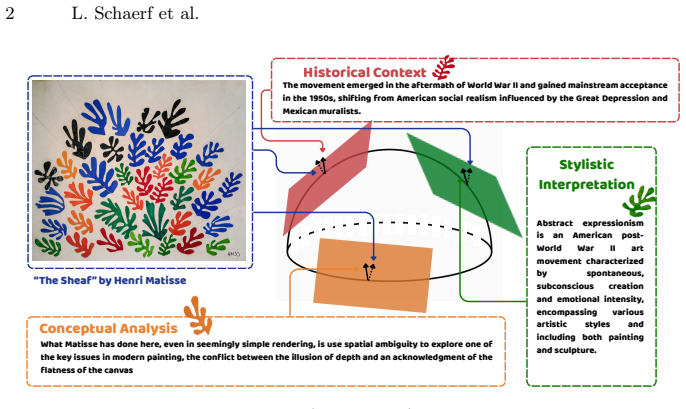
A single artwork is not one point in embedding space; it is a set of points, one per relation type. CANVAS learns, for each typed image-text edge, a restriction map that transforms the shared CLIP embedding into a relation-specific subspace, and a softened contrastive loss, derived from the line graph of the bipartite data graph, keeps pairs that share an image or text from being pushed apart as hard negatives. The result is that the same painting is embedded differently depending on whether it is being compared by style, by author, by title, or by historical context, and these multiple viewpoints yield better retrieval and classification than any single alignment.
Load-bearing premise
The load-bearing premise is that the typed relation labels (style, author, title, context, etc.) faithfully decompose how images and texts relate, and that two image-text pairs sharing an image or a text are genuinely semantically closer than pairs that do not; if the labels are noisy or the shared-node proximity is spurious, the learned subspaces align to arbitrary metadata rather than to art-historical meaning.
Editorial extensions
If this is right
- Image-to-text retrieval improves substantially, with Recall@10 rising from 0.084 to 0.514 on a dataset absent from CLIP's pretraining data.
- Relation-aware classification becomes more consistent across attributes such as Artist, Period, Genre, Style, and Material, with no single baseline matching the model's uniformity.
- The model is fully inductive: unseen artworks can be embedded at test time without access to the graph structure, unlike prior graph-based approaches.
- The relation type can be inferred from the text by a small classifier (test accuracy 0.86–1.00), so the method requires no extra annotation at inference.
- Ablations show that both the graph-regularized loss and the relation-conditioned modulation are necessary; removing either degrades performance sharply.
Reading between the lines
- If the relation-conditioned subspaces genuinely capture distinct art-historical dimensions, the same architecture could transfer to other domains with heterogeneous image-text relations, such as medical imaging or cultural heritage documentation.
- The method's soft targets encode 'sharing a node implies semantic proximity'; this is a strong assumption, and a natural stress test is to measure performance when the relation labels are deliberately shuffled or when shared nodes are known to be semantically heterogeneous.
- The fixed, discrete relation vocabulary means the method cannot discover new relations on its own; a possible extension is to replace the typed labels with learned latent relation vectors and let the model decide which subspaces to form.
Editorial analysis
A structured set of objections, weighed in public.
Referee Report
Summary. The paper introduces CANVAS, a fine-tuning method that extends CLIP with relation-conditioned FiLM modulations and a line-graph-based soft target. Images and texts are encoded by CLIP; for each typed relation, a learned FiLM layer projects the node embedding into a relation-specific subspace. A graph-regularized KL loss (Eq. 11) encourages cosine similarities to match a heat-kernel-derived soft target on the line graph. The authors evaluate on three art datasets, including the new HertzianaDP, and report retrieval and classification improvements over CLIP, SigLIP, ColPali, and graph baselines.
Significance. The idea of relation-conditioned subspaces for art-historical multimodal understanding is timely, and the HertzianaDP benchmark is a potentially valuable resource if the release is permanent. The paper also contains an extensive ablation (Table 2) and hyperparameter sensitivity analysis (Fig. 7) and attempts to control for CLIP pretraining leakage. However, the central claim of consistent outperformance is not supported by all reported metrics, and the training objective as written is ill-defined. With corrections, the method could be useful; in the current form, the empirical evidence is not reproducible from the equations.
major comments (3)
- [§3.6, Eq. (11)] The graph-regularized KL term is not well-defined as written. S_UV in Eq. (8) is an inner-product matrix of ℓ2-normalized embeddings; its rows are not probability distributions (entries can be negative, row sums are not 1), so log(S_UV) and KL(P∥S_UV) are undefined. If the implementation follows SoftCLIP [10], the text must include the temperature-scaled softmax normalisation before computing KL(P∥softmax(S/τ)). This is not a cosmetic issue: Table 2 and Fig. 7 attribute the T2I gains specifically to this term, so the experiments cannot be reproduced or checked from the equations as stated. Please correct the loss definition and state whether the reported results use the normalised or unnormalised version.
- [Abstract/§5.1, Tables 1, 6, 7] The abstract's claim that CANVAS outperforms the baselines in multimodal retrieval is contradicted by the paper's own tables. On WikiArt+ T2I, CANVAS R@5/R@10 = 0.144/0.217 vs SigLIP = 0.239/0.301 (Table 1); on HertzianaDP T2I P@5/P@10 and NDCG@5/N@10, CANVAS is 0.001/0.001, below SigLIP-ft (0.007/0.005, 0.018/0.021) (Tables 6-7). More seriously, the appendix Precision/NDCG values are inconsistent with the Recall values under standard retrieval definitions: for binary relevance, P@K ≥ R@K/K; e.g., Table 1 R@5=0.099/R@10=0.158 contradicts Table 6 P@5=P@10=0.001. Please recheck the metric computation and qualify the claims to I2T or specific datasets.
- [Table 2 (ablation)] The 'only InfoNCE' variant gives T2I R@5/R@10 = 0.002/0.004 but I2T R@5/R@10 = 0.525/0.541. This is an order of magnitude worse than fine-tuned CLIP on T2I (CLIP-ft = 0.046/0.069 on HertzianaDP), while I2T is high. Such an extreme asymmetry from a symmetric InfoNCE loss is surprising and should be explained. If it is correct, the loss component is not behaving like a standard contrastive alignment; if it is an artifact of the evaluation protocol, the ablation conclusion ('combining the losses leverages the benefits of both') is not supported.
minor comments (4)
- [§3.5] The phrase 'small values preserve only immediate neighbors' is imprecise for the heat kernel W = exp(−τL): for small τ, W is close to the identity (self-affinity), and larger τ propagates affinity to more distant nodes. Please rephrase to avoid confusion.
- [Appendix B, first sentence] The claim that Precision/NDCG results are 'consistent with the trends observed for Recall' is not supported for the HertzianaDP T2I metric, where Precision/NDCG are orders of magnitude lower than Recall would imply. The metric definitions and computation should be clarified.
- [§3.3] Please state explicitly which layers are unfrozen when fine-tuning 'the projection layers and the last transformer blocks' and whether the image and text projection heads share parameters.
- [Table 8] The relationship-prediction accuracy of 1.00 on HertzianaDP and 0.99 on WikiArt+ is very high. Please provide details on the classifier, label distribution, and example predictions to rule out label leakage or an overly simple task.
Circularity Check
No significant circularity: CANVAS is an empirically evaluated fine-tuning method whose training target is built from training-set graph structure, not from the test metric.
full rationale
The central claim is that relation-conditioned subspaces and a graph-regularized KL contrastive loss improve art retrieval and classification. The soft target P = λW̃ + (1−λ)I (Eqs. 6–10) is constructed from the line graph of the training edges and is used only during training; test retrieval and classification never access graph connectivity, and the split ensures items appear only once. The relation-conditioned FiLM restriction maps (Eqs. 2–5) are standard conditioned modulation, and the KL softening is explicitly attributed to SoftCLIP [10], an external citation. Two benchmarks are built from prior author work (SemArt+ from SemArt [13] and Explain Me the Painting [1]), but these self-citations supply data, not the theoretical conclusion, and the main comparisons are against external CLIP, SigLIP, ColPali, ColQwen, GraphCLIP, and other baselines. The paper also addresses the relation-type comparability concern by showing relation labels can be inferred from text (Tab. 8) and that using predicted labels does not degrade performance (Tab. 10). The KL-normalization issue in Eq. 11 is a correctness/implementation concern, not circularity: it does not make the reported result equivalent to its inputs. There is no step in which a fitted parameter is renamed a prediction, no uniqueness theorem imported from the authors, and no load-bearing self-citation; the derivation is self-contained against independent benchmarks.
Assumptions & free parameters
free parameters (6)
- tau (τ) =
0.7
- alpha (α) =
1.2
- lambda (λ) =
0.7
- eta (η) =
0.5
- number of sheaf layers (N) =
3
- fine-tuning layers (Lft) =
3
assumptions (4)
- standard math Cellular sheaf definitions and heat-kernel/Laplacian facts.
- domain assumption Each image-text edge has one discrete relation label that faithfully captures the relation.
- domain assumption Line-graph proximity (sharing an image or text) corresponds to semantic closeness.
- domain assumption OpenCLIP ViT-B/32 pretrained on LAION-2B provides a suitable foundation for art embeddings.
Cite this review
Pith. "Pith review of Art Beyond Semantics: Sheaf-Informed Contrastive Learning for Multi-Relational Representations." pith.science (2026). https://pith.science/paper/43ZP3HRF
@misc{pith2026260716321,
  author       = {Pith},
  title        = {Pith review of: Art Beyond Semantics: Sheaf-Informed Contrastive Learning for Multi-Relational Representations},
  year         = {2026},
  howpublished = {\url{https://pith.science/paper/43ZP3HRF}},
  note         = {Machine review of arXiv:2607.16321}
}
read the original abstract
Understanding a painting is never a single act. Art historians may analyze the same work through concepts of style, iconography, or historical context, dimensions that are not interchangeable, and each carries distinct semantic relationships between the visual and the textual. Vision-Language Models (VLMs) like CLIP, which learn a single shared embedding space, collapse this richness into a single homogeneous alignment, thereby losing the multi-relational structure that defines art-historical reasoning. We introduce CANVAS (Contrastive Art-aware Network for Vision-Language Alignment with Sheaves), a framework for learning relation-aware multimodal representations inspired by sheaf theory. Each artwork is projected into multiple embeddings conditioned on the type of relation (i.e., the context), and a novel contrastive loss encodes contextual information during training, with no dependency on external data at inference. We evaluate on three newly introduced benchmarks of artworks for multi-relational art understanding: WikiArt+, derived from WikiArt and Wikipedia, HertzianaDP, from the Bibliotheca Hertziana collection, and SemArt+, refined from the SemArt dataset. In multimodal retrieval and art understanding, CANVAS outperforms the baselines, supporting the view that multi-relational alignment is not just theoretically motivated but also practically essential.
Figures


Figures from the paper (4 more)


Reference graph
Works this paper leans on
-
[10]
In: AAAI
Gao, Y., Liu, J., Xu, Z., Wu, T., Zhang, E., Li, K., Yang, J., Liu, W., Sun, X.: Softclip: Softer cross-modal alignment makes clip stronger. In: AAAI. vol. 38, pp. 1860–1868 (2024)
2024
-
[1]
In: CVPR
Bai, Z., Nakashima, Y., Garcia, N.: Explain me the painting: Multi-topic knowl- edgeable art description generation. In: CVPR. pp. 5422–5432 (2021)
2021
-
[2]
In: Topological, Algebraic and Geometric Learning Workshops 2022
Barbero, F., Bodnar, C., de Ocáriz Borde, H.S., Bronstein, M., Veličković, P., Liò, P.: Sheaf neural networks with connection laplacians. In: Topological, Algebraic and Geometric Learning Workshops 2022. pp. 28–36. PMLR (2022)
2022
-
[3]
Advances in Neural Information Processing Systems35, 18527–18541 (2022)
Bodnar, C., Di Giovanni, F., Chamberlain, B., Lio, P., Bronstein, M.: Neural sheaf diffusion: A topological perspective on heterophily and oversmoothing in gnns. Advances in Neural Information Processing Systems35, 18527–18541 (2022)
2022
-
[4]
Neural Computing and Ap- plications33(19), 12263–12282 (2021)
Castellano, G., Vessio, G.: Deep learning approaches to pattern extraction and recognition in paintings and drawings: An overview. Neural Computing and Ap- plications33(19), 12263–12282 (2021)
2021
-
[5]
In: Proceedings of the British Machine Vision Conference
Crowley, E., Zisserman, A.: The state of the art: Object retrieval in paintings using discriminative regions. In: Proceedings of the British Machine Vision Conference
-
[6]
In: CVPR
Deng, J., Dong, W., Socher, R., Li, L.J., Li, K., Fei-Fei, L.: Imagenet: A large-scale hierarchical image database. In: CVPR. pp. 248–255. Ieee (2009)
2009
-
[7]
In: ACM MM
Efthymiou, A., Rudinac, S., Kackovic, M., Worring, M., Wijnberg, N.: Graph neu- ral networks for knowledge enhanced visual representation of paintings. In: ACM MM. pp. 3710–3719 (2021)
2021
Show all 40 references
-
[8]
Mul- timedia Tools and Applications pp
El Vaigh, C.B., Garcia, N., Renoust, B., Chu, C., Nakashima, Y., Qian, Y., Naga- hara, H.: Gnnboost: boosting artwork classification with graph embeddings. Mul- timedia Tools and Applications pp. 1–21 (2025)
2025
-
[9]
In: ICLR (2025)
Faysse, M., Sibille, H., Wu, T., Omrani, B., Viaud, G., Hudelot, C., Colombo, P.: Colpali: Efficient document retrieval with vision language models. In: ICLR (2025)
2025
-
[11]
Garcia, N., Renoust, B., Nakashima, Y.: Context-aware embeddings for automatic artanalysis.In:Proceedingsofthe2019onInternationalConferenceonMultimedia Retrieval. pp. 25–33 (2019)
2019
-
[12]
International Journal of Multimedia Information Retrieval9(1), 17–30 (2020)
Garcia, N., Renoust, B., Nakashima, Y.: Contextnet: representation and explo- ration for painting classification and retrieval in context. International Journal of Multimedia Information Retrieval9(1), 17–30 (2020)
2020
-
[13]
Garcia, N., Vogiatzis, G.: How to read paintings: semantic art understanding with multi-modal retrieval. In: Eur. Conf. Comput. Vis. Worksh. pp. 0–0 (2018)
2018
-
[14]
In: Koyejo, S., Mohamed, S., Agarwal, A., Belgrave, D., Cho, K., Oh, A
Goel, S., Bansal, H., Bhatia, S., Rossi, R., Vinay, V., Grover, A.: Cyclip: Cyclic contrastive language-image pretraining. In: Koyejo, S., Mohamed, S., Agarwal, A., Belgrave, D., Cho, K., Oh, A. (eds.) NeurIPS. vol. 35, pp. 6704–6719 (2022)
2022
-
[15]
NeurIPS30(2017)
Hamilton, W., Ying, Z., Leskovec, J.: Inductive representation learning on large graphs. NeurIPS30(2017)
2017
-
[16]
In: Proceedings of the 43rd International ACM SIGIR conference on research and development in Information Retrieval
He, X., Deng, K., Wang, X., Li, Y., Zhang, Y., Wang, M.: Lightgcn: Simplifying and powering graph convolution network for recommendation. In: Proceedings of the 43rd International ACM SIGIR conference on research and development in Information Retrieval. pp. 639–648 (2020)
2020
-
[17]
The Annals of Mathematical Statistics35(2), 883–885 (1964)
Hoffman, A.J.: On the line graph of the complete bipartite graph. The Annals of Mathematical Statistics35(2), 883–885 (1964)
1964
-
[18]
arXiv preprint arXiv:1311.3715 (2013) Sheaf-Informed Contrastive Learning for Multi-Relational Representations 17
Karayev, S., Trentacoste, M., Han, H., Agarwala, A., Darrell, T., Hertzmann, A., Winnemoeller, H.: Recognizing image style. arXiv preprint arXiv:1311.3715 (2013) Sheaf-Informed Contrastive Learning for Multi-Relational Representations 17
2013 arXiv
-
[19]
Fotothek - Bibliotheca Hertziana (2025).https://doi.org/10.17617/3.Z8W2JR,https://doi.org/10
Liuzzo, P.M.: Paintings Gemma-Enriched Dataset. Fotothek - Bibliotheca Hertziana (2025).https://doi.org/10.17617/3.Z8W2JR,https://doi.org/10. 17617/3.Z8W2JR
2025 doi
-
[20]
Proceedings of the National Academy of Sciences101(49), 17006–17010 (2004)
Lyu, S., Rockmore, D., Farid, H.: A digital technique for art authentication. Proceedings of the National Academy of Sciences101(49), 17006–17010 (2004). https://doi.org/10.1073/pnas.0406398101,https://www.pnas.org/doi/abs/ 10.1073/pnas.0406398101
2004 doi
-
[21]
Journal of machine learn- ing research9(Nov), 2579–2605 (2008)
Maaten, L.v.d., Hinton, G.: Visualizing data using t-sne. Journal of machine learn- ing research9(Nov), 2579–2605 (2008)
2008
-
[22]
arXiv preprint arXiv:1807.03748 (2018)
Oord, A.v.d., Li, Y., Vinyals, O.: Representation learning with contrastive predic- tive coding. arXiv preprint arXiv:1807.03748 (2018)
2018 arXiv
-
[23]
NeurIPS35, 22895–22910 (2022)
Pan, X., Ye, T., Han, D., Song, S., Huang, G.: Contrastive language-image pre- training with knowledge graphs. NeurIPS35, 22895–22910 (2022)
2022
-
[24]
In: AAAI
Perez, E., Strub, F., De Vries, H., Dumoulin, V., Courville, A.: Film: Visual rea- soning with a general conditioning layer. In: AAAI. vol. 32 (2018)
2018
-
[25]
Qiao, Y., Hu, Y., Zhao, L.: Multimodal representation learning conditioned on semantic relations (2025),https://arxiv.org/abs/2508.17497
2025 arXiv
-
[26]
In: ICML
Radford, A., Kim, J.W., Hallacy, C., Ramesh, A., Goh, G., Agarwal, S., Sastry, G., Askell, A., Mishkin, P., Clark, J., et al.: Learning transferable visual models from natural language supervision. In: ICML. pp. 8748–8763. PmLR (2021)
2021
-
[27]
In: CVPR
Ramos, P., Ramos, R., Garcia, N.: Data leakage in visual datasets. In: CVPR. pp. 6309–6319 (2025)
2025
-
[28]
In: ECCV (2026)
Ruthardt, J., Gaur, M., Ramanan, D., Tapaswi, M., Asano, Y.M.: Steerable visual representations. In: ECCV (2026)
2026
-
[29]
arXiv preprint arXiv:1505.00855 (2015)
Saleh, B., Elgammal, A.: Large-scale classification of fine-art paintings: Learning the right metric on the right feature. arXiv preprint arXiv:1505.00855 (2015)
2015 arXiv
-
[30]
Knowledge-Based Systems 310, 112857 (2025)
Scaringi, R., Fiameni, G., Vessio, G., Castellano, G.: Graphclip: Image-graph con- trastive learning for multimodal artwork classification. Knowledge-Based Systems 310, 112857 (2025)
2025
-
[31]
arXiv preprint arXiv:1708.00684 (2017)
Strezoski, G., Worring, M.: Omniart: multi-task deep learning for artistic data analysis. arXiv preprint arXiv:1708.00684 (2017)
2017 arXiv
-
[32]
IEEE TIP28(1), 394–409 (2019).https: //doi.org/10.1109/TIP.2018.2866698,https://doi.org/10.1109/TIP.2018
Tan, W.R., Chan, C.S., Aguirre, H., Tanaka, K.: Improved artgan for conditional synthesis of natural image and artwork. IEEE TIP28(1), 394–409 (2019).https: //doi.org/10.1109/TIP.2018.2866698,https://doi.org/10.1109/TIP.2018. 2866698
2019
-
[33]
In: ICML
Teru, K., Denis, E., Hamilton, W.: Inductive relation prediction by subgraph rea- soning. In: ICML. pp. 9448–9457. PMLR (2020)
2020
-
[34]
Tutte, W.T.: Graph theory, vol. 21. Cambridge university press (2001)
2001
-
[35]
Pattern Recognition61, 583–592 (2017)
Van Noord, N., Postma, E.: Learning scale-variant and scale-invariant features for deep image classification. Pattern Recognition61, 583–592 (2017)
2017
-
[36]
In: Proceedings of the 33rd ACM International Conference on Information and Knowledge Management
Xie, Y., Wang, Y., Xie, Y., Tan, X., Li, J., Li, X., Peng, W., Tang, M., Fang, M.: Image-text retrieval with main semantics consistency. In: Proceedings of the 33rd ACM International Conference on Information and Knowledge Management. p. 2629–2638. CIKM ’24, Association for Co...
2024
-
[37]
In: CVPR
Zhai, X., Mustafa, B., Kolesnikov, A., Beyer, L.: Sigmoid loss for language image pre-training. In: CVPR. pp. 11975–11986 (2023)
2023
-
[38]
In: Proceedings of the 2022 Conference on Empirical Methods in Natural Language Processing
Zhu, Y., Zhu, Z., Lin, B., Liang, X., Zhao, F., Liu, J.: Relclip: Adapting language- image pretraining for visual relationship detection via relational contrastive learn- ing. In: Proceedings of the 2022 Conference on Empirical Methods in Natural Language Processing. pp. 4800–...
2022
-
[39]
forest floor
Zou, Z., Chen, K., Shi, Z., Guo, Y., Ye, J.: Object detection in 20 years: A survey. Proceedings of the IEEE111(3), 257–276 (2023) Sheaf-Informed Contrastive Learning for Multi-Relational Representations 19 Supplementary Material A Experimental details Table4:Numberofimages,te...
2023
-
[2014]
British Machine Vision Association (2014)
2014
Reviewed August 2, 2026 · model on record in the stance chip above.
Discussion (0). Continue with ORCID to comment.