Pretrain-to-alignment learning paradigm to improve geophysical AI applicability under scarce field labels and synthetic-to-field gaps: A case study of relative geologic time estimation in global shelf-edge clinothems
Pith reviewed 2026-05-19 19:30 UTC · model grok-4.3
The pith
A pretrain-to-alignment paradigm enables accurate geophysical AI despite scarce labels and synthetic-to-field gaps.
A machine-rendered reading of the paper's core claim, the machinery that carries it, and where it could break.
Core claim
The pretrain-to-alignment learning paradigm systematically integrates self-supervised pretraining, synthetic supervision, prior-driven refinement, and domain-adaptation fine-tuning into a unified progressive learning workflow. Geophysical AI models are developed through sequential stages that progressively build field-relevant representations, task-specific mapping capability, field consistency, and target-specific adaptability. Validation using cross-survey relative geologic time estimation in global shelf-edge clinothems on 3,000 field datasets demonstrates accurate, robust, and well-generalized performance across diverse field surveys while significantly improving fine-scale stratigraphic
What carries the argument
The pretrain-to-alignment learning paradigm, which unifies self-supervised pretraining, synthetic supervision, prior-driven refinement, and domain-adaptation fine-tuning into sequential stages that build field-relevant representations and mappings for geophysical tasks.
If this is right
- The paradigm produces accurate, robust, and generalized relative geologic time estimates across diverse global field surveys.
- It yields significant gains in fine-scale stratigraphic and structural detail compared with prior approaches.
- The workflow provides a practical reference for applying AI to other geophysical problems such as interpretation, regression, and inversion under similar data constraints.
Where Pith is reading between the lines
- The staged approach could serve as a template for domain adaptation in other scientific machine-learning settings that rely heavily on synthetic data.
- Reducing the need for large labeled field datasets might lower costs for subsurface analysis in exploration geophysics.
- Isolating the contribution of each stage through ablation tests would clarify which steps drive the observed gains in generalization.
Load-bearing premise
That sequential integration of self-supervised pretraining, synthetic supervision, prior-driven refinement, and domain-adaptation fine-tuning will progressively build field-relevant representations and task-specific mapping without introducing inconsistencies or overfitting to the synthetic domain.
What would settle it
If a controlled test on a new field survey shows that the full paradigm produces no measurable gain in accuracy or fine-scale detail over a model trained only on synthetic data, the claim that the progressive stages deliver field-relevant improvements would be falsified.
Figures





read the original abstract
Artificial intelligence (AI) has been increasingly applied to various geophysical scenarios, yet its practical deployment remains limited by scarce field labels, pronounced synthetic-to-field domain gaps, and insufficient physical consistency under complex and variable field conditions. To address these challenges, we propose a pretrain-to-alignment learning paradigm that systematically integrates self-supervised pretraining, synthetic supervision, prior-driven refinement, and domain-adaptation fine-tuning into a unified progressive learning workflow. In this paradigm, geophysical AI models are developed through sequential stages that progressively build field-relevant representations, task-specific mapping capability, field consistency, and target-specific adaptability. We validate this paradigm using cross-survey relative geologic time (RGT) estimation in global shelf-edge clinothems as a representative case study. Results from 3,000 field datasets spanning multiple sedimentary basins demonstrate that the proposed paradigm achieves accurate, robust, and well-generalized performance across diverse field surveys, while significantly improving fine-scale stratigraphic and structural details. More broadly, this study provides a practical methodological reference for a broader range of geophysical AI tasks, such as interpretation, regression, and inversion problems.
Editorial analysis
A structured set of objections, weighed in public.
Referee Report
Summary. The paper introduces a pretrain-to-alignment learning paradigm that sequentially integrates self-supervised pretraining, synthetic supervision, prior-driven refinement, and domain-adaptation fine-tuning to enhance geophysical AI models facing scarce field labels and synthetic-to-field gaps. Validated through a case study on relative geologic time (RGT) estimation in global shelf-edge clinothems, the approach is tested on 3,000 field datasets from multiple sedimentary basins, with claims of accurate, robust, and well-generalized performance that improves fine-scale stratigraphic and structural details.
Significance. If substantiated, the paradigm could significantly advance the practical deployment of AI in geophysics by providing a structured way to leverage synthetic data while aligning to field conditions. The large-scale validation across diverse surveys strengthens the potential generalizability, offering a reference for related tasks such as interpretation and inversion.
major comments (3)
- [§4.2] §4.2 (Ablation experiments): No results are shown for a pipeline variant that omits the prior-driven refinement stage; without this, it is impossible to confirm that the sequential stages progressively build field-relevant representations rather than introducing uncorrected biases from earlier synthetic supervision.
- [Table 3] Table 3 (Cross-basin generalization metrics): The reported improvements on the 3,000 field datasets lack per-stage performance breakdowns or inconsistency checks when synthetic priors conflict with field observations; this directly undermines the central claim that the full workflow maintains physical consistency.
- [§5.1] §5.1 (Domain-adaptation fine-tuning): The description does not detail the mechanism for detecting and correcting overfitting to the synthetic domain; if any stage introduces uncorrectable bias, the generalization results on diverse basins cannot be attributed to the progressive alignment.
minor comments (2)
- [Abstract] The abstract introduces the 'pretrain-to-alignment learning paradigm' without a single-sentence operational definition; adding this would clarify the contribution for readers.
- [Figure 4] Figure 4 captions omit quantitative metrics (e.g., mean absolute error on fine-scale features) for the visual improvements shown in the RGT maps.
Simulated Author's Rebuttal
We thank the referee for the thorough and constructive review. The comments highlight important aspects of our ablation studies, generalization metrics, and domain-adaptation details that we will address to strengthen the manuscript. Below we respond point by point.
read point-by-point responses
-
Referee: [§4.2] §4.2 (Ablation experiments): No results are shown for a pipeline variant that omits the prior-driven refinement stage; without this, it is impossible to confirm that the sequential stages progressively build field-relevant representations rather than introducing uncorrected biases from earlier synthetic supervision.
Authors: We agree that demonstrating the incremental benefit of the prior-driven refinement stage is important for validating the progressive alignment claim. In the revised manuscript we will add a new ablation variant in §4.2 that removes this stage entirely, reporting quantitative metrics (e.g., RGT accuracy and stratigraphic continuity) on the same field datasets to show its specific contribution to bias correction and field-relevant representations. revision: yes
-
Referee: [Table 3] Table 3 (Cross-basin generalization metrics): The reported improvements on the 3,000 field datasets lack per-stage performance breakdowns or inconsistency checks when synthetic priors conflict with field observations; this directly undermines the central claim that the full workflow maintains physical consistency.
Authors: We acknowledge the value of per-stage breakdowns and explicit inconsistency checks. We will expand Table 3 to include performance metrics after each stage across the 3,000 datasets and add a dedicated analysis subsection that quantifies physical consistency (e.g., via stratigraphic continuity scores and conflict detection between synthetic priors and field observations) to directly support the physical-consistency claim. revision: yes
-
Referee: [§5.1] §5.1 (Domain-adaptation fine-tuning): The description does not detail the mechanism for detecting and correcting overfitting to the synthetic domain; if any stage introduces uncorrectable bias, the generalization results on diverse basins cannot be attributed to the progressive alignment.
Authors: We agree that the current description of the domain-adaptation stage is insufficiently detailed on overfitting mitigation. In the revised §5.1 we will explicitly describe the detection and correction mechanisms, including domain-discrepancy monitoring (e.g., via adversarial or MMD losses), field-specific regularization terms, and early-stopping criteria based on field validation performance, thereby clarifying how progressive alignment is preserved. revision: yes
Circularity Check
No circularity; empirical claims rest on external field data validation
full rationale
The paper describes a four-stage progressive learning workflow (self-supervised pretraining, synthetic supervision, prior-driven refinement, domain-adaptation fine-tuning) and asserts performance via results on 3,000 field datasets across basins. No equations, fitted parameters renamed as predictions, self-definitional constructs, or load-bearing self-citations appear in the provided text that would reduce the central claims to inputs by construction. The validation is presented as external empirical evidence rather than an internal redefinition or renaming of known patterns, rendering the derivation self-contained against benchmarks.
Axiom & Free-Parameter Ledger
axioms (2)
- domain assumption Self-supervised pretraining on unlabeled geophysical data produces representations that are useful for downstream RGT estimation after adaptation.
- domain assumption Synthetic supervision plus prior-driven refinement can enforce physical consistency under complex field conditions.
invented entities (1)
-
pretrain-to-alignment learning paradigm
no independent evidence
Lean theorems connected to this paper
-
IndisputableMonolith/Cost/FunctionalEquation.leanwashburn_uniqueness_aczel unclear?
unclearRelation between the paper passage and the cited Recognition theorem.
we propose a pretrain-to-alignment learning paradigm that systematically integrates self-supervised pretraining, synthetic supervision, prior-driven refinement, and domain-adaptation fine-tuning into a unified progressive learning workflow
-
IndisputableMonolith/Foundation/AlexanderDuality.leanalexander_duality_circle_linking unclear?
unclearRelation between the paper passage and the cited Recognition theorem.
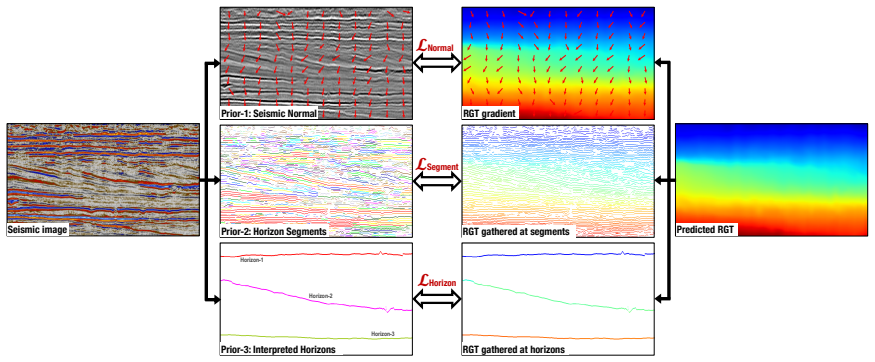
three complementary geological prior information are formulated as label-independent loss functions ... LNormal = 1−cosine similarity(∇τ,u)
What do these tags mean?
- matches
- The paper's claim is directly supported by a theorem in the formal canon.
- supports
- The theorem supports part of the paper's argument, but the paper may add assumptions or extra steps.
- extends
- The paper goes beyond the formal theorem; the theorem is a base layer rather than the whole result.
- uses
- The paper appears to rely on the theorem as machinery.
- contradicts
- The paper's claim conflicts with a theorem or certificate in the canon.
- unclear
- Pith found a possible connection, but the passage is too broad, indirect, or ambiguous to say the theorem truly supports the claim.
Reference graph
Works this paper leans on
-
[1]
Amir Adler, Mauricio Araya-Polo, and Tomaso Poggio. Deep learning for seismic inverse problems: Toward the acceleration of geophysical analysis workflows. IEEE signal processing magazine, 38 0 (2): 0 89--119, 2021
work page 2021
-
[2]
Basin analysis: Principles and application to petroleum play assessment
Philip A Allen and John R Allen. Basin analysis: Principles and application to petroleum play assessment. John Wiley & Sons, 2013
work page 2013
-
[3]
Yu An, Haiwen Du, Siteng Ma, Yingjie Niu, Dairui Liu, Jing Wang, Yuhan Du, Conrad Childs, John Walsh, and Ruihai Dong. Current state and future directions for deep learning based automatic seismic fault interpretation: A systematic review. Earth-Science Reviews, 243: 0 104509, 2023
work page 2023
-
[4]
Ingrid Anell and Ivar Midtkandal. The quantifiable clinothem--types, shapes and geometric relationships in the plio-pleistocene giant foresets formation, taranaki basin, new zealand. Basin Research, 29: 0 277--297, 2017
work page 2017
-
[5]
Machine learning in microseismic monitoring
Denis Anikiev, Claire Birnie, Umair bin Waheed, Tariq Alkhalifah, Chen Gu, Dirk J Verschuur, and Leo Eisner. Machine learning in microseismic monitoring. Earth-Science Reviews, 239: 0 104371, 2023
work page 2023
-
[6]
Mauricio Araya-Polo, Joseph Jennings, Amir Adler, and Taylor Dahlke. Deep-learning tomography. The Leading Edge, 37 0 (1): 0 58--66, 2018
work page 2018
-
[7]
Scott Bullimore, Sverre Henriksen, Frode M Liest l, and William Helland-Hansen. Clinoform stacking patterns, shelf-edge trajectories and facies associations in tertiary coastal deltas, offshore norway: Implications for the prediction of lithology in prograding systems. Norwegian Journal of Geology/Norsk Geologisk Forening, 85, 2005
work page 2005
-
[8]
Embedded physical constraints in machine learning to enhance vegetation phenology prediction
Mengying Cao and Qihao Weng. Embedded physical constraints in machine learning to enhance vegetation phenology prediction. GIScience & Remote Sensing, 61 0 (1): 0 2426598, 2024
work page 2024
-
[9]
Shengguang Chu, Kewen Li, and Guangyue Zhou. A pretraining and fine-tuning framework for 3d fault detection based on global-local feature learning. Expert Systems with Applications, 292: 0 128641, 2025
work page 2025
-
[10]
Augusto Cunha, Axelle Pochet, H \'e lio Lopes, and Marcelo Gattass. Seismic fault detection in real data using transfer learning from a convolutional neural network pre-trained with synthetic seismic data. Computers & Geosciences, 135: 0 104344, 2020
work page 2020
-
[11]
Petrophysical properties prediction from prestack seismic data using convolutional neural networks
Vishal Das and Tapan Mukerji. Petrophysical properties prediction from prestack seismic data using convolutional neural networks. Geophysics, 85 0 (5): 0 N41--N55, 2020
work page 2020
-
[12]
Convolutional neural network for seismic impedance inversion
Vishal Das, Ahinoam Pollack, Uri Wollner, and Tapan Mukerji. Convolutional neural network for seismic impedance inversion. Geophysics, 84 0 (6): 0 R869--R880, 2019
work page 2019
-
[14]
Learning-based seismic velocity inversion with synthetic and field data
Stuart Farris, Robert Clapp, and Mauricio Araya-Polo. Learning-based seismic velocity inversion with synthetic and field data. Sensors, 23 0 (19): 0 8277, 2023
work page 2023
-
[15]
Fast structural interpretation with structure-oriented filtering
Gijs C Fehmers and Christian FW H \"o cker. Fast structural interpretation with structure-oriented filtering. Geophysics, 68 0 (4): 0 1286--1293, 2003
work page 2003
-
[16]
Hang Gao, Xinming Wu, Luming Liang, Hanlin Sheng, Xu Si, Hui Gao, and Yaxing Li. A foundation model enpowered by a multi-modal prompt engine for universal seismic geobody interpretation across surveys. Information Fusion, page 103437, 2025 a
work page 2025
-
[17]
Clinoformnet-1.0: stratigraphic forward modeling and deep learning for seismic clinoform delineation
Hui Gao, Xinming Wu, Jinyu Zhang, Xiaoming Sun, and Zhengfa Bi. Clinoformnet-1.0: stratigraphic forward modeling and deep learning for seismic clinoform delineation. Geoscientific Model Development, 16 0 (9): 0 2495--2513, 2023
work page 2023
-
[18]
Hui Gao, Xinming Wu, and Xuesong Ding. A geologically informed and data-driven ai workflow for fully seismic stratigraphic interpretation of sedimentary basin. IEEE Transactions on Geoscience and Remote Sensing, 63: 0 1--13, 2025 b . doi:10.1109/TGRS.2025.3583211
-
[19]
Massive-scale unlabeled field and labeled synthetic seismic datasets of global shelf-edge clinothems
Hui Gao, Xinming Wu, Jintao Li, Xiaoming Sun, and Jiarun Yang. Massive-scale unlabeled field and labeled synthetic seismic datasets of global shelf-edge clinothems, 2026 a . URL https://arxiv.org/abs/2604.17235
work page internal anchor Pith review Pith/arXiv arXiv 2026
-
[21]
Deep learning for relative geologic time and seismic horizons
Zhicheng Geng, Xinming Wu, Yunzhi Shi, and Sergey Fomel. Deep learning for relative geologic time and seismic horizons. Geophysics, 85 0 (4): 0 WA87--WA100, 2020
work page 2020
-
[22]
Structure-oriented smoothing and semblance
Dave Hale. Structure-oriented smoothing and semblance. CWP report, 635 0 (635), 2009
work page 2009
-
[23]
Gary J Hampson and Joep EA Storms. Geomorphological and sequence stratigraphic variability in wave-dominated, shoreface-shelf parasequences. Sedimentology, 50 0 (4): 0 667--701, 2003
work page 2003
-
[24]
Self-supervised pre-training and few-shot finetuning for gas-bearing prediction
Long Han, Xinming Wu, Renjie Chen, Yunhua Shi, Zhanxuan Hu, and Huijing Fang. Self-supervised pre-training and few-shot finetuning for gas-bearing prediction. Journal of Geophysical Research: Machine Learning and Computation, 2 0 (2): 0 e2025JH000631, 2025
work page 2025
-
[25]
Masked autoencoders are scalable vision learners
Kaiming He, Xinlei Chen, Saining Xie, Yanghao Li, Piotr Doll \'a r, and Ross Girshick. Masked autoencoders are scalable vision learners. In Proceedings of the IEEE/CVF conference on computer vision and pattern recognition, pages 16000--16009, 2022
work page 2022
-
[26]
Nicholas E Holgate, Gary J Hampson, Christopher A-L Jackson, and Steen A Petersen. Constraining uncertainty in interpretation of seismically imaged clinoforms in deltaic reservoirs, troll field, norwegian north sea: Insights from forward seismic models of outcrop analogs. AAPG Bulletin, 98 0 (12): 0 2629--2663, 2014
work page 2014
-
[28]
Mapping full seismic waveforms to vertical velocity profiles by deep learning
Vladimir Kazei, Oleg Ovcharenko, Pavel Plotnitskii, Daniel Peter, Xiangliang Zhang, and Tariq Alkhalifah. Mapping full seismic waveforms to vertical velocity profiles by deep learning. Geophysics, 86 0 (5): 0 R711--R721, 2021
work page 2021
-
[29]
Deep learning for simultaneous seismic image super-resolution and denoising
Jintao Li, Xinming Wu, and Zhanxuan Hu. Deep learning for simultaneous seismic image super-resolution and denoising. IEEE Transactions on Geoscience and Remote Sensing, 60: 0 1--11, 2021
work page 2021
-
[30]
Jintao Li, Yunzhi Shi, and Xinming Wu. Cigvis: An open-source python tool for the real-time interactive visualization of multidimensional geophysical data. Geophysics, 90 0 (1): 0 F1--F10, 2025
work page 2025
-
[31]
Lei Lin, Zhi Zhong, Chenglong Li, Andrew Gorman, Hao Wei, Yanbin Kuang, Shiqi Wen, Zhongxian Cai, and Fang Hao. Machine learning for subsurface geological feature identification from seismic data: Methods, datasets, challenges, and opportunities. Earth-science reviews, 257: 0 104887, 2024
work page 2024
-
[32]
Jiawei Liu, Guanghui Wu, Lixin Chen, Xiaoguo Wan, Bingshan Ma, Ransong Zhang, Chen Qiu, and Xupeng Wang. Deep transfer learning for seismic characterization of strike-slip faults in karstified carbonates from the northern tarim basin. Scientific Reports, 15 0 (1): 0 9242, 2025
work page 2025
-
[34]
S Mostafa Mousavi, Stephen P Horton, Charles A Langston, and Borhan Samei. Seismic features and automatic discrimination of deep and shallow induced-microearthquakes using neural network and logistic regression. Geophysical Journal International, 207 0 (1): 0 29--46, 2016
work page 2016
-
[35]
S Mostafa Mousavi, William L Ellsworth, Weiqiang Zhu, Lindsay Y Chuang, and Gregory C Beroza. Earthquake transformer—an attentive deep-learning model for simultaneous earthquake detection and phase picking. Nature communications, 11 0 (1): 0 3952, 2020
work page 2020
-
[36]
Stefano Patruno and William Helland-Hansen. Clinoforms and clinoform systems: Review and dynamic classification scheme for shorelines, subaqueous deltas, shelf edges and continental margins. Earth-Science Reviews, 185: 0 202--233, 2018
work page 2018
-
[37]
Automatic channel detection using deep learning
Nam Pham, Sergey Fomel, and Dallas Dunlap. Automatic channel detection using deep learning. Interpretation, 7 0 (3): 0 SE43--SE50, 2019
work page 2019
-
[38]
Carlos Pirmez, Lincoln F Pratson, and Michael S Steckler. Clinoform development by advection-diffusion of suspended sediment: Modeling and comparison to natural systems. Journal of Geophysical Research: Solid Earth, 103 0 (B10): 0 24141--24157, 1998
work page 1998
-
[39]
Seismic geomorphology--an overview
Henry W Posamentier, Richard J Davies, Joseph A Cartwright, and Lesli Wood. Seismic geomorphology--an overview. 2007
work page 2007
-
[40]
Jorge Quesada, Chen Zhou, Prithwijit Chowdhury, Mohammad Alotaibi, Ahmad Mustafa, Yusufjon Kumakov, Mohit Prabhushankar, and Ghassan AlRegib. A large-scale benchmark on geological fault delineation models: Domain shift, training dynamics, generalizability, evaluation, and inferential behavior. IEEE Access, 13: 0 215110--215131, 2025
work page 2025
-
[41]
Seismic foundation model: A next generation deep-learning model in geophysics
Hanlin Sheng, Xinming Wu, Xu Si, Jintao Li, Sibo Zhang, and Xudong Duan. Seismic foundation model: A next generation deep-learning model in geophysics. Geophysics, 90 0 (2): 0 IM59--IM79, 02 2025. ISSN 0016-8033. doi:10.1190/geo2024-0262.1
-
[42]
Saltseg: Automatic 3d salt segmentation using a deep convolutional neural network
Yunzhi Shi, Xinming Wu, and Sergey Fomel. Saltseg: Automatic 3d salt segmentation using a deep convolutional neural network. Interpretation, 7 0 (3): 0 SE113--SE122, 2019
work page 2019
-
[43]
Xu Si, Xinming Wu, Zefeng Li, Shenghou Wang, and Jun Zhu. An all-in-one seismic phase picking, location, and association network for multi-task multi-station earthquake monitoring. Communications Earth & Environment, 5 0 (1): 0 22, 2024
work page 2024
-
[44]
Unwrapping instantaneous phase to generate a relative geologic time volume
Tracy J Stark. Unwrapping instantaneous phase to generate a relative geologic time volume. In SEG International Exposition and Annual Meeting, pages SEG--2003. SEG, 2003
work page 2003
-
[45]
Tracy J Stark. Relative geologic time (age) volumes—relating every seismic sample to a geologically reasonable horizon. The Leading Edge, 23 0 (9): 0 928--932, 2004
work page 2004
-
[46]
RJ Steel, T Olsen, JM Armentrout, and NC Rosen. Sequence stratigraphic models for exploration and production: Evolving methodology, emerging models and application histories, volume 22. 2002
work page 2002
-
[47]
Stacked shelf-edge delta reservoirs of the columbus basin, trinidad, west indies
Johan C Sydow, Joe Finneran, and Andrew P Bowman. Stacked shelf-edge delta reservoirs of the columbus basin, trinidad, west indies. 2013
work page 2013
-
[48]
Estimators for orientation and anisotropy in digitized images
Lucas J Van Vliet and Piet W Verbeek. Estimators for orientation and anisotropy in digitized images. In ASCI, volume 95, pages 16--18, 1995
work page 1995
-
[49]
Multiscale structural similarity for image quality assessment
Zhou Wang, Eero P Simoncelli, and Alan C Bovik. Multiscale structural similarity for image quality assessment. In The Thrity-Seventh Asilomar Conference on Signals, Systems & Computers, 2003, volume 2, pages 1398--1402. Ieee, 2003
work page 2003
-
[50]
Image quality assessment: from error visibility to structural similarity
Zhou Wang, Alan C Bovik, Hamid R Sheikh, and Eero P Simoncelli. Image quality assessment: from error visibility to structural similarity. IEEE transactions on image processing, 13 0 (4): 0 600--612, 2004
work page 2004
-
[51]
Xinming Wu, Luming Liang, Yunzhi Shi, and Sergey Fomel. Faultseg3d: Using synthetic data sets to train an end-to-end convolutional neural network for 3d seismic fault segmentation. Geophysics, 84 0 (3): 0 IM35--IM45, 2019
work page 2019
-
[52]
Xinming Wu, Zhicheng Geng, Yunzhi Shi, Nam Pham, Sergey Fomel, and Guillaume Caumon. Building realistic structure models to train convolutional neural networks for seismic structural interpretation. Geophysics, 85 0 (4): 0 WA27--WA39, 2020
work page 2020
-
[53]
Sensing prior constraints in deep neural networks for solving exploration geophysical problems
Xinming Wu, Jianwei Ma, Xu Si, Zhengfa Bi, Jiarun Yang, Hui Gao, Dongzi Xie, Zhixiang Guo, and Jie Zhang. Sensing prior constraints in deep neural networks for solving exploration geophysical problems. Proceedings of the National Academy of Sciences, 120 0 (23): 0 e2219573120, 2023
work page 2023
-
[54]
Parametric convolutional neural network-domain full-waveform inversion
Yulang Wu and George A McMechan. Parametric convolutional neural network-domain full-waveform inversion. Geophysics, 84 0 (6): 0 R881--R896, 2019
work page 2019
-
[55]
Seismic fault detection with convolutional neural network
Wei Xiong, Xu Ji, Yue Ma, Yuxiang Wang, Nasher M AlBinHassan, Mustafa N Ali, and Yi Luo. Seismic fault detection with convolutional neural network. Geophysics, 83 0 (5): 0 O97--O103, 2018
work page 2018
-
[56]
Minghui Xu, Luanxiao Zhao, Mingliang Liu, and Jianhua Geng. Machine learning-based seismic subsurface characterization: The state of the art and future perspectives. Journal of Geophysical Research: Machine Learning and Computation, 2 0 (4): 0 e2025JH000846, 2025 a
work page 2025
-
[57]
Ying Xu, Renguang Zuo, and Yang Bai. Geological knowledge-guided dual-branch deep learning model for identification of geochemical anomalies related to mineralization. Journal of Geophysical Research: Machine Learning and Computation, 2 0 (1): 0 e2024JH000468, 2025 b
work page 2025
-
[58]
Zhifeng Xu, Kewen Li, Ruonan Yin, Yating Fan, and Jian Ma. 3d saltseg-cl: Unsupervised embedding characterization based multi-task dense prediction method for 3d salt bodies. Expert Systems with Applications, 267: 0 126249, 2025 c
work page 2025
-
[59]
Deep-learning inversion: A next-generation seismic velocity model building method
Fangshu Yang and Jianwei Ma. Deep-learning inversion: A next-generation seismic velocity model building method. Geophysics, 84 0 (4): 0 R583--R599, 2019
work page 2019
-
[60]
Yang Yang, Zhuo Wang, Naihao Liu, Yuxin Zhang, Rongchang Liu, and Jinghuai Gao. Seismic resolution enhancement using physics-assisted seismic deconvolution network and domain adaptation. Geophysics, 90 0 (3): 0 R113--R125, 2025
work page 2025
-
[61]
Fault2seisgan: A method for the expansion of fault datasets based on generative adversarial networks
Shuo Zhao, Renwei Ding, Tianjiao Han, YiLin Liu, Jinwei Zhang, and Lihong Zhao. Fault2seisgan: A method for the expansion of fault datasets based on generative adversarial networks. Frontiers in Earth Science, 11: 0 1091803, 2023 a
work page 2023
-
[62]
Artificial intelligence for geoscience: Progress, challenges, and perspectives
Tianjie Zhao, Sheng Wang, Chaojun Ouyang, Min Chen, Chenying Liu, Jin Zhang, Long Yu, Fei Wang, Yong Xie, Jun Li, et al. Artificial intelligence for geoscience: Progress, challenges, and perspectives. The Innovation, 5 0 (5), 2024
work page 2024
-
[63]
Few-shot learning for seismic facies segmentation via prototype learning
Yunhe Zhao, Bianfang Chai, Liangxun Shuo, Zenghao Li, Heng Wu, and Tianyi Wang. Few-shot learning for seismic facies segmentation via prototype learning. Geophysics, 88 0 (3): 0 IM41--IM49, 2023 b
work page 2023
-
[64]
Guangyue Zhou, Kewen Li, Ruonan Yin, and Shengguang Chu. Fault-pls-pcl: Cross-domain seismic fault detection via pseudo-label selection and prototype contrastive learning. Pattern Recognition, page 112960, 2025
work page 2025
-
[65]
Seismic fault detection with iterative deep learning
Ruoshui Zhou, Yufei Cai, Fucai Yu, and Guangmin Hu. Seismic fault detection with iterative deep learning. In SEG International Exposition and Annual Meeting, page D033S077R006. SEG, 2019
work page 2019
-
[66]
Learning from unlabelled real seismic data: Fault detection based on transfer learning
Ruoshui Zhou, Xingmiao Yao, Guangmin Hu, and Fucai Yu. Learning from unlabelled real seismic data: Fault detection based on transfer learning. Geophysical Prospecting, 69 0 (6): 0 1218--1234, 2021
work page 2021
-
[67]
Phasenet: a deep-neural-network-based seismic arrival-time picking method
Weiqiang Zhu and Gregory C Beroza. Phasenet: a deep-neural-network-based seismic arrival-time picking method. Geophysical Journal International, 216 0 (1): 0 261--273, 2019
work page 2019
-
[68]
Renguang Zuo, Fanfan Yang, Qiuming Cheng, and Oliver P Kreuzer. A novel data-knowledge dual-driven model coupling artificial intelligence with a mineral systems approach for mineral prospectivity mapping. Geology, 2024
work page 2024
-
[69]
Sequence stratigraphic models for exploration and production: Evolving methodology, emerging models and application histories , author=
-
[70]
Geomorphological and sequence stratigraphic variability in wave-dominated, shoreface-shelf parasequences , author=. Sedimentology , volume=. 2003 , publisher=
work page 2003
-
[71]
Earth-Science Reviews , volume=
Clinoforms and clinoform systems: Review and dynamic classification scheme for shorelines, subaqueous deltas, shelf edges and continental margins , author=. Earth-Science Reviews , volume=. 2018 , publisher=
work page 2018
-
[72]
Seismic geomorphology--an overview , author=
-
[73]
Journal of Geophysical Research: Solid Earth , volume=
Clinoform development by advection-diffusion of suspended sediment: Modeling and comparison to natural systems , author=. Journal of Geophysical Research: Solid Earth , volume=. 1998 , publisher=
work page 1998
- [74]
-
[75]
Stacked shelf-edge delta reservoirs of the Columbus Basin, Trinidad, West Indies , author=
-
[76]
Constraining uncertainty in interpretation of seismically imaged clinoforms in deltaic reservoirs, Troll field, Norwegian North Sea: Insights from forward seismic models of outcrop analogs , author=. AAPG Bulletin , volume=
-
[77]
Basin analysis: Principles and application to petroleum play assessment , author=. 2013 , publisher=
work page 2013
-
[78]
SEG International Exposition and Annual Meeting , pages=
Seismic stratigraphic interpretation from a geological model-A north sea case study , author=. SEG International Exposition and Annual Meeting , pages=. 2011 , organization=
work page 2011
-
[79]
Predictive painting of 3D seismic volumes , author=. Geophysics , volume=. 2010 , publisher=
work page 2010
-
[80]
Journal of Applied Geophysics , volume=
Fast seismic horizon reconstruction based on local dip transformation , author=. Journal of Applied Geophysics , volume=. 2013 , publisher=
work page 2013
-
[81]
Least-squares horizons with local slopes and multigrid correlations , author=. Geophysics , volume=. 2018 , publisher=
work page 2018
-
[82]
SEG International Exposition and Annual Meeting , pages=
Unwrapping instantaneous phase to generate a relative geologic time volume , author=. SEG International Exposition and Annual Meeting , pages=. 2003 , organization=
work page 2003
-
[83]
Relative geologic time (age) volumes—Relating every seismic sample to a geologically reasonable horizon , author=. The Leading Edge , volume=. 2004 , publisher=
work page 2004
-
[84]
Deep learning for relative geologic time and seismic horizons , author=. Geophysics , volume=. 2020 , publisher=
work page 2020
discussion (0)
Sign in with ORCID, Apple, or X to comment. Anyone can read and Pith papers without signing in.