REVIEW 4 major objections 3 minor 29 references
Self-guided Knowledgeable Network of Thoughts: Amplifying Reasoning with Large Language Models
T0 review · 4 major / 3 minor · reviewed 2026-08-11 · deepseek-v4-flash
Pith's one-line read Large language models that script their own step-by-step reasoning networks outperform standard prompting schemes on six tasks while needing fewer hand-written prompts.
desk verdict LWT is a genuinely useful new prompting format, but the paper's headline accuracy claims rest on a mismatched-model comparison and need a controlled rerun before they can be trusted. read the letter →
The pith
A machine-rendered reading of the paper's core claim, the machinery that carries it, and where it could break.
The reading
What carries the argument
The LLM Workflow Template (LWT) is a script format where each numbered instruction is a single LLM call, input fields {(N)} pass an entire earlier output and {(N)}[M] pass one indexed item from it. This carries the argument by turning an LLM's plan into an executable sequence of elementary operations connected by explicit message passing, so no single inference must track the whole task and the reasoning structure can be any network rather than only a chain, tree, or split-then-merge graph.
What would settle it
Run the first two kNoT steps on a few hundred fresh queries per task and check whether every produced LWT script is syntactically valid, contains no unresolvable {(N)} or {(N)}[M] references, and would yield the correct answer if every instruction were answered perfectly; a substantial fraction of failing scripts would refute the claim that kNoT's advantage is structural.
Extended reading notes
Core claim
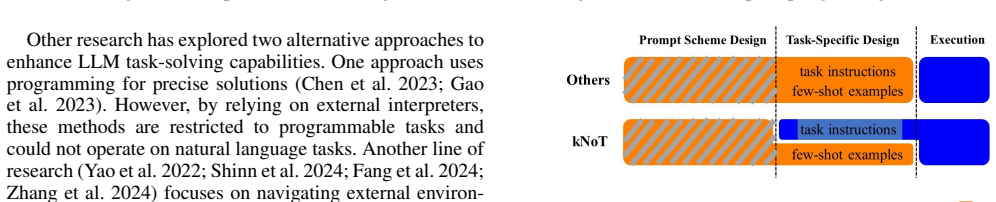
kNoT works in three steps: knowledge extraction, where the LLM produces a solution plan; LWT translation, where the plan is turned into a numbered script whose instructions reference earlier outputs through {(N)} and {(N)}[M]; and script execution, where each instruction is run by the LLM and its output is stored for later reference. By indexing individual list elements, each operation can be elementary, for example adding two digits or checking one set element against another. The paper reports 92 percent accuracy for sorting 32 numbers, versus 12 percent for ToT and 31 percent for GoT, and near-zero baseline accuracy at larger problem sizes on several tasks, while using fewer task-specific prompt characters.
Load-bearing premise
Everything rests on the assumption that the model can reliably write down a correct, parseable plan script before execution begins; if that script is malformed, uses a wrong index, or omits a step, the whole pipeline fails regardless of how well individual steps run.
Editorial extensions
If this is right
- On the six evaluated tasks, kNoT reaches accuracy levels that CoT, ToT, and GoT do not reach at the same problem sizes, especially with 32 to 128 elements.
- Because LWT supports indexing, kNoT confines each LLM call to an elementary operation, which the paper argues is why accuracy holds on long sequences where whole-task prompting fails.
- The scheme reduces task-specific prompt engineering: a single short LWT example per task type suffices, cutting task-specific prompt characters by up to 84.4 percent versus ToT and 87.3 percent versus GoT.
- LLM API costs for high-accuracy runs are lower for kNoT than for ToT and GoT on the tested tasks.
- LLMs generate instance-specific scripts, so the reasoning network is customized per query rather than fixed by a human-designed template.
Reading between the lines
- If the planner and executor are different models, kNoT could be tested as a pipeline in which a strong model writes scripts that a weaker model executes, potentially separating planning ability from execution reliability.
- The LWT indexing mechanism resembles a restricted programming language; one could extend it with conditionals or iteration, though the paper deliberately forbids loops to keep scripts sequential.
- The approach may be most fragile exactly where the paper's gains are largest: as problem size grows, scripts get longer and the planner must keep indices consistent without any feedback, so an error-injection study that perturbs indices would reveal how much of the accuracy margin comes from planning versus execution.
- The paper's framework for counting constant versus task-specific prompts in human labor could be applied to compare future prompt schemes on engineering effort rather than final accuracy alone.
Editorial analysis
A structured set of objections, weighed in public.
Referee Report
Summary. The paper proposes kNoT, a prompting scheme in which an LLM first produces a natural-language solution plan, translates that plan into an LWT-formatted script of numbered 'LLM' instructions with input-field and indexing notation, and then executes the script sequentially, allowing arbitrary networks of elementary LLM operations. The method is evaluated on six tasks spanning natural-language, symbolic, and arithmetic reasoning, with comparisons to CoT, ToT, GoT, and other baselines, and the paper reports large accuracy gains, lower task-specific prompt sizes, ablations, scalability results, and API cost measurements.
Significance. If the empirical claims are validated, kNoT is a worthwhile contribution to prompt engineering: the LWT format cleanly separates plan generation from plan execution, supports flexible network topologies, and the indexing mechanism is a natural way to force elementary operations. The paper is also refreshingly concrete in publishing its prompt templates and examples. The ablations and cost tables are useful, and the scalability experiments address an important weakness of prior schemes. However, the central comparison is currently confounded by the use of GPT-4o for kNoT's script generation while baselines are executed on GPT-3.5-turbo, so the magnitude of the reported gains over the baselines is not yet established.
major comments (4)
- [§5.1, Table 3] The headline comparison is not model-matched. Section 5.1 states that kNoT 'directly leverage[s] the LWT-formatted script generated with GPT-4o as the task instructions', while all baseline prompt schemes are executed on GPT-3.5-turbo. Baselines therefore receive hand-written, fixed task-specific modules, whereas kNoT receives a per-query plan authored by a stronger model. Table 6 reinforces the concern: when ToT and GoT are executed with GPT-4o, they reach 100% accuracy on most tasks, so the large margins in Table 3 may reflect the planner's strength rather than the LWT structure. Please add matched-model conditions, for example kNoT with GPT-3.5-turbo-generated scripts, and ToT/GoT with GPT-4o-generated modules or at least GPT-4o execution, and report the same task table under matched planner/executor settings.
- [§5.1, Algorithm 1] The pipeline has no specified validation or fallback for script generation, and no failure-rate measurement is reported. The claim that kNoT can 'directly leverage' a generated LWT script assumes GPT-4o always produces a syntactically valid, complete, and executable script. Please report, per task and problem size, the fraction of queries for which knowledge extraction or LWT translation fails, including malformed instructions, unresolved or out-of-range indices, non-list outputs when indexed fields are used, or scripts that reference non-existent steps. Without this information, the reliability of the method and the interpretation of the reported accuracies cannot be assessed.
- [Appendix C.2] The few-shot arithmetic examples provided for the CoT baseline contain arithmetic and formatting errors. For example, the first example writes '25+2=37' where the preceding line already gives 35, and the second example writes '27+7=24' where the correct value is 34; later examples use '52=10', '33=9', and '527=70' without multiplication symbols. If these strings were used in the executed baseline prompts, the baselines may have been systematically handicapped, making the comparison in Table 3 unfair. Please verify the executed prompts, correct any typos in the manuscript, and re-run the affected baselines if the erroneous strings were actually used.
- [§5.4, Tables 7 and 9] The quantitative labor-reduction claim is not internally consistent. Table 9 reports kNoT's task-specific token counts averaging about 307 tokens per task, but §5.4 states that kNoT 'requires only 600 tokens per task'; the stated ToT and GoT averages of 1467 and 1893 tokens also do not match Table 9, whose averages are about 1390 and 1746, respectively. Because the advertised 'up to 84.4% and 87.3%' reductions are central to the paper's contribution, please clarify which prompt components are counted in each table, recompute the averages, and report token and character counts consistently.
minor comments (3)
- [Table 1] The symbols in Table 1 render as broken glyphs (e.g., '/reve'), making the comparison table difficult to interpret; please replace them with standard checkmark/cross symbols.
- [§5.2, Table 3] The accuracy results are reported as point estimates on 100 queries per setting without confidence intervals or significance tests. Adding standard errors or a small statistical comparison would strengthen the claim of 'significantly outperforms', especially for the smaller margins such as Yelp (75% vs 52%).
- [Figure 4] Figure 4 is referenced in the text but is not described in enough detail in the manuscript; please ensure axis labels, task definitions, and the baselines shown are fully specified in the caption.
Circularity Check
No circularity: kNoT's claims are empirical comparisons against external baselines; no fitted parameter, self-citation, or definitional identity drives the results. The model-asymmetry caveat is an experimental confound, not a circular reduction.
full rationale
The derivation chain here is empirical rather than mathematical. kNoT proposes a prompt format (LWT) and evaluates it on six external benchmark-style tasks against published schemes (CoT, ToT, GoT, etc.). The claimed reductions in task-specific prompt characters are direct counts of the authors' own prompt designs, not quantities predicted from a fitted parameter; the LWT example E and context C are explicitly listed as task-specific inputs (Section 4.2, Table 2), and the per-query script S is generated rather than fit to the test answers. No uniqueness theorem, ansatz, or load-bearing self-citation is invoked; the reference list contains no overlapping authors' prior results that carry the argument. The strongest caveat is Section 5.1's asymmetry: kNoT's scripts are authored by GPT-4o while all baselines are executed with hand-written GPT-3.5-turbo prompts. That is a meaningful confound for the superiority claim, and Table 6 shows the margin shrinks when all schemes are run on GPT-4o, but it is not an equivalence between input and output by construction, so it does not constitute circularity under the stated rules.
Assumptions & free parameters
free parameters (3)
- Per-task LWT example E =
Hand-authored scripts per task (Appendix B.2)
- Per-task context description C =
Short hints such as 'You can use counting sort' (Appendix B.2)
- Constant prompt templates K and T =
Text in Appendix B.1
assumptions (4)
- ad hoc to paper GPT-4o generates a valid and complete LWT script for each task query without human correction.
- domain assumption The executing LLM reliably follows LWT instructions, including indexed input fields, and returns parseable outputs.
- ad hoc to paper Character count of task-specific prompts is an appropriate proxy for human prompt-engineering effort.
- domain assumption 100 exact-match samples per cell are sufficient to establish that kNoT outperforms baselines.
invented entities (1)
-
LLM Workflow Template (LWT)
Cite this review
Pith. "Pith review of Self-guided Knowledgeable Network of Thoughts: Amplifying Reasoning with Large Language Models." pith.science (2026). https://pith.science/paper/47OSRW5Y
@misc{pith2026241216533,
  author       = {Pith},
  title        = {Pith review of: Self-guided Knowledgeable Network of Thoughts: Amplifying Reasoning with Large Language Models},
  year         = {2026},
  howpublished = {\url{https://pith.science/paper/47OSRW5Y}},
  note         = {Machine review of arXiv:2412.16533}
}
read the original abstract
We introduce Knowledgeable Network of Thoughts (kNoT): a prompt scheme that advances the capabilities of large language models (LLMs) beyond existing paradigms like Chain-of-Thought (CoT), Tree of Thoughts (ToT), and Graph of Thoughts (GoT). The key innovation of kNoT is the LLM Workflow Template (LWT), which allows for an executable plan to be specified by LLMs for LLMs. LWT allows these plans to be arbitrary networks, where single-step LLM operations are nodes, and edges correspond to message passing between these steps. Furthermore, LWT supports selection of individual elements through indexing, facilitating kNoT to produce intricate plans where each LLM operation can be limited to elementary operations, greatly enhancing reliability over extended task sequences. We demonstrate that kNoT significantly outperforms the state of the art on six use cases, while reducing the need for extensive prompt engineering. For instance, kNoT finds 92% accuracy for sorting 32 numbers over 12% and 31% for ToT and GoT, while utilizing up to 84.4% and 87.3% less task-specific prompts, respectively.
Figures


Figures from the paper (1 more)

Reference graph
Works this paper leans on
-
[1]
, " * write output.state after.block = add.period write newline
ENTRY address archivePrefix author booktitle chapter edition editor eid eprint howpublished institution isbn journal key month note number organization pages publisher school series title type volume year label extra.label sort.label short.list INTEGERS output.state before.all mid.sentence after.sentence after.block FUNCTION init.state.consts #0 'before.a...
-
[2]
write newline
" write newline "" before.all 'output.state := FUNCTION n.dashify 't := "" t empty not t #1 #1 substring "-" = t #1 #2 substring "--" = not "--" * t #2 global.max substring 't := t #1 #1 substring "-" = "-" * t #2 global.max substring 't := while if t #1 #1 substring * t #2 global.max substring 't := if while FUNCTION word.in bbl.in capitalize " " * FUNCT...
-
[3]
Bao, G.; Zhang, H.; Yang, L.; Wang, C.; and Zhang, Y. 2024. Llms with chain-of-thought are non-causal reasoners. arXiv preprint arXiv:2402.16048
arXiv 2024
-
[4]
Besta, M.; Blach, N.; Kubicek, A.; Gerstenberger, R.; Podstawski, M.; Gianinazzi, L.; Gajda, J.; Lehmann, T.; Niewiadomski, H.; Nyczyk, P.; et al. 2024. Graph of thoughts: Solving elaborate problems with large language models. In Proceedings of the AAAI Conference on Artificial Intelligence, volume 38, 17682--17690
work page 2024
-
[5]
Carter, S.; and Nielsen, M. 2017. Using artificial intelligence to augment human intelligence. Distill, 2(12): e9
work page 2017
-
[6]
Chen, W.; Ma, X.; Wang, X.; and Cohen, W. W. 2023. Program of Thoughts Prompting: Disentangling Computation from Reasoning for Numerical Reasoning Tasks. Transactions on Machine Learning Research
work page 2023
-
[7]
Engelbart, D. C. 2023. Augmenting human intellect: A conceptual framework. In Augmented Education in the Global Age, 13--29. Routledge
work page 2023
-
[8]
Fang, M.; Deng, S.; Zhang, Y.; Shi, Z.; Chen, L.; Pechenizkiy, M.; and Wang, J. 2024. Large language models are neurosymbolic reasoners. In Proceedings of the AAAI Conference on Artificial Intelligence, volume 38, 17985--17993
work page 2024
Show all 29 references
-
[9]
Feng, G.; Zhang, B.; Gu, Y.; Ye, H.; He, D.; and Wang, L. 2024. Towards revealing the mystery behind chain of thought: a theoretical perspective. Advances in Neural Information Processing Systems, 36
2024
-
[10]
Gao, L.; Madaan, A.; Zhou, S.; Alon, U.; Liu, P.; Yang, Y.; Callan, J.; and Neubig, G. 2023. Pal: Program-aided language models. In International Conference on Machine Learning, 10764--10799. PMLR
2023
-
[11]
E.; Pasunuru, R.; Golovneva, O.; Sinha, K.; Celikyilmaz, A.; Bosselut, A.; and Wang, T
Gao, S.; Dwivedi-Yu, J.; Yu, P.; Tan, X. E.; Pasunuru, R.; Golovneva, O.; Sinha, K.; Celikyilmaz, A.; Bosselut, A.; and Wang, T. 2024. Efficient Tool Use with Chain-of-Abstraction Reasoning. arXiv preprint arXiv:2401.17464
2024 arXiv
-
[12]
Inc., Y. 2015. Yelp Review Dataset. Accessed: 2024-08-05
2015
-
[13]
S.; Reid, M.; Matsuo, Y.; and Iwasawa, Y
Kojima, T.; Gu, S. S.; Reid, M.; Matsuo, Y.; and Iwasawa, Y. 2022. Large language models are zero-shot reasoners. Advances in neural information processing systems, 35: 22199--22213
2022
-
[14]
R.; Kailkhura, B.; Bhatele, A.; Geiping, J.; Schwarzschild, A.; et al
McLeish, S.; Bansal, A.; Stein, A.; Jain, N.; Kirchenbauer, J.; Bartoldson, B. R.; Kailkhura, B.; Bhatele, A.; Geiping, J.; Schwarzschild, A.; et al. 2024. Transformers Can Do Arithmetic with the Right Embeddings. arXiv preprint arXiv:2405.17399
2024 arXiv
-
[15]
Ning, X.; Lin, Z.; Zhou, Z.; Wang, Z.; Yang, H.; and Wang, Y. 2023. Skeleton-of-thought: Large language models can do parallel decoding. NeurIPS 2023 Workshop on Efficient Natural Language and Speech Processing (ENLSP)
2023
-
[16]
Paul, D.; Ismayilzada, M.; Peyrard, M.; Borges, B.; Bosselut, A.; West, R.; and Faltings, B. 2023. Refiner: Reasoning feedback on intermediate representations. arXiv preprint arXiv:2304.01904
2023 arXiv
-
[17]
K.; Saha, S.; Jain, V.; Mondal, S.; and Chadha, A
Sahoo, P.; Singh, A. K.; Saha, S.; Jain, V.; Mondal, S.; and Chadha, A. 2024. A Systematic Survey of Prompt Engineering in Large Language Models: Techniques and Applications. arXiv preprint arXiv:2402.07927
2024 arXiv
-
[18]
Saxton, D.; Grefenstette, E.; Hill, F.; and Kohli, P. 2019. Analysing mathematical reasoning abilities of neural models. arXiv preprint arXiv:1904.01557
2019 arXiv
-
[19]
Shinn, N.; Cassano, F.; Gopinath, A.; Narasimhan, K.; and Yao, S. 2024. Reflexion: Language agents with verbal reinforcement learning. Advances in Neural Information Processing Systems, 36
2024
-
[20]
Stechly, K.; Valmeekam, K.; and Kambhampati, S. 2024. Chain of Thoughtlessness: An Analysis of CoT in Planning. arXiv preprint arXiv:2405.04776
2024 arXiv
-
[21]
Sun, J.; Zheng, C.; Xie, E.; Liu, Z.; Chu, R.; Qiu, J.; Xu, J.; Ding, M.; Li, H.; Geng, M.; et al. 2023. A survey of reasoning with foundation models. arXiv preprint arXiv:2312.11562
2023 arXiv
-
[22]
N.; Kaiser, L
Vaswani, A.; Shazeer, N.; Parmar, N.; Uszkoreit, J.; Jones, L.; Gomez, A. N.; Kaiser, L. u.; and Polosukhin, I. 2017. Attention is All you Need. In Guyon, I.; Luxburg, U. V.; Bengio, S.; Wallach, H.; Fergus, R.; Vishwanathan, S.; and Garnett, R., eds., Advances in Neural Infor...
2017
-
[23]
V.; Chi, E
Wang, X.; Wei, J.; Schuurmans, D.; Le, Q. V.; Chi, E. H.; Narang, S.; Chowdhery, A.; and Zhou, D. 2022. Self-Consistency Improves Chain of Thought Reasoning in Language Models. In The Eleventh International Conference on Learning Representations
2022
-
[24]
V.; Zhou, D.; et al
Wei, J.; Wang, X.; Schuurmans, D.; Bosma, M.; Xia, F.; Chi, E.; Le, Q. V.; Zhou, D.; et al. 2022. Chain-of-thought prompting elicits reasoning in large language models. Advances in neural information processing systems, 35: 24824--24837
2022
-
[25]
Yang, Z.; Ding, M.; Lv, Q.; Jiang, Z.; He, Z.; Guo, Y.; Bai, J.; and Tang, J. 2023. Gpt can solve mathematical problems without a calculator. arXiv preprint arXiv:2309.03241
2023 arXiv
-
[26]
Yao, S.; Yu, D.; Zhao, J.; Shafran, I.; Griffiths, T.; Cao, Y.; and Narasimhan, K. 2024. Tree of thoughts: Deliberate problem solving with large language models. Advances in Neural Information Processing Systems, 36
2024
-
[27]
Yao, S.; Zhao, J.; Yu, D.; Du, N.; Shafran, I.; Narasimhan, K.; and Cao, Y. 2022. React: Synergizing reasoning and acting in language models. arXiv preprint arXiv:2210.03629
2022 arXiv
-
[28]
Zhang, C.; Yang, K.; Hu, S.; Wang, Z.; Li, G.; Sun, Y.; Zhang, C.; Zhang, Z.; Liu, A.; Zhu, S.-C.; et al. 2024. ProAgent: building proactive cooperative agents with large language models. In Proceedings of the AAAI Conference on Artificial Intelligence, volume 38, 17591--17599
2024
-
[29]
Zhang, Z.; Zhang, A.; Li, M.; and Smola, A. 2023. Automatic Chain of Thought Prompting in Large Language Models. In The Eleventh International Conference on Learning Representations
2023
Reviewed August 11, 2026 · model on record in the stance chip above.
Discussion (0). Continue with ORCID to comment.