REVIEW 3 major objections 4 minor 1 cited by
Quantum Diffie-Hellman key exchange
T0 review · 3 major / 4 minor · reviewed 2026-08-10 · deepseek-v4-flash
Pith's one-line read A quantum version of Diffie-Hellman key exchange can be built by encoding integers as weak coherent states, and for mean photon numbers below about 0.02 the encoding hides the shared key from an eavesdropper's best analyzed attack.
desk verdict A genuinely new coherent-state key-exchange protocol with careful attack analysis, whose full security claim rests on a conjecture the author openly states. read the letter →
The pith
A machine-rendered reading of the paper's core claim, the machinery that carries it, and where it could break.
The reading
What carries the argument
The central object is the set S_N of N symmetric single-mode coherent states |ψ_x⟩ = |√μ $e^{{i x 2π/N}}$⟩, together with the elementary phase-shift operator U = $e^{{i 2π a†a/N}}$. The map x ↦ |ψ_x⟩ is the proposed quantum one-way function; the operators U^x form a cyclic group that commutes and adds modulo N, providing the quantum analogue of exponentiation modulo a prime. The security analysis hinges on the minimum-error probability of the square-root measurement for these states, computed from the Poisson photon statistics and leading to the criterion D ≤ ε for closeness to an ideal one-way function.
What would settle it
Find a concrete joint or collective measurement on Eve's collected copies of |ψ_a⟩ and |ψ_b⟩ from many rounds that achieves a guessing probability for s_j exceeding $2^{{-H_min}}$ at μ = 0.02, N = 20; a numerical search over joint POVMs on the tensor-product states would settle whether the conjectured optimality holds.
Extended reading notes
Core claim
The paper's central discovery is that the algebraic structure of phase-shift operations on a fixed coherent state replicates the two properties that make classical Diffie-Hellman work: any two phase shifts commute, and their combined action adds modulo N. Encoding Alice's and Bob's private integers as states |ψ_x⟩ = U^x|ψ_0⟩ drawn from the publicly known set S_N of symmetric coherent states, the protocol lets each user apply their own shift to the state received from the other, so both arrive at the common state |ψ_{a⊕b}⟩ with neither knowing the key value. The security claim is that for μ ≲ 0.02 and N ≥ N*(μ) the encoding acts as a quantum one-way function: the square-root measurement, which is optimal for minimum-error discrimination of these states, yields a success probability that is within ε = 2×$10^{{-2}}$ of random guessing, and the conditional min-entropy of the encoded bit against this attack satisfies H_min(s_j|s~_j) ≥ 0.96 bits. The paper further argues that the photon-number-splitting attack is not a threat, because Eve would need multiphoton pulses from both exchanged states (probability at most $μ^{4}$/4) and would then face the same discrimination problem. On this basis it conjectures that the best eavesdropping strategy is the independent minimum-error-discrimination attack, and derives a secret-key length via the leftover-hash bound.
Load-bearing premise
Eve's optimal attack is the individual minimum-error-discrimination measurement on each intercepted state, so the guessing probability p_E(cor) used in the min-entropy bound is maximal.
Editorial extensions
If this is right
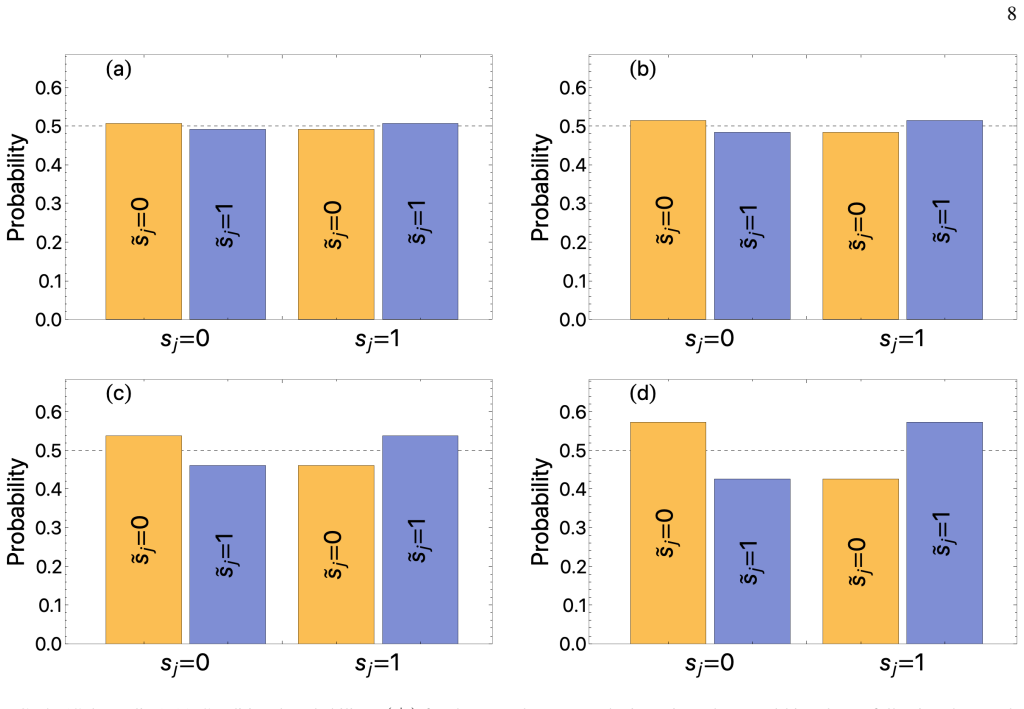
- For μ ≲ 0.02 and N ≥ N*, an eavesdropper using the minimum-error-discrimination attack can guess the encoded bit with probability close to 1/2, giving a conditional min-entropy of at least 0.96 bits per raw bit.
- At these parameters, a minimum-error-discrimination attack drives the error rate in Alice's and Bob's sifted keys to roughly 0.5, so a threshold of P_err_max = 0.2 provides a clear detection signal.
- The photon-number-splitting attack is ineffective because it succeeds only when both intercepted states contain at least two photons (probability at most μ^4/4), and even then it reduces to the same minimum-error-discrimination problem.
- The protocol does not require a third party and can be implemented with existing coherent-state technology, including phase modulators, beam splitters, and single-photon detectors.
- The security parameter ε = 2×10^{-2} defines the threshold N*(μ), which grows with μ; for μ = 0.02, N = 20 lies within the secure regime.
- If the conjectured optimality of the independent minimum-error-discrimination attack holds, the protocol yields a secret-key length governed by the leftover-hash bound, with the min-entropy term essentially equal to the raw key length.
Reading between the lines
- The paper leaves open the security against collective or joint measurements across multiple intercepted states; a proof that such measurements do not beat the independent minimum-error-discrimination guessing probability would turn the conjectured optimality into a theorem, but no such proof is given.
- The protocol's dependence on a common phase reference and low phase drift means its secure distance is limited by phase coherence; phase-stabilization techniques from twin-field QKD could extend the reach, though the paper does not quantify this.
- A natural generalization is to encode more than one bit per state (for example by using multiple phase-shift values for the bit), with the per-round min-entropy then set by the discrimination error; the framework presented here could be extended in that direction.
- If the central security claim holds, the same coherent-state map could serve as a building block for other public-key-style quantum protocols, since it provides a physical one-way function with a clear group structure.
Formalized claims in Lean
-
Claim #1: The paper's central discovery is that the algebraic structure of phase-shift operations on a fixed coherent state replicates the two properties that make classical Diffie-Hellman work: any two phase shifts commute, and their combined action adds modulo N. Encoding Alice's and Bob's private integers as states |ψ_x⟩ = U^x|ψ_0⟩ drawn from the publicly known set S_N of symmetric coherent states, the p
/-- @claim 1 The paper's central discovery is that the algebraic structure of phase-shift operations on a fixed coherent state replicates the two properties that make classical Diffie-Hellman work: any two phase shifts commute, and their combined action adds modulo N. Encoding Alice's and Bob's private integers as states |ψ_x⟩ = U^x|ψ_0⟩ drawn from the publicly known set S_N of symmetric coherent states, the p -/
def central_claim : Prop :=
Signed reviews
Editorial analysis
A structured set of objections, weighed in public.
Referee Report
Summary. The paper proposes a quantum version of Diffie-Hhellman key exchange. Alice and Bob independently choose random integers a_j and b_j, encode them as symmetric coherent states |ψ_a⟩ and |ψ_b⟩, and exchange them. Each party applies his/her own phase shift to the received state, obtaining a common quantum key |ψ_{a⊕b}⟩. Alice then encodes a secret bit s_j by a phase flip and sends the cipher state to Bob, who compares it with his local key by interference on a beam splitter. The paper analyzes the protocol's operation under realistic losses and phase drift, introduces a quantitative criterion for when the map x ↦ |ψ_x⟩ acts as a quantum one-way function, and studies two attacks: a minimum-error-discrimination attack and a photon-number-splitting attack. It concludes that for mean photon number μ ≲ 0.02 and sufficiently many phase slices N, the encoded bit s_j is well protected (H_min ≥ 0.96) and any such attack induces a high error rate (~0.5) in the sifted key, so the protocol would abort.
Significance. If rigorously established, the protocol would be a genuinely new construction: a Diffie-Hellman-like key agreement whose security is based on a quantum one-way function rather than on standard QKD principles. The paper contains useful concrete results: a quantitative QOWF criterion (Eq. (7) with D ≤ ε), analytical formulas for the detection and error probabilities (Eqs. (19)-(26), (30)-(33)), and a clear analysis of why the PNS attack is not directly useful. The numerical simulations and figures are reproducible from the given formulas. However, the strongest security claim is explicitly conditional on a conjecture about the optimality of the analyzed attack. Because this conjecture is load-bearing for the central claim, the current manuscript does not yet provide a complete security proof but does supply a substantial analytic and numerical basis for the protocol's behavior under specific attacks.
major comments (3)
- [Sec. III D, Eqs. (35)-(36)] The central claim that the encoded bit is well protected, quantified by H_min(s_j|tilde s_j) ≈ 1 and hence by a secret-key length close to |s| in Eq. (35), relies on the conjecture stated in the text that the two-stage minimum-error-discrimination attack of Sec. III B maximizes p_E(cor). This conjecture is load-bearing. The supporting argument that independent preparation of a_j and b_j makes collective attacks useless is not a proof: the relevant quantity is k_j = a_j ⊕ b_j, which is a function of the joint state |ψ_a⟩⊗|ψ_b⟩. A joint POVM could estimate k_j directly, or decide s_j after seeing the cipher state, without first committing to individual estimates of a_j and b_j. The Holevo and Fano bounds in Sec. II bound the information about a single state, not about a function of a pair of states. Nothing in the manuscript rules out such a joint measurement, so the numerical values in Fig. 7 and the key-length estimate in Eq. (35) are conditional on an unproven optimality statement.
- [Sec. III B and Step 8 of Definition 1] The security analysis does not establish the trade-off between Eve's information and the induced error rate, which is the basis for the abort decision. The paper computes p_E(cor) and H_min for a specific, unconstrained attack, and separately computes the error rate (~0.5) that this attack induces. It does not show that any attack that is consistent with the observed error rate (i.e., q ≤ P_err^max = 0.2) leaves H_min at the values used in Eq. (35). For example, Eve could deliberately guess s_j less aggressively, or use a correlated strategy across rounds, to reduce the induced error rate while still gaining some information about s_j. Without a bound of the form H_min ≥ f(q) relating the min-entropy to the observed error rate, the protocol's secret-key length is not proven secure even against the family of attacks considered.
- [Sec. III D, line after Eq. (35)] The equality H_min(s|tilde s) = |s| H_min(s_j|tilde s_j) is stated without proof and is not generally exact for conditional min-entropy of finite-size strings. For i.i.d. rounds, the conditional min-entropy of the joint string is only asymptotically equal to n times the single-round value, up to smoothing and finite-size corrections. The Chernoff-bound sample size in Eq. (34) is not connected to the key-length estimate in Eq. (35). As written, the extractable key length may be overstated. The authors should either state that Eq. (35) is an asymptotic expression (with corrections) or perform a proper finite-key analysis.
minor comments (4)
- [Sec. III D, first paragraph] There is an empty citation after 'the secure key length that can be extracted from s' (the brackets contain no reference).
- [Fig. 5 caption] The caption lists '(b) μ = 0.02, N = 20. (c) μ = 0.05, N = 20. (b) μ = 0.1, N = 20'; the last panel should be labeled (d).
- [Throughout] The notation ⊖ for subtraction modulo N is used in some equations (e.g., Eq. (8d)) but not defined as explicitly as ⊕; a short notational clarification would improve readability.
- [Sec. II B and Fig. 1] The choice ε = 2 × 10^{-2} is presented as a security parameter, but the paper does not discuss how this value relates to a concrete security level (e.g., a lower bound on the adversary's error probability). A brief remark that ε is a design choice and what its magnitude implies would be helpful.
Circularity Check
No significant circularity; the central security claim rests on an explicitly conjectured optimality of Eve's attack, which is a correctness risk but not a circular reduction.
full rationale
The derivation chain is self-contained. The QOWF criterion D≤ε in Eq. (7) is a definitional threshold, not an assumption of the result; the minimum-error probabilities and p_E(cor) are computed from the standard square-root measurement for symmetric coherent states (cited to external state-discrimination literature [9,10]) and from the beam-splitter detection model of Sec. III A, rather than being fitted to force Hmin≥0.96. The central security claim is explicitly conditional on a conjecture in Sec. III D: 'we conjecture that the probability p_E(cor) ... is also maximal', and similarly in Sec. III C: 'we conjecture that the best option for Eve to attack the proposed QDH protocol is the minimum-error-discrimination attack'. These are unproven optimality assumptions and therefore a genuine limitation: if a joint measurement across the two intercepted states gave a higher correct-guessing probability than p_E(cor), the min-entropy in Eq. (36) and the secret-key length in Eq. (35) would shrink. That is a correctness risk, not a circularity, because the paper does not define p_E(cor) to be optimal by construction, nor does it derive Eq. (36) by assuming the conclusion. Self-citations [7,8] motivate the coherent-state encoding setup but do not carry the load-bearing security argument, which relies on standard Holevo, Fano, state-discrimination, and finite-key results. The exponential fit Hmin≈e^{-2.1μ} is descriptive of the computed data, not an input used to produce the security claim. No load-bearing step reduces, by the paper's own equations or by self-citation, to its own input.
Assumptions & free parameters
free parameters (4)
- QOWF security parameter ε =
0.02
- Mean photon number threshold μ ≤ 0.02 =
0.02
- Error-rate threshold Perr_max =
0.2
- Sample-size parameters ε and ξ for Chernoff bound =
ε=0.02, ξ=10^-6
assumptions (5)
- standard math Square-root measurement is the minimum-error measurement for symmetric coherent states, giving p_min^err (Ref. [10]).
- standard math Holevo bound and Fano inequality bound the information extractable from a quantum state.
- domain assumption Random phase drift φ follows a normal distribution N(0, σ_φ) with σ_φ = √(DL).
- ad hoc to paper Eve does not gain by collective attacks on the independently prepared states.
- ad hoc to paper The minimum-error-discrimination attack is the optimal attack for Eve (conjectured).
Cite this review
Pith. "Pith review of Quantum Diffie-Hellman key exchange." pith.science (2026). https://pith.science/paper/4AVCEHMO
@misc{pith2026250109568,
  author       = {Pith},
  title        = {Pith review of: Quantum Diffie-Hellman key exchange},
  year         = {2026},
  howpublished = {\url{https://pith.science/paper/4AVCEHMO}},
  note         = {Machine review of arXiv:2501.09568}
}
read the original abstract
The Diffie-Hellman key exchange plays a crucial role in conventional cryptography, as it allows two legitimate users to establish a common, usually ephemeral, secret key. Its security relies on the discrete-logarithm problem, which is considered to be a mathematical one-way function, while the final key is formed by random independent actions of the two users. In the present work we investigate the extension of Diffie-Hellman key exchange to the quantum setting, where the two legitimate users exchange independent random quantum states. The proposed protocol relies on the bijective mapping of integers onto a set of symmetric coherent states, and we investigate the regime of parameters for which the map behaves as a quantum one-way function. Its security is analyzed in the framework of minimum-error-discrimination and photon-number-splitting attacks, while its performance and the challenges in a possible realization are also discussed.
Figures


Figures from the paper (4 more)



Forward citations
Cited by 1 Pith paper
-
Quantum One-Way Functions and Related Cryptographic Primitives
A topical review that clarifies the relationships and differences among quantum one-way functions, OWSGs, PRSGs, and EFI pairs, emphasizing physical realizability.
Reference graph
Works this paper leans on
-
[1]
Menezes, P
A. Menezes, P. van Oorschot and S. Vanstone, Handbook of Applied Cryptography (CRC Press, 1996)
1996
-
[2]
K. M. Martin, Everyday Cryptography: Fundamental Prin- ciples and Applications (Oxford University Press, New York, 2012)
work page 2012
-
[3]
A Three-Stage Quantum Cryptography Protocol,
S. Kak, "A Three-Stage Quantum Cryptography Protocol," Found. Phys. Lett. 19, 293 (2006)
work page 2006
-
[4]
A quantum Diffie-Hellman protocol,
P. Subramaniam, and A. Parakh, "A quantum Diffie-Hellman protocol," International Journal of Security and Networks 11, 213–223 (2016)
work page 2016
-
[5]
V .S. Naresh, M.M. Nasralla, S. Reddi, I. García-Magariño, "Quantum Diffie–Hellman Extended to Dynamic Quantum Group Key Agreement for e-Healthcare Multi-Agent Systems in Smart Cities," Sensors 20, 3940 (2020) 13
work page 2020
-
[6]
Experimentally realizable quantum comparison of coherent states and its applications,
E. Andersson, M. Curty, and I. Jex, "Experimentally realizable quantum comparison of coherent states and its applications," Phys. Rev. A 74, 022304 (2006)
work page 2006
-
[7]
Applications of single-qubit rotations in quantum public-key cryptography,
G. M. Nikolopoulos, "Applications of single-qubit rotations in quantum public-key cryptography," Phys. Rev. A 77, 032348 (2008); 78, 019903 (2008)
work page 2008
-
[8]
Deterministic quantum-public-key encryption: Forward search attack and randomization,
G. M. Nikolopoulos and L. M. Ioannou, "Deterministic quantum-public-key encryption: Forward search attack and randomization," Phys. Rev. A 79, 042327 (2009)
work page 2009
Show all 27 references
-
[9]
Quantum state discrimination,
S. M. Barnett and S. Croke, "Quantum state discrimination," Advances in Optics and Photonics 1, 238–278 (2009)
2009
-
[10]
Opti- mum measurements for discrimination among symmetric states and parameter estimation,
M. Ban, K. Kurokawa, R. Momose, and O. Hirota, “Opti- mum measurements for discrimination among symmetric states and parameter estimation,” IEEE Transl. J. Magn. Jpn. 36, 1269–1288 (1997)
1997
-
[11]
M. A. Nielsen and I. L. Chuang, Quantum Computation and Quantum Information (Cambridge University Press, Cam- bridge, England, 2000)
2000
-
[12]
Overcoming the rate–distance limit of quantum key distribu- tion without quantum repeaters,
M. Lucamarini, Z. L. Yuan, J. F. Dynes and A. J. Shields, "Overcoming the rate–distance limit of quantum key distribu- tion without quantum repeaters," Nature 557, 400 (2018)
2018
-
[13]
Phase-noise measurements in long-fiber interferometers for quantum-repeater applications,
J. Miná ˇr, H. de Riedmatten, C. Simon, H. Zbinden, and N. Gisin, "Phase-noise measurements in long-fiber interferometers for quantum-repeater applications," Phys. Rev. A 77, 052325 (2008)
2008
-
[14]
Twin-field quantum key distribution with large misalignment error,
X. B. Wang, Z. W. Yu, and X. L. Hu, "Twin-field quantum key distribution with large misalignment error," Phys. Rev. A 98, 062323 (2018)
2018
-
[15]
Experimental quantum key distribution beyond the repeaterless secret key capacity,
M. Minder, M. Pittaluga, G. L. Roberts, M. Lucamarini, J. F. Dynes, Z. L. Yuan and A. J. Shields, "Experimental quantum key distribution beyond the repeaterless secret key capacity," Nature Photonics 13, 334–338 (2019)
2019
-
[16]
Twin-Field Quantum Key Distribution without Phase Locking,
W. Li, L. Zhang, Y . Lu, Z.-P. Li, C. Jiang, Y . Liu, J. Huang, H. Li, and Z. Wang, X.-B. Wang, Q. Zhang, L. You, F. Xu, and J.- W. Pan, "Twin-Field Quantum Key Distribution without Phase Locking," Phys. Rev. Lett. 130, 250802 (2023)
2023
-
[17]
Error Reconcil- iation in Quantum Key Distribution Protocols,
M. Mehic, M. Niemiec, H. Siljak, M. V oznak, "Error Reconcil- iation in Quantum Key Distribution Protocols," In: Reversible Computation: Extending Horizons of Computing , Edited by I. Ulidowski, I. Lanese, U. Schultz, C. Ferreira, Lecture Notes in Computer Science 12070, pp. 2...
2020
-
[18]
Privacy amplifi- cation by public discussion,
C. H. Bennett, G. Brassard, and J.-M. Robert, "Privacy amplifi- cation by public discussion," SIAM J. Comput.,17, 210 (1988)
1988
-
[19]
Generalized privacy amplification,
C. H. Bennett, G. Brassard, C. Crepeau, and U. M. Maurer, "Generalized privacy amplification," IEEE Trans. Inf. Theory 41, 1915 (1995)
1995
-
[20]
Continuous-variable quantum authentication of physical unclonable keys,
G. M. Nikolopoulos, and E. Diamanti, "Continuous-variable quantum authentication of physical unclonable keys," Sci. Rep. 7, 46047 (2017)
2017
-
[21]
Limi- tations on practical quantum cryptography,
G. Brassard, N. Lütkenhaus, T. Mor and B. C. Sanders, "Limi- tations on practical quantum cryptography," Phys. Rev. Lett.85, 1330 (2000)
2000
-
[22]
Left- over Hashing Against Quantum Side Information,
M. Tomamichel, C. Schaffner, A. Smith, and R. Renner, "Left- over Hashing Against Quantum Side Information," IEEE Trans. Inf. Th. 57, 5524 (2011)
2011
-
[23]
Min- entropy and quantum key distribution: Nonzero key rates for “small
S. Bratzik, M. Mertz, H. Kampermann, and D. Bruss, "Min- entropy and quantum key distribution: Nonzero key rates for “small” numbers of signals," Phys. Rev. A 83, 022330 (2011)
2011
-
[24]
Nu- merical finite-key analysis of quantum key distribution,
D. Bunandar, L. C. G. Govia, H. Krovi, and D. Englund, "Nu- merical finite-key analysis of quantum key distribution," npj Quantum Information 6, 104 (2020)
2020
-
[25]
Abidin, Authentication in Quantum Key Distribution: Se- curity Proof and Universal Hash Functions, Ph.D
A. Abidin, Authentication in Quantum Key Distribution: Se- curity Proof and Universal Hash Functions, Ph.D. Thesis, Linköping University, Sweden, 2013
2013
-
[26]
Experimental authentication of quantum key distribution with post-quantum cryptography,
L.-J. Wang, K.-Y . Zhang, J.-Y . Wang, J. Cheng, Y .-H. Yang, S.- B. Tang, D. Yan, Y .-L. Tang, Z. Liu, Y . Yu, Q. Zhang, and J.-W. Pan, "Experimental authentication of quantum key distribution with post-quantum cryptography," npj Quant. Inf. 7, 67 (2021)
2021
-
[27]
Quantum Key Distribu- tion with Post-Processing Driven by Physical Unclonable Func- tions,
G. M. Nikolopoulos and M. Fischlin, "Quantum Key Distribu- tion with Post-Processing Driven by Physical Unclonable Func- tions," Appl. Sci. 14, 464 (2024)
2024
Reviewed August 10, 2026 · model on record in the stance chip above.
Discussion (0). Continue with ORCID to comment.