A Toolbox to Understand the Physics of Quantum Data Management
Pith reviewed 2026-06-30 20:26 UTC · model grok-4.3
The pith
A toolbox enables physics-based analysis of quantum annealing for data management problems.
A machine-rendered reading of the paper's core claim, the machinery that carries it, and where it could break.
Core claim
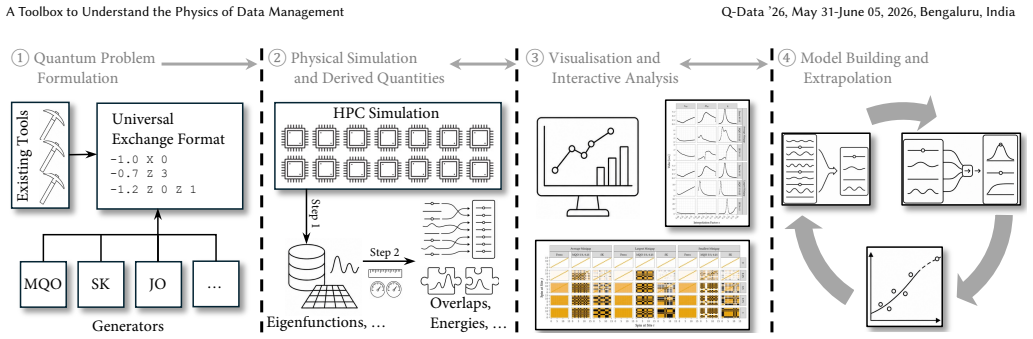
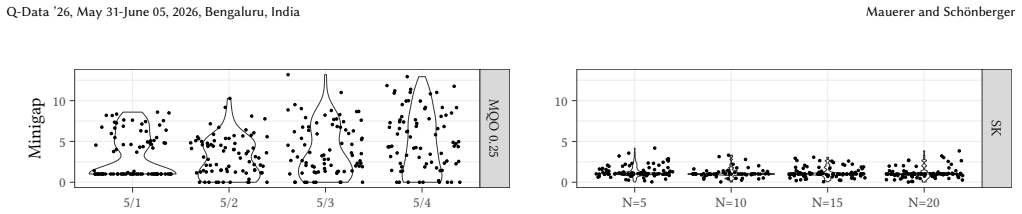
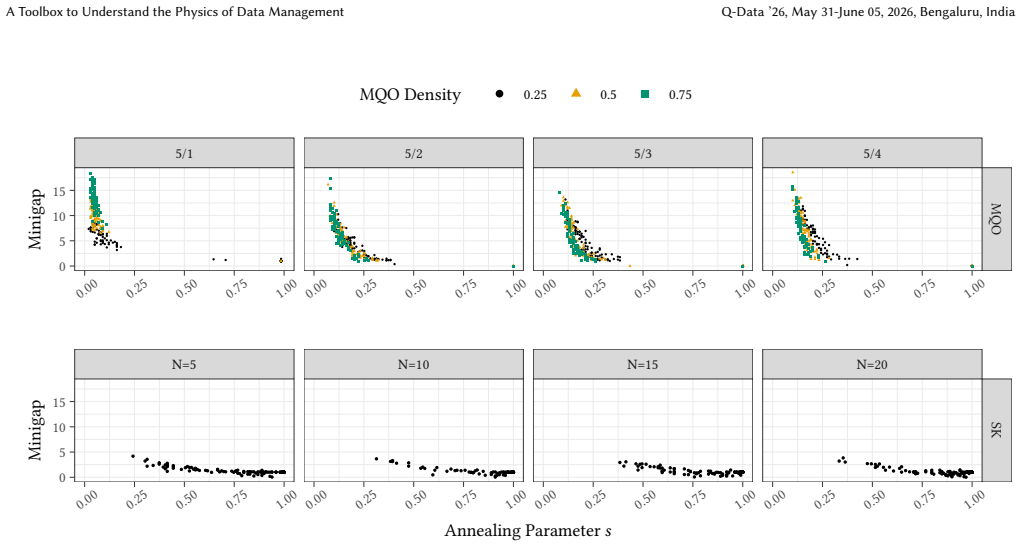
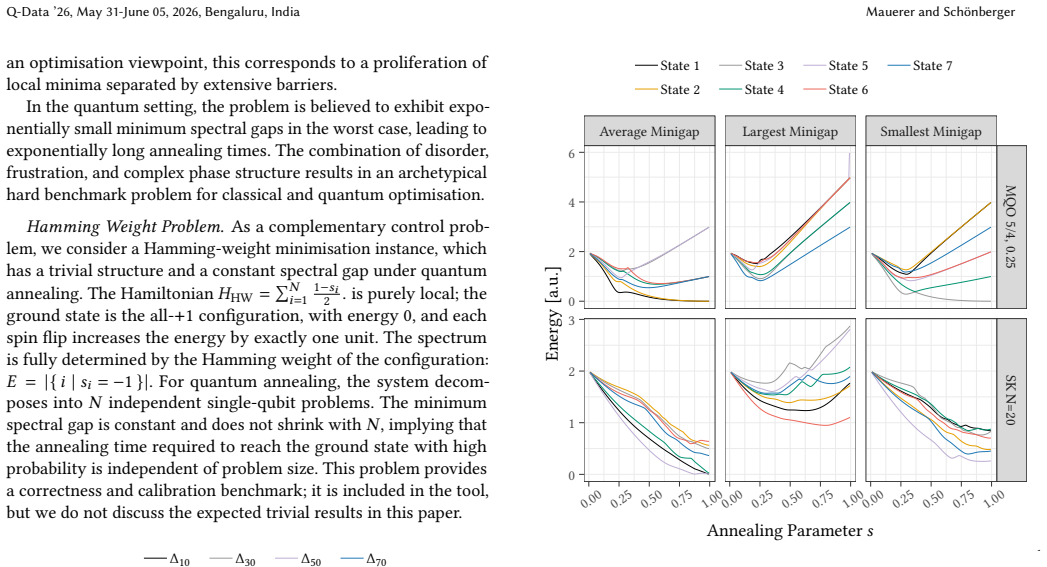
The toolbox provides systematic numerical analysis of quantum annealing processes derived from data management formulations, giving access to energy gaps, eigenstate structure, optimization dynamics, and comparisons to physical models that support evaluation of computational hardness and scaling.
What carries the argument
The computational toolbox for numerical simulation and analysis of spectral and dynamical properties such as energy gaps in quantum annealing from data management problem formulations.
If this is right
- Enables study of spectral and dynamical properties inaccessible through direct hardware measurements.
- Supports interpretation of optimisation dynamics and identification of structural similarities to physical models.
- Facilitates construction of reduced effective descriptions for the systems.
- Provides a foundation for evaluating quantum approaches and guiding co-design between quantum computing and database systems.
Where Pith is reading between the lines
- The same numerical approach could be adapted to study other quantum paradigms such as variational algorithms for data tasks.
- Visualisation outputs might suggest new mappings that reduce the effective hardness of certain database optimisation problems.
- Reduced effective descriptions derived from the toolbox could enable classical pre-screening of problem instances before quantum execution.
Load-bearing premise
Numerical simulations of quantum annealing derived from data management formulations accurately capture the physical behaviour relevant to computational hardness on actual quantum devices.
What would settle it
A comparison where the energy gaps and scaling predictions from the toolbox fail to correlate with observed performance or success rates when the same problems are executed on quantum annealing hardware.
Figures

read the original abstract
The application of quantum computing to data management has attracted growing interest, yet remains constrained by a limited understanding of how the physical behaviour of quantum devices relates to the structure and difficulty of database problems. In particular, evaluating quantum annealing approaches for combinatorial optimisation, which is central to many data management tasks, poses significant challenges beyond the scope of conventional empirical and complexity-theoretic methods. We present a computational toolbox for the systematic numerical analysis of quantum annealing processes derived from data management problem formulations. Adopting a physics-informed perspective, the toolbox enables the study of spectral and dynamical properties -- such as energy gaps and eigenstate structure -- that are inaccessible through direct hardware measurements, yet essential for understanding computational hardness and scaling behaviour. Our approach further provides derived quantities and visualisation techniques that support the interpretation of optimisation dynamics, the identification of structural similarities to canonical physical models, and the construction of reduced effective descriptions. By bridging methodological gaps between quantum computing and database systems research, this work establishes a principled foundation for evaluating quantum approaches and guiding future co-design efforts.
Editorial analysis
A structured set of objections, weighed in public.
Referee Report
Summary. The paper claims to present a computational toolbox for the systematic numerical analysis of quantum annealing processes derived from data management problem formulations. Adopting a physics-informed perspective, the toolbox enables the study of spectral and dynamical properties such as energy gaps and eigenstate structure that are inaccessible through direct hardware measurements, along with derived quantities and visualisation techniques to support interpretation of optimisation dynamics, identification of structural similarities to canonical physical models, and construction of reduced effective descriptions.
Significance. If the toolbox is implemented with the claimed capabilities and its results are validated, it would provide a useful methodological bridge between quantum computing and database systems research, potentially aiding in the evaluation of quantum approaches to combinatorial optimisation problems in data management and guiding co-design efforts. The focus on properties relevant to computational hardness could be significant for the field.
major comments (2)
- [Abstract] The abstract outlines the intended capabilities of the toolbox but supplies no implementation details, validation results, error analysis, or evidence that the toolbox achieves its stated goals, leaving the central claims without demonstrated support.
- [Abstract] The claim that spectral properties extracted from ideal numerical simulations are essential for understanding computational hardness does not address how hardware noise, decoherence, control errors, or finite-temperature effects on actual devices could close or reopen gaps and alter dynamics in ways invisible to closed-system numerics (see skeptic concern on ideal Schrödinger dynamics).
Simulated Author's Rebuttal
We thank the referee for the constructive report and the recommendation for major revision. We address each major comment below with point-by-point responses. The manuscript already contains implementation details, validation examples, and error analysis in the main text; we are prepared to make targeted clarifications for emphasis.
read point-by-point responses
-
Referee: [Abstract] The abstract outlines the intended capabilities of the toolbox but supplies no implementation details, validation results, error analysis, or evidence that the toolbox achieves its stated goals, leaving the central claims without demonstrated support.
Authors: The abstract is deliberately concise. The full manuscript supplies the requested elements: implementation details appear in Sections 3–4 (including the numerical diagonalization routines and derived-quantity pipelines), validation on concrete database-derived Hamiltonians is shown in Section 5 with explicit gap and eigenstate computations, and error analysis for the closed-system solvers is given in Section 2.3 together with convergence checks. These sections collectively demonstrate that the toolbox meets its stated goals. We can add a single sentence to the abstract referencing the validation sections if the editor permits. revision: partial
-
Referee: [Abstract] The claim that spectral properties extracted from ideal numerical simulations are essential for understanding computational hardness does not address how hardware noise, decoherence, control errors, or finite-temperature effects on actual devices could close or reopen gaps and alter dynamics in ways invisible to closed-system numerics (see skeptic concern on ideal Schrödinger dynamics).
Authors: We agree that hardware imperfections can qualitatively modify gaps and dynamics. The toolbox is intentionally restricted to closed-system ideal Schrödinger evolution precisely to isolate the intrinsic spectral features that arise from the database-problem encoding itself. This baseline is a necessary first step before open-system effects can be interpreted; the manuscript already notes this scope limitation in the final discussion paragraph. Extending the toolbox to Lindblad or finite-temperature models would constitute a separate, larger project. We can insert an explicit clarifying clause in the abstract and introduction to state the ideal-system focus. revision: partial
Circularity Check
Toolbox description contains no derivations, predictions or self-citation chains
full rationale
The manuscript presents a software toolbox for numerical simulation of quantum annealing Hamiltonians derived from database problems. It makes no first-principles claims, performs no parameter fitting, issues no predictions that could reduce to fitted inputs, and invokes no uniqueness theorems or prior self-citations as load-bearing justification. The central statements concern the existence and utility of the tool for inspecting spectra and dynamics; these statements are not equivalent to their own inputs by construction. No enumerated circularity pattern applies.
Axiom & Free-Parameter Ledger
Reference graph
Works this paper leans on
-
[1]
Tameem Albash and Daniel A. Lidar. 2018. Adiabatic quantum computation. Reviews of Modern Physics90, 1 (Jan. 2018). doi:10.1103/revmodphys.90.015002
-
[2]
M. H. S. Amin. 2009. Consistency of the Adiabatic Theorem.Physical Review Letters102, 22 (June 2009). doi:10.1103/physrevlett.102.220401
-
[3]
M. H. S. Amin and V. Choi. 2009. First-order quantum phase transition in adiabatic quantum computation.Physical Review A80, 6 (Dec. 2009). doi:10.1103/physreva. 80.062326
-
[4]
Satish Balay, Shrirang Abhyankar, Mark F. Adams, Steven Benson, Jed Brown, Peter Brune, Kris Buschelman, Emil Constantinescu, Lisandro Dalcin, Alp Dener, Victor Eijkhout, Jacob Faibussowitsch, William D. Gropp, Václav Hapla, Tobin Isaac, Pierre Jolivet, Dmitry Karpeev, Dinesh Kaushik, Matthew G. Knepley, Fande Kong, Scott Kruger, Dave A. May, Lois Curfman...
-
[5]
Gropp, Lois Curfman McInnes, and Barry F
Satish Balay, William D. Gropp, Lois Curfman McInnes, and Barry F. Smith. 1997. Efficient Management of Parallelism in Object Oriented Numerical Software Libraries. InModern Software Tools in Scientific Computing, E. Arge, A. M. Bruaset, and H. P. Langtangen (Eds.). Birkhäuser Press, 163–202
1997
-
[6]
Andreas Bayerstadler, Guillaume Becquin, Julia Binder, Thierry Botter, Hans Ehm, Thomas Ehmer, Marvin Erdmann, Norbert Gaus, Philipp Harbach, Max- imilian Hess, Johannes Klepsch, Martin Leib, Sebastian Luber, Andre Luckow, Maximilian Mansky, Wolfgang Mauerer, Florian Neukart, Christoph Niedermeier, Lilly Palackal, Ruben Pfeiffer, Carsten Polenz, Johanna S...
-
[7]
Tim Bittner and Sven Groppe. 2020. Avoiding Blocking by Scheduling Transac- tions Using Quantum Annealing. InProceedings of the 24th International Database Engineering & Applications Symposium. 21:1–21:10. doi:10.1145/3410566.3410593
-
[8]
Tim Bittner and Sven Groppe. 2020. Hardware Accelerating the Optimization of Transaction Schedules via Quantum Annealing by Avoiding Blocking.Open Journal of Cloud Computing7, 1 (2020), 1–21
2020
-
[9]
Tim Bode and Frank K. Wilhelm. 2024. Adiabatic bottlenecks in quantum an- nealing and nonequilibrium dynamics of paramagnons.Physical Review A110, 1 (July 2024). doi:10.1103/physreva.110.012611
-
[10]
Cecilia Carbonelli, Michael Felderer, Matthias Jung, Elisabeth Lobe, Malte Lochau, Sebastian Luber, Wolfgang Mauerer, Rudolf Ramler, Ina Schäfer, and Christoph Schroth. 2024. Challenges for Quantum Software Engineering: An Industrial Use Case Perspective. InQuantum Software: Aspects of Theory and System Design. Springer-Nature. doi:10.1007/978-3-031-64136-7_12
-
[11]
Umut Çalıkyilmaz, Sven Groppe, Jinghua Groppe, Tobias Winker, Stefan Prestel, Farida Shagieva, Daanish Arya, Florian Preis, and Le Gruenwald. 2023. Op- portunities for Quantum Acceleration of Databases: Optimization of Queries and Transaction Schedules.Proceedings of the VLDB Endowment16, 9 (2023), 2344–2353. doi:10.14778/3598581.3598603
-
[12]
E. J. Crosson and D. A. Lidar. 2021. Prospects for quantum enhancement with diabatic quantum annealing.Nature Reviews Physics3, 7 (May 2021), 466–489. doi:10.1038/s42254-021-00313-6
-
[13]
Jens Eisert and John Preskill. 2025. Mind the gaps: The fraught road to quantum advantage. arXiv:2510.19928 [quant-ph] https://arxiv.org/abs/2510.19928
work page internal anchor Pith review Pith/arXiv arXiv 2025
-
[14]
Tobias Fankhauser, Marc E. Solèr, Rudolf M. F"uchslin, and Kurt Stockinger. 2021. Multiple Query Optimization Using a Hybrid Approach of Classical and Quantum Computing.CoRRabs/2107.10508 (2021). doi:10.48550/arXiv.2107.10508
-
[15]
Solèr, Rudolf Marcel F"uchslin, and Kurt Stockinger
Tobias Fankhauser, Marc E. Solèr, Rudolf Marcel F"uchslin, and Kurt Stockinger
-
[16]
IEEE Access11 (2023), 114031–114043
Multiple Query Optimization Using a Gate-Based Quantum Computer. IEEE Access11 (2023), 114031–114043. doi:10.1109/ACCESS.2023.3324253
-
[17]
Edward Farhi, Jeffrey Goldstone, Sam Gutmann, and Michael Sipser. 2000. Quantum Computation by Adiabatic Evolution.arXiv preprint(2000). arXiv:quant-ph/0001106
work page internal anchor Pith review Pith/arXiv arXiv 2000
-
[18]
Maja Franz, Tobias Winker, Sven Groppe, and Wolfgang Mauerer. 2024. Hype or Heuristic? Quantum Reinforcement Learning for Join Order Optimisation. InIEEE International Conference on Quantum Computing and Engineering (QCE 2024). 409–420. doi:10.1109/QCE60285.2024.00055
-
[19]
Kristin Fritsch and Stefanie Scherzinger. 2023. Solving Hard Variants of Database Schema Matching on Quantum Computers.Proceedings of the VLDB Endowment 16, 12 (2023), 3990–3993. doi:10.14778/3611540.3611603
-
[20]
Thomas Gabor, Sebastian Zielinski, Sebastian Feld, Christoph Roch, Christian Seidel, Florian Neukart, Isabella Galter, Wolfgang Mauerer, and Claudia Linnhoff- Popien. 2019. Assessing Solution Quality of 3SAT on a Quantum Annealing Platform. InQuantum Technology and Optimization Problems. Springer Interna- tional Publishing, 23–35. doi:10.1007/978-3-030-14082-3_3
-
[21]
Martin Gogeißl, Hila Safi, and Wolfgang Mauerer. 2024. Quantum Data Encoding Patterns and their Consequences. InProceedings of the Workshop on Quantum Computing and Quantum-Inspired Technology for Data-Intensive Systems and Applications (Q-Data ’24). doi:10.1145/3665225.3665446
-
[22]
Yi Wang, Pierre-Marc Jodoin, Fatih Porikli, Janusz Konrad, Yannick Benezeth, and Prakash Ishwar
Gene H. Golub and Charles F. Van Loan. 2013.Matrix Compu- tations - 4th Edition. Johns Hopkins University Press, Philadelphia, PA. arXiv:https://epubs.siam.org/doi/pdf/10.1137/1.9781421407944 doi:10.1137/1. 9781421407944
-
[23]
Felix Greiwe, Tom Krüger, and Wolfgang Mauerer. 2023. Effects of Imperfections on Quantum Algorithms: A Software Engineering Perspective. In2023 IEEE Inter- national Conference on Quantum Software (QSW). 31–42. doi:10.1109/QSW59989. 2023.00014
-
[24]
Sven Groppe and Jinghua Groppe. 2021. Optimizing Transaction Schedules on Universal Quantum Computers via Code Generation for Grover’s Search Algorithm. InProceedings of the 25th International Database Engineering & Ap- plications Symposium. 149–156. doi:10.1145/3472163.3472164
-
[25]
Le Gruenwald, Tobias Winker, Umut ÇalıKyilmaz, Jinghua Groppe, and Sven Groppe. 2023. Index Tuning with Machine Learning on Quantum Computers for Large-Scale Database Applications. InJoint Proceedings of Workshops at the 49th International Conference on Very Large Data Bases (VLDBW 2023) – International Workshop on Quantum Data Science and Management (QDS...
2023
-
[26]
Hernández, J
V. Hernández, J. E. Román, and A. Tomás. 2007. Parallel Arnoldi eigensolvers with enhanced scalability via global communications rearrangement.Parallel Comput.33, 7-8 (2007), 521–540
2007
-
[27]
Hernandez, J
V. Hernandez, J. E. Roman, and V. Vidal. 2003. SLEPc: Scalable Library for Eigenvalue Problem Computations.Lect. Notes Comput. Sci.2565 (2003), 377– 391
2003
-
[28]
Roman, and Vicente Vidal
Vicente Hernandez, Jose E. Roman, and Vicente Vidal. 2005. SLEPc: A scalable and flexible toolkit for the solution of eigenvalue problems.ACM Trans. Math. Software31, 3 (2005), 351–362
2005
-
[29]
Torsten Hoefler, Thomas Häner, and Matthias Troyer. 2023. Disentangling Hype from Practicality: On Realistically Achieving Quantum Advantage.Commun. ACM66, 5 (April 2023), 82–87. doi:10.1145/3571725
-
[30]
Sabine Jansen, Mary-Beth Ruskai, and Ruedi Seiler. 2007. Bounds for the adiabatic approximation with applications to quantum computation.J. Math. Phys.48, 10 (Oct. 2007). doi:10.1063/1.2798382
- [31]
- [32]
-
[33]
King, Alberto Nocera, Marek M
Andrew D. King, Alberto Nocera, Marek M. Rams, Jacek Dziarmaga, Roeland Wiersema, William Bernoudy, Jack Raymond, Nitin Kaushal, Niclas Heinsdorf, Richard Harris, Kelly Boothby, Fabio Altomare, Mohsen Asad, Andrew J. Berkley, Martin Boschnak, Kevin Chern, Holly Christiani, Samantha Cibere, Jake Connor, Martin H. Dehn, Rahul Deshpande, Sara Ejtemaee, Pau F...
2025
-
[34]
arXiv:https://www.science.org/doi/pdf/10.1126/science.ado6285 doi:10.1126/ science.ado6285
-
[35]
Tom Krüger and Wolfgang Mauerer. 2025. Out of the Loop: Structural Approx- imation of Optimisation Landscapes and non-Iterative Quantum Optimisation. Quantum9 (Nov. 2025), 1903. doi:10.22331/q-2025-11-06-1903
-
[36]
Tom Krüger and Wolfgang Mauerer. 2020. Quantum Annealing-Based Software Components: An Experimental Case Study with SAT Solving. InProceedings of the IEEE/ACM 42nd International Conference on Software Engineering Workshops (Seoul, Republic of Korea)(ICSEW’20). Association for Computing Machinery, New York, NY, USA, 445–450. doi:10.1145/3387940.3391472
-
[37]
Gushu Li, Anbang Wu, Yunong Shi, Ali Javadi-Abhari, Yufei Ding, and Yuan Xie
-
[38]
On the Co-Design of Quantum Software and Hardware. InProceedings of the Eight Annual ACM International Conference on Nanoscale Computing and Com- munication(Virtual Event, Italy)(NANOCOM ’21). Association for Computing Machinery, New York, NY, USA, Article 15, 7 pages. doi:10.1145/3477206.3477464
-
[39]
Hanwen Liu, Federico M. Spedalieri, and Ibrahim Sabek. 2025. A Demonstration of Q2O: Quantum-augmented Query Optimizer.Proceedings of the VLDB Endowment 18, 12 (2025), 5439–5443. doi:10.14778/3750601.3750691
-
[40]
Jeanette Miriam Lorenz, Thomas Monz, Jens Eisert, Daniel Reitzner, Félicien Schopfer, Frédéric Barbaresco, Krzysztof Kurowski, Ward van der Schoot, Thomas Strohm, Jean Senellart, Cécile M. Perrault, Martin Knufinke, Ziyad Amodjee, and Q-Data ’26, May 31-June 05, 2026, Bengaluru, India Mauerer and Schönberger Mattia Giardini. 2025. Systematic benchmarking ...
-
[41]
Stefan Raimund Maschek, Jürgen Schwittalla, Maja Franz, and Wolfgang Mauerer
-
[42]
InProceedings of the IEEE International Conference on Quantum Software (QSW)
Make Some Noise! Measuring Noise Model Quality in Real-World Quantum Software. InProceedings of the IEEE International Conference on Quantum Software (QSW). arXiv:2506.03636 doi:10.1109/QSW67625.2025.00010
- [43]
-
[44]
Vrinda Mehta, Hans De Raedt, Kristel Michielsen, and Fengping Jin. 2025. Per- formance of quantum annealing for 2-satisfiability problems with multiple satisfy- ing assignments.Phys. Rev. A112 (Jul 2025), 012405. Issue 1. doi:10.1103/n7r5-s63q
-
[45]
Vrinda Mehta, Fengping Jin, Hans De Raedt, and Kristel Michielsen. 2021. Quantum annealing with trigger Hamiltonians: Application to 2-satisfiability and nonstoquastic problems.Phys. Rev. A104 (Sep 2021), 032421. Issue 3. doi:10.1103/PhysRevA.104.032421
-
[46]
1997.Quantum Mechanics, 3rd Edition
Eugen Merzbacher. 1997.Quantum Mechanics, 3rd Edition
1997
-
[47]
1986.Spin Glass Theory and Beyond
M Mezard, G Parisi, and M Virasoro. 1986.Spin Glass Theory and Beyond. WORLD SCIENTIFIC. arXiv:https://www.worldscientific.com/doi/pdf/10.1142/0271 doi:10. 1142/0271
-
[48]
Siddharth Muthukrishnan, Tameem Albash, and Daniel A. Lidar. 2016. Tunneling and Speedup in Quantum Optimization for Permutation-Symmetric Problems. Physical Review X6, 3 (July 2016). doi:10.1103/physrevx.6.031010
-
[49]
Nitin Nayak, Jan Rehfeld, Tobias Winker, Benjamin Warnke, Umut Çalıkyilmaz, and Sven Groppe. 2023. Constructing Optimal Bushy Join Trees by Solving QUBO Problems on Quantum Hardware and Simulators. InProceedings of the International Workshop on Big Data in Emergent Distributed Environments. 7:1–7:7. doi:10.1145/3579142.3594298
-
[50]
A. Pelissetto and E. Vicari. 2024. Scaling Behaviors at Quantum and Classical First-Order Transitions. In50 Years of the Renormalization Group. World Scientific, 437–476. doi:10.1142/9789811282386_0027
-
[51]
Hans De Raedt, Jiri Kraus, Andreas Herten, Vrinda Mehta, Mathis Bode, Markus Hrywniak, Kristel Michielsen, and Thomas Lippert. 2025. Universal Quantum Simulation of 50 Qubits on Europe‘s First Exascale Supercomputer Harnessing Its Heterogeneous CPU-GPU Architecture. arXiv:2511.03359 [quant-ph] https: //arxiv.org/abs/2511.03359
work page internal anchor Pith review Pith/arXiv arXiv 2025
-
[52]
Jérémie Roland and Nicolas J. Cerf. 2002. Quantum search by local adiabatic evolution.Physical Review A65, 4 (March 2002). doi:10.1103/physreva.65.042308
-
[53]
J. E. Roman, F. Alvarruiz, C. Campos, L. Dalcin, P. Jolivet, and A. Lamas Daviña
-
[54]
Improvements to SLEPc in releases 3.14–3.18.ACM Trans. Math. Software 49, 3 (2023), 29:1–29:11
2023
-
[55]
Almudever, Se- bastian Feld, and Wolfgang Mauerer
Hila Safi, Medina Bandic, Christoph Niedermeier, Carmen G. Almudever, Se- bastian Feld, and Wolfgang Mauerer. 2025. Stacking the odds: full-stack quantum system design space exploration.EPJ Quantum Technology12, 1 (Oct. 2025). doi:10.1140/epjqt/s40507-025-00413-7
-
[56]
Hila Safi, Karen Wintersperger, and Wolfgang Mauerer. 2023. Influence of HW- SW-Co-Design on Quantum Computing Scalability. InIEEE International Confer- ence on Quantum Software (QSW). 104–115. doi:10.1109/QSW59989.2023.00022
-
[57]
Giulia Salatino, Maximilian Matzler, Annarita Scocco, Procolo Lucignano, and Gianluca Passarelli. 2025. Noise effects on diabatic quantum annealing protocols. Physical Review A112, 2 (Aug. 2025). doi:10.1103/x9hw-xhvj
-
[58]
Irmi Sax, Sebastian Feld, Sebastian Zielinski, Thomas Gabor, Claudia Linnhoff- Popien, and Wolfgang Mauerer. 2020. Approximate approximation on a quantum annealer. InProceedings of the 17th ACM International Conference on Computing Frontiers(Catania, Sicily, Italy)(CF ’20). Association for Computing Machinery, New York, NY, USA, 108–117. doi:10.1145/33879...
-
[59]
Lukas Schmidbauer, Elisabeth Lobe, Ina Schaefer, and Wolfgang Mauerer. 2026. It’s Quick to be Square: Fast Quadratisation for Quantum Toolchains.ACM Transactions on Quantum Computing(March 2026). doi:10.1145/3800943
-
[60]
Feedback connections in quan- tum reservoir computing with mid-circuit measurements
Lukas Schmidbauer, Carlos A. Riofrío, Florian Heinrich, Vanessa Junk, Ulrich Schwenk, Thomas Husslein, and Wolfgang Mauerer. 2025. Path Matters: Industrial Data Meet Quantum Optimization. In2025 IEEE International Conference on Quantum Computing and Engineering (QCE), Vol. 01. 2101–2111. doi:10.1109/ QCE65121.2025.00230
-
[61]
Manuel Schönberger, Stefanie Scherzinger, and Wolfgang Mauerer. 2023. Ready to Leap (by Co-Design)? Join Order Optimisation on Quantum Hardware.Proc. ACM Manag. Data1, 1, Article 92 (May 2023), 27 pages. doi:10.1145/3588946
-
[62]
Manuel Schönberger, Immanuel Trummer, and Wolfgang Mauerer. 2023. Quantum-Inspired Digital Annealing for Join Ordering.Proc. VLDB Endow. 17, 3 (Nov. 2023), 511–524. doi:10.14778/3632093.3632112
-
[63]
Manuel Schönberger, Immanuel Trummer, and Wolfgang Mauerer. 2023. Quantum Optimisation of General Join Trees. InJoint Proceedings of Workshops at the 49th International Conference on Very Large Data Bases (VLDBW 2023) – International Workshop on Quantum Data Science and Management (QDSM’23). https://ceur-ws.org/Vol-3462/QDSM2.pdf
2023
-
[64]
Manuel Schönberger, Immanuel Trummer, and Wolfgang Mauerer. 2025. Large- Scale Multiple Query Optimisation with Incremental Quantum(-Inspired) An- nealing.Proc. ACM Manag. Data3, 4, Article 253 (Sept. 2025), 25 pages. doi:10.1145/3749171
-
[65]
Timos K. Sellis. 1988. Multiple-Query Optimization.ACM Trans. Database Syst. 13, 1 (mar 1988), 23–52. doi:10.1145/42201.42203
-
[66]
G. W. Stewart. 2002. A Krylov–Schur Algorithm for Large Eigenproblems.SIAM J. Matrix Anal. Appl.23, 3 (Jan. 2002), 601–614. doi:10.1137/s0895479800371529
-
[67]
Immanuel Trummer. 2025. Cost-Based Query Optimization for Quantum Compu- tation. InProceedings of the 2nd Workshop on Quantum Computing and Quantum- Inspired Technology for Data-Intensive Systems and Applications (Q-DATA ’25). 1–2. doi:10.1145/3736393.3736690
-
[68]
Immanuel Trummer and Christoph Koch. 2016. Multiple Query Optimization on the D-Wave 2X Adiabatic Quantum Computer.Proc. VLDB Endow.9, 9 (may 2016), 648–659. doi:10.14778/2947618.2947621
-
[69]
Matthias Werner, Artur García-Sáez, and Marta P. Estarellas. 2023. Bounding first-order quantum phase transitions in adiabatic quantum computing.Phys. Rev. Res.5 (Dec 2023), 043236. Issue 4. doi:10.1103/PhysRevResearch.5.043236
-
[70]
Tobias Winker, Umut Çalıkyilmaz, Le Gruenwald, and Sven Groppe. 2023. Quantum Machine Learning for Join Order Optimization Using Variational Quantum Circuits. InProceedings of the International Workshop on Big Data in Emergent Distributed Environments. 5:1–5:7. doi:10.1145/3579142.3594299
-
[71]
A. P. Young, S. Knysh, and V. N. Smelyanskiy. 2010. First-Order Phase Transition in the Quantum Adiabatic Algorithm.Physical Review Letters104, 2 (Jan. 2010). doi:10.1103/physrevlett.104.020502
-
[72]
Tao Yue, Wolfgang Mauerer, Shaukat Ali, and Davide Taibi. 2023. Challenges and Opportunities in Quantum Software Architecture. InSoftware Architecture: Research Roadmaps from the Community. Springer Nature Switzerland, Cham, 1–23. doi:10.1007/978-3-031-36847-9_1
discussion (0)
Sign in with ORCID, Apple, or X to comment. Anyone can read and Pith papers without signing in.