tt BlackHawk tt v3.0: Hawking Radiation from Regular Black Holes
Pith reviewed 2026-06-28 00:03 UTC · model grok-4.3
The pith
BlackHawk v3.0 adds Hawking radiation calculations for Bardeen, Hayward and other regular black hole metrics.
A machine-rendered reading of the paper's core claim, the machinery that carries it, and where it could break.
Core claim
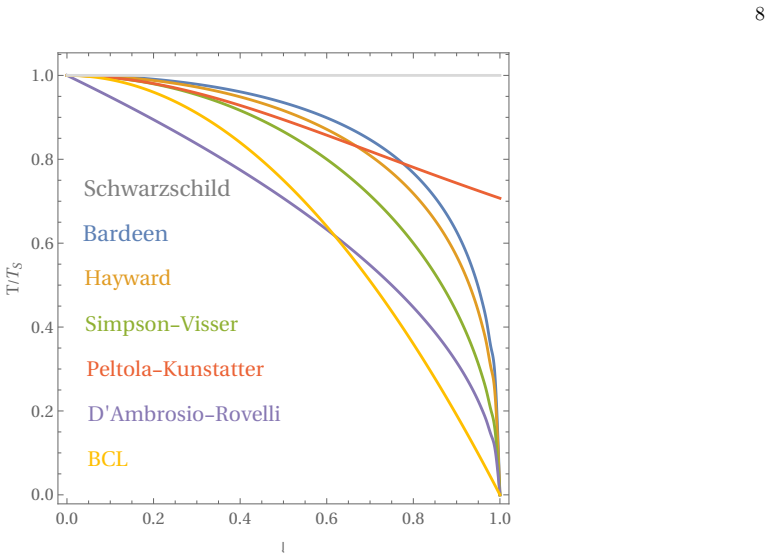
BlackHawk v3.0 implements the Bardeen and Hayward regular black holes, the Simpson-Visser and Peltola-Kunstatter black-bounces, the D'Ambrosio-Rovelli black hole-to-white hole metric, and the Babichev-Charmousis-Lehébel black hole, together with their Hawking temperatures and greybody factors obtained through dedicated numerical routines from the companion GrayHawk code, thereby enabling primary Hawking emission spectra for particles of different spins in these geometries.
What carries the argument
The implementation of the six new spherically symmetric metrics inside the BlackHawk code, combined with numerical solution of the wave equations via GrayHawk routines to obtain greybody factors for each metric.
If this is right
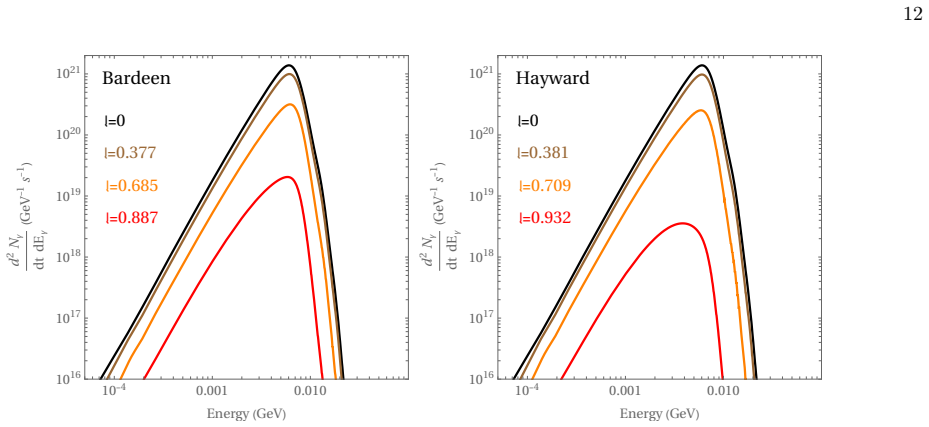
- The code can now produce primary Hawking emission spectra for particles of different spins in each of the six new geometries.
- Hawking temperatures are available for the Bardeen, Hayward, black-bounce, black hole-to-white hole, and Babichev-Charmousis-Lehébel metrics.
- Technical improvements increase the precision and efficiency of spectrum calculations across all supported metrics.
- The public code becomes a more versatile tool for studying Hawking radiation from alternative black hole solutions.
Where Pith is reading between the lines
- Researchers could test whether radiation from these regular metrics produces measurable differences from Schwarzschild evaporation at late times.
- Similar numerical routines might be adapted to additional non-standard metrics if the wave-equation solver proves sufficiently general.
- Public release of the code could enable community checks of the greybody calculations against analytic limits for the new metrics.
Load-bearing premise
The numerical integration routines solve the wave equations correctly for each new metric without introducing uncontrolled errors or needing unstated metric-specific adjustments.
What would settle it
Compare the greybody factors and emission spectra produced by the updated code for the Schwarzschild metric against results from earlier versions of BlackHawk or independent calculations in the literature.
Figures
read the original abstract
We present $\tt BlackHawk$ $\tt v3.0$, a major update of the public code designed to compute Hawking radiation spectra of black holes. Building upon previous versions, this release considerably extends the range of black hole geometries that can be studied by implementing several new spherically symmetric metrics: the Bardeen and Hayward regular black holes, the Simpson-Visser and Peltola-Kunstatter black-bounces, the D'Ambrosio-Rovelli black hole-to-white hole metric, and the Babichev-Charmousis-Leh\'ebel black hole. For each metric, we compute the corresponding Hawking temperatures and greybody factors, enabling the determination of primary Hawking emission spectra for particles of different spins. The greybody factors are obtained through dedicated numerical routines based on the companion code $\tt GrayHawk$. Additionally, $\tt BlackHawk$ $\tt v3.0$ introduces several technical improvements aimed at enhancing precision and efficiency, providing a highly versatile tool. The code is publicly available at https://blackhawk.hepforge.org/
Editorial analysis
A structured set of objections, weighed in public.
Referee Report
Summary. The manuscript presents BlackHawk v3.0, a major update to the public code for computing Hawking radiation spectra of black holes. It implements several new spherically symmetric metrics (Bardeen and Hayward regular black holes, Simpson-Visser and Peltola-Kunstatter black-bounces, D'Ambrosio-Rovelli black hole-to-white hole metric, and Babichev-Charmousis-Lehébel black hole). For each metric the corresponding Hawking temperatures and greybody factors are computed via dedicated numerical routines based on the companion GrayHawk code, enabling primary emission spectra for particles of different spins. Technical improvements for precision and efficiency are introduced, and the code is released publicly.
Significance. If the numerical implementations are shown to be accurate, the updated code would constitute a useful public resource for studying Hawking radiation from regular and black-bounce geometries that arise in quantum-gravity-motivated models. The public availability and focus on multiple particle spins strengthen its potential utility for the community.
major comments (2)
- [Abstract] Abstract: the claim that temperatures and greybody factors are computed for the new metrics is not accompanied by any validation data, convergence tests, or comparisons against known limits (e.g., Schwarzschild). Because the central claim of the paper is the reliable computation of these quantities for non-standard metrics, the absence of such checks is load-bearing.
- [Numerical implementation (GrayHawk routines)] The greybody factors are obtained through GrayHawk routines that solve the radial wave equations. The new metrics possess non-standard lapse functions and curvature profiles that alter the effective potential and boundary conditions relative to Schwarzschild; without reported error budgets, coordinate-singularity handling, or cross-checks against independent solvers, it is impossible to confirm that the numerical integration remains controlled for these geometries.
Simulated Author's Rebuttal
We thank the referee for the careful reading of the manuscript and the constructive comments. We address each major point below and will revise the manuscript accordingly to strengthen the presentation of the numerical results.
read point-by-point responses
-
Referee: [Abstract] Abstract: the claim that temperatures and greybody factors are computed for the new metrics is not accompanied by any validation data, convergence tests, or comparisons against known limits (e.g., Schwarzschild). Because the central claim of the paper is the reliable computation of these quantities for non-standard metrics, the absence of such checks is load-bearing.
Authors: We agree that the abstract would be improved by referencing the validation steps performed for the new metrics. In the revised manuscript we will add a concise statement to the abstract noting that the Hawking temperatures and greybody factors have been cross-checked against the Schwarzschild limit and that convergence tests have been carried out. A new subsection in the main text will present representative convergence plots, relative errors, and direct comparisons with the Schwarzschild case for each implemented metric. revision: yes
-
Referee: [Numerical implementation (GrayHawk routines)] The greybody factors are obtained through GrayHawk routines that solve the radial wave equations. The new metrics possess non-standard lapse functions and curvature profiles that alter the effective potential and boundary conditions relative to Schwarzschild; without reported error budgets, coordinate-singularity handling, or cross-checks against independent solvers, it is impossible to confirm that the numerical integration remains controlled for these geometries.
Authors: We acknowledge that the current manuscript does not provide a dedicated error analysis for the GrayHawk implementation on the new geometries. In the revised version we will expand the numerical-methods section to include: (i) explicit error budgets obtained from Richardson extrapolation and variation of integration tolerances, (ii) the coordinate choices used to avoid singularities (regular coordinates or horizon-penetrating coordinates), and (iii) comparisons of selected greybody factors against independent numerical solvers or known analytic limits. These additions will be accompanied by tables or figures summarizing the achieved precision for each metric. revision: yes
Circularity Check
No circularity: direct code implementation of standard Hawking formulas
full rationale
The paper is a software release note describing the addition of several known regular black hole metrics to an existing numerical code. Hawking temperatures follow from the standard surface gravity formula applied to each metric's lapse function; greybody factors are obtained by numerical integration of the wave equation via the companion GrayHawk routines. No equation is shown to be defined in terms of its own output, no fitted parameter is relabeled as a prediction, and no load-bearing uniqueness claim or ansatz is imported via self-citation. The derivation chain therefore remains self-contained and non-circular.
Axiom & Free-Parameter Ledger
axioms (1)
- domain assumption Hawking radiation formulas and greybody calculations apply without modification to the listed regular metrics.
Forward citations
Cited by 1 Pith paper
-
Hawking Emission from Black Holes Evaporating toward Wormholes and the Accuracy of the WKB Approximation
Numerical greybody factors for photons and massless Dirac fields in Simpson-Visser and Casadio-Fabbri-Mazzacurati geometries reveal that WKB overestimates luminosities by orders of magnitude near wormhole endpoints, i...
Reference graph
Works this paper leans on
-
[1]
It is defined by the line element ds2 =− 1− 2M r2 (r2 +ℓ 2)3/2 dt2 + 1− 2M r2 (r2 +ℓ 2)3/2 −1 dr2 +r 2dΩ2 ,(5) whereℓis the regularizing parameter andMdenotes the BH mass
Bardeen Black Hole The Bardeen BH [237] is one of the most well-known examples of RBHs and, to the best of our knowledge, the first RBH that appeared in the literature. It is defined by the line element ds2 =− 1− 2M r2 (r2 +ℓ 2)3/2 dt2 + 1− 2M r2 (r2 +ℓ 2)3/2 −1 dr2 +r 2dΩ2 ,(5) whereℓis the regularizing parameter andMdenotes the BH mass. 1 It is easy to ...
-
[2]
When expressed in terms of the BH massM, the regularizing parameterℓis subject to the same bound as the Bardeen BH, namelyℓ≤ p 16/27M
Hayward Black Hole Another well-known example of RBH is the Hayward BH [238], which is defined by the line element: ds2 =− 1− 2M r2 r3 + 2M ℓ2 dt2 + 1− 2M r2 r3 + 2M ℓ2 −1 dr2 +r 2dΩ2 .(8) Also, in this case, it is straightforward to see that the Schwarzschild solution is smoothly recovered in theℓ→0 limit. When expressed in terms of the BH massM, the reg...
-
[3]
represents the minimal violence to the standard Schwarzschild solution
Simpson-Visser Black Bounce The Simpson–Visser metric is a one-parameter extension of the Schwarzschild metric and is arguably the most pop- ular example of black-bounce geometry. As Simpson and Visser themselves describe it, this construction “represents the minimal violence to the standard Schwarzschild solution” required to enforce regularity [239]. Th...
-
[4]
Peltola-Kunstatter Black Bounce The Peltola–Kunstatter space-time is a loop quantum gravity (LQG)–inspired metric obtained by applying effective polymerization techniques to the Schwarzschild BH. While LQG is expected to resolve the singularities inherent in general relativity, the complexity of the full quantum system motivates the use of semiclassical p...
-
[5]
D’Ambrosio-Rovelli Black Hole-to-White Hole Metric The D’Ambrosio–Rovelli space-time, also motivated by LQG, was originally developed with aims other than sin- gularity resolution. It provides a natural extension of the Schwarzschild geometry in which ther= 0 singularity is smoothly crossed into the interior of a white hole, and can be regarded as theℏ→0 ...
-
[6]
The action Eq
Babichev-Charmousis-Leh´ ebel Black Hole The Babichev-Charmousis-Leh´ ebel (BCL) metric [242, 333] is a black hole solution of a subset of Horndeski theories referred to as the quadratic shift-symmetric theories, which are described by the action S[gµν, ϕ] = Z d4x F(X)R+P(X) +Q(X)□ϕ+ 2 ∂F ∂X ϕµνϕµν −(□ϕ) 2 ,(19) whereX≡ ∇ µϕ∇µϕandϕ µν ≡ ∇ µ∇νϕ. The action...
-
[7]
Γ s l,m are the GBFs
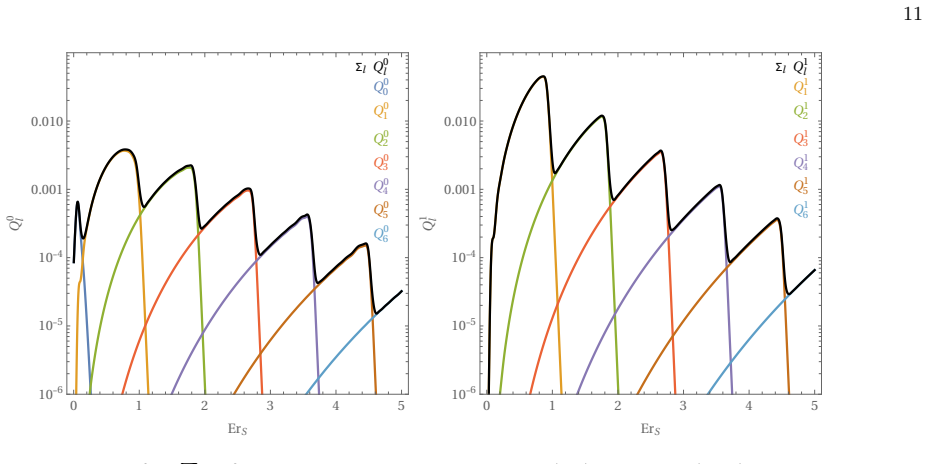
Greybody Factors The Hawking radiation rate of a given particle speciesiwith spins, as predicted by Hawking [205–208], is given by d2Ni dtdEi = 1 2π X l,m niΓs l,m(ω) eω/T ±1 ,(26) wheren i is the number of degrees of freedom of the particle in question,E i =ωis the mode frequency (in natural units), and the plus (minus) sign in the denominator is associa...
-
[8]
Quantum Fields in Gravity, Cosmology and BHs
Improved Kerr tables In the previous versions ofBlackHawk, the framework discussed above was generalized to rotating BHs by means of a clever choice of radial coordinates, which allows for reducing the rotating version of the Teukolsky equation into a Schr¨ odinger-like equation. Specifically, the Kerr metric in Boyer-Lindquist coordinates (t, r, θ, φ) re...
-
[9]
V. Cardoso and P. Pani, Living Rev. Rel.22, 4 (2019), arXiv:1904.05363 [gr-qc]
Pith/arXiv arXiv 2019
-
[10]
Bambi, Annalen Phys.530, 1700430 (2018), arXiv:1711.10256 [gr-qc]
C. Bambi, Annalen Phys.530, 1700430 (2018), arXiv:1711.10256 [gr-qc]
Pith/arXiv arXiv 2018
-
[11]
Akiyamaet al.(Event Horizon Telescope), Astrophys
K. Akiyamaet al.(Event Horizon Telescope), Astrophys. J. Lett.875, L1 (2019), arXiv:1906.11238 [astro-ph.GA]
Pith/arXiv arXiv 2019
-
[12]
Kocherlakotaet al.(Event Horizon Telescope), Phys
P. Kocherlakotaet al.(Event Horizon Telescope), Phys. Rev. D103, 104047 (2021), arXiv:2105.09343 [gr-qc]
arXiv 2021
-
[13]
Akiyamaet al.(Event Horizon Telescope), Astrophys
K. Akiyamaet al.(Event Horizon Telescope), Astrophys. J. Lett.930, L17 (2022), arXiv:2311.09484 [astro-ph.HE]
arXiv 2022
-
[14]
B. P. Abbottet al.(LIGO Scientific, Virgo), Phys. Rev. Lett.116, 061102 (2016), arXiv:1602.03837 [gr-qc]
Pith/arXiv arXiv 2016
-
[15]
B. P. Abbottet al.(LIGO Scientific, Virgo), Phys. Rev. Lett.119, 161101 (2017), arXiv:1710.05832 [gr-qc]
Pith/arXiv arXiv 2017
-
[16]
B. P. Abbottet al.(LIGO Scientific, Virgo), Phys. Rev. Lett.123, 011102 (2019), arXiv:1811.00364 [gr-qc]
Pith/arXiv arXiv 2019
-
[17]
P. Creminelli and F. Vernizzi, Phys. Rev. Lett.119, 251302 (2017), arXiv:1710.05877 [astro-ph.CO]
Pith/arXiv arXiv 2017
-
[18]
J. Sakstein and B. Jain, Phys. Rev. Lett.119, 251303 (2017), arXiv:1710.05893 [astro-ph.CO]
Pith/arXiv arXiv 2017
-
[19]
J. M. Ezquiaga and M. Zumalac´ arregui, Phys. Rev. Lett.119, 251304 (2017), arXiv:1710.05901 [astro-ph.CO]
Pith/arXiv arXiv 2017
-
[20]
S. Boran, S. Desai, E. O. Kahya, and R. P. Woodard, Phys. Rev. D97, 041501 (2018), arXiv:1710.06168 [astro-ph.HE]
Pith/arXiv arXiv 2018
-
[21]
T. Baker, E. Bellini, P. G. Ferreira, M. Lagos, J. Noller, and I. Sawicki, Phys. Rev. Lett.119, 251301 (2017), arXiv:1710.06394 [astro-ph.CO]
Pith/arXiv arXiv 2017
-
[22]
L. Amendola, M. Kunz, I. D. Saltas, and I. Sawicki, Phys. Rev. Lett.120, 131101 (2018), arXiv:1711.04825 [astro-ph.CO]
Pith/arXiv arXiv 2018
-
[23]
L. Visinelli, N. Bolis, and S. Vagnozzi, Phys. Rev. D97, 064039 (2018), arXiv:1711.06628 [gr-qc]
arXiv 2018
-
[24]
M. Crisostomi and K. Koyama, Phys. Rev. D97, 021301 (2018), arXiv:1711.06661 [astro-ph.CO]
Pith/arXiv arXiv 2018
-
[25]
A. Dima and F. Vernizzi, Phys. Rev. D97, 101302 (2018), arXiv:1712.04731 [gr-qc]
Pith/arXiv arXiv 2018
-
[26]
Y.-F. Cai, C. Li, E. N. Saridakis, and L. Xue, Phys. Rev. D97, 103513 (2018), arXiv:1801.05827 [gr-qc]
Pith/arXiv arXiv 2018
-
[27]
A. Casalino, M. Rinaldi, L. Sebastiani, and S. Vagnozzi, Phys. Dark Univ.22, 108 (2018), arXiv:1803.02620 [gr-qc]
Pith/arXiv arXiv 2018
-
[28]
L. Baracket al., Class. Quant. Grav.36, 143001 (2019), arXiv:1806.05195 [gr-qc]
Pith/arXiv arXiv 2019
-
[29]
A. Casalino, M. Rinaldi, L. Sebastiani, and S. Vagnozzi, Class. Quant. Grav.36, 017001 (2019), arXiv:1811.06830 [gr-qc]
Pith/arXiv arXiv 2019
-
[30]
A. Held, R. Gold, and A. Eichhorn, JCAP06, 029 (2019), arXiv:1904.07133 [gr-qc]
Pith/arXiv arXiv 2019
- [31]
-
[32]
S. Vagnozzi and L. Visinelli, Phys. Rev. D100, 024020 (2019), arXiv:1905.12421 [gr-qc]
arXiv 2019
-
[33]
T. Zhu, Q. Wu, M. Jamil, and K. Jusufi, Phys. Rev. D100, 044055 (2019), arXiv:1906.05673 [gr-qc]
arXiv 2019
-
[34]
P. V. P. Cunha, C. A. R. Herdeiro, and E. Radu, Universe5, 220 (2019), arXiv:1909.08039 [gr-qc]
arXiv 2019
-
[35]
I. Banerjee, S. Chakraborty, and S. SenGupta, Phys. Rev. D101, 041301 (2020), arXiv:1909.09385 [gr-qc]
arXiv 2020
-
[36]
I. Banerjee, S. Sau, and S. SenGupta, Phys. Rev. D101, 104057 (2020), arXiv:1911.05385 [gr-qc]
arXiv 2020
-
[37]
A. Allahyari, M. Khodadi, S. Vagnozzi, and D. F. Mota, JCAP02, 003 (2020), arXiv:1912.08231 [gr-qc]
arXiv 2020
-
[38]
S. Vagnozzi, C. Bambi, and L. Visinelli, Class. Quant. Grav.37, 087001 (2020), arXiv:2001.02986 [gr-qc]
arXiv 2020
-
[39]
M. Khodadi, A. Allahyari, S. Vagnozzi, and D. F. Mota, JCAP09, 026 (2020), arXiv:2005.05992 [gr-qc]
arXiv 2020
- [40]
-
[41]
M. Khodadi and E. N. Saridakis, Phys. Dark Univ.32, 100835 (2021), arXiv:2012.05186 [gr-qc]
arXiv 2021
-
[42]
R. C. Pantig, P. K. Yu, E. T. Rodulfo, and A. ¨Ovg¨ un, Annals Phys.436, 168722 (2022), arXiv:2104.04304 [gr-qc]
arXiv 2022
-
[43]
M. Khodadi, G. Lambiase, and D. F. Mota, JCAP09, 028 (2021), arXiv:2107.00834 [gr-qc]
arXiv 2021
-
[44]
R. Roy, S. Vagnozzi, and L. Visinelli, Phys. Rev. D105, 083002 (2022), arXiv:2112.06932 [astro-ph.HE]
arXiv 2022
- [45]
-
[46]
R. C. Pantig and A. ¨Ovg¨ un, Annals Phys.448, 169197 (2023), arXiv:2206.02161 [gr-qc]
arXiv 2023
-
[47]
S. G. Ghosh and M. Afrin, Astrophys. J.944, 174 (2023), arXiv:2206.02488 [gr-qc]
arXiv 2023
-
[48]
M. Khodadi and G. Lambiase, Phys. Rev. D106, 104050 (2022), arXiv:2206.08601 [gr-qc]
arXiv 2022
-
[49]
R. Kumar Walia, S. G. Ghosh, and S. D. Maharaj, Astrophys. J.939, 77 (2022), arXiv:2207.00078 [gr-qc]
arXiv 2022
-
[50]
R. Shaikh, Mon. Not. Roy. Astron. Soc.523, 375 (2023), arXiv:2208.01995 [gr-qc]
arXiv 2023
-
[51]
S. D. Odintsov and V. K. Oikonomou, EPL139, 59003 (2022), arXiv:2208.07972 [gr-qc]
arXiv 2022
-
[52]
V. K. Oikonomou, P. Tsyba, and O. Razina, Universe8, 484 (2022), arXiv:2209.04669 [gr-qc]
arXiv 2022
-
[53]
R. C. Pantig, Chin. J. Phys.87, 49 (2024), arXiv:2303.01698 [gr-qc]
arXiv 2024
-
[54]
E. Gonz´ alez, K. Jusufi, G. Leon, and E. N. Saridakis, Phys. Dark Univ.42, 101304 (2023), arXiv:2305.14305 [astro- ph.CO]
arXiv 2023
-
[55]
S. K. Sahoo, N. Yadav, and I. Banerjee, Phys. Rev. D109, 044008 (2024), arXiv:2305.14870 [gr-qc]
arXiv 2024
-
[56]
K. Nozari and S. Saghafi, Eur. Phys. J. C83, 588 (2023), arXiv:2305.17237 [gr-qc]
arXiv 2023
- [57]
-
[58]
A. A. A. Filho, J. A. A. S. Reis, and H. Hassanabadi, JCAP05, 029 (2024), arXiv:2309.15778 [gr-qc]
arXiv 2024
-
[59]
M. A. Raza, J. Rayimbaev, F. Sarikulov, M. Zubair, B. Ahmedov, and Z. Stuchlik, Phys. Dark Univ.44, 101488 (2024), arXiv:2311.15784 [gr-qc]
arXiv 2024
-
[60]
H. Hoshimov, O. Yunusov, F. Atamurotov, M. Jamil, and A. Abdujabbarov, Phys. Dark Univ.43, 101392 (2024), arXiv:2312.10678 [gr-qc]
arXiv 2024
-
[61]
L. Chakhchi, H. El Moumni, and K. Masmar, Phys. Dark Univ.44, 101501 (2024), arXiv:2403.09756 [gr-qc]
arXiv 2024
-
[62]
W. Liu, D. Wu, X. Fang, J. Jing, and J. Wang, JCAP08, 035 (2024), arXiv:2406.00579 [gr-qc]
arXiv 2024
-
[63]
W. Liu, D. Wu, and J. Wang, JCAP05, 017 (2025), arXiv:2407.07416 [gr-qc]
arXiv 2025
-
[64]
M. Khodadi, S. Vagnozzi, and J. T. Firouzjaee, Sci. Rep.14, 26932 (2024), arXiv:2408.03241 [gr-qc]. 16
arXiv 2024
-
[65]
W. Liu, D. Wu, and J. Wang, Phys. Lett. B858, 139052 (2024), arXiv:2408.05569 [gr-qc]
arXiv 2024
-
[66]
S. Nojiri and S. D. Odintsov, Phys. Dark Univ.46, 101669 (2024), arXiv:2408.05668 [gr-qc]
arXiv 2024
-
[67]
Maggioreet al.(ET), JCAP03, 050 (2020), arXiv:1912.02622 [astro-ph.CO]
M. Maggioreet al.(ET), JCAP03, 050 (2020), arXiv:1912.02622 [astro-ph.CO]
Pith/arXiv arXiv 2020
-
[68]
Abacet al.(ET), JCAP03, 081 (2026), arXiv:2503.12263 [gr-qc]
A. Abacet al.(ET), JCAP03, 081 (2026), arXiv:2503.12263 [gr-qc]
Pith/arXiv arXiv 2026
-
[69]
D. Reitzeet al., Bull. Am. Astron. Soc.51, 035 (2019), arXiv:1907.04833 [astro-ph.IM]
Pith/arXiv arXiv 2019
-
[70]
Evanset al., (2021), arXiv:2109.09882 [astro-ph.IM]
M. Evanset al., (2021), arXiv:2109.09882 [astro-ph.IM]
Pith/arXiv arXiv 2021
-
[71]
Auclairet al.(LISA Cosmology Working Group), Living Rev
P. Auclairet al.(LISA Cosmology Working Group), Living Rev. Rel.26, 5 (2023), arXiv:2204.05434 [astro-ph.CO]
arXiv 2023
- [72]
-
[73]
S. S. Doelemanet al., Galaxies11, 107 (2023), arXiv:2306.08787 [astro-ph.IM]
arXiv 2023
-
[74]
M. D. Johnsonet al., Galaxies11, 61 (2023), arXiv:2304.11188 [astro-ph.HE]
arXiv 2023
-
[75]
M. D. Johnsonet al., Proc. SPIE Int. Soc. Opt. Eng.13092, 130922D (2024), arXiv:2406.12917 [astro-ph.IM]
arXiv 2024
- [76]
-
[77]
M. Y. Khlopov, Res. Astron. Astrophys.10, 495 (2010), arXiv:0801.0116 [astro-ph]
Pith/arXiv arXiv 2010
-
[78]
B. Carr, F. Kuhnel, and M. Sandstad, Phys. Rev. D94, 083504 (2016), arXiv:1607.06077 [astro-ph.CO]
Pith/arXiv arXiv 2016
-
[79]
A. M. Green and B. J. Kavanagh, J. Phys. G48, 043001 (2021), arXiv:2007.10722 [astro-ph.CO]
Pith/arXiv arXiv 2021
-
[80]
B. Carr and F. Kuhnel, Ann. Rev. Nucl. Part. Sci.70, 355 (2020), arXiv:2006.02838 [astro-ph.CO]
Pith/arXiv arXiv 2020
discussion (0)
Sign in with ORCID, Apple, or X to comment. Anyone can read and Pith papers without signing in.