REVIEW 1 major objections 5 minor 5 cited by
Properties of the Circumgalactic Medium in Cosmic Ray-Dominated Galaxy Halos
T0 review · 1 major / 5 minor · reviewed 2026-08-14 · deepseek-v4-flash
Pith's one-line read In cosmological simulations, cosmic-ray pressure, not heat, supports the gas halos of Milky Way-mass galaxies.
desk verdict A serious simulation study proposing CR pressure as the dominant support of MW-mass CGM gas, with testable O VI predictions, but the central claim rests on one extrapolated transport coefficient that the authors themselves flag. read the letter →
The pith
A machine-rendered reading of the paper's core claim, the machinery that carries it, and where it could break.
The reading
What carries the argument
The load-bearing element is the claim that the cosmic-ray pressure gradient balances gravity in the CGM, with a predicted equilibrium gas density $\rho_{\rm eq}(r) \propto \dot{E}_{\rm cr}/(V_c^2 \tilde{v}_{\rm st} r^2)$ that is independent of gas temperature. The CR treatment injects a fixed fraction $\epsilon_{\rm cr} = 0.1$ of supernova kinetic energy into a GeV cosmic-ray fluid that streams along magnetic field lines at the local Alfvén speed and diffuses anisotropically with constant parallel diffusivity $\kappa_\parallel = 3\times10^{29}$ cm$^2$ s$^{-1}$, chosen to match gamma-ray observations, with hadronic, Coulomb, and streaming losses included. The temperature-independence of $\rho_{\rm eq}$ is what lets cool and hot gas coexist at the same density at a given radius, making a volume-filling, thermally under-pressured cool phase possible. An analytic scaling, $$\frac{|\nabla P_{\rm cr}|}{|\rho\nabla\Phi|} \sim 0.5\,\$\alpha$\,\epsilon_{\rm cr}\,\frac{(1+z)^{3/2}}{f_{\rm gas,0.1}\,\tilde{\kappa}_{29}}\,\frac{M_*}{f_b\,M_{\rm halo}}$$, explains why CR dominance appears only near Milky Way mass and at low redshift, matching the simulated pressure-gradient profiles.
What would settle it
Measure the cosmic-ray diffusion coefficient in the outer halo ($\gtrsim$30 kpc from the disk) of a Milky Way-mass galaxy—for example from the radial gradient of radio synchrotron or gamma-ray emission, or from secondary-to-primary cosmic-ray ratios in halo gas. If the effective diffusivity there is even a few times the assumed constant value of $3\times10^{29}$ cm$^2$ s$^{-1}$, cosmic rays would escape before building the pressure gradient that balances gravity, and the predicted cool, volume-filling halo would not form.
Extended reading notes
Core claim
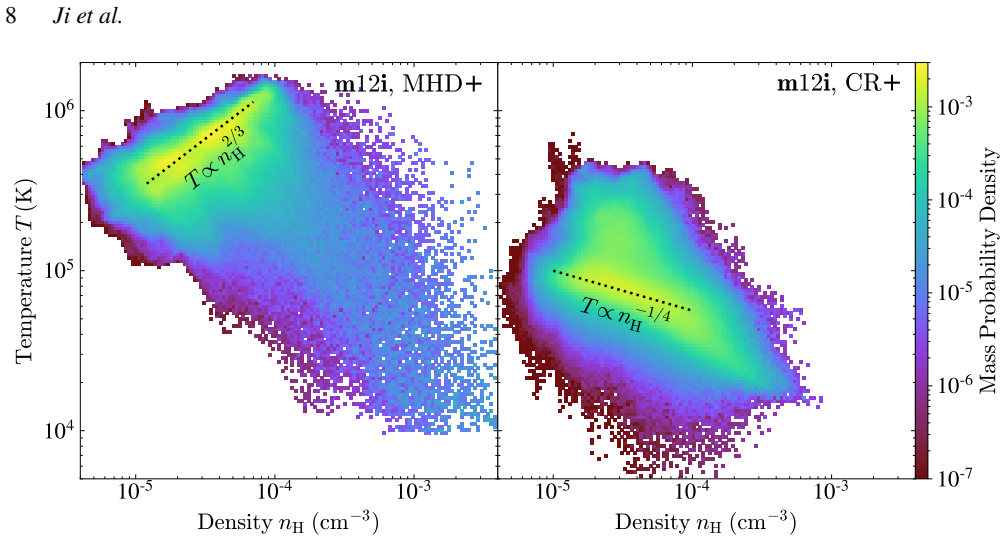
Comparing otherwise identical cosmological zoom-in simulations with and without explicit cosmic-ray (CR) transport, the paper finds a qualitative transition at halo masses of a few $\times 10^{11}$ to $10^{12}\,M_\odot$ and redshifts $z \lesssim 1$–2. In the Milky Way-mass runs, the CR pressure gradient exceeds the thermal pressure gradient by more than an order of magnitude and approximately balances gravity across the CGM ($\approx$30–300 kpc): in the paper's words, 'the CR pressure becomes dominant over thermal (and magnetic) pressure in the CGM, and balances gravity.' In these CR-dominated halos the gas is mostly cool (a few $\times 10^4$ K), the cool phase is volume-filling rather than confined to dense filaments, and its thermal pressure lies below the level needed for local or virial pressure balance; the cool gas is thermally under-pressured but the total (thermal plus CR) pressure at fixed radius is nearly uniform because the two pressures are locally anti-correlated. The density profile follows a temperature-independent equilibrium density $\rho_{\rm eq}$ at which the CR pressure gradient balances gravity, so gas at very different temperatures coexists at the same density. As a result the low and mid ions (H I, Mg II, Si IV, N V, O VI) are predominantly photo-ionized, with O VI columns $\gtrsim 10^{14.5}$ cm$^{-2}$ out to $\gtrsim150$ kpc, while Ne VIII columns drop; runs without CRs retain the hot, collisionally-ionized, thermally-supported halo assumed by earlier models and underproduce the observed O VI.
Load-bearing premise
The entire CR-dominated halo rests on assuming that the cosmic-ray diffusion coefficient inferred within roughly 10 kpc of the disk stays constant all the way out to 300 kpc; if cosmic rays instead escape far more freely through the dilute outer halo, the predicted pressure support—and with it the cool, volume-filling, photo-ionized CGM—would not form.
Editorial extensions
If this is right
- O VI columns of $\gtrsim 10^{14.5}$ cm$^{-2}$ extending to $\gtrsim150$ kpc around low-redshift star-forming galaxies are produced by photo-ionized cool gas supported by cosmic-ray pressure, not by collisionally-ionized warm gas, resolving the energy-budget problem that collisional models of the observed O VI have faced.
- The cool CGM in Milky Way-mass halos is volume-filling and thermally under-pressured, matching the state inferred from observations of low-ion absorbers, and the sightline-to-sightline scatter in low- and mid-ion columns is much smaller than in runs without cosmic rays.
- Cosmic-ray dominance is confined to halos near $10^{12}\,M_\odot$ at $z \lesssim 1$–2: dwarf halos and high-redshift Milky Way-mass progenitors show essentially no cosmic-ray effects, so the model predicts a sharp dependence of CGM phase structure and ion columns on halo mass and redshift.
- Galaxies whose star formation is quenched would lack the cosmic-ray injection that sustains the cool, volume-filling halo, giving a natural explanation for the observed deficit of O VI around passive galaxies relative to star-forming ones.
- The CGM density profile is set by the cosmic-ray pressure gradient rather than by virial temperature, so halo gas can be supported at a few $\times 10^4$ K while remaining in global force balance.
Reading between the lines
- The temperature-independent equilibrium density at the heart of the argument is not specific to cosmic rays: any pressure component with a steep radial gradient and weak coupling to gas temperature—magnetic fields, Alfvén-wave pressure, or turbulent pressure—would, if sustained at comparable amplitude, produce the same volume-filling cool phase; cosmic rays are the one candidate the simulations ca
- A diagnostic the paper leaves implicit: in the CR-supported halo, the O VI-bearing gas at 100–200 kpc should have thermal pressures below roughly $10^{-3}$ eV cm$^{-3}$ and line widths dominated by bulk motions, so density- or ionization-ratio-sensitive observations of the same absorbers could test the model without any direct cosmic-ray measurement.
- Because the CR-to-gravity force ratio in the analytic scaling is inversely proportional to the diffusion coefficient, the mass–redshift window where cosmic rays dominate is the most fragile prediction: if the true diffusivity grows with decreasing density, as microphysical transport models suggest, the window shrinks or vanishes, making scale-dependent transport models the natural next test.
- The model also implies that the hot $\sim10^6$ K phase is strongly suppressed at 50–200 kpc in Milky Way-mass halos; X-ray absorption measurements such as O VII around these galaxies could check this prediction independently of the O VI comparison.
Signed reviews
Editorial analysis
A structured set of objections, weighed in public.
Referee Report
Summary. This paper presents FIRE-2 cosmological zoom-in simulations of the circumgalactic medium (CGM) with explicit cosmic-ray (CR) transport, including supernova injection, anisotropic diffusion and streaming, and collisional and streaming losses. For Milky Way-mass halos at z≲1--2, it finds that the CR pressure gradient exceeds the thermal pressure gradient by more than an order of magnitude and nearly balances gravity, driving the CGM into a cool, volume-filling, largely photoionized phase. The paper predicts H I, O VI, and N V column densities that are consistent with low-redshift absorption-line observations, with O VI columns about 10^14.5 cm^-2 persisting to ~150 kpc, whereas the same halos in MHD-only runs are warm/hot and collisionally ionized. The interpretation is supported by an analytic equilibrium model, and the authors explicitly discuss caveats, most importantly the uncertainty in the CR diffusion coefficient.
Significance. If the CR-dominated state is realized in nature, the paper offers a single mechanism that simultaneously explains the observed under-pressured cool CGM, the large O VI column densities around star-forming galaxies, and the low thermal pressure of photoionized absorbers. The work uses high-resolution cosmological simulations with a comprehensive physics package (MHD, anisotropic conduction/viscosity, FIRE-2 feedback), and the ion columns are computed with the standard Trident post-processing tool. The authors show resolution tests and several Milky Way-mass halos to support generality, and the simulation code and data are publicly available. The central results make concrete falsifiable predictions: flat low/mid-ion column profiles, reduced sightline-to-sightline scatter, and anti-correlation between CR and thermal pressure at fixed radius. The main weakness is that the entire predicted state rests on a constant parallel CR diffusivity calibrated at radii ≲10 kpc and extrapolated to 30--300 kpc; the authors themselves note that a plausible rapid increase of diffusivity would allow CRs to escape and erase the CR-dominated halo.
major comments (1)
- [§5.2(i); central argument (Figs. 1, 6--8)] The central claim that CR pressure balances gravity in the CGM and produces the cool, photoionized phase with O VI columns ~10^14.5 cm^-2 depends entirely on the constant parallel diffusivity κ‖=3×10^29 cm^2/s and Alfvén-speed streaming remaining valid from the ISM out to r~30--300 kpc. Section 5.2(i) states explicitly that the calibrating gamma-ray observations constrain κ only within ~10 kpc and that a plausible rapid increase of diffusivity in the CGM would let CRs escape and destroy the CR-dominated halo. Because every downstream prediction (phase structure, pressure balance, ion columns) follows from the CR-dominated state, this is a load-bearing sensitivity rather than a peripheral caveat. The citation of Hopkins et al. (2020) for robustness across transport models does not fully resolve the issue, since §5.2(i) itself identifies a plausible regime in which the effect collapses. I request a quantitative treatment: either simulations with a radially or plasma-dependent κ (or at least an analytic estimate of the radius at which CR escape becomes important), or a clear reframing in the abstract and conclusions stating that all results are predictions of a specific, observationally calibrated transport model rather than a claim that CRs necessarily dominate the CGM.
minor comments (5)
- [Eq. (1), §4.1] As typeset, Eq. (1) places κ~29 and (1+z)^3/2 in the numerator. This appears inconsistent with the point-source steady-state solution in §4.1, where P_cr ∝ E_dot/(κ~ r) in the diffusion-dominated limit, and with the sentence immediately following the equation, which invokes the (1+z)^3/2 factor to argue that CRs decrease in importance at high redshift. Please verify the equation and correct the typesetting if needed.
- [§3.4] The text refers to dwarf halos 'm10b and m11b', but Table 1 lists the halo as m10q; please reconcile the naming.
- [§3.6] The sentence 'so this produces overall less Ne viii column compared to MHD+ case, as seen in Fig. 7' should likely reference Fig. 9, which shows the ion-weighted density-temperature diagrams.
- [Appendix B, first paragraph] The appendix says it compares 'HM12 and FG19', but the model is FG09 (Faucher-Giguère et al. 2009); please correct the label.
- [Fig. 8 caption] The caption reports '8002 sightlines'; this should presumably read '800^2 sightlines' as in the text. Please fix the typography.
Circularity Check
No significant circularity: the CR pressure support and ion-column predictions are derived from an independently calibrated transport coefficient and checked against external observations, not constructed from the quantities they predict.
full rationale
The paper's central claim is that with constant parallel diffusivity kappa_parallel = 3e29 cm^2/s, CR pressure balances gravity in MW-mass halos and changes the CGM phase structure. The diffusivity is explicitly calibrated to independent gamma-ray observations: 'with constant parallel diffusivity $\kappa\sim3\times10^{29}\,\mathrm{cm^2\ s^{-1}}$ chosen to match $\gamma$-ray observations'. This calibration does not use the CGM ion columns or O VI columns that the paper later compares to data, so the predictions are not fitted inputs renamed as predictions. The analytic equilibrium scalings in Section 4.1, including Eq. (1), are presented as a consistency check ('This analytic estimation produces resonable CR pressure gradient profiles ... consistent with our simulation results'), not as the source of the simulated CR pressure. The paper's reliance on Hopkins et al. (2019) and Chan et al. (2019) for the transport model and its calibration is self-citation, but the cited work contains independent, externally falsifiable calibrations to gamma-ray observations and is not used as an unverified authority to forbid alternatives. The robustness claim via Hopkins et al. (2020) is supportive, not load-bearing. The explicit caveat in Section 5.2(i) that observations constrain kappa only within ~10 kpc and that a rapidly increasing diffusivity could allow CRs to escape is an honest statement of external-physics sensitivity; it weakens the certainty of the conclusions but does not make the derivation circular. The ion columns are post-processed from the simulated gas using Trident, with the UV background choice discussed separately, and are then compared with observations rather than used to determine the simulation parameters. Thus, no step in the derivation chain reduces, by construction or by definition, to the result it is supposed to predict.
Assumptions & free parameters
free parameters (3)
- κ‖ (constant parallel CR diffusivity) =
3×10^29 cm^2/s
- ϵ_cr (SN CR injection fraction) =
0.1
- v_stream (CR streaming speed) =
v_A (local Alfvén speed)
assumptions (5)
- domain assumption FIRE-2 sub-grid galaxy formation model (cooling, star formation, stellar feedback) adequately represents the ISM and feedback.
- domain assumption CRs are treated as a single-bin ultra-relativistic fluid (γ=4/3) with strong coupling and isotropic pressure.
- domain assumption The sample of six representative halos is sufficient to establish mass and redshift trends.
- domain assumption The analytic scaling Eq. (1) from Hopkins et al. (2019) (point-source injection, steady state, negligible losses, isothermal sphere) applies to the simulations.
- domain assumption UV background models (FG09 for low ions, HM12 for high ions) are appropriate for photo-ionization post-processing.
Cite this review
Pith. "Pith review of Properties of the Circumgalactic Medium in Cosmic Ray-Dominated Galaxy Halos." pith.science (2026). https://pith.science/paper/4GTF6UDO
@misc{pith2026190900003,
  author       = {Pith},
  title        = {Pith review of: Properties of the Circumgalactic Medium in Cosmic Ray-Dominated Galaxy Halos},
  year         = {2026},
  howpublished = {\url{https://pith.science/paper/4GTF6UDO}},
  note         = {Machine review of arXiv:1909.00003}
}
abstract
We investigate the impact of cosmic rays (CRs) on the circumgalactic medium (CGM) in FIRE-2 simulations, for ultra-faint dwarf through Milky Way (MW)-mass halos hosting star-forming (SF) galaxies. Our CR treatment includes injection by supernovae, anisotropic streaming and diffusion along magnetic field lines, collisional and streaming losses, with constant parallel diffusivity $\kappa\sim3\times10^{29}\,\mathrm{cm^2\ s^{-1}}$ chosen to match $\gamma$-ray observations. With this, CRs become more important at larger halo masses and lower redshifts, and dominate the pressure in the CGM in MW-mass halos at $z\lesssim 1-2$. The gas in these "CR-dominated" halos differs significantly from runs without CRs: the gas is primarily cool (a few $\sim10^{4}\,$K), and the cool phase is volume-filling and has a thermal pressure below that needed for virial or local thermal pressure balance. Ionization of the "low" and "mid" ions in this diffuse cool gas is dominated by photo-ionization, with O VI columns $\gtrsim 10^{14.5}\,\mathrm{cm^{-2}}$ at distances $\gtrsim 150\,\mathrm{kpc}$. CR and thermal gas pressure are locally anti-correlated, maintaining total pressure balance, and the CGM gas density profile is determined by the balance of CR pressure gradients and gravity. Neglecting CRs, the same halos are primarily warm/hot ($T\gtrsim 10^{5}\,$K) with thermal pressure balancing gravity, collisional ionization dominates, O VI columns are lower and Ne VIII higher, and the cool phase is confined to dense filaments in local thermal pressure equilibrium with the hot phase.
Figures


Figures from the paper (8 more)




Forward citations
Cited by 5 Pith papers
-
The mass-dependent interplay of active galacitc nuclei and supernova feedback in shaping the $L_{\rm X}$--$T$ relation of early-type galaxies
Mass-dependent coupling of AGN winds and supernovae, including a metal-lifting fountain in dwarfs, explains the steep L_X-T relation of early-type galaxies.
-
CRexit observed: probing cosmic ray transport in the circumgalactic medium with absorption line spectra
Efficient cosmic-ray transport in CR-pressure-dominated CGM simulations produces stronger cool-gas absorption (MgII, SiII) and covering fractions matching star-forming galaxies, while slow transport underproduces them.
-
Time-Dependent Cosmic Ray Halos from Bursty Star Formation and Active Galactic Nuclei: Semi-Analytic Formalism and Galaxy Formation Implications
Time-dependent injection from bursty star formation or episodic black hole accretion substantially modifies cosmic ray pressure profiles in massive galaxy halos, flattening them at large radii relative to steady-state...
-
CRESCENDO II: Spectral cosmic rays with improved energy losses and realistic supernova seeding
CRESCENDO's spectral cosmic-ray solver now includes improved energy-loss processes, non-ultra-relativistic energy/pressure integrals, and supernova-remnant template injection.
-
The Circumgalactic Medium
A comprehensive review of the circumgalactic medium, its multiphase structure, absorption and emission probes, and role in the baryon cycle, containing no new research results.
Reference graph
Works this paper leans on
-
[1]
Anderson M. E., Churazov E., Bregman J. N., 2015, @doi [ ] 10.1093/mnras/stv1559 , http://adsabs.harvard.edu/abs/2015MNRAS.452.3905A 452, 3905
-
[2]
F., Quataert E., Murray N., 2017, Monthly Notices of the Royal Astronomical Society, 470, 4698
Angl \'e s-Alc \'a zar D., Faucher-Gigu \`e re C.-A., Kere s D., Hopkins P. F., Quataert E., Murray N., 2017, Monthly Notices of the Royal Astronomical Society, 470, 4698
2017
-
[3]
N., Spitzer Jr L., 1969, The Astrophysical Journal, 156, L63
Bahcall J. N., Spitzer Jr L., 1969, The Astrophysical Journal, 156, L63
1969
-
[4]
C., Fabian A., 1990, Monthly Notices of the Royal Astronomical Society, 244, 26P
Begelman M. C., Fabian A., 1990, Monthly Notices of the Royal Astronomical Society, 244, 26P
1990
-
[5]
Beresnyak A., Yan H., Lazarian A., 2011, The Astrophysical Journal, 728, 60
2011
-
[6]
I., 1965, Reviews of Plasma Physics, http://adsabs.harvard.edu/abs/1965RvPP....1..205B 1, 205
Braginskii S. I., 1965, Reviews of Plasma Physics, http://adsabs.harvard.edu/abs/1965RvPP....1..205B 1, 205
1965
-
[7]
N., Anderson M
Bregman J. N., Anderson M. E., Miller M. J., Hodges-Kluck E., Dai X., Li J.-T., Li Y., Qu Z., 2018, The Astrophysical Journal, 862, 3
2018
-
[8]
Bryan G. L., Norman M. L., 1998, @doi [ ] 10.1086/305262 , http://adsabs.harvard.edu/abs/1998ApJ...495...80B 495, 80
doi:10.1086/305262 1998
Show all 131 references
-
[9]
N., et al., 2018, arXiv preprint arXiv:1810.06560
Burchett J. N., et al., 2018, arXiv preprint arXiv:1810.06560
2018 arXiv
-
[10]
S., Quinn T
Butsky I. S., Quinn T. R., 2018, The Astrophysical Journal, 868, 108
2018
-
[11]
Cai Z., et al., 2017, @doi [ ] 10.3847/1538-4357/aa6a1a , http://adsabs.harvard.edu/abs/2017ApJ...839..131C 839, 131
2017 doi
-
[12]
X., Hennawi J
Cantalupo S., Arrigoni-Battaia F., Prochaska J. X., Hennawi J. F., Madau P., 2014, @doi [ ] 10.1038/nature12898 , http://adsabs.harvard.edu/abs/2014Natur.506...63C 506, 63
2014 doi
-
[13]
Cen R., 2013, The Astrophysical Journal, 770, 139
2013
-
[14]
Chan T., Kere s D., Hopkins P., Quataert E., Su K., Hayward C., Faucher-Gigu \`e re C., 2019, Monthly Notices of the Royal Astronomical Society, 488, 3716
2019
-
[15]
J., Ma X., Hopkins P
Colbrook M. J., Ma X., Hopkins P. F., Squire J., 2017, @doi [ ] 10.1093/mnras/stx261 , http://adsabs.harvard.edu/abs/2017MNRAS.467.2421C 467, 2421
2017 doi
-
[16]
L., McKee C
Cowie L. L., McKee C. F., 1977, @doi [ ] 10.1086/154911 , http://adsabs.harvard.edu/abs/1977ApJ...211..135C 211, 135
1977 doi
-
[17]
Dekel A., Birnboim Y., 2006, Monthly notices of the royal astronomical society, 368, 2
2006
-
[18]
Dursi L., Pfrommer C., 2008, The Astrophysical Journal, 677, 993
2008
-
[19]
Escala I., et al., 2018, @doi [ ] 10.1093/mnras/stx2858 , http://adsabs.harvard.edu/abs/2018MNRAS.474.2194E 474, 2194
2018 doi
-
[20]
E., Zweibel E
Everett J. E., Zweibel E. G., Benjamin R. A., McCammon D., Rocks L., Gallagher III J. S., 2008, The Astrophysical Journal, 674, 258
2008
-
[21]
F., 2017, The Astrophysical Journal, 835, 52
Faerman Y., Sternberg A., McKee C. F., 2017, The Astrophysical Journal, 835, 52
2017
-
[22]
Fang T., Bullock J., Boylan-Kolchin M., 2012, The Astrophysical Journal, 762, 20
2012
-
[23]
Faucher-Gigu \`e re C.-A., 2020, Monthly Notices of the Royal Astronomical Society, 493, 1614
2020
-
[24]
Faucher-Giguere C.-A., Lidz A., Zaldarriaga M., Hernquist L., 2009, The Astrophysical Journal, 703, 1416
2009
-
[25]
F., Kere s D., Muratov A
Faucher-Gigu \`e re C.-A., Hopkins P. F., Kere s D., Muratov A. L., Quataert E., Murray N., 2015, Monthly Notices of the Royal Astronomical Society, 449, 987
2015
-
[26]
F., Murray N., 2016, Monthly Notices of the Royal Astronomical Society: Letters, 461, L32
Faucher-Gigu \`e re C.-A., Feldmann R., Quataert E., Kere s D., Hopkins P. F., Murray N., 2016, Monthly Notices of the Royal Astronomical Society: Letters, 461, L32
2016
-
[27]
Ferland G., et al., 2017, arXiv preprint arXiv:1705.10877
2017 arXiv
-
[28]
A., 2016, Monthly Notices of the Royal Astronomical Society, 466, 3810
Fielding D., Quataert E., McCourt M., Thompson T. A., 2016, Monthly Notices of the Royal Astronomical Society, 466, 3810
2016
-
[29]
Girichidis P., Naab T., Hanasz M., Walch S., 2018, Monthly Notices of the Royal Astronomical Society, 479, 3042
2018
-
[30]
F., 2010, The Astrophysical Journal, 718, 1315
Gnat O., Sternberg A., McKee C. F., 2010, The Astrophysical Journal, 718, 1315
2010
-
[31]
M., Hivon E., Banday A
G \'o rski K. M., Hivon E., Banday A. J., Wandelt B. D., Hansen F. K., Reinecke M., Bartelmann M., 2005, @doi [ ] 10.1086/427976 , http://adsabs.harvard.edu/abs/2005ApJ...622..759G 622, 759
2005 doi
-
[32]
A., Black J
Grenier I. A., Black J. H., Strong A. W., 2015, Annual Review of Astronomy and Astrophysics, 53, 199
2015
-
[33]
P., 2008, @doi [ ] 10.1111/j.1365-2966.2007.12692.x , http://adsabs.harvard.edu/abs/2008MNRAS.384..251G 384, 251
Guo F., Oh S. P., 2008, @doi [ ] 10.1111/j.1365-2966.2007.12692.x , http://adsabs.harvard.edu/abs/2008MNRAS.384..251G 384, 251
2008
-
[34]
Haardt F., Madau P., 2012, The Astrophysical Journal, 746, 125
2012
-
[35]
Hafen Z., et al., 2017, Monthly Notices of the Royal Astronomical Society, 469, 2292
2017
-
[36]
Hafen Z., et al., 2018, arXiv preprint arXiv:1811.11753
2018 arXiv
-
[37]
Hahn O., Abel T., 2011, @doi [ ] 10.1111/j.1365-2966.2011.18820.x , http://adsabs.harvard.edu/abs/2011MNRAS.415.2101H 415, 2101
2011
-
[38]
F., Prochaska J
Hennawi J. F., Prochaska J. X., Cantalupo S., Arrigoni-Battaia F., 2015, @doi [Science] 10.1126/science.aaa5397 , http://adsabs.harvard.edu/abs/2015Sci...348..779H 348, 779
2015 doi
-
[39]
D., Ionson J
Holman G. D., Ionson J. A., Scott J. S., 1979, @doi [ ] 10.1086/156881 , http://adsabs.harvard.edu/abs/1979ApJ...228..576H 228, 576
1979 doi
-
[40]
F., 2015, @doi [ ] 10.1093/mnras/stv195 , http://adsabs.harvard.edu/abs/2015MNRAS.450...53H 450, 53
Hopkins P. F., 2015, @doi [ ] 10.1093/mnras/stv195 , http://adsabs.harvard.edu/abs/2015MNRAS.450...53H 450, 53
2015 doi
-
[41]
F., 2016, @doi [ ] 10.1093/mnras/stw1578 , http://adsabs.harvard.edu/abs/2016MNRAS.462..576H 462, 576
Hopkins P. F., 2016, @doi [ ] 10.1093/mnras/stw1578 , http://adsabs.harvard.edu/abs/2016MNRAS.462..576H 462, 576
2016 doi
-
[42]
F., 2017, @doi [ ] 10.1093/mnras/stw3306 , http://adsabs.harvard.edu/abs/2017MNRAS.466.3387H 466, 3387
Hopkins P. F., 2017, @doi [ ] 10.1093/mnras/stw3306 , http://adsabs.harvard.edu/abs/2017MNRAS.466.3387H 466, 3387
2017 doi
-
[43]
Hopkins P. F. e. a., 2018a, , in preparation
-
[44]
Hopkins P. F. e. a., 2018b, @doi [ ] 10.1093/mnras/sty1690 , http://adsabs.harvard.edu/abs/2018MNRAS.480..800H 480, 800
-
[45]
F., Raives M
Hopkins P. F., Raives M. J., 2016, @doi [ ] 10.1093/mnras/stv2180 , http://adsabs.harvard.edu/abs/2016MNRAS.455...51H 455, 51
2016 doi
-
[46]
F., Narayanan D., Murray N., 2013, @doi [ ] 10.1093/mnras/stt723 , http://adsabs.harvard.edu/abs/2013MNRAS.432.2647H 432, 2647
Hopkins P. F., Narayanan D., Murray N., 2013, @doi [ ] 10.1093/mnras/stt723 , http://adsabs.harvard.edu/abs/2013MNRAS.432.2647H 432, 2647
2013 doi
-
[47]
F., Kere s D., O \ n orbe J., Faucher-Gigu \`e re C.-A., Quataert E., Murray N., Bullock J
Hopkins P. F., Kere s D., O \ n orbe J., Faucher-Gigu \`e re C.-A., Quataert E., Murray N., Bullock J. S., 2014, Monthly Notices of the Royal Astronomical Society, 445, 581
2014
-
[48]
F., et al., 2018, @doi [ ] 10.1093/mnras/sty674 , http://adsabs.harvard.edu/abs/2018MNRAS.477.1578H 477, 1578
Hopkins P. F., et al., 2018, @doi [ ] 10.1093/mnras/sty674 , http://adsabs.harvard.edu/abs/2018MNRAS.477.1578H 477, 1578
2018 doi
-
[49]
F., et al., 2019, arXiv preprint arXiv:1905.04321
Hopkins P. F., et al., 2019, arXiv preprint arXiv:1905.04321
2019 arXiv
-
[50]
F., Squire J., Chan T., Quataert E., Ji S., Keres D., Faucher-Gigu \`e re C.-A., 2020, arXiv preprint arXiv:2002.06211
Hopkins P. F., Squire J., Chan T., Quataert E., Ji S., Keres D., Faucher-Gigu \`e re C.-A., 2020, arXiv preprint arXiv:2002.06211
2020 arXiv
-
[51]
B., Bryan G
Hummels C. B., Bryan G. L., Smith B. D., Turk M. J., 2013, Monthly Notices of the Royal Astronomical Society, 430, 1548
2013
-
[52]
B., Smith B
Hummels C. B., Smith B. D., Silvia D. W., 2017, The Astrophysical Journal, 847, 59
2017
-
[53]
B., et al., 2018, arXiv preprint arXiv:1811.12410
Hummels C. B., et al., 2018, arXiv preprint arXiv:1811.12410
2018 arXiv
-
[54]
D., 2007, Computing in science & engineering, 9, 90
Hunter J. D., 2007, Computing in science & engineering, 9, 90
2007
-
[55]
P., McCourt M., 2018, Monthly Notices of the Royal Astronomical Society, 476, 852
Ji S., Oh S. P., McCourt M., 2018, Monthly Notices of the Royal Astronomical Society, 476, 852
2018
-
[56]
P., Masterson P., 2019, Monthly Notices of the Royal Astronomical Society, 487, 737
Ji S., Oh S. P., Masterson P., 2019, Monthly Notices of the Royal Astronomical Society, 487, 737
2019
-
[57]
P., 2018, @doi [ ] 10.3847/1538-4357/aaa6ce , http://adsabs.harvard.edu/abs/2018ApJ...854....5J 854, 5
Jiang Y.-F., Oh S. P., 2018, @doi [ ] 10.3847/1538-4357/aaa6ce , http://adsabs.harvard.edu/abs/2018ApJ...854....5J 854, 5
2018 doi
-
[58]
D., Chen H.-W., Mulchaey J
Johnson S. D., Chen H.-W., Mulchaey J. S., 2015, Monthly Notices of the Royal Astronomical Society, 449, 3263
2015
-
[59]
A., et al., 2017, The Astrophysical Journal Supplement Series, 230, 6
Keeney B. A., et al., 2017, The Astrophysical Journal Supplement Series, 230, 6
2017
-
[60]
H., Dav \'e R., 2005, Monthly Notices of the Royal Astronomical Society, 363, 2
Kere s D., Katz N., Weinberg D. H., Dav \'e R., 2005, Monthly Notices of the Royal Astronomical Society, 363, 2
2005
-
[61]
Komarov S., Churazov E., Schekochihin A., ZuHone J., 2014, Monthly Notices of the Royal Astronomical Society, 440, 1153
2014
-
[62]
A., Churazov E., Spitkovsky A., 2018, @doi [Journal of Plasma Physics] 10.1017/S0022377818000399 , http://adsabs.harvard.edu/abs/2018JPlPh..84c9005K 84, 905840305
Komarov S., Schekochihin A. A., Churazov E., Spitkovsky A., 2018, @doi [Journal of Plasma Physics] 10.1017/S0022377818000399 , http://adsabs.harvard.edu/abs/2018JPlPh..84c9005K 84, 905840305
2018 doi
-
[63]
C., 2013, , in press, arXiv:1304.7762, http://adsabs.harvard.edu/abs/2013arXiv1304.7762K
Kormendy J., Ho L. C., 2013, , in press, arXiv:1304.7762, http://adsabs.harvard.edu/abs/2013arXiv1304.7762K
2013 arXiv
-
[64]
Kroupa P., 2001, @doi [ ] 10.1046/j.1365-8711.2001.04022.x , http://adsabs.harvard.edu/abs/2001MNRAS.322..231K 322, 231
2001
-
[65]
R., Gnedin N
Krumholz M. R., Gnedin N. Y., 2011, @doi [ ] 10.1088/0004-637X/729/1/36 , http://adsabs.harvard.edu/abs/2011ApJ...729...36K 729, 36
2011 doi
-
[66]
M., 2005, Plasma physics for astrophysics
Kulsrud R. M., 2005, Plasma physics for astrophysics . Princeton, N.J. : Princeton University Press
2005
-
[67]
P., 1969, @doi [ ] 10.1086/149981 , http://adsabs.harvard.edu/abs/1969ApJ...156..445K 156, 445
Kulsrud R., Pearce W. P., 1969, @doi [ ] 10.1086/149981 , http://adsabs.harvard.edu/abs/1969ApJ...156..445K 156, 445
1969 doi
-
[68]
L., 2010, The Astrophysical Journal, 719, 523
Kwak K., Shelton R. L., 2010, The Astrophysical Journal, 719, 523
2010
-
[69]
Lazarian A., 2016, The Astrophysical Journal, 833, 131
2016
-
[70]
M., Fox A
Lehner N., O'Meara J. M., Fox A. J., Howk J. C., Prochaska J. X., Burns V., Armstrong A. A., 2014, The Astrophysical Journal, 788, 119
2014
-
[71]
Leitherer C., et al., 1999, @doi [ ] 10.1086/313233 , http://adsabs.harvard.edu/abs/1999ApJS..123....3L 123, 3
1999 doi
-
[72]
D., Irwin J
Li J.-T., Li Z., Wang Q. D., Irwin J. A., Rossa J., 2008, Monthly Notices of the Royal Astronomical Society, 390, 59
2008
-
[73]
J., Kravtsov A
Liang C. J., Kravtsov A. V., Agertz O., 2016, Monthly Notices of the Royal Astronomical Society, 458, 1164
2016
-
[74]
F., Faucher-Gigu \`e re C.-A., Zolman N., Muratov A
Ma X., Hopkins P. F., Faucher-Gigu \`e re C.-A., Zolman N., Muratov A. L., Kere s D., Quataert E., 2015, Monthly Notices of the Royal Astronomical Society, 456, 2140
2015
-
[75]
G., Prochaska J
Mathews W. G., Prochaska J. X., 2017, The Astrophysical Journal Letters, 846, L24
2017
-
[76]
M., Madigan A.-M., Quataert E., 2015, Monthly Notices of the Royal Astronomical Society, 449, 2
McCourt M., O'Leary R. M., Madigan A.-M., Quataert E., 2015, Monthly Notices of the Royal Astronomical Society, 449, 2
2015
-
[77]
P., O'Leary R., Madigan A.-M., 2017, Monthly Notices of the Royal Astronomical Society, 473, 5407
McCourt M., Oh S. P., O'Leary R., Madigan A.-M., 2017, Monthly Notices of the Royal Astronomical Society, 473, 5407
2017
-
[78]
S., Schombert J
McGaugh S. S., Schombert J. M., De Blok W., Zagursky M. J., 2009, The Astrophysical Journal Letters, 708, L14
2009
-
[79]
F., Voelk H
McKenzie J. F., Voelk H. J., 1982, , http://adsabs.harvard.edu/abs/1982A
1982
-
[80]
K., 2018, The Astrophysical Journal, 852, 33
McQuinn M., Werk J. K., 2018, The Astrophysical Journal, 852, 33
2018
-
[81]
J., Bregman J
Miller M. J., Bregman J. N., 2013, The Astrophysical Journal, 770, 118
2013
-
[82]
L., Kere s D., Faucher-Gigu \`e re C.-A., Hopkins P
Muratov A. L., Kere s D., Faucher-Gigu \`e re C.-A., Hopkins P. F., Quataert E., Murray N., 2015, Monthly Notices of the Royal Astronomical Society, 454, 2691
2015
-
[83]
L., et al., 2017, Monthly Notices of the Royal Astronomical Society, 468, 4170
Muratov A. L., et al., 2017, Monthly Notices of the Royal Astronomical Society, 468, 4170
2017
-
[84]
H., Bullock J
O \ n orbe J., Garrison-Kimmel S., Maller A. H., Bullock J. S., Rocha M., Hahn O., 2014, @doi [ ] 10.1093/mnras/stt2020 , http://adsabs.harvard.edu/abs/2014MNRAS.437.1894O 437, 1894
2014 doi
-
[85]
E., 2007, Computing in Science & Engineering, 9, 10
Oliphant T. E., 2007, Computing in Science & Engineering, 9, 10
2007
-
[86]
D., et al., 2016, Monthly Notices of the Royal Astronomical Society, 460, 2157
Oppenheimer B. D., et al., 2016, Monthly Notices of the Royal Astronomical Society, 460, 2157
2016
-
[87]
D., Segers M., Schaye J., Richings A
Oppenheimer B. D., Segers M., Schaye J., Richings A. J., Crain R. A., 2017, Monthly Notices of the Royal Astronomical Society, 474, 4740
2017
-
[88]
S., et al., 2018, arXiv preprint arXiv:1810.06566
Peeples M. S., et al., 2018, arXiv preprint arXiv:1810.06566
2018 arXiv
-
[89]
Planck Collaboration et al., 2013, @doi [ ] 10.1051/0004-6361/201220941 , http://adsabs.harvard.edu/abs/2013A
2013 doi
-
[90]
X., et al., 2017a, pyigm/pyigm: Initial release for publications, @doi 10.5281/zenodo.1045480 , https://doi.org/10.5281/zenodo.1045480
Prochaska J. X., et al., 2017a, pyigm/pyigm: Initial release for publications, @doi 10.5281/zenodo.1045480 , https://doi.org/10.5281/zenodo.1045480
-
[91]
X., et al., 2017b, The Astrophysical Journal, 837, 169
Prochaska J. X., et al., 2017b, The Astrophysical Journal, 837, 169
-
[92]
K., Zweibel E., 2017, The Astrophysical Journal, 834, 208
Ruszkowski M., Yang H.-Y. K., Zweibel E., 2017, The Astrophysical Journal, 834, 208
2017
-
[93]
L., Corlies L., 2016, Monthly Notices of the Royal Astronomical Society, 456, 582
Salem M., Bryan G. L., Corlies L., 2016, Monthly Notices of the Royal Astronomical Society, 456, 582
2016
-
[94]
Skilling J., 1971, @doi [ ] 10.1086/151210 , http://adsabs.harvard.edu/abs/1971ApJ...170..265S 170, 265
1971 doi
-
[95]
Rev.] 10.1103/PhysRev.89.977 , 89, 977
Spitzer L., H\"arm R., 1953, @doi [Phys. Rev.] 10.1103/PhysRev.89.977 , 89, 977
1953 doi
-
[96]
A., Quataert E., 2017a, @doi [New Journal of Physics] 10.1088/1367-2630/aa6bb1 , http://adsabs.harvard.edu/abs/2017NJPh...19e5005S 19, 055005
Squire J., Schekochihin A. A., Quataert E., 2017a, @doi [New Journal of Physics] 10.1088/1367-2630/aa6bb1 , http://adsabs.harvard.edu/abs/2017NJPh...19e5005S 19, 055005
-
[97]
W., 2017b, @doi [Journal of Plasma Physics] 10.1017/S0022377817000940 , http://adsabs.harvard.edu/abs/2017JPlPh..83f9013S 83, 905830613
Squire J., Quataert E., Kunz M. W., 2017b, @doi [Journal of Plasma Physics] 10.1017/S0022377817000940 , http://adsabs.harvard.edu/abs/2017JPlPh..83f9013S 83, 905830613
-
[98]
W., Quataert E., Schekochihin A
Squire J., Kunz M. W., Quataert E., Schekochihin A. A., 2017c, @doi [Physical Review Letters] 10.1103/PhysRevLett.119.155101 , http://adsabs.harvard.edu/abs/2017PhRvL.119o5101S 119, 155101
-
[99]
F., Prochaska J
Stern J., Hennawi J. F., Prochaska J. X., Werk J. K., 2016, The Astrophysical Journal, 830, 87
2016
-
[100]
F., Hafen Z., Johnson S
Stern J., Faucher-Gigu \`e re C.-A., Hennawi J. F., Hafen Z., Johnson S. D., Fielding D., 2018, The Astrophysical Journal, 865, 91
2018
-
[101]
Stern J., Fielding D., Faucher-Gigu \`e re C.-A., Quataert E., 2019, arXiv preprint arXiv:1906.07737
2019 arXiv
-
[102]
T., Keeney B
Stocke J. T., Keeney B. A., Danforth C. W., Shull J. M., Froning C. S., Green J. C., Penton S. V., Savage B. D., 2013a, @doi [ ] 10.1088/0004-637X/763/2/148 , http://adsabs.harvard.edu/abs/2013ApJ...763..148S 763, 148
-
[103]
T., Keeney B
Stocke J. T., Keeney B. A., Danforth C. W., Shull J. M., Froning C. S., Green J. C., Penton S. V., Savage B. D., 2013b, The Astrophysical Journal, 763, 148
-
[104]
F., Hayward C
Su K.-Y., Hopkins P. F., Hayward C. C., Faucher-Gigu \`e re C.-A., Kere s D., Ma X., Robles V. H., 2017a, Monthly Notices of the Royal Astronomical Society, 471, 144
-
[105]
C., Hopkins P
Su K.-Y., Hayward C. C., Hopkins P. F., Quataert E., Faucher-Gigu \`e re C.-A., Kere s D., 2017b, Monthly Notices of the Royal Astronomical Society: Letters, 473, L111
-
[106]
arXiv:1812.03997
Su K.-Y., et al., 2018, , submitted, arXiv:1812.03997, https://ui.adsabs.harvard.edu/\#abs/2018arXiv181203997S p. arXiv:1812.03997
2018 arXiv
-
[107]
Su K.-Y., et al., 2019, Monthly Notices of the Royal Astronomical Society, 487, 4393
2019
-
[108]
R., Kudoh T., 2014, The Astrophysical Journal, 787, 169
Suzuki A., Takahashi H. R., Kudoh T., 2014, The Astrophysical Journal, 787, 169
2014
-
[109]
Thomas T., Pfrommer C., 2019, Monthly Notices of the Royal Astronomical Society
2019
-
[110]
Tumlinson J., et al., 2011, Science, 334, 948
2011
-
[111]
S., Werk J
Tumlinson J., Peeples M. S., Werk J. K., 2017, Annual Review of Astronomy and Astrophysics, 55, 389
2017
-
[112]
J., Smith B
Turk M. J., Smith B. D., Oishi J. S., Skory S., Skillman S. W., Abel T., Norman M. L., 2010, The Astrophysical Journal Supplement Series, 192, 9
2010
-
[113]
C., Varoquaux G., 2011, Computing in Science & Engineering, 13, 22
Van Der Walt S., Colbert S. C., Varoquaux G., 2011, Computing in Science & Engineering, 13, 22
2011
-
[114]
M., 2018, arXiv preprint arXiv:1811.04976
Voit G. M., 2018, arXiv preprint arXiv:1811.04976
2018 arXiv
-
[115]
D., et al., 2005, The Astrophysical Journal, 635, 386
Wang Q. D., et al., 2005, The Astrophysical Journal, 635, 386
2005
-
[116]
G., 1968, @doi [ ] 10.1086/149611 , http://adsabs.harvard.edu/abs/1968ApJ...152..987W 152, 987
Wentzel D. G., 1968, @doi [ ] 10.1086/149611 , http://adsabs.harvard.edu/abs/1968ApJ...152..987W 152, 987
1968 doi
-
[117]
K., Prochaska J
Werk J. K., Prochaska J. X., Thom C., Tumlinson J., Tripp T. M., O'Meara J. M., Peeples M. S., 2013, The Astrophysical Journal Supplement Series, 204, 17
2013
-
[118]
K., et al., 2014, The Astrophysical Journal, 792, 8
Werk J. K., et al., 2014, The Astrophysical Journal, 792, 8
2014
-
[119]
K., et al., 2016, The Astrophysical Journal, 833, 54
Werk J. K., et al., 2016, The Astrophysical Journal, 833, 54
2016
-
[120]
D., Rees M
White S. D., Rees M. J., 1978, Monthly Notices of the Royal Astronomical Society, 183, 341
1978
-
[121]
G., 2013, Astrophysical Journal, 767
Wiener J., Peng Oh S., Zweibel E. G., 2013, Astrophysical Journal, 767
2013
-
[122]
P., Zweibel E
Wiener J., Oh S. P., Zweibel E. G., 2017, Monthly Notices of the Royal Astronomical Society, 467, 646
2017
-
[123]
Xu S., Yan H., Lazarian A., 2016, The Astrophysical Journal, 826, 166
2016
-
[124]
Yan H., Lazarian A., 2008, @doi [ ] 10.1086/524771 , http://adsabs.harvard.edu/abs/2008ApJ...673..942Y 673, 942
2008 doi
-
[125]
S., Chen H.-W., Johnson S
Zahedy F. S., Chen H.-W., Johnson S. D., Pierce R. M., Rauch M., Huang Y.-H., Weiner B. J., Gauthier J.-R., 2019, Monthly Notices of the Royal Astronomical Society, 484, 2257
2019
-
[126]
Zhang D., 2018, Galaxies, 6, 114
2018
-
[127]
Zonca A., Singer L., Lenz D., Reinecke M., Rosset C., Hivon E., Gorski K., 2019, @doi [Journal of Open Source Software] 10.21105/joss.01298 , 4, 1298
2019 doi
-
[128]
G., 2013, Physics of Plasmas, 20, 055501
Zweibel E. G., 2013, Physics of Plasmas, 20, 055501
2013
-
[129]
F., Faucher-Gigu \`e re C.-A., Feldmann R., Kere s D., Chan T., Hafen Z., 2016, Monthly Notices of the Royal Astronomical Society, 463, 4533
van de Voort F., Quataert E., Hopkins P. F., Faucher-Gigu \`e re C.-A., Feldmann R., Kere s D., Chan T., Hafen Z., 2016, Monthly Notices of the Royal Astronomical Society, 463, 4533
2016
-
[130]
C., Pakmor R., 2018, Monthly Notices of the Royal Astronomical Society: Letters, 482, L85
van de Voort F., Springel V., Mandelker N., van den Bosch F. C., Pakmor R., 2018, Monthly Notices of the Royal Astronomical Society: Letters, 482, L85
2018
-
[131]
write newline
" write newline "" before.all 'output.state := FUNCTION fin.entry write newline FUNCTION new.block output.state before.all = 'skip after.block 'output.state := if FUNCTION new.sentence output.state after.block = 'skip output.state before.all = 'skip after.sentence 'output.stat...
Reviewed August 14, 2026 · model on record in the stance chip above.
Discussion (0). Continue with ORCID to comment.