Weighted Sum Rate Optimization for Movable Antenna Enabled Near-Field ISAC
Pith reviewed 2026-05-21 20:52 UTC · model grok-4.3
The pith
Movable antennas in near-field ISAC systems raise the achievable weighted sum rate for communication users while meeting a sensing requirement.
A machine-rendered reading of the paper's core claim, the machinery that carries it, and where it could break.
Core claim
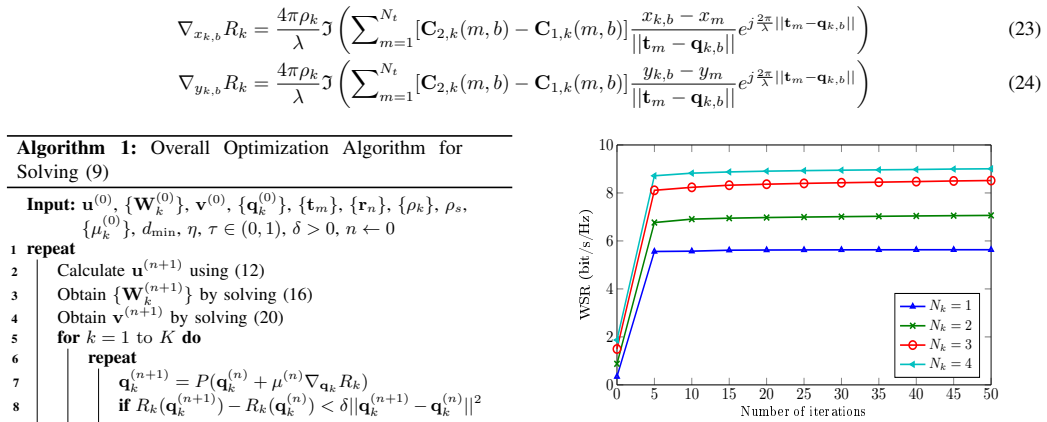
The central claim is that an alternating optimization algorithm, which iteratively refines the sensing receive combiner, communication precoding matrices, sensing transmit beamformer, and the physical positions of the movable antennas, maximizes the weighted sum rate for communication users while enforcing a minimum sensing signal-to-interference-plus-noise ratio in a near-field ISAC system. This joint optimization exploits the spherical-wave channel structure to yield higher rates than configurations limited to fixed antenna positions.
What carries the argument
Alternating optimization that cycles through updates to the sensing receive combiner, communication precoding matrices, sensing transmit beamformer, and movable-antenna positions.
If this is right
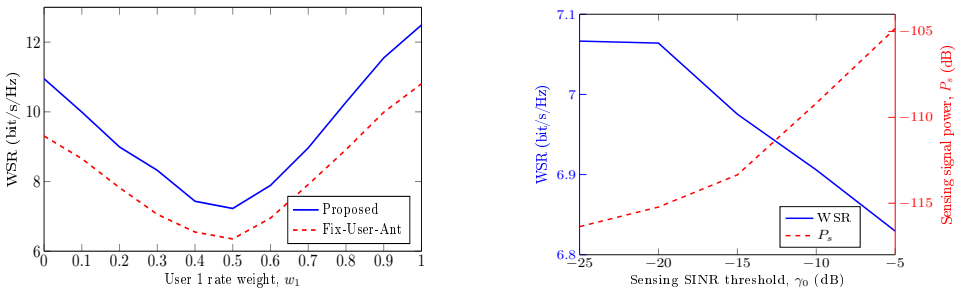
- Allocating larger weights to communication users closer to the base station produces the highest weighted sum rate.
- Raising the minimum sensing SINR threshold degrades sensing performance more sharply than communication performance.
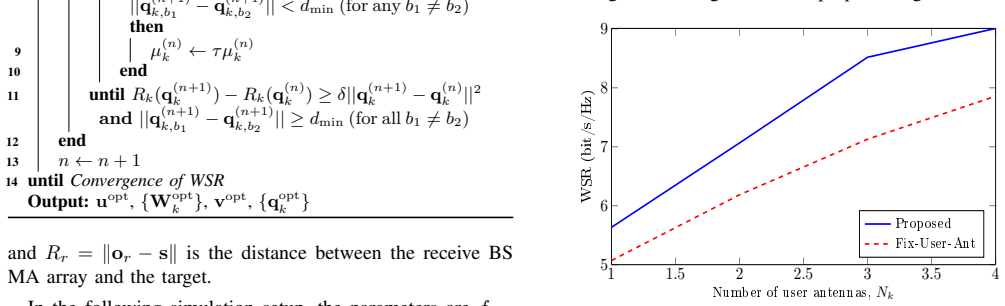
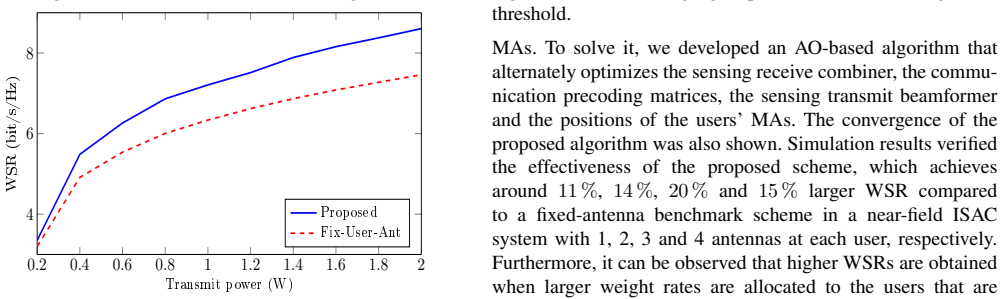
- Movable antennas deliver substantial weighted-sum-rate gains over fixed-antenna near-field ISAC systems.
- The optimization framework remains feasible when the number of movable antennas is modest.
Where Pith is reading between the lines
- Real-time repositioning of antennas could adapt to user mobility without requiring additional fixed hardware.
- The same alternating procedure might extend to multi-base-station deployments where sensing targets move across cells.
- Reducing the density of fixed antennas while retaining movable ones could lower deployment cost in dense near-field scenarios.
Load-bearing premise
The near-field channel is accurately captured by the spherical-wave model and the alternating updates converge to a high-quality operating point rather than a poor local solution.
What would settle it
A measurement campaign or refined simulation in which repositioning the antennas produces no measurable weighted-sum-rate improvement over fixed locations, under identical power and sensing-SINR constraints, would falsify the reported advantage.
Figures
read the original abstract
Integrated sensing and communication (ISAC) has been recognized as one of the key technologies capable of simultaneously improving communication and sensing services in future wireless networks. Moreover, the introduction of recently developed movable antennas (MAs) has the potential to further increase the performance gains of ISAC systems. Achieving these gains can pose a significant challenge for MA-enabled ISAC systems operating in the near-field due to the corresponding spherical wave propagation. Motivated by this, in this paper we maximize the weighted sum rate (WSR) for communication users while maintaining a minimal sensing requirement in an MA-enabled near-field ISAC system. To achieve this goal, we propose an algorithm that optimizes the sensing receive combiner, the communication precoding matrices, the sensing transmit beamformer and the positions of the users' MAs in an alternating manner. Simulation results show that using MAs in near-field ISAC systems provides a substantial performance advantage compared to near-field ISAC systems with only fixed antennas. Additionally, we demonstrate that the highest WSR is obtained when larger weights are allocated to the users placed closer to the BS, and that the sensing performance is significantly more affected by the minimum sensing signal-to-interference-plus-noise ratio (SINR) threshold compared to the communication performance.
Editorial analysis
A structured set of objections, weighed in public.
Referee Report
Summary. The paper claims to maximize the weighted sum rate (WSR) for communication users in a movable antenna (MA) enabled near-field ISAC system while satisfying a minimum sensing SINR requirement. An alternating optimization algorithm is proposed to jointly optimize the sensing receive combiner, communication precoders, sensing transmit beamformer, and MA positions. Simulations demonstrate substantial WSR gains over fixed-antenna systems, with insights on user weight allocation and sensitivity to the sensing threshold.
Significance. This work addresses an emerging topic at the intersection of movable antennas and near-field ISAC, which could offer practical performance improvements in future wireless systems. The simulation results, if robust, provide evidence for the advantages of MA position optimization. However, the reliance on heuristic optimization without convergence assurances limits the significance until these aspects are addressed.
major comments (2)
- [Section IV] The alternating optimization procedure lacks any convergence analysis or guarantee of reaching a high-quality stationary point. Since the MA position optimization subproblem is non-convex (MA positions enter the spherical-wave channel model nonlinearly), the substantial performance gains reported may correspond to local optima rather than a reliable advantage over fixed antennas.
- [Section V] Details on the optimization initialization, number of trials to avoid poor local optima, and exact parameter settings for the channel model and convergence criteria are only summarized at a high level. This weakens the support for the central simulation-based claim of substantial advantage.
minor comments (1)
- The paper would benefit from a table summarizing all simulation parameters (e.g., array sizes, distances, noise powers) for easier reproducibility.
Simulated Author's Rebuttal
We thank the referee for the constructive comments on our manuscript. We address each major comment below and describe the changes planned for the revised version.
read point-by-point responses
-
Referee: [Section IV] The alternating optimization procedure lacks any convergence analysis or guarantee of reaching a high-quality stationary point. Since the MA position optimization subproblem is non-convex (MA positions enter the spherical-wave channel model nonlinearly), the substantial performance gains reported may correspond to local optima rather than a reliable advantage over fixed antennas.
Authors: We agree that the alternating optimization lacks a theoretical convergence guarantee to a stationary point because the MA-position subproblem is non-convex. This limitation is inherent to the problem structure. Nevertheless, the algorithm exhibits reliable empirical convergence in all simulated scenarios, and the reported performance advantage over fixed-antenna baselines remains consistent across multiple random initializations. In the revision we will add a dedicated paragraph in Section IV discussing the observed convergence behavior, iteration statistics, and the effect of different initializations, thereby clarifying that the gains are not isolated local-optima artifacts. revision: partial
-
Referee: [Section V] Details on the optimization initialization, number of trials to avoid poor local optima, and exact parameter settings for the channel model and convergence criteria are only summarized at a high level. This weakens the support for the central simulation-based claim of substantial advantage.
Authors: We appreciate the referee highlighting the need for greater reproducibility. In the revised manuscript we will expand Section V with explicit descriptions of the initialization procedure for all optimization variables, the number of independent random trials performed, the precise numerical values used for the near-field channel parameters, and the exact convergence thresholds applied to each subproblem. revision: yes
Circularity Check
No circularity: standard alternating optimization on independently defined objective
full rationale
The paper defines the WSR objective and spherical-wave channel model from first principles, then applies a standard block-alternating procedure over precoders, combiners, beamformer and MA positions. None of the subproblems or the overall result is shown to reduce by the paper's own equations to a quantity defined solely by fitted parameters or by a self-citation chain. The simulation claims rest on numerical evaluation rather than any tautological renaming or self-referential prediction. This is the normal non-circular outcome for an optimization paper whose central contribution is algorithmic rather than a closed-form derivation that collapses to its inputs.
Axiom & Free-Parameter Ledger
free parameters (2)
- user weights for WSR
- minimum sensing SINR threshold
axioms (1)
- domain assumption Spherical wave propagation model accurately describes near-field channels
Lean theorems connected to this paper
-
IndisputableMonolith/Foundation/RealityFromDistinction.leanreality_from_one_distinction unclear?
unclearRelation between the paper passage and the cited Recognition theorem.
We propose an alternating optimization (AO) based algorithm ... sensing receive combiner ... SCA ... SDR ... PGM ... prove the convergence
-
IndisputableMonolith/Cost/FunctionalEquation.leanwashburn_uniqueness_aczel unclear?
unclearRelation between the paper passage and the cited Recognition theorem.
spherical wave channel model ... Hk = ρk [exp(j 2π/λ ∥tm − qk,b∥)]
What do these tags mean?
- matches
- The paper's claim is directly supported by a theorem in the formal canon.
- supports
- The theorem supports part of the paper's argument, but the paper may add assumptions or extra steps.
- extends
- The paper goes beyond the formal theorem; the theorem is a base layer rather than the whole result.
- uses
- The paper appears to rely on the theorem as machinery.
- contradicts
- The paper's claim conflicts with a theorem or certificate in the canon.
- unclear
- Pith found a possible connection, but the passage is too broad, indirect, or ambiguous to say the theorem truly supports the claim.
Reference graph
Works this paper leans on
-
[1]
Integrated sensing and communications: Toward dual- functional wireless networks for 6G and beyond,
F. Liuet al., “Integrated sensing and communications: Toward dual- functional wireless networks for 6G and beyond,”IEEE J. Sel. Areas Commun., vol. 40, no. 6, pp. 1728–1767, 2022
work page 2022
-
[2]
Sensing rate optimization for multi-band coopera- tive ISAC systems,
N. S. Perovi ´cet al., “Sensing rate optimization for multi-band coopera- tive ISAC systems,”IEEE Commun. Lett., vol. 29, no. 9, pp. 2163–2167, 2025
work page 2025
-
[3]
Movable antenna enhanced wireless sensing via antenna position optimization,
W. Maet al., “Movable antenna enhanced wireless sensing via antenna position optimization,”IEEE Trans. Wireless Commun., vol. 23, no. 11, pp. 16 575–16 589, 2024
work page 2024
-
[4]
Movable antenna enabled integrated sensing and commu- nication,
W. Lyuet al., “Movable antenna enabled integrated sensing and commu- nication,”IEEE Trans. Wireless Commun., vol. 24, no. 4, pp. 2862–2875, 2025
work page 2025
-
[5]
R. Yanget al., “Robust transceiver design for RIS enhanced dual- functional radar-communication with movable antenna,”arXiv preprint arXiv:2506.07610, 2025
-
[6]
Advanced ISAC design: Movable antennas and accounting for dynamic RCS,
A. Khalili and R. Schober, “Advanced ISAC design: Movable antennas and accounting for dynamic RCS,” inProc. IEEE GLOBECOM, 2024, pp. 4022–4027
work page 2024
-
[7]
Rotatable and movable antenna-enabled near-field inte- grated sensing and communication,
Y . Sunet al., “Rotatable and movable antenna-enabled near-field inte- grated sensing and communication,”arXiv preprint arXiv:2501.04490, 2025
-
[8]
Movable antenna-aided near-field integrated sensing and communication,
J. Dinget al., “Movable antenna-aided near-field integrated sensing and communication,”IEEE Trans. Wireless Commun., 2025, early access
work page 2025
-
[9]
Near-field communications: A tutorial review,
Y . Liuet al., “Near-field communications: A tutorial review,”IEEE open j. Commun. Soc., vol. 4, pp. 1999–2049, 2023
work page 1999
-
[10]
Full-duplex communication for ISAC: Joint beamforming and power optimization,
Z. Heet al., “Full-duplex communication for ISAC: Joint beamforming and power optimization,”IEEE J. Sel. Areas Commun., vol. 41, no. 9, pp. 2920–2936, 2023
work page 2023
-
[11]
Discerning and enhancing the weighted sum- rate maximization algorithms in communications,
Z. Zhanget al., “Discerning and enhancing the weighted sum- rate maximization algorithms in communications,”arXiv preprint arXiv:2311.04546, 2023
-
[12]
Sensing as a service in 6G perceptive networks: A unified framework for ISAC resource allocation,
F. Donget al., “Sensing as a service in 6G perceptive networks: A unified framework for ISAC resource allocation,”IEEE Trans. Wireless Commun., vol. 22, no. 5, pp. 3522–3536, 2022
work page 2022
discussion (0)
Sign in with ORCID, Apple, or X to comment. Anyone can read and Pith papers without signing in.