The influence of strong coupling between single-photon source and spectral filter on photon statistics
Pith reviewed 2026-06-30 20:18 UTC · model grok-4.3
The pith
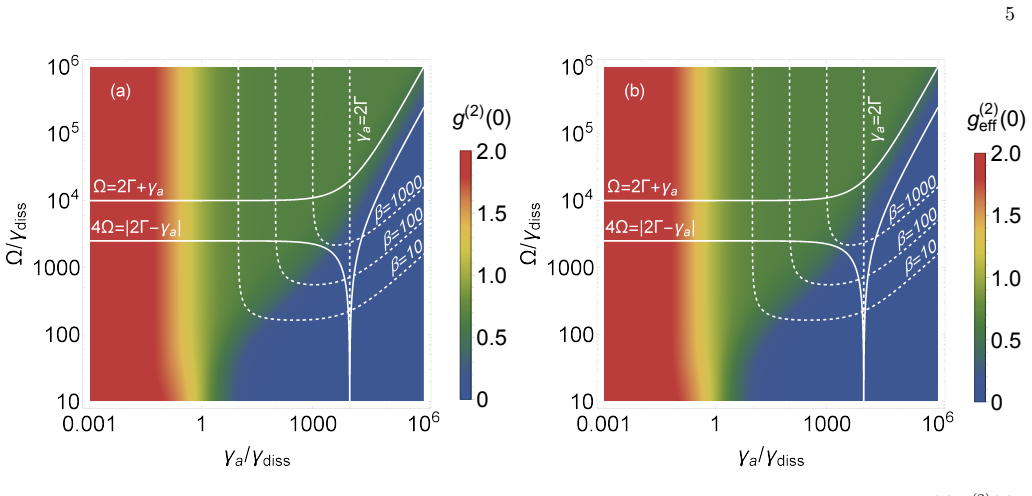
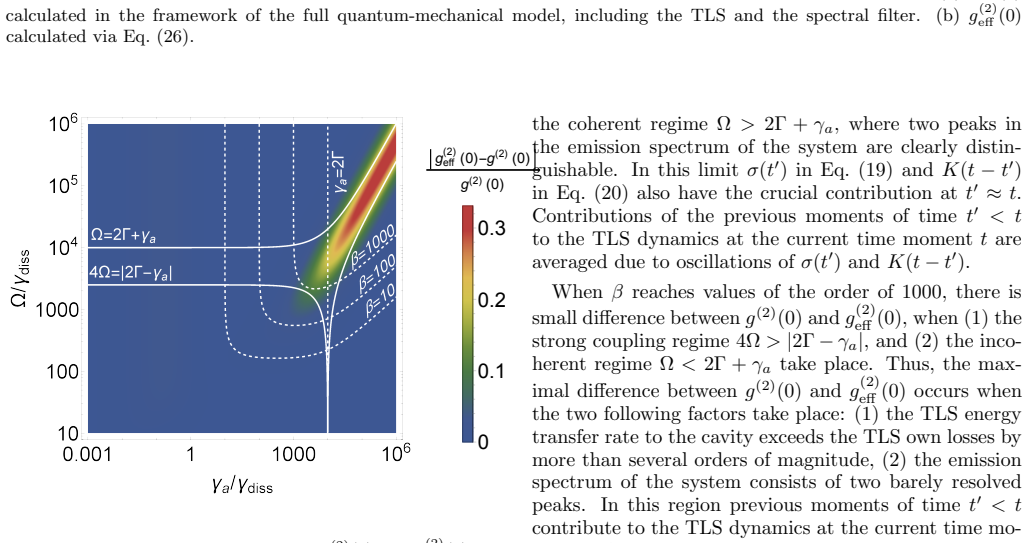
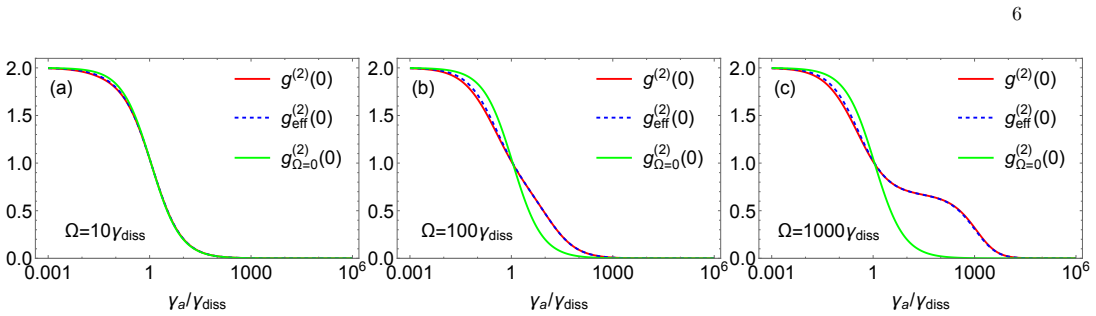
An effective spectral filtering model correctly describes photon statistics from a single-photon source even in the strong-coupling regime with a cavity.
A machine-rendered reading of the paper's core claim, the machinery that carries it, and where it could break.
Core claim
The central claim is that the influence of the spectral filter on the single-photon source dynamics can be captured entirely by an effective spectral filtering model without explicit treatment of back-action, and that this model correctly describes the photon statistics even in a strong-coupling regime between the single-photon source and the spectral filter.
What carries the argument
Effective analytical model treating cavity influence solely as spectral filtering.
If this is right
- Photon statistics of cavity-coupled emitters can be computed analytically via filtering alone.
- The same model applies across the full range from weak to strong coupling.
- Results extend to quantum emitters interacting with arbitrary electromagnetic interfaces that act as spectral filters.
Where Pith is reading between the lines
- Design of single-photon sources for integrated quantum circuits could rely on this approximation to reduce simulation cost.
- Similar filtering-only models might be tested for other structured environments such as photonic crystals or waveguides.
- The approach could be combined with existing input-output theory to handle multi-emitter or multi-cavity systems.
Load-bearing premise
The spectral filter's influence on the source can be modeled without any explicit back-action on the source dynamics.
What would settle it
A direct numerical comparison of second-order correlation function g(2)(τ) computed from the full master equation versus the effective filter model, for coupling strengths where the Rabi frequency exceeds the filter linewidth.
Figures
read the original abstract
One of the most common approaches for coupling optical single-photon sources and photonic integrated circuits is to use a cavity. The cavity acts as a spectral filter that distorts the light spectrum and changes its statistical properties. But in the general case one should take into account not only spectral filtering of light but also the spectral filter influence on the single-photon source dynamics. We build an effective analytical model for description of the cavity influence on the photon statistics of light emitted by the single-photon source as spectral filtering only. We show that this model correctly describes the photon statistics even in a strong-coupling regime between the single-photon source and the spectral filter. Our results can be useful for analytical modeling of photon statistics of quantum emitters strongly coupled to various electromagnetic interfaces.
Editorial analysis
A structured set of objections, weighed in public.
Referee Report
Summary. The manuscript develops an effective analytical model treating the cavity's influence on photon statistics from a single-photon source as pure spectral filtering (without explicit back-action treatment). It claims this model accurately reproduces the statistics even in the strong-coupling regime between source and filter, with potential utility for analytical modeling of quantum emitters coupled to electromagnetic interfaces.
Significance. If the central claim holds, the work would enable simplified analytical calculations of photon statistics in strongly coupled systems by bypassing full quantum master-equation solutions that include coherent exchange and cavity-modified decay. This could streamline design of photonic circuits incorporating single-photon sources.
major comments (2)
- [Abstract] Abstract: the assertion that the effective filtering model 'correctly describes the photon statistics even in a strong-coupling regime' is the load-bearing claim, yet the provided text supplies no derivation steps, validation against full dynamics, error analysis, or comparison data; the skeptic concern that post-emission linear filtering cannot automatically capture hybridized-state effects on emission timing when g > κ, γ therefore remains unaddressed.
- [Model construction] The model construction (implied in the abstract's 'effective analytical model') assumes the filter kernel can be chosen to exactly compensate for back-action; the manuscript must explicitly derive or validate this kernel under strong-coupling conditions, showing either exact equivalence or the regime where back-action becomes negligible.
minor comments (1)
- [Abstract] Abstract: specify the photon-statistics observables (e.g., second-order correlation function) being compared.
Simulated Author's Rebuttal
We thank the referee for their detailed review and constructive criticism. We address each major comment below, clarifying the support for our claims in the full manuscript while agreeing to revisions that improve explicitness and accessibility.
read point-by-point responses
-
Referee: [Abstract] Abstract: the assertion that the effective filtering model 'correctly describes the photon statistics even in a strong-coupling regime' is the load-bearing claim, yet the provided text supplies no derivation steps, validation against full dynamics, error analysis, or comparison data; the skeptic concern that post-emission linear filtering cannot automatically capture hybridized-state effects on emission timing when g > κ, γ therefore remains unaddressed.
Authors: The abstract summarizes the central result; the full manuscript derives the effective model in Section II via the cavity response function and presents direct numerical validation against the full Jaynes-Cummings master equation in Section III, including strong-coupling cases (g/κ > 1). These comparisons include error metrics and address hybridized-state dynamics by showing that the effective kernel reproduces the modified emission timing and g^(2)(τ) without explicit coherent exchange terms. We will revise the abstract to reference these sections and note the validation. revision: partial
-
Referee: [Model construction] The model construction (implied in the abstract's 'effective analytical model') assumes the filter kernel can be chosen to exactly compensate for back-action; the manuscript must explicitly derive or validate this kernel under strong-coupling conditions, showing either exact equivalence or the regime where back-action becomes negligible.
Authors: Section II explicitly constructs the kernel from the Fourier transform of the coupled source-cavity Green's function and validates its use for photon statistics by matching two-time correlation functions to the full dynamics. Analytical arguments show that back-action is absorbed into the kernel for the quantities of interest (intensity and g^(2)), with numerical benchmarks confirming accuracy across weak-to-strong coupling without requiring a separate back-action term. We will add a dedicated paragraph in Section II with the step-by-step kernel derivation for the strong-coupling limit. revision: yes
Circularity Check
No significant circularity; effective model presented as independent derivation
full rationale
The paper constructs an effective analytical model that treats cavity influence solely as spectral filtering and asserts it reproduces photon statistics in the strong-coupling regime. No quoted equations, self-citations, or derivation steps in the available text reduce the central claim to a fitted input, self-definition, or load-bearing prior result by the authors. The model is introduced as a first-principles effective description whose validity is asserted via direct comparison or derivation rather than by renaming or constructionally forcing the output to match the input. This is the common case of a self-contained theoretical construction without detectable circular reduction.
Axiom & Free-Parameter Ledger
Reference graph
Works this paper leans on
-
[1]
R. J. Hughes, D. M. Alde, P. Dyer, G. G. Luther, G. L. Morgan, and M. Schauer, Quantum cryptography, Con- temporary Physics36, 149 (1995)
1995
-
[2]
Gschrey, A
M. Gschrey, A. Thoma, P. Schnauber, M. Seifried, R. Schmidt, B. Wohlfeil, L. Kr¨ uger, J.-H. Schulze, T. Heindel, S. Burger,et al., Highly indistinguishable photons from deterministic quantum-dot microlenses uti- lizing three-dimensional in situ electron-beam lithogra- phy, Nature communications6, 7662 (2015)
2015
-
[3]
X.-D. Cai, C. Weedbrook, Z.-E. Su, M.-C. Chen, M. Gu, M.-J. Zhu, L. Li, N.-L. Liu, C.-Y. Lu, and J.-W. Pan, Ex- perimental quantum computing to solve systems of linear 7 equations, Physical review letters110, 230501 (2013)
2013
-
[4]
Von Helversen, J
M. Von Helversen, J. B¨ ohm, M. Schmidt, M. Gschrey, J.-H. Schulze, A. Strittmatter, S. Rodt, J. Beyer, T. Heindel, and S. Reitzenstein, Quantum metrology of solid-state single-photon sources using photon-number- resolving detectors, New Journal of Physics21, 035007 (2019)
2019
-
[5]
F¨ ortsch, J
M. F¨ ortsch, J. U. F¨ urst, C. Wittmann, D. Strekalov, A. Aiello, M. V. Chekhova, C. Silberhorn, G. Leuchs, and C. Marquardt, A versatile source of single photons for quantum information processing, Nature communica- tions4, 1818 (2013)
2013
-
[6]
Tanzilli, A
S. Tanzilli, A. Martin, F. Kaiser, M. P. De Micheli, O. Al- ibart, and D. B. Ostrowsky, On the genesis and evolution of integrated quantum optics, Laser & Photonics Reviews 6, 115 (2012)
2012
-
[7]
Faraon, C
A. Faraon, C. Santori, Z. Huang, K.-M. C. Fu, V. M. Acosta, D. Fattal, and R. G. Beausoleil, Quantum pho- tonic devices in single-crystal diamond, New Journal of Physics15, 025010 (2013)
2013
-
[8]
Radulaski, J
M. Radulaski, J. L. Zhang, Y.-K. Tzeng, K. G. Lagoudakis, H. Ishiwata, C. Dory, K. A. Fischer, Y. A. Kelaita, S. Sun, P. C. Maurer,et al., Nanodiamond in- tegration with photonic devices, Laser & Photonics Re- views13, 1800316 (2019)
2019
-
[9]
Faraon, C
A. Faraon, C. Santori, Z. Huang, V. M. Acosta, and R. G. Beausoleil, Coupling of nitrogen-vacancy centers to pho- tonic crystal cavities in monocrystalline diamond, Phys- ical Review Letters109, 033604 (2012)
2012
-
[10]
Benedikter, H
J. Benedikter, H. Kaupp, T. H¨ ummer, Y. Liang, A. Bom- mer, C. Becher, A. Krueger, J. M. Smith, T. W. H¨ ansch, and D. Hunger, Cavity-enhanced single-photon source based on the silicon-vacancy center in diamond, Physi- cal Review Applied7, 024031 (2017)
2017
-
[11]
T. Ming, H. Chen, R. Jiang, Q. Li, and J. Wang, Plasmon-controlled fluorescence: beyond the intensity enhancement, The Journal of Physical Chemistry Letters 3, 191 (2012)
2012
-
[12]
J. C. L´ opez Carre˜ no, E. del Valle, and F. P. Laussy, Pho- ton correlations from the mollow triplet, Laser & Pho- tonics Reviews11, 1700090 (2017)
2017
-
[13]
Mandel, E
L. Mandel, E. Wolf, and J. H. Shapiro, Optical coherence and quantum optics (1996)
1996
-
[14]
Kn¨ oll, W
L. Kn¨ oll, W. Vogel, and D.-G. Welsch, Quantum noise in spectral filtering of light, JOSA B3, 1315 (1986)
1986
-
[15]
del Valle, A
E. del Valle, A. Gonzalez-Tudela, F. P. Laussy, C. Teje- dor, and M. J. Hartmann, Theory of frequency-filtered and time-resolved n-photon correlations, Physical review letters109, 183601 (2012)
2012
-
[16]
Gonzalez-Tudela, F
A. Gonzalez-Tudela, F. P. Laussy, C. Tejedor, M. J. Hart- mann, and E. d. Valle, Two-photon spectra of quantum emitters, New Journal of Physics15, 033036 (2013)
2013
-
[17]
J. C. L´ opez Carre˜ no, E. Zubizarreta Casalengua, B. Silva, E. del Valle, and F. P. Laussy, Loss of antibunching, Physical Review A105, 023724 (2022)
2022
-
[18]
Albrecht, A
R. Albrecht, A. Bommer, C. Pauly, F. M¨ ucklich, A. W. Schell, P. Engel, T. Schr¨ oder, O. Benson, J. Reichel, and C. Becher, Narrow-band single photon emission at room temperature based on a single nitrogen-vacancy center coupled to an all-fiber-cavity, Applied Physics Letters 105(2014)
2014
-
[19]
Laucht, N
A. Laucht, N. Hauke, J. Villas-Bˆ oas, F. Hofbauer, G. B¨ ohm, M. Kaniber, and J. Finley, Dephasing of ex- citon polaritons in photoexcited ingaas quantum dots in gaas nanocavities, Physical Review Letters103, 087405 (2009)
2009
-
[20]
Ollivier, I
H. Ollivier, I. Maillette de Buy Wenniger, S. Thomas, S. C. Wein, A. Harouri, G. Coppola, P. Hilaire, C. Millet, A. Lemaitre, I. Sagnes,et al., Reproducibility of high- performance quantum dot single-photon sources, ACS photonics7, 1050 (2020)
2020
-
[21]
Lombardi, M
P. Lombardi, M. Trapuzzano, M. Colautti, G. Margheri, I. P. Degiovanni, M. L´ opez, S. K¨ uck, and C. Toninelli, A molecule-based single-photon source applied in quantum radiometry, Advanced Quantum Technologies3, 1900083 (2020)
2020
-
[22]
Reserbat-Plantey, I
A. Reserbat-Plantey, I. Epstein, I. Torre, A. T. Costa, P. Gon¸ calves, N. A. Mortensen, M. Polini, J. C. Song, N. M. Peres, and F. H. Koppens, Quantum nanophoton- ics in two-dimensional materials, ACS Photonics8, 85 (2021)
2021
-
[23]
M. O. Scully and M. S. Zubairy,Quantum optics(Cam- bridge university press, 1997)
1997
-
[24]
Breuer and F
H.-P. Breuer and F. Petruccione,The theory of open quantum systems(Oxford University Press on Demand, 2002)
2002
discussion (0)
Sign in with ORCID, Apple, or X to comment. Anyone can read and Pith papers without signing in.