REVIEW 3 major objections 6 minor 22 references
Linearity-based neural network compression
T0 review · 3 major / 6 minor · reviewed 2026-08-06 · deepseek-v4-flash
Pith's one-line read A new compression method removes near-always-active ReLU neurons by folding their weights into the next layer, shrinking models to a quarter of their size with little accuracy loss on most tasks.
desk verdict A genuinely new pruning axis—removing the most-active, near-linear ReLU neurons—but the 'lossless' headline is approximate and the parameter count ignores existing shortcuts, so the size claims need fixing before I would rely on them. read the letter →
The pith
A machine-rendered reading of the paper's core claim, the machinery that carries it, and where it could break.
The reading
What carries the argument
The carrying device is the weight-redistribution identity for a linear neuron: if neuron $j$ in layer $i$ is linear, then each neuron $p$ in layer $i+1$ absorbs the contribution by adding $w^{(i+1,p)}_{h_{i,j}} w^{(i,j)}_{h_{i-1,l}}$ to its incoming weight from each neuron $l$ of layer $i-1$ and $w^{(i+1,p)}_{h_{i,j}} b_{i,j}$ to its bias, after which the neuron and its outgoing weights are deleted and replaced by a shortcut connection from layer $i-1$ to layer $i+1$. The parameter-count condition that decides when the operation is profitable is the inequality $w_{i-1} w_{i+1} \le n_{\mathrm{linear}} (w_{i-1} + 1 + w_{i+1})$, which the paper derives as Inequation 6 and uses as a per-layer threshold; in practice, linearity is approximated by a neuron's activation rate, the fraction of pruning-set examples on which its output is positive.
What would settle it
Take a trained fully connected ReLU network, add an identity shortcut connection that bypasses one internal layer, then apply the paper's compression with its per-layer size threshold to that layer; if the total parameter count increases, which Inequation 7 does not account for because it ignores existing shortcuts, the size-reduction guarantee is falsified for cascaded compressions.
Extended reading notes
Core claim
The paper claims that near-always-active ReLU neurons are effectively linear and can be removed by redistributing their weights into the next layer, a procedure that is exact when the neuron's weights and bias are non-negative and approximate otherwise. The central result is that compressing a layer reduces total parameters exactly when the new dense shortcut connection costs less than the removed weights, expressed as $w_{i-1} w_{i+1} \le n_{\mathrm{linear}} (w_{i-1} + 1 + w_{i+1})$. The experiments show that on most of the 61 OpenML-CC18 tasks, models can be compressed to 25% of their original parameter count with no drop in accuracy, and that linearity-based compression can be applied after importance-based pruning because the two methods target different neurons.
Load-bearing premise
The reported size reductions assume that compressing a layer always removes more parameters than the new dense shortcut connection adds, which holds only when the layer has enough linear neurons and no pre-existing skip connections; the paper's own formula ignores existing shortcut connections, so cascaded compressions can add parameters instead of removing them.
Editorial extensions
If this is right
- Models with many near-always-active ReLU neurons in a layer can be compressed without retraining and with negligible accuracy change, down to 25% of original size on most of the 61 OpenML-CC18 tasks.
- Linearity-based compression can be stacked on top of importance-based pruning: the two methods target opposite ends of the activation spectrum, and on an already 60%-pruned FashionMNIST model the combined pipeline removed roughly a further million parameters with little accuracy loss.
- Compression is exact only for provably linear neurons (all weights and bias non-negative), which the authors found in none of the 61 trained models, so practical use rests on the approximation introduced by the activation-rate threshold.
- For constant-width layers, meaningful compression requires at least half the neurons to be linear, so the method favors networks with varying layer sizes.
- The theory extends to any piecewise-linear activation function: a neuron consistently active on the same linear segment can be treated as linear with that segment's slope and intercept.
Reading between the lines
- Because the method caches shortcut outputs at inference time, parameter savings may not translate into latency savings; measuring wall-clock throughput on a compressed model would test whether the memory reduction also speeds up inference.
- The activation-rate proxy for linearity could be sharpened by measuring, for each neuron, the stability of its pre-activation sign under small input perturbations, which would identify neurons that are linear on a larger region and could reduce accuracy loss at aggressive thresholds.
- The theory suggests a train-time extension: adding a small regularizer that encourages high activation rates would produce models that are more compressible after training, a direction the paper leaves for future work.
- The dense shortcut matrices created by merging may themselves be sparse or low-rank, so applying a second pass of weight pruning or low-rank factorization to the compressed model could yield additional savings beyond the paper's single-level combination.
Editorial analysis
A structured set of objections, weighed in public.
Referee Report
Summary. The paper introduces 'linearity-based neural network compression,' a method that identifies ReLU neurons with very high empirical activation rates, treats them as linear, and removes them by folding their input weights into a direct shortcut connection from the previous layer to the next (Sections 2-3). A layer-threshold rule (Eq. 7) decides when the new shortcut costs fewer parameters than the removed neurons. The method is evaluated on fully connected networks for Titanic, Fashion-MNIST, and 61 OpenML-CC18 tasks, compressing to 75%, 50%, and 25% of original size, and in combination with an importance-pruning baseline (Sections 4.4-4.6). The abstract claims 'lossless compression down to 1/4 of the original model size in over the majority of tested models.'
Significance. If the central claims were fully supported, the paper would offer a genuinely complementary compression mechanism: unlike importance-based pruning, it removes the most frequently active neurons, and the exact merging algebra in Section 2.1 is correct and useful. The authors also provide code and evaluate across 61 tasks, and the combination experiment in Section 4.6 is a reasonable first test of orthogonality. However, the headline claims are not currently established: 'lossless' is contradicted by reported accuracy drops, and the parameter-counting formula used to define target sizes ignores existing shortcut connections, so the reported 25/50/75% sizes are not guaranteed for cascaded compressions. The paper's own Sections 3.2 and 4.4 concede this issue.
major comments (3)
- [Sections 2.3, 4.4, 4.5] Inequation 6 and layer-threshold Eq. 7 count the cost of compressing layer i as one new width_{i-1} x width_{i+1} connection and ignore shortcut connections that already terminate at layer i. After compressing an earlier layer, layer i's input includes the original previous-layer activations and one or more shortcut outputs; removing a linear neuron in layer i then creates new shortcut weights from all of those inputs to layer i+1, so the parameter change is larger than Eq. 7 predicts. The paper explicitly notes this in Section 3.2 ('consecutive layers must carry weights for both the original layer and the output of the shortcut connection') and Section 4.4 ('existing shortcut connections are ignored, which could theoretically increase model size'). Because the OpenML protocol in Section 4.5 stops when the Eq. 7-based count first falls below 75/50/25%, the reported compressed sizes are not verified; a layer can be skipped even when the true parameter change is positive. Please correct the parameter accounting (or restrict the method to layers without incoming shortcuts) and repeat the experiments that support the size claims.
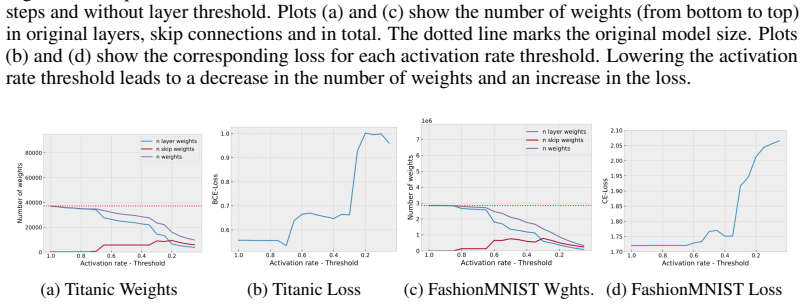
- [Abstract and Section 4.5] The claim of 'lossless compression' is not supported by the reported experiments. The empirical linearity criterion in Section 3.1 is based on activation rates on a pruning set, not provable linearity, and Section 4.5 reports accuracy drops up to 0.5, with approximately 0.35 for the 25% compression level. Section 4.4 also reports loss increases as the activation-rate threshold is lowered. Please either provide a precise definition of 'lossless' and report the number and fraction of models with zero accuracy change under that definition, or revise the claim to 'near-lossless' or 'with small accuracy drop.'
- [Section 4.5] The target sizes are reached by sweeping the activation-rate threshold downward until the estimated size first falls below the desired fraction of the original size. This means the compression ratios are realized by construction rather than predicted from the theory; this is not itself an error, but it makes it essential to verify the final sizes with an exact parameter counter that includes all shortcut weights. The current Eq. 7-based count does not do this. Please report actual post-compression parameter counts for the OpenML models, not just the estimated counts.
minor comments (6)
- [Section 2.1, Eq. (3)] The notation in Equation (3) is badly garbled (for example, 'w(i+1p) hij' and 'w(i1) hi−1l−−updated'); the derivation should be rewritten with clear, consistently indexed weight symbols.
- [Section 2.2] The statement that a neuron with non-negative weights and bias 'behaves linearly' should explicitly state the additional condition that all its inputs are non-negative, which is not guaranteed for the first hidden layer; this is later acknowledged but should be stated at the point of the claim.
- [Section 4.3] The paragraph on provable linear neurons is confusing: it says all 18 found neurons reside in the first hidden layer, then says none of the models ultimately contain a provably linear neuron. Please state explicitly that first-hidden-layer neurons cannot be certified because external inputs may be negative.
- [Appendix, Algorithm 1] The pseudocode uses truthiness of 'current_skip_output' and 'layer.shortcut_connection' as control-flow conditions; since these may be tensors or layer objects, the intended semantics should be made explicit (e.g., 'is not None').
- [Section 4.5, Figure 4] The text says 'the majority of models are uninfluenced' but does not give exact counts. Please report the number of models with no accuracy change, and ideally a distribution summary, for each compression level.
- [Throughout] There are numerous typos and grammatical errors, including 'not effected,' 'So compare Molchanov et al.,' 'V ollgraf' in the references, and inconsistent citation formatting. A careful copyedit is needed.
Circularity Check
No circularity: the parameter-count derivation is self-contained algebra and the empirical thresholds are openly used as construction controls rather than as predictions.
full rationale
The paper's derivation chain is self-contained. Section 2.1 establishes the weight-redistribution identity in Eq. 3 by direct algebraic substitution of a linear neuron's output into the following layer. Section 2.2 states the condition ReLU(x) = x for nonnegative inputs, which is a definitional property of the activation function, not an assumed conclusion. Section 2.3 counts parameters before compression in Eq. 5 and after compression in Eq. 6, and Eq. 7 is the algebraic rearrangement of Eq. 6 into a layer threshold. None of these equations depend on fitted values, experimental results, or citations to the authors' prior work. Empirically, the activation-rate threshold is openly used as a control knob: Section 4.5 states that models are compressed with decreasing thresholds 'until the size first falls below the desired fraction of the original size.' Thus the reported sizes are construction targets, not predictions, and the paper does not describe them as predictions. The accuracy and loss values are measured on test data not used for training or pruning, so the performance evaluation is not forced by the threshold choice. The paper itself flags the main counting limitation in Section 4.4: 'Note that existing shortcut connections are ignored, which could theoretically increase model size through consecutive shortcut connections.' That is a correctness and robustness concern about the parameter-count formula, not circularity, because the flaw does not make the derivation equivalent to its own output. There is no load-bearing self-citation chain, no imported uniqueness theorem, and no fitted quantity renamed as a derived prediction. Therefore no specific circular step can be exhibited, and the appropriate finding is no significant circularity.
Assumptions & free parameters
free parameters (2)
- activation rate threshold =
swept from 1.0 down to 0.55 or 0.35 in 0.05 steps; chosen per model to reach target sizes of 75%, 50%, and 25%
- layer threshold (minimum linear neurons per layer) =
computed from Eq. 7 for each layer; an absolute-value variant is also tested in the appendix
assumptions (4)
- standard math A neuron that is active on every input computes the identity on its positive inputs and can be removed by redistributing weights to the next layer (Section 2.1, Eq. 3).
- domain assumption All inputs to a hidden ReLU are non-negative, so non-negative weights and bias imply always-on linear behavior (Section 2.2).
- domain assumption Activation rate on the pruning set is a faithful proxy for linearity on the true data distribution (Section 3.1).
- ad hoc to paper Parameter count after merging is bounded by width_{i-1} x width_{i+1} independent of the number of linear neurons, with no accounting for existing shortcut connections (Section 2.3, Eq. 6).
Cite this review
Pith. "Pith review of Linearity-based neural network compression." pith.science (2026). https://pith.science/paper/4L4ICNZJ
@misc{pith2026250621146,
  author       = {Pith},
  title        = {Pith review of: Linearity-based neural network compression},
  year         = {2026},
  howpublished = {\url{https://pith.science/paper/4L4ICNZJ}},
  note         = {Machine review of arXiv:2506.21146}
}
read the original abstract
In neural network compression, most current methods reduce unnecessary parameters by measuring importance and redundancy. To augment already highly optimized existing solutions, we propose linearity-based compression as a novel way to reduce weights in a neural network. It is based on the intuition that with ReLU-like activation functions, neurons that are almost always activated behave linearly, allowing for merging of subsequent layers. We introduce the theory underlying this compression and evaluate our approach experimentally. Our novel method achieves a lossless compression down to 1/4 of the original model size in over the majority of tested models. Applying our method on already importance-based pruned models shows very little interference between different types of compression, demonstrating the option of successful combination of techniques. Overall, our work lays the foundation for a new type of compression method that enables smaller and ultimately more efficient neural network models.
Figures


Figures from the paper (4 more)


Reference graph
Works this paper leans on
-
[1]
Howard , Menglong Zhu , Bo Chen , Dmitry Kalenichenko , and Hartwig Adam
Andrew G. Howard , Menglong Zhu , Bo Chen , Dmitry Kalenichenko , and Hartwig Adam . MobileNets: Efficient Convolutional Neural Networks for Mobile Vision Applications. 2017
work page 2017
- [2]
-
[3]
Bernd Bischl, Giuseppe Casalicchio, Matthias Feurer, Pieter Gijsbers, Frank Hutter, Michel Lang, Rafael G. Mantovani, Jan N. van Rijn , and Joaquin Vanschoren. Openml benchmarking suites. ArXiv preprint, 2017
work page 2017
-
[4]
Tom B. Brown, Benjamin Mann, Nick Ryder, Melanie Subbiah, Jared Kaplan, Prafulla Dhariwal, Arvind Neelakantan, Pranav Shyam, Girish Sastry, Amanda Askell, Sandhini Agarwal, Ariel Herbert - Voss, Gretchen Krueger, Tom Henighan, Rewon Child, Aditya Ramesh, Daniel M. Ziegler, Jeffrey Wu, Clemens Winter, Christopher Hesse, Mark Chen, Eric Sigler, Mateusz Litw...
work page 2020
-
[5]
Hanjing Cheng, Zidong Wang, Lifeng Ma, Zhihui Wei, Fawaz E. Alsaadi, and Xiaohui Liu. Differentiable channel pruning guided via attention mechanism: a novel neural network pruning approach. Complex & Intelligent Systems , 0 (5): 0 5611--5624, 2023
work page 2023
-
[6]
Titanic - machine learning from disaster, 2012
Will Cukierski. Titanic - machine learning from disaster, 2012. URL https://kaggle.com/competitions/titanic
work page 2012
-
[7]
Aleksandr Dekhovich, David M. J. Tax, Marcel H. F. Sluiter, and Miguel A. Bessa. Neural network relief: a pruning algorithm based on neural activity. Machine Learning, 0 (5): 0 2597--2618, 2024. ISSN 1573-0565
work page 2024
-
[8]
Centripetal SGD for pruning very deep convolutional networks with complicated structure
Xiaohan Ding, Guiguang Ding, Yuchen Guo, and Jungong Han. Centripetal SGD for pruning very deep convolutional networks with complicated structure. pages 4943--4953. Computer Vision Foundation / IEEE , 2019
work page 2019
Show all 22 references
-
[9]
Tushar Ganguli and Edwin K. P. Chong. Activation-based pruning of neural networks. Algorithms, 0 (1): 0 48, 2024
2024
-
[10]
Song Han, Huizi Mao, and William J. Dally. Deep compression: Compressing deep neural networks with pruning, trained quantization and huffman coding, 2015
2015
-
[11]
Pruning filters for efficient convnets
Hao Li, Asim Kadav, Igor Durdanovic, Hanan Samet, and Hans Peter Graf. Pruning filters for efficient convnets. OpenReview.net, 2017
2017
-
[12]
Deep learning based method for pruning deep neural networks
Lianqiang Li, Jie Zhu, and Ming-Ting Sun. Deep learning based method for pruning deep neural networks. In 2019 IEEE International Conference on Multimedia & Expo Workshops (ICMEW) . IEEE, 2019
2019
-
[13]
Doermann
Shaohui Lin, Rongrong Ji, Chenqian Yan, Baochang Zhang, Liujuan Cao, Qixiang Ye, Feiyue Huang, and David S. Doermann. Towards optimal structured CNN pruning via generative adversarial learning. pages 2790--2799. Computer Vision Foundation / IEEE , 2019
2019
-
[14]
Thinet: A filter level pruning method for deep neural network compression
Jian - Hao Luo, Jianxin Wu, and Weiyao Lin. Thinet: A filter level pruning method for deep neural network compression. pages 5068--5076. IEEE Computer Society, 2017
2017
-
[15]
Importance estimation for neural network pruning
Pavlo Molchanov, Arun Mallya, Stephen Tyree, Iuri Frosio, and Jan Kautz. Importance estimation for neural network pruning. pages 11264--11272. Computer Vision Foundation / IEEE , 2019
2019
-
[16]
Neural network compression by filter similarity detection and visualization
Mayesha Mukarrama, Abul Kalam Al Azad , and Khan Raqib Mahmud . Neural network compression by filter similarity detection and visualization. IEEE, 2020
2020
-
[17]
An overview of neural network compression, 2020
James O' Neill. An overview of neural network compression, 2020
2020
-
[18]
Mobilebert: a compact task-agnostic bert for resource-limited devices
Zhiqing Sun, Hongkun Yu, Xiaodan Song, Renjie Liu, Yiming Yang, and Denny Zhou. Mobilebert: a compact task-agnostic bert for resource-limited devices. arXiv preprint arXiv:2004.02984, 2020
2004 arXiv
-
[19]
Fashion-mnist: a novel image dataset for benchmarking machine learning algorithms, 2017
Han Xiao, Kashif Rasul, and Roland Vollgraf. Fashion-mnist: a novel image dataset for benchmarking machine learning algorithms, 2017
2017
-
[20]
Morariu, Xintong Han, Mingfei Gao, Ching - Yung Lin, and Larry S
Ruichi Yu, Ang Li, Chun - Fu Chen, Jui - Hsin Lai, Vlad I. Morariu, Xintong Han, Mingfei Gao, Ching - Yung Lin, and Larry S. Davis. NISP: pruning networks using neuron importance score propagation. In 2018 IEEE Conference on Computer Vision and Pattern Recognition, CVPR 2018, ...
2018
-
[21]
, " * write output.state after.block = add.period write
ENTRY address author booktitle chapter doi edition editor eid howpublished institution journal key month note number organization pages publisher school series title type url volume year label INTEGERS output.state before.all mid.sentence after.sentence after.block FUNCTION in...
-
[22]
write newline
" write newline "" before.all 'output.state := FUNCTION n.dashify 't := "" t empty not t #1 #1 substring "-" = t #1 #2 substring "--" = not "--" * t #2 global.max substring 't := t #1 #1 substring "-" = "-" * t #2 global.max substring 't := while if t #1 #1 substring * t #2 gl...
Reviewed August 6, 2026 · model on record in the stance chip above.
Discussion (0). Continue with ORCID to comment.