Boson Stars in Teleparallel Gravity with a Nonminimally Coupled Field: The Violation of Energy Conditions and Gravitational Waveforms from EMRIs
Pith reviewed 2026-07-03 08:28 UTC · model grok-4.3
The pith
Excited-state boson stars in teleparallel gravity with non-minimal coupling exhibit negative energy density that violates all standard energy conditions, while ground states satisfy them and their EMRIs produce LISA-detectable waves.
A machine-rendered reading of the paper's core claim, the machinery that carries it, and where it could break.
Core claim
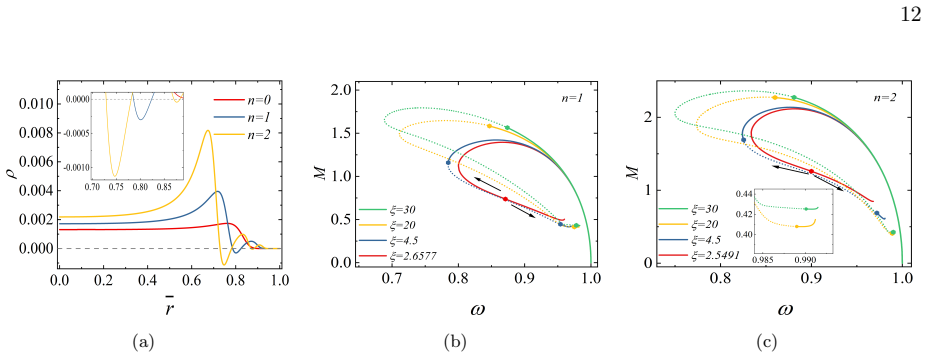
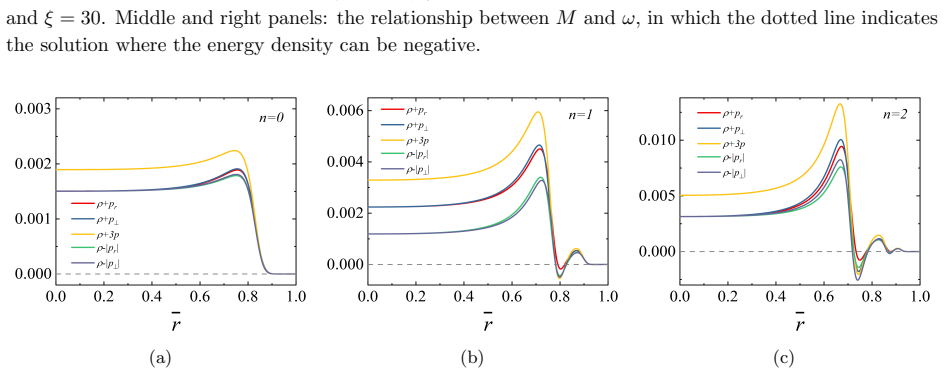
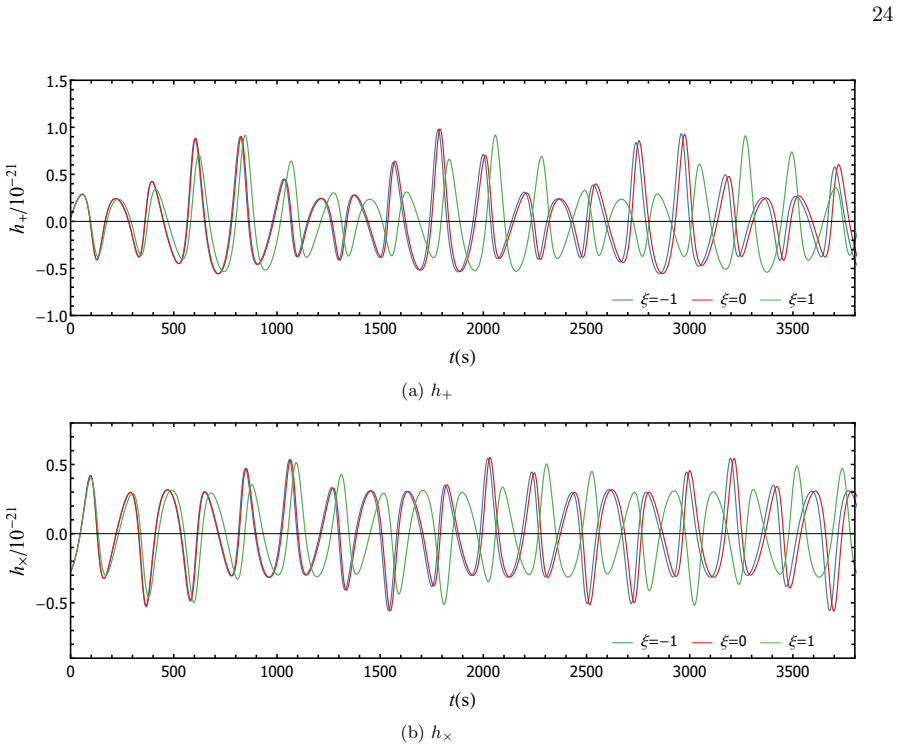
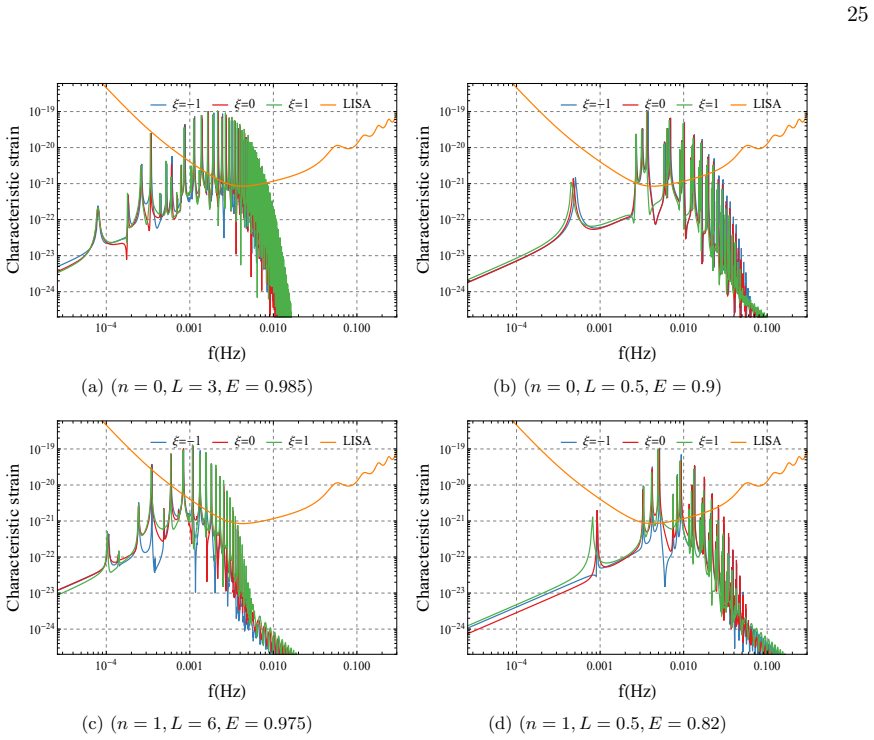
The paper obtains both ground-state and excited-state boson star solutions in teleparallel gravity with non-minimal coupling. The excited-state solutions exhibit regions of negative energy density that violate the null, weak, strong, and dominant energy conditions, whereas the ground-state solutions maintain positive energy density and satisfy all four conditions. Additionally, the frequency-domain characteristic strain of gravitational waveforms from extreme-mass-ratio inspirals with these boson stars falls within the LISA detection range.
What carries the argument
Static spherically symmetric metric ansatz together with the teleparallel field equations that include non-minimal scalar-torsion coupling, which permit numerical construction of excited-state configurations possessing negative energy density.
If this is right
- Ground-state solutions always keep positive energy density and satisfy the four energy conditions.
- Excited-state solutions violate every one of the four standard energy conditions because of negative energy density.
- The characteristic strain of EMRI waveforms sourced by these boson stars lies inside the LISA detection band.
- These solutions supply concrete gravitational-wave signatures that could distinguish the objects from black holes.
Where Pith is reading between the lines
- If the excited states are stable, they could serve as observable alternatives to black holes in teleparallel gravity.
- LISA data could place bounds on the non-minimal coupling strength by searching for the reported waveform features.
- The contrast between ground and excited states suggests that energy-condition violation may be tied to the radial excitation level of the scalar field.
Load-bearing premise
The numerically obtained excited-state solutions are free of instabilities or coordinate artifacts that would remove the reported negative energy-density regions.
What would settle it
An independent numerical integration or analytic check that eliminates the negative energy-density regions in the excited states under a change of coordinates or a different regularization scheme.
Figures
read the original abstract
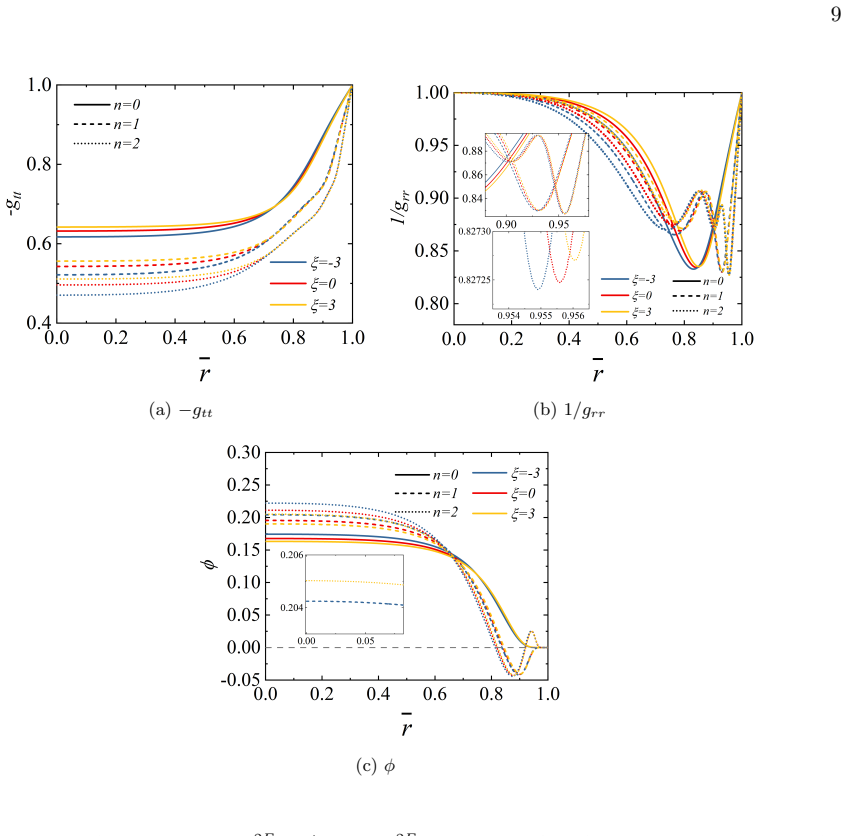
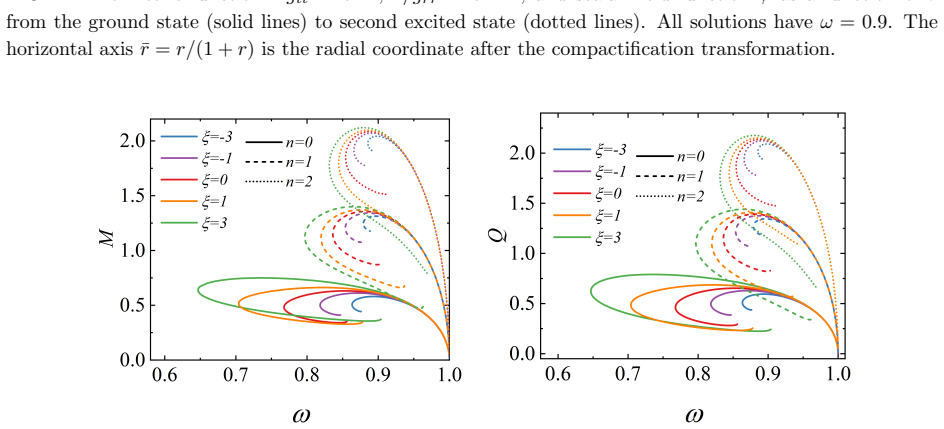
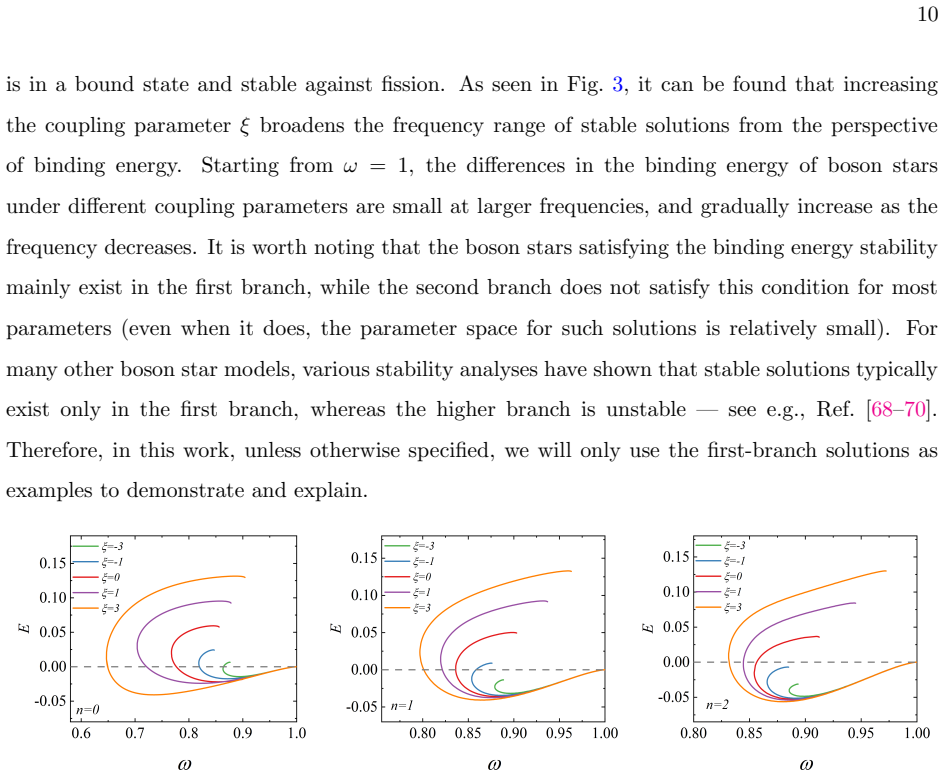
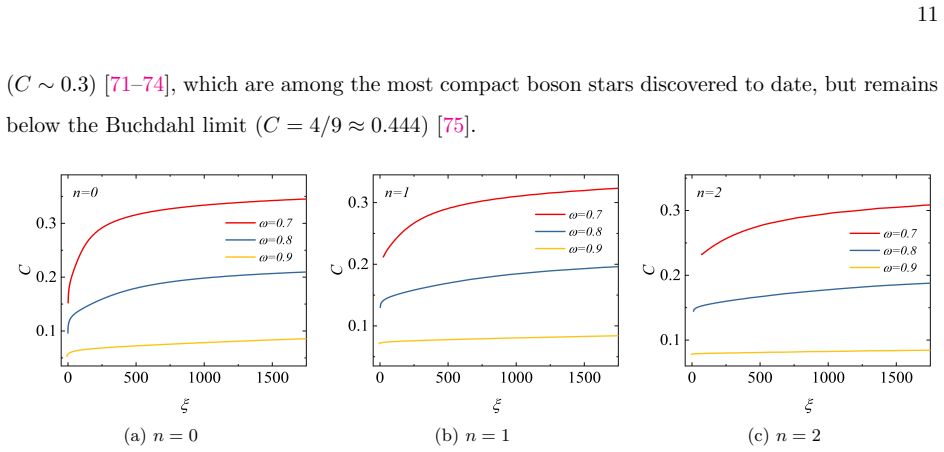
In this work, we investigate boson star models within the framework of teleparallel gravity with non-minimal coupling, and obtain static, spherically symmetric solutions for both the ground state and excited states. The results indicate that the energy density of the excited-state solutions can become negative. For these solutions, the four commonly used energy conditions are no longer satisfied. In contrast, for all the ground-state solutions we have studied, the energy density remains positive and all four energy conditions are consistently satisfied. Moreover, considering the importance of astrophysical observations, the gravitational-wave signals from Extreme-Mass-Ratio Inspirals (EMRIs) composed of these boson stars are investigated. Our results reveal that the frequency-domain characteristic strain of these waveforms falls within the detectability range of LISA, which can provide potential evidence for distinguishing compact astrophysical objects.
Editorial analysis
A structured set of objections, weighed in public.
Referee Report
Summary. The manuscript constructs static spherically symmetric boson-star solutions in teleparallel gravity with non-minimal scalar-field coupling. It reports that excited-state solutions develop regions of negative energy density, violating the null, weak, strong, and dominant energy conditions, while all examined ground-state solutions maintain positive energy density and satisfy the four conditions. The work further computes frequency-domain characteristic strains for extreme-mass-ratio inspirals (EMRIs) containing these objects and concludes that the signals lie within the LISA sensitivity band.
Significance. If the numerical solutions are shown to be reliable, the result would establish a concrete example in which teleparallel gravity plus non-minimal coupling produces energy-condition violation in compact objects while still yielding LISA-accessible waveforms. This would supply a falsifiable signature that could be used to distinguish such objects from standard neutron stars or black holes and would add to the catalog of modified-gravity effects on boson-star phenomenology.
major comments (2)
- [Results section (excited-state solutions)] The abstract and results section state that excited-state solutions were obtained and energy conditions checked, yet no ODE system, boundary conditions, shooting parameters, residual norms, or convergence tests are supplied. Without these diagnostics the reported negative energy-density regions remain unverifiable and constitute the load-bearing claim of the paper.
- [Energy-conditions subsection] The claim that all four energy conditions are violated for excited states rests on the sign of the energy density ho; the manuscript must demonstrate that the numerical integration preserves the correct sign of ho to within a stated tolerance across the radial domain, especially near nodes where excited states are most sensitive to truncation error.
minor comments (2)
- [Parameter space] The range of the non-minimal coupling strength and scalar mass parameter explored should be stated explicitly, together with the number of nodes retained for the excited states.
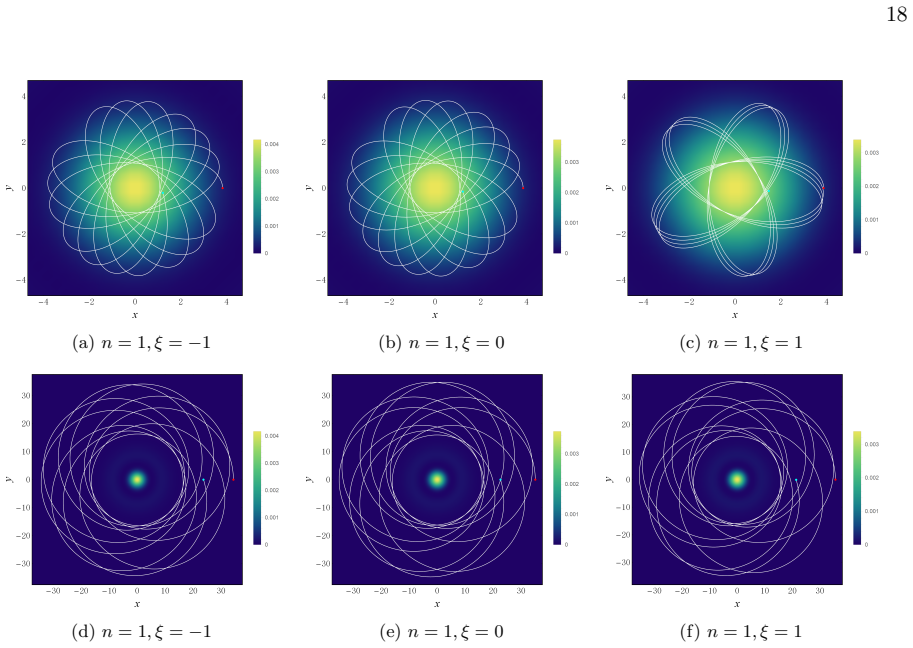
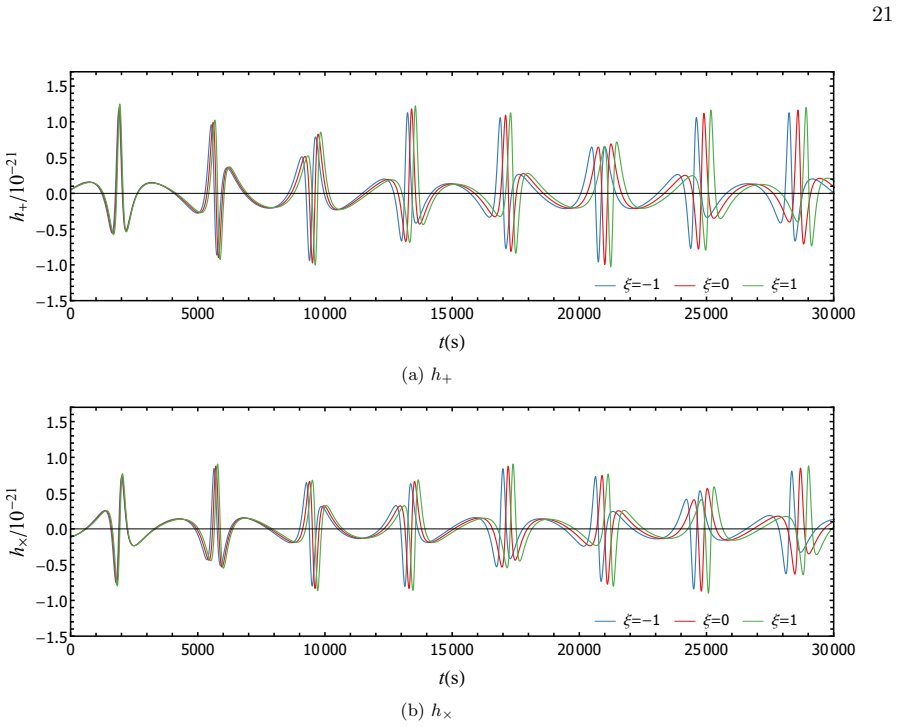
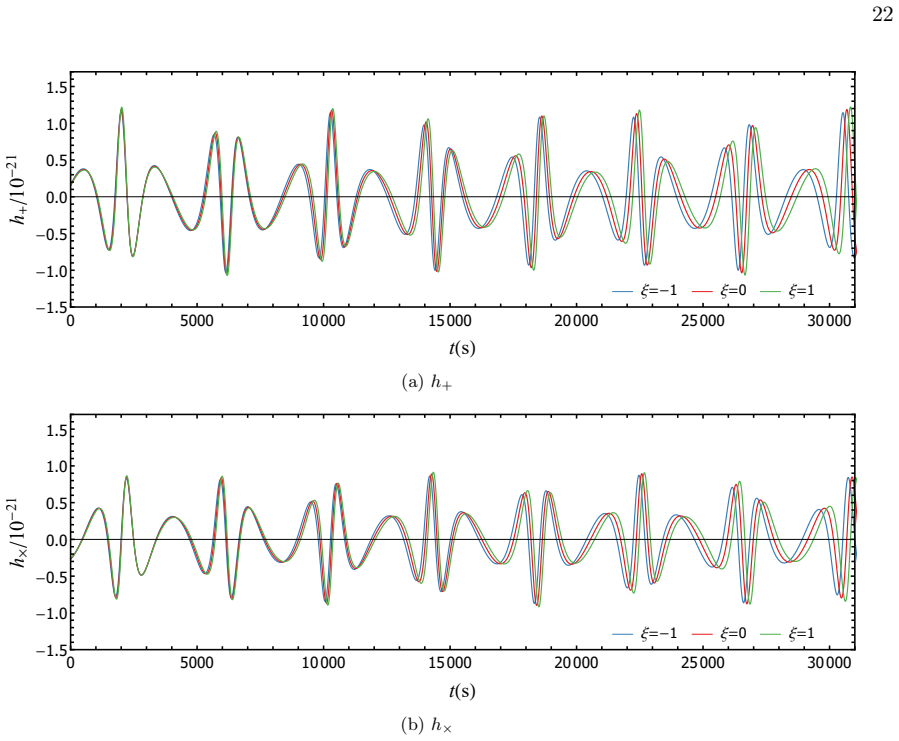
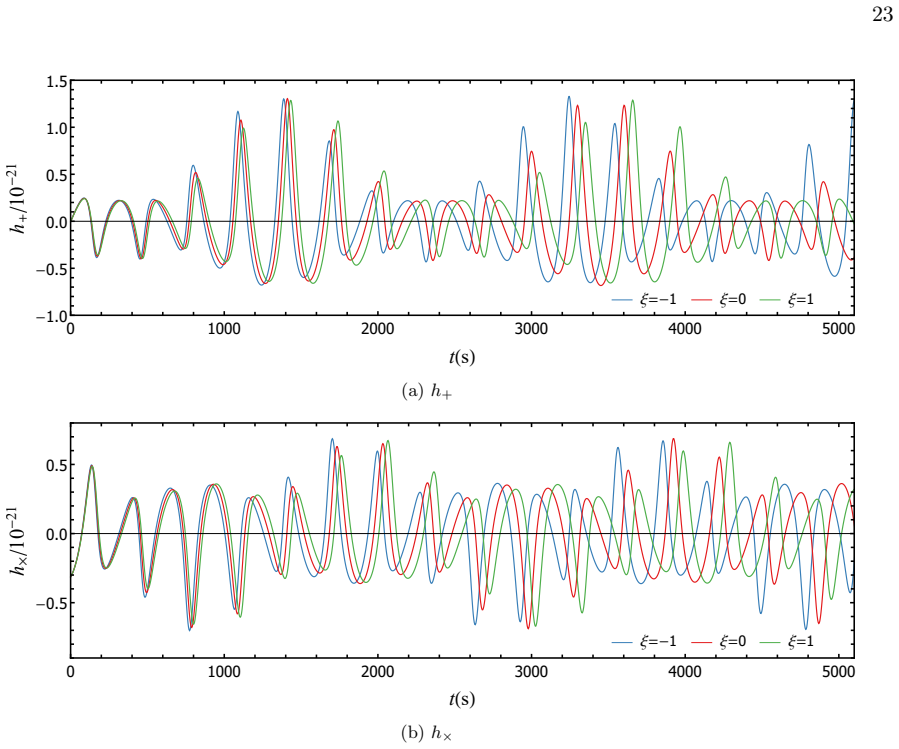
- [EMRI waveforms] Figure captions for the waveform plots should include the specific boson-star parameters (mass, coupling, node number) used to generate each curve.
Simulated Author's Rebuttal
We thank the referee for the careful reading of the manuscript and the constructive comments. We agree that the numerical methodology requires explicit documentation to support the central claims regarding excited-state solutions. Below we respond point by point to the major comments.
read point-by-point responses
-
Referee: [Results section (excited-state solutions)] The abstract and results section state that excited-state solutions were obtained and energy conditions checked, yet no ODE system, boundary conditions, shooting parameters, residual norms, or convergence tests are supplied. Without these diagnostics the reported negative energy-density regions remain unverifiable and constitute the load-bearing claim of the paper.
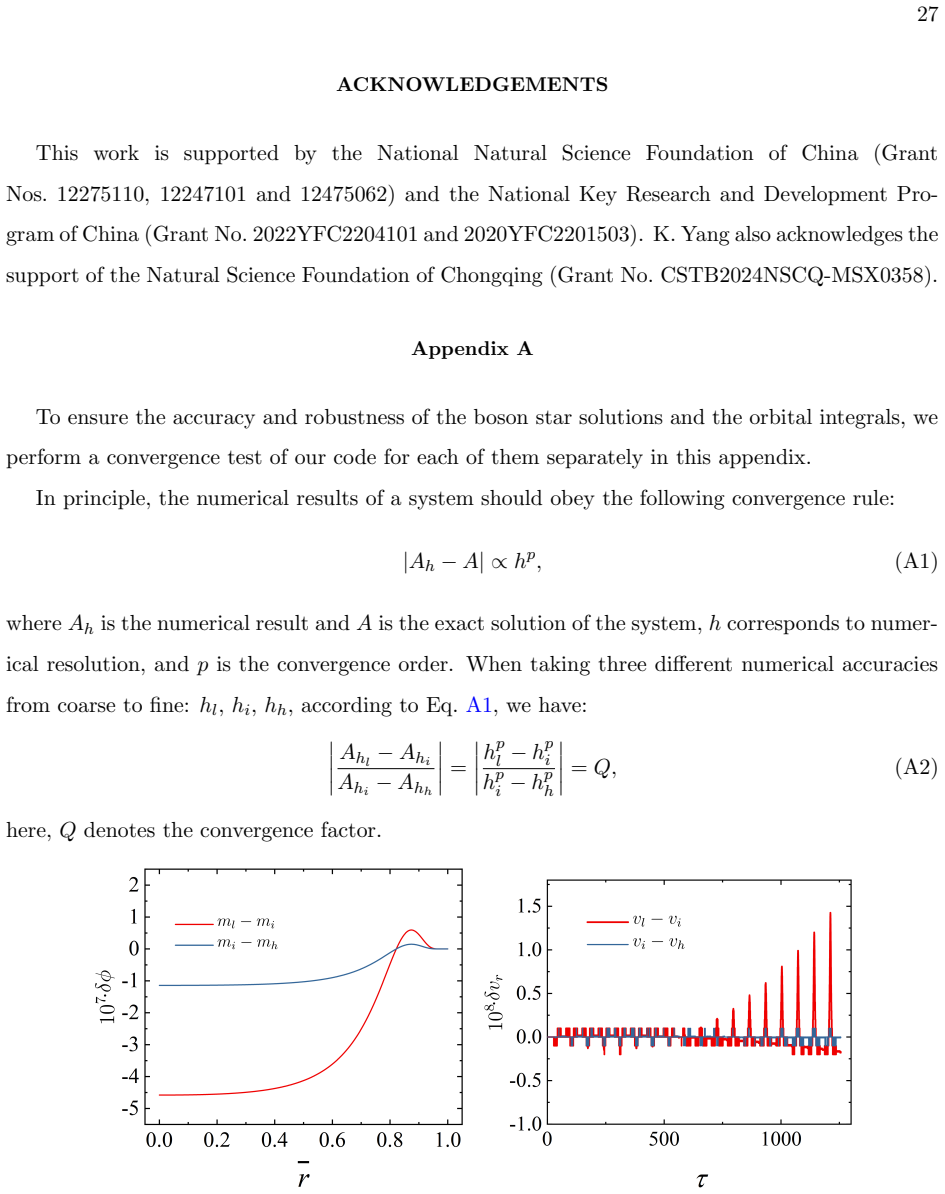
Authors: We acknowledge that the current manuscript omits the explicit numerical implementation details. The system of ODEs is obtained by substituting the static spherically symmetric ansatz into the teleparallel field equations with non-minimal coupling, but these equations, the central regularity conditions, the asymptotic decay requirements, the shooting parameters, and the convergence diagnostics were not reported. In the revised version we will add a dedicated numerical-methods subsection that presents the full first-order ODE system, the boundary conditions, the shooting procedure, the integrator tolerances, and the achieved residual norms for both ground and excited states. This addition will make the negative-energy-density regions reproducible. revision: yes
-
Referee: [Energy-conditions subsection] The claim that all four energy conditions are violated for excited states rests on the sign of the energy density ρ; the manuscript must demonstrate that the numerical integration preserves the correct sign of ρ to within a stated tolerance across the radial domain, especially near nodes where excited states are most sensitive to truncation error.
Authors: We agree that an explicit verification of the sign of ρ, together with an error estimate, is required. The revised manuscript will include a short convergence study (varying step size and integrator tolerance) focused on the radial intervals containing nodes, together with a table or figure reporting the minimum value of ρ and the maximum relative truncation error in those regions. We will state the tolerance within which the sign of ρ is preserved and confirm that the reported violations remain stable under refinement. revision: yes
Circularity Check
No significant circularity detected
full rationale
The paper constructs static spherically symmetric boson-star solutions by numerically integrating the field equations derived from the teleparallel action with non-minimal coupling, then directly evaluates the energy density and energy conditions from the resulting stress-energy tensor. The reported negative energy density for excited states and the LISA-range EMRI waveforms are outputs of this integration process rather than quantities defined in terms of fitted parameters or self-referential inputs. No load-bearing step reduces by construction to a self-citation, ansatz smuggled via citation, or renaming of a known result; the derivation chain remains self-contained against external numerical benchmarks.
Axiom & Free-Parameter Ledger
free parameters (2)
- non-minimal coupling strength
- scalar field mass parameter
axioms (1)
- domain assumption The teleparallel equivalent of general relativity plus the chosen non-minimal coupling term yields a well-posed system of differential equations for static spherical symmetry.
Reference graph
Works this paper leans on
-
[1]
The boundary conditions and numerical method In order to solve the system of ODEs (15) - (18), appropriate boundary conditions should be provided
+r 2F ′′ 0 r2 −κp ⊥ = 0,(17) ϕ′′ + 2 +F ′ 0 −F ′ 1 r ϕ′ + h4ξ(1 +e F1)F ′ 0 r + 2ξ(1−2e F1 +e 2F1) r2 + (ω2e−2F0 −µ 2)e2F1 i ϕ= 0,(18) with the energy density ρ=−Θ tt = e−2F0ω2 +µ 2 ϕ2 + e−2F1ϕ′2 −8ξr −1e−2F1 eF1 −1 ϕϕ′ κ(1 + 2ξϕ2) ,(19) the radial pressure pr = Θrr = e−2F0ω2 −µ 2 ϕ2 + e−2F1ϕ′2 κ(1 + 2ξϕ2) (20) and the transverse pressure p⊥ = Θϑϑ = Θφφ =...
-
[2]
penetrating orbits
In addition, due to spherical symmetry, for simplicity, we only consider the orbit lying on the equatorial plane (i.e.θ=π/2). In addition, static spherical symmetry means that the spacetime can possess a timelike Killing vector (∂ t)µ and a spacelike Killing vector (∂ φ)µ, which are associated with two motion constants, i.e., the specific energy E= ∂L ∂ ˙...
2000
-
[3]
Observation of Gravitational Waves from a Binary Black Hole Merger
B. P. Abbottet al.[LIGO Scientific and Virgo], “Observation of Gravitational Waves from a Binary Black Hole Merger,” Phys. Rev. Lett.116(2016) no.6, 061102 [arXiv:1602.03837 [gr-qc]]
work page internal anchor Pith review Pith/arXiv arXiv 2016
-
[4]
First M87 Event Horizon Telescope Results. I. The Shadow of the Supermassive Black Hole
K. Akiyamaet al.[Event Horizon Telescope], “First M87 Event Horizon Telescope Results. I. The Shadow of the Supermassive Black Hole,” Astrophys. J. Lett.875(2019), L1 [arXiv:1906.11238 [astro- ph.GA]]
work page internal anchor Pith review Pith/arXiv arXiv 2019
-
[5]
First M87 Event Horizon Telescope Results. II. Array and Instrumentation
K. Akiyamaet al.[Event Horizon Telescope], “First M87 Event Horizon Telescope Results. II. Array and Instrumentation,” Astrophys. J. Lett.875(2019) no.1, L2 [arXiv:1906.11239 [astro-ph.IM]]
work page internal anchor Pith review Pith/arXiv arXiv 2019
-
[6]
First M87 Event Horizon Telescope Results. III. Data Processing and Calibration
K. Akiyamaet al.[Event Horizon Telescope], “First M87 Event Horizon Telescope Results. III. Data Processing and Calibration,” Astrophys. J. Lett.875(2019) no.1, L3 [arXiv:1906.11240 [astro-ph.GA]]
work page internal anchor Pith review Pith/arXiv arXiv 2019
-
[7]
First M87 Event Horizon Telescope Results. IV. Imaging the Central Supermassive Black Hole
K. Akiyamaet al.[Event Horizon Telescope], “First M87 Event Horizon Telescope Results. IV. Imaging the Central Supermassive Black Hole,” Astrophys. J. Lett.875(2019) no.1, L4 [arXiv:1906.11241 [astro-ph.GA]]
work page internal anchor Pith review Pith/arXiv arXiv 2019
-
[8]
First M87 Event Horizon Telescope Results. V. Physical Origin of the Asymmetric Ring
K. Akiyamaet al.[Event Horizon Telescope], “First M87 Event Horizon Telescope Results. V. Physical Origin of the Asymmetric Ring,” Astrophys. J. Lett.875(2019) no.1, L5 [arXiv:1906.11242 [astro- ph.GA]]
work page internal anchor Pith review Pith/arXiv arXiv 2019
-
[9]
First M87 Event Horizon Telescope Results. VI. The Shadow and Mass of the Central Black Hole
K. Akiyamaet al.[Event Horizon Telescope], “First M87 Event Horizon Telescope Results. VI. The Shadow and Mass of the Central Black Hole,” Astrophys. J. Lett.875(2019) no.1, L6 [arXiv:1906.11243 [astro-ph.GA]]
work page internal anchor Pith review Pith/arXiv arXiv 2019
-
[10]
Gravitational collapse and space-time singularities,
R. Penrose, “Gravitational collapse and space-time singularities,” Phys. Rev. Lett.14(1965), 57-59
1965
-
[11]
The Occurrence of singularities in cosmology,
S. Hawking, “The Occurrence of singularities in cosmology,” Proc. Roy. Soc. Lond. A294(1966), 511-521
1966
-
[12]
Black holes in general relativity,
S. W. Hawking, “Black holes in general relativity,” Commun. Math. Phys.25(1972), 152-166
1972
-
[13]
The Four laws of black hole mechanics,
J. M. Bardeen, B. Carter and S. W. Hawking, “The Four laws of black hole mechanics,” Commun. Math. Phys.31(1973), 161-170
1973
-
[14]
Wald, Robert M. Quantum field theory in curved spacetime and black hole thermody- 29 namics,
R. M. Wald, “Wald, Robert M. Quantum field theory in curved spacetime and black hole thermody- 29 namics,” University of Chicago press, 1994
1994
-
[15]
Positivity of the Total Mass of a General Space-Time,
R. Schoen and S. T. Yau, “Positivity of the Total Mass of a General Space-Time,” Phys. Rev. Lett.43 (1979), 1457-1459
1979
-
[16]
On the Proof of the positive mass conjecture in general relativity,
R. Schon and S. T. Yau, “On the Proof of the positive mass conjecture in general relativity,” Commun. Math. Phys.65(1979), 45-76
1979
-
[17]
PROOF THAT THE BONDI MASS IS POSITIVE,
R. Schon and S. T. Yau, “PROOF THAT THE BONDI MASS IS POSITIVE,” Phys. Rev. Lett.48 (1982), 369-371
1982
-
[18]
A Positive Mass Theorem Based on the Focusing and Retardation of Null Geodesics
R. Penrose, R. D. Sorkin and E. Woolgar, “A Positive mass theorem based on the focusing and retar- dation of null geodesics,” [arXiv:gr-qc/9301015 [gr-qc]]
work page internal anchor Pith review Pith/arXiv arXiv
-
[19]
Energy conditions in general relativity and quantum field theory,
E. A. Kontou and K. Sanders, “Energy conditions in general relativity and quantum field theory,” Class. Quant. Grav.37(2020) no.19, 193001 [arXiv:2003.01815 [gr-qc]]
-
[20]
Time, closed timelike curves and causality,
F. Lobo and P. Crawford, “Time, closed timelike curves and causality,” inThe Nature of Time: Ge- ometry, Physics and Perception, Springer Netherlands, pp. 289–296, 2003
2003
-
[21]
Wormholes, Time Machines, and the Weak Energy Condition,
M. S. Morris, K. S. Thorne and U. Yurtsever, “Wormholes, Time Machines, and the Weak Energy Condition,” Phys. Rev. Lett.61(1988), 1446-1449
1988
-
[22]
Twilight for the energy conditions?
C. Barcelo and M. Visser, “Twilight for the energy conditions?,” Int. J. Mod. Phys. D11(2002), 1553-1560 doi:10.1142/S0218271802002888 [arXiv:gr-qc/0205066 [gr-qc]]
work page internal anchor Pith review Pith/arXiv arXiv doi:10.1142/s0218271802002888 2002
-
[23]
A Primer on Energy Conditions,
E. Curiel, “A Primer on Energy Conditions,” Einstein Stud.13(2017), 43-104 [arXiv:1405.0403 [physics.hist-ph]]
-
[24]
The large scale structure of space-time,
S.W. Hawking and G.F.R. Ellis, “The large scale structure of space-time,” Cambridge University Press , 1973
1973
-
[25]
General Relativity,
R. M. Wald, “General Relativity,” The University of Chicago Press , 1984
1984
-
[26]
Observational Evidence from Supernovae for an Accelerating Universe and a Cosmological Constant
A. G. Riesset al.[Supernova Search Team], “Observational evidence from supernovae for an accelerat- ing universe and a cosmological constant,” Astron. J.116(1998), 1009-1038 [arXiv:astro-ph/9805201 [astro-ph]]
work page internal anchor Pith review Pith/arXiv arXiv 1998
-
[27]
Measurements of Omega and Lambda from 42 High-Redshift Supernovae
S. Perlmutteret al.[Supernova Cosmology Project], “Measurements of Ω and Λ from 42 High Redshift Supernovae,” Astrophys. J.517(1999), 565-586 [arXiv:astro-ph/9812133 [astro-ph]]
work page internal anchor Pith review Pith/arXiv arXiv 1999
-
[28]
Beyond $\Lambda$CDM: Problems, solutions, and the road ahead
P. Bull, Y. Akrami, J. Adamek, T. Baker, E. Bellini, J. Beltran Jimenez, E. Bentivegna, S. Camera, S. Clesse and J. H. Davis,et al.“Beyond ΛCDM: Problems, solutions, and the road ahead,” Phys. Dark Univ.12(2016), 56-99 [arXiv:1512.05356 [astro-ph.CO]]
work page internal anchor Pith review Pith/arXiv arXiv 2016
-
[29]
Cosmological Tests of Modified Gravity
K. Koyama, “Cosmological Tests of Modified Gravity,” Rept. Prog. Phys.79(2016) no.4, 046902 [arXiv:1504.04623 [astro-ph.CO]]
work page internal anchor Pith review Pith/arXiv arXiv 2016
-
[30]
Modified Gravity Theories on a Nutshell: Inflation, Bounce and Late-time Evolution
S. Nojiri, S. D. Odintsov and V. K. Oikonomou, “Modified Gravity Theories on a Nutshell: Inflation, Bounce and Late-time Evolution,” Phys. Rept.692(2017), 1-104 [arXiv:1705.11098 [gr-qc]]
work page internal anchor Pith review Pith/arXiv arXiv 2017
-
[31]
Modified Gravity and Cosmology. An Update by the CAN- TATA Network,
E. N. Saridakiset al.[CANTATA], “Modified Gravity and Cosmology. An Update by the CAN- TATA Network,” Springer, 2021, ISBN 978-3-030-83714-3, 978-3-030-83717-4, 978-3-030-83715-0 [arXiv:2105.12582 [gr-qc]]
-
[32]
Introduction to Modified Gravity,
A. Petrov, J. R. Nascimento and P. Porfirio, “Introduction to Modified Gravity,” Springer, 2020, ISBN 978-3-031-46633-5, 978-3-031-46634-2, 978-3-030-52861-4, 978-3-030-52862-1 [arXiv:2004.12758 [gr-qc]]
-
[33]
Spectrum of Primordial Gravitational Waves in Modified Gravities: A Short Overview,
S. D. Odintsov, V. K. Oikonomou and R. Myrzakulov, “Spectrum of Primordial Gravitational Waves in Modified Gravities: A Short Overview,” Symmetry14(2022) no.4, 729 [arXiv:2204.00876 [gr-qc]]
-
[34]
Modified theories of gravity: Why, how and what?,
S. Shankaranarayanan and J. P. Johnson, “Modified theories of gravity: Why, how and what?,” Gen. Rel. Grav.54(2022) no.5, 44 [arXiv:2204.06533 [gr-qc]]
-
[35]
GW Tests of General Relativity with Ground-Based Detectors and Pulsar-Timing Arrays,
N. Yunes, X. Siemens and K. Yagi, “GW Tests of General Relativity with Ground-Based Detectors and Pulsar-Timing Arrays,” [arXiv:2408.05240 [gr-qc]]
-
[36]
R + R**2 gravity as R + back reaction,
J. H. Kung, “R + R**2 gravity as R + back reaction,” Phys. Rev. D52(1995), 6922-6928 [arXiv:gr- qc/9509058 [gr-qc]]
-
[37]
Strong Energy Condition in $R + R^2$ Gravity
J. H. Kung, “Strong energy condition in R + R**2 gravity,” Phys. Rev. D53(1996), 3017-3021 30 [arXiv:gr-qc/9510008 [gr-qc]]
work page internal anchor Pith review Pith/arXiv arXiv 1996
-
[38]
Energy conditions in f(R)-gravity
J. Santos, J. S. Alcaniz, M. J. Reboucas and F. C. Carvalho, “Energy conditions in f(R)-gravity,” Phys. Rev. D76(2007), 083513 [arXiv:0708.0411 [astro-ph]]
work page internal anchor Pith review Pith/arXiv arXiv 2007
-
[39]
Energy Conditions and Stability in $f(R)$ theories of gravity with non-minimal coupling to matter
O. Bertolami and M. C. Sequeira, “Energy Conditions and Stability in f(R) theories of gravity with non-minimal coupling to matter,” Phys. Rev. D79(2009), 104010 [arXiv:0903.4540 [gr-qc]]
work page internal anchor Pith review Pith/arXiv arXiv 2009
-
[40]
Constraining f(R) theories with the energy conditions
S. E. Perez Bergliaffa, “Constraining f(R) theories with the energy conditions,” Phys. Lett. B642 (2006), 311-314 [arXiv:gr-qc/0608072 [gr-qc]]
work page internal anchor Pith review Pith/arXiv arXiv 2006
-
[41]
Energy conditions in f(R) gravity and Brans-Dicke theories
K. Atazadeh, A. Khaleghi, H. R. Sepangi and Y. Tavakoli, “Energy conditions in f(R) gravity and Brans-Dicke theories,” Int. J. Mod. Phys. D18(2009), 1101-1111 [arXiv:0811.4269 [gr-qc]]
work page internal anchor Pith review Pith/arXiv arXiv 2009
-
[42]
Energy conditions bounds on f(T) gravity
D. Liu and M. J. Reboucas, “Energy conditions bounds on f(T) gravity,” Phys. Rev. D86(2012), 083515 [arXiv:1207.1503 [astro-ph.CO]]
work page internal anchor Pith review Pith/arXiv arXiv 2012
-
[43]
Energy conditions in $f(T)$ gravity with non-minimal torsion-matter coupling
M. Zubair and S. Waheed, “Energy conditions inf(T) gravity with non-minimal torsion-matter cou- pling,” Astrophys. Space Sci.355(2015), 361-369 [arXiv:1502.03002 [gr-qc]]
work page internal anchor Pith review Pith/arXiv arXiv 2015
-
[44]
Energy conditions in f(T) gravity with higher-derivative torsion terms
T. Azizi and M. Gorjizadeh, “Energy conditions in f(T) gravity with higher-derivative torsion terms,” EPL117(2017) no.6, 60003 [arXiv:1701.00796 [gr-qc]]
work page internal anchor Pith review Pith/arXiv arXiv 2017
-
[45]
T. P. Sotiriou and V. Faraoni, “f(R) Theories Of Gravity,” Rev. Mod. Phys.82(2010), 451-497 [arXiv:0805.1726 [gr-qc]]
work page internal anchor Pith review Pith/arXiv arXiv 2010
-
[46]
The teleparallel equivalent of general relativity
J. W. Maluf, “The teleparallel equivalent of general relativity,” Annalen Phys.525(2013), 339-357 [arXiv:1303.3897 [gr-qc]]
work page internal anchor Pith review Pith/arXiv arXiv 2013
-
[47]
f(T) teleparallel gravity and cosmology
Y. F. Cai, S. Capozziello, M. De Laurentis and E. N. Saridakis, “f(T) teleparallel gravity and cosmol- ogy,” Rept. Prog. Phys.79(2016) no.10, 106901 [arXiv:1511.07586 [gr-qc]]
work page internal anchor Pith review Pith/arXiv arXiv 2016
-
[48]
Teleparallel gravity: from theory to cosmology,
S. Bahamonde, K. F. Dialektopoulos, C. Escamilla-Rivera, G. Farrugia, V. Gakis, M. Hendry, M. Hohmann, J. Levi Said, J. Mifsud and E. Di Valentino, “Teleparallel gravity: from theory to cosmology,” Rept. Prog. Phys.86(2023) no.2, 026901 [arXiv:2106.13793 [gr-qc]]
-
[49]
Modified teleparallel gravity: inflation without inflaton
R. Ferraro and F. Fiorini, “Modified teleparallel gravity: Inflation without inflaton,” Phys. Rev. D75 (2007), 084031 [arXiv:gr-qc/0610067 [gr-qc]]
work page internal anchor Pith review Pith/arXiv arXiv 2007
-
[50]
Nonminimally coupled scalar field in teleparallel gravity: boson stars
D. Horvat, S. Iliji´ c, A. Kirin and Z. Naranˇ ci´ c, “Nonminimally coupled scalar field in teleparallel gravity: boson stars,” Class. Quant. Grav.32(2015) no.3, 035023 [arXiv:1407.2067 [gr-qc]]
work page internal anchor Pith review Pith/arXiv arXiv 2015
-
[51]
Klein-Gordon Geon,
D. J. Kaup, “Klein-Gordon Geon,” Phys. Rev.172(1968), 1331-1342
1968
-
[52]
Systems of selfgravitating particles in general relativity and the concept of an equation of state,
R. Ruffini and S. Bonazzola, “Systems of selfgravitating particles in general relativity and the concept of an equation of state,” Phys. Rev.187(1969), 1767-1783
1969
-
[53]
Spherical Boson Stars as Black Hole mimickers
F. S. Guzman and J. M. Rueda-Becerril, “Spherical boson stars as black hole mimickers,” Phys. Rev. D80(2009), 084023 [arXiv:1009.1250 [astro-ph.HE]]
work page internal anchor Pith review Pith/arXiv arXiv 2009
-
[54]
Black hole mimickers: from theory to observation,
C. Bambi, R. Brustein, V. Cardoso, A. Chael, U. Danielsson, S. Giri, A. Gupta, P. Heidmann, L. Lehner and S. Liebling,et al.“Black hole mimickers: from theory to observation,” [arXiv:2505.09014 [gr-qc]]
-
[55]
TOPICAL REVIEW: General relativistic boson stars
F. E. Schunck and E. W. Mielke, “General relativistic boson stars,” Class. Quant. Grav.20(2003), R301-R356 [arXiv:0801.0307 [astro-ph]]
work page internal anchor Pith review Pith/arXiv arXiv 2003
-
[56]
S. L. Liebling and C. Palenzuela, “Dynamical boson stars,” Living Rev. Rel.26(2023) no.1, 1 [arXiv:1202.5809 [gr-qc]]
work page internal anchor Pith review Pith/arXiv arXiv 2023
-
[57]
Stars of Bosons with Nonminimal Energy Momentum Tensor,
J. J. van der Bij and M. Gleiser, “Stars of Bosons with Nonminimal Energy Momentum Tensor,” Phys. Lett. B194(1987), 482-486
1987
-
[58]
C. Q. Geng, C. C. Lee, E. N. Saridakis and Y. P. Wu, ““Teleparallel” dark energy,” Phys. Lett. B704 (2011), 384-387 [arXiv:1109.1092 [hep-th]]
work page internal anchor Pith review Pith/arXiv arXiv 2011
-
[59]
Dynamics of Teleparallel Dark Energy
H. Wei, “Dynamics of Teleparallel Dark Energy,” Phys. Lett. B712(2012), 430-436 [arXiv:1109.6107 [gr-qc]]
work page internal anchor Pith review Pith/arXiv arXiv 2012
-
[60]
Scaling attractors in interacting teleparallel dark energy
G. Otalora, “Scaling attractors in interacting teleparallel dark energy,” JCAP07(2013), 044 [arXiv:1305.0474 [gr-qc]]
work page internal anchor Pith review Pith/arXiv arXiv 2013
-
[61]
Neutron stars in scalar torsion theories with non minimal 31 coupling,
Y. Kehal, K. Nouicer and H. Boumaza, “Neutron stars in scalar torsion theories with non minimal 31 coupling,” JCAP05(2024), 057 [arXiv:2305.12155 [gr-qc]]
-
[62]
The covariant formulation of f(T) gravity
M. Krˇ sˇ s´ ak and E. N. Saridakis, “The covariant formulation of f(T) gravity,” Class. Quant. Grav.33 (2016) no.11, 115009 [arXiv:1510.08432 [gr-qc]]
work page internal anchor Pith review Pith/arXiv arXiv 2016
-
[63]
Spin Connection and Renormalization of Teleparallel Action
M. Krˇ sˇ s´ ak and J. G. Pereira, “Spin Connection and Renormalization of Teleparallel Action,” Eur. Phys. J. C75(2015) no.11, 519 [arXiv:1504.07683 [gr-qc]]
work page internal anchor Pith review Pith/arXiv arXiv 2015
-
[64]
Teleparallel theories of gravity: illuminating a fully invariant approach,
M. Krssak, R. J. van den Hoogen, J. G. Pereira, C. G. B¨ ohmer and A. A. Coley, “Teleparallel theories of gravity: illuminating a fully invariant approach,” Class. Quant. Grav.36(2019) no.18, 183001 [arXiv:1810.12932 [gr-qc]]
-
[65]
Non trivial frames for f(T) theories of gravity and beyond
R. Ferraro and F. Fiorini, “Non trivial frames for f(T) theories of gravity and beyond,” Phys. Lett. B 702(2011), 75-80 [arXiv:1103.0824 [gr-qc]]
work page internal anchor Pith review Pith/arXiv arXiv 2011
-
[66]
Birkhoff's theorem in the f(T) gravity
X. H. Meng and Y. B. Wang, “Birkhoff’s theorem in the f(T) gravity,” Eur. Phys. J. C71(2011), 1755 [arXiv:1107.0629 [astro-ph.CO]]
work page internal anchor Pith review Pith/arXiv arXiv 2011
-
[67]
Existence of relativistic stars in f(T) gravity
C. G. Boehmer, A. Mussa and N. Tamanini, “Existence of relativistic stars in f(T) gravity,” Class. Quant. Grav.28(2011), 245020 [arXiv:1107.4455 [gr-qc]]
work page internal anchor Pith review Pith/arXiv arXiv 2011
-
[68]
Spherically symmetric static spacetimes in vacuum f(T) gravity
R. Ferraro and F. Fiorini, “Spherically symmetric static spacetimes in vacuum f(T) gravity,” Phys. Rev. D84(2011), 083518 [arXiv:1109.4209 [gr-qc]]
work page internal anchor Pith review Pith/arXiv arXiv 2011
-
[69]
Good and bad tetrads in f(T) gravity
N. Tamanini and C. G. Boehmer, “Good and bad tetrads in f(T) gravity,” Phys. Rev. D86(2012), 044009 [arXiv:1204.4593 [gr-qc]]
work page internal anchor Pith review Pith/arXiv arXiv 2012
-
[70]
Gravitational Stability of Scalar Matter,
M. Gleiser and R. Watkins, “Gravitational Stability of Scalar Matter,” Nucl. Phys. B319(1989), 733-746
1989
-
[71]
Dynamical Evolution of Boson Stars. 1. Perturbing the Ground State,
E. Seidel and W. M. Suen, “Dynamical Evolution of Boson Stars. 1. Perturbing the Ground State,” Phys. Rev. D42(1990), 384-403
1990
-
[72]
Dynamical Evolution of Boson Stars II: Excited States and Self-Interacting Fields
J. Balakrishna, E. Seidel and W. M. Suen, “Dynamical evolution of boson stars. 2. Excited states and selfinteracting fields,” Phys. Rev. D58(1998), 104004 [arXiv:gr-qc/9712064 [gr-qc]]
work page internal anchor Pith review Pith/arXiv arXiv 1998
-
[73]
Scalar Soliton Stars and Black Holes,
R. Friedberg, T. D. Lee and Y. Pang, “Scalar Soliton Stars and Black Holes,” Phys. Rev. D35(1987), 3658
1987
-
[74]
ECO-spotting: looking for extremely compact objects with bosonic fields,
V. Cardoso, C. F. B. Macedo, K. i. Maeda and H. Okawa, “ECO-spotting: looking for extremely compact objects with bosonic fields,” Class. Quant. Grav.39(2022) no.3, 034001 [arXiv:2112.05750 [gr-qc]]
-
[75]
Soliton boson stars, Q-balls and the causal Buchdahl bound,
M. Boˇ skovi´ c and E. Barausse, “Soliton boson stars, Q-balls and the causal Buchdahl bound,” JCAP 02(2022) no.02, 032 [arXiv:2111.03870 [gr-qc]]
-
[76]
Solitonic boson stars: Numerical solutions beyond the thin-wall approximation,
L. G. Collodel and D. D. Doneva, “Solitonic boson stars: Numerical solutions beyond the thin-wall approximation,” Phys. Rev. D106(2022) no.8, 084057 [arXiv:2203.08203 [gr-qc]]
-
[77]
General Relativistic Fluid Spheres,
H. A. Buchdahl, “General Relativistic Fluid Spheres,” Phys. Rev.116(1959), 1027
1959
-
[78]
"Kludge" gravitational waveforms for a test-body orbiting a Kerr black hole
S. Babak, H. Fang, J. R. Gair, K. Glampedakis and S. A. Hughes, “’Kludge’ gravitational waveforms for a test-body orbiting a Kerr black hole,” Phys. Rev. D75(2007), 024005 [erratum: Phys. Rev. D 77(2008), 04990] [arXiv:gr-qc/0607007 [gr-qc]]
work page internal anchor Pith review Pith/arXiv arXiv 2007
-
[79]
Boson Stars in Bumblebee Gravity and Their Gravitational Waveforms from Extreme-Mass-Ratio Inspirals
M. J. Liu, L. X. Huang, Y. Q. Wang and K. Yang, “Boson Stars in Bumblebee Gravity and Their Gravitational Waveforms from Extreme-Mass-Ratio Inspirals,” Eur. Phys. J. C 86 (2026), 651 [arXiv:2512.19581 [gr-qc]]
work page internal anchor Pith review Pith/arXiv arXiv 2026
-
[80]
Multipole Expansions of Gravitational Radiation,
K. S. Thorne, “Multipole Expansions of Gravitational Radiation,” Rev. Mod. Phys.52(1980), 299-339
1980
discussion (0)
Sign in with ORCID, Apple, or X to comment. Anyone can read and Pith papers without signing in.