reconCTI: A Proactive Approach to Cyber-Threat Intelligence
Pith reviewed 2026-05-20 04:00 UTC · model grok-4.3
The pith
A Python tool called reconCTI lets users keyword-scan surface and dark web sites for sensitive data leaks and map results to MITRE ATT&CK for threat reports with mitigation steps.
A machine-rendered reading of the paper's core claim, the machinery that carries it, and where it could break.
Core claim
The authors introduce reconCTI, a command-line tool built in Python for Linux systems that searches for sensitive data leaks across surface web and dark web platforms, accepts user keywords for multi-site scans, assesses findings by referencing the MITRE ATT&CK framework, and compiles the results into a threat report that includes possible mitigation strategies.
What carries the argument
The reconCTI command-line tool that runs keyword-driven multi-site scans on surface and dark web platforms then maps detections to MITRE ATT&CK entries for report generation.
Load-bearing premise
That a keyword-driven scan can reliably locate and correctly interpret sensitive data leaks on the dark web while remaining technically feasible, legally permissible, and accurate enough to produce useful MITRE ATT&CK mappings and mitigation advice.
What would settle it
Running reconCTI with known leaked data on accessible dark web sites and observing that the tool either misses the leaks, produces no report, or generates incorrect MITRE ATT&CK mappings and mitigations.
Figures





read the original abstract
The rapid advancement of information technology has introduced a noticeable shift from traditional offline practices to more efficient and interconnected online environments. This transition, while offering convenience, has also increased exposure to various cyber threats such as identity theft, impersonation, and phishing scams. Reconnaissance, or briefly known as information gathering, is a key stage for threat actors, often relying on open-source intelligence (OSINT) to collect sensitive and extensive data on targets. In response to this challenge, this study introduces reconCTI, a command-line tool built using Python for Linux systems. The tool is designed to search for sensitive data leaks across both surface web and dark web platforms. It allows users to input specific keywords, scan multiple sites at once, and then assess the findings by referencing the MITRE ATT&CK framework. The results are compiled into a threat report that also includes possible mitigation strategies. reconCTI is intended to support both cybersecurity professionals and individuals in identifying risks early and taking appropriate action.
Editorial analysis
A structured set of objections, weighed in public.
Referee Report
Summary. The paper introduces reconCTI, a Python-based command-line tool for Linux systems that performs keyword-driven searches for sensitive data leaks across surface web and dark web platforms, scans multiple sites simultaneously, maps findings to the MITRE ATT&CK framework, and generates threat reports that include mitigation strategies to enable proactive cyber-threat intelligence for professionals and individuals.
Significance. If the described functionality were demonstrated to work reliably, the tool could offer a practical contribution to open-source intelligence (OSINT) workflows in cybersecurity by combining multi-platform scanning with standardized attack mapping and actionable reporting. This addresses the reconnaissance phase of threats such as identity theft and phishing. However, the current lack of any supporting evidence substantially reduces the assessed significance.
major comments (3)
- Abstract: the claim that reconCTI 'supports both cybersecurity professionals and individuals in identifying risks early and taking appropriate action' is unsupported, as the manuscript supplies only a high-level description of intended workflow with no validation data, test results, error analysis, precision/recall metrics, or case studies on real or synthetic leaks.
- Abstract and full manuscript: no implementation details, source code, scan outputs, or assessment of dark-web access feasibility are provided, leaving the central claim that keyword-driven scans can reliably locate and correctly interpret sensitive data leaks unevaluable.
- Abstract: the assumption that results can be accurately mapped to MITRE ATT&CK and paired with useful mitigation strategies is presented without any discussion of mapping accuracy, false-positive handling, or legal/technical constraints of dark-web scanning, which is load-bearing for the tool's claimed utility.
minor comments (2)
- Abstract: the phrase 'reconnaissance, or briefly known as information gathering' could be clarified with a standard reference to OSINT literature for improved precision.
- Abstract: consider adding a brief note on the specific mechanisms or libraries intended for surface-web versus dark-web access to aid reproducibility.
Simulated Author's Rebuttal
We thank the referee for the detailed and constructive feedback on our manuscript describing reconCTI. The comments correctly identify that the current version is primarily a high-level description of the tool's intended functionality without accompanying empirical validation or implementation specifics. We address each major comment below and will revise the manuscript accordingly to strengthen the presentation.
read point-by-point responses
-
Referee: Abstract: the claim that reconCTI 'supports both cybersecurity professionals and individuals in identifying risks early and taking appropriate action' is unsupported, as the manuscript supplies only a high-level description of intended workflow with no validation data, test results, error analysis, precision/recall metrics, or case studies on real or synthetic leaks.
Authors: We agree that the abstract claim regarding support for professionals and individuals is not backed by empirical evidence in the current manuscript. The text describes the designed workflow rather than demonstrated outcomes. In revision we will modify the abstract to present the claim as the tool's intended purpose and add a dedicated evaluation section that includes preliminary test cases, example outputs, and planned metrics such as precision for leak detection. revision: yes
-
Referee: Abstract and full manuscript: no implementation details, source code, scan outputs, or assessment of dark-web access feasibility are provided, leaving the central claim that keyword-driven scans can reliably locate and correctly interpret sensitive data leaks unevaluable.
Authors: The manuscript indeed focuses on conceptual design and does not include code, sample outputs, or feasibility analysis. We will expand the methods section with pseudocode for the multi-platform scanning logic, anonymized example scan results, and a new subsection assessing dark-web access via Tor, including technical challenges such as connectivity reliability and rate limiting. revision: yes
-
Referee: Abstract: the assumption that results can be accurately mapped to MITRE ATT&CK and paired with useful mitigation strategies is presented without any discussion of mapping accuracy, false-positive handling, or legal/technical constraints of dark-web scanning, which is load-bearing for the tool's claimed utility.
Authors: We acknowledge the absence of discussion on mapping accuracy, false-positive mitigation, and constraints. The revision will add a section describing the heuristic mapping approach to MITRE ATT&CK tactics, explicit handling of potential false positives through user review, and coverage of legal/ethical considerations and technical limitations of dark-web queries to provide a balanced assessment of utility. revision: yes
Circularity Check
No circularity: tool-description paper with no derivations or self-referential claims
full rationale
The manuscript introduces reconCTI as a Python command-line tool for keyword-driven scanning of surface and dark web for data leaks, followed by MITRE ATT&CK mapping and report generation with mitigations. No equations, fitted parameters, predictions, uniqueness theorems, or ansatzes appear anywhere in the text. The central claim is a high-level description of intended software workflow rather than a derived analytical result; therefore no load-bearing step reduces to its own inputs by construction. The paper is self-contained as a tool proposal and receives the default non-circularity finding.
Axiom & Free-Parameter Ledger
Lean theorems connected to this paper
-
IndisputableMonolith/Foundation/RealityFromDistinction.leanreality_from_one_distinction unclear?
unclearRelation between the paper passage and the cited Recognition theorem.
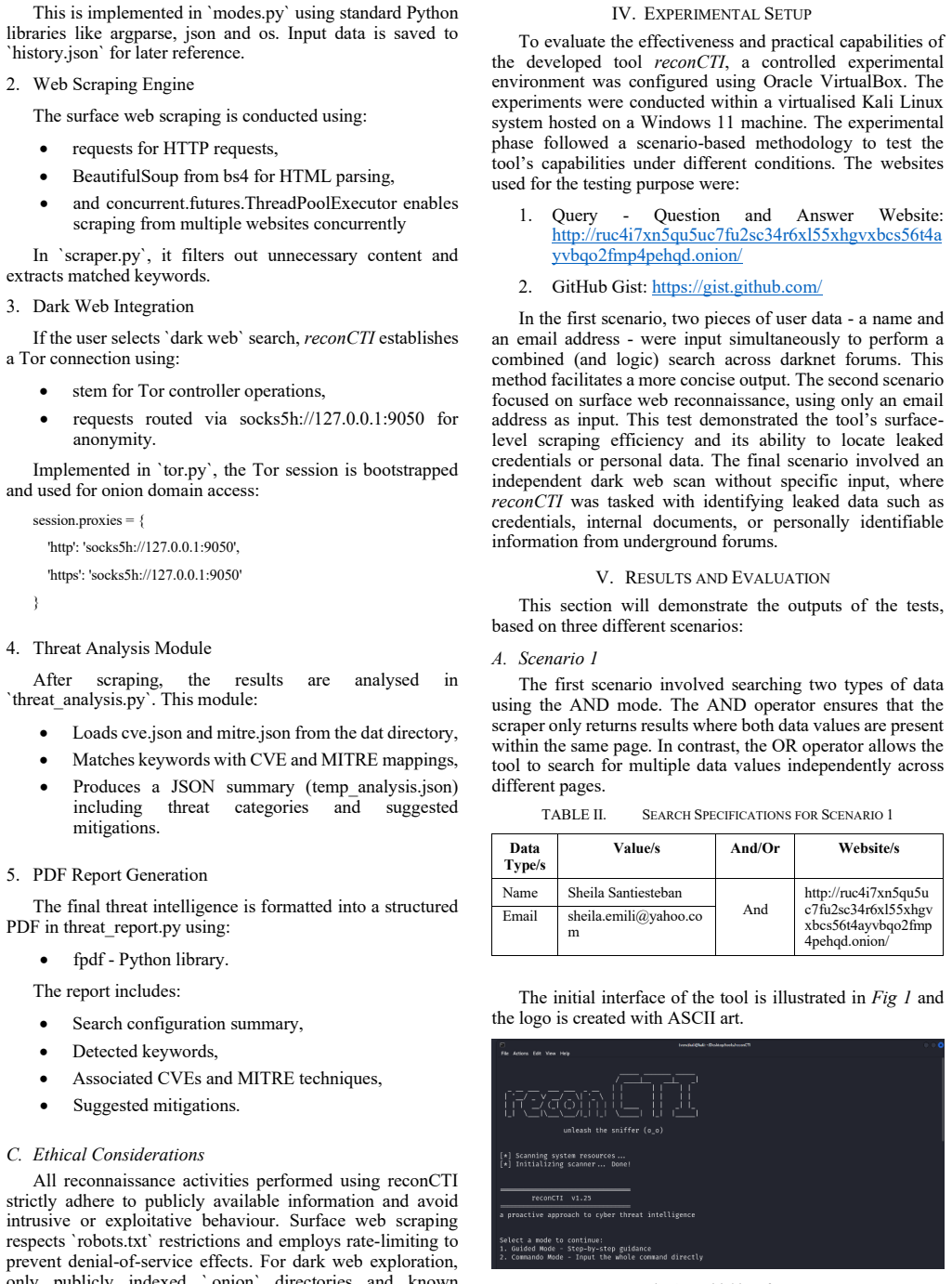
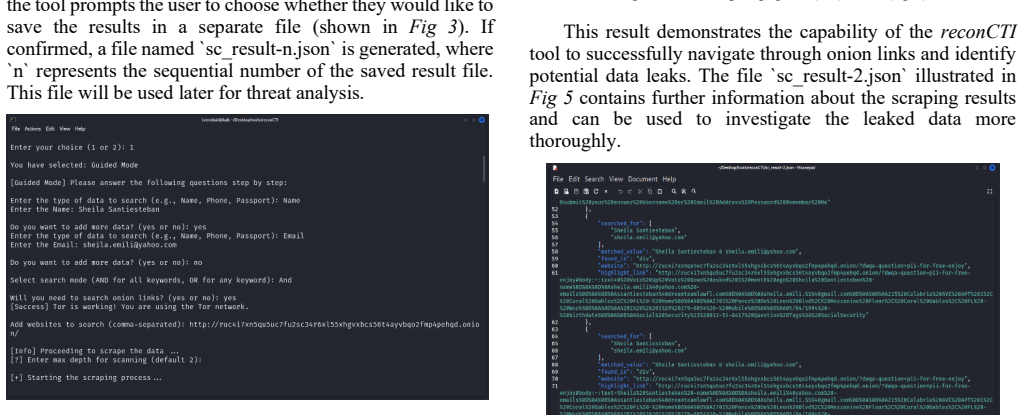
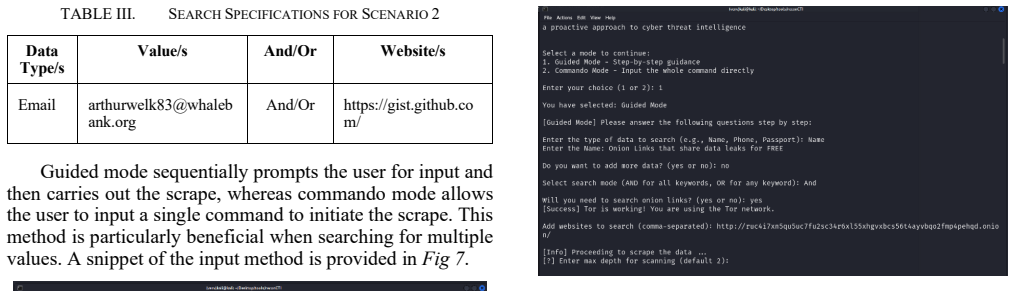
The tool is designed to search for sensitive data leaks across both surface web and dark web platforms. It allows users to input specific keywords, scan multiple sites at once, and then assess the findings by referencing the MITRE ATT&CK framework.
-
IndisputableMonolith/Cost/FunctionalEquation.leanwashburn_uniqueness_aczel unclear?
unclearRelation between the paper passage and the cited Recognition theorem.
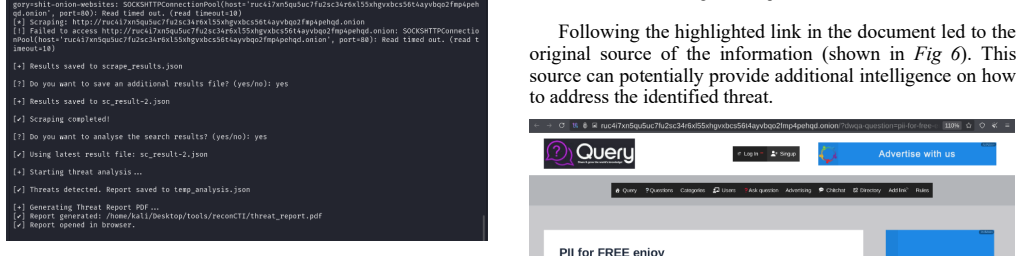
The results are compiled into a threat report that also includes possible mitigation strategies.
What do these tags mean?
- matches
- The paper's claim is directly supported by a theorem in the formal canon.
- supports
- The theorem supports part of the paper's argument, but the paper may add assumptions or extra steps.
- extends
- The paper goes beyond the formal theorem; the theorem is a base layer rather than the whole result.
- uses
- The paper appears to rely on the theorem as machinery.
- contradicts
- The paper's claim conflicts with a theorem or certificate in the canon.
- unclear
- Pith found a possible connection, but the passage is too broad, indirect, or ambiguous to say the theorem truly supports the claim.
Reference graph
Works this paper leans on
-
[1]
Lockheed-Martin, ‘Gaining the Advantage - Applying Cyber Kill Chain® Methodology to Network Defense’, Nov. 2024. Accessed: Nov. 25, 2024. [Online]. Available: https://www.lockheedmartin.com/content/dam/lockheed- martin/rms/documents/cyber/Gaining_the_Advantage_Cyber_Kil l_Chain.pdf
work page 2024
-
[2]
Robertson et al., Darkweb Cyber Threat Intelligence Mining
J. Robertson et al., Darkweb Cyber Threat Intelligence Mining . Cambridge University Press, 2017
work page 2017
- [3]
-
[4]
R. P, A. Mansoor, T. Mansour, M. A, and C. G, ‘Analysis Of Cyber Threat Detection And Emulation Using MITRE Attack Framework’, International Conference on Intelligent Data Science Technologies and Applications (IDSTA), 2022
work page 2022
-
[5]
C. Martins and I. Medeiros, ‘Generating Quality Threat Intelligence Leveraging OSINT and a Cyber Threat Unified Taxonomy’, ACM Transactions on Privacy and Security, vol. 25, no. 3, pp. 1–39, Nov. 2022
work page 2022
-
[6]
J. S. Slinde, ‘Unveiling the Potential of Open-Source Intelligence (OSINT) for Enhanced Cybersecurity Posture’, University of Agder, 2023
work page 2023
-
[7]
M. G. Solomon and S. -P. Oriyano, Ethical Hacking: Techniques, Tools, and Countermeasures. Jones & Bartlett Learning, 2022
work page 2022
-
[8]
W. Tounsi and H. Rais, ‘A survey on technical threat intelligence in the age of sophisticated cyber attacks’, Comput Secur, vol. 72, pp. 212–233, Nov. 2018
work page 2018
-
[9]
C. Sabottke, O. Suciu, and T. Dumitraş, ‘Vulnerability Disclosure in the Age of Social Media: Exploiting Twitter for Predicting Real- World Exploits’, in Proceedings of the 24th USENIX Security Symposium, USENIX Association, Nov. 2015
work page 2015
-
[10]
A. ZIÓŁKOWSKA, ‘OPEN SOURCE INTELLIGENCE (OSINT) AS AN ELEMENT OF MILITARY RECON’, War Studies University, Warsaw, 2018
work page 2018
-
[11]
Google, ‘We’re All in this Together: A Year in Review of Zero - Days Exploited In-the-Wild in 2023’, Nov. 2024
work page 2023
-
[12]
D. De Pascale, G. Cascavilla, D. A. Tamburri, and W. Van Den Heuvel, ‘CRATOR: a Dark Web Crawler’, arXiv:2405.06356v1, 2024
-
[13]
B. AlKhatib and R. Basheer, ‘Crawling the Dark Web: A Conceptual Perspective, Challenges and Implementation’, Journal of Digital Information Management, vol. 17, no. 2, 2019
work page 2019
- [14]
-
[15]
M. Al Ismaili, ‘Enhancing Cybersecurity: Exploring Effective Ethical Hacking Techniques with Kali Linux’, Research and Applications Towards Mathematics and Computer Science , pp. 135–152, 2023
work page 2023
-
[16]
P. Kashyap and V. Selvarajah, ‘Analysis of Different Methods of Reconnaissance’, in 3rd International Conference on Integrated Intelligent Computing Communication & Security (ICIIC 2021) , Atlantis Press, 2021, pp. 509–519
work page 2021
-
[17]
Botwright, Advanced OSINT Strategies: Online Investigations And Intelligence Gathering
R. Botwright, Advanced OSINT Strategies: Online Investigations And Intelligence Gathering. Pastor Publishing Limited, 2024
work page 2024
discussion (0)
Sign in with ORCID, Apple, or X to comment. Anyone can read and Pith papers without signing in.