REVIEW 4 major objections 5 minor 1 cited by
Med-R$^3$: Enhancing Medical Retrieval-Augmented Reasoning of LLMs via Progressive Reinforcement Learning
T0 review · 4 major / 5 minor · reviewed 2026-08-06 · deepseek-v4-flash
Pith's one-line read A three-stage progressive reinforcement learning pipeline that jointly trains retrieval and reasoning achieves state-of-the-art medical question answering for open-source models.
desk verdict A substantive three-stage RL recipe for medical RAG with a real judge-circularity problem at the center; worth reviewing, not worth citing yet. read the letter →
The pith
A machine-rendered reading of the paper's core claim, the machinery that carries it, and where it could break.
The reading
What carries the argument
The central mechanism is the medical knowledge graph extracted from each reasoning trajectory: every step is parsed into triplets (head entity, relation, tail entity, retrieval flag) where the flag marks whether the fact came from an external document. This representation turns qualitative reasoning quality into measurable quantities: Jaccard overlap of entity and relation sets, weighted Jaccard overlap of j-hop logical paths, and the proportion of retrieved triplets (breadth). These feed the stage-specific rewards, and GRPO (group-relative policy optimization) updates the policy from the group-normalized advantages.
What would settle it
Have two independent physician panels score a random sample (say 500 questions per dataset) of outputs from Qwen2.5-14B + Med-R3 and GPT-4o-mini, blinded to model identity; the paper's central claim predicts Med-R3 should win by at least the 13.53% margin under human scoring. Alternatively, re-run the same staged RL pipeline with a different frontier judge for all rewards and final evaluation, and check whether the margin over GPT-4o-mini and the ablation ordering (1→2→3 > 1&2&3) survive.
Extended reading notes
Core claim
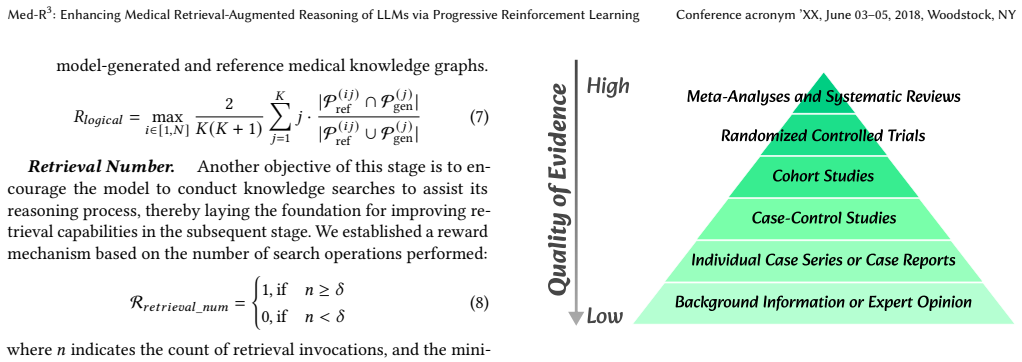
Med-R3 establishes that progressive RL — reasoner first, retriever second, joint coordination third — with medical-specific reward components yields state-of-the-art medical QA among open-source 7B–14B models. The decisive design choices are the structured reward signals: the reasoning reward decomposes into semantic, entity/relation-coverage, and k-hop logical-path similarities against reference trajectories, and the retrieval reward combines an evidence-quality score from the evidence-based-medicine hierarchy with the fraction of the reasoning trajectory's knowledge-graph triplets that came from retrieved documents. Removing any stage degrades performance, with the reasoner-cultivation stage the most critical (7.30% drop), and merging all rewards at once (1&2&3) produces a 4.77% drop from reward conflicts.
Load-bearing premise
The whole pipeline treats DeepSeek-V3's judgments — for answer correctness, reasoning quality, evidence levels, and final accuracy — as ground truth, so if that judge is systematically biased in favor of certain phrasings or knowledge, the model would be trained to please the judge rather than to be medically right, and the reported gains over GPT-4o-mini could be inflated.
Editorial extensions
If this is right
- Open-source 7B–14B models trained with Med-R3 exceed GPT-4o-mini's average accuracy on seven medical QA benchmarks, by 3.93% for LLaMA3.1-8B-Instruct and 13.53% for Qwen2.5-14B.
- Progressive stage ordering is load-bearing: removing Stage 1 (reasoner cultivation) costs 7.30%, removing Stage 2 costs 5.89%, removing Stage 3 costs 2.88%, and swapping Stages 1 and 2 costs 2.56%.
- Optimizing all three reward groups simultaneously is worse than staging them, dropping average accuracy by 4.77% relative to the 1→2→3 order.
- Among reasoning rewards, entity/relation coverage (R_statistic) is the most valuable — removing it costs 5.65%; among retrieval rewards, breadth (R_breadth) removal costs 3.70%.
- A reward for the number of retrievals in Stage 1 is needed to establish retrieval behavior: without it, average retrieval frequency falls from 3.67 to 0.44 in Stage 1.
Reading between the lines
- The staged recipe likely transfers to other knowledge-intensive domains where reasoning is relational (law, scientific literature, finance), where coverage of key entities and evidence quality are similarly measurable.
- Since the judge (DeepSeek-V3) supplies both intermediate rewards and final accuracy labels, the reported margins are partly a function of that judge; a systematic judge-bias study with human panels beyond the 200-step/150-document/30-answers meta-evaluation would clarify how much.
- A testable extension: warm-start the policy with a short SFT stage and then apply Med-R3's staged RL, to test whether the generalization gains of RL are compatible with SFT initialization speed.
- The failure analysis (42% retrieval failures, 58% reasoning failures) suggests adding a reward that penalizes irrelevant documents specifically (rather than only rewarding high-quality ones) could further improve results.
Editorial analysis
A structured set of objections, weighed in public.
Referee Report
Summary. The paper proposes Med-R3, a three-stage progressive reinforcement learning framework for medical retrieval-augmented reasoning. Stage 1 cultivates reasoning over medical questions with rewards for format, answer correctness, a composite reasoning reward (semantic, entity/relation coverage, and logical k-hop path similarity against reference trajectories), and a retrieval-count bonus. Stage 2 optimizes retrieval effectiveness via an evidence-quality reward based on an Evidence-Based Medicine hierarchy and a breadth reward measuring the proportion of retrieved knowledge-graph triples. Stage 3 jointly optimizes end-to-end correctness with format and answer rewards. Training data (about 10.5K instances) is built from MedQA, MedMCQA, and RareArena via DeepSeek-R1 generation and DeepSeek-V3 filtering. Experiments on eight medical benchmark columns with LLaMA3.1-8B-Instruct, Qwen2.5-7B, and Qwen2.5-14B report consistent gains over SFT, R1-Searcher*, and ReSearch*, with the strongest claim being LLaMA3.1-8B-Instruct + Med-R3 outperforming GPT-4o-mini by 3.93% on average and Qwen2.5-14B + Med-R3 gaining 13.53%. Ablations show the value of progressive staging and of individual reward components. The paper also includes a failure-case analysis and a small human meta-evaluation of the LLM-as-Judge pipeline.
Significance. The contribution is potentially significant: it is a concrete, well-specified attempt to jointly optimize retrieval and reasoning for the medical domain, with a richer reward structure than outcome-only RAG-RL baselines. The empirical scope is substantial (three backbones, eight evaluation columns, stage and reward ablations, and a physician-labeled failure analysis), and the detailed prompts and reward equations make the method easy to reproduce in principle. The staged nature of the training pipeline, the use of medical knowledge graphs for reasoning-process rewards, and the EBM-based evidence quality reward are genuine novelties. However, the strength of the central claim depends entirely on the trustworthiness of the evaluation judge, and the paper currently does not establish that independence. If the judge-circularity concern is addressed, this would be a useful contribution to medical LLM training methodology.
major comments (4)
- [§3.1 and §2.2 (Eqs. (3), (5)-(7), (10))] The final evaluation metric and the training rewards are both produced by DeepSeek-V3: answer correctness (Eq. (3)), the reasoning rewards (Eqs. (5)-(7)), and the evidence-quality reward (Eq. (10)) all use DeepSeek-V3 as judge or extractor, and Section 3.1 states that benchmark accuracy is computed with the same LLM-as-Judge. Because the policy is optimized against this judge, the reported accuracies, including the 3.93% margin over GPT-4o-mini in Table 2, may reflect stylistic alignment with the judge rather than medical correctness. The human meta-evaluation in Appendix C.6.2 (Table 9) samples 30 answers per dataset from the three trained backbones only; it does not cover GPT-4o-mini or the R1-Searcher/ReSearch baselines, and a 3% disagreement rate could in principle erase the 3.93% margin. The Discussion concedes this bias risk but the paper provides no countermeasure. Please add an independent evaluation (e.g., exact-match on the multiple-choice subsets, a second judge, or clinician scoring of all systems in Table 2) and report agreement separately for every compared system.
- [Abstract vs. §3.2 and Table 2] The abstract reports that Qwen3-8B + Med-R3 surpasses GPT-4o-mini by 12.22% and that Qwen2.5-14B + Med-R3 gains 16.31%, but the full text and Table 2 report LLaMA3.1-8B-Instruct + Med-R3 surpassing GPT-4o-mini by 3.93% and Qwen2.5-14B + Med-R3 gaining 13.53%. Qwen3-8B does not appear anywhere in the experiments. This discrepancy must be corrected, and the exact configuration behind each headline number clarified.
- [Table 2 and §3.1] No variance or significance information is reported for any accuracy number. With an LLM-as-Judge evaluation there is judge stochasticity in addition to sampling noise, so a single-point difference such as the 3.93% average margin over GPT-4o-mini cannot be assessed for significance. Please report bootstrap confidence intervals across items or across repeated judge calls, and state the number of judge calls per answer.
- [§2.2.3 and Table 3] The claim that Stage 3 'directly prioritizes end-to-end performance' with only format and answer-correctness rewards is not fully supported by the ablation. Removing Stage 3 (1→2) gives a 2.88% drop for Qwen2.5-7B, but the difference is small and no significance test is provided. Moreover, because the Stage-3 reward is the same answer-correctness judge used for evaluation, this ablation does not separate the value of joint optimization from the value of additional training on the judge's preferences. Please clarify what Stage 3 adds beyond more epochs of the same reward signal.
minor comments (5)
- [Appendix C.5] There is a typo in the library list: 'transfomrers' should be 'transformers'.
- [Appendix C.6] The word 'descirbed' should be 'described' in the first sentence.
- [References] References [35] and [36] appear to be the same paper (both are 'Beyond Distillation: Pushing the Limits of Medical LLM Reasoning with Minimalist Rule-Based RL' by Che Liu et al.); one should be removed or distinguished.
- [Figure 5] Figure 5 is referenced in the main text ('as depicted in Figure 5') but does not appear in the manuscript; please include the figure or remove the reference.
- [Eq. (8) and §2.1.1] The retrieval-count threshold δ=3 and the filtering cutoffs (scores of 2 and 5, n′≤3) are free parameters with no sensitivity analysis; a brief discussion or small sweep would strengthen the robustness of the pipeline.
Circularity Check
The headline margins over GPT-4o-mini are measured by the same DeepSeek-V3 correctness judge that Med-R3 is trained to maximize; the human meta-evaluation does not break this tie.
-
fitted input called prediction
[Section 2.2.1 (Eq. 3); Section 3.1; Section 6 Discussion; Appendix G 'Answer Correctness Judgment' prompt]
"we employ a frontier model (e.g., DeepSeek-V3) as the evaluator to score the generated answers. ... We utilize LLM-as-Judge based on the frontier model DeepSeek-V3 to verify the correctness of the responses, and then calculate the accuracy scores as the evaluation metric. ... The evaluation of model performance during training, e.g., the reward calculation, relies on frontier large language models (e.g., DeepSeek-V3), which may lead to the propagation of biases."
The reported accuracy is the DeepSeek-V3 'Answer Correctness Judgment' score (Section 3.1). Equation (3) defines R_answer as exactly that same judgment, and Stage 3's reward is 'the sum of normalized format and answer correctness' (Section 2.2.3). GRPO therefore optimizes the policy to maximize the very function later reported as accuracy. The headline margins over GPT-4o-mini (3.93% and 13.53%, Table 2) are thus measured with a metric that only Med-R3 was trained to maximize; baselines were not.
full rationale
The rest of the derivation is self-contained: there are no load-bearing self-citations, no imported uniqueness theorems, and no ansatz smuggled in via citation. The reference reasoning trajectories are generated by DeepSeek-R1 and filtered by DeepSeek-V3, and the reasoning rewards (Eqs. 5-7) compare against those trajectories, but those rewards are not the reported benchmark metric; the concern there is alignment, not circularity. The metadata abstract cites different headline numbers (Qwen3-8B, 12.22%, 16.31%) than the full text (LLaMA3.1-8B, 3.93%; Qwen2.5-14B, 13.53%); this is an inconsistency that should be corrected, but it does not itself constitute a circular step. The central circularity is the shared judge between training reward and evaluation metric, which is real but partial: final answers are still checked against fixed ground-truth labels via the judge, and a small human meta-evaluation supports the judge on the trained models. Because that meta-evaluation does not cover the baseline models and samples only 30 instances per dataset, the reported margins over GPT-4o-mini remain partly dependent on the judge that Med-R3 was explicitly optimized to satisfy.
Assumptions & free parameters
free parameters (5)
- Minimum retrieval count delta (δ) =
3
- Reference trajectory retention score =
5 out of 5
- Difficulty filtering thresholds =
n' <= 3 (too easy), all scores <= 2 (too ambiguous)
- Retrieved documents per query =
top-5
- Stage epoch allocation =
1 epoch per stage (3 total)
assumptions (5)
- domain assumption Frontier model judgments (DeepSeek-V3/R1) provide reliable supervision for medical reasoning quality, answer correctness, knowledge graph extraction, and evidence level assignment.
- domain assumption Medical reasoning can be faithfully represented as knowledge graph triples (h,l,t,s) with a binary retrieval flag (Eq. 1).
- standard math GRPO with the stated KL penalty and group normalization is an appropriate optimizer for this multi-reward objective.
- domain assumption The EBM evidence hierarchy (Levels I-VI) is a valid ordinal quality scale for retrieved medical documents.
- ad hoc to paper The reference trajectories generated by DeepSeek-R1 and filtered by DeepSeek-V3 represent high-quality medical reasoning worth imitating.
Cite this review
Pith. "Pith review of Med-R$^3$: Enhancing Medical Retrieval-Augmented Reasoning of LLMs via Progressive Reinforcement Learning." pith.science (2026). https://pith.science/paper/4UICV5CO
@misc{pith2026250723541,
  author       = {Pith},
  title        = {Pith review of: Med-R$^3$: Enhancing Medical Retrieval-Augmented Reasoning of LLMs via Progressive Reinforcement Learning},
  year         = {2026},
  howpublished = {\url{https://pith.science/paper/4UICV5CO}},
  note         = {Machine review of arXiv:2507.23541}
}
abstract
In medical scenarios, effectively retrieving external knowledge and leveraging it for rigorous logical reasoning is of significant importance. Despite their potential, existing work has predominantly focused on enhancing either retrieval or reasoning capabilities of the models in isolation, with little attention given to their joint optimization, which leads to limited coordination between the two processes. Additionally, current methods rely heavily on supervised fine-tuning (SFT), which can cause models to memorize existing problem-solving pathways, thereby restricting their generalization ability when confronted with novel problem contexts. Furthermore, while some studies have explored to improve retrieval-augmented reasoning in general domains via reinforcement learning, their reward function designs do not adequately capture the specific demands of the medical domain. To address these challenges, we introduce **Med-R$^3$**, a **Med**ical **R**etrieval-augmented **R**easoning framework driven by progressive **R**einforcement learning. In this framework, we first develop the model's ability to perform logical reasoning over medical problems. Subsequently, on the basis of this foundation, we adaptively optimize the retrieval capability to better align with the characteristics of knowledge corpus and external information utilization throughout the reasoning process. Finally, we conduct joint optimization of the model's retrieval and reasoning coordination. Extensive experiments indicate that **Med-R$^3$** could achieve state-of-the-art performances, with Qwen3-8B + Med-R$^3$ surpassing closed-sourced GPT-4o-mini by 12.22% at a comparable parameter scale, while Qwen2.5-14B augmented with \ours shows a more substantial gain of 16.31%.
Figures


Figures from the paper (6 more)


Forward citations
Cited by 1 Pith paper
-
C-MIG: Multi-view Information Gain-based Retrieval-Augmented Generation for Clinical Diagnosis Reasoning
C-MIG uses multi-view information gain from retrieved documents and refinements to supervise RAG-RL for clinical diagnosis, claiming top performance on four medical benchmarks.
Reference graph
Works this paper leans on
-
[1]
Iñigo Alonso, Maite Oronoz, and Rodrigo Agerri. 2024. Medexpqa: Multilingual benchmarking of large language models for medical question answering.Artificial intelligence in medicine155 (2024), 102938
work page 2024
-
[2]
Akari Asai, Zexuan Zhong, Danqi Chen, Pang Wei Koh, Luke Zettlemoyer, Han- naneh Hajishirzi, and Wen-tau Yih. 2024. Reliable, adaptable, and attributable language models with retrieval.arXiv preprint arXiv:2403.03187(2024)
arXiv 2024
-
[3]
Junying Chen, Zhenyang Cai, Ke Ji, Xidong Wang, Wanlong Liu, Rongsheng Wang, and Benyou Wang. 2025. Towards Medical Complex Reasoning with LLMs through Medical Verifiable Problems. InFindings of the Association for Computational Linguistics: ACL 2025, Wanxiang Che, Joyce Nabende, Ekaterina Shutova, and Mohammad Taher Pilehvar (Eds.). Association for Compu...
-
[4]
Jianlv Chen, Shitao Xiao, Peitian Zhang, Kun Luo, Defu Lian, and Zheng Liu. 2024. Bge m3-embedding: Multi-lingual, multi-functionality, multi-granularity text embeddings through self-knowledge distillation.arXiv preprint arXiv:2402.03216 (2024)
arXiv 2024
-
[5]
Mingyang Chen, Tianpeng Li, Haoze Sun, Yijie Zhou, Chenzheng Zhu, Haofen Wang, Jeff Z Pan, Wen Zhang, Huajun Chen, Fan Yang, et al . 2025. Learn- ing to reason with search for llms via reinforcement learning.arXiv preprint arXiv:2503.19470(2025)
arXiv 2025
-
[6]
Zeming Chen, Alejandro Hernández Cano, Angelika Romanou, Antoine Bonnet, Kyle Matoba, Francesco Salvi, Matteo Pagliardini, Simin Fan, Andreas Köpf, Amirkeivan Mohtashami, et al. 2023. Meditron-70b: Scaling medical pretraining for large language models.arXiv preprint arXiv:2311.16079(2023)
arXiv 2023
-
[7]
Jan Clusmann, Fiona R Kolbinger, Hannah Sophie Muti, Zunamys I Carrero, Jan-Niklas Eckardt, Narmin Ghaffari Laleh, Chiara Maria Lavinia Löffler, Sophie- Caroline Schwarzkopf, Michaela Unger, Gregory P Veldhuizen, et al. 2023. The future landscape of large language models in medicine.Communications medicine 3, 1 (2023), 141
work page 2023
-
[8]
Jacob Cohen. 1968. Weighted kappa: Nominal scale agreement provision for scaled disagreement or partial credit.Psychological bulletin70, 4 (1968), 213
1968
Show all 66 references
-
[10]
Joseph L Fleiss. 1971. Measuring nominal scale agreement among many raters. Psychological bulletin76, 5 (1971), 378
1971
-
[11]
Wikimedia Foundation. 2024. Wikimedia Downloads. https://dumps.wikimedia. org
2024
-
[12]
Yanjun Gao, Ruizhe Li, Emma Croxford, John Caskey, Brian W Patterson, Matthew Churpek, Timothy Miller, Dmitriy Dligach, and Majid Afshar. 2025. Leveraging medical knowledge graphs into large language models for diagnosis prediction: Design and application study.Jmir Ai4 (2025), e58670
2025
-
[13]
Ethan Goh, Robert Gallo, Jason Hom, Eric Strong, Yingjie Weng, Hannah Kerman, Joséphine A Cool, Zahir Kanjee, Andrew S Parsons, Neera Ahuja, et al . 2024. Large language model influence on diagnostic reasoning: a randomized clinical trial.JAMA Network Open7, 10 (2024), e244096...
2024
-
[14]
Aaron Grattafiori, Abhimanyu Dubey, Abhinav Jauhri, Abhinav Pandey, Abhishek Kadian, Ahmad Al-Dahle, Aiesha Letman, Akhil Mathur, Alan Schelten, Alex Vaughan, et al. 2024. The llama 3 herd of models.arXiv preprint arXiv:2407.21783 (2024)
2024 arXiv
-
[15]
Jiawei Gu, Xuhui Jiang, Zhichao Shi, Hexiang Tan, Xuehao Zhai, Chengjin Xu, Wei Li, Yinghan Shen, Shengjie Ma, Honghao Liu, et al . 2024. A survey on llm-as-a-judge.arXiv preprint arXiv:2411.15594(2024)
2024 arXiv
-
[16]
Yu Gu, Robert Tinn, Hao Cheng, Michael Lucas, Naoto Usuyama, Xiaodong Liu, Tristan Naumann, Jianfeng Gao, and Hoifung Poon. 2021. Domain-specific language model pretraining for biomedical natural language processing.ACM Transactions on Computing for Healthcare (HEALTH)3, 1 (20...
2021
-
[17]
Daya Guo, Dejian Yang, Haowei Zhang, Junxiao Song, Ruoyu Zhang, Runxin Xu, Qihao Zhu, Shirong Ma, Peiyi Wang, Xiao Bi, et al . 2025. Deepseek-r1: Incentivizing reasoning capability in llms via reinforcement learning.arXiv preprint arXiv:2501.12948(2025)
2025 arXiv
-
[18]
Kai Hakala, Suwisa Kaewphan, Tapio Salakoski, and Filip Ginter. 2016. Syntactic analyses and named entity recognition for PubMed and PubMed Central — up-to- the-minute. InProceedings of the 15th Workshop on Biomedical Natural Language Processing, Kevin Bretonnel Cohen, Dina De...
2016
-
[19]
Peter Hall. 1987. On Kullback-Leibler loss and density estimation.The Annals of Statistics(1987), 1491–1519
1987
-
[20]
Alex Havrilla, Yuqing Du, Sharath Chandra Raparthy, Christoforos Nalmpantis, Jane Dwivedi-Yu, Maksym Zhuravinskyi, Eric Hambro, Sainbayar Sukhbaatar, and Roberta Raileanu. 2024. Teaching large language models to reason with reinforcement learning.arXiv preprint arXiv:2403.04642(2024)
2024 arXiv
-
[21]
Dan Hendrycks, Collin Burns, Steven Basart, Andy Zou, Mantas Mazeika, Dawn Song, and Jacob Steinhardt. 2021. Measuring Massive Multitask Language Under- standing.Proceedings of the International Conference on Learning Representations (ICLR)(2021)
2021
-
[22]
Marilu A Hoeppner. 2012. NCBI Bookshelf: books and documents in life sciences and health care.Nucleic Acids Research41, D1 (2012), D1251–D1260
2012
-
[23]
Aaron Hurst, Adam Lerer, Adam P Goucher, Adam Perelman, Aditya Ramesh, Aidan Clark, AJ Ostrow, Akila Welihinda, Alan Hayes, Alec Radford, et al. 2024. Gpt-4o system card.arXiv preprint arXiv:2410.21276(2024)
2024 arXiv
-
[24]
Paul Jaccard. 1912. The distribution of the flora in the alpine zone. 1.New phytologist11, 2 (1912), 37–50
1912
-
[25]
Aaron Jaech, Adam Kalai, Adam Lerer, Adam Richardson, Ahmed El-Kishky, Aiden Low, Alec Helyar, Aleksander Madry, Alex Beutel, Alex Carney, et al. 2024. Openai o1 system card.arXiv preprint arXiv:2412.16720(2024)
2024 arXiv
-
[26]
Minbyul Jeong, Jiwoong Sohn, Mujeen Sung, and Jaewoo Kang. 2024. Improving medical reasoning through retrieval and self-reflection with retrieval-augmented large language models.Bioinformatics40, Supplement_1 (2024), i119–i129
2024
-
[27]
Shuyang Jiang, Yusheng Liao, Zhe Chen, Ya Zhang, Yanfeng Wang, and Yu Wang
-
[28]
Di Jin, Eileen Pan, Nassim Oufattole, Wei-Hung Weng, Hanyi Fang, and Peter Szolovits. 2020. What Disease does this Patient Have? A Large-scale Open Domain Question Answering Dataset from Medical Exams.arXiv preprint arXiv:2009.13081 (2020)
2020 arXiv
-
[29]
Uriel Katz, Eran Cohen, Eliya Shachar, Jonathan Somer, Adam Fink, Eli Morse, Beki Shreiber, and Ido Wolf. 2024. GPT versus resident physicians—a benchmark based on official board scores.Nejm Ai1, 5 (2024), AIdbp2300192
2024
-
[30]
Yuxiang Lai, Jike Zhong, Ming Li, Shitian Zhao, and Xiaofeng Yang. 2025. Med-r1: Reinforcement learning for generalizable medical reasoning in vision-language models.arXiv preprint arXiv:2503.13939(2025)
2025
-
[31]
Carlos Lassance, Hervé Déjean, Thibault Formal, and Stéphane Clinchant. 2024. SPLADE-v3: New baselines for SPLADE.arXiv preprint arXiv:2403.06789(2024)
2024 arXiv
-
[32]
Aitor Lewkowycz, Anders Andreassen, David Dohan, Ethan Dyer, Henryk Michalewski, Vinay Ramasesh, Ambrose Slone, Cem Anil, Imanol Schlag, Theo Gutman-Solo, et al. 2022. Solving quantitative reasoning problems with language models.NeurIPS35 (2022), 3843–3857
2022
-
[33]
Dawei Li, Bohan Jiang, Liangjie Huang, Alimohammad Beigi, Chengshuai Zhao, Zhen Tan, Amrita Bhattacharjee, Yuxuan Jiang, Canyu Chen, Tianhao Wu, et al
-
[34]
Aixin Liu, Bei Feng, Bing Xue, Bingxuan Wang, Bochao Wu, Chengda Lu, Cheng- gang Zhao, Chengqi Deng, Chenyu Zhang, Chong Ruan, et al. 2024. Deepseek-v3 technical report.arXiv preprint arXiv:2412.19437(2024)
2024 arXiv
-
[35]
InProceedings of the 2025 Conference on Empirical Methods in Natural Language Processing
From generation to judgment: Opportunities and challenges of llm-as- a-judge. InProceedings of the 2025 Conference on Empirical Methods in Natural Language Processing. 2757–2791
2025
-
[36]
Che Liu, Haozhe Wang, Jiazhen Pan, Zhongwei Wan, Yong Dai, Fangzhen Lin, Wenjia Bai, Daniel Rueckert, and Rossella Arcucci. 2025. Beyond Distillation: Pushing the Limits of Medical LLM Reasoning with Minimalist Rule-Based RL. arXiv preprint arXiv: 2505.17952(2025)
2025 arXiv
-
[38]
Mary M Lucas, Justin Yang, Jon K Pomeroy, and Christopher C Yang. 2024. Reasoning with large language models for medical question answering.Journal of the American Medical Informatics Association31, 9 (2024), 1964–1975
2024
-
[39]
Keer Lu, Zheng Liang, Zhuoran Zhang, Da Pan, Shusen Zhang, Xin Wu, Weipeng Chen, Zenan Zhou, Guosheng Dong, Bin Cui, Tengjiao Wang, and Wentao Zhang
-
[40]
Med-R 2: Crafting Trustworthy LLM Physicians through Retrieval and Reasoning of Evidence-Based Medicine.arXiv preprint arXiv:2501.11885(2025)
2025
-
[41]
David L Sackett, William MC Rosenberg, JA Muir Gray, R Brian Haynes, and W Scott Richardson. 1996. Evidence based medicine: what it is and what it isn’t. 71–72 pages
1996
-
[42]
Ankit Pal, Logesh Kumar Umapathi, and Malaikannan Sankarasubbu. 2022. Medmcqa: A large-scale multi-subject multi-choice dataset for medical domain question answering. InConference on health, inference, and learning. PMLR, 248– 260
2022
-
[43]
Richard J Roberts. 2001. PubMed Central: The GenBank of the published literature. 381–382 pages
2001
-
[44]
Eric W Sayers, Jeffrey Beck, Evan E Bolton, Devon Bourexis, James R Brister, Kathi Canese, Donald C Comeau, Kathryn Funk, Sunghwan Kim, William Klimke, et al
-
[45]
Gerard Salton, Anita Wong, and Chung-Shu Yang. 1975. A vector space model for automatic indexing.Commun. ACM18, 11 (1975), 613–620
1975
-
[46]
Thomas Savage, Ashwin Nayak, Robert Gallo, Ekanath Rangan, and Jonathan H Chen. 2024. Diagnostic reasoning prompts reveal the potential for large language model interpretability in medicine.NPJ Digital Medicine7, 1 (2024), 20
2024
-
[47]
Karan Singhal, Shekoofeh Azizi, Tao Tu, S Sara Mahdavi, Jason Wei, Hyung Won Chung, Nathan Scales, Ajay Tanwani, Heather Cole-Lewis, Stephen Pfohl, et al
-
[48]
Huatong Song, Jinhao Jiang, Yingqian Min, Jie Chen, Zhipeng Chen, Wayne Xin Zhao, Lei Fang, and Ji-Rong Wen. 2025. R1-searcher: Incentivizing the search capability in llms via reinforcement learning.arXiv preprint arXiv:2503.05592 (2025)
2025 arXiv
-
[49]
Zhihong Shao, Peiyi Wang, Qihao Zhu, Runxin Xu, Junxiao Song, Xiao Bi, Haowei Zhang, Mingchuan Zhang, YK Li, Y Wu, et al . 2024. Deepseekmath: Pushing the limits of mathematical reasoning in open language models.arXiv preprint Conference acronym ’XX, June 03–05, 2018, Woodstoc...
2024 arXiv
-
[50]
Guangming Sheng, Chi Zhang, Zilingfeng Ye, Xibin Wu, Wang Zhang, Ru Zhang, Yanghua Peng, Haibin Lin, and Chuan Wu. 2025. Hybridflow: A flexible and efficient rlhf framework. InProceedings of the Twentieth European Conference on Computer Systems. 1279–1297
2025
-
[51]
THUMedInfo. 2025. RareArena: A Dataset for Rare Disease Information Retrieval. https://huggingface.co/datasets/THUMedInfo/RareArena
2025
-
[52]
Benyou Wang, Qianqian Xie, Jiahuan Pei, Zhihong Chen, Prayag Tiwari, Zhao Li, and Jie Fu. 2023. Pre-trained language models in biomedical domain: A systematic survey.Comput. Surveys56, 3 (2023), 1–52
2023
-
[53]
Junda Wang, Zhichao Yang, Zonghai Yao, and Hong Yu. 2024. Jmlr: Joint medical llm and retrieval training for enhancing reasoning and professional question answering capability.arXiv preprint arXiv:2402.17887(2024)
2024 arXiv
-
[54]
Kimi Team, Angang Du, Bofei Gao, Bowei Xing, Changjiu Jiang, Cheng Chen, Cheng Li, Chenjun Xiao, Chenzhuang Du, Chonghua Liao, et al. 2025. Kimi k1.5: Scaling reinforcement learning with llms.arXiv preprint arXiv:2501.12599(2025)
2025 arXiv
-
[55]
Arun James Thirunavukarasu, Darren Shu Jeng Ting, Kabilan Elangovan, Laura Gutierrez, Ting Fang Tan, and Daniel Shu Wei Ting. 2023. Large language models in medicine.Nature medicine29, 8 (2023), 1930–1940
2023
-
[56]
Shitao Xiao, Zheng Liu, Peitian Zhang, and Niklas Muennighoff. 2023. C-Pack: Packaged Resources To Advance General Chinese Embedding. arXiv:2309.07597 [cs.CL]
2023 arXiv
-
[57]
Guangzhi Xiong, Qiao Jin, Zhiyong Lu, and Aidong Zhang. 2024. Benchmarking retrieval-augmented generation for medicine. InFindings of the Association for Computational Linguistics ACL 2024. 6233–6251
2024
-
[58]
Guangzhi Xiong, Qiao Jin, Xiao Wang, Minjia Zhang, Zhiyong Lu, and Aidong Zhang. 2024. Improving retrieval-augmented generation in medicine with it- erative follow-up questions. InBiocomputing 2025: Proceedings of the Pacific Symposium. World Scientific, 199–214
2024
-
[59]
Wikimedia Foundation. 2024. Wikipedia Dataset. https://huggingface.co/datasets/ wikimedia/wikipedia. Accessed: 2025-07-08
2024
-
[60]
Xuehong Wu, Junwen Duan, Yi Pan, and Min Li. 2023. Medical knowledge graph: Data sources, construction, reasoning, and applications.Big Data Mining and Analytics6, 2 (2023), 201–217
2023
-
[61]
Guangtao Zeng, Wenmian Yang, Zeqian Ju, Yue Yang, Sicheng Wang, Ruisi Zhang, Meng Zhou, Jiaqi Zeng, Xiangyu Dong, Ruoyu Zhang, et al. 2020. MedDialog: Large-scale medical dialogue datasets. InProceedings of the 2020 conference on empirical methods in natural language processin...
2020
-
[62]
Kaiyan Zhang, Sihang Zeng, Ermo Hua, Ning Ding, Zhang-Ren Chen, Zhiyuan Ma, Haoxin Li, Ganqu Cui, Biqing Qi, Xuekai Zhu, et al . 2024. Ultramedical: Building specialized generalists in biomedicine.Advances in Neural Information Processing Systems37 (2024), 26045–26081
2024
-
[63]
best evidence
Lianmin Zheng, Wei-Lin Chiang, Ying Sheng, Siyuan Zhuang, Zhanghao Wu, Yonghao Zhuang, Zi Lin, Zhuohan Li, Dacheng Li, Eric Xing, et al. 2023. Judging llm-as-a-judge with mt-bench and chatbot arena.Advances in neural information processing systems36 (2023), 46595–46623. Med-R3...
2023
-
[64]
An Yang, Baosong Yang, Beichen Zhang, Binyuan Hui, Bo Zheng, Bowen Yu, Chengyuan Li, Dayiheng Liu, Fei Huang, Haoran Wei, et al . 2024. Qwen2. 5 Technical Report.arXiv preprint arXiv:2412.15115(2024)
2024 arXiv
-
[65]
Ori Yoran, Tomer Wolfson, Ori Ram, and Jonathan Berant. 2023. Making retrieval-augmented language models robust to irrelevant context.arXiv preprint arXiv:2310.01558(2023)
2023 arXiv
-
[2021]
Nucleic acids research49, D1 (2021), D10–D17
Database resources of the national center for biotechnology information. Nucleic acids research49, D1 (2021), D10–D17
2021
-
[2023]
Large language models encode clinical knowledge.Nature620, 7972 (2023), 172–180
2023
-
[2025]
MedS 3: Towards Medical Small Language Models with Self-Evolved Slow Thinking.arXiv preprint arXiv:2501.12051(2025)
2025
Reviewed August 6, 2026 · model on record in the stance chip above.
Discussion (0). Sign in to comment.