D⁰--D_s^+ elliptic-flow splitting from sequential hadronization in O--O collisions at sqrt{s_(NN)} = 5.36 TeV
Pith reviewed 2026-05-21 04:01 UTC · model grok-4.3
The pith
Sequential hadronization assigns different formation temperatures to D0 and Ds+ mesons, producing a measurable elliptic-flow splitting that scales linearly with partonic flow in the 1.2 Tc to Tc window.
A machine-rendered reading of the paper's core claim, the machinery that carries it, and where it could break.
Core claim
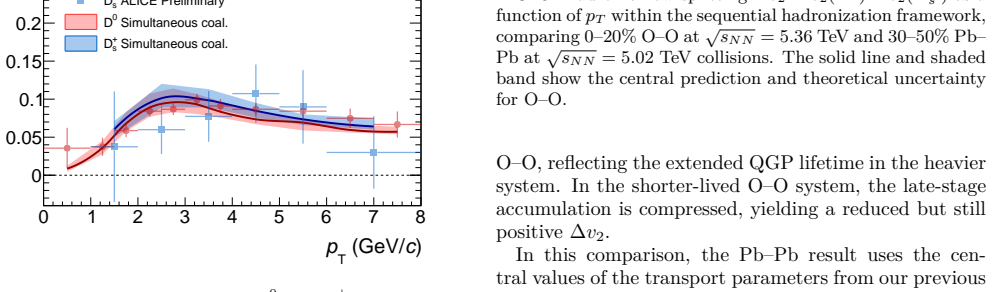
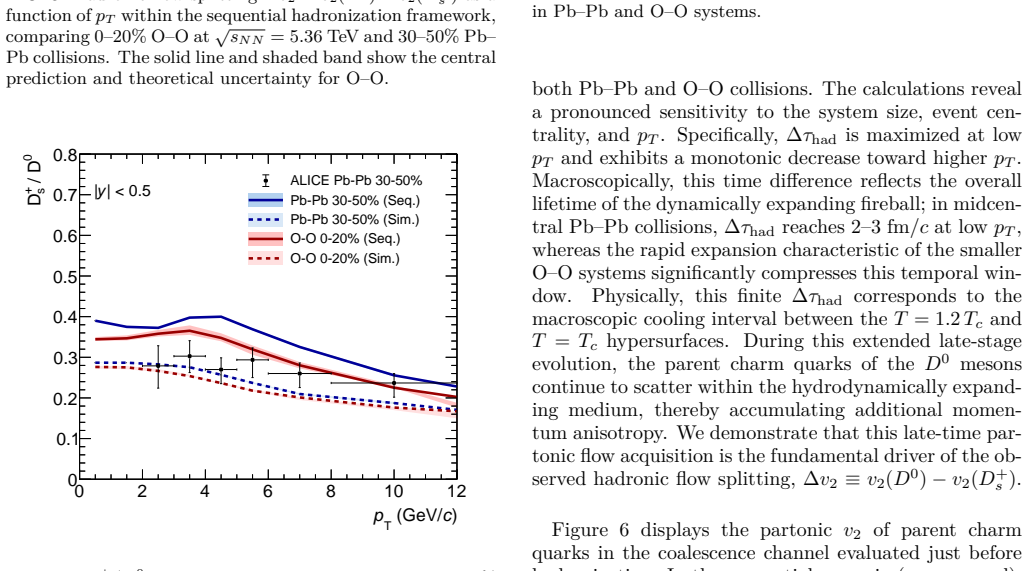
In the sequential hadronization framework, Ds+ forms at 1.2 Tc and D0 at Tc. This produces v2(D0) greater than v2(Ds+), matching preliminary ALICE data, and an enhanced Ds+/D0 yield ratio at low pT. The hadronic splitting scales linearly with the partonic flow increment accumulated during the 1.2 Tc to Tc evolution window, establishing the D0-Ds+ flow splitting as a hadronization chronometer of the quark-gluon plasma.
What carries the argument
Sequential hadronization with Ds+ forming at 1.2 Tc and D0 forming at Tc, so that the observed hadronic elliptic-flow splitting directly tracks the partonic flow built up in the intervening temperature window.
If this is right
- The splitting in O-O 0-20% collisions at 5.36 TeV is substantially smaller than in Pb-Pb 30-50% collisions.
- The sequential scenario produces an enhanced Ds+/D0 yield ratio at low pT.
- A universal linear scaling exists between the hadronic splitting and the partonic flow increment in the 1.2 Tc to Tc window.
- The sequential scenario reproduces the v2(D0) greater than v2(Ds+) ordering reported in preliminary data.
Where Pith is reading between the lines
- The linear scaling could be checked in additional small systems to map how the duration of the 1.2 Tc to Tc window changes with collision size.
- Precision data on the splitting size might help narrow the allowed range for the formation temperatures of other heavy mesons.
- The same chronometer idea might apply to flow differences among other pairs of heavy-flavor hadrons that form at different temperatures.
Load-bearing premise
That Ds+ forms at 1.2 Tc while D0 forms at Tc, introduced to reproduce the v2(D0) greater than v2(Ds+) ordering.
What would settle it
A measurement in O-O collisions showing v2(D0) less than or equal to v2(Ds+), or the absence of linear scaling between the splitting and the partonic flow increment across multiple collision systems.
Figures




read the original abstract
We investigate the elliptic-flow splitting between prompt $D^0$ and $D_s^+$ mesons in O--O and Pb--Pb collisions within a heavy-quark transport framework with sequential hadronization, in which $D_s^+$ forms at $1.2\,T_c$ and $D^0$ at $T_c$. We present predictions for the $p_T$-differential $v_2$ and $D_s^+/D^0$ yield ratio in O--O $0$--$20\%$ collisions at $\sqrt{s_{NN}} = 5.36$~TeV. The sequential scenario reproduces the $v_2(D^0) > v_2(D_s^+)$ ordering observed in preliminary ALICE data and predicts an enhanced $D_s^+/D^0$ ratio at low $p_T$, whereas a simultaneous baseline yields the opposite $v_2$ ordering. The splitting in O--O is substantially smaller than in Pb--Pb $30$--$50\%$, which we trace to the competition between the initial geometric eccentricity and the duration of the $1.2\,T_c \to T_c$ evolution window. A systematic scan across nine collision configurations reveals a universal linear scaling between the hadronic splitting and the partonic flow increment accumulated during this window, establishing the $D^0$--$D_s^+$ flow splitting as a hadronization chronometer of the quark-gluon plasma.
Editorial analysis
A structured set of objections, weighed in public.
Referee Report
Summary. The manuscript investigates the elliptic-flow splitting between prompt D^0 and D_s^+ mesons in O-O and Pb-Pb collisions within a heavy-quark transport framework that incorporates sequential hadronization, with D_s^+ forming at 1.2 T_c and D^0 at T_c. It presents predictions for the p_T-differential v_2 and the D_s^+/D^0 yield ratio in 0-20% O-O collisions at 5.36 TeV, reproduces the v_2(D^0) > v_2(D_s^+) ordering from preliminary ALICE data, contrasts this with a simultaneous hadronization baseline, and reports a universal linear scaling between the hadronic splitting and the partonic flow increment accumulated in the 1.2 T_c to T_c window across nine collision configurations, thereby proposing the splitting as a QGP hadronization chronometer.
Significance. If the sequential formation temperatures receive independent justification, the reported linear scaling could establish a useful new chronometer for the duration of the hadronization phase. The systematic scan across multiple collision systems and the explicit comparison to simultaneous hadronization constitute strengths that enhance the potential impact of the observable for future heavy-ion experiments.
major comments (2)
- The formation temperatures (D_s^+ at 1.2 T_c and D^0 at T_c) are introduced explicitly to reproduce the v_2(D^0) > v_2(D_s^+) ordering observed in preliminary ALICE data. This choice is load-bearing for the sequential hadronization scenario and for the extraction of the claimed universal linear scaling; without independent support from lattice calculations or potential models, the chronometer interpretation risks circular dependence on the same data it aims to explain.
- The universality of the linear scaling is obtained from a scan across collision configurations that all share the identical fixed temperature thresholds. It remains to be shown whether the linearity and the sign of the splitting survive if the formation temperatures are varied or replaced by a simultaneous baseline, which could alter the central claim.
Simulated Author's Rebuttal
We thank the referee for the thorough review and valuable feedback on our manuscript. We address each of the major comments in detail below and outline the revisions we will make to strengthen the presentation and robustness of our results.
read point-by-point responses
-
Referee: The formation temperatures (D_s^+ at 1.2 T_c and D^0 at T_c) are introduced explicitly to reproduce the v_2(D^0) > v_2(D_s^+) ordering observed in preliminary ALICE data. This choice is load-bearing for the sequential hadronization scenario and for the extraction of the claimed universal linear scaling; without independent support from lattice calculations or potential models, the chronometer interpretation risks circular dependence on the same data it aims to explain.
Authors: We acknowledge the referee's concern regarding the motivation for the specific formation temperatures. While the temperatures are chosen such that the model reproduces the observed ordering, this is not the sole basis; the sequential scenario is motivated by the physical expectation that the Ds+ meson, containing a strange quark, hadronizes at a higher temperature than the D0 due to differences in binding energies and coupling to the medium, as suggested by various potential models. In the revised version, we will expand the discussion in the introduction and methodology sections to include citations to relevant lattice QCD studies and potential model calculations that support earlier formation for strange hadrons. This will help mitigate any appearance of circularity by grounding the choice in independent theoretical input, while the data serves as a validation. revision: yes
-
Referee: The universality of the linear scaling is obtained from a scan across collision configurations that all share the identical fixed temperature thresholds. It remains to be shown whether the linearity and the sign of the splitting survive if the formation temperatures are varied or replaced by a simultaneous baseline, which could alter the central claim.
Authors: We appreciate this point, which highlights the need to demonstrate robustness. The manuscript does include a simultaneous hadronization baseline where both species form at Tc, leading to a reversal of the v2 ordering and no splitting in the manner described. This effectively tests the case with zero temperature window. For variations in the formation temperatures, we agree that additional checks would be beneficial. In the revised manuscript, we will include a new figure or subsection showing the scaling for a slightly varied Ds+ formation temperature in selected systems (e.g., O-O and one Pb-Pb centrality), confirming that the linear relation holds with a slope proportional to the accumulated flow in the adjusted interval. This will support the claim that the splitting acts as a chronometer sensitive to the duration of the hadronization phase. revision: yes
Circularity Check
Sequential hadronization temperatures (1.2 Tc for Ds+, Tc for D0) chosen to reproduce observed v2 ordering, making chronometer claim dependent on tuned ansatz
specific steps
-
fitted input called prediction
[Abstract]
"within a heavy-quark transport framework with sequential hadronization, in which D_s^+ forms at 1.2 T_c and D^0 at T_c. ... The sequential scenario reproduces the v_2(D^0) > v_2(D_s^+) ordering observed in preliminary ALICE data ... A systematic scan across nine collision configurations reveals a universal linear scaling between the hadronic splitting and the partonic flow increment accumulated during this window, establishing the D^0--D_s^+ flow splitting as a hadronization chronometer of the quark-gluon plasma."
The temperatures 1.2 Tc (Ds+) and Tc (D0) are introduced specifically so that the model reproduces the observed v2 ordering; the linear scaling and chronometer interpretation are then obtained from scans that all employ these same fixed thresholds. The claimed universality therefore measures flow accumulation inside a window whose boundaries were tuned to the data rather than fixed independently.
full rationale
The derivation begins by adopting a sequential hadronization framework with fixed formation temperatures selected to match the ALICE v2(D0) > v2(Ds+) ordering. A systematic scan across collision systems then extracts a linear scaling between hadronic splitting and partonic flow in the 1.2 Tc–Tc window, which is presented as establishing a universal chronometer. Because the temperature thresholds are not derived from lattice QCD, potential models, or coalescence calculations but are instead introduced to reproduce the data sign, the scaling and chronometer interpretation are extracted inside a framework whose key input already encodes the target splitting behavior. This constitutes a fitted-input-called-prediction pattern with moderate circularity; the O–O predictions remain new but the central interpretive claim reduces to the modeling choice.
Axiom & Free-Parameter Ledger
free parameters (2)
- Ds+ formation temperature =
1.2 Tc
- D0 formation temperature =
Tc
axioms (1)
- domain assumption Heavy-quark transport accurately captures charm-quark diffusion and flow development in the QGP.
Lean theorems connected to this paper
-
IndisputableMonolith/Cost/FunctionalEquation.leanwashburn_uniqueness_aczel unclear?
unclearRelation between the paper passage and the cited Recognition theorem.
sequential hadronization scenario ... Ds+ forms at 1.2 Tc and D0 at Tc ... universal linear scaling between the hadronic splitting and the partonic flow increment
-
IndisputableMonolith/Foundation/AbsoluteFloorClosure.leanabsolute_floor_iff_bare_distinguishability unclear?
unclearRelation between the paper passage and the cited Recognition theorem.
distinct binding energies ... Dirac equation with an in-medium lattice potential
What do these tags mean?
- matches
- The paper's claim is directly supported by a theorem in the formal canon.
- supports
- The theorem supports part of the paper's argument, but the paper may add assumptions or extra steps.
- extends
- The paper goes beyond the formal theorem; the theorem is a base layer rather than the whole result.
- uses
- The paper appears to rely on the theorem as machinery.
- contradicts
- The paper's claim conflicts with a theorem or certificate in the canon.
- unclear
- Pith found a possible connection, but the passage is too broad, indirect, or ambiguous to say the theorem truly supports the claim.
Reference graph
Works this paper leans on
-
[1]
with degeneracy Nq = 6. The Wigner function Wh represents the probability density for the parton pair to form a specific hadron state. Taking charmed mesons as an example, the phase-space Wigner functions for the specific wave states involved in 4 this model read [ 58–60]: W1S(r, p) =8e−ξ, W1P (r, p) = 8 3 e−ξ(2ξ − 3), W1D(r, p) = 8 15 e−ξ(15 + 4ξ2 − 20ξ ...
-
[2]
A. Andronic, P. Braun-Munzinger, M. K. Köhler, A. Mazeliauskas, K. Redlich, J. Stachel, and V. Vislavi- cius, The multiple-charm hierarchy in the statistical hadronization model, JHEP 07, 035 , arXiv:2104.12754 [hep-ph]
-
[3]
J. Adam et al. (ALICE), Measurement of d+ s produc- tion and nuclear modification factor in pb-pb collisions at √sNN = 2 .76 tev, JHEP 03, 082 , arXiv:1509.07287 [nucl-ex]
work page internal anchor Pith review Pith/arXiv arXiv
-
[4]
S. Acharya et al. (ALICE), Measurement of d0, d+, d∗+ and d+ s production in pb-pb collisions at √sNN = 5 .02 tev, JHEP 10, 174 , arXiv:1804.09083 [nucl-ex]
work page internal anchor Pith review Pith/arXiv arXiv
-
[5]
V. Minissale, S. Plumari, Y. Sun, and V. Greco, Multi- charmed and singled charmed hadrons from coalescence: yields and ratios in different collision systems at LHC, Eur. Phys. J. C 84, 228 (2024) , arXiv:2305.03687 [hep- ph]
- [6]
-
[7]
S. Pucillo (ALICE), Recent results on strangeness en- hancement in small collision systems with ALICE, (2025), arXiv:2504.02527 [nucl-ex]
-
[8]
G. Giacalone et al. , Exploiting Ne20 Isotopes for Preci- sion Characterizations of Collectivity in Small Systems, Phys. Rev. Lett. 135, 012302 (2025) , arXiv:2402.05995 [nucl-th]
-
[9]
D. Ali Hassan Abdallah et al. (ALICE), Evidence of dif- ferent c-baryon and D-meson elliptic flow in Pb −Pb col- lisions at √sNN = 5.36 TeV with ALICE at the LHC, (2026), arXiv:2603.18966 [nucl-ex]
- [10]
- [11]
- [13]
-
[14]
R. J. Fries, B. Muller, C. Nonaka, and S. A. Bass, Hadron production in heavy ion collisions: Fragmentation and recombination from a dense parton phase, Phys. Rev. C 68, 044902 (2003) , arXiv:nucl-th/0306027
work page internal anchor Pith review Pith/arXiv arXiv 2003
- [15]
- [16]
- [17]
-
[18]
Phase-Space Coalescence for heavy and light quarks at RHIC
V. Greco, H. van Hees, and R. Rapp, Phase-space coa- lescence for heavy and light quarks at RHIC, Eur. Phys. J. ST 155, 45 (2008) , arXiv:0710.0486 [hep-ph]
work page internal anchor Pith review Pith/arXiv arXiv 2008
-
[19]
S. Cao, G.-Y. Qin, and S. A. Bass, Energy loss, hadronization and hadronic interactions of heavy fla- vors in relativistic heavy-ion collisions, Phys. Rev. C 92, 024907 (2015) , arXiv:1505.01413 [nucl-th]
work page internal anchor Pith review Pith/arXiv arXiv 2015
- [20]
-
[21]
P. B. Gossiaux, R. Bierkandt, and J. Aichelin, Tomogra- phy of a quark gluon plasma at RHIC and LHC energies, Phys. Rev. C 79, 044906 (2009) , arXiv:0901.0946 [hep- ph]
work page internal anchor Pith review Pith/arXiv arXiv 2009
-
[22]
M. He, R. J. Fries, and R. Rapp, Ds-Meson as Quan- titative Probe of Diffusion and Hadronization in Nu- clear Collisions, Phys. Rev. Lett. 110, 112301 (2013) , arXiv:1204.4442 [nucl-th]
work page internal anchor Pith review Pith/arXiv arXiv 2013
-
[23]
Heavy flavours in heavy-ion collisions: quenching, flow and correlations
A. Beraudo, A. De Pace, M. Monteno, M. Nardi, and F. Prino, Heavy flavors in heavy-ion collisions: quench- ing, flow and correlations, Eur. Phys. J. C 75, 121 (2015) , arXiv:1410.6082 [hep-ph]
work page internal anchor Pith review Pith/arXiv arXiv 2015
- [24]
- [25]
-
[26]
T. Song, H. Berrehrah, D. Cabrera, J. M. Torres-Rincon, L. Tolos, W. Cassing, and E. Bratkovskaya, Tomogra- phy of the Quark-Gluon-Plasma by Charm Quarks, Phys. Rev. C 92, 014910 (2015) , arXiv:1503.03039 [nucl-th]
work page internal anchor Pith review Pith/arXiv arXiv 2015
-
[27]
S. Plumari, V. Minissale, S. K. Das, G. Coci, and V. Greco, Charmed Hadrons from Coalescence plus Fragmentation in relativistic nucleus-nucleus collisions at RHIC and LHC, Eur. Phys. J. C 78, 348 (2018) , arXiv:1712.00730 [hep-ph]
work page internal anchor Pith review Pith/arXiv arXiv 2018
-
[28]
S. K. Das, J. M. Torres-Rincon, L. Tolos, V. Minissale, F. Scardina, and V. Greco, Propagation of heavy baryons in heavy-ion collisions, Phys. Rev. D 94, 114039 (2016) , arXiv:1604.05666 [nucl-th]
work page internal anchor Pith review Pith/arXiv arXiv 2016
- [29]
- [30]
-
[31]
S. Shi, X. Guo, and P. Zhuang, Flavor Dependence of Me- son Melting Temperature in Relativistic Potential Model, Phys. Rev. D 88, 014021 (2013) , arXiv:1306.1896 [nucl- th]
work page internal anchor Pith review Pith/arXiv arXiv 2013
-
[32]
ALICE Collaboration, presented at the International Conference on Strangeness in Quark Matter (SQM 2026), Los Angeles, USA, 2026 (unpublished), ALICE Prelimi- nary figure ALI-PREL-622235
work page 2026
-
[33]
J. S. Moreland, J. E. Bernhard, and S. A. Bass, Alter- native ansatz to wounded nucleon and binary collision scaling in high-energy nuclear collisions, Phys. Rev. C 92, 011901 (2015) , arXiv:1412.4708 [nucl-th]
work page internal anchor Pith review Pith/arXiv arXiv 2015
-
[34]
L.-G. Pang, H. Petersen, and X.-N. Wang, Pseudo- rapidity distribution and decorrelation of anisotropic flow within the open-computing-language implementa- tion CL Visc hydrodynamics, Phys. Rev. C 97, 064918 (2018), arXiv:1802.04449 [nucl-th]
work page internal anchor Pith review Pith/arXiv arXiv 2018
-
[35]
X.-Y. Wu, G.-Y. Qin, L.-G. Pang, and X.-N. Wang, (3+1)-D viscous hydrodynamics at finite net baryon den- sity: Identified particle spectra, anisotropic flows, and flow fluctuations across energies relevant to the beam- energy scan at RHIC, Phys. Rev. C 105, 034909 (2022) , arXiv:2107.04949 [hep-ph]
-
[36]
The equation of state in (2+1)-flavor QCD
A. Bazavov et al. (HotQCD), Equation of state in ( 2+1 )-flavor QCD, Phys. Rev. D 90, 094503 (2014) , arXiv:1407.6387 [hep-lat]
work page internal anchor Pith review Pith/arXiv arXiv 2014
-
[37]
J. E. Bernhard, J. S. Moreland, S. A. Bass, J. Liu, and U. Heinz, Applying Bayesian parameter estimation to rel- ativistic heavy-ion collisions: simultaneous characteriza- tion of the initial state and quark-gluon plasma medium, Phys. Rev. C 94, 024907 (2016) , arXiv:1605.03954 [nucl- th]
work page internal anchor Pith review Pith/arXiv arXiv 2016
-
[38]
S. Ryu, J. F. Paquet, C. Shen, G. S. Denicol, B. Schenke, S. Jeon, and C. Gale, Importance of the Bulk Viscosity of QCD in Ultrarelativistic Heavy-Ion Collisions, Phys. Rev. Lett. 115, 132301 (2015) , arXiv:1502.01675 [nucl- th]
work page internal anchor Pith review Pith/arXiv arXiv 2015
-
[39]
S. Cao, G.-Y. Qin, and S. A. Bass, Heavy-quark dynam- ics and hadronization in ultrarelativistic heavy-ion colli- sions: Collisional versus radiative energy loss, Phys. Rev. C 88, 044907 (2013) , arXiv:1308.0617 [nucl-th]
work page internal anchor Pith review Pith/arXiv arXiv 2013
- [40]
-
[41]
Theoretical predictions for charm and bottom production at the LHC
M. Cacciari, S. Frixione, N. Houdeau, M. L. Mangano, P. Nason, and G. Ridolfi, Theoretical predictions for charm and bottom production at the LHC, JHEP 10, 137, arXiv:1205.6344 [hep-ph]
work page internal anchor Pith review Pith/arXiv arXiv
- [42]
- [43]
- [44]
- [45]
-
[46]
X.-F. Xue, Z.-X. Xu, W. Dai, J. Zhao, and B.-W. Zhang, Bayesian inference of heavy-quark dissipation and jet transport parameters from D-meson observables in heavy-ion collisions at energies available at the CERN Large Hadron Collider, Phys. Rev. C 113, 054902 (2026) , arXiv:2512.07169 [nucl-th]
work page internal anchor Pith review Pith/arXiv arXiv 2026
-
[47]
Kubo, The fluctuation-dissipation theorem, Rept
R. Kubo, The fluctuation-dissipation theorem, Rept. Prog. Phys. 29, 255 (1966)
work page 1966
-
[48]
L. Altenkort, O. Kaczmarek, R. Larsen, S. Mukherjee, P. Petreczky, H.-T. Shu, and S. Stendebach (HotQCD), Heavy Quark Diffusion from 2+1 Flavor Lattice QCD with 320 MeV Pion Mass, Phys. Rev. Lett. 130, 231902 (2023), arXiv:2302.08501 [hep-lat]
-
[49]
P. Petreczky, Quarkonium in Hot Medium, J. Phys. G 37, 094009 (2010) , arXiv:1001.5284 [hep-ph]
work page internal anchor Pith review Pith/arXiv arXiv 2010
-
[50]
X.-f. Guo and X.-N. Wang, Multiple scattering, par- ton energy loss and modified fragmentation functions in deeply inelastic e A scattering, Phys. Rev. Lett. 85, 3591 (2000), arXiv:hep-ph/0005044
work page internal anchor Pith review Pith/arXiv arXiv 2000
-
[51]
Heavy Quark Energy Loss in Nuclear Medium
B.-W. Zhang, E. Wang, and X.-N. Wang, Heavy quark energy loss in nuclear medium, Phys. Rev. Lett. 93, 072301 (2004) , arXiv:nucl-th/0309040
work page internal anchor Pith review Pith/arXiv arXiv 2004
-
[52]
Multiple Parton Scattering in Nuclei: Heavy Quark Energy Loss and Modified Fragmentation Functions
B.-W. Zhang, E.-k. Wang, and X.-N. Wang, Multiple par- ton scattering in nuclei: Heavy quark energy loss and modified fragmentation functions, Nucl. Phys. A 757, 493 (2005) , arXiv:hep-ph/0412060
work page internal anchor Pith review Pith/arXiv arXiv 2005
-
[53]
Hard collinear gluon radiation and multiple scattering in a medium
A. Majumder, Hard collinear gluon radiation and mul- tiple scattering in a medium, Phys. Rev. D 85, 014023 (2012), arXiv:0912.2987 [nucl-th]
work page internal anchor Pith review Pith/arXiv arXiv 2012
-
[54]
Multiple Parton Scattering in Nuclei: Modified DGLAP Evolution for Fragmentation Functions
W.-t. Deng and X.-N. Wang, Multiple Parton Scatter- ing in Nuclei: Modified DGLAP Evolution for Frag- mentation Functions, Phys. Rev. C 81, 024902 (2010) , arXiv:0910.3403 [hep-ph]
work page internal anchor Pith review Pith/arXiv arXiv 2010
- [55]
-
[56]
Charm-Baryon Production in Proton-Proton Collisions
M. He and R. Rapp, Charm-Baryon Production in Proton-Proton Collisions, Phys. Lett. B 795, 117 (2019) , arXiv:1902.08889 [nucl-th]
work page internal anchor Pith review Pith/arXiv arXiv 2019
- [57]
-
[58]
R. J. Fries, V. Greco, and P. Sorensen, Coalescence Models For Hadron Formation From Quark Gluon Plasma, Ann. Rev. Nucl. Part. Sci. 58, 177 (2008) , arXiv:0807.4939 [nucl-th]
work page internal anchor Pith review Pith/arXiv arXiv 2008
-
[59]
J. Zhao, S. Shi, N. Xu, and P. Zhuang, Sequential Coales- cence with Charm Conservation in High Energy Nuclear Collisions, (2018), arXiv:1805.10858 [hep-ph]
work page internal anchor Pith review Pith/arXiv arXiv 2018
-
[60]
Zhao et al., Hadronization of heavy quarks, Phys
J. Zhao et al., Hadronization of heavy quarks, Phys. Rev. C 109, 054912 (2024) , arXiv:2311.10621 [hep-ph]
- [61]
-
[62]
C. Peterson, D. Schlatter, I. Schmitt, and P. M. Zerwas, Scaling Violations in Inclusive e+ e- Annihilation Spec- tra, Phys. Rev. D 27, 105 (1983)
work page 1983
-
[63]
Combined analysis of charm-quark fragmentation-fraction measurements
M. Lisovyi, A. Verbytskyi, and O. Zenaiev, Combined analysis of charm-quark fragmentation-fraction measure- ments, Eur. Phys. J. C 76, 397 (2016) , arXiv:1509.01061 [hep-ex]
work page internal anchor Pith review Pith/arXiv arXiv 2016
-
[64]
V. Minissale, S. Plumari, and V. Greco, Charm hadrons in pp collisions at LHC energy within a coalescence plus fragmentation approach, Phys. Lett. B 821, 136622 (2021), arXiv:2012.12001 [hep-ph]
-
[65]
Development of heavy-flavour flow-harmonics in high-energy nuclear collisions
A. Beraudo, A. De Pace, M. Monteno, M. Nardi, and F. Prino, Development of heavy-flavour flow- harmonics in high-energy nuclear collisions, JHEP 02, 043, arXiv:1712.00588 [hep-ph]
work page internal anchor Pith review Pith/arXiv arXiv
-
[66]
Heavy ions at the Future Circular Collider
A. Dainese et al. , Heavy ions at the Future Cir- cular Collider 10.23731/CYRM-2017-003.635 (2016), arXiv:1605.01389 [hep-ph]
work page internal anchor Pith review Pith/arXiv arXiv doi:10.23731/cyrm-2017-003.635 2017
-
[67]
Future heavy-ion facilities: FCC-AA
A. Dainese et al. , Future heavy-ion facilities: FCC-AA, PoS HardProbes2018, 005 (2019) , arXiv:1901.10952 [hep-ph]
work page internal anchor Pith review Pith/arXiv arXiv 2019
-
[68]
A. Abada et al. (FCC), FCC Physics Opportunities: Fu- ture Circular Collider Conceptual Design Report Volume 1, Eur. Phys. J. C 79, 474 (2019)
work page 2019
-
[69]
A. Abada et al. (FCC), FCC-hh: The Hadron Collider: Future Circular Collider Conceptual Design Report Vol- ume 3, Eur. Phys. J. ST 228, 755 (2019)
work page 2019
discussion (0)
Sign in with ORCID, Apple, or X to comment. Anyone can read and Pith papers without signing in.