Accurate and Scalable Detection and Investigation of Cyber Persistence Threats
Pith reviewed 2026-05-23 23:26 UTC · model grok-4.3
The pith
A detector identifies cyber persistence threats by causally linking setup and execution phases via provenance data, cutting false positives by 93%.
A machine-rendered reading of the paper's core claim, the machinery that carries it, and where it could break.
Core claim
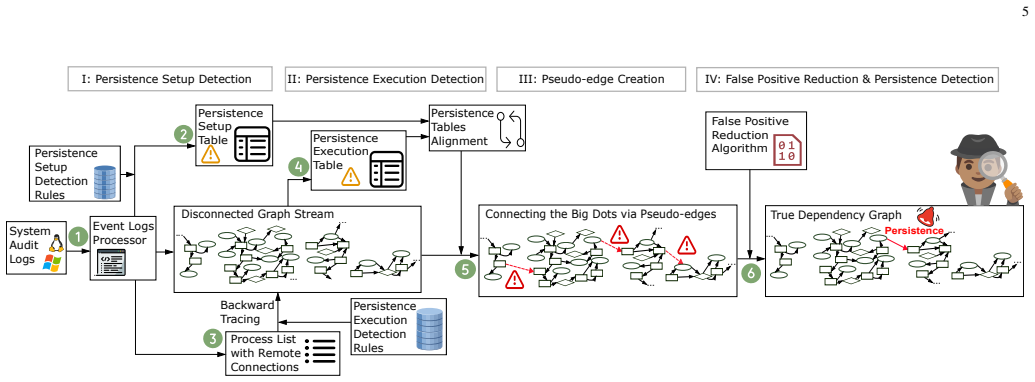
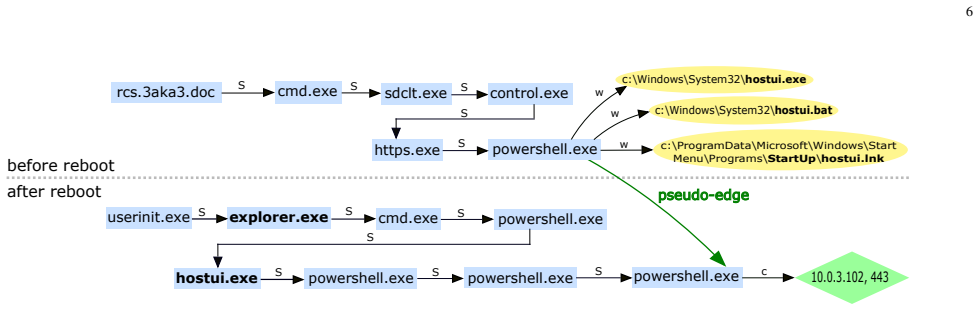
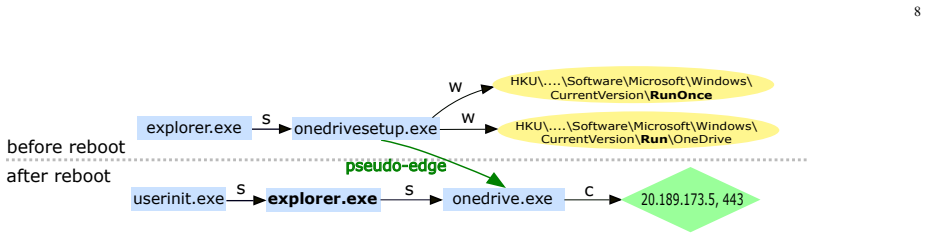
Persistent operations typically manifest in two phases, the persistence setup and the subsequent persistence execution. By causally relating these phases through provenance analytics and the introduction of pseudo-dependency edges, the CPD system first discerns setups that signal an impending threat and then traces processes linked to remote connections to identify execution activities. Expert-guided edges further speed tracing and shrink log size. A novel alert triage algorithm reduces associated false positives, and evaluations on well-known datasets show an average 93 percent reduction in false positive rate compared with state-of-the-art methods.
What carries the argument
Pseudo-dependency edges that connect disjoint persistence setup and execution phases using data provenance analysis.
If this is right
- Expert-guided edges enable faster tracing of persistence activities together with reduced log size.
- The alert triage algorithm further lowers false positives tied to persistence threats.
- The two-phase model supports both accurate detection and efficient investigation of cyber persistence on standard datasets.
- Provenance-based linking of phases scales to large audit logs while maintaining low false-positive rates.
Where Pith is reading between the lines
- The same causal-phase linking could be tested on other multi-stage attack behaviors such as lateral movement or data exfiltration.
- Real-time deployment would require measuring how often attackers deliberately break the assumed causal relation between setup and execution.
- Combining the pseudo-edges with existing host-based telemetry might extend coverage to endpoints without full system-call logging.
Load-bearing premise
Persistent operations typically manifest in two phases that can be causally related through provenance analytics and the introduced pseudo-dependency edges.
What would settle it
A labeled dataset of persistence threats in which setup and execution phases lack recoverable causal links through provenance, where the claimed false-positive reduction fails to appear.
Figures




read the original abstract
In Advanced Persistent Threat (APT) attacks, achieving stealthy persistence within target systems is often crucial for an attacker's success. This persistence allows adversaries to maintain prolonged access, often evading detection mechanisms. Recognizing its pivotal role in the APT lifecycle, this paper introduces Cyber Persistence Detector (CPD), a novel system dedicated to detecting cyber persistence through provenance analytics. CPD is founded on the insight that persistent operations typically manifest in two phases: the "persistence setup" and the subsequent "persistence execution". By causally relating these phases, we enhance our ability to detect persistent threats. First, CPD discerns setups signaling an impending persistent threat and then traces processes linked to remote connections to identify persistence execution activities. A key feature of our system is the introduction of pseudo-dependency edges (pseudo-edges), which effectively connect these disjoint phases using data provenance analysis, and expert-guided edges, which enable faster tracing and reduced log size. These edges empower us to detect persistence threats accurately and efficiently. Moreover, we propose a novel alert triage algorithm that further reduces false positives associated with persistence threats. Evaluations conducted on well-known datasets demonstrate that our system reduces the average false positive rate by 93% compared to state-of-the-art methods.
Editorial analysis
A structured set of objections, weighed in public.
Referee Report
Summary. The manuscript introduces the Cyber Persistence Detector (CPD), a provenance analytics-based system for detecting Advanced Persistent Threat (APT) persistence. It identifies two phases of persistent operations—setup and execution—and uses pseudo-dependency edges and expert-guided edges to causally link them, along with a novel alert triage algorithm. The key result is a claimed 93% reduction in average false positive rate compared to state-of-the-art methods on well-known datasets.
Significance. Should the 93% FPR reduction be substantiated with detailed, reproducible evaluations, the work would offer a meaningful advance in provenance-based threat detection by tackling the challenge of linking disjoint persistence phases. The pseudo-dependency edges could provide a generalizable technique for enhancing causal analysis in security provenance graphs.
major comments (2)
- [Abstract] The abstract asserts a 93% false-positive reduction but supplies no information on datasets, baselines, evaluation metrics, or methodology, so the data cannot be checked against the claim. This is load-bearing for the central performance result.
- [System overview / edge construction] The system's performance rests on pseudo-dependency edges (and expert-guided edges) correctly linking the persistence setup and execution phases without excessive false connections. No ablation study on these edges or measured precision of the linking step is reported, leaving the weakest assumption untested.
Simulated Author's Rebuttal
We thank the referee for the constructive feedback. We address the two major comments below and will incorporate revisions to strengthen the manuscript.
read point-by-point responses
-
Referee: [Abstract] The abstract asserts a 93% false-positive reduction but supplies no information on datasets, baselines, evaluation metrics, or methodology, so the data cannot be checked against the claim. This is load-bearing for the central performance result.
Authors: We agree the abstract should be more self-contained. In the revision we will expand it to name the standard provenance datasets used, the state-of-the-art baselines, the primary metric (average false-positive rate), and the high-level evaluation methodology that produced the 93% reduction figure. revision: yes
-
Referee: [System overview / edge construction] The system's performance rests on pseudo-dependency edges (and expert-guided edges) correctly linking the persistence setup and execution phases without excessive false connections. No ablation study on these edges or measured precision of the linking step is reported, leaving the weakest assumption untested.
Authors: The observation is correct; the current manuscript reports only end-to-end results and does not contain an ablation or precision measurement for the pseudo-dependency and expert-guided edges. We will add a dedicated ablation study in the revised version that isolates the contribution of these edges and reports the precision of the linking step. revision: yes
Circularity Check
No significant circularity; derivation is self-contained
full rationale
The paper introduces a new detection system (CPD) with novel pseudo-dependency edges and an alert triage algorithm, then evaluates its false-positive reduction on external well-known datasets against independent state-of-the-art baselines. No load-bearing step reduces by construction to fitted inputs, self-citations, or renamed prior results; the central performance claim rests on external measurement rather than tautological re-derivation of its own assumptions.
Axiom & Free-Parameter Ledger
axioms (1)
- domain assumption Persistent operations typically manifest in two phases: the persistence setup and the subsequent persistence execution
invented entities (2)
-
pseudo-dependency edges
no independent evidence
-
expert-guided edges
no independent evidence
Reference graph
Works this paper leans on
-
[1]
The MITRE Corporation. “MITRE ATT&CK.” Accessed: Jan. 2023, [Online]. Available: https://attack.mitre.org
work page 2023
-
[2]
Crowdstrike 2023 global threat report,
CrowdStrike, Inc., “Crowdstrike 2023 global threat report,” 2023. [Online]. Available: https : / / www. crowdstrike . com / global - threat - report/
work page 2023
-
[3]
The MITRE Corporation. “Sandworm Team.” Accessed: June 2023, [Online]. Available: https://attack.mitre.org/groups/G0034/
work page 2023
-
[4]
Sandworm intrusion set campaign targeting Centreon systems,
French Cybersecurity Agency, “Sandworm intrusion set campaign targeting Centreon systems,” 2021. [Online]. Available: https://www. cert.ssi.gouv.fr/uploads/CERTFR-2021-CTI-005.pdf
work page 2021
-
[5]
Pulsedive. “P.A.S. Webshell.” Accessed: Sept. 2023, [Online]. Avail- able: https://pulsedive.com/threat/P.A.S.%5C%20Webshell
work page 2023
-
[6]
Deep dive into the Solorigate second- stage activation
Microsoft Threat Intelligence. “Deep dive into the Solorigate second- stage activation.” Accessed: Oct. 2023, [Online]. Available: https:// www.microsoft.com/en-us/security/blog/2021/01/20/deep-dive-into- the- solorigate- second- stage- activation- from- sunburst- to- teardrop- and-raindrop/
work page 2023
-
[7]
SolarWinds hack: the mystery of one of the biggest cyberattacks ever
P. Paganini. “SolarWinds hack: the mystery of one of the biggest cyberattacks ever.” Accessed: Oct. 2023, [Online]. Available: https : //cybernews.com/security/solarwinds- hack- the- mystery- of- one- of- the-biggest-cyberattacks-ever/
work page 2023
-
[8]
SUNSPOT: An Implant in the Build Process
CrowdStrike Intelligence Team. “SUNSPOT: An Implant in the Build Process.” Accessed: Oct. 2023, [Online]. Available: https : / / www . crowdstrike.com/blog/sunspot-malware-technical-analysis/
work page 2023
-
[9]
UNICORN: Runtime provenance-based detector for advanced persistent threats,
X. Han, T. Pasqueir, A. Bates, J. Mickens, and M. Seltzer, “UNICORN: Runtime provenance-based detector for advanced persistent threats,” in Proc. Netw. Distrib. Syst. Secur. Symp. , 2020, pp. 1–18
work page 2020
-
[10]
ProTracer: Towards practical provenance tracing by alternating between logging and tainting,
S. Ma, X. Zhang, and D. Xu, “ProTracer: Towards practical provenance tracing by alternating between logging and tainting,” in Proc. Netw. Distrib. Syst. Secur. Symp. , 2016, pp. 1–15
work page 2016
-
[11]
SLEUTH: Real- time attack scenario reconstruction from COTS audit data,
M. N. Hossain, S. M. Milajerdi, J. Wang, B. Eshete, R. Gjomemo, R. Sekar, S. D. Stoller, and V . Venkatakrishnan, “SLEUTH: Real- time attack scenario reconstruction from COTS audit data,” in Proc. USENIX Secur. Symp., 2017, pp. 487–504
work page 2017
-
[12]
To- wards scalable cluster auditing through grammatical inference over provenance graphs,
W. U. Hassan, L. Mark, N. Aguse, A. Bates, and T. Moyer, “To- wards scalable cluster auditing through grammatical inference over provenance graphs,” in Proc. Netw. Distrib. Syst. Secur. Symp. , 2018, pp. 1–15
work page 2018
-
[13]
HOLMES: Real-time apt detection through corre- lation of suspicious information flows,
S. M. Milajerdi, R. Gjomemo, B. Eshete, R. Sekar, and V . N. Venkatakrishnan, “HOLMES: Real-time apt detection through corre- lation of suspicious information flows,” in Proc. IEEE Symp. Secur. Privacy, 2019, pp. 1137–1152
work page 2019
-
[14]
NoDoze: Combatting threat alert fatigue with automated provenance triage,
W. U. Hassan, S. Guo, D. Li, Z. Chen, K. Jee, Z. Li, and A. Bates, “NoDoze: Combatting threat alert fatigue with automated provenance triage,” in Proc. Netw. Distrib. Syst. Secur. Symp. , 2019, pp. 1–15
work page 2019
-
[15]
Tactical provenance analysis for endpoint detection and response systems,
W. U. Hassan, A. Bates, and D. Marino, “Tactical provenance analysis for endpoint detection and response systems,” in Proc. IEEE Symp. Secur. Privacy, 2020, pp. 1172–1189
work page 2020
-
[16]
Combating dependence explosion in forensic analysis using alternative tag propagation seman- tics,
M. N. Hossain, S. Sheikhi, and R. Sekar, “Combating dependence explosion in forensic analysis using alternative tag propagation seman- tics,” in Proc. IEEE Symp. Secur. Privacy , 2020, pp. 1139–1155
work page 2020
-
[17]
KAIROS: Practical intrusion detection and investigation using whole-system provenance,
Z. Cheng, Q. Lv, J. Liang, Y . Wang, D. Sun, T. Pasquier, and X. Han, “KAIROS: Practical intrusion detection and investigation using whole-system provenance,” in Proc. IEEE Symp. Secur. Privacy, 2024, pp. 9–28
work page 2024
-
[18]
Flash: A comprehensive approach to intrusion detection via provenance graph representation learning,
M. Rehman, H. Ahmadi, and W. Hassan, “Flash: A comprehensive approach to intrusion detection via provenance graph representation learning,” in Proc. IEEE Symp. Secur. Privacy , 2024, pp. 142–161
work page 2024
-
[19]
Shadewatcher: Recommendation-guided cyber threat analysis using system audit records,
J. Zeng, X. Wang, J. Liu, Y . Chen, Z. Liang, T.-S. Chua, and Z. L. Chua, “Shadewatcher: Recommendation-guided cyber threat analysis using system audit records,” in Proc. IEEE Symp. Secur. Privacy, 2022, pp. 489–506
work page 2022
-
[20]
Prographer: An anomaly detection system based on provenance graph embedding,
F. Yang, J. Xu, C. Xiong, Z. Li, and K. Zhang, “Prographer: An anomaly detection system based on provenance graph embedding,” in Proc. USENIX Secur. Symp. , 2023, pp. 4355–4372
work page 2023
-
[21]
Elastic. “Elastic Detection Rules.” Accessed: Sept. 2023, [Online]. Available: https://github.com/elastic/detection-rules
work page 2023
-
[22]
Google Security Operations. “Chronicle Detection Rules.” Accessed: Sept. 2023, [Online]. Available: https://github.com/chronicle/detection- rules
work page 2023
-
[23]
SigmaHQ. “Sigma.” Accessed: Sept. 2023, [Online]. Available: https: //github.com/SigmaHQ/sigma
work page 2023
-
[24]
The MITRE Corporation. “MITRE T1547001.” Accessed: May 2023, [Online]. Available: https://attack.mitre.org/techniques/T1547/001/
work page 2023
-
[25]
You are what you do: Hunting stealthy malware via data provenance analysis,
Q. Wang, W. U. Hassan, D. Li, K. Jee, X. Yu, K. Zou, J. Rhee, Z. Chen, W. Cheng, C. A. Gunter, et al., “You are what you do: Hunting stealthy malware via data provenance analysis,” in Proc. Netw. Distrib. Syst. Secur. Symp., 2020, pp. 1–17
work page 2020
-
[26]
S. Wang, Z. Wang, T. Zhou, H. Sun, X. Yin, D. Han, H. Zhang, X. Shi, and J. Yang, “Threatrace: Detecting and tracing host-based threats in node level through provenance graph learning,” IEEE Transactions on Information Forensics and Security , vol. 17, pp. 3972–3987, 2022
work page 2022
- [27]
-
[28]
A. Goyal, X. Han, G. Wang, and A. Bates, “Sometimes, you aren’t what you do: Mimicry attacks against provenance graph host intrusion detection systems,” in Proc. Netw. Distrib. Syst. Secur. Symp. , 2023, pp. 1–18
work page 2023
-
[29]
Evading Provenance-Based ML detectors with adversarial system actions,
K. Mukherjee, J. Wiedemeier, T. Wang, J. Wei, F. Chen, M. Kim, M. Kantarcioglu, and K. Jee, “Evading Provenance-Based ML detectors with adversarial system actions,” in Proc. USENIX Secur. Symp., 2023, pp. 1199–1216
work page 2023
-
[30]
E. Segal. “Alert Fatigue.” Accessed: Aug. 2023, [Online]. Available: https://www.forbes.com/sites/edwardsegal/2021/11/08/alert-fatigue- can - lead - to - missed - cyber- threats - and - staff - retentionrecruitment - issues-study/?sh=4c96871035c9
work page 2023
-
[31]
In Cybersecurity Every Alert Matters,
C. Robinson, “In Cybersecurity Every Alert Matters,” 2021. [Online]. Available: https://www.criticalstart.com/wp-content/uploads/2021/11/ US48277521 TLWP.pdf
work page 2021
-
[32]
99% false positives: A qualitative study of soc analysts’ perspectives on security alarms,
B. A. Alahmadi, L. Axon, and I. Martinovic, “99% false positives: A qualitative study of soc analysts’ perspectives on security alarms,” in Proc. USENIX Secur. Symp. , 2022, pp. 2783–2800
work page 2022
-
[33]
M. Wojtasiak, “The defenders’ dilemma,” 2023. [Online]. Available: https://info.vectra.ai/state-of-threat-detection
work page 2023
-
[34]
The Impact of Security Alert Overload,
CRITICALSTART, “The Impact of Security Alert Overload,” 2019. [Online]. Available: https://www.criticalstart.com/wp-content/uploads/ 2021/02/CS Report-The-Impact-of-Security-Alert-Overload.pdf
work page 2019
-
[35]
The MITRE Corporation. “MITRE Matrix.” Accessed: Jan. 2023, [Online]. Available: https://attack.mitre.org/matrices/enterprise/
work page 2023
-
[36]
MITRE Adversary Emulation Library
The MITRE Corporation. “MITRE Adversary Emulation Library.” Accessed: Jan. 2023, [Online]. Available: https://github.com/center- for-threat-informed-defense/adversary emulation library
work page 2023
-
[37]
The MITRE Corporation. “MITRE Attack Stix Data.” Accessed: April 2023, [Online]. Available: https://github.com/mitre-attack/attack-stix- data
work page 2023
-
[38]
M. van Opstal and W. Arbaugh. “DARPA OpTC.” Accessed: Sept. 2023, [Online]. Available: https://github.com/FiveDirections/OpTC- data
work page 2023
-
[39]
J. Torrey. “DARPA Transparent Computing.” Accessed: Sept. 2023, [Online]. Available: https : / / github . com / darpa - i2o / Transparent - Computing
work page 2023
-
[40]
Atlas: A sequence-based learning approach for attack investigation,
A. Alsaheel, Y . Nan, S. Ma, L. Yu, G. Walkup, Z. B. Celik, X. Zhang, and D. Xu, “Atlas: A sequence-based learning approach for attack investigation,” in Proc. USENIX Secur. Symp. , 2021, pp. 3005–3022
work page 2021
-
[41]
M. Russinovich and T. Garnier. “System Monitor.” Accessed: Feb. 2023, [Online]. Available: https : / / learn . microsoft . com / en - us / sysinternals/downloads/sysmon
work page 2023
-
[42]
Grubb, The Linux audit daemon , Accessed: Feb
S. Grubb, The Linux audit daemon , Accessed: Feb. 2023. [Online]. Available: https://linux.die.net/man/8/auditd
work page 2023
-
[43]
Red Canary. “Atomic Red Team.” Accessed: Jan. 2023, [Online]. Available: https://atomicredteam.io/
work page 2023
-
[44]
Elastic NV. “EQL search.” Accessed: Sept. 2023, [Online]. Available: https://www.elastic.co/guide/en/elasticsearch/reference/current/eql. html
work page 2023
- [45]
-
[46]
A. Allievi, A. Ionescu, D. A. Solomon, K. Chase, and M. E. Russi- novich, Windows Internals, Part 2, 7th Edition. Microsoft Press, 2022
work page 2022
-
[47]
“APT29.” Accessed: April 2023, [Online]
The MITRE Corporation. “APT29.” Accessed: April 2023, [Online]. Available: https://attack.mitre.org/groups/G0016/
work page 2023
-
[48]
The MITRE Corporation. “Wizard Spider.” Accessed: April 2023, [Online]. Available: https://attack.mitre.org/groups/G0102/. 16
work page 2023
-
[49]
S. White. “Windows Remote Management.” Accessed: March 2023, [Online]. Available: https://learn.microsoft.com/en-us/windows/win32/ winrm/portal
work page 2023
- [50]
-
[51]
Elastic NV. “Elasticsearch.” Accessed: Sept. 2023, [Online]. Available: https://www.elastic.co/
work page 2023
- [52]
-
[53]
West Health Institute. “PyVis.” Accessed: Sept. 2023, [Online]. Avail- able: https://pyvis.readthedocs.io/en/latest/
work page 2023
-
[54]
D. Marshall. “NT Kernel Logger.” Accessed: Feb. 2023, [Online]. Available: https : / / learn . microsoft . com / en - us / windows - hardware / drivers/devtest/nt-kernel-logger-trace-session
work page 2023
-
[55]
DARPA Transparent Computing E3
A. D. Keromytis. “DARPA Transparent Computing E3.” Accessed: Sept. 2023, [Online]. Available: https : / / github . com / darpa - i2o / Transparent-Computing/blob/master/README-E3.md
work page 2023
- [56]
-
[57]
VMware LLC. “Carbon Black Cloud.” Accessed: Oct. 2023, [Online]. Available: https://www.vmware.com/products/carbon- black- cloud. html
work page 2023
-
[58]
The MITRE Corporation. “MITRE Engenuity.” Accessed: Jan. 2023, [Online]. Available: https://attackevals.mitre-engenuity.org/
work page 2023
-
[59]
The MITRE Corporation. “MITRE Engenuity Evaluation.” Accessed: Jan. 2023, [Online]. Available: https://attackevals.mitre-engenuity.org/ enterprise/wizard-spider-sandworm/
work page 2023
-
[60]
Elastic. “A Elastic rule sample.” Accessed: Sept. 2023, [Online]. Available: https://github.com/elastic/detection-rules/blob/main/rules/ windows/persistence registry uncommon.toml
work page 2023
-
[61]
SigmaHQ. “A Sigma rule sample.” Accessed: Sept. 2023, [Online]. Available: https : / / github. com / SigmaHQ / sigma / blob / master / rules / windows / file / file event / file event win creation unquoted service path.yml
work page 2023
-
[62]
Google Security Operations. “A Chronicle rule sample.” Accessed: Sept. 2023, [Online]. Available: https://github.com/chronicle/detection- rules / blob / main / mitre attack / T1053 005 windows creation of scheduled task.yaral
work page 2023
-
[63]
F. Pedregosa and P. Gervais. “Memory Profiler.” Accessed: Oct. 2023, [Online]. Available: https://pypi.org/project/memory-profiler/
work page 2023
-
[64]
Hopper: Modeling and detecting lateral move- ment,
G. Ho, M. Dhiman, D. Akhawe, V . Paxson, S. Savage, G. M. V oelker, and D. A. Wagner, “Hopper: Modeling and detecting lateral move- ment,” in Proc. USENIX Secur. Symp. , 2021, pp. 3093–3110
work page 2021
-
[65]
Euler: Detecting network lateral move- ment via scalable temporal link prediction,
I. J. King and H. H. Huang, “Euler: Detecting network lateral move- ment via scalable temporal link prediction,” in Proc. Netw. Distrib. Syst. Secur. Symp., 2022, pp. 1–16
work page 2022
-
[66]
Detecting credential spearphishing in enterprise settings,
G. Ho, A. Sharma, M. Javed, V . Paxson, and D. Wagner, “Detecting credential spearphishing in enterprise settings,” inProc. USENIX Secur. Symp., 2017, pp. 469–485
work page 2017
-
[67]
Information based heavy hitters for real-time dns data exfiltration detection,
Y . Ozery, A. Nadler, and A. Shabtai, “Information based heavy hitters for real-time dns data exfiltration detection,” in Proc. Netw. Distrib. Syst. Secur. Symp., 2024, pp. 1–15
work page 2024
-
[68]
Flow-based detection and proxy-based evasion of encrypted malware c2 traffic,
C. Novo and R. Morla, “Flow-based detection and proxy-based evasion of encrypted malware c2 traffic,” in Proc. ACM Workshop on Artificial Intelligence and Security , 2020, pp. 83–91
work page 2020
-
[69]
UN- VEIL: A Large-Scale, automated approach to detecting ransomware,
A. Kharaz, S. Arshad, C. Mulliner, W. Robertson, and E. Kirda, “UN- VEIL: A Large-Scale, automated approach to detecting ransomware,” in Proc. USENIX Secur. Symp. , 2016, pp. 757–772
work page 2016
-
[70]
Sok: History is a vast early warning system: Auditing the provenance of system intrusions,
M. A. Inam, Y . Chen, A. Goyal, J. Liu, J. Mink, N. Michael, S. Gaur, A. Bates, and W. U. Hassan, “Sok: History is a vast early warning system: Auditing the provenance of system intrusions,” in Proc. IEEE Symp. Secur. Privacy, 2023, pp. 2620–2638
work page 2023
-
[71]
High fidelity data reduction for big data security dependency analyses,
Z. Xu, Z. Wu, Z. Li, K. Jee, J. Rhee, X. Xiao, F. Xu, H. Wang, and G. Jiang, “High fidelity data reduction for big data security dependency analyses,” in Proc. ACM SIGSAC Conf. Comput. Commun. Secur. , 2016, pp. 504–516
work page 2016
-
[72]
H. Ding, S. Yan, J. Zhai, and S. Ma, “Elise: A storage efficient logging system powered by redundancy reduction and representation learning,” in Proc. USENIX Secur. Symp. , 2021, pp. 3023–3040
work page 2021
-
[73]
Nodemerge: Template based efficient data reduction for big-data causality analysis,
Y . Tang, D. Li, Z. Li, M. Zhang, K. Jee, X. Xiao, Z. Wu, J. Rhee, F. Xu, and Q. Li, “Nodemerge: Template based efficient data reduction for big-data causality analysis,” in Proc. ACM SIGSAC Conf. Comput. Commun. Secur., 2018, pp. 1324–1337
work page 2018
-
[74]
Dependence- Preserving data compaction for scalable forensic analysis,
M. N. Hossain, J. Wang, R. Sekar, and S. D. Stoller, “Dependence- Preserving data compaction for scalable forensic analysis,” in Proc. USENIX Secur. Symp., 2018, pp. 1723–1740
work page 2018
discussion (0)
Sign in with ORCID, Apple, or X to comment. Anyone can read and Pith papers without signing in.