REVIEW 4 major objections 4 minor 67 references
Adjoint sharding for very long context training of state space models
T0 review · 4 major / 4 minor · reviewed 2026-08-10 · deepseek-v4-flash
Pith's one-line read Adjoint sharding computes backpropagation-equivalent gradients for state-space models by decomposing them into independent vector-Jacobian products, cutting training memory by up to 3X at 1M-token context.
desk verdict A clean adjoint-method decomposition for SSM gradients with a real parallelization idea, but the abstract's memory-reduction claims are unsupported by any experiments and the paper's own storage analysis undermines them. read the letter →
The pith
A machine-rendered reading of the paper's core claim, the machinery that carries it, and where it could break.
The reading
What carries the argument
The load-bearing object is the adjoint state $\lambda_{t,\tau}^k = C_t^k \prod_{i=1}^{t-\tau} A_{t+1-i}^k$ for layer $k$, which replaces the chained derivatives of backpropagation. Proposition 1 (the adjoint method for recurrences) supplies the recurrence $\lambda_{i-1}=\lambda_i\,\partial f(i,h_{i-1},\theta)/\partial h_{i-1}$ that makes these states computable by a backward pass without storing the forward computation graph. The residual identity $y_t^K = y_t^0 + \sum_k \tilde{y}_t^k$ then lets the gradient separate into a sum over layers. Each term in the resulting sum is a vector-Jacobian product of the form $\mathrm{vjp}(v) = v \cdot \partial \mathrm{Net}_\theta(\mathrm{Input}_i)$, which can be evaluated with reverse-mode automatic differentiation initialized with the vector $v$, and which the paper treats as costing about one forward pass. The independence of these VJPs is what allows memory to be sharded and computation to be parallelized.
What would settle it
Train a 1.27B-parameter state-space model on a 1M-token sequence with adjoint sharding and record peak GPU memory, comparing with backpropagation under activation checkpointing on the same hardware; if adjoint sharding's peak memory is not roughly 3X lower, the abstract's central memory claim is contradicted.
Extended reading notes
Core claim
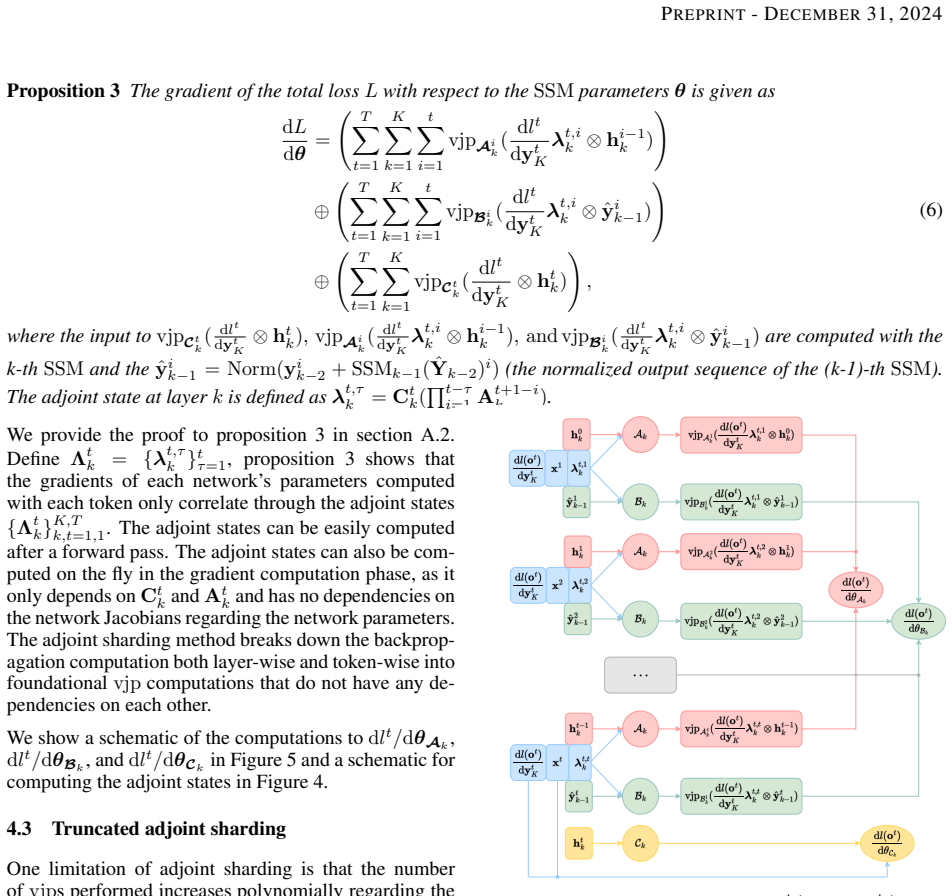
The central claim is that for a residual stack of state-space layers, the gradient of the training loss with respect to every parameter can be written as a sum (over tokens $t$ and layers $k$) of independent vector-Jacobian products, with no cross-dependencies between terms. For a single SSM layer, Proposition 2 gives $$\frac{d l_t}{d\$\theta$} = \Big[\sum_{i=1}^t \mathrm{vjp}^{A_i}\big(\tfrac{dl_t}{dy_t}\lambda_{t,i}\otimes h_{i-1}\big)\Big] \oplus \Big[\sum_{i=1}^t \mathrm{vjp}^{B_i}\big(\tfrac{dl_t}{dy_t}\lambda_{t,i}\otimes \hat{x}_i\big)\Big] \oplus \mathrm{vjp}^{C_t}\big(\tfrac{dl_t}{dy_t}\otimes h_t\big),$$ with adjoint state $\lambda_{t,\tau}=C_t\prod_{i=1}^{t-\tau} A_{t+1-i}$; Proposition 3 extends this to $K$ stacked residual layers, so the full gradient is a sum of such terms over $t$ and $k$. Because each vector-Jacobian product depends only on the saved forward states and the adjoint state, the products can be sharded by time and layer across devices, computed in parallel, and discarded immediately. The paper also introduces truncated adjoint sharding, which limits the time sum to the last $\bar{T}$ states, cutting the number of VJPs from $O(T^2)$ to $O(T\bar{T})$ while retaining implicit dependence on all earlier states through the recurrence.
Load-bearing premise
The promised memory savings depend on the assumption that storing the intermediate values the method needs for every token and every layer—the transition and output matrices, hidden states, and normalized inputs—costs less memory than backpropagation's stored activations, so peak memory still drops sharply.
Editorial extensions
If this is right
- Training or fine-tuning a 1.27B-parameter SSM on contexts above 100K tokens becomes possible on a small cluster of five instances, where backpropagation tops out near 35K tokens.
- Gradient computation for residual and recurrent models becomes embarrassingly parallel across time and layers, so wall-clock training time can drop if the independent VJPs are scheduled across GPUs or GPU instances.
- Truncated adjoint sharding computes an approximate gradient in linear time, making very long contexts computationally feasible where the full method's $O(T^2)$ VJP count would be prohibitive.
- Because the gradient decomposition is exact for the full method, training with adjoint sharding reproduces backpropagation's training results while using less memory.
- Activations, gradients, and optimizer states can all be sharded across devices, so per-GPU memory falls roughly as $1/\Upsilon$ with $\Upsilon$ devices.
Reading between the lines
- The paper does not report measured memory for the 1M-token, 1.27B-parameter case its abstract cites, only smaller-scale curves; whether the stored states keep peak memory below backpropagation at that scale is an open empirical question.
- If the VJP decomposition is computed in FP16, rounding may accumulate differently than in backpropagation's sequential chain, so 'equivalent gradients' likely holds only up to numerical precision; a mixed-precision gradient-equality check would clarify this.
- Truncated adjoint sharding is effectively a truncated-backpropagation-through-time variant for SSMs; its convergence and the optimal truncation length $\bar{T}$ are left for future work, and likely depend on how fast the products $\prod A_t$ decay, which is a testable prediction.
- The paper's parallel-speedup estimate assumes VJPs are compute-bound at roughly one forward pass each; if memory bandwidth is the binding constraint, the practical speedup on GPU instances will fall below the analyzed figure.
Editorial analysis
A structured set of objections, weighed in public.
Referee Report
Summary. The paper proposes adjoint sharding, a method that computes gradients for state-space model (SSM) language models by decomposing backpropagation into independent vector-Jacobian products via the adjoint method. It claims this reduces training memory by up to 3X (abstract) or "orders of magnitude" (abstract and conclusion), enabling training on 1M-token contexts for a 1.27B parameter model on five AWS P4 instances. The paper derives gradient-equivalence results in Propositions 2 and 3, introduces a truncated variant and a distributed algorithm, and presents an analytical memory/FLOP analysis. The manuscript contains no experimental section, no measured memory numbers, and no code.
Significance. If the memory-reduction claims were established, adjoint sharding would be a practically valuable technique for long-context SSM training. The gradient-equivalence derivations in Propositions 2 and 3 appear internally consistent and provide a useful formalization of the adjoint approach for recurrent SSM layers. However, the practical impact is entirely unverified: the paper's central empirical assertions are unsupported, and its own memory accounting raises serious doubts about the claimed savings. For a cs.LG systems submission, the absence of experiments is a fundamental gap.
major comments (4)
- [Abstract and Conclusion] The abstract states "Empirical results show the proposed adjoint sharding algorithm reduces memory usage by up to 3X with a 1.27B parameter large language model on 1M context length training," and the conclusion repeats "orders of magnitude of memory reduction," yet the manuscript contains no experimental section, no measurement protocol, no memory numbers, and no code. Figure 1 is a plot without axes or experimental setup, and Figure 6 is based on assumed speedups. This is load-bearing because the paper's contribution is a training method whose benefit is memory reduction; the gradient-equivalence proofs alone do not establish any memory savings.
- [Section 4.5] The memory analysis states that storing {A_t^k, C_t^k, h_t^k, y_t^k} over T tokens and K layers costs T K(2N+P) + T P FP16 numbers. For the claimed scale (T=1M, K=100, N=225, P=128), this is approximately 5.8e10 FP16 values, or about 116 GB, which exceeds the 40 GB memory of a single AWS P4 (A100) instance. Even distributed over five GPUs, this is roughly 23 GB per GPU before vjp workspaces, model weights, and optimizer states are counted. The paper never compares this peak memory with a backpropagation baseline using activation checkpointing, so the "up to 3X" and "orders of magnitude" claims are unsupported.
- [Algorithm 1] Algorithm 1, line 10, requires storing per-token, per-layer states {h_t^k, C_t^k, y_hat_t^k, A_t^k} on each device. This storage grows as O(T K N) with context length and layer count and is not a constant-memory scheme. The claimed advantage of adjoint sharding over backpropagation therefore depends on comparing this O(T K N) state storage against the memory cost of the autograd graph in BPTT, a comparison the paper does not provide. The theoretical gradient equivalence does not imply lower memory.
- [Section 4.3] Truncated adjoint sharding is introduced with the phrase "empirically showcase its performance," but no empirical evaluation appears anywhere in the manuscript. The same section later states "We leave investigation of bar(T)'s impact on performances for future works," which explicitly acknowledges that the performance-maintenance claim is not established. The statement that truncated adjoint sharding achieves "similar results" is therefore unsupported.
minor comments (4)
- [Abstract and Conclusion] The abstract reports "up to 3X" memory reduction, while both the abstract's earlier sentence and the conclusion claim "orders of magnitude" reduction; these are inconsistent quantitative claims.
- [Appendix A.2] In the proof of Proposition 3, the vjpBi terms are written with x_hat_i^k and later changed to y_hat_i^{k-1}; the notation should be harmonized to match Proposition 3 and the main text.
- [Figures 1 and 6] Figure 1 and Figure 6 lack axis labels, units, and any description of the experimental or simulated setup, so they cannot be interpreted or reproduced.
- [References] The bibliography contains duplicate entries: reference [4] is repeated, and references [52] and [53] both cite the ZeRO paper; these should be consolidated.
Circularity Check
No load-bearing circularity: the gradient derivation is a direct chain-rule expansion, and the only self-citation is non-load-bearing.
full rationale
The derivative chain is self-contained. Proposition 1 is the standard adjoint-sensitivity formula quoted from the independent references [8,32]; Proposition 2 applies it to the linear SSM recurrence ht = At ht-1 + Bt xhat_t, yt = Ct ht by direct substitution (Eq. 8), and Proposition 3 sums over the residual layers. These are rearrangements of the same chain-rule terms that backpropagation computes, so the claimed gradient equivalence is derived, not assumed. No parameter is fitted to a subset of data and then reported as a prediction: the truncation window \(\bar{T}\) is a user-set hyperparameter whose convergence the paper explicitly leaves to future work, and no experimental memory numbers are used in the derivation. The only author-overlapping citation is [66] in the background sentence "The adjoint method is a constant-memory optimization technique for dynamical systems [9, 66]"; it is paired with the independent [9] and is not load-bearing. The abstract's "up to 3X" and "orders of magnitude" memory claims are unsupported by an experimental section, but that is a verifiability/correctness gap, not circularity, and the paper itself flags the missing implementation and convergence analysis in its Limitation paragraph.
Assumptions & free parameters
free parameters (1)
- Truncation window \bar{T} =
not specified
assumptions (4)
- domain assumption SSM dynamics h_t = A_t h_{t-1} + B_t x_t and y_t = C_t h_t.
- domain assumption Residual structure y_t^K = y_t^0 + sum_k \tilde{y}_t^k.
- standard math Adjoint equations from Proposition 1 of [8] are correct.
- domain assumption VJPs can be computed with memory comparable to a forward pass and can be parallelized on modern GPUs.
Cite this review
Pith. "Pith review of Adjoint sharding for very long context training of state space models." pith.science (2026). https://pith.science/paper/55GVQLEE
@misc{pith2026250100692,
  author       = {Pith},
  title        = {Pith review of: Adjoint sharding for very long context training of state space models},
  year         = {2026},
  howpublished = {\url{https://pith.science/paper/55GVQLEE}},
  note         = {Machine review of arXiv:2501.00692}
}
read the original abstract
Despite very fast progress, efficiently training large language models (LLMs) in very long contexts remains challenging. Existing methods fall back to training LLMs with short contexts (a maximum of a few thousands tokens in training) and use inference time techniques when evaluating on long contexts (above 1M tokens context window at inference). As opposed to long-context-inference, training on very long context input prompts is quickly limited by GPU memory availability and by the prohibitively long training times it requires on state-of-the-art hardware. Meanwhile, many real-life applications require not only inference but also training/fine-tuning with long context on specific tasks. Such applications include, for example, augmenting the context with various sources of raw reference information for fact extraction, fact summarization, or fact reconciliation tasks. We propose adjoint sharding, a novel technique that comprises sharding gradient calculation during training to reduce memory requirements by orders of magnitude, making training on very long context computationally tractable. Adjoint sharding is based on the adjoint method and computes equivalent gradients to backpropagation. We also propose truncated adjoint sharding to speed up the algorithm while maintaining performance. We provide a distributed version, and a paralleled version of adjoint sharding to further speed up training. Empirical results show the proposed adjoint sharding algorithm reduces memory usage by up to 3X with a 1.27B parameter large language model on 1M context length training. This allows to increase the maximum context length during training or fine-tuning of a 1.27B parameter model from 35K tokens to above 100K tokens on a training infrastructure composed of five AWS P4 instances.
Figures


Figures from the paper (3 more)


Reference graph
Works this paper leans on
-
[1]
Blackmamba: Mixture of experts for state-space models, 2024
Quentin Anthony, Yury Tokpanov, Paolo Glorioso, and Beren Millidge. Blackmamba: Mixture of experts for state-space models, 2024. URL https://arxiv.org/abs/2402.01771
arXiv 2024
-
[2]
Fast jacobian-vector product for deep networks, 2021
Randall Balestriero and Richard Baraniuk. Fast jacobian-vector product for deep networks, 2021. URL https: //arxiv.org/abs/2104.00219
arXiv 2021
-
[4]
Pearlmutter, Alexey Andreyevich Radul, and Jeffrey Mark Siskind
Atilim Gunes Baydin, Barak A. Pearlmutter, Alexey Andreyevich Radul, and Jeffrey Mark Siskind. Automatic differentiation in machine learning: a survey, 2018. URL https://arxiv.org/abs/1502.05767
arXiv 2018
-
[5]
xlstm: Extended long short-term memory, 2024
Maximilian Beck, Korbinian P ¨oppel, Markus Spanring, Andreas Auer, Oleksandra Prudnikova, Michael Kopp, G¨unter Klambauer, Johannes Brandstetter, and Sepp Hochreiter. xlstm: Extended long short-term memory, 2024. URL https://arxiv.org/abs/2405.04517
arXiv 2024
-
[6]
Iz Beltagy, Matthew E. Peters, and Arman Cohan. Longformer: The long-document transformer, 2020. URL https://arxiv.org/abs/2004.05150
arXiv 2020
-
[7]
Zheng Cai, Maosong Cao, Haojiong Chen, Kai Chen, Keyu Chen, Xin Chen, et al. Internlm2 technical report,
-
[8]
Adjoint sensitivity analysis for differential-algebraic equations: algorithms and software
Yang Cao, Shengtai Li, and Linda Petzold. Adjoint sensitivity analysis for differential-algebraic equations: algorithms and software. Journal of Computational and Applied Mathematics , 149(1):171–191, 2002. ISSN 0377-0427. doi: https://doi.org/10.1016/S0377-0427(02)00528-9. URL https://www.sciencedirect.com/ science/article/pii/S0377042702005289. Scientif...
-
[9]
Ricky T. Q. Chen, Yulia Rubanova, Jesse Bettencourt, and David Duvenaud. Neural ordinary differential equa- tions, 2019. URL https://arxiv.org/abs/1806.07366
arXiv 2019
Show all 67 references
-
[10]
Extending context window of large language models via positional interpolation, 2023
Shouyuan Chen, Sherman Wong, Liangjian Chen, and Yuandong Tian. Extending context window of large language models via positional interpolation, 2023. URL https://arxiv.org/abs/2306.15595
2023 arXiv
-
[11]
Longlora: Efficient fine-tuning of long-context large language models, 2024
Yukang Chen, Shengju Qian, Haotian Tang, Xin Lai, Zhijian Liu, Song Han, and Jiaya Jia. Longlora: Efficient fine-tuning of long-context large language models, 2024. URL https://arxiv.org/abs/2309.12307
2024 arXiv
-
[12]
The backpropagation algorithm for a math student, 2023
Saeed Damadi, Golnaz Moharrer, and Mostafa Cham. The backpropagation algorithm for a math student, 2023. URL https://arxiv.org/abs/2301.09977
2023 arXiv
-
[13]
Flashattention-2: Faster attention with better parallelism and work partitioning, 2023
Tri Dao. Flashattention-2: Faster attention with better parallelism and work partitioning, 2023. URL https: //arxiv.org/abs/2307.08691
2023 arXiv
-
[15]
Transformers are ssms: Generalized models and efficient algorithms through structured state space duality, 2024
Tri Dao and Albert Gu. Transformers are ssms: Generalized models and efficient algorithms through structured state space duality, 2024. URL https://arxiv.org/abs/2405.21060
2024 arXiv
-
[16]
Fu, Stefano Ermon, Atri Rudra, and Christopher R´e
Tri Dao, Daniel Y . Fu, Stefano Ermon, Atri Rudra, and Christopher R´e. Flashattention: Fast and memory-efficient exact attention with io-awareness, 2022. URL https://arxiv.org/abs/2205.14135
2022 arXiv
-
[17]
Soham De, Samuel L. Smith, Anushan Fernando, Aleksandar Botev, George Cristian-Muraru, Albert Gu, Ruba Haroun, Leonard Berrada, Yutian Chen, Srivatsan Srinivasan, Guillaume Desjardins, Arnaud Doucet, David Budden, Yee Whye Teh, Razvan Pascanu, Nando De Freitas, and Caglar Gulc...
2024
-
[19]
Longrope: Extending llm context window beyond 2 million tokens, 2024
Yiran Ding, Li Lyna Zhang, Chengruidong Zhang, Yuanyuan Xu, Ning Shang, Jiahang Xu, Fan Yang, and Mao Yang. Longrope: Extending llm context window beyond 2 million tokens, 2024. URL https://arxiv.org/ abs/2402.13753
2024 arXiv
-
[20]
Augmented neural odes, 2019
Emilien Dupont, Arnaud Doucet, and Yee Whye Teh. Augmented neural odes, 2019. URL https://arxiv. org/abs/1904.01681. 11 PREPRINT - D ECEMBER 31, 2024
2019 arXiv
-
[21]
Fu, Tri Dao, Khaled K
Daniel Y . Fu, Tri Dao, Khaled K. Saab, Armin W. Thomas, Atri Rudra, and Christopher R ´e. Hungry hungry hippos: Towards language modeling with state space models, 2023. URL https://arxiv.org/abs/2212. 14052
2023
-
[23]
Mamba: Linear-time sequence modeling with selective state spaces, 2024
Albert Gu and Tri Dao. Mamba: Linear-time sequence modeling with selective state spaces, 2024. URL https: //arxiv.org/abs/2312.00752
2024 arXiv
-
[24]
Combining recurrent, convolutional, and continuous-time models with linear state-space layers, 2021
Albert Gu, Isys Johnson, Karan Goel, Khaled Saab, Tri Dao, Atri Rudra, and Christopher R ´e. Combining recurrent, convolutional, and continuous-time models with linear state-space layers, 2021. URL https:// arxiv.org/abs/2110.13985
2021 arXiv
-
[25]
How to train your hippo: State space models with generalized orthogonal basis projections, 2022
Albert Gu, Isys Johnson, Aman Timalsina, Atri Rudra, and Christopher R´e. How to train your hippo: State space models with generalized orthogonal basis projections, 2022. URL https://arxiv.org/abs/2206.12037
2022 arXiv
-
[26]
Attention mechanisms in computer vision: A survey
Meng-Hao Guo, Tian-Xing Xu, Jiang-Jiang Liu, Zheng-Ning Liu, Peng-Tao Jiang, Tai-Jiang Mu, Song-Hai Zhang, Ralph R Martin, Ming-Ming Cheng, and Shi-Min Hu. Attention mechanisms in computer vision: A survey. Computational visual media, 8(3):331–368, 2022
2022
-
[27]
Simplifying and understanding state space models with diago- nal linear rnns, 2023
Ankit Gupta, Harsh Mehta, and Jonathan Berant. Simplifying and understanding state space models with diago- nal linear rnns, 2023. URL https://arxiv.org/abs/2212.00768
2023 arXiv
-
[28]
Deep residual learning for image recognition, 2015
Kaiming He, Xiangyu Zhang, Shaoqing Ren, and Jian Sun. Deep residual learning for image recognition, 2015. URL https://arxiv.org/abs/1512.03385
2015 arXiv
-
[29]
Deep residual learning for image recognition
Kaiming He, Xiangyu Zhang, Shaoqing Ren, and Jian Sun. Deep residual learning for image recognition. In Proceedings of the IEEE Conference on Computer Vision and Pattern Recognition (CVPR), June 2016
2016
-
[30]
Optimal checkpointing for heterogeneous chains: how to train deep neural networks with limited memory, 2019
Julien Herrmann, Olivier Beaumont, Lionel Eyraud-Dubois, Julien Hermann, Alexis Joly, and Alena Shilova. Optimal checkpointing for heterogeneous chains: how to train deep neural networks with limited memory, 2019. URL https://arxiv.org/abs/1911.13214
2019
-
[31]
A tutorial on training recurrent neural networks , covering bppt , rtrl , ekf and the ” echo state network ” approach - semantic scholar
Herbert Jaeger. A tutorial on training recurrent neural networks , covering bppt , rtrl , ekf and the ” echo state network ” approach - semantic scholar. In National Research Center for Information Technology, 2002 , 2005. URL https://api.semanticscholar.org/CorpusID:192593367
2002
-
[32]
Adjoint methods and sensitivity analysis for recurrence, 01 2007
Steven Johnson. Adjoint methods and sensitivity analysis for recurrence, 01 2007
2007
-
[33]
Linear dynamical systems as a core computational primitive
Shiva Kaul. Linear dynamical systems as a core computational primitive. In H. Larochelle, M. Ranzato, R. Had- sell, M.F. Balcan, and H. Lin, editors, Advances in Neural Information Processing Systems , volume 33, pages 16808–16820. Curran Associates, Inc., 2020. URL https://pr...
2020
-
[34]
Segment anything
Alexander Kirillov, Eric Mintun, Nikhila Ravi, Hanzi Mao, Chloe Rolland, Laura Gustafson, Tete Xiao, Spencer Whitehead, Alexander C Berg, Wan-Yen Lo, et al. Segment anything. In Proceedings of the IEEE/CVF Interna- tional Conference on Computer Vision, pages 4015–4026, 2023
2023
-
[35]
Gonzalez, Ion Stoica, Xuezhe Ma, and Hao Zhang
Dacheng Li*, Rulin Shao*, Anze Xie, Ying Sheng, Lianmin Zheng, Joseph E. Gonzalez, Ion Stoica, Xuezhe Ma, and Hao Zhang. How long can open-source llms truly promise on context length?, June 2023. URL https://lmsys.org/blog/2023-06-29-longchat
2023
-
[36]
Long-context llms struggle with long in-context learning, 2024
Tianle Li, Ge Zhang, Quy Duc Do, Xiang Yue, and Wenhu Chen. Long-context llms struggle with long in-context learning, 2024. URL https://arxiv.org/abs/2404.02060
2024 arXiv
-
[37]
Jamba: A hybrid transformer-mamba language model, 2024
Opher Lieber, Barak Lenz, Hofit Bata, Gal Cohen, Jhonathan Osin, Itay Dalmedigos, Erez Safahi, Shaked Meirom, Yonatan Belinkov, Shai Shalev-Shwartz, Omri Abend, Raz Alon, Tomer Asida, Amir Bergman, Roman Glozman, Michael Gokhman, Avashalom Manevich, Nir Ratner, Noam Rozen, Ere...
2024 arXiv
-
[38]
Ring attention with blockwise transformers for near-infinite context,
Hao Liu, Matei Zaharia, and Pieter Abbeel. Ring attention with blockwise transformers for near-infinite context,
-
[39]
World model on million-length video and language with blockwise ringattention, 2024
Hao Liu, Wilson Yan, Matei Zaharia, and Pieter Abbeel. World model on million-length video and language with blockwise ringattention, 2024. URL https://arxiv.org/abs/2402.08268
2024 arXiv
-
[40]
The llama 3 herd of models, 2024
Meta et al. The llama 3 herd of models, 2024. URL https://arxiv.org/abs/2407.21783
2024 arXiv
-
[41]
Mixed precision training, 2018
Paulius Micikevicius, Sharan Narang, Jonah Alben, Gregory Diamos, Erich Elsen, David Garcia, Boris Ginsburg, Michael Houston, Oleksii Kuchaiev, Ganesh Venkatesh, and Hao Wu. Mixed precision training, 2018. URL https://arxiv.org/abs/1710.03740. 12 PREPRINT - D ECEMBER 31, 2024
2018 arXiv
-
[42]
Schoenholz
Roman Novak, Jascha Sohl-Dickstein, and Samuel S. Schoenholz. Fast finite width neural tangent kernel, 2022. URL https://arxiv.org/abs/2206.08720
2022 arXiv
-
[43]
Matrix multiplication background user’s guide, 2024
NVIDIA. Matrix multiplication background user’s guide, 2024. URL https://docs.nvidia.com/ deeplearning/performance/dl-performance-matrix-multiplication/index.html
2024
-
[44]
Gpt-4 technical report, 2024
OpenAI et al. Gpt-4 technical report, 2024. URL https://arxiv.org/abs/2303.08774
2024 arXiv
-
[45]
Resurrecting recurrent neural networks for long sequences, 2023
Antonio Orvieto, Samuel L Smith, Albert Gu, Anushan Fernando, Caglar Gulcehre, Razvan Pascanu, and Soham De. Resurrecting recurrent neural networks for long sequences, 2023. URL https://arxiv.org/abs/2303. 06349
2023
-
[46]
On the difficulty of training recurrent neural networks,
Razvan Pascanu, Tomas Mikolov, and Yoshua Bengio. On the difficulty of training recurrent neural networks,
-
[47]
Pytorch: An imperative style, high-performance deep learning library, 2019
Adam Paszke, Sam Gross, Francisco Massa, Adam Lerer, James Bradbury, Gregory Chanan, Trevor Killeen, Zeming Lin, Natalia Gimelshein, Luca Antiga, Alban Desmaison, Andreas K ¨opf, Edward Yang, Zach DeVito, Martin Raison, Alykhan Tejani, Sasank Chilamkurthy, Benoit Steiner, Lu F...
2019 arXiv
-
[48]
Scalable diffusion models with transformers
William Peebles and Saining Xie. Scalable diffusion models with transformers. In Proceedings of the IEEE/CVF International Conference on Computer Vision, pages 4195–4205, 2023
2023
-
[49]
Wind, Stanislaw Wozniak, Ruichong Zhang, Zhenyuan Zhang, Qihang Zhao, Peng Zhou, Qinghua Zhou, Jian Zhu, and Rui-Jie Zhu
Bo Peng, Eric Alcaide, Quentin Anthony, Alon Albalak, Samuel Arcadinho, Stella Biderman, Huanqi Cao, Xin Cheng, Michael Chung, Matteo Grella, Kranthi Kiran GV , Xuzheng He, Haowen Hou, Jiaju Lin, Przemyslaw Kazienko, Jan Kocon, Jiaming Kong, Bartlomiej Koptyra, Hayden Lau, Kri...
2023 arXiv
-
[50]
Yarn: Efficient context window extension of large language models, 2023
Bowen Peng, Jeffrey Quesnelle, Honglu Fan, and Enrico Shippole. Yarn: Efficient context window extension of large language models, 2023. URL https://arxiv.org/abs/2309.00071
2023 arXiv
-
[51]
Moe-mamba: Efficient selective state space models with mixture of experts, 2024
Maciej Pi ´oro, Kamil Ciebiera, Krystian Kr ´ol, Jan Ludziejewski, Michał Krutul, Jakub Krajewski, Szymon An- toniak, Piotr Miło´s, Marek Cygan, and Sebastian Jaszczur. Moe-mamba: Efficient selective state space models with mixture of experts, 2024. URL https://arxiv.org/abs/2...
2024 arXiv
-
[53]
Zero: Memory optimizations toward training trillion parameter models, 2020
Samyam Rajbhandari, Jeff Rasley, Olatunji Ruwase, and Yuxiong He. Zero: Memory optimizations toward training trillion parameter models, 2020. URL https://arxiv.org/abs/1910.02054
2020 arXiv
-
[54]
Zero-offload: Democratizing billion-scale model training, 2021
Jie Ren, Samyam Rajbhandari, Reza Yazdani Aminabadi, Olatunji Ruwase, Shuangyan Yang, Minjia Zhang, Dong Li, and Yuxiong He. Zero-offload: Democratizing billion-scale model training, 2021. URL https: //arxiv.org/abs/2101.06840
2021 arXiv
-
[55]
Flashattention-3: Fast and accurate attention with asynchrony and low-precision, 2024
Jay Shah, Ganesh Bikshandi, Ying Zhang, Vijay Thakkar, Pradeep Ramani, and Tri Dao. Flashattention-3: Fast and accurate attention with asynchrony and low-precision, 2024. URL https://arxiv.org/abs/2407. 08608
2024
-
[56]
Sohoni, Christopher R
Nimit S. Sohoni, Christopher R. Aberger, Megan Leszczynski, Jian Zhang, and Christopher R ´e. Low-memory neural network training: A technical report, 2022. URL https://arxiv.org/abs/1904.10631
2022 arXiv
-
[57]
Unbiasing truncated backpropagation through time, 2017
Corentin Tallec and Yann Ollivier. Unbiasing truncated backpropagation through time, 2017. URL https: //arxiv.org/abs/1705.08209
2017 arXiv
-
[58]
Focused transformer: Contrastive training for context scaling, 2023
Szymon Tworkowski, Konrad Staniszewski, Mikołaj Pacek, Yuhuai Wu, Henryk Michalewski, and Piotr Miło ´s. Focused transformer: Contrastive training for context scaling, 2023. URL https://arxiv.org/abs/2307. 03170
2023
-
[59]
Ntk-aware scaled rope, 2023
Reddit users. Ntk-aware scaled rope, 2023. URL https://www.reddit.com/r/LocalLLaMA/comments/ 14lz7j5/ntkaware_scaled_rope_allows_llama_models_to_have/
2023
-
[60]
Gomez, Lukasz Kaiser, and Illia Polosukhin
Ashish Vaswani, Noam Shazeer, Niki Parmar, Jakob Uszkoreit, Llion Jones, Aidan N. Gomez, Lukasz Kaiser, and Illia Polosukhin. Attention is all you need, 2023. URL https://arxiv.org/abs/1706.03762
2023 arXiv
-
[61]
Rellermeyer
Joost Verbraeken, Matthijs Wolting, Jonathan Katzy, Jeroen Kloppenburg, Tim Verbelen, and Jan S. Rellermeyer. A survey on distributed machine learning. ACM Computing Surveys, 53(2):1–33, March 2020. ISSN 1557-7341. doi: 10.1145/3377454. URL http://dx.doi.org/10.1145/3377454. 1...
2020 doi
-
[62]
An empirical study of mamba-based language models, 2024
Roger Waleffe, Wonmin Byeon, Duncan Riach, Brandon Norick, Vijay Korthikanti, Tri Dao, Albert Gu, Ali Hatamizadeh, Sudhakar Singh, Deepak Narayanan, Garvit Kulshreshtha, Vartika Singh, Jared Casper, Jan Kautz, Mohammad Shoeybi, and Bryan Catanzaro. An empirical study of mamba-...
2024 arXiv
-
[63]
State-space models with layer-wise nonlinearity are universal approximators with exponential decaying memory, 2023
Shida Wang and Beichen Xue. State-space models with layer-wise nonlinearity are universal approximators with exponential decaying memory, 2023. URL https://arxiv.org/abs/2309.13414
2023 arXiv
-
[64]
P.J. Werbos. Backpropagation through time: what it does and how to do it. Proceedings of the IEEE , 78(10): 1550–1560, 1990. doi: 10.1109/5.58337
1990 doi
-
[65]
Efficient streaming language models with attention sinks, 2024
Guangxuan Xiao, Yuandong Tian, Beidi Chen, Song Han, and Mike Lewis. Efficient streaming language models with attention sinks, 2024. URL https://arxiv.org/abs/2309.17453
2024 arXiv
-
[66]
Characteristic neural ordinary differential equations, 2022
Xingzi Xu, Ali Hasan, Khalil Elkhalil, Jie Ding, and Vahid Tarokh. Characteristic neural ordinary differential equations, 2022. URL https://arxiv.org/abs/2111.13207
2022 arXiv
-
[67]
Focal self- attention for local-global interactions in vision transformers, 2021
Jianwei Yang, Chunyuan Li, Pengchuan Zhang, Xiyang Dai, Bin Xiao, Lu Yuan, and Jianfeng Gao. Focal self- attention for local-global interactions in vision transformers, 2021. URL https://arxiv.org/abs/2107. 00641
2021
-
[68]
Soaring from 4k to 400k: Extending llm’s context with activation beacon, 2024
Peitian Zhang, Zheng Liu, Shitao Xiao, Ninglu Shao, Qiwei Ye, and Zhicheng Dou. Soaring from 4k to 400k: Extending llm’s context with activation beacon, 2024. URL https://arxiv.org/abs/2401.03462
2024 arXiv
-
[69]
tX i=1 dlt dyt λt,i(Ai θhi−1 + Bi θ ˆxi) # + dlt dyt Ct θht =
Yanli Zhao, Andrew Gu, Rohan Varma, Liang Luo, Chien-Chin Huang, Min Xu, Less Wright, Hamid Shojanaz- eri, Myle Ott, Sam Shleifer, Alban Desmaison, Can Balioglu, Pritam Damania, Bernard Nguyen, Geeta Chauhan, Yuchen Hao, Ajit Mathews, and Shen Li. Pytorch fsdp: Experiences on ...
2023 arXiv
-
[2013]
URL https://arxiv.org/abs/1211.5063
-
[2023]
URL https://arxiv.org/abs/2310.01889
-
[2024]
URL https://arxiv.org/abs/2403.17297
Reviewed August 10, 2026 · model on record in the stance chip above.
Discussion (0). Continue with ORCID to comment.