GUI-CIDER: Mid-training GUI Agents via Causal Internalization and Density-aware Exemplar Reselection
Pith reviewed 2026-06-29 13:09 UTC · model grok-4.3
The pith
Mid-training on distilled causal knowledge lets GUI agents comprehend interface operations instead of memorizing trajectories.
A machine-rendered reading of the paper's core claim, the machinery that carries it, and where it could break.
Core claim
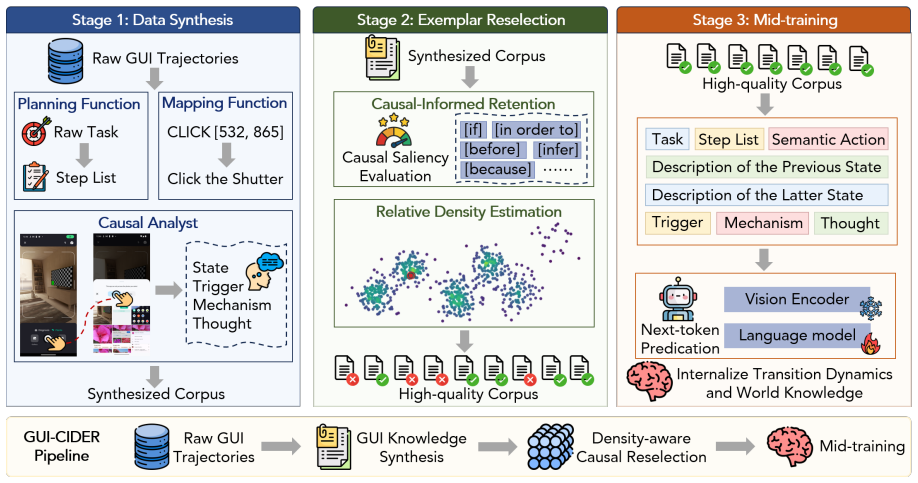
GUI-CIDER works by synthesizing text from GUI trajectories that captures static planning and dynamic causal knowledge, then reselection the exemplars to reward causal structures and penalize redundancy, and finally mid-training on this refined corpus to embed the knowledge explicitly in the agent.
What carries the argument
Causal Internalization and Density-aware Exemplar Reselection, a three-stage process that converts trajectory data into filtered text for mid-training.
If this is right
- Agents gain explicit understanding of GUI operations beyond action annotations.
- Task success rates increase on completion benchmarks.
- Knowledge benchmarks show improved comprehension of interface mechanics.
- Less dependence on multi-agent systems or reward-based training for knowledge acquisition.
Where Pith is reading between the lines
- Similar distillation techniques could apply to other embodied agents or robotic control tasks.
- Combining this mid-training with subsequent RL might amplify gains in real-world deployment.
- Testing on more diverse GUI environments could reveal limits of the causal distillation approach.
Load-bearing premise
That distilling trajectories into text descriptions of causal knowledge and then mid-training on them produces genuine comprehension of GUI operations rather than another layer of memorization.
What would settle it
An experiment where the trained agent encounters novel GUI elements or operations not present in the synthesized data and fails to demonstrate causal reasoning or successful adaptation.
Figures




read the original abstract
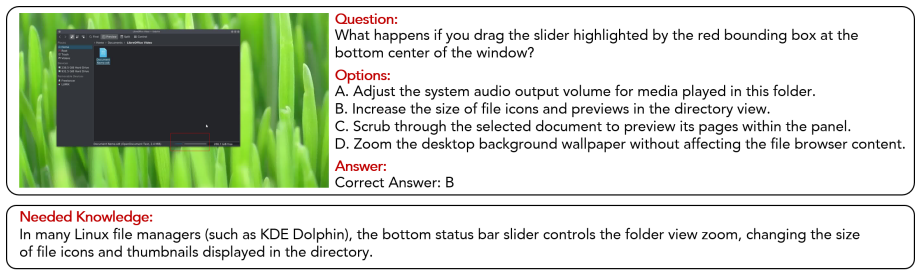
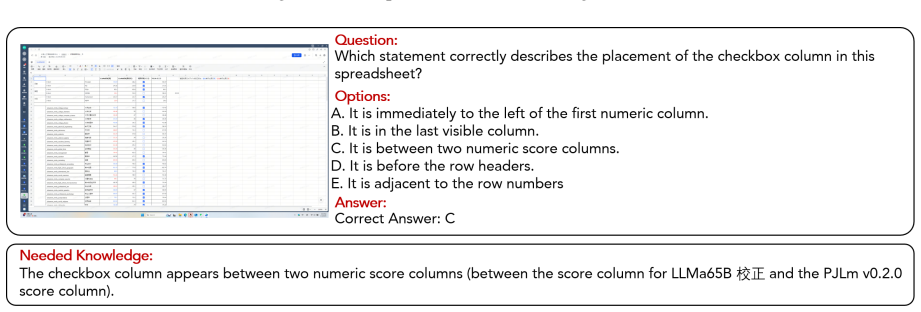
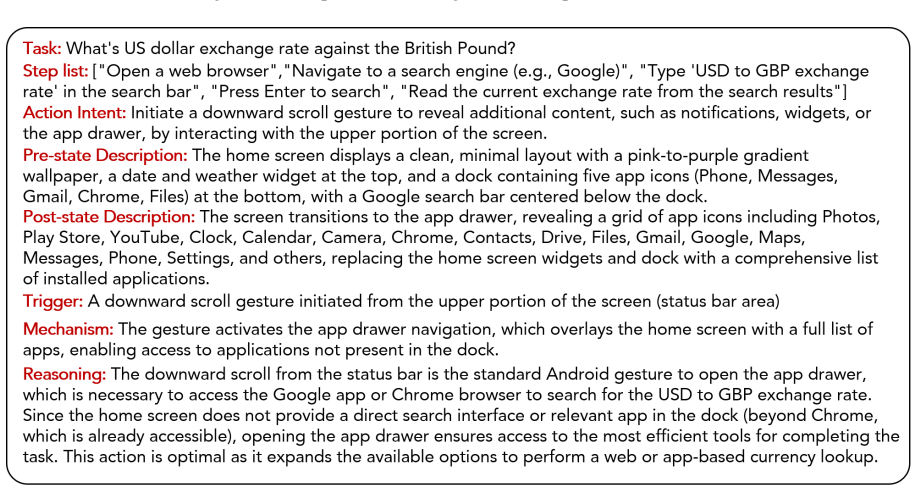
Despite the rapid progress of multimodal large language models in building Graphical User Interface (GUI) agents, their real-world task completion is fundamentally bottlenecked by a lack of world knowledge about GUI operations. Existing solutions typically rely on expensive multi-agent scaffolding or conventional post-training paradigms, such as Supervised Fine-Tuning (SFT) and Reinforcement Learning (RL). However, post-training only allows agents to implicitly absorb world knowledge through action annotations or reward signals, leading to inefficient trajectory memorization rather than genuine comprehension. Therefore, an approach that enables explicit learning of this knowledge is imperative. To this end, we propose GUI-CIDER, a mid-training method that explicitly internalizes GUI world knowledge through Causal Internalization and Density-aware Exemplar Reselection. GUI-CIDER operates in three stages: (1) data synthesis, which distills static planning and dynamic causal knowledge from GUI trajectories into text; (2) exemplar reselection, which filters the corpus by rewarding causal structures and penalizing semantic redundancy; and (3) mid-training, where the refined data is used to embed the acquired knowledge. Extensive experiments on two GUI knowledge benchmarks and three task completion benchmarks demonstrate that GUI-CIDER consistently improves both the agent's understanding of GUI operations and its task success rates.The codes are available at https://github.com/Wuzheng02/GUI-CIDER.
Editorial analysis
A structured set of objections, weighed in public.
Referee Report
Summary. The paper proposes GUI-CIDER, a three-stage mid-training method for GUI agents based on multimodal LLMs. Stage 1 distills static planning and dynamic causal knowledge from GUI trajectories into text descriptions. Stage 2 applies density-aware exemplar reselection that rewards causal structures and penalizes semantic redundancy. Stage 3 performs mid-training on the refined corpus to explicitly internalize the knowledge. The central claim is that this yields consistent gains in GUI operation understanding on two knowledge benchmarks and task success rates on three completion benchmarks, outperforming standard SFT and RL post-training.
Significance. If the results hold and the gains are attributable to explicit causal internalization rather than data curation or volume effects, the work would offer a practical alternative to expensive scaffolding or reward-based post-training for embedding world knowledge in GUI agents. The open-sourced code is a clear positive. Significance is tempered by the absence of controls that would isolate the proposed mechanism.
major comments (2)
- [§5] §5 (Experiments): No ablation is reported that holds total training tokens or data volume fixed while removing the causal distillation step. The performance lift on the two GUI knowledge benchmarks and three task benchmarks is therefore compatible with the interpretation that the method supplies additional curated next-token data drawn from the same trajectory distribution used for synthesis.
- [§5.3] §5.3 (OOD evaluation): The manuscript presents no out-of-distribution probe requiring inference over GUI state transitions absent from the synthesis corpus. Without such a test, the claim that mid-training produces 'genuine comprehension' rather than refined pattern fitting on the chosen benchmarks cannot be distinguished from memorization of the distillation distribution.
minor comments (2)
- [Abstract] Abstract: The statement that GUI-CIDER 'consistently improves' both understanding and success rates supplies no quantitative deltas, error bars, or baseline names; a one-sentence summary of the magnitude of gains would improve readability.
- [§3] §3 (Method): The notation for the density-aware reselection objective is introduced without an explicit equation; adding a numbered equation would clarify how the causal reward and redundancy penalty are combined.
Simulated Author's Rebuttal
We thank the referee for the constructive feedback. We address each major comment below and outline revisions that will strengthen the isolation of causal internalization effects.
read point-by-point responses
-
Referee: [§5] §5 (Experiments): No ablation is reported that holds total training tokens or data volume fixed while removing the causal distillation step. The performance lift on the two GUI knowledge benchmarks and three task benchmarks is therefore compatible with the interpretation that the method supplies additional curated next-token data drawn from the same trajectory distribution used for synthesis.
Authors: We agree that an ablation controlling for total training tokens and data volume while removing the causal distillation step would more cleanly isolate the contribution of our mechanism from curation or volume effects. In the revised manuscript we will add this control by constructing a matched-volume corpus drawn directly from the original trajectories (without causal text synthesis) and report comparative results on all five benchmarks. revision: yes
-
Referee: [§5.3] §5.3 (OOD evaluation): The manuscript presents no out-of-distribution probe requiring inference over GUI state transitions absent from the synthesis corpus. Without such a test, the claim that mid-training produces 'genuine comprehension' rather than refined pattern fitting on the chosen benchmarks cannot be distinguished from memorization of the distillation distribution.
Authors: We acknowledge that an explicit probe on state transitions absent from the synthesis corpus would provide stronger evidence against memorization. The OOD results in §5.3 already use benchmarks whose GUI elements and task distributions differ from the training trajectories; we will augment the revision with a new experiment that evaluates performance on held-out synthetic trajectories containing novel state transitions, thereby directly testing generalization beyond the distillation distribution. revision: yes
Circularity Check
No circularity: empirical method with no equations or self-referential derivations
full rationale
The paper presents GUI-CIDER as a three-stage empirical pipeline (data synthesis from trajectories, density-aware reselection, and mid-training) whose central claims rest on benchmark improvements rather than any mathematical derivation chain. No equations, fitted parameters, or predictions appear in the abstract or described method. No self-citations are invoked as load-bearing uniqueness theorems, and the process does not reduce any claimed output to its inputs by construction. The derivation is therefore self-contained as an engineering procedure evaluated externally on benchmarks.
Axiom & Free-Parameter Ledger
axioms (1)
- domain assumption Post-training via SFT or RL leads only to trajectory memorization rather than genuine comprehension of GUI operations.
Reference graph
Works this paper leans on
-
[1]
Deepseek-v3 technical report.arXiv preprint arXiv:2412.19437. Yuhang Liu, Zeyu Liu, Shuanghe Zhu, Pengxiang Li, Congkai Xie, Jiasheng Wang, Xueyu Hu, Xiaotian Han, Jianbo Yuan, Xinyao Wang, and 1 others. 2026. Infigui-g1: Advancing gui grounding with adaptive 9 exploration policy optimization. InProceedings of the AAAI Conference on Artificial Intelligenc...
work page internal anchor Pith review Pith/arXiv arXiv 2026
-
[2]
Fei Tang, Zhangxuan Gu, Zhengxi Lu, Xuyang Liu, Shuheng Shen, Changhua Meng, Wen Wang, Wenqi Zhang, Yongliang Shen, Weiming Lu, and 1 others
Llm-based multi-agent decision-making: Chal- lenges and future directions.IEEE Robotics and Automation Letters. Fei Tang, Zhangxuan Gu, Zhengxi Lu, Xuyang Liu, Shuheng Shen, Changhua Meng, Wen Wang, Wenqi Zhang, Yongliang Shen, Weiming Lu, and 1 others
-
[3]
arXiv preprint arXiv:2504.13865 , year=
Gui-g2: Gaussian reward modeling for gui grounding. InProceedings of the AAAI Conference on Artificial Intelligence, volume 40, pages 33214– 33222. Fei Tang, Haolei Xu, Hang Zhang, Siqi Chen, Xingyu Wu, Yongliang Shen, Wenqi Zhang, Guiyang Hou, Zeqi Tan, Yuchen Yan, and 1 others. 2025. A sur- vey on (m) llm-based gui agents.arXiv preprint arXiv:2504.13865...
-
[4]
arXiv preprint arXiv:2602.09082 , year=
Ui-venus-1.5 technical report.arXiv preprint arXiv:2602.09082. Chengying Tu, Xuemiao Zhang, Rongxiang Weng, Rumei Li, Chen Zhang, Yang Bai, Hongfei Yan, Jin- gang Wang, and Xunliang Cai. 2025. A survey on llm mid-training.arXiv preprint arXiv:2510.23081. Junyang Wang, Haiyang Xu, Haitao Jia, Xi Zhang, Ming Yan, Weizhou Shen, Ji Zhang, Fei Huang, and Jitao...
-
[5]
InFindings of the Association for Computational Linguistics: EMNLP 2024, pages 12016–12031
Android in the zoo: Chain-of-action-thought for gui agents. InFindings of the Association for Computational Linguistics: EMNLP 2024, pages 12016–12031. Zhuosheng Zhang and Aston Zhang. 2024. You only look at screens: Multimodal chain-of-action agents. InFindings of the Association for Computational Linguistics: ACL 2024, pages 3132–3149. Yuqi Zhou, Sunhao...
2024
discussion (0)
Sign in with ORCID, Apple, or X to comment. Anyone can read and Pith papers without signing in.