REVIEW 4 major objections 5 minor 124 references
Runaway O-type stars make up 17.5% of the local volume-complete population, versus 7.0% for B-type stars.
Reviewed by Pith at T0; open to challenge. T0 means a machine referee read the full paper against a public rubric. the ladder, T0–T4 →
T0 review · deepseek-v4-flash
2026-08-02 01:30 UTC pith:56CIZHZR
load-bearing objection Useful first volume-complete runaway fractions; the headline uncertainties understate the Poisson noise and the 3D check does not actually validate the 2D-selected fractions. the 4 major comments →
Runaway OB stars within 1 kpc of the Sun
The pith
A machine-rendered reading of the paper's core claim, the machinery that carries it, and where it could break.
Core claim
Using a volume-complete catalogue of 40 O-type stars and 24,488 B-type stars within 1 kpc of the Sun, the paper measures runaway fractions of 17.5% for O-type stars and 7.0% for B-type stars, applying a fixed two-dimensional peculiar-velocity threshold of 23 km/s. This is the first measurement of the runaway fraction from a spatially complete local sample, and it confirms that O-type stars are ejected more often than B-type stars. The O-type fraction substantially exceeds the at-most-2% prediction of binary-supernova-scenario simulations, leading the authors to conclude that most O-type runaways are produced by dynamical ejection in dense clusters. They also calibrate the two-dimensional ana
What carries the argument
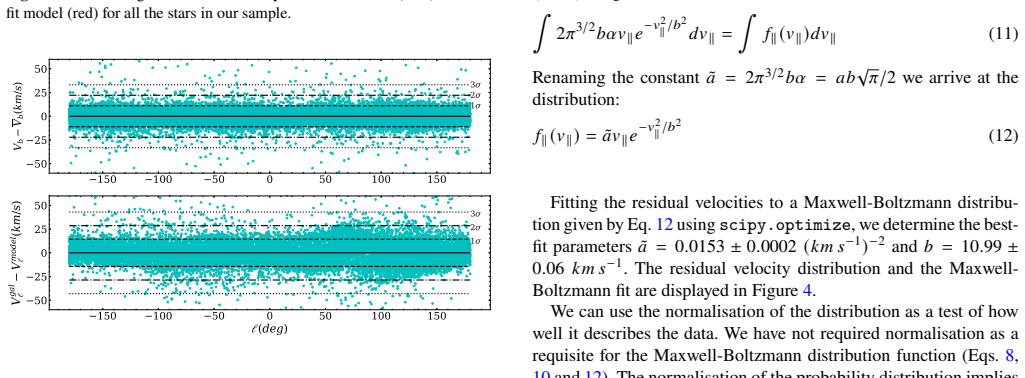
The central machinery is a Galactic rotation model, expanded to first order in galactocentric radius and fit to proper motions using a likelihood that handles asymmetric velocity uncertainties. Residual peculiar velocities are then fit to a Maxwell-Boltzmann distribution, whose shape sets a 23 km/s runaway threshold where the observed excess over the model becomes clear. A Monte Carlo propagation over distance, proper-motion, and model-parameter uncertainties converts each star's peculiar velocity into a runaway probability and yields the reported fractions with asymmetric error bars.
Load-bearing premise
The volume-complete catalogue is over 95% complete for OB stars within 1 kpc and its astro-photometric distances are accurate, and because peculiar velocities are computed from those distances, any systematic distance error or hidden incompleteness would bias both the threshold and the runaway fractions.
What would settle it
A complete radial-velocity survey of the same 1-kpc OB sample, combined with a re-derivation of distances from Gaia parallaxes, would settle the claim: if the 3D runaway fraction for O-type stars drops toward or below the binary-supernova prediction, or if the distances shift enough to change spectral classifications, the measured 17.5% figure would not survive.
If this is right
- If the O-type runaway fraction is truly 17.5%, then previous magnitude- or spectroscopically-selected samples were biased toward catching runaways, and volume-complete samples give lower, cleaner fractions.
- The O-type fraction exceeding the binary-supernova ceiling implies that most O-type runaways were ejected dynamically, placing constraints on the density and binary content of their birth clusters.
- The B-type runaway fraction of about 7% is consistent with a mix of binary-supernova and dynamical ejections, suggesting that the two channels contribute differently for O and B stars.
- Runaway stars show a more diffuse vertical distribution than the general OB population, meaning stars found far from the Galactic plane are more likely to be runaways.
- The 3D calibration supports the use of 2D proper-motion selections for statistical studies, though individual stars moving mostly along the line of sight may be missed.
Where Pith is reading between the lines
- If the 17.5% O-type fraction holds, then the roughly seven O-type runaways within 1 kpc are promising targets for tracing back to their birth clusters, which would test predictions about ejection ages and cluster densities.
- A direct test would be to repeat this analysis on the same volume-complete sample once full radial velocities are available for more stars; the authors' own examples (stars with high radial but low tangential peculiar velocity) suggest some runaways will only be found in 3D.
- The threshold choice matters: because the runaway fraction depends steeply on the adopted velocity cut, inter-study comparisons should use identical thresholds or identical Maxwell-Boltzmann fitting procedures.
- The assumption of axisymmetric Galactic rotation could be relaxed using a non-axisymmetric model; the small residual structure the authors note around l=80 degrees hints that local spiral structure may perturb peculiar velocities at the few-km/s level.
Editorial analysis
A structured set of objections, weighed in public.
Referee Report
Summary. The paper identifies runaway OB stars in the volume-complete Quintana et al. (2025) catalogue within 1 kpc of the Sun. It converts Gaia proper motions to transverse velocities, fits a first-order Galactic rotation model with MCMC, and computes 2D peculiar velocities for 40 O-type and 24,488 B-type stars. Runaways are selected with a fixed 2D velocity threshold of 23 km/s (Method 1) and with a 3-sigma normalized-velocity criterion (Method 2). The authors report runaway fractions of 17.5+0.1−2.5% for O stars and 7.0±0.1% for B stars by Method 1, and lower values by Method 2. They calibrate the 2D threshold using a 3,884-star subsample with radial velocities, compare with literature, and interpret the O-type fraction as evidence that dynamical ejection dominates over the binary-supernova channel.
Significance. If the central estimates are correct, this is a valuable, volume-complete measurement of runaway fractions, and the comparison with BSS/DES predictions is potentially important. The paper has real strengths: use of a nearly complete local sample, explicit Monte Carlo propagation of proper-motion and model uncertainties, a 3D calibration subsample, and careful comparison with heterogeneous literature values. However, the headline numbers rest on a 2D projection assumption that is asserted rather than tested, a threshold calibrated on the same data that are classified, and uncertainty reporting that omits finite-sample Poisson uncertainty. These issues are fixable but need to be addressed before the conclusions can be taken as established.
major comments (4)
- [Table 5 and §4.2] The listed counts and fractions are internally inconsistent. Method 1 B-type: 1502/24488 = 6.1%, not 7.0%. Method 2 O-type: 5/40 = 12.5%, not 10.0%. Method 2 B-type: 861/24488 = 3.5%, not 2.5%. Either the N_runaways columns or the quoted fractions are wrong. Since §4.2, the abstract, and the discussion rely on these values, the table and text must be reconciled.
- [§4.3, §5.1] The 3D calibration validates only the threshold scaling (23 km/s × sqrt(3/2) ≈ 28 km/s), not the recovered runaway fraction. The 3,884-star RV subsample is not used to compare 2D and 3D classifications for the same stars. The statement in §5.1 that 'the overall statistics of the sample should be similar if we assume spatial isotropy' is an assumption, not a test. If ejection directions are anisotropic (e.g., preferentially in the plane), the 2D fraction can be biased. The authors should compute 3D fractions on the RV subsample or perform an injection/recovery simulation to quantify projection bias.
- [§3.3, §4.1, Eq. (14)] The 23 km/s threshold is circular: it is derived from the same residual-velocity distribution that includes the runaway stars being selected. The Maxwell-Boltzmann fit in §3.3 is made to all residual velocities, and the authors themselves note (N = 0.92 ± 0.02) that the distribution is not perfectly Maxwellian. Setting the threshold where observed density is twice the model prediction does not establish 'more likely than not to be a runaway' in a probabilistic sense. The sensitivity of the resulting fractions to the fitting range and to iterative removal of high-velocity stars should be quantified.
- [§4.2, Table 5, abstract] The reported uncertainties for the O-type fraction are misleading as headline values. The Monte Carlo interval (+0.1/−2.5%) reflects only velocity/model perturbations, while the finite-sample Poisson uncertainty is 6.6% (Table 5). The abstract should either report the combined uncertainty or explicitly state that the quoted interval excludes Poisson sampling noise. Without this, the comparison with literature values and with the 2% BSS upper limit in §5.4 is presented with a confidence that the data do not support.
minor comments (5)
- [Abstract] The abstract says 24,487 B-type stars, while the text and Table 5 say 24,488. Please make this consistent.
- [§2.2] The text says the final O list contains 48 sources, but the three subsets sum to 49 (36+9+4), and the final sample is 40 O-type stars. The path from 48/49 to 40 (Hipparcos-only proper motion exclusions) should be stated explicitly.
- [Table 5] For the reader's benefit, the 'Poisson noise' column should be labelled as sqrt(N_runaways)/N_stars, as in Eq. (17), and the Method-1 O row should show the combined asymmetric interval including the Poisson term, or explain why it is omitted.
- [Figure 4 caption] There are typographical errors in the caption: 'Ma)(ell-Boltzman' and 'Runa(ay selection threshold'. Please correct.
- [§5.3] The notation '17.5+0.1−2.5 ± 6.6%' mixes asymmetric and symmetric uncertainties ambiguously. Define the convention for combining MC and Poisson uncertainties.
Circularity Check
No significant circularity: the runaway fractions are empirical tail counts above a data-calibrated threshold, and the self-citations used are not load-bearing reductions.
full rationale
The central derivation is a measurement, not a prediction from fitted parameters. Residual velocities are constructed by subtracting a Galactic rotation model fitted to the sample; runaway stars are then selected by two empirical criteria. The reported fractions are the tail fractions above the chosen threshold, so there is no equation in which a fitted parameter is renamed as the target result. The Maxwell-Boltzmann fit in §3.3 is used to motivate the 23 km/s threshold, and the fit is performed on the same residual-velocity distribution that contains the runaway tail. This is a genuine methodological weakness: the threshold is not independent of the population it is applied to, and the paper itself notes the distribution is not perfectly Maxwellian because ejected stars are included. However, the fraction is not algebraically forced by the fit; it is the observed survival function at that threshold, so this is a calibration concern rather than a circular reduction under the required standard. The Q25 catalogue is authored by overlapping authors, but it is an external, published astro-photometric catalogue with its own SED-fitting methodology and is supplemented by GOSC cross-matching; the completeness claim is not derived from the present paper's results. The 3D calibration in §4.3 checks threshold consistency with the sqrt(3/2) scaling and does not recompute the runaway fraction in 3D, and the paper explicitly concedes that some 2D-selected runaways would fail a 3D threshold. This is an unvalidated isotropy assumption, not circularity. Overall, no load-bearing step reduces to its own inputs, so the circularity score is low.
Axiom & Free-Parameter Ledger
free parameters (11)
- V_phi,0 (mean azimuthal Galactic rotation velocity) =
236.52 ± 0.11 km/s
- dV_phi/dR (rotation curve shear) =
-0.73 ± 0.17 km/s/kpc
- V_R,0 (mean radial velocity component) =
0.44 ± 0.10 km/s
- dV_R/dR (radial shear) =
-3.70 ± 0.29 km/s/kpc
- sigma (residual velocity dispersion in l) =
11.11 ± 0.06 km/s
- Maxwell-Boltzmann 2D normalization a_tilde =
0.0153 ± 0.0002 (km/s)^-2
- Maxwell-Boltzmann 2D scale b =
10.99 ± 0.06 km/s
- Maxwell-Boltzmann 3D normalization a_3D =
(7.1 ± 0.2) × 10^-4 (km/s)^-3
- Maxwell-Boltzmann 3D scale b_3D =
13.9 ± 0.2 km/s
- Method 1 2D peculiar-velocity threshold =
23 km/s (2D); 28 km/s (3D)
- Method 2 sigma factor =
3
axioms (7)
- domain assumption Q25 catalogue is >95% complete for OB stars within 1 kpc
- domain assumption SED-fitted effective temperatures from Q25 correctly classify B-type members
- domain assumption Galactic rotation model truncation to first order and axisymmetry
- domain assumption Velocity distribution of non-runaway stars is Maxwell-Boltzmann
- domain assumption Distances from Q25, Bailer-Jones et al., and Hipparcos are unbiased
- domain assumption 3D cross-match subset is representative and velocities are isotropic
- domain assumption GOSC and Garmany et al. catalogues contain all O-type stars within 1 kpc
read the original abstract
Runaway stars are high-velocity stars ejected from their birth environments that can provide insights into the kinematic history of the stellar cluster they were ejected from. We derived runaway star probabilities for 40 O-type stars and $24,487$ B-type stars taken from a recently published volume-complete sample of OB stars within 1 kpc of the Sun. We fit a Galactic rotation model to the observed proper motions of these stars and identify runaway stars using both a fixed 2D peculiar velocity threshold of $23\,km\,s^{-1}$ and by comparing individual peculiar velocities to the dispersion of the whole sample. We find runaway fractions of $17.5^{+0.1}_{-2.5}\%$ for O-type stars and $6.9\pm0.1\%$ for B-type stars; both using the fixed velocity threshold method. These values are consistent with previous studies, but with differences that are largely attributable to the underlying samples of OB stars used in various studies to identify runaway stars and to variations in the methods used to select them.
Figures




Reference graph
Works this paper leans on
-
[1]
The Villafranca catalog of Galactic OB groups. I. Systems with O2-O3.5 stars. , keywords =. doi:10.1051/0004-6361/202038228 , archivePrefix =. 2009.05773 , primaryClass =
Pith/arXiv arXiv 2009
-
[2]
Search for Galactic runaway stars using Gaia Data Release 1 and HIPPARCOS proper motions. , keywords =. doi:10.1051/0004-6361/201832787 , archivePrefix =. 1804.06915 , primaryClass =
-
[3]
A Comprehensive Search for Stellar Bowshock Nebulae in the Milky Way: A Catalog of 709 Mid-infrared Selected Candidates. , keywords =. doi:10.3847/0067-0049/227/2/18 , archivePrefix =. 1609.02204 , primaryClass =
-
[4]
On the kinematics of a runaway Be star population. , keywords =. doi:10.1093/mnras/sty980 , archivePrefix =. 1804.05849 , primaryClass =
-
[5]
Galactic runaway O and Be stars found using Gaia DR3. , keywords =. doi:10.1051/0004-6361/202346613 , archivePrefix =. 2311.01827 , primaryClass =
-
[7]
The Origins and Evolutionary Status of B Stars Found Far from the Galactic Plane. II. Kinematics and Full Sample Analysis. , keywords =. doi:10.1086/504079 , archivePrefix =. astro-ph/0603238 , primaryClass =
-
[8]
E-BOSS: an Extensive stellar BOw Shock Survey. I. Methods and first catalogue. , keywords =. doi:10.1051/0004-6361/201118116 , archivePrefix =. 1109.3689 , primaryClass =
-
[9]
E-BOSS: An Extensive stellar BOw Shock Survey. II. Catalogue second release. , keywords =. doi:10.1051/0004-6361/201424676 , archivePrefix =. 1504.04264 , primaryClass =
-
[10]
Kinematics of the Central Stars Powering Bowshock Nebulae and the Large Multiplicity Fraction of Runaway OB Stars. , keywords =. doi:10.3847/1538-3881/ac7f2b , archivePrefix =. 2206.09281 , primaryClass =
-
[11]
Boletin de los Observatorios Tonantzintla y Tacubaya , keywords =
Run-away Stars as the Result of the Gravitational Collapse of Proto-stellar Clusters. Boletin de los Observatorios Tonantzintla y Tacubaya , keywords =
-
[12]
, keywords =
On the Origin of the Runaway Stars. , keywords =
-
[13]
Runaway Stars from Young Star Clusters Containing Initial Binaries. II. A Mass Spectrum and a Binary Energy Spectrum. , keywords =. doi:10.1086/115354 , adsurl =
-
[14]
, year = 1961, month = may, volume =
On the origin of the O- and B-type stars with high velocities (the ``run-away'' stars), and some related problems. , year = 1961, month = may, volume =
1961
-
[15]
The origin of massive O-type field stars: II. Field O stars as runaways. , keywords =. doi:10.1051/0004-6361:20042489 , archivePrefix =. astro-ph/0503337 , primaryClass =
-
[16]
The Binary Frequency and Origin of the OB Runaway Stars. , keywords =. doi:10.1086/191118 , adsurl =
-
[17]
The Properties of Dynamically Ejected Runaway and Hyper-runaway Stars. , keywords =. doi:10.1088/0004-637X/751/2/133 , archivePrefix =. 1202.2356 , primaryClass =
-
[18]
Dynamical ejections of massive stars from young star clusters under diverse initial conditions. , keywords =. doi:10.1051/0004-6361/201628233 , archivePrefix =. 1604.00006 , primaryClass =
-
[19]
Hyper-velocity and tidal stars from binaries disrupted by a massive Galactic black hole. , keywords =. doi:10.1038/331687a0 , adsurl =
-
[20]
High-velocity stars from close interaction of a globular cluster and a supermassive black hole. , keywords =. doi:10.1093/mnras/stv2123 , archivePrefix =. 1509.03170 , primaryClass =
-
[21]
High-velocity stars from the interaction of a globular cluster and a massive black hole binary. , keywords =. doi:10.1093/mnras/stw531 , archivePrefix =. 1510.08310 , primaryClass =
-
[22]
Morphological astronomy
-
[23]
The Characteristics of High-Velocity O and B Stars Which Are Ejected from Supernovae in Binary Systems. , keywords =. doi:10.1086/317190 , archivePrefix =. astro-ph/0005021 , primaryClass =
-
[24]
The two-step ejection of massive stars and the issue of their formation in isolation. , keywords =. doi:10.1111/j.1365-2966.2010.16376.x , archivePrefix =. 1001.3671 , primaryClass =
arXiv 2010
-
[25]
Runaway OB Stars in the Small Magellanic Cloud. III. Updated Kinematics and Insights into Dynamical versus Supernova Ejections. , keywords =. doi:10.3847/1538-4357/ad3909 , archivePrefix =. 2403.17198 , primaryClass =
-
[26]
Classical OBe Stars as Post-supernova Runaways: Confirming Binary Origins. , keywords =. doi:10.3847/1538-4357/ac8988 , archivePrefix =. 2208.10408 , primaryClass =
-
[27]
Stringent upper limit on Be star fractions produced by binary interaction. , keywords =. doi:10.1051/0004-6361/202141269 , archivePrefix =. 2106.12263 , primaryClass =
-
[28]
Improving the open cluster census. II. An all-sky cluster catalogue with Gaia DR3. , keywords =. doi:10.1051/0004-6361/202346285 , archivePrefix =. 2303.13424 , primaryClass =
-
[29]
What is a globular cluster? An observational perspective. , keywords =. doi:10.1007/s00159-019-0119-3 , archivePrefix =. 1911.02835 , primaryClass =
Pith/arXiv arXiv 1911
-
[30]
Characterisation of young stellar clusters. , keywords =. doi:10.1051/0004-6361/201219695 , archivePrefix =. 1209.1585 , primaryClass =
-
[31]
The massive star population of Cygnus OB2. , keywords =. doi:10.1093/mnras/stv323 , archivePrefix =. 1502.05718 , primaryClass =
-
[32]
The Gaia-ESO Survey: empirical estimates of stellar ages from lithium equivalent widths (EAGLES). , keywords =. doi:10.1093/mnras/stad1293 , archivePrefix =. 2304.12197 , primaryClass =
-
[33]
Kinematics of OB-associations in Gaia epoch. , keywords =. doi:10.1093/mnras/stx2225 , archivePrefix =. 1708.08337 , primaryClass =
-
[34]
The kinematics of the Scorpius-Centaurus OB association from Gaia DR1. , keywords =. doi:10.1093/mnras/sty207 , archivePrefix =. 1801.08540 , primaryClass =
-
[35]
Massive stars in the hinterland of the young cluster, Westerlund 2. , keywords =. doi:10.1093/mnras/sty1905 , archivePrefix =. 1807.06486 , primaryClass =
-
[36]
The O star hinterland of the Galactic starburst, NGC 3603. , keywords =. doi:10.1093/mnras/stz864 , archivePrefix =. 1903.09053 , primaryClass =
Pith/arXiv arXiv 1903
-
[37]
Proper motions of OB stars in the far Carina Arm. , keywords =. doi:10.1093/mnras/stab2905 , archivePrefix =. 2110.02081 , primaryClass =
-
[38]
The Galactic O-Star Spectroscopic Survey (GOSSS)
The Galactic O-star spectroscopic survey (GOSSS). Highlights of Spanish Astrophysics VI , year = 2011, editor =. doi:10.48550/arXiv.1010.5680 , archivePrefix =. 1010.5680 , primaryClass =
work page internal anchor Pith review Pith/arXiv arXiv doi:10.48550/arxiv.1010.5680 2011
-
[39]
The Be Star Spectra (BeSS) Database. , keywords =. doi:10.1088/0004-6256/142/5/149 , adsurl =
-
[40]
Massive Stars: From alpha to Omega , year = 2013, month = jun, eid =
First whole-sky results from the Galactic O-Star Spectroscopic Survey. Massive Stars: From alpha to Omega , year = 2013, month = jun, eid =. doi:10.48550/arXiv.1306.6417 , archivePrefix =. 1306.6417 , primaryClass =
-
[41]
The Galactic O-Star Spectroscopic Survey. I. Classification System and Bright Northern Stars in the Blue-violet at R -0.5ex 2500. , keywords =. doi:10.1088/0067-0049/193/2/24 , archivePrefix =. 1101.4002 , primaryClass =
-
[42]
Lucky Spectroscopy, an equivalent technique to Lucky Imaging. Spatially resolved spectroscopy of massive close visual binaries using the William Herschel Telescope. , keywords =. doi:10.1051/0004-6361/201832885 , archivePrefix =. 1804.03133 , primaryClass =
-
[43]
The Galactic O-Star Spectroscopic Survey (GOSSS). III. 142 Additional O-type Systems. , keywords =. doi:10.3847/0067-0049/224/1/4 , archivePrefix =. 1602.01336 , primaryClass =
-
[44]
The Galactic O-Star Spectroscopic Survey (GOSSS). II. Bright Southern Stars. , keywords =. doi:10.1088/0067-0049/211/1/10 , archivePrefix =. 1312.6222 , primaryClass =
-
[45]
MONOS: Multiplicity Of Northern O-type Spectroscopic systems. I. Project description and spectral classifications and visual multiplicity of previously known objects. , keywords =. doi:10.1051/0004-6361/201935359 , archivePrefix =. 1904.11385 , primaryClass =
Pith/arXiv arXiv 1904
-
[46]
Spectral Classification and Multicolour Photometry , year = 1973, editor =
Two-Dimensional Classificaiton of the HD Stars. Spectral Classification and Multicolour Photometry , year = 1973, editor =
1973
-
[47]
New and revised parameters for several southern OB binaries. , keywords =. doi:10.1051/0004-6361/201423455 , archivePrefix =. 1404.1686 , primaryClass =
-
[48]
The APOGEE-2 Survey of the Orion Star-forming Complex. II. Six-dimensional Structure. , keywords =. doi:10.3847/1538-3881/aad1f1 , archivePrefix =. 1805.04649 , primaryClass =
-
[49]
Not all stars form in clusters - measuring the kinematics of OB associations with Gaia. , keywords =. doi:10.1093/mnras/sty117 , archivePrefix =. 1801.03938 , primaryClass =
-
[50]
Internal motions in OB associations with Gaia DR2. , keywords =. doi:10.1093/mnras/staa454 , archivePrefix =. 2002.05044 , primaryClass =
Pith/arXiv arXiv 2002
-
[51]
The dynamics of the Vel cluster and nearby Vela OB2 association. , keywords =. doi:10.1093/mnras/staa939 , archivePrefix =. 2003.14209 , primaryClass =
Pith/arXiv arXiv 2003
-
[52]
OB Associations and their origins. , keywords =. doi:10.1016/j.newar.2020.101549 , archivePrefix =. 2011.09483 , primaryClass =
arXiv 2020
-
[53]
OB Associations. arXiv e-prints , keywords =. doi:10.48550/arXiv.2203.10007 , archivePrefix =. 2203.10007 , primaryClass =
work page internal anchor Pith review Pith/arXiv arXiv doi:10.48550/arxiv.2203.10007
-
[54]
Runaway Stars as Fossils of Sub-Cluster Mergers
Massive Star Cluster Formation II. Runaway Stars as Fossils of Sub-Cluster Mergers. arXiv e-prints , keywords =. doi:10.48550/arXiv.2405.12286 , archivePrefix =. 2405.12286 , primaryClass =
-
[55]
The early evolution of young massive clusters. II. The kinematic history of NGC 6618/M 17. , keywords =. doi:10.1051/0004-6361/202347383 , archivePrefix =. 2311.04174 , primaryClass =
-
[56]
Impacts of the Local arm on the local circular velocity inferred from the Gaia DR3 young stars in the Milky Way. , keywords =. doi:10.1093/mnras/stae158 , archivePrefix =. 2310.06831 , primaryClass =
-
[57]
A new kinematic model of the Galaxy: analysis of the stellar velocity field from Gaia Data Release 3. , keywords =. doi:10.1093/mnras/stae772 , archivePrefix =. 2307.08527 , primaryClass =
-
[58]
A geometric distance measurement to the Galactic center black hole with 0.3 , DOI= "10.1051/0004-6361/201935656", url= "https://doi.org/10.1051/0004-6361/201935656", journal =
-
[59]
The Galaxy in Context: Structural, Kinematic, and Integrated Properties. , keywords =. doi:10.1146/annurev-astro-081915-023441 , archivePrefix =. 1602.07702 , primaryClass =
-
[60]
Gaia EDR3 documentation Chapter 4: Astrometric data
-
[61]
emcee: The MCMC Hammer. , keywords =. doi:10.1086/670067 , archivePrefix =. 1202.3665 , primaryClass =
-
[62]
A Runaway Yellow Supergiant Star in the Small Magellanic Cloud. , keywords =. doi:10.3847/1538-3881/aab964 , archivePrefix =. 1803.02859 , primaryClass =
-
[63]
doi:10.1088/978-0-7503-1329-2 , adsurl =
Astrophysics of Red Supergiants. doi:10.1088/978-0-7503-1329-2 , adsurl =
-
[64]
APS April Meeting Abstracts , year = 2023, series =
Investigating Milky Way Red Supergiants. APS April Meeting Abstracts , year = 2023, series =
2023
-
[65]
A New Catalog of Asymptotic Giant Branch Stars in Our Galaxy. , keywords =. doi:10.3847/1538-4365/ac1274 , archivePrefix =. 2107.02350 , primaryClass =
-
[66]
A WISE view on extreme AGB stars. , keywords =. doi:10.1051/0004-6361/202142648 , archivePrefix =. 2203.09875 , primaryClass =
-
[67]
A Catalog of Known Galactic K-M Stars of Class I Candidate Red Supergiants in Gaia DR2. , keywords =. doi:10.3847/1538-3881/ab1cbd , archivePrefix =. 1905.03744 , primaryClass =
Pith/arXiv arXiv 1905
-
[68]
Rotating massive main-sequence stars. I. Grids of evolutionary models and isochrones. , keywords =. doi:10.1051/0004-6361/201016113 , archivePrefix =. 1102.0530 , primaryClass =
-
[69]
Star cluster formation from turbulent clumps. II. Gradual star cluster formation. , keywords =. doi:10.1093/mnras/sty3470 , archivePrefix =. 1809.04607 , primaryClass =
-
[70]
Stellar Spectral Classification
-
[71]
Swiss Society for Astrophysics and Astronomy , author=
Dynamics of Young Star Clusters and Associations: Saas-Fee Advanced Course 42. Swiss Society for Astrophysics and Astronomy , author=. 2015 , publisher=
2015
-
[72]
Galactic Dynamics: Second Edition
-
[73]
Revisiting the Cygnus OB associations. , keywords =. doi:10.1093/mnras/stab2663 , archivePrefix =. 2109.07499 , primaryClass =
-
[74]
Mapping the distribution of OB stars and associations in Auriga. , keywords =. doi:10.1093/mnras/stad1160 , archivePrefix =. 2304.08370 , primaryClass =
-
[75]
A new Gaia census of OB associations within 1 kpc. , keywords =. doi:10.1093/mnras/stag853 , archivePrefix =. 2512.05854 , primaryClass =
-
[76]
Massive runaway and walkaway stars. A study of the kinematical imprints of the physical processes governing the evolution and explosion of their binary progenitors. , keywords =. doi:10.1051/0004-6361/201833297 , archivePrefix =. 1804.09164 , primaryClass =
-
[77]
Active OB Stars: Structure, Evolution, Mass Loss, and Critical Limits , year = 2011, editor =
The multiplicity of massive stars. Active OB Stars: Structure, Evolution, Mass Loss, and Critical Limits , year = 2011, editor =. doi:10.1017/S1743921311011124 , archivePrefix =. 1009.4197 , primaryClass =
Pith/arXiv arXiv 2011
-
[78]
Binary systems and stellar mergers in massive star formation. , keywords =. doi:10.1111/j.1365-2966.2005.09360.x , archivePrefix =. astro-ph/0506689 , primaryClass =
arXiv 2005
-
[79]
Toward Understanding Massive Star Formation. , keywords =. doi:10.1146/annurev.astro.44.051905.092549 , archivePrefix =. 0707.1279 , primaryClass =
-
[80]
Colliding Winds from Early-Type Stars in Binary Systems. , keywords =. doi:10.1086/171013 , adsurl =
-
[81]
Rotational mixing in tidally locked massive main-sequence binaries
Rotational mixing in tidally locked massive main sequence binaries. Communications in Asteroseismology , keywords =. doi:10.48550/arXiv.0811.3981 , archivePrefix =. 0811.3981 , primaryClass =
work page internal anchor Pith review Pith/arXiv arXiv doi:10.48550/arxiv.0811.3981
discussion (0)
Sign in with ORCID, Apple, or X to comment. Anyone can read and Pith papers without signing in.