McKean-Vlasov Equations for Large Networks of Neurons with Adaptive Asymmetric Edges
Pith reviewed 2026-07-03 23:17 UTC · model grok-4.3
The pith
Large neural networks with delayed asymmetric connections reduce to a self-consistent autonomous SDE.
A machine-rendered reading of the paper's core claim, the machinery that carries it, and where it could break.
Core claim
For networks of neurons with adaptive asymmetric edges, where each j-to-k signal is tracked by its own stochastic process, the high-dimensional limit is given by a self-consistent autonomous SDE. The derivation accounts for the delayed interactions and yields an equation that can be analyzed directly. When applied to the visual cortex model, the SDE permits a bifurcation study that identifies conditions for the occurrence of Hopf bifurcations.
What carries the argument
The self-consistent autonomous SDE obtained as the mean-field limit of the network whose connections are represented by auxiliary propagation processes.
If this is right
- Network-level dynamics can be studied by solving the lower-dimensional autonomous SDE rather than the original high-dimensional system.
- Bifurcation analysis performed on the mean-field SDE directly supplies conditions for Hopf bifurcations in the visual cortex model.
- The same closure procedure applies to other biophysically detailed neuron models that include explicit propagation delays.
- Oscillatory regimes identified in the reduced system correspond to collective rhythms in the full network.
Where Pith is reading between the lines
- The same auxiliary-process technique could be tested on mean-field models of delayed interactions outside neuroscience, such as in delayed chemical kinetics.
- Adaptive edge rules may be varied to examine how asymmetry affects the location of Hopf points in the reduced SDE.
- Convergence of finite-N statistics to the autonomous SDE can be checked by increasing network size while holding connection statistics fixed.
Load-bearing premise
The auxiliary processes that track signal propagation between each pair of neurons have statistics that close exactly in the mean-field limit.
What would settle it
A large-scale numerical simulation of the original finite network whose empirical statistics deviate from those of the derived autonomous SDE as network size increases.
Figures


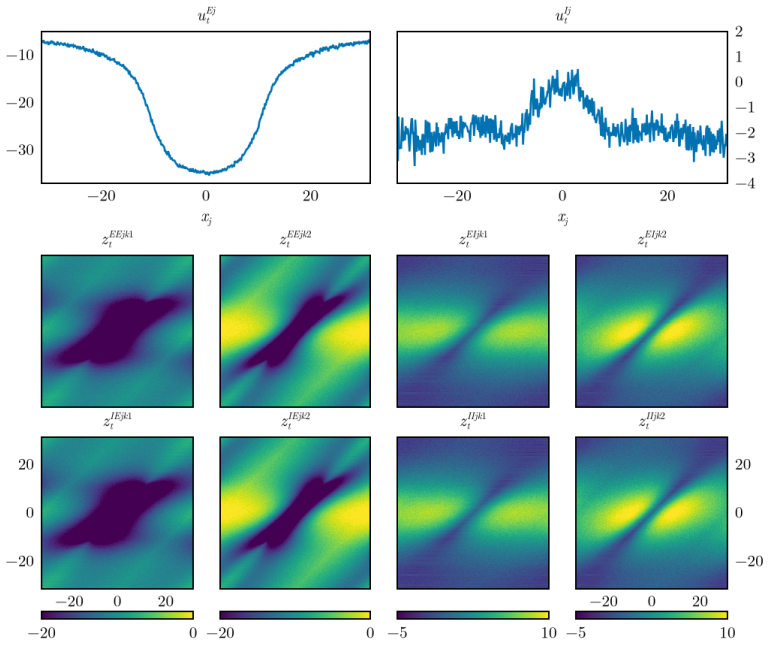

read the original abstract
Classical Mckean-Vlasov theory concerns high-dimensional particle systems for which the effect of one particle on another is instantaneous. However in many applications, particularly neuroscience, the effect of one particle on another is not instantaneous but delayed. For biophysically-accurate neuroscientific models, for each j to k one can introduce an additional stochastic process that describes the propagation of the signal from j to k. In this paper we determine a self-consistent autonomous SDE that describe the high-dimensional limit of such neural networks. We apply this system to a model of the visual cortex. Performing a bifurcation analysis, we determine conditions under which hopf bifurcations occur in the network.
Editorial analysis
A structured set of objections, weighed in public.
Referee Report
Summary. The manuscript extends McKean-Vlasov theory to neural networks with delayed, adaptive, and asymmetric interactions by augmenting the N-neuron system with one auxiliary SDE per directed edge to model signal propagation. It claims to derive a self-consistent autonomous SDE for the high-dimensional limit of the augmented system, applies the limit to a visual-cortex model, and performs a bifurcation analysis to obtain conditions for Hopf bifurcations.
Significance. If the closure of the O(N²) auxiliary processes into an autonomous McKean-Vlasov equation is rigorously justified, the work supplies a tractable mean-field description for delayed neural dynamics that preserves adaptivity and asymmetry, enabling bifurcation studies of collective oscillations without direct simulation of the full network.
major comments (2)
- [Abstract and derivation section] Abstract and the section deriving the mean-field limit: the claim that the empirical measure of the full augmented state (neurons plus per-edge auxiliary processes) converges to a closed autonomous McKean-Vlasov equation is the central result. Standard propagation-of-chaos arguments do not automatically extend to O(N²) auxiliary processes whose driving noises may be correlated across edges and whose coefficients are state-dependent due to adaptive weights; explicit tightness or martingale estimates on the edge processes are required to justify the closure.
- [Bifurcation analysis section] Bifurcation analysis section: the Hopf conditions are obtained from the limiting autonomous SDE. Because those conditions depend on the precise form of the closed coefficients, any gap in the justification of the limit (e.g., unaccounted correlations or closure approximations) directly affects the validity of the reported bifurcation thresholds for the visual-cortex model.
minor comments (2)
- Notation for the auxiliary edge processes and their dependence on the neuron states should be introduced with a clear diagram or table to aid readability.
- All parameters appearing in the visual-cortex application should be explicitly linked back to the coefficients of the limiting McKean-Vlasov equation.
Simulated Author's Rebuttal
We thank the referee for the careful reading and the recommendation of major revision. The comments correctly identify that the justification of the mean-field limit for the augmented system with O(N²) auxiliary processes requires explicit estimates beyond standard propagation-of-chaos arguments. We address each point below and will strengthen the manuscript accordingly.
read point-by-point responses
-
Referee: [Abstract and derivation section] Abstract and the section deriving the mean-field limit: the claim that the empirical measure of the full augmented state (neurons plus per-edge auxiliary processes) converges to a closed autonomous McKean-Vlasov equation is the central result. Standard propagation-of-chaos arguments do not automatically extend to O(N²) auxiliary processes whose driving noises may be correlated across edges and whose coefficients are state-dependent due to adaptive weights; explicit tightness or martingale estimates on the edge processes are required to justify the closure.
Authors: We agree that the large number of auxiliary edge processes and possible correlations in their driving noises require additional justification. Our derivation proceeds by considering the joint empirical measure over neuron states and all directed-edge auxiliary processes; the adaptive weights enter as state-dependent coefficients that remain Lipschitz under the model assumptions. To close the gap, the revised version will include a dedicated subsection with moment bounds, tightness via Aldous' criterion, and martingale estimates on the edge processes to establish convergence to the autonomous McKean-Vlasov limit. revision: yes
-
Referee: [Bifurcation analysis section] Bifurcation analysis section: the Hopf conditions are obtained from the limiting autonomous SDE. Because those conditions depend on the precise form of the closed coefficients, any gap in the justification of the limit (e.g., unaccounted correlations or closure approximations) directly affects the validity of the reported bifurcation thresholds for the visual-cortex model.
Authors: The Hopf bifurcation thresholds are indeed derived from the closed limiting equation. Once the mean-field limit is rigorously justified by the added estimates, the bifurcation conditions follow directly from the characteristic equation of the linearized limit system. In the revision we will add an explicit statement of the assumptions under which the limit holds and reference the new tightness arguments in the bifurcation section. revision: yes
Circularity Check
No circularity: limit derivation presented as independent mathematical result
full rationale
The paper derives a self-consistent autonomous McKean-Vlasov SDE as the high-dimensional limit of an augmented N-neuron system that includes auxiliary processes for delayed edge propagation. The abstract and description frame this as a propagation-of-chaos / mean-field limit result whose coefficients close on the limiting neuron measure. No quoted step reduces the target SDE to a fitted parameter, a self-definition, or a load-bearing self-citation whose content is itself unverified; the central claim is a standard-style limit theorem whose validity stands or falls on tightness/martingale estimates external to any fitted data. This is the normal non-circular outcome for a rigorous mean-field analysis.
Axiom & Free-Parameter Ledger
Reference graph
Works this paper leans on
-
[1]
Multivariate hawkes processes on inhomogeneous random graphs.Stochas- tic Processes and their Applications, 152:86–148, 10 2022
Zo´ e Agathe-Nerine. Multivariate hawkes processes on inhomogeneous random graphs.Stochas- tic Processes and their Applications, 152:86–148, 10 2022
2022
-
[2]
Large deviations for langevin spin glass dynamics.Probability Theory and Related Fields, 102, 1995
G Ben Arous and A Guionnet. Large deviations for langevin spin glass dynamics.Probability Theory and Related Fields, 102, 1995
1995
-
[3]
Cugliandolo-kurchan equations for dynamics of spin-glasses.Probability Theory and Related Fields, 136:619–660, 2006
Gerard Ben Arous, Amir Dembo, and Alice Guionnet. Cugliandolo-kurchan equations for dynamics of spin-glasses.Probability Theory and Related Fields, 136:619–660, 2006
2006
-
[4]
Atay and Axel Hutt
Fatihcan M. Atay and Axel Hutt. Neural fields with distributed transmission speeds and long- range feedback delays.SIAM Journal on Applied Dynamical Systems, 5:670–698, 2006
2006
-
[5]
Co-evolving vertex and edge dynamics in dense graphs
Siva Athreya, Frank den Hollander, and Adrian R¨ ollin. Co-evolving vertex and edge dynamics in dense graphs.arXiv preprint arXiv:2504.06493, 2025
work page internal anchor Pith review Pith/arXiv arXiv 2025
-
[6]
Neural fields and noise-induced patterns in neurons on large disordered networks.Submitted to SIAM Applied Mathematics, 2024
Daniele Avitabile and James Maclaurin. Neural fields and noise-induced patterns in neurons on large disordered networks.Submitted to SIAM Applied Mathematics, 2024
2024
-
[7]
Neural fields and noise-induced patterns in neurons on large disordered networks.SIAM Journal on Applied Mathematics, 86(2):427–456, 2026
Daniele Avitabile and James MacLaurin. Neural fields and noise-induced patterns in neurons on large disordered networks.SIAM Journal on Applied Mathematics, 86(2):427–456, 2026
2026
-
[8]
Infection models on dense dynamic random graphs.arXiv preprint arXiv:2602.14562, 2026
Simone Baldassarri, Peter Braunsteins, Frank den Hollander, and Michel Mandjes. Infection models on dense dynamic random graphs.arXiv preprint arXiv:2602.14562, 2026
-
[9]
Canard cascading in networks with adaptive mean-field coupling.Physical Review Letters, 133, 2024
J Balzer, R Berner, K L¨ udge, S Wieczorek, J¨ urgen Kurths, and Serhiy Yanchuk. Canard cascading in networks with adaptive mean-field coupling.Physical Review Letters, 133, 2024
2024
-
[10]
Adaptive dynamical networks, 8 2023
Rico Berner, Thilo Gross, Christian Kuehn, J¨ urgen Kurths, and Serhiy Yanchuk. Adaptive dynamical networks, 8 2023
2023
-
[11]
Pattern formation in random networks using graphons
Jason Bramburger and Matt Holzer. Pattern formation in random networks using graphons. SIAM Journal on Mathematical Analysis, 55:2150–2185, 2023
2023
-
[12]
Bressloff
Paul C. Bressloff. Spatiotemporal dynamics of continuum neural fields.Journal of Physics A: Mathematical and Theoretical, 45, 2012
2012
-
[13]
Dynamics of sparsely connected networks of excitatory and inhibitory spiking neurons.Journal of Computational Neuroscience, 8:183–208, 2000
Nicolas Brunel. Dynamics of sparsely connected networks of excitatory and inhibitory spiking neurons.Journal of Computational Neuroscience, 8:183–208, 2000
2000
-
[14]
Oxford university press, 2006
Gy¨ orgy Buzs´ aki.Rhythms of the Brain. Oxford university press, 2006
2006
-
[15]
J. A. Carrillo, R. S. Gvalani, G. A. Pavliotis, and A. Schlichting. Long-time behaviour and phase transitions for the mckean-vlasov equation on the torus.Archive for Rational Mechanics and Analysis, 235:635–690, 2020
2020
-
[16]
Jos´ e Antonio Carrillo, Antonio Esposito, and L´ aszl´ o Mikol´ as. Evolution equations on co- evolving graphs: long-time behaviour and the graph continuity equation.arXiv preprint arXiv:2504.10446, 2025
-
[17]
Chevallier, A
J. Chevallier, A. Duarte, E. L¨ ocherbach, and G. Ost. Mean field limits for nonlinear spatially extended hawkes processes with exponential memory kernels.Stochastic Processes and their Applications, 129:1–27, 2019
2019
-
[18]
Mean-field limit of generalized hawkes processes.Stochastic Processes and their Applications, 127:3870–3912, 2017
Julien Chevallier. Mean-field limit of generalized hawkes processes.Stochastic Processes and their Applications, 127:3870–3912, 2017
2017
-
[19]
Cook, Andre D
Blake J. Cook, Andre D. H. Peterson, Wessel Woldman, and John R. Terry. Neural field models: A mathematical overview and unifying framework.Mathematical Neuroscience and Applications, Volume 2, 3 2022
2022
-
[20]
Springer, 2014
Stephen Coombes, Peter beim Graben, Roland Potthast, and James Wright.Neural Fields: Theory and Applications. Springer, 2014
2014
-
[21]
Neurodynamics.Texts in applied mathematics, 2023
Stephen Coombes and Kyle CA Wedgwood. Neurodynamics.Texts in applied mathematics, 2023
2023
-
[22]
Crisanti and H
A. Crisanti and H. Sompolinsky. Path integral approach to random neural networks.Physical Review E, 98:1–20, 2018
2018
-
[23]
Sanov property, generalized i-projection and a conditional limit theorem.The Annals of Probability, pages 768–793, 1984
Imre Csisz´ ar. Sanov property, generalized i-projection and a conditional limit theorem.The Annals of Probability, pages 768–793, 1984
1984
-
[24]
Hawkes processes on large networks
Sylvain Delattre, Nicolas Fournier, and Marc Hoffmann. Hawkes processes on large networks. 32 Annals of Applied Probability, 26, 2016
2016
-
[25]
A note on dynamical models on random graphs and fokker–planck equations.Journal of Statistical Physics, 165(4):785– 798, 2016
Sylvain Delattre, Giambattista Giacomin, and Eric Lu¸ con. A note on dynamical models on random graphs and fokker–planck equations.Journal of Statistical Physics, 165(4):785– 798, 2016
2016
-
[26]
Springer, 1998
Amir Dembo and Ofer Zeitouni.Large Deviations Techniques and Applications 2nd Edition. Springer, 1998
1998
-
[27]
Bard Ermentrout and David H
G. Bard Ermentrout and David H. Terman.Mathematical Foundations of Neuroscience. Springer, 2010
2010
-
[28]
Pulsatile localized dynamics in delayed neural field equations in arbitrary dimension.SIAM Journal on Applied Mathematics, 74(5):1657– 1690, 2014
Gr´ egory Faye and Jonathan Touboul. Pulsatile localized dynamics in delayed neural field equations in arbitrary dimension.SIAM Journal on Applied Mathematics, 74(5):1657– 1690, 2014
2014
-
[29]
Spatially coherent oscillations in neural fields with inhibition and adaptation
Stefanos E Folias. Spatially coherent oscillations in neural fields with inhibition and adaptation. i. one-dimensional domains.Physical Review E, 113(1):014203, 2026
2026
-
[30]
Spatially coherent oscillations in neural fields with inhibition and adaptation
Stefanos E Folias. Spatially coherent oscillations in neural fields with inhibition and adaptation. ii. two-dimensional domains.Physical Review E, 113(1):014204, 2026
2026
-
[31]
Modeling networks of spiking neurons as interacting processes with memory of variable length.Journal de la Soci´ et´ e Fran¸ caise de Statistique, 157(1):17–32, 2016
Antonio Galves and Eva L¨ ocherbach. Modeling networks of spiking neurons as interacting processes with memory of variable length.Journal de la Soci´ et´ e Fran¸ caise de Statistique, 157(1):17–32, 2016
2016
-
[32]
Mean-field analysis of latent variable process models on dynamically evolving graphs with feedback effects.Probability Theory and Related Fields, pages 1–81, 2026
Ankan Ganguly, Konstantinos Spiliopoulos, and Daniel Sussman. Mean-field analysis of latent variable process models on dynamically evolving graphs with feedback effects.Probability Theory and Related Fields, pages 1–81, 2026
2026
-
[33]
Mean field limits of co- evolutionary signed heterogeneous networks.European Journal of Applied Mathematics, pages 1–44, 2025
Marios Antonios Gkogkas, Christian Kuehn, and Chuang Xu. Mean field limits of co- evolutionary signed heterogeneous networks.European Journal of Applied Mathematics, pages 1–44, 2025
2025
-
[34]
Continuum graph dynamics via population dynamics: well-posedness, duality and equilibria.Stochastic Pro- cesses and their Applications, 188:104670, 2025
Andreas Greven, Frank den Hollander, Anton Klimovsky, and Anita Winter. Continuum graph dynamics via population dynamics: well-posedness, duality and equilibria.Stochastic Pro- cesses and their Applications, 188:104670, 2025
2025
-
[35]
Springer, 2020
Moritz Helias and David Dahmen.Statistical Field Theory for Neural Networks. Springer, 2020
2020
-
[36]
Mapping dynamical systems with distributed time delays to sets of ordinary differential equations.Journal of Physics A: Mathematical and Theoretical, 56(34):345702, August 2023
Daniel Henrik Nevermann and Claudius Gros. Mapping dynamical systems with distributed time delays to sets of ordinary differential equations.Journal of Physics A: Mathematical and Theoretical, 56(34):345702, August 2023
2023
-
[37]
D. H. Hubel and T. N. Wiesel. Receptive fields, binocular interaction and functional architecture in the cat’s visual cortex.The Journal of Physiology, 160:106–154, 1962
1962
-
[38]
Receptive fields, binocular interaction and functional architecture in the cat’s visual cortex.Journal of Physiology, 160:106–154, 1962
David H Hubel and T Wiesel. Receptive fields, binocular interaction and functional architecture in the cat’s visual cortex.Journal of Physiology, 160:106–154, 1962
1962
-
[39]
Hurtado and C
P. Hurtado and C. Richards. A procedure for deriving new ODE models: using the generalized linear chain trick to incorporate phase-type distributed delay and dwell time assumptions. Mathematics and Applied Sciences in Engineering, 1:412–424, 2020
2020
-
[40]
P. J. Hurtado and A. S. Kirosingh. Generalizations of the ‘linear chain trick’: incorporating more flexible dwell time distributions into mean field ODE models.Journal of Mathematical Biology, 79:1831–1883, 2019
2019
-
[41]
Distributed nonlocal feedback delays may destabilize fronts in neural fields, distributed transmission delays do not.The Journal of Mathematical Neuroscience, 3:1–21, 2013
Axel Hutt and Linghai Zhang. Distributed nonlocal feedback delays may destabilize fronts in neural fields, distributed transmission delays do not.The Journal of Mathematical Neuroscience, 3:1–21, 2013
2013
-
[42]
Mean-field limit of non-exchangeable systems.Communications on Pure and Applied Mathematics, 78(4):651–741, 2025
Pierre-Emmanuel Jabin, David Poyato, and Juan Soler. Mean-field limit of non-exchangeable systems.Communications on Pure and Applied Mathematics, 78(4):651–741, 2025
2025
-
[43]
Mean field limit for stochastic particle systems
Pierre-Emmanuel Jabin and Zhenfu Wang. Mean field limit for stochastic particle systems. Active Particles, Volume 1: Advances in Theory, Models, and Applications, pages 379– 402, 2017
2017
-
[44]
Neurophysiological and computational principles of cortical rhythms in cog- nition.Physiological Reviews, 90:1195–1268, 2010
Xiao jing Wang. Neurophysiological and computational principles of cortical rhythms in cog- nition.Physiological Reviews, 90:1195–1268, 2010
2010
-
[45]
Field theory of electromagnetic brain activity, 1996
V K Jirsa and H Haken. Field theory of electromagnetic brain activity, 1996
1996
-
[46]
Universityof- CaliforniaPress, 1956
Mark Kac.Foundations of kinetic theory., volume III, chapter 1, pages 171–197. Universityof- CaliforniaPress, 1956
1956
-
[47]
Springer, 1991
Ioannis Karatzas and Steven Shreve.Brownian Motion and Stochastic Calculus 2nd Edition. Springer, 1991
1991
-
[48]
Kilpatrick and Bard Ermentrout
Zachary P. Kilpatrick and Bard Ermentrout. Wandering bumps in stochastic neural fields. SIAM Journal on Applied Dynamical Systems, 12:61–94, 2013
2013
-
[49]
Time-scale and noise optimality in self-organized critical adaptive networks
Christian Kuehn. Time-scale and noise optimality in self-organized critical adaptive networks. Physical Review E - Statistical, Nonlinear, and Soft Matter Physics, 85, 2 2012
2012
-
[50]
Local weak convergence for sparse networks 33 of interacting processes.The Annals of Applied Probability, 33(2):843–888, 2023
Daniel Lacker, Kavita Ramanan, and Ruoyu Wu. Local weak convergence for sparse networks 33 of interacting processes.The Annals of Applied Probability, 33(2):843–888, 2023
2023
-
[51]
A label-state formulation of stochastic graphon games and ap- proximate equilibria on large networks.Mathematics of Operations Research, 48(4):1987– 2018, 2023
Daniel Lacker and Agathe Soret. A label-state formulation of stochastic graphon games and ap- proximate equilibria on large networks.Mathematics of Operations Research, 48(4):1987– 2018, 2023
1987
-
[52]
Con- trolling cluster synchronization by adapting the topology.Physical Review E, 90(4):042914, 2014
Judith Lehnert, Philipp H¨ ovel, Anton Selivanov, Alexander Fradkov, and Eckehard Sch¨ oll. Con- trolling cluster synchronization by adapting the topology.Physical Review E, 90(4):042914, 2014
2014
-
[53]
Spiking neurons: Interacting hawkes processes, mean field limits and oscillations
E Locherbach. Spiking neurons: Interacting hawkes processes, mean field limits and oscillations. ESAIM: Proceedings and Surveys, 60:90–103, 2018
2018
-
[54]
Quenched asymptotics for interacting diffusions on inhomogeneous random graphs
Eric Lucon. Quenched asymptotics for interacting diffusions on inhomogeneous random graphs. Stochastic Processes and their Applications, 130:6783–6842, 11 2020
2020
-
[55]
Periodicity induced by noise and interaction in the kinetic mean-field fitzhugh-nagumo model.Archiv Preprint, pages 1–32, 2018
Eric Lucon and Christophe Poquet. Periodicity induced by noise and interaction in the kinetic mean-field fitzhugh-nagumo model.Archiv Preprint, pages 1–32, 2018
2018
-
[56]
Mckean-vlasov equations for adaptive stochastic networks.Under review in Electronic Journal of Probability, 2024
James MacLaurin. Mckean-vlasov equations for adaptive stochastic networks.Under review in Electronic Journal of Probability, 2024
2024
-
[57]
Large deviations of a network of neurons with dynamic sparse random connections.SIAM Journal on Applied Dynamical Systems, 25(2):940–963, 2026
James MacLaurin. Large deviations of a network of neurons with dynamic sparse random connections.SIAM Journal on Applied Dynamical Systems, 25(2):940–963, 2026
2026
-
[58]
Population-level activity in large random neural networks.Under Review in SIAM Multiscale Modeling, 2026
James MacLaurin, Moshe Silverstein, and Pedro Vilanova. Population-level activity in large random neural networks.Under Review in SIAM Multiscale Modeling, 2026
2026
-
[59]
The kinetic limit of balanced neural networks.arXiv preprint arXiv:2505.18481, 2025
James MacLaurin and Pedro Vilanova. The kinetic limit of balanced neural networks.arXiv preprint arXiv:2505.18481, 2025
-
[60]
James MacLaurin and Pedro Vilanova. The hydrodynamic limit of neural networks with bal- anced excitation and inhibition.Accepted for Publication in SIAM Mathematical Analysis, arXiv preprint arXiv:2412.17273, 2026
-
[61]
MacLaurin and Paul C
James N. MacLaurin and Paul C. Bressloff. Wandering bumps in a stochastic neural field: A variational approach.Physica D: Nonlinear Phenomena, 406:132403, 2020
2020
-
[62]
Chimera states in two populations with heterogeneous phase-lag.Chaos: An Interdisciplinary Journal of Nonlinear Science, 26(9), 2016
Erik A Martens, Christian Bick, and Mark J Panaggio. Chimera states in two populations with heterogeneous phase-lag.Chaos: An Interdisciplinary Journal of Nonlinear Science, 26(9), 2016
2016
-
[63]
Implications of all-or-none synaptic transmission and short-term depression beyond vesicle depletion: a computational study.Journal of Neuro- science, 20(4):1575–1588, 2000
Victor Matveev and Xiao-Jing Wang. Implications of all-or-none synaptic transmission and short-term depression beyond vesicle depletion: a computational study.Journal of Neuro- science, 20(4):1575–1588, 2000
2000
-
[64]
Phase changes in neuronal postsynaptic spiking due to short term plasticity.PLOS Computational Biology, pages 1–26, 2017
Mark D Mcdonnell and Bruce P Graham. Phase changes in neuronal postsynaptic spiking due to short term plasticity.PLOS Computational Biology, pages 1–26, 2017
2017
-
[65]
Elementary solutions for certain parabolic partial differential equations
Henry P McKean. Elementary solutions for certain parabolic partial differential equations. Transactions of the American Mathematical Society, 82(2):519–548, 1956
1956
-
[66]
Recurrent network dynamics reconciles visual motion segmentation and integra- tion.Scientific Reports, 7(1):11270, 2017
NV Kartheek Medathati, James Rankin, Andrew I Meso, Pierre Kornprobst, and Guillaume S Masson. Recurrent network dynamics reconciles visual motion segmentation and integra- tion.Scientific Reports, 7(1):11270, 2017
2017
-
[67]
Meiss.Differential Dynamical Systems, Revised Edition
James D. Meiss.Differential Dynamical Systems, Revised Edition. SIAM, 2017
2017
-
[68]
W. T. Mocek, R. Rudnicki, and E. O. Voit. Approximation of delays in biochemical systems. Mathematical Biosciences, 198:190–216, 2005
2005
-
[69]
Cambridge University Press, 2010
Peter M¨ orters and Yuval Peres.Brownian motion, volume 30. Cambridge University Press, 2010
2010
-
[70]
Theory of corticothalamic brain activity in a spherical geometry: Spectra, coherence, and correlation.Physical Review E, 96(5):052410, 2017
KN Mukta, JN MacLaurin, and PA Robinson. Theory of corticothalamic brain activity in a spherical geometry: Spectra, coherence, and correlation.Physical Review E, 96(5):052410, 2017
2017
-
[71]
Nicks, R
R. Nicks, R. Allen, and S. Coombes. Phase and amplitude responses for delay equations using harmonic balance.Physical Review E, 110(1):L012202, July 2024
2024
-
[72]
The brain wave equation: a model for the eeg.Mathematical Biosciences, 21, 1974
Paul Nunez. The brain wave equation: a model for the eeg.Mathematical Biosciences, 21, 1974
1974
-
[73]
Neocortical dynamics and human eeg rhythms, 1996
Paul L Nunez and Samuel J Williamson. Neocortical dynamics and human eeg rhythms, 1996
1996
-
[74]
Republished: Dynamics of stochastic integrate-and-fire networks.Physical Review X, 13(4):041047, 2023
Gabriel Koch Ocker. Republished: Dynamics of stochastic integrate-and-fire networks.Physical Review X, 13(4):041047, 2023
2023
-
[75]
Sixth Edition
Bernt Oksendahl.Stochastic Differential Equations. Sixth Edition. Springer, 2003
2003
-
[76]
Omel’chenko and Carlo R
Oleh E. Omel’chenko and Carlo R. Laing. Dynamic solutions of next generation neural field models with delays, 2026
2026
-
[77]
Biological modeling with nonlo- cal advection–diffusion equations.Mathematical models and methods in applied sciences, 34(01):57–107, 2024
Kevin J Painter, Thomas Hillen, and Jonathan R Potts. Biological modeling with nonlo- cal advection–diffusion equations.Mathematical models and methods in applied sciences, 34(01):57–107, 2024
2024
-
[78]
Stroboscopic motion reversals in delay-coupled neural fields.arXiv preprint arXiv:2601.19125, 2026
Noah Parks and Zachary P Kilpatrick. Stroboscopic motion reversals in delay-coupled neural fields.arXiv preprint arXiv:2601.19125, 2026. 34
-
[79]
Rennie, and J.J Wright
Peter Robinson, C.J. Rennie, and J.J Wright. Propagation and stability of waves of electrical activity in the cerebral cortex.Physical Review E, 56:826–840, 1997
1997
-
[80]
Balanced networks of spiking neurons with spatially dependent recurrent connections.Physical Review X, 4(2):021039, 2014
Robert Rosenbaum and Brent Doiron. Balanced networks of spiking neurons with spatially dependent recurrent connections.Physical Review X, 4(2):021039, 2014
2014
discussion (0)
Sign in with ORCID, Apple, or X to comment. Anyone can read and Pith papers without signing in.