Lyman-Alpha Forest and its Cross-Correlation with High-Redshift Galaxies in Effective Field Theory at the Field Level
Pith reviewed 2026-06-26 01:35 UTC · model grok-4.3
The pith
A perturbative effective field theory forward model reproduces the Lyman-alpha forest flux decrement and its galaxy cross-correlations at the percent level in simulations.
A machine-rendered reading of the paper's core claim, the machinery that carries it, and where it could break.
Core claim
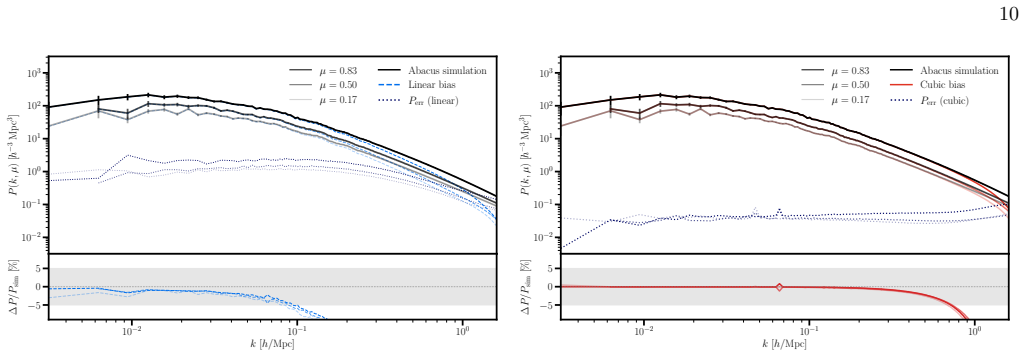
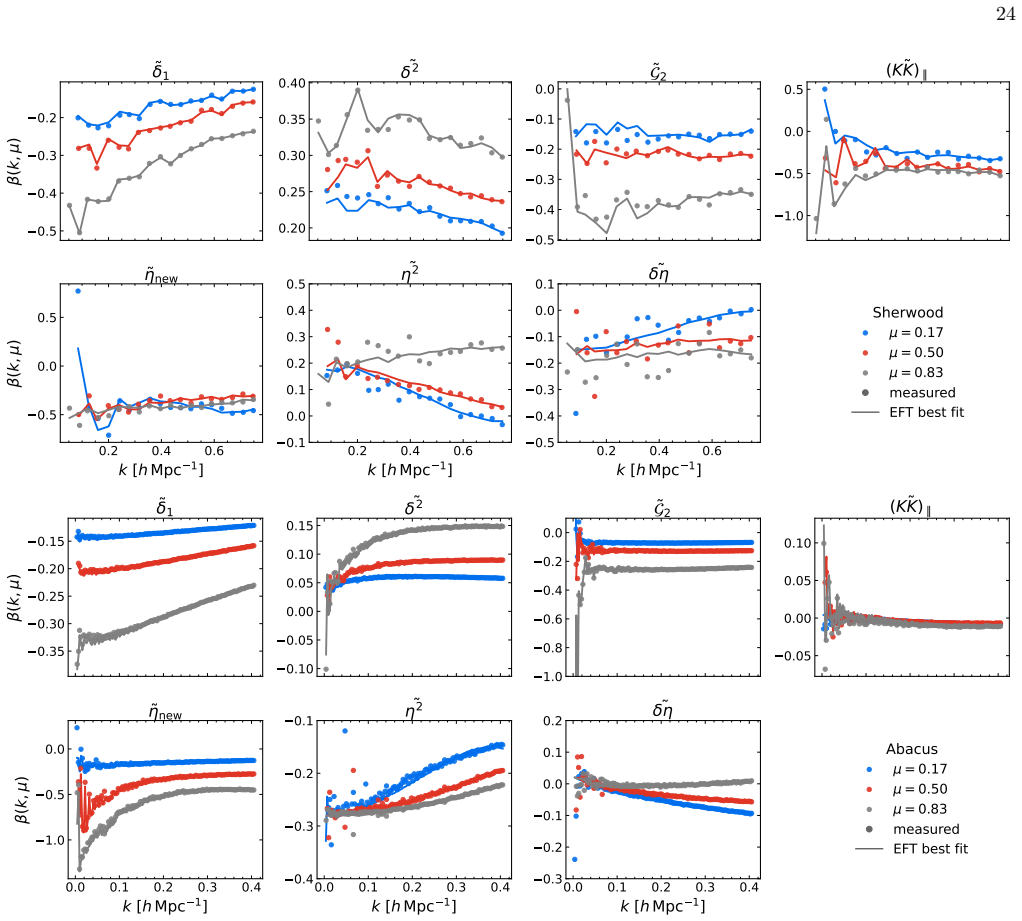
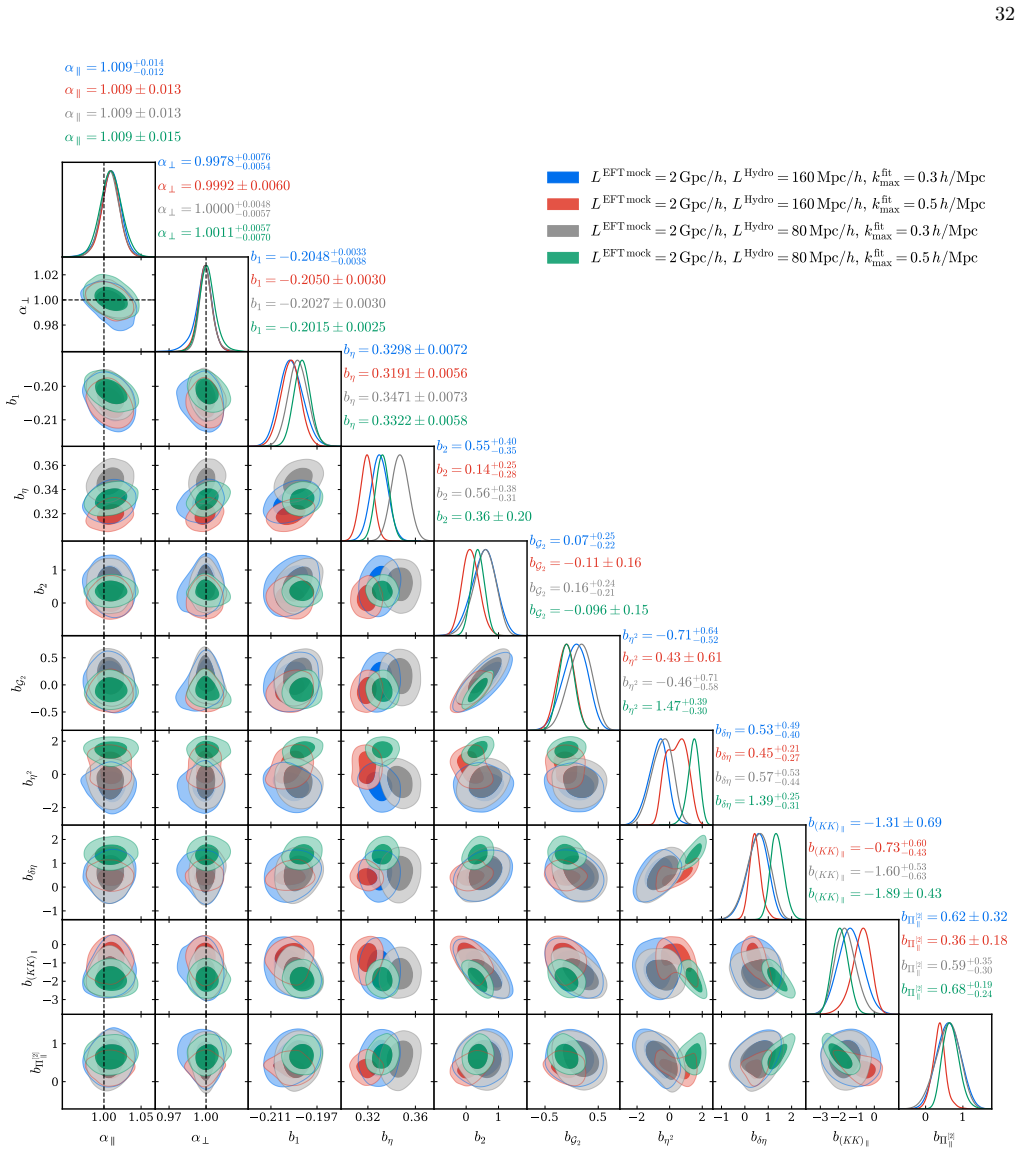
We present a field-level perturbative forward model for the Lyman-alpha forest flux decrement. Across the redshift range of the simulations (z=2.0-3.2), the 3D and 1D power spectra of the model match the simulated Lya fields at the 1% (5%) level up to k <= 0.3 (1.0) h/Mpc, with similar performance for the cross-correlation with massive dark matter halos. The counts-in-cells statistic shows excellent agreement down to cell radii of 2 Mpc/h. Leveraging cosmic variance cancellation, the model enables precision measurements of Lya bias parameters and robustly detects the full set of quadratic line-of-sight bias operators, consistent with the notion of naturalness in effective field theory. We qu
What carries the argument
field-level perturbative forward model in effective field theory for the Lyman-alpha forest flux decrement
If this is right
- The model enables precision measurements of Lyman-alpha bias parameters via cosmic variance cancellation.
- The full set of quadratic line-of-sight bias operators is detectable and consistent with EFT naturalness.
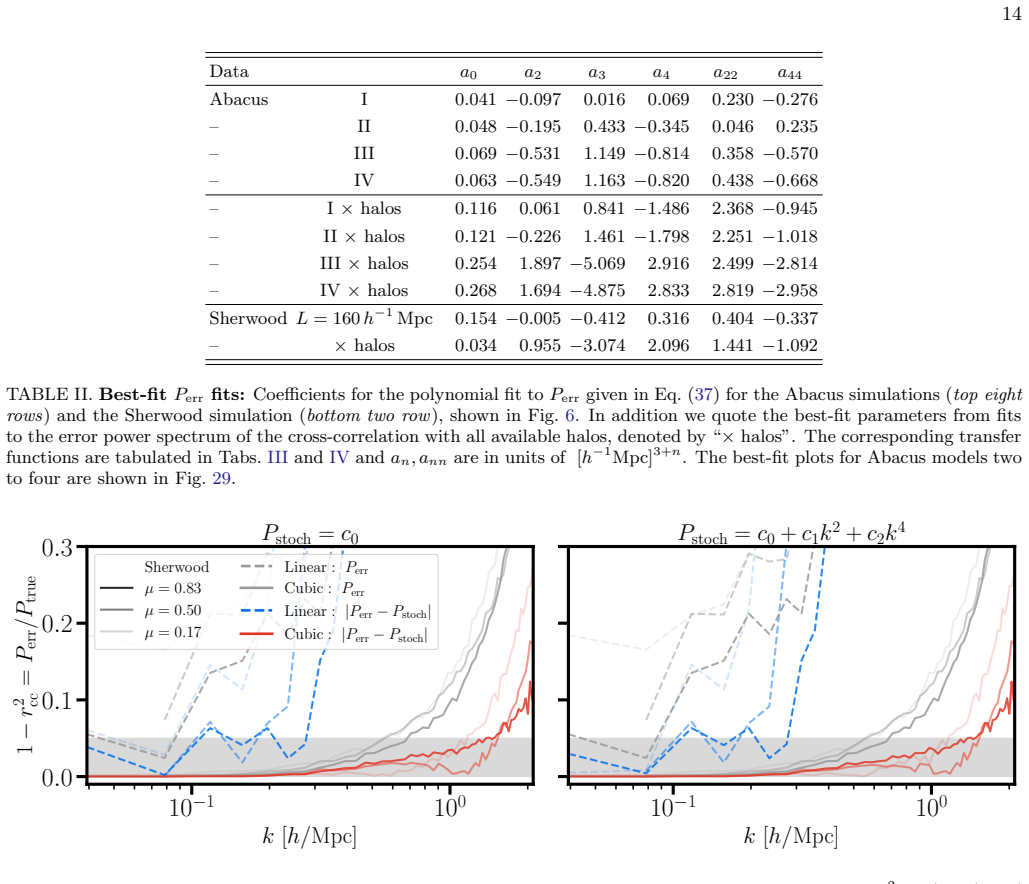
- The stochasticity of the Lyman-alpha forest is white and scale-independent on large scales.
- Phenomenological flux power spectrum models fail at the field level even on quasi-linear scales.
- Large-volume mocks can be generated for DESI cosmological inference and for joint Lyman-alpha plus Lyman-break galaxy analyses at z=3.
Where Pith is reading between the lines
- Joint analyses of Lyman-alpha forest and high-redshift galaxy samples could reduce cosmic variance in bias and cosmological parameter constraints.
- The white stochastic term identified here may correspond to a specific physical contribution, such as small-scale gas physics, that future higher-resolution simulations could isolate.
- The same EFT machinery could be tested for consistency on scales slightly smaller than 0.3 h/Mpc by adding next-order operators and checking whether the 1 percent match extends further.
Load-bearing premise
The perturbative EFT expansion remains accurate and complete for the Lyman-alpha forest flux decrement at the field level on the scales and redshifts of the simulations without significant higher-order or non-perturbative contributions.
What would settle it
A direct measurement in simulations or data showing that the model's 3D power spectrum deviates from the simulated Lyman-alpha field by more than 1 percent at any wavenumber below 0.3 h/Mpc, or that the quadratic line-of-sight bias operators cannot be detected at the predicted amplitude.
Figures









read the original abstract
We present a field-level perturbative forward model for the Lyman-alpha (Lya) forest flux decrement. We validate it on two simulation suites: large-volume AbacusSummit N-body simulations with the Lya forest painted onto the dark matter field, and the Sherwood hydrodynamic simulations. Across the redshift range of the simulations (z=2.0-3.2), the 3D and 1D power spectra of the model match the simulated Lya fields at the 1% (5%) level up to k <= 0.3 (1.0) h/Mpc, with similar performance for the cross-correlation with massive dark matter halos. The counts-in-cells statistic shows excellent agreement down to cell radii of 2 Mpc/h. Leveraging cosmic variance cancellation, the model enables precision measurements of Lya bias parameters and robustly detects the full set of quadratic line-of-sight bias operators, consistent with the notion of naturalness in effective field theory (EFT). We quantify the stochasticity of the Lya forest (the analog to the one-halo term), and find it to be white (scale- and orientation-independent) on large scales, matching EFT predictions. We further find that phenomenological flux power spectrum models, based on modulations of the linear-theory power spectrum, fail at the field level even on quasi-linear scales. For the currently observing Dark Energy Spectroscopic Instrument (DESI), we generate large-scale clustering mocks of the Lya forest to validate cosmological parameter inference pipelines. Looking ahead to its successor, DESI-II, we produce large-volume mocks of representative samples of Lyman-break galaxies (LBGs) and Lya emitters (LAEs), calibrated on Astrid hydrodynamic simulations and matched to observations at z=3, enabling joint analyses of Lya forest and high-redshift galaxy data.
Editorial analysis
A structured set of objections, weighed in public.
Referee Report
Summary. The manuscript develops a perturbative effective field theory (EFT) forward model for the Lyman-alpha forest flux decrement at the field level, incorporating linear and quadratic line-of-sight bias operators plus white stochasticity. It validates the model on AbacusSummit N-body simulations with painted Lya forest and on Sherwood hydrodynamic simulations across z=2.0-3.2, reporting 1% (5%) agreement in 3D and 1D power spectra up to k<=0.3 (1.0) h/Mpc, comparable performance in cross-correlation with massive halos, and good counts-in-cells agreement down to 2 Mpc/h. The work uses cosmic variance cancellation to measure Lya bias parameters, detects the full set of quadratic operators consistent with EFT naturalness, quantifies scale-independent stochasticity, shows that phenomenological flux power spectrum models fail at the field level, and generates DESI mocks plus large-volume LBG/LAE mocks calibrated on Astrid simulations.
Significance. If the central claim of field-level accuracy holds, the model supplies a controlled EFT framework for precision Lya forest analyses with DESI and DESI-II, enabling joint galaxy-Lya clustering studies and improved cosmological inference via field-level information. Strengths include validation against two independent simulation suites, explicit detection of quadratic operators, and quantification of stochasticity matching EFT expectations; these elements support the utility for mock generation and bias measurements.
major comments (3)
- [Abstract] Abstract and validation sections: the reported percent-level agreement is confined to power spectra and counts-in-cells; these statistics are insensitive to higher cumulants or localized non-perturbative residuals (e.g., thermal broadening or Jeans smoothing), so they do not directly establish that the forward model reproduces the entire simulated flux field at the level required for unbiased bias-parameter inference or mock generation.
- [Validation and results sections] § on quadratic operators and stochasticity: the detection of quadratic line-of-sight operators and the claim of white stochasticity are presented as consistency checks with EFT naturalness, but without an explicit test (e.g., via bispectrum or field residuals) that higher-order or scale-dependent terms remain negligible, the completeness of the operator basis at the field level remains an assumption rather than a demonstrated result.
- [Applications to DESI] Mock generation paragraph: the DESI and DESI-II mocks are generated from the EFT model calibrated on the reported scales; if the field-level expansion misses operators that affect higher statistics, the mocks could introduce systematic biases in cosmological parameter pipelines even while the quoted two-point and counts-in-cells metrics remain within tolerance.
minor comments (2)
- [Methods] Notation for the line-of-sight operators and stochastic term should be defined explicitly with equations in the methods section to improve readability for readers unfamiliar with Lya EFT.
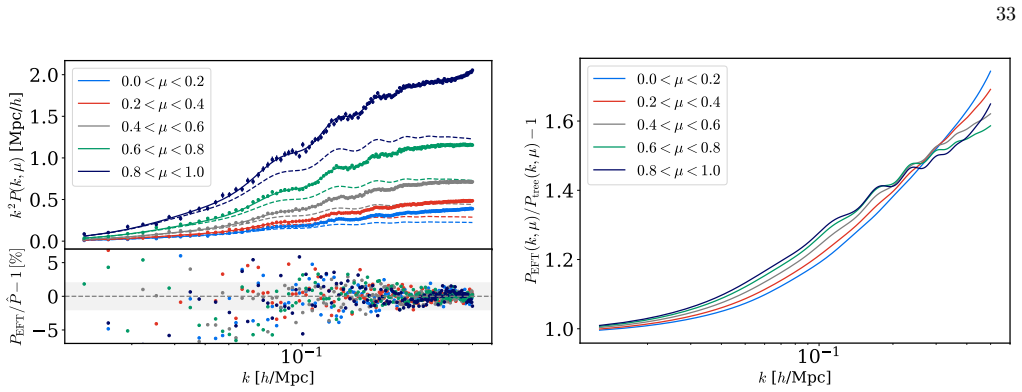
- [Figures] Figure captions for power-spectrum comparisons should include the precise k-range and redshift bins used for the 1% agreement claim.
Simulated Author's Rebuttal
We thank the referee for the constructive and detailed report. We address each major comment below, indicating where revisions will be made to clarify scope and limitations.
read point-by-point responses
-
Referee: [Abstract] Abstract and validation sections: the reported percent-level agreement is confined to power spectra and counts-in-cells; these statistics are insensitive to higher cumulants or localized non-perturbative residuals (e.g., thermal broadening or Jeans smoothing), so they do not directly establish that the forward model reproduces the entire simulated flux field at the level required for unbiased bias-parameter inference or mock generation.
Authors: We agree that power spectra and counts-in-cells do not capture higher cumulants or localized non-perturbative effects. The EFT model is perturbative and validated for quasi-linear scales where two-point statistics carry the primary cosmological information. We will revise the abstract and validation sections to explicitly state the validation scope and intended applicability for bias inference and mock generation. revision: yes
-
Referee: [Validation and results sections] § on quadratic operators and stochasticity: the detection of quadratic line-of-sight operators and the claim of white stochasticity are presented as consistency checks with EFT naturalness, but without an explicit test (e.g., via bispectrum or field residuals) that higher-order or scale-dependent terms remain negligible, the completeness of the operator basis at the field level remains an assumption rather than a demonstrated result.
Authors: The quadratic operators are detected via their contribution in the field-level fit to the flux, and stochasticity is quantified from residual power spectra. While a bispectrum test would further constrain completeness, it lies outside the present scope. We will add a discussion acknowledging this point and the reliance on two-point consistency with EFT expectations. revision: partial
-
Referee: [Applications to DESI] Mock generation paragraph: the DESI and DESI-II mocks are generated from the EFT model calibrated on the reported scales; if the field-level expansion misses operators that affect higher statistics, the mocks could introduce systematic biases in cosmological parameter pipelines even while the quoted two-point and counts-in-cells metrics remain within tolerance.
Authors: The mocks target pipelines that rely primarily on two-point statistics within the validated scales. We agree that unaccounted higher-order terms could affect other uses. We will revise the mock-generation section to include an explicit discussion of the model's range of validity and associated caveats. revision: yes
Circularity Check
No significant circularity; derivation validated on external simulations
full rationale
The paper constructs an EFT forward model for the Lya flux field and validates its 3D/1D power spectra, cross-correlations, and counts-in-cells directly against two independent simulation suites (AbacusSummit painted N-body and Sherwood hydro). Bias parameters are measured from these external fields; the quadratic operator detection is reported only as a consistency check with EFT naturalness expectations rather than a fitted prediction. No self-definitional equations, fitted-inputs-renamed-as-predictions, or load-bearing self-citation chains appear in the provided text. The central performance claims rest on external benchmarks, satisfying the self-contained criterion.
Axiom & Free-Parameter Ledger
free parameters (1)
- Lya bias parameters
axioms (1)
- domain assumption Effective field theory perturbative expansion applies to the Lyman-alpha forest flux on quasi-linear scales
Reference graph
Works this paper leans on
-
[1]
21, by performing BAO fits to the measured power spectra, as detailed in Sec
Validation of Ly-αforest mocks at fixed redshift ofz= 2.8 We validate the field-level mock, shown in Fig. 21, by performing BAO fits to the measured power spectra, as detailed in Sec. A. In Fig. 22 we show the resulting best-fit power spectra usingk max = 0.5hMpc −1 (left panel) and the corresponding loop correction plot (right panel) for the large-scale ...
-
[2]
The best-fit spectra are shown in Fig
Ly-αclustering mocks atz eff = 2.33 Similarly, we perform a BAO fit of the Ly-αforest EFT mocks atz= 2.33, the effective redshift of the Ly-αforest sample of DESI DR1 [51]. The best-fit spectra are shown in Fig. 24 and the marginalized EFT nuisance and BAO parameters are tabulated in the last two columns of Tab. VII. We highlight two key findings for thez...
2048
-
[3]
S. S. Vogt, S. L. Allen, B. C. Bigelow, L. Bresee, B. Brown, T. Cantrall et al.,HIRES: the high-resolution echelle spectrometer on the Keck 10-m Telescope, inInstrumentation in Astronomy VIII, D. L. Crawford and E. R. Craine, eds., vol. 2198 ofSociety of Photo-Optical Instrumentation Engineers (SPIE) Conference Series, p. 362, June, 1994, DOI
1994
-
[4]
J. M. O’Meara, N. Lehner, J. C. Howk and J. X. Prochaska,The Third Data Release of the KODIAQ Survey, AJ161 (2021) 45 [2010.09061]
arXiv 2021
-
[5]
Dekker, S
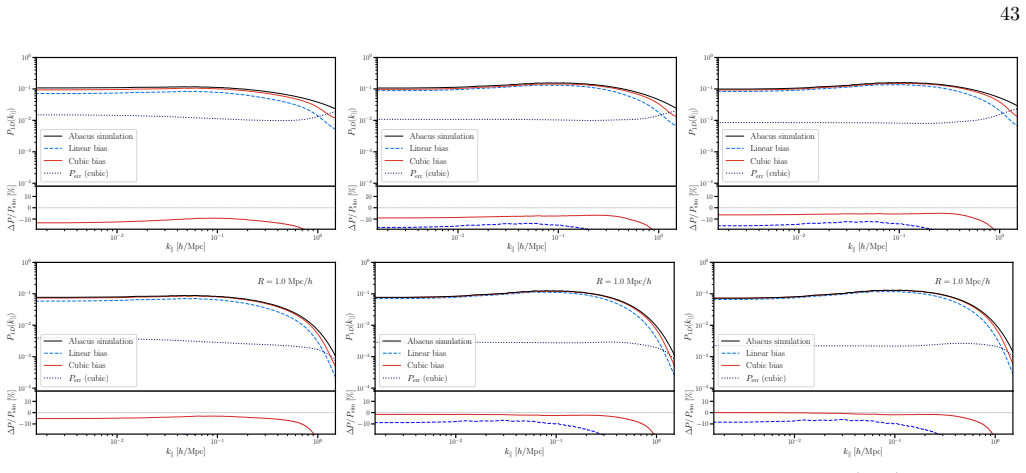
H. Dekker, S. D’Odorico, A. Kaufer, B. Delabre and H. Kotzlowski,Design, construction, and performance of UVES, the echelle spectrograph for the UT2 Kueyen Telescope at the ESO Paranal Observatory, inOptical and IR Telescope 43 10−2 10−1 100 10−4 10−3 10−2 10−1 100 P1D(k∥) Abacus simulation Linear bias Cubic bias Perr (cubic) 10−2 10−1 100 k∥ [h/Mpc] −10 ...
2000
-
[6]
M. T. Murphy, G. G. Kacprzak, G. A. D. Savorgnan and R. F. Carswell,The UVES Spectral Quasar Absorption Database (SQUAD) data release 1: the first 10 million seconds, MNRAS482(2019) 3458 [1810.06136]
Pith/arXiv arXiv 2019
-
[7]
U. Seljak, A. Makarov, P. McDonald, S. F. Anderson, N. A. Bahcall, J. Brinkmann et al.,Cosmological parameter analysis including SDSS Lyαforest and galaxy bias: Constraints on the primordial spectrum of fluctuations, neutrino mass, and dark energy, Phys. Rev. D71(2005) 103515 [astro-ph/0407372]
Pith/arXiv arXiv 2005
-
[8]
M. Viel, J. Lesgourgues, M. G. Haehnelt, S. Matarrese and A. Riotto,Constraining warm dark matter candidates including sterile neutrinos and light gravitinos with WMAP and the Lyman-αforest, Phys. Rev. D71(2005) 063534 [astro-ph/0501562]
Pith/arXiv arXiv 2005
-
[9]
P. McDonald, U. Seljak, S. Burles, D. J. Schlegel, D. H. Weinberg, R. Cen et al.,The LyαForest Power Spectrum from the Sloan Digital Sky Survey, ApJS163(2006) 80 [astro-ph/0405013]
Pith/arXiv arXiv 2006
-
[10]
N. Palanque-Delabrouille, C. Y` eche, A. Borde, J.-M. Le Goff, G. Rossi, M. Viel et al.,The one-dimensional Lyαforest power spectrum from BOSS, A&A559(2013) A85 [1306.5896]
Pith/arXiv arXiv 2013
-
[11]
S. Chabanier, N. Palanque-Delabrouille, C. Y` eche, J.-M. Le Goff, E. Armengaud, J. Bautista et al.,The one-dimensional power spectrum from the SDSS DR14 Lyαforests, J. Cosmology Astropart. Phys.2019(2019) 017 [1812.03554]
arXiv 2019
- [13]
-
[14]
N. G. Kara¸ caylı, P. Martini, J. Guy, C. Ravoux, M. L. A. Karim, E. Armengaud et al.,Optimal 1D LyαForest Power Spectrum Estimation - III. DESI early data, MNRAS (2024) [2306.06316]
arXiv 2024
-
[15]
M. Viel, M. G. Haehnelt and V. Springel,The effect of neutrinos on the matter distribution as probed by the intergalactic medium, J. Cosmology Astropart. Phys.2010(2010) 015 [1003.2422]
Pith/arXiv arXiv 2010
-
[16]
N. Palanque-Delabrouille, C. Y` eche, N. Sch¨ oneberg, J. Lesgourgues, M. Walther, S. Chabanier et al.,Hints, neutrino bounds, and WDM constraints from SDSS DR14 Lyman-αand Planck full-survey data, J. Cosmology Astropart. Phys. 2020(2020) 038 [1911.09073]
arXiv 2020
-
[17]
M. M. Ivanov, M. W. Toomey and N. G. Kara¸ caylı,Fundamental Physics with the Lyman-Alpha Forest: Constraints on the Growth of Structure and Neutrino Masses from SDSS with Effective Field Theory,Phys. Rev. Lett.134(2025) 091001 [2405.13208]
arXiv 2025
-
[18]
A. He, R. An, M. M. Ivanov and V. Gluscevic,Self-Interacting Neutrinos in Light of Large-Scale Structure Data, 2309.03956
-
[19]
A. He, M. M. Ivanov, S. Bird, R. An and V. Gluscevic,A Fresh Look at Neutrino Self-Interactions With the Lyman-α Forest: Constraints from EFT and PRIYA,2503.15592
-
[20]
N. Afshordi, P. McDonald and D. N. Spergel,Primordial Black Holes as Dark Matter: The Power Spectrum and Evaporation of Early Structures, ApJ594(2003) L71 [astro-ph/0302035]
Pith/arXiv arXiv 2003
- [21]
-
[22]
M. M. Ivanov and S. Trifinopoulos,Effective Field Theory Constraints on Primordial Black Holes from the High-Redshift Lyman-αForest,2508.04767
-
[23]
M. Viel, G. D. Becker, J. S. Bolton and M. G. Haehnelt,Warm dark matter as a solution to the small scale crisis: New constraints from high redshift Lyman-αforest data, Phys. Rev. D88(2013) 043502 [1306.2314]
Pith/arXiv arXiv 2013
-
[24]
J. Baur, N. Palanque-Delabrouille, C. Y` eche, C. Magneville and M. Viel,Lyman-alpha forests cool warm dark matter, J. Cosmology Astropart. Phys.2016(2016) 012 [1512.01981]
Pith/arXiv arXiv 2016
-
[25]
V. Irˇ siˇ c, M. Viel, M. G. Haehnelt, J. S. Bolton, S. Cristiani, G. D. Becker et al.,New Constraints on the free-streaming of warm dark matter from intermediate and small scale Lyman-αforest data,ArXiv e-prints(2017) [1702.01764]
Pith/arXiv arXiv 2017
-
[26]
T. Kobayashi, R. Murgia, A. De Simone, V. Irˇ siˇ c and M. Viel,Lyman-αconstraints on ultralight scalar dark matter: Implications for the early and late universe, Phys. Rev. D96(2017) 123514 [1708.00015]
Pith/arXiv arXiv 2017
-
[27]
E. Armengaud, N. Palanque-Delabrouille, C. Y` eche, D. J. E. Marsh and J. Baur,Constraining the mass of light bosonic dark matter using SDSS Lyman-αforest, MNRAS471(2017) 4606 [1703.09126]
Pith/arXiv arXiv 2017
-
[28]
R. Murgia, V. Irˇ siˇ c and M. Viel,Novel constraints on noncold, nonthermal dark matter from Lyman-αforest data, Phys. Rev. D98(2018) 083540 [1806.08371]
Pith/arXiv arXiv 2018
-
[29]
A. Garzilli, A. Magalich, T. Theuns, C. S. Frenk, C. Weniger, O. Ruchayskiy et al.,The Lyman-αforest as a diagnostic of the nature of the dark matter, MNRAS489(2019) 3456 [1809.06585]
arXiv 2019
-
[30]
V. Irˇ siˇ c, H. Xiao and M. McQuinn,Early structure formation constraints on the ultralight axion in the postinflation scenario, Phys. Rev. D101(2020) 123518 [1911.11150]
arXiv 2020
-
[31]
K. K. Rogers, C. Dvorkin and H. V. Peiris,Limits on the Light Dark Matter-Proton Cross Section from Cosmic Large-Scale Structure, Phys. Rev. Lett.128(2022) 171301 [2111.10386]
arXiv 2022
-
[32]
B. Villasenor, B. Robertson, P. Madau and E. Schneider,New constraints on warm dark matter from the Lyman-α forest power spectrum, Phys. Rev. D108(2023) 023502 [2209.14220]
arXiv 2023
-
[33]
V. Irˇ siˇ c, M. Viel, M. G. Haehnelt, J. S. Bolton, M. Molaro, E. Puchwein et al.,Unveiling Dark Matter free-streaming at the smallest scales with high redshift Lyman-alpha forest,arXiv e-prints(2023) arXiv:2309.04533 [2309.04533]. 45
arXiv 2023
-
[34]
M. Zaldarriaga,Searching for Fluctuations in the Intergalactic Medium Temperature Using the LyαForest, ApJ564 (2002) 153 [astro-ph/0102205]
Pith/arXiv arXiv 2002
-
[35]
A. A. Meiksin,The physics of the intergalactic medium,Reviews of Modern Physics81(2009) 1405 [0711.3358]
Pith/arXiv arXiv 2009
-
[36]
McQuinn,The Evolution of the Intergalactic Medium, ARA&A54(2016) 313 [1512.00086]
M. McQuinn,The Evolution of the Intergalactic Medium, ARA&A54(2016) 313 [1512.00086]
Pith/arXiv arXiv 2016
-
[37]
M. Viel, J. Lesgourgues, M. G. Haehnelt, S. Matarrese and A. Riotto,Can Sterile Neutrinos Be Ruled Out as Warm Dark Matter Candidates?, Phys. Rev. Lett.97(2006) 071301 [astro-ph/0605706]
Pith/arXiv arXiv 2006
-
[38]
M. Walther, J. O˜ norbe, J. F. Hennawi and Z. Luki´ c,New Constraints on IGM Thermal Evolution from the LyαForest Power Spectrum, ApJ872(2019) 13 [1808.04367]
Pith/arXiv arXiv 2019
-
[39]
J. S. Bolton, M. Viel, T. S. Kim, M. G. Haehnelt and R. F. Carswell,Possible evidence for an inverted temperature-density relation in the intergalactic medium from the flux distribution of the Lyαforest, MNRAS386 (2008) 1131 [0711.2064]
Pith/arXiv arXiv 2008
-
[40]
A. Garzilli, J. S. Bolton, T. S. Kim, S. Leach and M. Viel,The intergalactic medium thermal history at redshift z = 1.7-3.2 from the Lyαforest: a comparison of measurements using wavelets and the flux distribution, MNRAS424 (2012) 1723 [1202.3577]
Pith/arXiv arXiv 2012
-
[41]
P. Gaikwad, R. Srianand, V. Khaire and T. R. Choudhury,Effect of non-equilibrium ionization on derived physical conditions of the high-z intergalactic medium, MNRAS490(2019) 1588 [1812.01016]
arXiv 2019
-
[42]
E. Boera, G. D. Becker, J. S. Bolton and F. Nasir,Revealing Reionization with the Thermal History of the Intergalactic Medium: New Constraints from the LyαFlux Power Spectrum, ApJ872(2019) 101 [1809.06980]
Pith/arXiv arXiv 2019
-
[43]
P. Gaikwad, R. Srianand, M. G. Haehnelt and T. R. Choudhury,A consistent and robust measurement of the thermal state of the IGM at 2≤z≤4 from a large sample of Lyαforest spectra: evidence for late and rapid He II reionization, MNRAS506(2021) 4389 [2009.00016]
arXiv 2021
- [44]
-
[45]
B. Villasenor, B. Robertson, P. Madau and E. Schneider,Inferring the Thermal History of the Intergalactic Medium from the Properties of the Hydrogen and Helium LyαForest, ApJ933(2022) 59 [2111.00019]
arXiv 2022
-
[46]
S. Goldstein, J. C. Hill, V. Irˇ siˇ c and B. D. Sherwin,Canonical Hubble-Tension-Resolving Early Dark Energy Cosmologies are Inconsistent with the Lyman-αForest,2303.00746
- [47]
-
[48]
M. Garny, T. Konstandin, L. Sagunski and S. Tulin,Lyman-αforest constraints on interacting dark sectors,JCAP09 (2018) 011 [1805.12203]
Pith/arXiv arXiv 2018
-
[49]
U. Seljak, A. Slosar and P. McDonald,Cosmological parameters from combining the Lyman-alpha forest with CMB, galaxy clustering and SN constraints,JCAP10(2006) 014 [astro-ph/0604335]
Pith/arXiv arXiv 2006
-
[50]
K. S. Dawson, J.-P. Kneib, W. J. Percival, S. Alam, F. D. Albareti, S. F. Anderson et al.,The SDSS-IV Extended Baryon Oscillation Spectroscopic Survey: Overview and Early Data, AJ151(2016) 44 [1508.04473]
Pith/arXiv arXiv 2016
-
[51]
DESI Collaboration, A. Aghamousa, J. Aguilar, S. Ahlen, S. Alam, L. E. Allen et al.,The DESI Experiment Part I: Science,Targeting, and Survey Design,arXiv e-prints(2016) arXiv:1611.00036 [1611.00036]
Pith/arXiv arXiv 2016
-
[52]
DESI Collaboration, A. G. Adame, J. Aguilar, S. Ahlen, S. Alam, D. M. Alexander et al.,DESI 2024 VI: Cosmological Constraints from the Measurements of Baryon Acoustic Oscillations,arXiv e-prints(2024) arXiv:2404.03002 [2404.03002]
Pith/arXiv arXiv 2024
-
[53]
DESI Collaboration, A. G. Adame, J. Aguilar, S. Ahlen, S. Alam, D. M. Alexander et al.,DESI 2024 IV: Baryon Acoustic Oscillations from the Lyman Alpha Forest,arXiv e-prints(2024) arXiv:2404.03001 [2404.03001]. [52]DESIcollaboration,DESI DR2 results. I. Baryon acoustic oscillations from the Lyman alpha forest,Phys. Rev. D112 (2025) 083514 [2503.14739]
Pith/arXiv arXiv 2024
- [54]
-
[55]
F. Gerardi, A. Cuceu, A. Font-Ribera, B. Joachimi and P. Lemos,Direct cosmological inference from three-dimensional correlations of the Lymanαforest,Mon. Not. Roy. Astron. Soc.518(2022) 2567 [2209.11263]
arXiv 2022
-
[56]
P. McDonald and D. J. Eisenstein,Dark energy and curvature from a future baryonic acoustic oscillation survey using the Lyman-αforest, Phys. Rev. D76(2007) 063009 [astro-ph/0607122]
Pith/arXiv arXiv 2007
-
[57]
A. Slosar, V. Irˇ siˇ c, D. Kirkby, S. Bailey, N. G. Busca, T. Delubac et al.,Measurement of baryon acoustic oscillations in the Lyman-αforest fluctuations in BOSS data release 9, J. Cosmology Astropart. Phys.2013(2013) 026 [1301.3459]
Pith/arXiv arXiv 2013
-
[58]
N. G. Busca, T. Delubac, J. Rich, S. Bailey, A. Font-Ribera, D. Kirkby et al.,Baryon acoustic oscillations in the Lyα forest of BOSS quasars, A&A552(2013) A96 [1211.2616]
Pith/arXiv arXiv 2013
- [60]
- [61]
-
[62]
Cuceu et al.,DESI DR1 Lyαforest: 3D full-shape analysis and cosmological constraints,2509.15308
A. Cuceu et al.,DESI DR1 Lyαforest: 3D full-shape analysis and cosmological constraints,2509.15308
-
[63]
R. Cen, J. Miralda-Escud´ e, J. P. Ostriker and M. Rauch,Gravitational Collapse of Small-Scale Structure as the Origin of the Lyman-Alpha Forest, ApJ437(1994) L9 [astro-ph/9409017]. 46
Pith/arXiv arXiv 1994
-
[64]
J. Miralda-Escud´ e, R. Cen, J. P. Ostriker and M. Rauch,The Ly alpha Forest from Gravitational Collapse in the Cold Dark Matter + Lambda Model, ApJ471(1996) 582 [astro-ph/9511013]
Pith/arXiv arXiv 1996
-
[65]
A. Meiksin, G. Bryan and M. Machacek,Hydrodynamical simulations of the Lyαforest: data comparisons, MNRAS327 (2001) 296 [astro-ph/0102367]
Pith/arXiv arXiv 2001
-
[66]
Sexton, Z
J. Sexton, Z. Lukic, A. Almgren, C. Daley, B. Friesen, A. Myers et al.,Nyx: A massively parallel amr code for computational cosmology,Journal of Open Source Software6(2021) 3068
2021
-
[68]
R. Weinberger, V. Springel, L. Hernquist, A. Pillepich, F. Marinacci, R. Pakmor et al.,Simulating galaxy formation with black hole driven thermal and kinetic feedback, MNRAS465(2017) 3291 [1607.03486]
Pith/arXiv arXiv 2017
-
[69]
S. Bird, M. Fernandez, M.-F. Ho, M. Qezlou, R. Monadi, Y. Ni et al.,PRIYA: a new suite of Lyman-αforest simulations for cosmology,JCAP10(2023) 037 [2306.05471]
arXiv 2023
-
[70]
Pillepich et al.,Simulating Galaxy Formation with the IllustrisTNG Model,Mon
A. Pillepich et al.,Simulating Galaxy Formation with the IllustrisTNG Model,Mon. Not. Roy. Astron. Soc.473(2018) 4077 [1703.02970]
Pith/arXiv arXiv 2018
-
[71]
F. Villaescusa-Navarro, D. Angl´ es-Alc´ azar, S. Genel, D. N. Spergel, R. S. Somerville, R. Dave et al.,The CAMELS Project: Cosmology and Astrophysics with Machine-learning Simulations, ApJ915(2021) 71 [2010.00619]
arXiv 2021
-
[72]
M. Walther, E. Armengaud, C. Ravoux, N. Palanque-Delabrouille, C. Y` eche and Z. Luki´ c,Simulating intergalactic gas for DESI-like small scale Lymanαforest observations, J. Cosmology Astropart. Phys.2021(2021) 059 [2012.04008]
arXiv 2021
-
[73]
S. Chabanier, C. Ravoux, L. Latrille, J. Sexton, E. Armengaud, J. Bautista et al.,The ACCEL2 project: simulating Lyman-αforest in large-volume hydrodynamical simulations,Mon. Not. Roy. Astron. Soc.534(2024) 2674 [2407.04473]
arXiv 2024
-
[74]
P. McDonald,Toward a measurement of the cosmological geometry at Z 2: predicting lyman-alpha forest correlation in three dimensions, and the potential of future data sets,Astrophys. J.585(2003) 34 [astro-ph/0108064]
Pith/arXiv arXiv 2003
-
[76]
J. J. Givans, A. Font-Ribera, A. Slosar, L. Seeyave, C. Pedersen, K. K. Rogers et al.,Non-linearities in the Lyman-α forest and in its cross-correlation with dark matter halos,JCAP09(2022) 070 [2205.00962]
arXiv 2022
-
[77]
H. du Mas des Bourboux, J. Rich, A. Font-Ribera, V. de Sainte Agathe, J. Farr, T. Etourneau et al.,The Completed SDSS-IV Extended Baryon Oscillation Spectroscopic Survey: Baryon Acoustic Oscillations with LyαForests, ApJ901 (2020) 153 [2007.08995]
arXiv 2020
-
[78]
R. de Belsunce, S.-F. Chen, M. M. Ivanov, C. Ravoux, S. Chabanier, J. Sexton et al.,The ACCEL2 Project: Precision Measurements of EFT Parameters and BAO Peak Shifts for the Lyman-αForest,arXiv e-prints(2024) arXiv:2412.06892 [2412.06892]
arXiv 2024
-
[79]
B. Hadzhiyska, R. de Belsunce, A. Cuceu, J. Guy, M. M. Ivanov, H. Coquinot et al.,Measuring and unbiasing the BAO shift in the Lyman-Alpha forest with AbacusSummit,2503.13442
-
[80]
M. M. Pieri, S. Bonoli, J. Chaves-Montero, I. Pˆ aris, M. Fumagalli, J. S. Bolton et al.,WEAVE-QSO: A Massive Intergalactic Medium Survey for the William Herschel Telescope, inSF2A-2016: Proceedings of the Annual meeting of the French Society of Astronomy and Astrophysics, C. Reyl´ e, J. Richard, L. Cambr´ esy, M. Deleuil, E. P´ econtal, L. Tresse et al.,...
Pith/arXiv arXiv 2016
- [81]
-
[82]
R. S. de Jong, O. Agertz, A. A. Berbel, J. Aird, D. A. Alexander, A. Amarsi et al.,4MOST: Project overview and information for the First Call for Proposals,The Messenger175(2019) 3 [1903.02464]
Pith/arXiv arXiv 2019
-
[83]
J. S. Bolton, E. Puchwein, D. Sijacki, M. G. Haehnelt, T.-S. Kim, A. Meiksin et al.,The Sherwood simulation suite: overview and data comparisons with the Lymanαforest at redshifts 2≤z≤5,Mon. Not. Roy. Astron. Soc.464(2017) 897 [1605.03462]
Pith/arXiv arXiv 2017
-
[84]
S. Bird, Y. Ni, T. Di Matteo, R. Croft, Y. Feng and N. Chen,The ASTRID simulation: galaxy formation and reionization, MNRAS512(2022) 3703 [2111.01160]
arXiv 2022
discussion (0)
Sign in with ORCID, Apple, or X to comment. Anyone can read and Pith papers without signing in.