BitC-3DGS: High-Capacity 3D Gaussian Splatting Watermarking via Bit Compression
Pith reviewed 2026-06-29 08:21 UTC · model grok-4.3
The pith
BitC-3DGS compresses multiple bits per token to embed 128-bit watermarks in 3D Gaussian Splatting.
A machine-rendered reading of the paper's core claim, the machinery that carries it, and where it could break.
Core claim
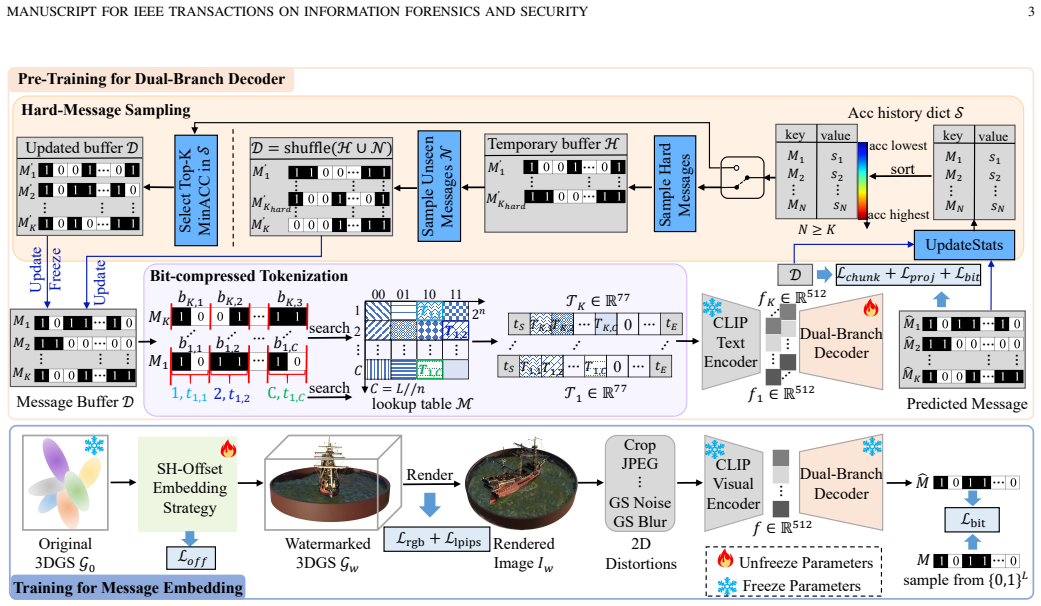
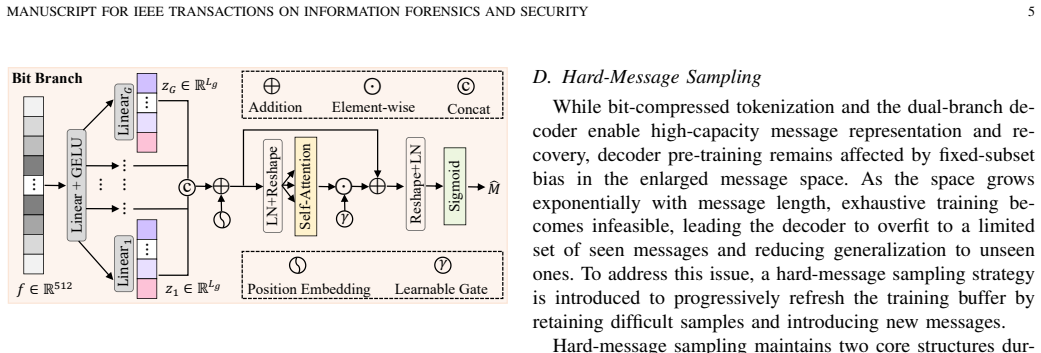
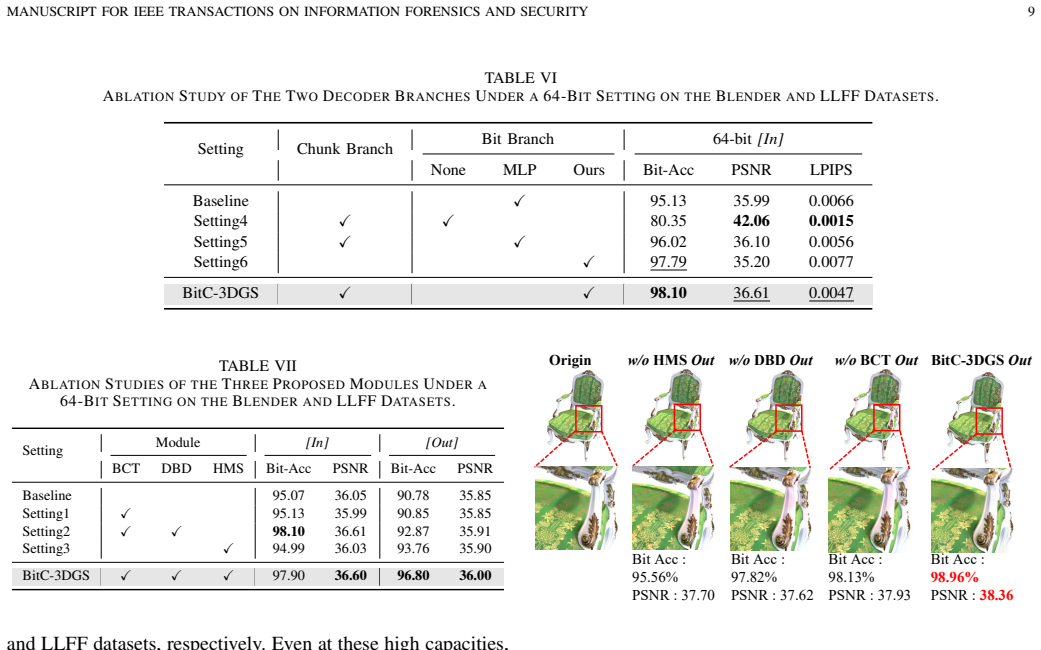
BitC-3DGS employs a bit-compressed tokenization scheme that encodes multiple bits within the same chunk into a single semantic token, together with a dual-branch architecture for joint chunk decompression and bit decoding and a hard-message sampling strategy, to support 128-bit message capacity with recovery accuracy comparable to that of 64-bit messages in recent state-of-the-art methods.
What carries the argument
Bit-compressed tokenization scheme that encodes multiple bits within the same chunk into a single semantic token, combined with a dual-branch architecture for joint chunk decompression and bit decoding.
If this is right
- 128-bit messages can be embedded and recovered at accuracy levels matching prior 64-bit work.
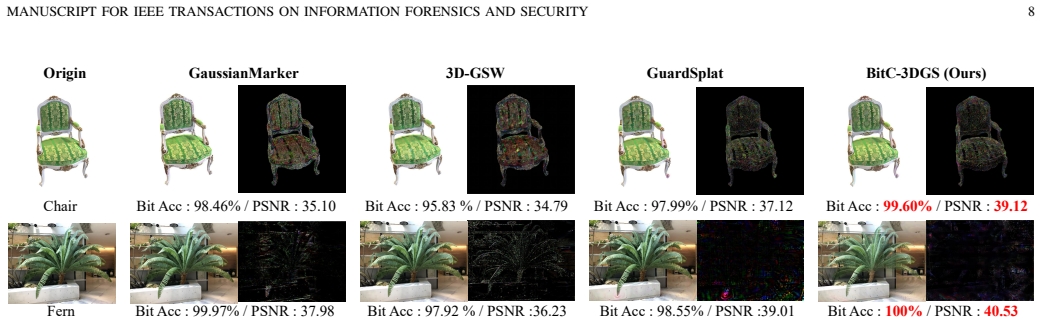
- Rendering fidelity remains high on the Blender and LLFF datasets.
- Rich information such as ownership, provenance, and authentication codes can be carried inside 3DGS assets.
- The approach enables reliable identification and integrity checks in large-scale 3D asset pipelines.
Where Pith is reading between the lines
- The same compression idea could be tested on other neural rendering representations that rely on fixed-length text encoders.
- Further increases in capacity might be possible by varying the number of bits packed per token according to message content.
- Integration into asset-management pipelines would allow automated provenance checks at render time.
Load-bearing premise
Multiple bits can be packed into one token and later recovered accurately by the dual-branch decoder without substantially harming the rendered image quality.
What would settle it
Embed 128-bit messages into 3DGS scenes on Blender or LLFF and check whether bit recovery accuracy falls below the level reported for 64-bit messages in prior methods or whether PSNR and SSIM degrade noticeably.
Figures




read the original abstract
High-capacity watermarking is necessary for 3D Gaussian Splatting (3DGS) assets to embed rich information (e.g., ownership, provenance, and authentication codes), enabling reliable identification and integrity verification in large-scale 3D asset pipelines. Existing bit-to-token watermarking methods based on a pre-trained text encoder are limited to 77-bit messages due to CLIP's fixed 77-token context length, as tokens beyond this limit are unsupported by learned positional embeddings. To address this limitation, we introduce BitC-3DGS, a bit-compression framework that encodes multiple message bits per token. It employs a bit-compressed tokenization scheme that encodes multiple bits within the same chunk into a single semantic token. To enable recovery of the compressed information, it further introduces a dual-branch architecture for joint chunk decompression and bit decoding, along with a hard-message sampling strategy to improve combinatorial coverage during decoder training. Extensive experiments on the Blender and LLFF datasets demonstrate the effectiveness of BitC-3DGS for high-capacity watermarking, achieving high message recovery accuracy and rendering fidelity. For example, it supports 128-bit message capacity with recovery accuracy comparable to that of 64-bit messages in recent state-of-the-art methods.
Editorial analysis
A structured set of objections, weighed in public.
Referee Report
Summary. The manuscript introduces BitC-3DGS, a bit-compression framework for high-capacity watermarking of 3D Gaussian Splatting (3DGS) assets. It overcomes the 77-token limit of pre-trained encoders such as CLIP by proposing a bit-compressed tokenization scheme that packs multiple message bits into each semantic token, paired with a dual-branch decoder for joint chunk decompression and bit recovery, and trained via a hard-message sampling strategy to increase combinatorial coverage. Experiments on the Blender and LLFF datasets are reported to support 128-bit message capacity with recovery accuracy comparable to recent 64-bit state-of-the-art methods while preserving rendering fidelity.
Significance. If the central claims hold, the work enables embedding of richer metadata (ownership, provenance, authentication) into 3DGS assets for large-scale pipelines. The bit-compression approach and dual-branch architecture directly address an external capacity bottleneck of existing encoder-based methods. The hard-message sampling strategy is a concrete engineering contribution to decoder training, though its generalization properties remain to be verified.
major comments (2)
- [Abstract] Abstract: the claim that 128-bit messages achieve recovery accuracy comparable to 64-bit SOTA methods rests on the dual-branch decoder generalizing beyond the hard-message samples; the manuscript provides no quantification of the fraction of the 2^128 space covered by sampling nor any evaluation on fully random or adversarial 128-bit messages, which is load-bearing for the reliability assertion.
- [Experiments] Experiments section: the abstract states that Blender and LLFF experiments show high recovery accuracy and fidelity, yet supplies no error bars, explicit baselines, data splits, number of trials, or trade-off curves between capacity and PSNR/SSIM; this absence prevents verification of the central performance claim.
minor comments (1)
- [Abstract] Abstract: the exact numerical recovery accuracies (e.g., bit-error rate or accuracy percentage) for the 128-bit case versus the 64-bit SOTA references should be stated for immediate comparison.
Simulated Author's Rebuttal
We thank the referee for the detailed and constructive report. We address each major comment below and will revise the manuscript accordingly to improve clarity and rigor.
read point-by-point responses
-
Referee: [Abstract] Abstract: the claim that 128-bit messages achieve recovery accuracy comparable to 64-bit SOTA methods rests on the dual-branch decoder generalizing beyond the hard-message samples; the manuscript provides no quantification of the fraction of the 2^128 space covered by sampling nor any evaluation on fully random or adversarial 128-bit messages, which is load-bearing for the reliability assertion.
Authors: We agree that explicit quantification of combinatorial coverage and evaluation on random/adversarial messages would strengthen the generalization claim. The hard-message sampling strategy was designed to prioritize difficult bit combinations during training, but the manuscript does not report coverage fractions or additional random-message tests. In revision we will add (i) an estimate of effective coverage derived from the sampling procedure and (ii) recovery results on fully random 128-bit messages drawn from the full space. revision: yes
-
Referee: [Experiments] Experiments section: the abstract states that Blender and LLFF experiments show high recovery accuracy and fidelity, yet supplies no error bars, explicit baselines, data splits, number of trials, or trade-off curves between capacity and PSNR/SSIM; this absence prevents verification of the central performance claim.
Authors: The referee correctly identifies missing experimental details. The current experiments section reports aggregate results on Blender and LLFF but omits error bars, explicit data-split descriptions, trial counts, and capacity-vs-fidelity curves. We will revise the section to include these elements: standard deviations over multiple random seeds, precise train/test splits, number of trials, and trade-off plots relating message capacity to both recovery accuracy and rendering metrics. revision: yes
Circularity Check
No circularity identified; claims rest on novel architecture and empirical results
full rationale
The paper proposes BitC-3DGS as a new bit-compression framework to exceed CLIP's 77-token limit via multi-bit tokenization, a dual-branch decoder, and hard-message sampling during training. The 128-bit capacity result is presented as an experimental outcome on Blender and LLFF datasets, with accuracy compared to prior 64-bit methods. No equations, definitions, or claims reduce by construction to fitted inputs or self-citations; the central components are introduced as independent design choices whose effectiveness is externally validated rather than presupposed.
Axiom & Free-Parameter Ledger
axioms (1)
- domain assumption Existing bit-to-token watermarking methods based on a pre-trained text encoder are limited to 77-bit messages due to CLIP's fixed 77-token context length
invented entities (2)
-
bit-compressed tokenization scheme
no independent evidence
-
dual-branch architecture for joint chunk decompression and bit decoding
no independent evidence
Reference graph
Works this paper leans on
-
[1]
Nerf: Representing scenes as neural radiance fields for view synthesis,
B. Mildenhall, P. P. Srinivasan, M. Tancik, J. T. Barron, R. Ramamoorthi, and R. Ng, “Nerf: Representing scenes as neural radiance fields for view synthesis,” vol. 65(1), pp. 99–106, 2021
2021
-
[2]
3d gaussian splatting for real-time radiance field rendering,
B. Kerbl, G. Kopanas, T. Leimk ¨uhler, and G. Drettakis, “3d gaussian splatting for real-time radiance field rendering,”ACM Trans. Graph., vol. 42(4), pp. 1–14, 2023
2023
-
[3]
Mantlemark: Migrating watermarks from multi-view images to radiance fields via frequency modulation,
Z. Luo, J. Liu, H. Li, A. Rocha, and R. Wan, “Mantlemark: Migrating watermarks from multi-view images to radiance fields via frequency modulation,”IEEE Trans. Inf. F orensics Security, vol. 21, pp. 256–271, 2026
2026
-
[4]
Robust texture-aware local adaptive image watermarking with perceptual guar- antee,
Y . Huang, H. Guan, J. Liu, S. Zhang, B. Liu, and G. Zhang, “Robust texture-aware local adaptive image watermarking with perceptual guar- antee,”IEEE Trans. Circuit Syst. Video Technol., vol. 33, no. 9, pp. 4660–4674, 2023
2023
-
[5]
Gaussianmarker: Uncertainty-aware copyright protection of 3d gaus- sian splatting,
X. Huang, R. Li, Y . ming Cheung, K. C. Cheung, S. See, and R. Wan, “Gaussianmarker: Uncertainty-aware copyright protection of 3d gaus- sian splatting,” inNeural Information Processing Systems, 2024, p. 33037–33060
2024
-
[6]
3d-gsw: 3d gaussian splatting watermark for protecting copyrights in radiance fields,
Y . Jang, H. Park, F. Yang, H. Ko, E. Choo, and S. Kim, “3d-gsw: 3d gaussian splatting watermark for protecting copyrights in radiance fields,” inConference on Computer Vision and Pattern Recognition, 2025, pp. 5938–5948
2025
-
[7]
Guardsplat: Efficient and robust watermarking for 3d gaussian splatting,
Z. Chen, G. Wang, J. Zhu, J. Lai, and X. Xie, “Guardsplat: Efficient and robust watermarking for 3d gaussian splatting,” inConference on Computer Vision and Pattern Recognition, 2025, pp. 16 325–16 335
2025
-
[8]
A robust reversible watermarking scheme using attack-simulation-based adaptive normaliza- tion and embedding,
Y . Tang, C. Wang, S. Xiang, and Y .-M. Cheung, “A robust reversible watermarking scheme using attack-simulation-based adaptive normaliza- tion and embedding,”IEEE Trans. Inf. F orensics Security, vol. 19, pp. 4114–4129, 2024
2024
-
[9]
Dual defense: Adversarial, traceable, and invisible robust watermarking against face swapping,
Y . Zhang, D. Ye, C. Xie, L. Tang, C. Chen, Z. Liu, and J. Deng, “Dual defense: Adversarial, traceable, and invisible robust watermarking against face swapping,”IEEE Trans. Inf. F orensics Security, vol. 19, pp. 4628–4641, 2024
2024
-
[10]
Learning transferable visual models from natural language supervision,
A. Radford, J. W. Kim, C. Hallacy, A. Ramesh, G. Goh, S. Agarwal, G. Sastry, A. Askell, P. Mishkin, and J. Clark, “Learning transferable visual models from natural language supervision,” inInternational Conference on Learning Representations, 2021, pp. 8748–8763
2021
-
[11]
Improved wavelet-based water- marking through pixel-wise masking,
M. Barni, F. Bartolini, and A. Piva, “Improved wavelet-based water- marking through pixel-wise masking,”IEEE Trans. Image Process., vol. 10(5), pp. 783–791, 2001
2001
-
[12]
A dwt based watermarking approach for medical image protection,
F. Kahlessenane, A. Khaldi, R. Kafi, and S. Euschi, “A dwt based watermarking approach for medical image protection,”Journal of Ambi- ent Intelligence and Humanized Computing, vol. 12(2), pp. 2931–2938, 2021
2021
-
[13]
A new dct-based robust im- age watermarking method using teaching-learning-based optimization,
M. Moosazadeh and G. Ekbatanifard, “A new dct-based robust im- age watermarking method using teaching-learning-based optimization,” Journal of Information Security and Applications, vol. 47, pp. 28–38, 2019
2019
-
[14]
Dwt-dct-svd based watermarking,
K. Navas, M. C. Ajay, M. Lekshmi, T. S. Archana, and M. Sasiku- mar, “Dwt-dct-svd based watermarking,” inIn 2008 3rd international conference on communication systems software and middleware and workshops, 2008, pp. 271–274
2008
-
[15]
Perceptual dft watermarking with improved detection and robustness to geometrical distortions,
M. U. D. Goudia and F. Autrusseau, “Perceptual dft watermarking with improved detection and robustness to geometrical distortions,”IEEE Trans. Inf. F orensics Security, vol. 9(7), pp. 1108–1119, 2014
2014
-
[16]
Digital image watermarking using discrete wavelet transform and singular value decomposition,
C.-C. Lai and C.-C. Tsai, “Digital image watermarking using discrete wavelet transform and singular value decomposition,”IEEE Trans. Instrum. Meas., vol. 59(11), pp. 3060–3063, 2010
2010
-
[17]
Hidden: Hiding data with deep networks,
J. Zhu, R. Kaplan, J. Johnson, and L. Fei-Fei, “Hidden: Hiding data with deep networks,” inEuropean Conference on Computer Vision, 2018, pp. 682–697
2018
-
[18]
Towards blind watermarking: Combining invertible and non-invertible mecha- nisms,
R. Ma, M. Guo, Y . Hou, F. Yang, Y . Li, H. Jia, and X. Xie, “Towards blind watermarking: Combining invertible and non-invertible mecha- nisms,” inACM International Conference on Multimedia, 2022, pp. 1532–1542
2022
-
[19]
Stegastamp: Invisible hyperlinks in physical photographs,
M. Tancik, B. Mildenhall, and R. Ng, “Stegastamp: Invisible hyperlinks in physical photographs,” inConference on Computer Vision and Pattern Recognition, 2020, pp. 2117–2126
2020
-
[20]
Red- mark: Framework for residual diffusion watermarking based on deep networks,
M. Ahmadi, A. Norouzi, N. Karimi, S. Samavi, and A. Emami, “Red- mark: Framework for residual diffusion watermarking based on deep networks,”Expert Systems with Applications, vol. 146, p. 113157, 2020
2020
-
[21]
High-capacity convolutional video steganography with temporal residual modeling,
X. Weng, Y . Li, L. Chi, and Y . Mu, “High-capacity convolutional video steganography with temporal residual modeling,” inICMR, 2019, pp. 87–95
2019
-
[22]
Joint watermarking-encryption-jpeg-ls for medical image reliability control in encrypted and compressed domains,
S. Haddad, G. Coatrieux, A. Moreau-Gaudry, and M. Cozic, “Joint watermarking-encryption-jpeg-ls for medical image reliability control in encrypted and compressed domains,”IEEE Trans. Inf. F orensics Security, vol. 15, pp. 2556–2569, 2020
2020
-
[23]
Imprints: Mitigating watermark removal attacks with defensive watermarks,
X. Chen, J. Deng, Y . Chen, C. Li, X. Fang, C. Liu, and W. Xu, “Imprints: Mitigating watermark removal attacks with defensive watermarks,”IEEE Trans. Inf. F orensics Security, vol. 20, pp. 1866–1881, 2025
2025
-
[24]
Screen-shooting resilient watermarking,
H. Fang, W. Zhang, H. Zhou, H. Cui, and N. Yu, “Screen-shooting resilient watermarking,”IEEE Trans. Inf. F orensics Security, vol. 14, no. 6, pp. 1403–1418, 2019
2019
-
[25]
Screen- shooting robust watermark based on style transfer and structural re- parameterization,
G. Gao, X. Chen, L. Li, Z. Xia, J. Fei, and Y .-Q. Shi, “Screen- shooting robust watermark based on style transfer and structural re- parameterization,”IEEE Trans. Inf. F orensics Security, vol. 20, pp. 2648–2663, 2025
2025
-
[26]
Gaus- sian shading: Provable performance-lossless image watermarking for diffusion models,
Z. Yang, K. Zeng, K. Chen, H. Fang, W. Zhang, and N. Yu, “Gaus- sian shading: Provable performance-lossless image watermarking for diffusion models,” inConference on Computer Vision and Pattern Recognition, 2024, pp. 12 162–12 171
2024
-
[27]
Omniguard: Hybrid manipulation localization via augmented versatile deep image watermarking,
X. Zhang, Z. Tang, Z. Xu, R. Li, Y . Xu, B. Chen, F. Gao, and J. Zhang, “Omniguard: Hybrid manipulation localization via augmented versatile deep image watermarking,” inConference on Computer Vision and Pattern Recognition, 2025, pp. 3008–3018
2025
-
[28]
The stable signature: Rooting watermarks in latent diffusion models,
P. Fernandez, G. Couairon, H. J ´egou, M. Douze, and T. Furon, “The stable signature: Rooting watermarks in latent diffusion models,” in International Conference on Computer Vision, 2023, pp. 22 466–22 477
2023
-
[29]
Denoising diffusion probabilistic models,
J. Ho, A. Jain, and P. Abbeel, “Denoising diffusion probabilistic models,” inNeural Information Processing Systems, 2020, pp. 6840–6851
2020
-
[30]
High- resolution image synthesis with latent diffusion models,
R. Rombach, A. Blattmann, D. Lorenz, P. Esser, and B. Ommer, “High- resolution image synthesis with latent diffusion models,” inConference on Computer Vision and Pattern Recognition, 2022, pp. 10 684–10 695
2022
-
[31]
Tensorf: Tensorial radiance fields,
A. Chen, Z. Xu, A. Geiger, J. Yu, and H. Su, “Tensorf: Tensorial radiance fields,” inEuropean Conference on Computer Vision, 2022, pp. 333–350
2022
-
[32]
Plenoxels: Radiance fields without neural networks,
S. Fridovich-Keil, A. Yu, M. Tancik, Q. Chen, B. Recht, and A. Kanazawa, “Plenoxels: Radiance fields without neural networks,” inConference on Computer Vision and Pattern Recognition, 2022, pp. 5501–5510
2022
-
[33]
Instant neural graphics primitives with a multiresolution hash encoding,
T. M ¨uller, A. Evans, C. Schied, and A. Keller, “Instant neural graphics primitives with a multiresolution hash encoding,”ACM Trans. Graph., vol. 41(4), pp. 1–15, 2022
2022
-
[34]
Copyrnerf: Protecting the copyright of neural radiance fields,
Z. Luo, Q. Guo, K. C. Cheung, S. See, and R. Wan, “Copyrnerf: Protecting the copyright of neural radiance fields,” inInternational Conference on Computer Vision, 2023, pp. 22 401–22 411
2023
-
[35]
Steganerf: Embedding invisible information within neural radiance fields,
C. Li, B. Y . Feng, Z. Fan, P. Pan, and Z. Wang, “Steganerf: Embedding invisible information within neural radiance fields,” inInternational Conference on Computer Vision, 2023, pp. 441–453
2023
-
[36]
Waterf: Robust watermarks in radiance fields for protection of copyrights,
Y . Jang, D. I. Lee, M. Jang, J. W. Kim, F. Yang, and S. Kim, “Waterf: Robust watermarks in radiance fields for protection of copyrights,” in Conference on Computer Vision and Pattern Recognition, 2024, pp. 12 087–12 097
2024
-
[37]
Fate: Full-head gaussian avatar with textural editing from monocular video,
J. Zhang, Z. Wu, Z. Liang, Y . Gong, D. Hu, Y . Yao, X. Cao, and H. Zhu, “Fate: Full-head gaussian avatar with textural editing from monocular video,” inConference on Computer Vision and Pattern Recognition, 2025, pp. 5535–5545
2025
-
[38]
Anigs: Animatable gaussian avatar from a single image with inconsistent gaussian reconstruction,
L. Qiu, S. Zhu, Q. Zuo, X. Gu, Y . Dong, J. Zhang, C. Xu, Z. Li, W. Yuan, L. Bo, G. Chen, and Z. Dong, “Anigs: Animatable gaussian avatar from a single image with inconsistent gaussian reconstruction,” inConference on Computer Vision and Pattern Recognition, 2025, pp. 21 148–21 158
2025
-
[39]
Real-time high-fidelity gaussian human avatars with position-based interpolation of spatially distributed mlps,
Y . Zhan, T. Shao, Y . Yang, and K. Zhou, “Real-time high-fidelity gaussian human avatars with position-based interpolation of spatially distributed mlps,” inConference on Computer Vision and Pattern Recognition, 2025, pp. 26 297–26 307
2025
-
[40]
Moga: 3d generative avatar prior for monocular gaussian avatar reconstruction,
Z. Dong, L. Duan, J. Song, M. J. Black, and A. Geiger, “Moga: 3d generative avatar prior for monocular gaussian avatar reconstruction,” in International Conference on Computer Vision, 2025, pp. 13 304–13 314
2025
-
[41]
Objectgs: Object-aware scene reconstruction and scene understanding via gaussian splatting,
R. Zhu, M. Yu, L. Xu, L. Jiang, Y . Li, T. Zhang, J. Pang, and B. Dai, “Objectgs: Object-aware scene reconstruction and scene understanding via gaussian splatting,” inInternational Conference on Computer Vision, 2025, pp. 8350–8360
2025
-
[42]
Robust and efficient 3d gaussian splatting for urban scene reconstruction,
Z. Yuan, H. Huang, Z. Xiong, D. Wang, and G. Yang, “Robust and efficient 3d gaussian splatting for urban scene reconstruction,” in International Conference on Computer Vision, 2025, pp. 26 209–26 219. MANUSCRIPT FOR IEEE TRANSACTIONS ON INFORMATION FORENSICS AND SECURITY 12
2025
-
[43]
Physsplat: Efficient physics simulation for 3d scenes via mllm-guided gaussian splatting,
H. Zhao, H. Wang, X. Zhao, H. Fei, H. Wang, C. Long, and H. Zou, “Physsplat: Efficient physics simulation for 3d scenes via mllm-guided gaussian splatting,” inInternational Conference on Computer Vision, 2025, pp. 5242–5252
2025
-
[44]
Motiongs: Exploring explicit motion guidance for deformable 3d gaussian splatting,
R. Zhu, Y . Liang, H. Chang, J. Deng, J. Lu, W. Yang, T. Zhang, and Y . Zhang, “Motiongs: Exploring explicit motion guidance for deformable 3d gaussian splatting,” inNeural Information Processing Systems, 2025, p. 101790–101817
2025
-
[45]
Generative sparse-view gaussian splatting,
H. Kong, X. Yang, and X. Wang, “Generative sparse-view gaussian splatting,” inConference on Computer Vision and Pattern Recognition, 2025, pp. 26 745–26 755
2025
-
[46]
Gaussiandreamer: Fast generation from text to 3d gaussians by bridging 2d and 3d diffusion models,
T. Yi, J. Fang, J. Wang, G. Wu, L. Xie, X. Zhang, W. Liu, Q. Tian, and X. Wang, “Gaussiandreamer: Fast generation from text to 3d gaussians by bridging 2d and 3d diffusion models,” inConference on Computer Vision and Pattern Recognition, 2024, pp. 6796–6807
2024
-
[47]
Uvgs: Reimagining unstructured 3d gaussian splatting using uv mapping,
A. Rai, D. Wang, M. Jain, N. Sarafianos, K. Chen, S. Sridhar, and A. Prakash, “Uvgs: Reimagining unstructured 3d gaussian splatting using uv mapping,” inConference on Computer Vision and Pattern Recognition, 2025, pp. 5927–5937
2025
-
[48]
Directtrigs: Triplane-based gaussian splatting field representation for 3d generation,
X. Ju and H. Li, “Directtrigs: Triplane-based gaussian splatting field representation for 3d generation,” inConference on Computer Vision and Pattern Recognition, 2025, pp. 16 229–16 239
2025
-
[49]
Gs-hider: Hiding messages into 3d gaussian splatting,
X. Zhang, J. Meng, R. Li, Z. Xu, Y . Zhang, and J. Zhang, “Gs-hider: Hiding messages into 3d gaussian splatting,” inNeural Information Processing Systems, 2024, p. 49780–49805
2024
-
[50]
Instantsplamp: Fast and generalizable stenography framework for generative gaussian splatting,
C. Li, H. Liu, Z. Fan, W. Li, Y . Liu, P. Pan, and Y . Yuan, “Instantsplamp: Fast and generalizable stenography framework for generative gaussian splatting,” inInternational Conference on Learning Representations, 2025
2025
-
[51]
The unreasonable effectiveness of deep features as a perceptual metric,
R. Zhang, P. Isola, A. A. Efros, E. Shechtman, and O. Wang, “The unreasonable effectiveness of deep features as a perceptual metric,” in Conference on Computer Vision and Pattern Recognition, 2018, pp. 586– 595
2018
-
[52]
Attention is all you need,
A. Vaswani, N. Shazeer, N. Parmar, J. Uszko-reit, L. Jones, A. N. Gomez, Łukasz Kaiser, and I. Polosukhin, “Attention is all you need,” inNeural Information Processing Systems, 2017, pp. 5998–6008
2017
-
[53]
Local light field fusion: Practical view synthesis with prescriptive sampling guidelines,
B. Mildenhall, P. P. Srinivasan, R. Ortiz-Cayon, N. K. Kalantari, R. Ra- mamoorthi, R. Ng, and A. Kar, “Local light field fusion: Practical view synthesis with prescriptive sampling guidelines,”ACM Trans. Graph., vol. 38(4), pp. 1–14, 2019
2019
-
[54]
Image quality assessment: from error visibility to structural similarity,
Z. Wang, A. C. Bovik, H. R. Sheikh, and E. P. Simoncelli, “Image quality assessment: from error visibility to structural similarity,”IEEE Trans. Image Process., vol. 13(4), pp. 600–612, 2004
2004
-
[55]
Adam: A Method for Stochastic Optimization
D. P. Kingma and J. Ba, “Adam: A method for stochastic optimization,” arXiv preprint arXiv:1412.6980, 2014
work page internal anchor Pith review Pith/arXiv arXiv 2014
-
[56]
Differentiable jpeg: The devil is in the details,
C. Reich, B. Debnath, D. Patel, and S. Chakradhar, “Differentiable jpeg: The devil is in the details,” inWinter Conference on Applications of Computer Vision, 2024, pp. 4126–4135
2024
discussion (0)
Sign in with ORCID, Apple, or X to comment. Anyone can read and Pith papers without signing in.