REVIEW 2 major objections 6 minor 25 references
Reusable KV state makes personalized LLM serving latency nearly independent of how much memory is retrieved.
Reviewed by Pith at T0; open to challenge. T0 means a machine referee read the full paper against a public rubric. the ladder, T0–T4 →
T0 review · grok-4.5
2026-07-30 11:27 UTC pith:5ET5AGXA
load-bearing objection Solid MLSys co-design: pre-RoPE KV injection plus Chunked RoPE actually flattens TTFT for dynamic personal memory, with the multi-hop accuracy gap scoped rather than hidden. the 2 major comments →
InferScale: GPU-Native KV Injection for Personalized LLM Serving
The pith
A machine-rendered reading of the paper's core claim, the machinery that carries it, and where it could break.
Core claim
For causal decoders, injecting precomputed memory KV at the intended positions is exactly equivalent to prompt-injecting the same tokens at query positions; with keys stored pre-RoPE, that equivalence survives dynamic reassembly. Therefore reusable KV state can decouple memory-conditioned serving latency from retrieved-context size while context-window encoding keeps application quality near the prompt-injection baseline.
What carries the argument
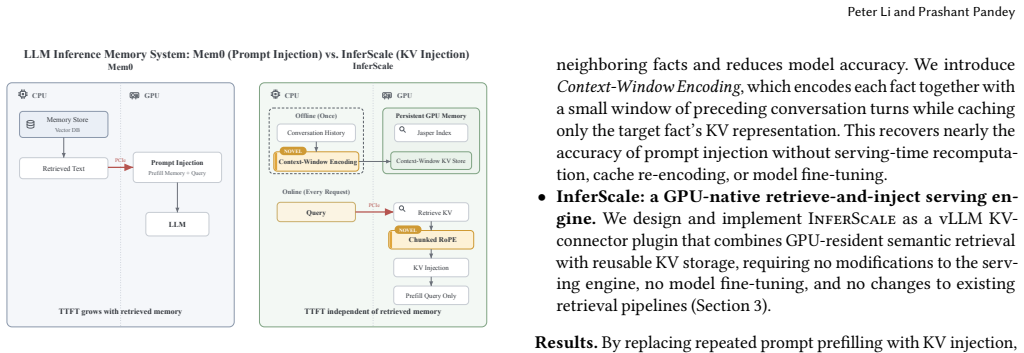
KV injection with Chunked RoPE: store each fact’s keys before rotary position encoding, re-rotate them to serving-time positions on injection into vLLM’s paged cache, and prove exact attention equivalence to prompt injection (Theorems 3 and 6). Context-Window Encoding supplies the residual accuracy by conditioning each fact offline on a window of preceding turns while caching only the target fact’s KV.
Load-bearing premise
That encoding each fact with only a finite offline window of prior turns recovers enough cross-fact context for answer quality when retrieval later assembles those facts in a different order and set than the encoding windows saw.
What would settle it
On LoCoMo-style multi-hop questions at large k, measure whether context-window KV injection closes the accuracy gap to joint prompt injection; a persistent large multi-hop deficit as windows grow would falsify the claim that quality is preserved.
If this is right
- Memory-conditioned TTFT need not grow with retrieval budget k if facts are injected as KV rather than re-prefilled as text.
- A fact encoded once can be placed at arbitrary prompt positions under RoPE without re-encoding, enabling dynamic top-k assembly.
- GPU-resident retrieval plus KV injection multiplies concurrent-user throughput because prefill work shrinks to the query alone.
- Offloading the pre-RoPE KV store to host DRAM lifts per-GPU user capacity at only milliseconds of extra end-to-end latency.
- The same retrieve-and-inject primitive applies to any largely static retrieved context (stable RAG corpora, system prompts, tool descriptions), not only personal memory.
Where Pith is reading between the lines
- If multi-hop remains the residual gap, hybrid schemes that jointly re-encode only the retrieved clique at serving time could close accuracy without returning to full prefill cost.
- Online insert/revise/delete of facts would turn the offline KV store into a live memory OS; consistency between the ANN index and pre-RoPE tensors becomes the hard systems problem.
- Paging hot facts in HBM and cold facts in host/disk along the retrieval path is the natural next capacity layer once per-conversation KV reaches multi-GB.
Editorial analysis
A structured set of objections, weighed in public.
Referee Report
Summary. InferScale replaces repeated prompt prefilling of retrieved personalized memory with reusable, GPU-resident KV state. Memory facts are encoded offline (with optional preceding-turn context), stored pre-RoPE alongside semantic embeddings, retrieved at serving time via a GPU ANN index (Jasper), re-rotated with Chunked RoPE, and scatter-copied into vLLM’s paged KV cache through the stock KV-connector interface—no engine changes or fine-tuning. Theorem 3 proves exact hidden-state/output equivalence of KV vs. prompt injection at query positions for jointly encoded memory under causal decoders; Theorem 6 shows pre-RoPE storage plus on-injection rotation yields exact position relocation. Context-Window Encoding (Theorem 8) is the explicit approximation that recovers most cross-fact context. On LoCoMo across Llama-3.1-8B, Mistral-7B, and Qwen2.5-7B (plus Qwen3-14B), engine TTFT stays nearly flat from k=5 to k=50 (e.g., 16.6→17.3 ms on Llama), 3.6–4.8× lower than Mem0 at k=50, with 60.3% vs. 63.3% accuracy at w=50 and 3.7–4.5× throughput at 100 users; CPU offload of the KV store adds only a few ms to TTFT.
Significance. The central systems claim—that reusable KV state decouples memory-conditioned TTFT from retrieved-context size while preserving application quality within a few points—is well supported and practically important for production personalized serving. Strengths include: (i) clean, correctly scoped theory (exact joint-encode equivalence and exact RoPE relocation, with the independent-fact residual explicitly measured rather than papered over); (ii) a non-invasive vLLM plugin implementation; (iii) thorough ablations of k, w, GPU vs. CPU index, GPU-resident vs. offloaded KV, model scale to 14B, and bf16 empirical equivalence; and (iv) clear separation of offline encoding cost from serving latency. If the result holds under broader workloads, attention-layer injection of static retrieved context is a natural serving primitive beyond Mem0-style memory systems.
major comments (2)
- [§6.3, Table 2, Appendix B, Corollary 9] §6.3, Table 2 and Appendix B: the residual multi-hop gap versus Mem0 (up to ~16 points at k=50 on Mistral) is the load-bearing accuracy caveat of independent encoding. Corollary 9 states exact joint-prefill KV only when the encoding window contains the entire retrieved prefix, which selective top-k does not guarantee. The paper already scopes this as an approximation, but the main claim’s “preserving application quality” language should be tightened in the abstract/conclusion to state that quality is recovered to within a few overall points, with the multi-hop shortfall remaining the principal residual—and ideally add a short analysis of how often retrieved facts at serving time were co-present in each other’s offline windows.
- [§6.4] §6.4 throughput setup: all N concurrent users share one conversation’s memory corpus and issue queries against that single store. This stresses batching and prefill elimination but does not exercise per-user KV isolation, multi-tenant HBM pressure, or cross-user retrieval contention that production personalized serving would see. A brief multi-corpus or multi-store measurement (even at smaller N), or an explicit limitation statement, would make the 3.7–4.5× QPS claim more transferable.
minor comments (6)
- [Figure 4, §6.2] Figure 4 caption and §6.2: state explicitly that prefix caching is enabled for Mem0 (best case) and that InferScale curves for w∈{0,5,20,50} overlap; the main text does, but a one-line callout in the figure helps.
- [§4.2 Theorem 3, Corollary 4] Theorem 3 title has a typo: “Eqivalence” → “Equivalence” (also Corollary 4).
- [§6.9, Table 7] §6.9 / Table 7: one Qwen open-ended case is “Different” under greedy bf16; a sentence on whether the factual content still matched (table says 100% factual accuracy) would close the loop for readers worried about non-determinism.
- [§1, §2] Related work (§1 closing, §2): CacheBlend, LMCache, Block-Attention, LazyAttention are contrasted at a high level; a short table of assumptions (fixed layout vs. dynamic assembly; fine-tuning required; recompute) would sharpen the positioning.
- [§6.7, Table 5] Table 5 / §6.7: report KV footprint also per fact or per 1K tokens so readers can extrapolate beyond LoCoMo conversation sizes.
- [§4] Minor notation: m is used both for memory token length and (implicitly) for composed segment length; a single consistent definition early in §4 would help.
Circularity Check
No significant circularity: theorems follow from causal attention and RoPE algebra; latency/accuracy claims are external empirical comparisons.
full rationale
InferScale’s load-bearing claims are (i) exact equivalence of KV vs prompt injection at query positions under joint encoding (Theorem 3), (ii) exact position relocation when keys are stored pre-RoPE (Theorem 6), and (iii) measured serving gains and near-parity accuracy on LoCoMo vs Mem0. Theorem 3 is an induction on the causal decoder recurrence using only causality and that prior positions enter via KV pairs; Theorem 6 follows from the standard RoPE identity R⊤_a R_b = R_{b-a}. Neither result is fitted to the target TTFT/accuracy numbers, nor defined in terms of those numbers. Context-window encoding (Theorem 8, Corollary 9) is explicitly scoped as an approximation whose residual multi-hop gap is reported (Table 2, Appendix B), not hidden as a forced prediction. Empirical claims use held-out LoCoMo QA against an independent production baseline (Mem0) with swept k and w. The Jasper GPU index is prior work with author overlap, but it is only a retrieval backend; the paper states the two indices return near-identical facts and that the backend affects latency not accuracy, so it is not load-bearing for the central KV-injection or quality claims. No self-definitional step, fitted-input-as-prediction, uniqueness import, or renaming of a known result appears in the derivation chain.
Axiom & Free-Parameter Ledger
free parameters (3)
- context-window size w (turns) =
primary reported operating points use w=5 or w=50
- retrieval budget k =
headline speedups reported at k=50
- Jasper ANN build/search params =
64 neighbors, beam width 64
axioms (5)
- domain assumption Under causal self-attention, a memory token’s KV depends only on that token and its left context, never on future query tokens—so memory KV is query-independent and reusable.
- domain assumption RoPE scores depend only on relative position (R_a^T R_b = R_{b-a}), so keys stored pre-rotation can be re-rotated at arbitrary injection positions with exact score recovery.
- domain assumption vLLM’s KV-connector interface can mark a prompt prefix as externally available, allocate paged blocks without prefilling them, and accept GPU-side scatter-copy of K/V before the forward pass.
- ad hoc to paper A finite window of preceding conversation turns is sufficient local context for fact disambiguation when only the target fact’s KV is retained.
- domain assumption User memory facts are stable enough to encode once offline and reuse across many requests (read-mostly store).
invented entities (2)
-
Chunked RoPE
independent evidence
-
Context-Window Encoding
no independent evidence
read the original abstract
Large language models are increasingly deployed with persistent personalized context, such as accumulated memory profiles or long conversation histories, that is shared across a user's many requests. Production memory systems (e.g., Mem0, MemGPT, and Zep) retrieve a relevant subset of this memory and inject it into the prompt, forcing the serving engine to repeatedly prefill the same content. As the retrieval budget grows, time-to-first-token (TTFT) increases even though the underlying memory is reused across requests. We present InferScale, a GPU-native LLM memory system that replaces repeated prompt prefilling with reusable KV state. InferScale precomputes each memory fact's KV representation, stores it alongside a semantic embedding on the GPU, retrieves relevant facts at serving time, and injects their KV directly into vLLM's paged cache. To support dynamically assembled memories under rotary position embeddings, we introduce Chunked RoPE, which stores keys before rotation and applies their serving-time positions during injection. However, encoding memory facts independently omits the cross-fact context available during joint prefilling. We mitigate this with Context-Window Encoding, which encodes each memory fact together with a small window of preceding conversation context while caching only the target fact's KV. InferScale is implemented through vLLM's KV-connector interface, requiring neither engine modifications nor model fine-tuning. Across three open-weight models on LoCoMo, InferScale keeps TTFT nearly constant as the retrieval budget increases: at k=50 it reduces TTFT by 72-79% (3.6-4.8x), achieves 60.3% accuracy versus 63.3% for Mem0 without serving-time recomputation, and delivers 3.7-4.5x the throughput under concurrent load. Reusable KV state thus decouples memory-conditioned serving latency from retrieved-context size while preserving application quality.
Figures


Reference graph
Works this paper leans on
-
[1]
Joshua Ainslie, James Lee-Thorp, Michiel de Jong, Yury Zemlyanskiy, Federico Lebrón, and Sumit Sanghai. 2023. GQA: Training Generalized Multi-Query Transformer Models from Multi-Head Checkpoints. InProceedings of the 2023 Conference on Empirical Methods in Natural Language Processing (EMNLP)
2023
-
[2]
Yaoqi Chen, Jinkai Zhang, Baotong Lu, Qianxi Zhang, Chengruidong Zhang, Jing Liu, Jingjia Luo, Di Liu, Huiqiang Jiang, Qi Chen, Bailu Ding, Xiao Yan, Jiawei Jiang, Chen Chen, Mingxing Zhang, Cheng Li, Yuqing Yang, Fan Yang, and Mao Yang. 2026. RetroInfer: A Vector Storage Engine for Scalable Long-Context LLM Inference.Proceedings of the VLDB Endowment19, ...
arXiv 2026
-
[3]
Prateek Chhikara, Dev Khant, Saket Aryan, Taranjeet Singh, and Deshraj Yadav
-
[4]
Gemma Team. 2024. Gemma 2: Improving Open Language Models at a Practical Size. arXiv:2408.00118 doi:10.48550/arXiv.2408.00118
-
[5]
Jeff Johnson, Matthijs Douze, and Hervé Jégou. 2019. Billion-Scale Similarity Search with GPUs.IEEE Transactions on Big Data(2019)
2019
-
[6]
Gonzalez, Hao Zhang, and Ion Stoica
Woosuk Kwon, Zhuohan Li, Siyuan Zhuang, Ying Sheng, Lianmin Zheng, Cody Hao Yu, Joseph E. Gonzalez, Hao Zhang, and Ion Stoica. 2023. Efficient Memory Management for Large Language Model Serving with PagedAttention. InProceedings of the 29th Symposium on Operating Systems Principles(Koblenz, Germany)(SOSP ’23). Association for Computing Machinery, New York...
arXiv 2023
-
[7]
Di Liu, Meng Chen, Baotong Lu, Huiqiang Jiang, Zhenhua Han, Qianxi Zhang, Qi Chen, Chengruidong Zhang, Bailu Ding, Kai Zhang, Chen Chen, Fan Yang, Yuqing Yang, and Lili Qiu. 2025. RetrievalAttention: Accelerating Long-Context LLM Inference via Vector Retrieval. InAdvances in Neural Information Processing Systems, Vol. 38. Curran Associates, Inc., Red Hook...
2025
-
[8]
Yuhan Liu, Yihua Cheng, Jiayi Yao, Yuwei An, Xiaokun Chen, Shaoting Feng, Yuyang Huang, Samuel Shen, Rui Zhang, Kuntai Du, and Junchen Jiang. 2025. LMCache: An Efficient KV Cache Layer for Enterprise-Scale LLM Inference. arXiv:2510.09665 doi:10.48550/arXiv.2510.09665
-
[9]
Dongyang Ma, Yan Wang, and Tian Lan. 2025. Block-Attention for Efficient Prefill- ing. InThe Thirteenth International Conference on Learning Representations. Open- Review.net, Singapore, 15 pages. https://proceedings.iclr.cc/paper_files/paper/ 2025/hash/a03037317560b8c5f2fb4b6466d4c439-Abstract-Conference.html
2025
-
[10]
Adyasha Maharana, Dong-Ho Lee, Sergey Tulyakov, Mohit Bansal, Francesco Bar- bieri, and Yuwei Fang. 2024. Evaluating Very Long-Term Conversational Memory of LLM Agents. InProceedings of the 62nd Annual Meeting of the Association for Computational Linguistics (Volume 1: Long Papers). Association for Computational Linguistics, Bangkok, Thailand, 13851–13870...
-
[11]
Malkov and Dmitry A
Yu A. Malkov and Dmitry A. Yashunin. 2020. Efficient and Robust Approximate Nearest Neighbor Search Using Hierarchical Navigable Small World Graphs.IEEE Transactions on Pattern Analysis and Machine Intelligence42, 4 (2020), 824–836
2020
-
[12]
Hunter McCoy, Zikun Wang, and Prashant Pandey. 2026. GPU-Accelerated ANNS: Quantized for Speed, Built for Change. arXiv:2601.07048 doi:10.48550/arXiv.2601.07048
work page internal anchor Pith review Pith/arXiv arXiv doi:10.48550/arxiv.2601.07048 2026
-
[13]
Mistral AI Team. 2024. Mistral-7B-Instruct-v0.3 Model Card. Hugging Face model repository. https://huggingface.co/mistralai/Mistral-7B-Instruct-v0.3 Accessed 17 July 2026
2024
-
[14]
Hiroyuki Ootomo, Akira Naruse, Corey Nolet, Ray Wang, Tamas Feher, and Yong Wang. 2023. CAGRA: Highly Parallel Graph Construction and Approximate Nearest Neighbor Search for GPUs.arXiv preprint arXiv:2308.15136(2023)
Pith/arXiv arXiv 2023
-
[15]
OpenAI. 2024. New Embedding Models and API Updates. OpenAI product announcement. https://openai.com/index/new-embedding-models-and-api- updates/ Published 25 January 2024; accessed 17 July 2026
2024
-
[16]
Patil, Ion Stoica, and Joseph E
Charles Packer, Sarah Wooders, Kevin Lin, Vivian Fang, Shishir G. Patil, Ion Stoica, and Joseph E. Gonzalez. 2023. MemGPT: Towards LLMs as Operating Systems. arXiv:2310.08560 doi:10.48550/arXiv.2310.08560
-
[17]
Qdrant Solutions GmbH. 2026. Qdrant: Vector Database and Vector Search Engine. Software repository. https://github.com/qdrant/qdrant Accessed 17 July 2026
2026
-
[18]
Qwen Team. 2024. Qwen2.5 Technical Report. arXiv:2412.15115 doi:10.48550/arXiv.2412.15115
-
[19]
Preston Rasmussen, Pavlo Paliychuk, Travis Beauvais, Jack Ryan, and Daniel Chalef. 2025. Zep: A Temporal Knowledge Graph Architecture for Agent Memory. arXiv:2501.13956 doi:10.48550/arXiv.2501.13956
-
[20]
Jianlin Su, Murtadha Ahmed, Yu Lu, Shengfeng Pan, Wen Bo, and Yunfeng Liu. 2024. RoFormer: Enhanced Transformer with Rotary Position Embedding. Neurocomputing568 (2024), 127063. doi:10.1016/j.neucom.2023.127063
arXiv 2024
-
[21]
Llama Team and AI @ Meta. 2024. The Llama 3 Herd of Models. arXiv:2407.21783 doi:10.48550/arXiv.2407.21783
-
[22]
Qwen Team. 2025. Qwen3 Technical Report. arXiv:2505.09388 doi:10.48550/arXiv.2505.09388
-
[23]
Haocheng Xia, Mihir Pamnani, Hanxi Fang, Supawit Chockchowwat, and Yongjoo Park. 2026. LazyAttention: Efficient Retrieval-Augmented Generation with Deferred Positional Encoding. arXiv:2606.04302 doi:10.48550/arXiv.2606.04302
work page internal anchor Pith review Pith/arXiv arXiv doi:10.48550/arxiv.2606.04302 2026
-
[24]
Jiayi Yao, Hanchen Li, Yuhan Liu, Siddhant Ray, Yihua Cheng, Qizheng Zhang, Kuntai Du, Shan Lu, and Junchen Jiang. 2025. CacheBlend: Fast Large Language Model Serving for RAG with Cached Knowledge Fusion. InProceedings of the Twentieth European Conference on Computer Systems(Rotterdam, Netherlands) (EuroSys ’25). Association for Computing Machinery, New Y...
arXiv 2025
-
[2025]
arXiv:2504.19413 doi:10.48550/arXiv.2504.19413
Mem0: Building Production-Ready AI Agents with Scalable Long-Term Memory. arXiv:2504.19413 doi:10.48550/arXiv.2504.19413
discussion (0)
Sign in with ORCID, Apple, or X to comment. Anyone can read and Pith papers without signing in.