Q-PhotoNAS: Hybrid Quantum Neural Architecture Search Framework on Photonic Devices
Pith reviewed 2026-05-22 05:53 UTC · model grok-4.3
The pith
A genetic algorithm automatically designs hybrid photonic quantum-classical networks that reach 99.44 percent accuracy on digit recognition by adding orthogonal quantum features.
A machine-rendered reading of the paper's core claim, the machinery that carries it, and where it could break.
Core claim
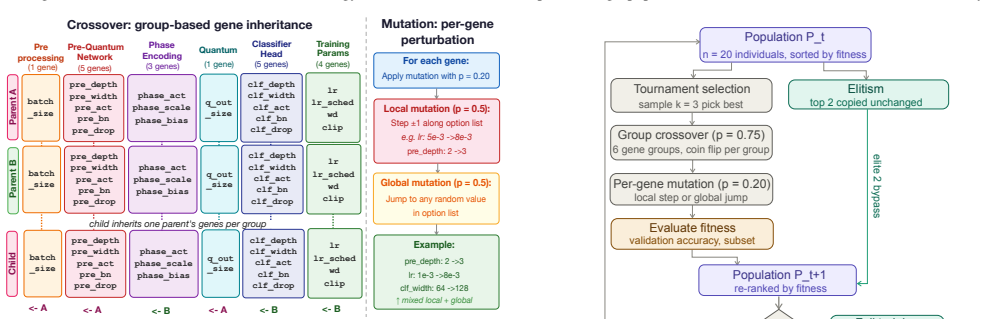
The framework encodes hybrid model design into nineteen hyperparameters grouped into six gene categories and evolves a population of architectures through group-based crossover, per-gene mutation, and elitism. Candidates receive short-budget training for ranking, after which the best design undergoes full retraining. On the Digits and MNIST benchmarks this process produces final validation accuracies of 99.44 percent and 98.78 percent, with first-principles estimates projecting single-image inference times of 67 ms and 149 ms on the target photonic processor. Separate analysis demonstrates that the photonic layer extracts features orthogonal to those of the classical pathway, yielding an end
What carries the argument
The genetic algorithm that jointly searches classical preprocessing, learnable quantum phase encoding, and photonic circuit structure through group-based crossover and mutation.
If this is right
- Hybrid models discovered by the search outperform classical-only baselines because the photonic layer supplies non-redundant features.
- Automated search renders systematic exploration of photonic quantum AI designs practical under hardware constraints.
- Projected inference times of 67 ms and 149 ms indicate that the found architectures are compatible with existing photonic quantum processors.
- The combination of learnable phase encoding with genetic evolution allows the framework to adapt circuit structure to specific classification tasks.
Where Pith is reading between the lines
- The same search strategy could be adapted to other quantum hardware modalities to test whether orthogonal feature extraction appears outside photonic systems.
- Scaling the genetic search to larger image datasets would reveal whether the current gene encoding remains effective when input dimensionality increases.
- Replacing the short-budget evaluation with a learned performance predictor might reduce the overall search cost while preserving ranking quality.
Load-bearing premise
Short-budget training of candidate architectures during the genetic search reliably ranks their final performance after full retraining, and the quantum contribution analysis correctly isolates orthogonal features without confounding effects from preprocessing choices.
What would settle it
Retraining the top architectures selected by short-budget search and observing accuracies substantially below the reported 99.44 percent and 98.78 percent would falsify the claim that the search method reliably identifies high-performing hybrids.
Figures




read the original abstract
Photonic quantum computing is a promising platform for scalable quantum machine learning, but designing effective hybrid architectures remains challenging under hardware and optimization constraints. Existing approaches rely on manually tuned architectures that fail to account for the collaboration between classical preprocessing, phase encoding, and photonic circuit structure, limiting both accuracy and hardware compatibility. In this paper, we propose a neural architecture search framework for hybrid photonic quantum-classical models that combines genetic algorithm-based search with learnable quantum phase encoding to systematically explore the joint design space of classical and quantum components. Our framework encodes 19 hyperparameters across six gene groups and evolves a population of hybrid architectures using group-based crossover, per-gene mutation, and elitism, evaluating each candidate on a short training budget before full retraining of the best found design. We evaluate our framework on two image classification benchmarks, Digits and MNIST, achieving final validation accuracies of 99.44% and 98.78%, respectively, with first-principles execution time estimates on the Quandela Ascella photonic QPU projecting single-image inference at 67 ms (Digits) and 149 ms (MNIST). Our quantum contribution analysis further shows that the photonic layer extracts non-redundant features orthogonal to the classical pathway, providing a measurable accuracy advantage over classical-only baselines. Our results demonstrate that automated architecture search is both practical and impactful for hybrid photonic systems, opening the way for systematic design space exploration of quantum AI on photonic devices.
Editorial analysis
A structured set of objections, weighed in public.
Referee Report
Summary. The manuscript introduces Q-PhotoNAS, a genetic-algorithm neural architecture search framework for hybrid photonic quantum-classical models. It encodes 19 hyperparameters across six gene groups and evolves architectures via group-based crossover, per-gene mutation, and elitism, evaluating candidates on short training budgets before full retraining of the best design. On Digits and MNIST the selected models reach 99.44% and 98.78% validation accuracy; first-principles estimates project single-image inference times of 67 ms and 149 ms on the Quandela Ascella photonic QPU. The paper further claims that the photonic layer extracts non-redundant orthogonal features that measurably improve accuracy over classical-only baselines.
Significance. If the reported accuracies and orthogonality analysis hold under rigorous verification, the work is significant for demonstrating that automated, hardware-aware search can produce practical hybrid photonic quantum models on current devices. The concrete timing projections and explicit comparison to classical baselines provide falsifiable benchmarks that could accelerate systematic exploration of quantum AI on photonic platforms.
major comments (2)
- [Abstract and evaluation protocol description] The central evaluation protocol (short-budget training of candidates during genetic search followed by full retraining of the selected architecture) is load-bearing for the optimality claim. If relative rankings change materially under longer training—as is known to occur in NAS when loss landscapes differ across budgets—the architecture reported with 99.44%/98.78% accuracy may not be the one that would have been chosen under the final protocol. This directly weakens the assertion that the automated search produces a demonstrably superior photonic-classical collaboration.
- [Quantum contribution analysis section] The quantum contribution analysis asserts that the photonic layer extracts features orthogonal to the classical pathway and provides a measurable accuracy advantage. However, the manuscript provides no quantitative definition of orthogonality (e.g., correlation coefficients, mutual information, or subspace angles), no error bars on the accuracy deltas, and no ablation isolating the effect of classical preprocessing or encoding choices. Without these, the orthogonality claim cannot be assessed as load-bearing evidence.
minor comments (2)
- [Abstract and results] The abstract and results sections report point accuracies without error bars, standard deviations across runs, or explicit train/validation/test split details.
- [Experimental setup] Baseline implementations (classical-only models, other NAS methods) are referenced but lack sufficient implementation or hyperparameter details to allow direct reproduction.
Simulated Author's Rebuttal
We thank the referee for the constructive and detailed feedback on our manuscript. We address each major comment point by point below, providing clarifications, additional analysis, and revisions to strengthen the presentation and evidence.
read point-by-point responses
-
Referee: [Abstract and evaluation protocol description] The central evaluation protocol (short-budget training of candidates during genetic search followed by full retraining of the selected architecture) is load-bearing for the optimality claim. If relative rankings change materially under longer training—as is known to occur in NAS when loss landscapes differ across budgets—the architecture reported with 99.44%/98.78% accuracy may not be the one that would have been chosen under the final protocol. This directly weakens the assertion that the automated search produces a demonstrably superior photonic-classical collaboration.
Authors: We acknowledge that differences in training budget can affect relative rankings in NAS, as established in the broader literature. Our use of short training budgets during the evolutionary search is a deliberate design choice to keep the overall search computationally tractable while still allowing full retraining of the final selected architecture. In the revised manuscript we have expanded the methodology section to explicitly discuss this trade-off, citing relevant NAS works that employ similar proxy-task protocols. We also added a small-scale verification experiment on a reduced search space showing that the top-performing candidates maintain stable rankings when training budgets are extended. To avoid overstatement we have revised the abstract, introduction, and conclusions to frame the result as the identification of high-performing hybrid architectures under the reported protocol rather than an assertion of absolute optimality. revision: partial
-
Referee: [Quantum contribution analysis section] The quantum contribution analysis asserts that the photonic layer extracts features orthogonal to the classical pathway and provides a measurable accuracy advantage. However, the manuscript provides no quantitative definition of orthogonality (e.g., correlation coefficients, mutual information, or subspace angles), no error bars on the accuracy deltas, and no ablation isolating the effect of classical preprocessing or encoding choices. Without these, the orthogonality claim cannot be assessed as load-bearing evidence.
Authors: The referee correctly notes that the original manuscript lacked explicit quantitative support for the orthogonality claim. In the revised version we have added a precise definition of orthogonality based on the average cosine similarity between the feature vectors produced by the classical preprocessing pathway and the photonic circuit output, together with mutual-information estimates between the two sets of features. We now report accuracy deltas with error bars computed over five independent runs using different random seeds. We have also inserted two ablation studies: (i) a direct comparison against a classical-only baseline with matched parameter count and (ii) an experiment that isolates the photonic circuit by freezing the preprocessing and encoding hyperparameters. These additions are presented in a new subsection of the results and provide the quantitative grounding needed to evaluate the non-redundant feature extraction claim. revision: yes
Circularity Check
No significant circularity; performance claims rest on independent held-out measurements after search.
full rationale
The paper presents a genetic-algorithm NAS that encodes 19 hyperparameters, evaluates candidates under a short training budget, selects the best, and then performs full retraining before reporting validation accuracies of 99.44% (Digits) and 98.78% (MNIST) on held-out sets. These final metrics are measured after the search completes and are compared against classical-only baselines; they are not algebraically or statistically forced by the search objective itself. The quantum contribution analysis is described as isolating non-redundant orthogonal features, but no equations or self-citations are shown that reduce this isolation to a definition or fit performed on the same data used for the headline numbers. Execution-time projections on the Quandela Ascella QPU are first-principles estimates separate from the accuracy claims. The derivation chain therefore remains self-contained against external benchmarks and does not collapse to any of the enumerated circularity patterns.
Axiom & Free-Parameter Ledger
free parameters (1)
- 19 hyperparameters across six gene groups
Lean theorems connected to this paper
-
IndisputableMonolith/Cost/FunctionalEquation.leanwashburn_uniqueness_aczel unclear?
unclearRelation between the paper passage and the cited Recognition theorem.
We encode 19 hyperparameters across six gene groups and evolve a population of hybrid architectures using group-based crossover, per-gene mutation, and elitism, evaluating each candidate on a short training budget
-
IndisputableMonolith/Foundation/AlphaCoordinateFixation.leanalpha_pin_under_high_calibration unclear?
unclearRelation between the paper passage and the cited Recognition theorem.
Learnable quantum phase encoding as a jointly optimized design axis... θi=actϕ(xi·si+bi)·π
-
IndisputableMonolith/Foundation/RealityFromDistinction.leanreality_from_one_distinction unclear?
unclearRelation between the paper passage and the cited Recognition theorem.
Quantum contribution analysis... inter-class cosine similarity of the quantum output vectors
What do these tags mean?
- matches
- The paper's claim is directly supported by a theorem in the formal canon.
- supports
- The theorem supports part of the paper's argument, but the paper may add assumptions or extra steps.
- extends
- The paper goes beyond the formal theorem; the theorem is a base layer rather than the whole result.
- uses
- The paper appears to rely on the theorem as machinery.
- contradicts
- The paper's claim conflicts with a theorem or certificate in the canon.
- unclear
- Pith found a possible connection, but the passage is too broad, indirect, or ambiguous to say the theorem truly supports the claim.
Reference graph
Works this paper leans on
-
[1]
J. Biamonte, P. Wittek, N. Pancotti, P. Rebentrost, N. Wiebe, and S. Lloyd, “Quantum machine learning,”Nature, vol. 549, no. 7671, p. 195–202, Sep. 2017. [Online]. Available: http://dx.doi.org/10.1038/nature23474
-
[2]
Challenges and opportunities in quantum machine learning,
M. Cerezo, G. Verdon, H.-Y . Huang, L. Cincio, and P. J. Coles, “Challenges and opportunities in quantum machine learning,”Nature Computational Science, vol. 2, no. 9, p. 567–576, Sep. 2022. [Online]. Available: http://dx.doi.org/10.1038/s43588-022-00311-3
-
[3]
A survey on quantum machine learning: Current trends, challenges, opportunities, and the road ahead,
K. Zaman, A. Marchisio, M. A. Hanif, and M. Shafique, “A survey on quantum machine learning: Current trends, challenges, opportunities, and the road ahead,”arXiv preprint arXiv:2310.10315, 2023
-
[4]
M. Schuld and F. Petruccione,Machine learning with quantum computers. Springer, 2021, vol. 676
work page 2021
-
[5]
Quantum computing and machine learning on an integrated photonics platform,
H. Zhu, H. Lin, S. Wu, W. Luo, H. Zhang, Y . Zhan, X. Wang, A. Liu, and L. C. Kwek, “Quantum computing and machine learning on an integrated photonics platform,”Information, vol. 15, no. 2, 2024. [Online]. Available: https://www.mdpi.com/2078-2489/15/2/95 11
work page 2024
-
[6]
A general-purpose single-photon-based quantum computing platform,
N. Maring, A. Fyrillas, M. Pont, E. Ivanov, P. Stepanov, N. Margaria, W. Hease, A. Pishchagin, T. H. Au, S. Boissier, E. Bertasi, A. Baert, M. Valdivia, M. Billard, O. Acar, A. Brieussel, R. Mezher, S. C. Wein, A. Salavrakos, P. Sinnott, D. A. Fioretto, P.-E. Emeriau, N. Belabas, S. Mansfield, P. Senellart, J. Senellart, and N. Somaschi, “A general-purpos...
-
[7]
Available: https://arxiv.org/abs/2306.00874
[Online]. Available: https://arxiv.org/abs/2306.00874
-
[8]
Superconducting qubits: Current state of play,
M. Kjaergaard, M. E. Schwartz, J. Braum ¨uller, P. Krantz, J. I.- J. Wang, S. Gustavsson, and W. D. Oliver, “Superconducting qubits: Current state of play,”Annual Review of Condensed Matter Physics, vol. 11, no. 1, p. 369–395, Mar. 2020. [Online]. Available: http://dx.doi.org/10.1146/annurev-conmatphys-031119-050605
-
[9]
Trapped-ion quantum computing: Progress and challenges
C. D. Bruzewicz, J. Chiaverini, R. McConnell, and J. M. Sage, “Trapped-ion quantum computing: Progress and challenges,”Applied Physics Reviews, vol. 6, no. 2, May 2019. [Online]. Available: http://dx.doi.org/10.1063/1.5088164
-
[10]
Photonic quantum information processing: a review,
F. Flamini, N. Spagnolo, and F. Sciarrino, “Photonic quantum information processing: a review,”Reports on Progress in Physics, vol. 82, no. 1, p. 016001, Nov. 2018. [Online]. Available: http://dx.doi.org/10.1088/1361-6633/aad5b2
-
[11]
S. Slussarenko and G. J. Pryde, “Photonic quantum information processing: A concise review,”Applied Physics Reviews, vol. 6, no. 4, Oct. 2019. [Online]. Available: http://dx.doi.org/10.1063/1.5115814
-
[12]
Proximl: Build- ing machine learning classifiers for photonic quantum computing,
A. Ranjan, T. Patel, D. Silver, H. Gandhi, and D. Tiwari, “Proximl: Build- ing machine learning classifiers for photonic quantum computing,” in Proceedings of the 29th ACM International Conference on Architectural Support for Programming Languages and Operating Systems, Volume 3, 2024, pp. 834–849
work page 2024
-
[13]
Photonic quantum-accelerated machine learning,
M. Rambach, A. Roy, A. Gilchrist, A. Sakurai, W. J. Munro, K. Nemoto, and A. G. White, “Photonic quantum-accelerated machine learning,”
-
[14]
Available: https://arxiv.org/abs/2512.08318
[Online]. Available: https://arxiv.org/abs/2512.08318
-
[15]
Neural architecture search: Insights from 1000 papers,
C. White, M. Safari, R. Sukthanker, B. Ru, T. Elsken, A. Zela, D. Dey, and F. Hutter, “Neural architecture search: Insights from 1000 papers,”
-
[16]
arXiv preprint arXiv:2301.08727 (2023)
[Online]. Available: https://arxiv.org/abs/2301.08727
-
[17]
Advances in neural architecture search,
X. Wang and W. Zhao, “Advances in neural architecture search,”National Science Review, vol. 11, no. 8, p. nwae282, 2024
work page 2024
-
[18]
Hierarchical quantum circuit representations for neural architecture search,
M. Lourens, I. Sinayskiy, D. K. Park, C. Blank, and F. Petruccione, “Hierarchical quantum circuit representations for neural architecture search,”npj Quantum Information, vol. 9, no. 1, Aug. 2023. [Online]. Available: http://dx.doi.org/10.1038/s41534-023-00747-z
-
[19]
Balanced quantum neural architecture search,
Y . Li, G. Liu, P. Zhao, R. Shang, and L. Jiao, “Balanced quantum neural architecture search,”Neurocomputing, vol. 590, p. 127753, 2024
work page 2024
-
[20]
S. Dutta, N. Innan, S. B. Yahia, and M. Shafique, “Qas-qtns: Curriculum reinforcement learning-driven quantum architecture search for quantum tensor networks,” in2025 IEEE International Conference on Quantum Computing and Engineering (QCE), vol. 1. IEEE, 2025, pp. 1739–1747
work page 2025
-
[21]
P. K. Choudhary, N. Innan, M. Shafique, and R. Singh, “Graph-based bayesian optimization for quantum circuit architecture search with uncertainty calibrated surrogates,”arXiv preprint arXiv:2512.09586, 2025
-
[22]
Faqnas: Flops-aware hybrid quantum neural architecture search using genetic algorithm,
M. Kashif, S. Khalid, A. Marchisio, N. Innan, and M. Shafique, “Faqnas: Flops-aware hybrid quantum neural architecture search using genetic algorithm,”arXiv preprint arXiv:2511.10062, 2025
-
[23]
GAT-QNN: Genetic Algorithm-Based Training of Hybrid Quantum Neural Networks
T. Ahmed, A. Marchisio, M. Kashif, N. Innan, and M. Shafique, “Gat-qnn: Genetic algorithm-based training of hybrid quantum neural networks,” arXiv preprint arXiv:2604.15048, 2026
work page internal anchor Pith review Pith/arXiv arXiv 2026
-
[24]
Experimental quantum-enhanced kernels on a photonic processor,
Z. Yin, I. Agresti, G. de Felice, D. Brown, A. Toumi, C. Pentangelo, S. Piacentini, A. Crespi, F. Ceccarelli, R. Osellame, B. Coecke, and P. Walther, “Experimental quantum-enhanced kernels on a photonic processor,” 2024. [Online]. Available: https://arxiv.org/abs/2407.20364
-
[25]
C. Notton, V . Apostolou, A. Senellart, A. Walsh, D. Wang, Y . Xie, S. Yang, I. Mejdoub, O. Zouhry, K.-C. Chen, C.-Y . Liu, A. Sharma, E. Y . Balaji, S. P. Pawar, L. L. Frioux, V . Macheret, A. Radet, V . Deumier, A. K. Gupta, G. Intoccia, D. J. Kenne, C. Marullo, G. Massafra, N. Reinaldet, V . S. D. Cola, D. Kolesnyk, Y . V odovozova, R. Mezher, P.-E. Em...
-
[26]
Quantum learning advantage on a scalable photonic platform,
Z.-H. Liu, R. Brunel, E. E. B. Østergaard, O. Cordero, S. Chen, Y . Wong, J. A. H. Nielsen, A. B. Bregnsbo, S. Zhou, H.-Y . Huang, C. Oh, L. Jiang, J. Preskill, J. S. Neergaard-Nielsen, and U. L. Andersen, “Quantum learning advantage on a scalable photonic platform,”Science, vol. 389, no. 6767, p. 1332–1335, Sep. 2025. [Online]. Available: http://dx.doi.o...
-
[27]
K. Chowdary and T. Janani, “Enhanced hybrid quantum classical neural networks with novel encoding techniques for image recognition,”Applied Soft Computing, vol. 193, p. 114856, 02 2026
work page 2026
-
[28]
Photonic quantum convolutional neural networks with adaptive state injection,
L. Monbroussou, B. Polacchi, V . Yacoub, E. Caruccio, G. Rodari, F. Hoch, G. Carvacho, N. Spagnolo, T. Giordani, M. Bossi, A. Rajan, N. Di Giano, R. Albiero, F. Ceccarelli, R. Osellame, E. Kashefi, and F. Sciarrino, “Photonic quantum convolutional neural networks with adaptive state injection,”Advanced Photonics, vol. 7, no. 06, Nov. 2025. [Online]. Avail...
-
[29]
Next- generation quantum neural networks: Enhancing efficiency, security, and privacy,
N. Innan, M. Kashif, A. Marchisio, M. Bennai, and M. Shafique, “Next- generation quantum neural networks: Enhancing efficiency, security, and privacy,” in2025 IEEE 31st International Symposium on On-Line Testing and Robust System Design (IOLTS). IEEE, 2025, pp. 1–4
work page 2025
-
[30]
Scaling Laws for Hybrid Quantum Neural Networks: Depth, Width, and Quantum-Centric Diagnostics
D. Vyskubov, K. Vyskubov, N. Innan, and M. Shafique, “Scaling laws for hybrid quantum neural networks: Depth, width, and quantum-centric diagnostics,”arXiv preprint arXiv:2604.06007, 2026
work page internal anchor Pith review Pith/arXiv arXiv 2026
-
[31]
Shallow hybrid quantum-classical convolutional neural network model for image classification,
A. Wang, J. Hu, S. Zhang, and L. Li, “Shallow hybrid quantum-classical convolutional neural network model for image classification,”Quantum Information Processing, vol. 23, no. 1, p. 17, Jan. 2024
work page 2024
-
[32]
Hybrid quantum neural network image anti-noise classification model combined with error mitigation,
N. Ji, R. Bao, Z. Chen, Y . Yu, and H. Ma, “Hybrid quantum neural network image anti-noise classification model combined with error mitigation,”Applied Sciences, vol. 14, no. 4, 2024. [Online]. Available: https://www.mdpi.com/2076-3417/14/4/1392
work page 2024
-
[33]
Hybrid quantum-classical-quantum convolutional neural networks,
C. Long, M. Huang, X. Ye, Y . Futamura, and T. Sakurai, “Hybrid quantum-classical-quantum convolutional neural networks,”Scientific Reports, vol. 15, no. 1, p. 31780, 2025. [Online]. Available: https://doi.org/10.1038/s41598-025-13417-1
-
[34]
Quantum-classical convolutional neural networks in radiological image classification,
A. Matic, M. Monnet, J. M. Lorenz, B. Schachtner, and T. Messerer, “Quantum-classical convolutional neural networks in radiological image classification,” 2022. [Online]. Available: https://arxiv.org/abs/2204.12390
-
[35]
Lean classical-quantum hybrid neural network model for image classification,
A. Liu, C. Wen, and J. Wang, “Lean classical-quantum hybrid neural network model for image classification,”Advanced Quantum Technologies, vol. 8, no. 10, p. 2400703, 2025. [Online]. Available: https: //advanced.onlinelibrary.wiley.com/doi/abs/10.1002/qute.202400703
-
[36]
B. Bose and S. Verma, “Quantum data encoding and variational algorithms: A framework for hybrid quantum classical machine learning,”
-
[37]
Available: https://arxiv.org/abs/2502.11951
[Online]. Available: https://arxiv.org/abs/2502.11951
-
[38]
Design Space Exploration of Hybrid Quantum Neural Networks for Chronic Kidney Disease
M. Kashif, H. M. Siraj, N. Innan, A. Marchisio, and M. Shafique, “Design space exploration of hybrid quantum neural networks for chronic kidney disease,”arXiv preprint arXiv:2604.13608, 2026
work page internal anchor Pith review Pith/arXiv arXiv 2026
-
[39]
An improved hyperparameter optimization framework for automl systems using evolutionary algorithms,
A. M. Vincent and P. Jidesh, “An improved hyperparameter optimization framework for automl systems using evolutionary algorithms,”Scientific Reports, vol. 13, no. 1, p. 4737, 2023
work page 2023
-
[40]
Evolving neural architectures: A genetic algorithm approach to deep learning optimization,
P. L, S. Lavanya, L. P. Dhyaram, G. Brindavanam, and K. Nethra, “Evolving neural architectures: A genetic algorithm approach to deep learning optimization,”SSRN Electronic Journal, 01 2025
work page 2025
-
[41]
Genetic algorithm based deep learning neural network structure and hyperparameter optimization,
S. Lee, J. Kim, H. Kang, D.-Y . Kang, and J. Park, “Genetic algorithm based deep learning neural network structure and hyperparameter optimization,”Applied Sciences, vol. 11, no. 2, 2021. [Online]. Available: https://www.mdpi.com/2076-3417/11/2/744
work page 2021
-
[42]
Quantum-inspired evolutionary algorithm applied to neural architecture search,
H. D. d. Mello Junior, M. Machado Vellasco, and M. Barbosa Re- buzzi Vellasco, “Quantum-inspired evolutionary algorithm applied to neural architecture search,”Parallel Computing, vol. 96, p. 102635, 2020
work page 2020
-
[43]
merlin.algorithms.layer — QuantumLayer.simple API reference,
Merlin team, “merlin.algorithms.layer — QuantumLayer.simple API reference,” Quandela MerLin Documentation, v0.3.2, 2026, accessed:
work page 2026
-
[44]
Available: https://merlinquantum.ai/api reference/api/ merlin.algorithms.layer.html
[Online]. Available: https://merlinquantum.ai/api reference/api/ merlin.algorithms.layer.html
-
[45]
Optical Recognition of Hand- written Digits,
E. Alpaydin and C. Kaynak, “Optical Recognition of Hand- written Digits,” UCI Machine Learning Repository, 1998, DOI: https://doi.org/10.24432/C50P49
-
[46]
Gradient-based learning applied to document recognition,
Y . Lecun, P. Haffner, Y . Rachmad, and L. Bottou, “Gradient-based learning applied to document recognition,”Proceedings of the IEEE, vol. 86, pp. 2278 – 2324, 12 1998
work page 1998
-
[47]
I. T. Jolliffe,Principal Component Analysis, 2nd ed. New York: Springer- Verlag, 2002
work page 2002
-
[48]
J. H. Holland,Adaptation in Natural and Artificial Systems. Ann Arbor: University of Michigan Press, 1975
work page 1975
-
[49]
Scikit-learn: Machine Learning in Python
F. Pedregosa, G. Varoquaux, A. Gramfort, V . Michel, B. Thirion, O. Grisel, M. Blondel, A. M ¨uller, J. Nothman, G. Louppe, P. Prettenhofer, R. Weiss, V . Dubourg, J. Vanderplas, A. Passos, D. Cournapeau, M. Brucher, M. Perrot, and ´Edouard Duchesnay, “Scikit-learn: Machine learning in python,” 2018. [Online]. Available: https://arxiv.org/abs/1201.0490
work page internal anchor Pith review Pith/arXiv arXiv 2018
-
[50]
Batch Normalization: Accelerating Deep Network Training by Reducing Internal Covariate Shift
S. Ioffe and C. Szegedy, “Batch normalization: Accelerating deep network training by reducing internal covariate shift,” 2015. [Online]. Available: https://arxiv.org/abs/1502.03167
work page internal anchor Pith review Pith/arXiv arXiv 2015
-
[51]
Genetic algorithms, tournament selection, and the effects of noise,
B. L. Miller and D. E. Goldberg, “Genetic algorithms, tournament selection, and the effects of noise,”Complex Syst., vol. 9, 1995. [Online]. Available: https://api.semanticscholar.org/CorpusID:6491320 12
work page 1995
-
[52]
Qnas: A neural architecture search framework for accurate and efficient quantum neural networks,
K. Maleki, A. Marchisio, and M. Shafique, “Qnas: A neural architecture search framework for accurate and efficient quantum neural networks,”
-
[53]
QNAS: A Neural Architecture Search Framework for Accurate and Efficient Quantum Neural Networks
[Online]. Available: https://arxiv.org/abs/2604.07013
work page internal anchor Pith review Pith/arXiv arXiv
-
[54]
Silicon thermo-optic phase shifters: a review of configurations and optimization strategies,
J. Parra, J. Navarro-Arenas, and P. Sanchis, “Silicon thermo-optic phase shifters: a review of configurations and optimization strategies,” Advanced Photonics Nexus, vol. 3, no. 11, p. 044001, 4 2024. [Online]. Available: https://www.researching.cn/articles/OJ65d959b1e95c60cc
work page 2024
-
[55]
Group index and group velocity dispersion in silicon-on-insulator photonic wires,
E. Dulkeith, F. Xia, L. Schares, W. Green, and Y . Vlasov, “Group index and group velocity dispersion in silicon-on-insulator photonic wires,” Optics Express, vol. 14, pp. 3853–3863, 05 2006
work page 2006
-
[56]
Adam: A method for stochastic optimization,
D. P. Kingma and J. Ba, “Adam: A method for stochastic optimization,”
-
[57]
Adam: A Method for Stochastic Optimization
[Online]. Available: https://arxiv.org/abs/1412.6980
work page internal anchor Pith review Pith/arXiv arXiv
-
[58]
SGDR: Stochastic Gradient Descent with Warm Restarts
I. Loshchilov and F. Hutter, “Sgdr: Stochastic gradient descent with warm restarts,” 2017. [Online]. Available: https://arxiv.org/abs/1608.03983
work page internal anchor Pith review Pith/arXiv arXiv 2017
discussion (0)
Sign in with ORCID, Apple, or X to comment. Anyone can read and Pith papers without signing in.