Zero-shot Tweet-Level Stance Detection Enhanced by External Knowledge and Reflective Chain-of-Thought Reasoning
Pith reviewed 2026-06-26 05:24 UTC · model grok-4.3
The pith
KIRP integrates knowledge graphs and reflective chain-of-thought reasoning to reach state-of-the-art zero-shot stance detection on tweets.
A machine-rendered reading of the paper's core claim, the machinery that carries it, and where it could break.
Core claim
KIRP is a zero-shot stance detection framework that supplements and reorganizes key textual entities with knowledge graphs, uses reflective Chain-of-Thought reasoning to extract and validate implicit targets, applies stance-aware contrastive learning to capture discriminative features, and employs a three-layer iterative prototype network for fine-grained classification, yielding F1 scores of 84.05 percent on SemEval-2016, 84.99 percent on WT-WT, and 79.18 percent on the new KIRP-D dataset.
What carries the argument
The KIRP framework, which pairs knowledge-graph entity reorganization with reflective chain-of-thought prompt chaining and an iterative prototype network.
If this is right
- The method improves separation of neutral and irrelevant stances when targets are implicit or previously unseen.
- Entity reorganization from knowledge graphs provides data augmentation that helps with short-text sparsity.
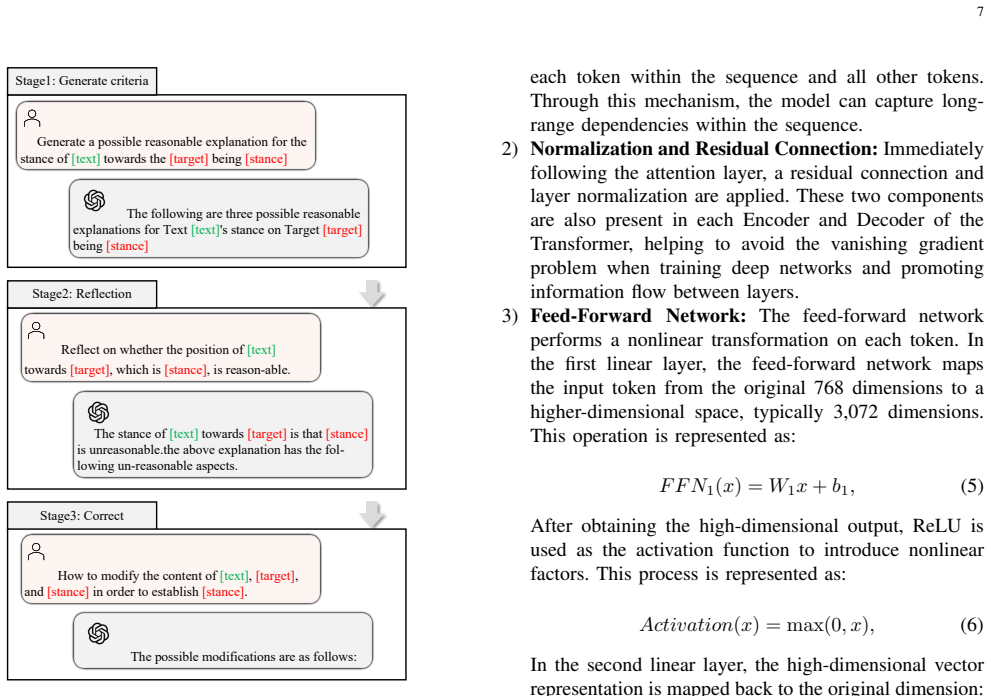
- Reflective chain-of-thought allows iterative validation of target relevance before final classification.
- The three-layer prototype network supports finer distinctions than standard classifiers in multi-class stance settings.
- Performance holds across English benchmark sets and a newly introduced Japanese tweet collection.
Where Pith is reading between the lines
- The same knowledge-plus-reasoning pattern could be tested on related short-text tasks such as rumor detection or event classification.
- Replacing the current knowledge graphs with domain-specific ones might further raise accuracy on specialized topics.
- The framework's reliance on prompt chaining suggests it could be adapted to other large language model pipelines without full retraining.
- If the prototype network proves stable, it might replace contrastive heads in other zero-shot classification setups.
Load-bearing premise
External knowledge graphs plus reflective chain-of-thought reasoning will reliably surface implicit targets and separate neutral from irrelevant labels on unseen topics without overfitting to the chosen graphs or datasets.
What would settle it
A test on a fresh collection of topics using a different knowledge source that shows KIRP falling below prior zero-shot methods on the same four-class or three-class metrics.
Figures




read the original abstract
Zero-shot tweet-level stance detection confronts two primary challenges: (1) mitigating the context sparsity inherent in short texts, and (2) establishing the relevance between implicit targets and textual content. While existing methods primarily focus on incorporating external knowledge, they neglect the intrinsic semantic cues embedded within key intra-textual entities. Furthermore, current models exhibit limited capability in determining the relevance of unseen targets to the given text, thereby struggling to differentiate between "neutral" and "irrelevant" stance labels. To address these issues, we first construct a four-class, multi-topic Japanese tweet dataset. To our knowledge, this is the first Japanese tweet-level dataset for stance detection. We then propose KIRP, a zero-shot stance detection framework. It integrates external knowledge with entity reorganization for data augmentation and employs prompt chaining for reasoning. Specifically, the framework incorporates knowledge graphs to supplement and reorganize key textual entities, while reflective Chain-of-Thought (CoT) reasoning extracts and validates implicit targets. To better distinguish "neutral" from "irrelevant" labels, we adopt stance-aware contrastive learning to capture discriminative features and design a three-layer iterative prototype network for fine-grained classification. Experimental results on SemEval-2016, WT-WT, and KIRP-D show that KIRP achieves state-of-the-art performance. KIRP obtains F1 scores of 84.05% (three-class) on SemEval-2016, and 84.99% and 79.18% (four-class) on WT-WT and KIRP-D, respectively.
Editorial analysis
A structured set of objections, weighed in public.
Referee Report
Summary. The paper introduces KIRP-D, claimed to be the first Japanese tweet-level stance detection dataset, and proposes the KIRP framework for zero-shot stance detection. KIRP augments data via knowledge-graph entity reorganization, uses reflective Chain-of-Thought prompting to identify implicit targets, applies stance-aware contrastive learning, and employs a three-layer iterative prototype network for classification. It reports SOTA F1 scores of 84.05% (3-class) on SemEval-2016, 84.99% (4-class) on WT-WT, and 79.18% (4-class) on KIRP-D.
Significance. If the zero-shot results hold under strict target hold-out without leakage from the external KGs or prompt engineering, the work would contribute a new non-English dataset and a method addressing context sparsity and neutral/irrelevant distinctions via KG augmentation and reflective reasoning. The new dataset itself is a clear positive contribution regardless of the framework's performance.
major comments (3)
- [Abstract] Abstract: The SOTA F1 claims (84.05% on SemEval-2016, 84.99%/79.18% on WT-WT/KIRP-D) are presented without ablations, error bars, dataset statistics, or baseline tables, so it is impossible to determine whether the KG reorganization, reflective CoT, contrastive learning, or prototype network are responsible for the gains versus implementation details or data characteristics.
- [Abstract] Abstract (zero-shot claim): The central guarantee that external KGs plus reflective CoT distinguish neutral from irrelevant for truly unseen targets rests on an unverified assumption; no analysis is supplied showing that KG relations for the held-out topics do not implicitly encode stance signals, and the topic-holdout protocol for KIRP-D is not described.
- [Abstract] Abstract (methods): The three-layer iterative prototype network and stance-aware contrastive learning are described only at the level of the abstract with no equations, pseudocode, or hyperparameter details, preventing assessment of whether these components are load-bearing for the reported four-class performance or could be reproduced.
minor comments (1)
- [Abstract] The abstract states KIRP-D is 'the first Japanese tweet-level dataset' but provides no citation or search to support this claim of novelty.
Simulated Author's Rebuttal
We thank the referee for the constructive feedback. We address each major comment below and will make targeted revisions to improve clarity, particularly in the abstract and supporting sections.
read point-by-point responses
-
Referee: [Abstract] Abstract: The SOTA F1 claims (84.05% on SemEval-2016, 84.99%/79.18% on WT-WT/KIRP-D) are presented without ablations, error bars, dataset statistics, or baseline tables, so it is impossible to determine whether the KG reorganization, reflective CoT, contrastive learning, or prototype network are responsible for the gains versus implementation details or data characteristics.
Authors: The abstract is space-constrained by design. The full manuscript (Sections 4 and 5) includes ablation studies isolating each component, error bars from multiple random seeds, dataset statistics, and baseline tables. These confirm the gains stem from the proposed elements rather than implementation artifacts. We will revise the abstract to briefly reference the ablation outcomes. revision: partial
-
Referee: [Abstract] Abstract (zero-shot claim): The central guarantee that external KGs plus reflective CoT distinguish neutral from irrelevant for truly unseen targets rests on an unverified assumption; no analysis is supplied showing that KG relations for the held-out topics do not implicitly encode stance signals, and the topic-holdout protocol for KIRP-D is not described.
Authors: We will expand the manuscript to explicitly describe the topic-holdout protocol used for KIRP-D. On the KG concern, the external graphs are general-purpose resources without stance annotations; we will add a verification subsection demonstrating that relations for held-out topics carry no implicit stance signals. revision: yes
-
Referee: [Abstract] Abstract (methods): The three-layer iterative prototype network and stance-aware contrastive learning are described only at the level of the abstract with no equations, pseudocode, or hyperparameter details, preventing assessment of whether these components are load-bearing for the reported four-class performance or could be reproduced.
Authors: Equations, pseudocode, and hyperparameters for both the stance-aware contrastive learning and the three-layer iterative prototype network appear in Sections 3.3–3.4 and the appendix. The abstract supplies only a high-level summary, which is conventional. We will insert explicit section cross-references into the abstract. revision: no
Circularity Check
No circularity: empirical framework with no derivations or self-referential predictions
full rationale
The paper describes an empirical ML framework (KIRP) combining external KGs, entity reorganization, reflective CoT prompting, stance-aware contrastive learning, and a three-layer iterative prototype network, evaluated on SemEval-2016, WT-WT, and a new KIRP-D dataset. No equations, first-principles derivations, or parameter-fitting steps are presented that could reduce a claimed prediction to its inputs by construction. All performance claims are experimental results rather than analytic outputs; the zero-shot setting and new dataset construction introduce no self-definitional or fitted-input-called-prediction patterns. Self-citations are not load-bearing in the provided text.
Axiom & Free-Parameter Ledger
Reference graph
Works this paper leans on
-
[1]
Detecting stance in tweets and analyzing its interaction with sentiment,
P. Sobhani, S. Mohammad, and S. Kiritchenko, “Detecting stance in tweets and analyzing its interaction with sentiment,” inProceedings of the 5th joint conference on Lexical and Computational Semantics, 2016, pp. 159–169
2016
-
[2]
Stance detection with bidirectional conditional encoding,
I. Augenstein, T. Rocktäschel, A. Vlachos, and K. Bontcheva, “Stance detection with bidirectional conditional encoding,” inProceedings of the 21st Conference on Empirical Methods in Natural Language Processing, 2016, pp. 876–885
2016
-
[3]
A dataset for multi-target stance detection,
P. Sobhani, D. Inkpen, and X. Zhu, “A dataset for multi-target stance detection,” inProceedings of the 15th Conference of the European Chapter of the Association for Computational Linguistics: volume 2, short papers, 2017, pp. 551–557
2017
-
[4]
An heuristics-based, weakly-supervised ap- proach for classification of stance in tweets,
M. Dias and K. Becker, “An heuristics-based, weakly-supervised ap- proach for classification of stance in tweets,” inProceedings of the 15th IEEE/WIC/ACM International Conference on Web Intelligence (WI). IEEE, 2016, pp. 73–80
2016
-
[5]
A topic-aware reinforced model for weakly supervised stance detection,
P. Wei, W. Mao, and G. Chen, “A topic-aware reinforced model for weakly supervised stance detection,” inProceedings of the 33rd AAAI Conference on Artificial Intelligence, vol. 33, no. 01, 2019, pp. 7249– 7256
2019
-
[6]
A weakly supervised approach for classifying stance in twitter replies,
S. Kumar, R. V . Cox, M. Babcock, and K. M. Carley, “A weakly supervised approach for classifying stance in twitter replies,”arXiv preprint arXiv:2103.07098, 2021
-
[7]
Negative stances detection from multilingual data streams in low-resource languages on social media using bert and cnn-based transfer learning model,
S. Kumar, “Negative stances detection from multilingual data streams in low-resource languages on social media using bert and cnn-based transfer learning model,”ACM Transactions on Asian and Low-Resource Language Information Processing, vol. 23, no. 1, pp. 1–18, 2024
2024
-
[8]
Few-shot cross- lingual stance detection with sentiment-based pre-training,
M. Hardalov, A. Arora, P. Nakov, and I. Augenstein, “Few-shot cross- lingual stance detection with sentiment-based pre-training,” inIn Pro- ceedings of the 36th AAAI Conference on Artificial Intelligence, vol. 36, no. 10, 2022, pp. 10 729–10 737
2022
-
[9]
R. Aiyappa, S. Senthilmani, J. An, H. Kwak, and Y .-Y . Ahn, “Bench- marking zero-shot stance detection with flant5-xxl: Insights from train- ing data, prompting, and decoding strategies into its near-sota perfor- mance,”arXiv preprint arXiv:2403.00236, 2024
-
[10]
Few-shot stance detection via target-aware prompt distillation,
Y . Jiang, J. Gao, H. Shen, and X. Cheng, “Few-shot stance detection via target-aware prompt distillation,” inProceedings of the 45th In- 15 ternational ACM SIGIR Conference on Research and Development in Information Retrieval, 2022, pp. 837–847
2022
-
[11]
Zero-shot stance detection via contrastive learning,
B. Liang, Z. Chen, L. Gui, Y . He, M. Yang, and R. Xu, “Zero-shot stance detection via contrastive learning,” inIn Proceedings of the 31st ACM web conference 2022, 2022, pp. 2738–2747
2022
-
[12]
Kpatch: Knowledge patch to pre-trained language model for zero-shot stance detection on social media,
S. Lin, W. Chen, Y . Gao, Z. Jiang, M. Liao, Z. Zhang, S. Zhao, and H. Wan, “Kpatch: Knowledge patch to pre-trained language model for zero-shot stance detection on social media,” inIn Proceedings of the 2024 Joint International Conference on Computational Linguistics, Language Resources and Evaluation (LREC-COLING 2024), 2024, pp. 9961–9973
2024
-
[13]
Commonsense-based adversarial learning framework for zero-shot stance detection,
H. Zhang, Y . Li, T. Zhu, and C. Li, “Commonsense-based adversarial learning framework for zero-shot stance detection,”Neurocomputing, vol. 563, p. 126943, 2024
2024
-
[14]
Multi-modal stance detection: New datasets and model,
B. Liang, A. Li, J. Zhao, L. Gui, M. Yang, Y . Yu, K.-F. Wong, and R. Xu, “Multi-modal stance detection: New datasets and model,” inIn Proceedings of the 62nd Association for Computational Linguistics: ACL 2024, 2024, pp. 12 373–12 387
2024
-
[15]
Few-shot learning for cross-target stance detection by aggregating multimodal embeddings,
P. J. Khiabani and A. Zubiaga, “Few-shot learning for cross-target stance detection by aggregating multimodal embeddings,”IEEE Transactions on Computational Social Systems, vol. 11, no. 2, pp. 2081–2090, 2023
2081
-
[16]
Topicbert: A topic- enhanced neural language model fine-tuned for sentiment classification,
Y . Zhou, L. Liao, Y . Gao, R. Wang, and H. Huang, “Topicbert: A topic- enhanced neural language model fine-tuned for sentiment classification,” IEEE Transactions on Neural Networks and Learning Systems, vol. 34, no. 1, pp. 380–393, 2021
2021
-
[17]
Stanceformer: Target-aware transformer for stance detection,
K. Garg and C. Caragea, “Stanceformer: Target-aware transformer for stance detection,” inIn Proceedings of the 29th Association for Computational Linguistics: EMNLP 2024, 2024, pp. 4969–4984
2024
-
[18]
Stance detection with a multi-target adversarial attention network,
Q. Sun, X. Xi, J. Sun, Z. Wang, and H. Xu, “Stance detection with a multi-target adversarial attention network,”ACM Transactions on Asian and Low-Resource Language Information Processing, vol. 22, no. 2, pp. 1–21, 2022
2022
-
[19]
Pro-woman, anti-man? identifying gender bias in stance detection,
Y . Li and Y . Zhang, “Pro-woman, anti-man? identifying gender bias in stance detection,” inIn Proceedings of the 62nd Association for Computational Linguistics: ACL 2024, 2024, pp. 3229–3236
2024
-
[20]
Enhancing stance classification on social media using quantified moral foundations,
H. Zhang, Q.-N. Nguyen, P. Bhattacharya, W. Gao, L. Z. Wong, B. S. Loh, J. J. Simons, and J. An, “Enhancing stance classification on social media using quantified moral foundations,” inIn Proceedings of the 16th International Conference on Advances in Social Networks Analysis and Mining. Springer, 2024, pp. 305–319
2024
-
[21]
Examining temporalities on stance detection towards covid-19 vaccination,
Y . Mu, M. Jin, K. Bontcheva, and X. Song, “Examining temporalities on stance detection towards covid-19 vaccination,” inIn Proceedings of the 2024 Joint International Conference on Computational Linguistics, Language Resources and Evaluation (LREC-COLING 2024), 2024, pp. 6732–6738
2024
-
[22]
Enhancing zero-shot stance detection with contrastive and prompt learning,
Z. Yao, W. Yang, and F. Wei, “Enhancing zero-shot stance detection with contrastive and prompt learning,”Entropy, vol. 26, no. 4, p. 325, 2024
2024
-
[23]
A meta-contrastive learning with data augmentation framework for zero-shot stance detection,
C. Wang, Y . Zhang, and S. Wang, “A meta-contrastive learning with data augmentation framework for zero-shot stance detection,”Expert Systems with Applications, vol. 250, p. 123956, 2024
2024
-
[24]
Msfr: Stance detection based on multi-aspect semantic feature representation via hierarchical contrastive learning,
X. Zhao, L. Tian, F. Xie, B. Zhou, H. Wang, H. Wu, and L. Gao, “Msfr: Stance detection based on multi-aspect semantic feature representation via hierarchical contrastive learning,” inIn Proceedings of the 49th ICASSP 2024-2024 IEEE International Conference on Acoustics, Speech and Signal Processing (ICASSP). IEEE, 2024, pp. 11 726–11 730
2024
-
[25]
Zero-shot stance detection via multi-perspective contrastive learning with unlabeled data,
Y . Jiang, J. Gao, H. Shen, and X. MCheng, “Zero-shot stance detection via multi-perspective contrastive learning with unlabeled data,”Infor- mation Processing & Management, vol. 60, no. 4, p. 103361, 2023
2023
-
[26]
Feature enhanced zero-shot stance detection via contrastive learning,
X. Zhao, J. Zou, Z. Zhang, F. Xie, B. Zhou, and L. Tian, “Feature enhanced zero-shot stance detection via contrastive learning,” inIn Proceedings of the 23rd SIAM International Conference on Data Mining (SDM). SIAM, 2023, pp. 900–908
2023
-
[27]
Zerostance: Leveraging chatgpt for open-domain stance detection via dataset generation,
C. Zhao, Y . Li, C. Caragea, and Y . Zhang, “Zerostance: Leveraging chatgpt for open-domain stance detection via dataset generation,” inIn Proceedings of the 62nd Association for Computational Linguistics: ACL 2024, 2024, pp. 13 390–13 405
2024
-
[28]
Stance detection with collaborative role-infused llm-based agents,
X. Lan, C. Gao, D. Jin, and Y . Li, “Stance detection with collaborative role-infused llm-based agents,” inIn Proceedings of the 18th interna- tional AAAI conference on web and social media, vol. 18, 2024, pp. 891–903
2024
-
[29]
Cross-target stance detection by exploiting target analytical perspectives,
D. Ding, R. Chen, L. Jing, B. Zhang, X. Huang, L. Dong, X. Zhao, and G. Song, “Cross-target stance detection by exploiting target analytical perspectives,” inIn Proceedings of the 49th ICASSP 2024-2024 IEEE International Conference on Acoustics, Speech and Signal Processing (ICASSP). IEEE, 2024, pp. 10 651–10 655
2024
-
[30]
Adversarial contrastive representation training with external knowledge injection for zero-shot stance detection,
Y . Ding, Y . Lei, A. Wang, X. Liu, T. Zhu, and Y . Li, “Adversarial contrastive representation training with external knowledge injection for zero-shot stance detection,”Neurocomputing, vol. 614, p. 128849, 2025
2025
-
[31]
Zero-shot stance detection: A dataset and model using generalized topic representations,
E. Allaway and K. McKeown, “Zero-shot stance detection: A dataset and model using generalized topic representations,” inIn Proceedings of the 25th Conference on Empirical Methods in Natural Language Processing (EMNLP), 2020, pp. 8913–8931
2020
-
[32]
Semeval-2016 task 6: Detecting stance in tweets,
S. Mohammad, S. Kiritchenko, P. Sobhani, X. Zhu, and C. Cherry, “Semeval-2016 task 6: Detecting stance in tweets,” inIn Proceedings of the 10th International Workshop on Semantic Evaluation (SemEval- 2016), 2016, pp. 31–41
2016
-
[33]
Will-they-won’t-they: A very large dataset for stance detection on twitter,
C. Conforti, J. Berndt, M. T. Pilehvar, C. Giannitsarou, F. Toxvaerd, and N. Collier, “Will-they-won’t-they: A very large dataset for stance detection on twitter,” inIn Proceedings of the 58th Annual meeting of the Association for Computational Linguistics, 2020, pp. 1715–1724
2020
-
[34]
P-stance: A large dataset for stance detection in political domain,
Y . Li, T. Sosea, A. Sawant, A. J. Nair, D. Inkpen, and C. Caragea, “P-stance: A large dataset for stance detection in political domain,” in In Proceedings of the 59th Association for Computational Linguistics: ACL-IJCNLP 2021, 2021, pp. 2355–2365
2021
-
[35]
Covaxnet: An online-offline data repository for covid-19 vaccine hesitancy research,
B. Jiang, P. Sheth, B. Li, and H. Liu, “Covaxnet: An online-offline data repository for covid-19 vaccine hesitancy research,”arXiv preprint arXiv:2207.01505, 2022
-
[36]
Knowledge-enhanced prompt-tuning for stance detection,
H. Huang, B. Zhang, Y . Li, B. Zhang, Y . Sun, C. Luo, and C. Peng, “Knowledge-enhanced prompt-tuning for stance detection,”ACM Trans- actions on Asian and Low-Resource Language Information Processing, vol. 22, no. 6, pp. 1–20, 2023
2023
-
[37]
Quantifying controversy from stance, sentiment, offensiveness and sarcasm: a fine- grained controversy intensity measurement framework on a chinese dataset,
H. Wang, Y . Wang, X. Song, B. Zhou, X. Zhao, and F. Xie, “Quantifying controversy from stance, sentiment, offensiveness and sarcasm: a fine- grained controversy intensity measurement framework on a chinese dataset,”World Wide Web, vol. 26, no. 5, pp. 3607–3632, 2023
2023
-
[38]
C-stance: A large dataset for chinese zero-shot stance detection,
C. Zhao, Y . Li, and C. Caragea, “C-stance: A large dataset for chinese zero-shot stance detection,” inIn Proceedings of the 61st Annual Meeting of the Association for Computational Linguistics (Volume 1: Long Papers), 2023, pp. 13 369–13 385
2023
-
[39]
Identification of multimodal stance towards frames of communication,
M. Weinzierl and S. Harabagiu, “Identification of multimodal stance towards frames of communication,” inIn Proceedings of the 28th conference on empirical methods in natural language processing, 2023, pp. 12 597–12 609
2023
-
[40]
A challenge dataset and effective models for conversational stance detection,
F. Niu, M. Yang, A. Li, B. Zhang, X. Peng, and B. Zhang, “A challenge dataset and effective models for conversational stance detection,” inIn Proceedings of the 2024 joint international conference on computational linguistics, language resources and evaluation (LREC-COLING 2024), 2024, pp. 122–132
2024
-
[41]
Cross-target stance classifica- tion with self-attention networks,
C. Xu, C. Paris, S. Nepal, and R. Sparks, “Cross-target stance classifica- tion with self-attention networks,” inIn Proceedings of the 56th Annual Meeting of the Association for Computational Linguistics (Volume 2: Short Papers), 2018, pp. 778–783
2018
-
[42]
Stance classification with target- specific neural attention networks,
J. Du, R. Xu, Y . He, and L. Gui, “Stance classification with target- specific neural attention networks,” inIn Proceedings of the 26th International Joint Conference on Artificial Intelligence, IJCAI 2017. International Joint Conferences on Artificial Intelligence, 2017, pp. 3988–3994
2017
-
[43]
Enhancing cross- target stance detection with transferable semantic-emotion knowledge,
B. Zhang, M. Yang, X. Li, Y . Ye, X. Xu, and K. Dai, “Enhancing cross- target stance detection with transferable semantic-emotion knowledge,” inIn Proceedings of the 58th Annual Meeting of the Association for Computational Linguistics, 2020, pp. 3188–3197
2020
-
[44]
Adversarial network with external knowledge for zero-shot stance detection,
W. Chunling, Z. Yijia, Y . Xingyu, L. Guantong, C. Fei, and L. Hongfei, “Adversarial network with external knowledge for zero-shot stance detection,” inIn Proceedings of the 22nd Chinese National Conference on Computational Linguistics, 2023, pp. 824–835
2023
-
[45]
Multi-task deep neural networks for natural language understanding,
X. Liu, P. He, W. Chen, and J. Gao, “Multi-task deep neural networks for natural language understanding,” inIn Proceedings of the 57th Annual Meeting of the Association for Computational Linguistics, 2019, pp. 4487–4496
2019
-
[46]
Enhancing zero-shot and few-shot stance detection with commonsense knowledge graph,
R. Liu, Z. Lin, Y . Tan, and W. Wang, “Enhancing zero-shot and few-shot stance detection with commonsense knowledge graph,” inIn Proceedings of the 59th Association for Computational Linguistics: ACL-IJCNLP 2021, 2021, pp. 3152–3157
2021
-
[47]
Modeling transferable topics for cross-target stance detection,
P. Wei and W. Mao, “Modeling transferable topics for cross-target stance detection,” inIn Proceedings of the 42nd International ACM SIGIR Conference on Research and Development in Information Retrieval, 2019, pp. 1173–1176
2019
-
[48]
Jointcl: A joint contrastive learning framework for zero-shot stance detection,
B. Liang, Q. Zhu, X. Li, M. Yang, L. Gui, Y . He, and R. Xu, “Jointcl: A joint contrastive learning framework for zero-shot stance detection,” inIn Proceedings of the 60th Annual Meeting of the Association for Computational Linguistics (volume 1: long papers), 2022, pp. 81–91. 16
2022
-
[49]
Target really matters: Target-aware contrastive learning and consistency regularization for few- shot stance detection,
R. Liu, Z. Lin, H. Ji, J. Li, P. Fu, and W. Wang, “Target really matters: Target-aware contrastive learning and consistency regularization for few- shot stance detection,” inIn Proceedings of the 29th International Conference on Computational Linguistics, 2022, pp. 6944–6954
2022
-
[50]
Connecting targets via latent topics and contrastive learning: A unified framework for robust zero-shot and few-shot stance detection,
R. Liu, Z. Lin, P. Fu, Y . Liu, and W. Wang, “Connecting targets via latent topics and contrastive learning: A unified framework for robust zero-shot and few-shot stance detection,” inIn Proceedings of the 47th ICASSP 2022-2022 IEEE International Conference on Acoustics, Speech and Signal Processing (ICASSP). IEEE, 2022, pp. 7812–7816
2022
-
[51]
Zero- shot stance detection based on multi-perspective transferable feature fusion,
X. Zhao, J. Zou, J. Miao, L. Tian, L. Gao, B. Zhou, and S. Pang, “Zero- shot stance detection based on multi-perspective transferable feature fusion,”Information Fusion, vol. 108, p. 102386, 2024
2024
-
[52]
Distantly supervised explainable stance detection via chain-of-thought supervi- sion,
D. Ding, G. Dai, C. Peng, X. Peng, B. Zhang, and H. Huang, “Distantly supervised explainable stance detection via chain-of-thought supervi- sion,”Mathematics, vol. 12, no. 7, p. 1119, 2024. 17 TABLE VIII: Appendix 1: Chain-of-Thought Prompting Pipeline Text User (Prompt) LLM (Response) Text: Industrial waste liquid, fuel debris. . . These wonderful elemen...
2024
-
[53]
wonderful
explanation 3. . . The following are three possible reasonable explanations for Text [Text]’s stance on Target [Target] being [Stance]. 1.Irony and Satire:The speaker might be using heavy irony to exaggerate the government’s actions, possibly criticizing sewage discharge while pretending to endorse it. The explanation suggests that by using the word “wond...
-
[54]
reflection 3 The stance of text [text] towards target [target] being [stance] isunreasonable, and the above explanation has the following unreasonable aspects:
-
[55]
wonderful elements
Contradictory Support:The explanation seems to ignore the contradiction within the text itself. While the speaker claims to support sewage discharge, they use phrases like “wonderful elements” and “mother river as nurturing as the Ganges” in a clearly exaggerated, absurd manner. These statements seem to mock, rather than truly endorse, the practice of sew...
-
[56]
saving a significant sum of money for officials
Failure to Acknowledge Criticism:The explanation fails to account for the critical undertone of the text. By emphasizing “saving a significant sum of money for officials” and “avoiding the need to hire specialized cleaning personnel, ” the speaker draws attention to the neglect and irresponsibility of the government’s actions
-
[57]
fish friends
Inconsistent Use of Humor and Sarcasm:The explanation does not fully recognize that the text likely uses absurdist humor or sarcasm to mock the sewage discharge. The reference to “fish friends” and the ridiculous comparison to the Ganges river highlight an ironic stance, meant to expose the absurdity of the situation. Stage 3: Correct How to modify the co...
-
[58]
These importantelements will becarefully managedby our government
[stance1]→[stance2] The possible modifications are as follows: [text1]→“Industrial waste liquid, fuel debris. . . These importantelements will becarefully managedby our government. Isn’t this a form ofenvironmental protection? We can save a significant sum of money for officials by avoiding the need to hire specialized cleaning personnel, while also bring...
-
[59]
explanation 3 The following are three possible reasonable explanations for Text [Text]’s stance on Target [Trump] being [favor]
-
[60]
The text emphasizes Trump’s unique expertise in business, contrasting it with the perceived lack of similar qualifications among other politicians, positioning him as the only candidate capable of driving wealth creation and economic prosperity, which might inspire voters to favor him
-
[61]
The statement suggests that Trump’s business acumen is the key to his success, with the implication that his presidency would bring material benefits to both individuals and the country, making him the preferred candidate for those seeking business-driven governance
-
[62]
business president
By noting Harris’ gender and suggesting that she lacks Trump’s business credentials, the text underscores Trump’s distinctive identity as a “business president. ” This creates a clear favor for Trump, positioning him as a candidate with a unique and valuable skill set that others, including Harris, do not possess. Stage 2: Reflection Based on the above ex...
-
[63]
reflection 3 The stance of text [Text] ’s stance towards target [Trump] being [favor] isunreasonable, and the above explanation has the following unreasonable aspects:
-
[64]
Overgeneralization of business acumen:The text assumes that Trump’s business background automatically translates to political success, overlooking the complexity of governance. Not all effective leaders in business make successful politicians, and this simplistic view disregards other qualities that contribute to good leadership, such as diplomacy, social...
-
[65]
The exclusion of important political experience or the ability to manage diverse policy issues makes the stance unreasonable
Disregard for other qualifications:By focusing solely on business acumen as the determinant for success, the text undermines other critical factors necessary for running a country. The exclusion of important political experience or the ability to manage diverse policy issues makes the stance unreasonable
-
[66]
business president
Bias and negative comparison:The text suggests that Harris’ lack of business experience disqualifies her from becoming a “business president. ” This is a biased stance that discounts her potential based on a single characteristic. It also dismisses other aspects of leadership, such as policy expertise, social justice work, and the ability to unite a count...
-
[67]
They are all waiting for Trump to bring them endlessprosperity
[stance1]→[stance2] The possible modifications are as follows: [text1]→[I believe Trump will win this election because there is no official in the US government who understands economicsas well as he does. They are all waiting for Trump to bring them endlessprosperity. Perhaps Harris will become the first female president in American history, but she will...
discussion (0)
Sign in with ORCID, Apple, or X to comment. Anyone can read and Pith papers without signing in.