The AURORA Survey: High-Redshift Empirical Metallicity Calibrations from Electron Temperature Measurements at z=2-10
Pith reviewed 2026-05-21 23:05 UTC · model grok-4.3
The pith
New empirical relations link 19 emission-line ratios to oxygen abundance in galaxies at z=1.4-10.6.
A machine-rendered reading of the paper's core claim, the machinery that carries it, and where it could break.
Core claim
A combined sample of 139 high-redshift galaxies with auroral-line detections yields empirical calibrations between 19 emission-line ratios and direct-method oxygen abundance. The relations span 0.02-0.9 Z⊙, are offset from typical z~0 calibrations, and are better matched by extreme local galaxies. Alpha-element lines (O, Ne, S, Ar) produce reliable tracers while N-driven ratios show large scatter from varying N/O at fixed O/H.
What carries the argument
Empirical calibrations between 19 emission-line ratios and direct-method oxygen abundance derived from electron-temperature measurements in the combined AURORA plus literature sample.
If this is right
- Metallicities can now be inferred for the majority of high-redshift galaxies observed with JWST that lack detectable auroral lines.
- Alpha-element line ratios remain reliable tracers of oxygen abundance across the sampled metallicity range.
- Nitrogen-based ratios are less reliable because of elevated N/O scatter at fixed O/H.
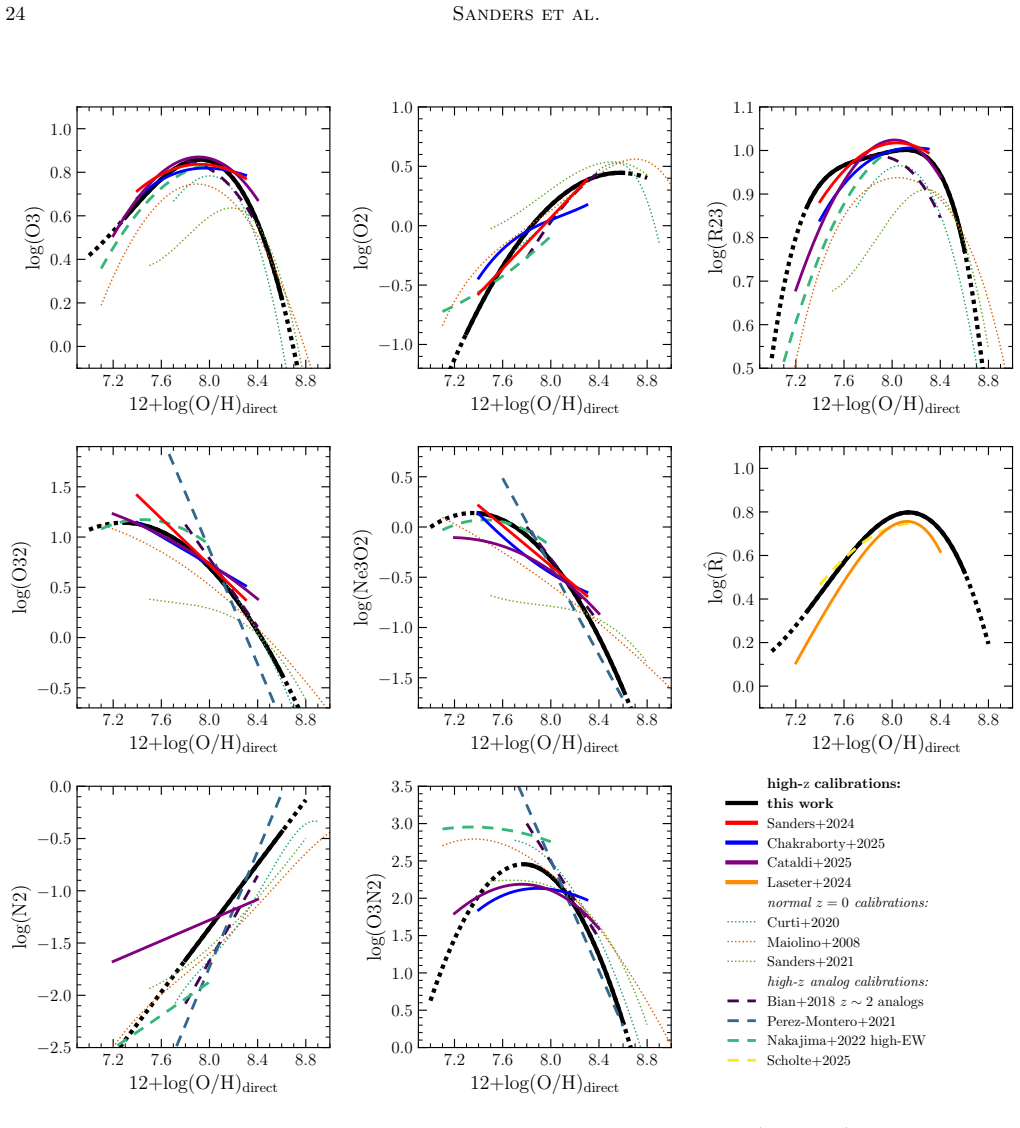
- The new relations are offset from z~0 calibrations and align better with extreme local analogs.
- These tools support systematic studies of chemical evolution from Cosmic Noon through the Epoch of Reionization.
Where Pith is reading between the lines
- The calibrations could be tested by applying them to galaxies with independent metallicity indicators such as rest-frame optical continuum fitting.
- The observed N/O dispersion may trace differences in star-formation history or gas accretion that are more common at high redshift.
- Future large spectroscopic surveys could use the alpha-element relations to map metallicity gradients inside individual high-redshift galaxies.
Load-bearing premise
The 139-galaxy sample with auroral detections is free of selection biases that would systematically shift the observed line-ratio versus metallicity relations away from the true high-redshift population.
What would settle it
A new sample of high-redshift galaxies with both auroral lines and the calibrated ratios that shows systematic offsets larger than the reported scatter from the derived relations.
Figures







read the original abstract
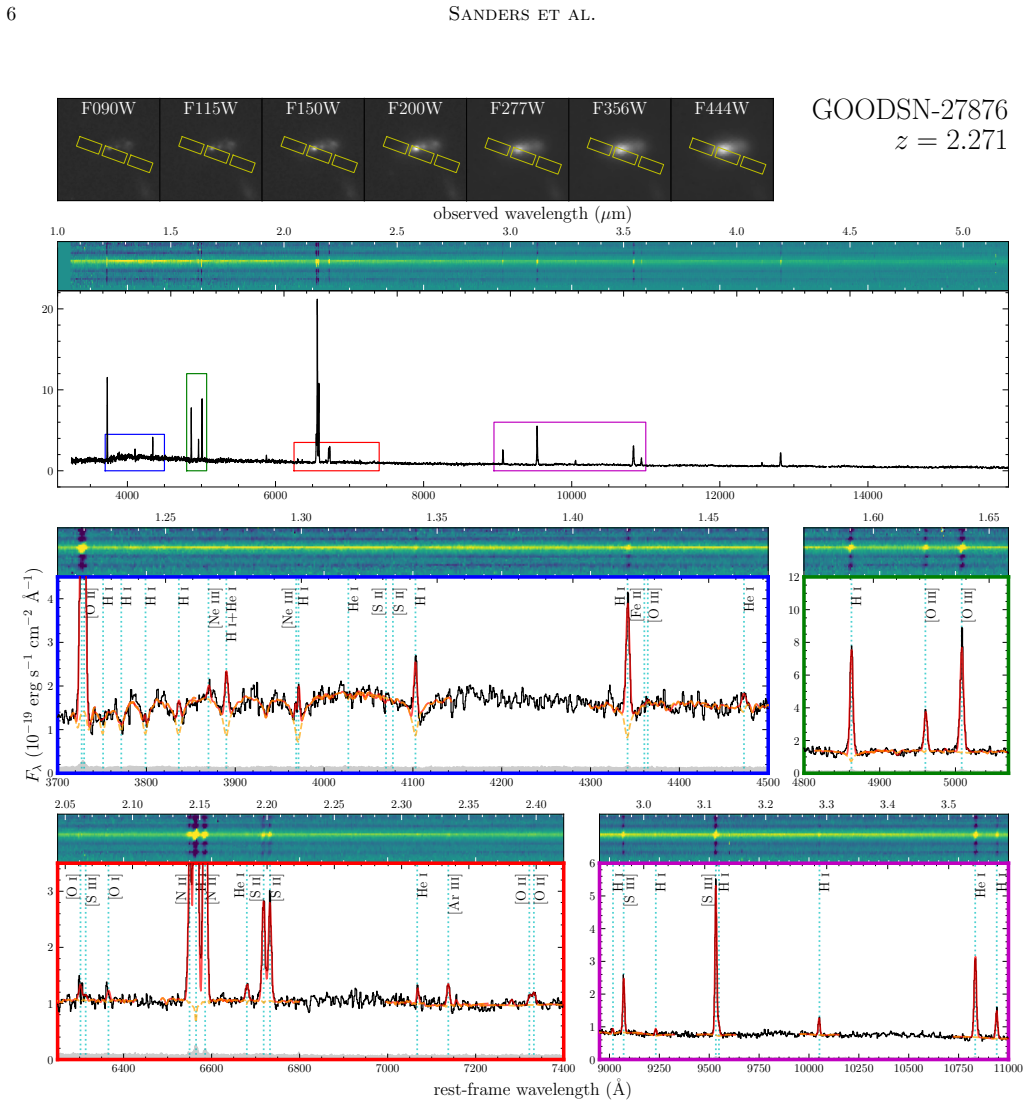
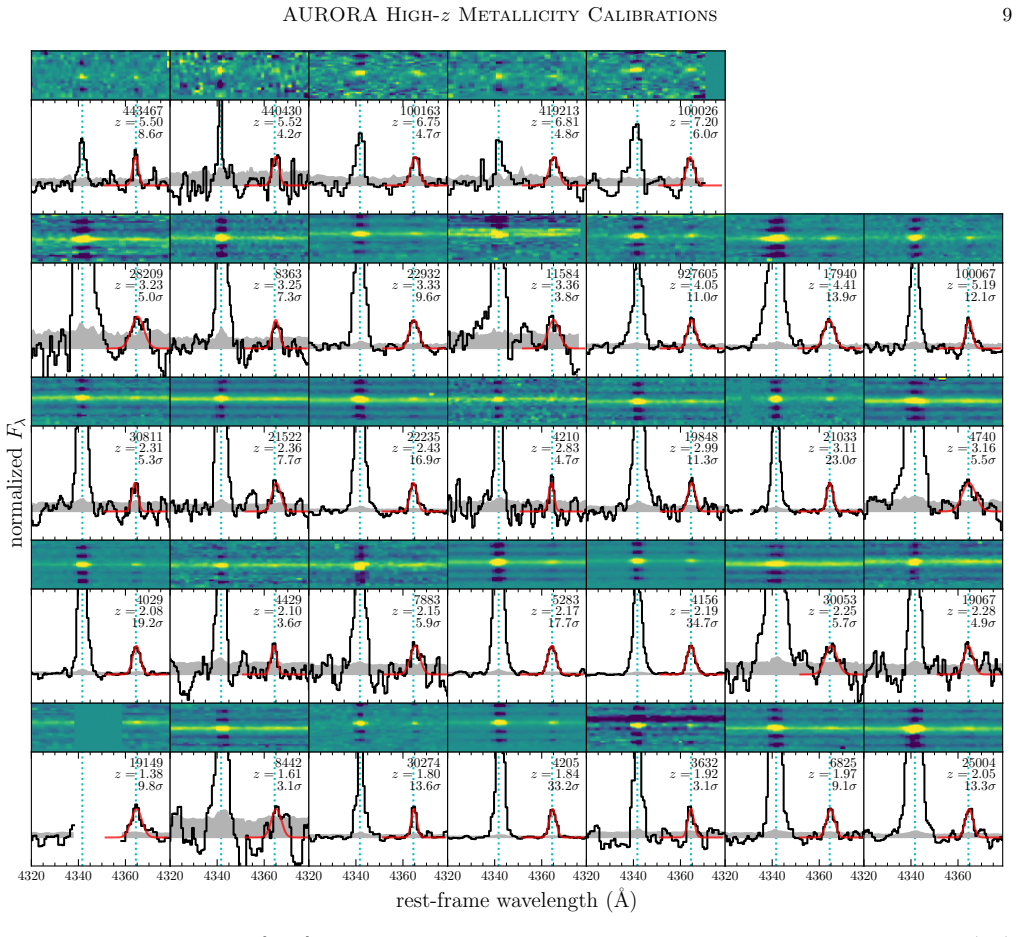
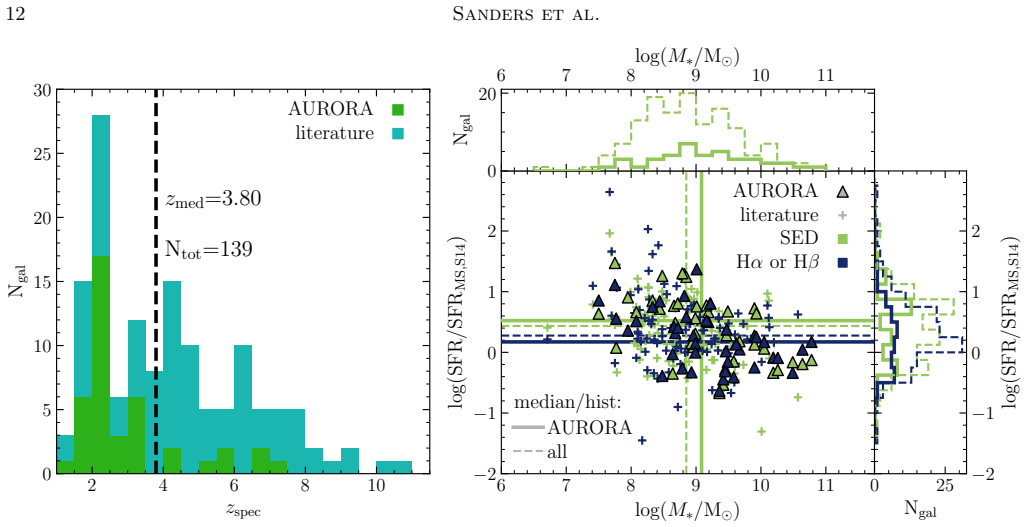
We present detections of auroral emission lines of [OIII], [OII], [SIII], and [SII] in deep JWST/NIRSpec spectroscopy for 41 star-forming galaxies at $z=1.4-7.2$ from the AURORA survey. We combine these new observations with 98 star-forming galaxies at $z=1.3-10.6$ with detected auroral lines drawn from the literature to form a sample of 139 high-redshift galaxies with robust electron temperature and direct-method oxygen abundance determinations. This sample notably covers a wider dynamic range in metallicity than previous work, spanning $0.02-0.9$~Z$_\odot$. We calibrate empirical relations between 19 emission-line ratios and oxygen abundance, providing a robust tool set to infer accurate gas-phase metallicities of high-redshift galaxies when auroral lines are not detected. While calibrations based on lines of $\alpha$ elements (O, Ne, S, Ar) appear reliable, we find significant scatter in calibrations involving lines of N driven by a high dispersion in N/O at fixed O/H, suggesting that N-based line ratios are less reliable tracers of the oxygen abundance at high redshift. These new high-redshift calibrations are notably offset from those based on typical $z\sim0$ galaxy and HII region samples, and are better matched by samples of extreme local galaxies that are analogs of high-redshift sources. The new metallicity calibrations presented in this work pave the way for robust studies of galaxy chemical evolution in the early Universe, leading to a better understanding of baryon cycling and galaxy formation from Cosmic Noon through the Epoch of Reionization.
Editorial analysis
A structured set of objections, weighed in public.
Referee Report
Summary. The manuscript reports auroral-line detections ([OIII]4363, [OII]7325, [SIII], [SII]) in 41 star-forming galaxies at z=1.4-7.2 from the AURORA JWST/NIRSpec survey. These are combined with 98 literature galaxies (z=1.3-10.6) to produce a sample of 139 objects with direct electron-temperature and oxygen-abundance measurements spanning 0.02-0.9 Z⊙. From this sample the authors fit empirical relations between 19 emission-line ratios and direct-method O/H, finding that α-element ratios yield reliable calibrations while N-based ratios exhibit larger scatter due to N/O variations at fixed O/H. The resulting high-redshift relations are offset from local calibrations but align better with extreme local analogs.
Significance. If the relations hold after accounting for selection, the work supplies the largest direct-method high-redshift calibration set to date, directly addressing a pressing need for JWST-era metallicity diagnostics when auroral lines fall below detection thresholds. The expanded metallicity baseline and explicit comparison to local samples constitute a clear advance for studies of chemical evolution from Cosmic Noon through reionization.
major comments (2)
- [§3] §3 (Sample Construction): The sample is defined by successful detection of faint auroral lines, which imposes a joint S/N and excitation threshold that correlates with lower metallicity and higher ionization parameter. The manuscript does not quantify this selection function or compare the line-ratio distribution to a parent sample of z=2-10 star-forming galaxies lacking auroral detections; without such a test or re-weighting, the fitted slopes and zero-points may contain systematic offsets when applied to the undetected majority.
- [§5] §5 (Calibration Fits): Details on error propagation from the heterogeneous literature measurements (different instruments, flux calibrations, and temperature diagnostics) into the 19 linear or polynomial fits are not provided. This information is required to assess whether the reported scatters and uncertainties are robust for the claimed applicability.
minor comments (3)
- [Abstract] Abstract: The redshift range for the literature compilation is stated as z=1.3-10.6; confirm that this matches the exact range used in the fits and note any objects excluded after initial selection.
- [Table 2] Table 2 (Calibration Parameters): List the rms scatter, number of objects, and covariance matrix (or at least the slope and intercept uncertainties) for each of the 19 relations so users can propagate errors correctly.
- [Figure 5] Figure 5 (Comparison to Local Samples): Add the individual high-redshift data points with error bars to the panels showing the new fits versus local relations for visual assessment of systematic offsets.
Simulated Author's Rebuttal
We thank the referee for their constructive report and positive assessment of the work's significance. We address each major comment below and outline the revisions we will make to the manuscript.
read point-by-point responses
-
Referee: [§3] §3 (Sample Construction): The sample is defined by successful detection of faint auroral lines, which imposes a joint S/N and excitation threshold that correlates with lower metallicity and higher ionization parameter. The manuscript does not quantify this selection function or compare the line-ratio distribution to a parent sample of z=2-10 star-forming galaxies lacking auroral detections; without such a test or re-weighting, the fitted slopes and zero-points may contain systematic offsets when applied to the undetected majority.
Authors: We agree that auroral-line detection imposes a selection bias toward higher-ionization, lower-metallicity systems. In the revised manuscript we will add a dedicated subsection to §3 that (i) quantifies the selection function using the full AURORA parent catalog and literature compilations of z≈2–10 star-forming galaxies, (ii) compares the distributions of strong-line ratios between the direct-method subsample and the undetected majority, and (iii) discusses the implications for the derived calibrations, including a simple re-weighting test where the data permit. revision: yes
-
Referee: [§5] §5 (Calibration Fits): Details on error propagation from the heterogeneous literature measurements (different instruments, flux calibrations, and temperature diagnostics) into the 19 linear or polynomial fits are not provided. This information is required to assess whether the reported scatters and uncertainties are robust for the claimed applicability.
Authors: We acknowledge that a transparent account of error propagation is necessary. In the revised §5 we will expand the description of the fitting procedure to include (i) how uncertainties from the heterogeneous literature data are combined with our new measurements, (ii) the treatment of possible systematic offsets in flux calibration and temperature diagnostics, and (iii) the resulting impact on the reported scatters and parameter uncertainties for each of the 19 relations. revision: yes
Circularity Check
No circularity detected in empirical line-ratio calibrations
full rationale
The paper measures electron temperatures and direct-method O/H abundances from detected auroral lines in the combined AURORA plus literature sample, then performs standard empirical fits of 19 line ratios against these independently determined abundances. No step defines a quantity in terms of itself, renames a fitted parameter as a prediction, or relies on a load-bearing self-citation chain; the calibrations are ordinary regressions to observed data points whose inputs (T_e-based O/H) are obtained via established atomic physics methods external to the fit. The derivation chain is therefore self-contained.
Axiom & Free-Parameter Ledger
free parameters (1)
- fitting coefficients for each of the 19 line-ratio calibrations
axioms (1)
- domain assumption Auroral-line ratios yield reliable electron temperatures and therefore accurate direct-method oxygen abundances at high redshift.
Lean theorems connected to this paper
-
IndisputableMonolith/Cost/FunctionalEquation.leanwashburn_uniqueness_aczel unclear?
unclearRelation between the paper passage and the cited Recognition theorem.
We calibrate empirical relations between 19 emission-line ratios and oxygen abundance... polynomials with the functional form log(R) = sum ci xi where x=12+log(O/H)-8.0
-
IndisputableMonolith/Foundation/RealityFromDistinction.leanreality_from_one_distinction unclear?
unclearRelation between the paper passage and the cited Recognition theorem.
sample of 139 high-redshift galaxies with robust electron temperature and direct-method oxygen abundance determinations
What do these tags mean?
- matches
- The paper's claim is directly supported by a theorem in the formal canon.
- supports
- The theorem supports part of the paper's argument, but the paper may add assumptions or extra steps.
- extends
- The paper goes beyond the formal theorem; the theorem is a base layer rather than the whole result.
- uses
- The paper appears to rely on the theorem as machinery.
- contradicts
- The paper's claim conflicts with a theorem or certificate in the canon.
- unclear
- Pith found a possible connection, but the passage is too broad, indirect, or ambiguous to say the theorem truly supports the claim.
Forward citations
Cited by 5 Pith papers
-
A Glimpse of the Low-Mass End of the Direct Mass-Metallicity Relation at $z\sim6-8$
Direct [OIII]4364-based metallicities show that galaxies with stellar masses 10^6.7-9 solar masses at z~6-8 are 0.3-0.5 dex more metal-poor than local galaxies of the same mass, with slope 0.25 and 0.2 dex scatter.
-
GLIMPSED: Direct evidence for a fast AGN-driven outflow from a z=6.64 Little Red Dot host galaxy
A z=6.64 LRD host galaxy exhibits a fast AGN-driven outflow with 5500 km/s velocities, dusty gas, and low metallicity, confirming AGN presence in these systems.
-
Tracing nitrogen enrichment across cosmic time with JWST
Galaxies at z>1 show N/O ratios elevated by a median 0.18 dex at fixed O/H relative to local trends, reaching 0.4-0.5 dex at low metallicity.
-
Shape of Direct-Method Mass-Metallicity Relation with JWST: Fast-Track Nitrogen and Helium Enrichment
JWST auroral-line selected galaxies at high redshift show an MZR slope of 0.38 with selection biases favoring high-SFR low-metallicity systems, while stacked non-detections lie closer to the fundamental metallicity relation.
-
Nitrogen abundances in star-forming galaxies 2.2 Gyr after the Big Bang are not elevated
N/O ratios in z~3 star-forming galaxies are indistinguishable from low-redshift values over the metallicity range 12+log(O/H)=7.5-8.44.
Reference graph
Works this paper leans on
-
[1]
Aggarwal, K. M., & Keenan, F. P. 1999, ApJS, 123, 311, doi: 10.1086/313232
-
[2]
Aller, L. H. 1984, Physics of thermal gaseous nebulae, doi: 10.1007/978-94-010-9639-3 ´Alvarez-M´ arquez, J., Crespo G´ omez, A., Colina, L., et al. 2025, A&A, 695, A250, doi: 10.1051/0004-6361/202451731
-
[3]
Andrews, B. H., & Martini, P. 2013, ApJ, 765, 140, doi: 10.1088/0004-637X/765/2/140 Arellano-C´ ordova, K. Z., Berg, D. A., Chisholm, J., et al. 2022, ApJL, 940, L23, doi: 10.3847/2041-8213/ac9ab2 Arellano-C´ ordova, K. Z., Cullen, F., Carnall, A. C., et al. 2025, MNRAS, 540, 2991, doi: 10.1093/mnras/staf855
-
[4]
Asplund, M., Amarsi, A. M., & Grevesse, N. 2021, A&A, 653, A141, doi: 10.1051/0004-6361/202140445
work page internal anchor Pith review doi:10.1051/0004-6361/202140445 2021
-
[5]
Bayliss, M. B., Rigby, J. R., Sharon, K., et al. 2014, ApJ, 790, 144, doi: 10.1088/0004-637X/790/2/144
-
[6]
Brammer, G. B. 2018, ApJ, 859, 164, doi: 10.3847/1538-4357/aab7fa
-
[7]
Berg, D. A., Pogge, R. W., Skillman, E. D., et al. 2020, ApJ, 893, 96, doi: 10.3847/1538-4357/ab7eab 34Sanders et al. T able 4.Electron temperatures derived from sulfur ion auroral lines. IDz spec Te(S2+)T e(S+) K K AURORA sample GOODSN-17940 4.4115 9120 +1150 −1290 14100+4370 −3280 GOODSN-21033 3.1120 13260 +1040 −1180 <17830 GOODSN-22235 2.4298 12760 +8...
-
[8]
2025, ApJL, 983, L30, doi: 10.3847/2041-8213/adc735
Bhattacharya, S., Arnaboldi, M., Gerhard, O., Kobayashi, C., & Saha, K. 2025, ApJL, 983, L30, doi: 10.3847/2041-8213/adc735
-
[9]
Bian, F., Kewley, L. J., & Dopita, M. A. 2018, ApJ, 859, 175, doi: 10.3847/1538-4357/aabd74
-
[10]
Bunker, A. J., Saxena, A., Cameron, A. J., et al. 2023, A&A, 677, A88, doi: 10.1051/0004-6361/202346159
-
[11]
Calzetti, D., Armus, L., Bohlin, R. C., et al. 2000, ApJ, 533, 682, doi: 10.1086/308692
work page internal anchor Pith review doi:10.1086/308692 2000
-
[12]
Cameron, A. J., Katz, H., Rey, M. P., & Saxena, A. 2023, MNRAS, 523, 3516, doi: 10.1093/mnras/stad1579
-
[13]
J., Katz, H., Witten, C., et al
Cameron, A. J., Katz, H., Witten, C., et al. 2024, MNRAS, 534, 523, doi: 10.1093/mnras/stae1547
-
[14]
1986, MNRAS, 223, 811, doi: 10.1093/mnras/223.4.811
Campbell, A., Terlevich, R., & Melnick, J. 1986, MNRAS, 223, 811, doi: 10.1093/mnras/223.4.811
-
[15]
Cardelli, J. A., Clayton, G. C., & Mathis, J. S. 1989, ApJ, 345, 245, doi: 10.1086/167900
-
[16]
2024, ApJ, 972, 143, doi: 10.3847/1538-4357/ad5f88
Castellano, M., Napolitano, L., Fontana, A., et al. 2024, ApJ, 972, 143, doi: 10.3847/1538-4357/ad5f88
-
[17]
2025, arXiv e-prints, arXiv:2504.03839, doi: 10.48550/arXiv.2504.03839
Cataldi, E., Belfiore, F., Curti, M., et al. 2025, arXiv e-prints, arXiv:2504.03839, doi: 10.48550/arXiv.2504.03839
-
[18]
Galactic Stellar and Substellar Initial Mass Function
Chabrier, G. 2003, PASP, 115, 763, doi: 10.1086/376392
work page internal anchor Pith review doi:10.1086/376392 2003
-
[19]
2025, ApJ, 985, 24, doi: 10.3847/1538-4357/adc7b5
Chakraborty, P., Sarkar, A., Smith, R., et al. 2025, ApJ, 985, 24, doi: 10.3847/1538-4357/adc7b5
-
[20]
2024, ApJL, 976, L15, doi: 10.3847/2041-8213/ad8dc9
Chemerynska, I., Atek, H., Dayal, P., et al. 2024, ApJL, 976, L15, doi: 10.3847/2041-8213/ad8dc9
-
[21]
Christensen, L., Laursen, P., Richard, J., et al. 2012, MNRAS, 427, 1973, doi: 10.1111/j.1365-2966.2012.22007.x
-
[22]
Clarke, L., Shapley, A. E., Sanders, R. L., et al. 2024, ApJ, 977, 133, doi: 10.3847/1538-4357/ad8ba4
-
[23]
Conroy, C., Gunn, J. E., & White, M. 2009, ApJ, 699, 486, doi: 10.1088/0004-637X/699/1/486
work page internal anchor Pith review doi:10.1088/0004-637x/699/1/486 2009
-
[24]
Nissen, P. E. 2011, MNRAS, 417, 1534, doi: 10.1111/j.1365-2966.2011.19365.x
-
[25]
Cullen, F., Shapley, A. E., McLure, R. J., et al. 2021, MNRAS, 505, 903, doi: 10.1093/mnras/stab1340
-
[26]
Cullen, F., Carnall, A. C., Scholte, D., et al. 2025, MNRAS, 540, 2176, doi: 10.1093/mnras/staf838
-
[27]
2017, MNRAS, 465, 1384, doi: 10.1093/mnras/stw2766
Curti, M., Cresci, G., Mannucci, F., et al. 2017, MNRAS, 465, 1384, doi: 10.1093/mnras/stw2766
-
[28]
2020, MNRAS, 491, 944, doi: 10.1093/mnras/stz2910
Curti, M., Mannucci, F., Cresci, G., & Maiolino, R. 2020, MNRAS, 491, 944, doi: 10.1093/mnras/stz2910
-
[29]
2023, MNRAS, 518, 425, doi: 10.1093/mnras/stac2737
Curti, M., D’Eugenio, F., Carniani, S., et al. 2023, MNRAS, 518, 425, doi: 10.1093/mnras/stac2737
-
[30]
2024, A&A, 684, A75, doi: 10.1051/0004-6361/202346698
Curti, M., Maiolino, R., Curtis-Lake, E., et al. 2024, A&A, 684, A75, doi: 10.1051/0004-6361/202346698
-
[31]
2025, A&A, 697, A89, doi: 10.1051/0004-6361/202451410 Dav´ e, R., Finlator, K., & Oppenheimer, B
Curti, M., Witstok, J., Jakobsen, P., et al. 2025, A&A, 697, A89, doi: 10.1051/0004-6361/202451410 Dav´ e, R., Finlator, K., & Oppenheimer, B. D. 2012, MNRAS, 421, 98, doi: 10.1111/j.1365-2966.2011.20148.x de Graaff, A., Rix, H.-W., Carniani, S., et al. 2024, A&A, 684, A87, doi: 10.1051/0004-6361/202347755
-
[32]
Donnan, C. T., McLure, R. J., Dunlop, J. S., et al. 2024, MNRAS, 533, 3222, doi: 10.1093/mnras/stae2037
-
[33]
Dopita, M. A., Kewley, L. J., Sutherland, R. S., & Nicholls, D. C. 2016, Ap&SS, 361, 61, doi: 10.1007/s10509-016-2657-8
-
[34]
Eisenstein, D. J., Johnson, B. D., Robertson, B., et al. 2023, arXiv e-prints, arXiv:2310.12340, doi: 10.48550/arXiv.2310.12340
-
[35]
Erb, D. K., Shapley, A. E., Pettini, M., et al. 2006, ApJ, 644, 813, doi: 10.1086/503623
-
[36]
Finlator, K., & Dav´ e, R. 2008, MNRAS, 385, 2181, doi: 10.1111/j.1365-2966.2008.12991.x
-
[37]
Garnett, D. R. 1992, AJ, 103, 1330, doi: 10.1086/116146
-
[38]
Gordon, K. D., Clayton, G. C., Misselt, K. A., Landolt, A. U., & Wolff, M. J. 2003, ApJ, 594, 279, doi: 10.1086/376774
-
[39]
Grogin, N. A., Kocevski, D. D., Faber, S. M., et al. 2011, ApJS, 197, 35, doi: 10.1088/0067-0049/197/2/35
-
[40]
Guseva, N. G., Izotov, Y. I., Stasi´ nska, G., et al. 2011, A&A, 529, A149, doi: 10.1051/0004-6361/201016291
-
[41]
Harikane, Y., Sanders, R. L., Ellis, R., et al. 2025, arXiv e-prints, arXiv:2505.09186, doi: 10.48550/arXiv.2505.09186
-
[42]
1986, PASP, 98, 609, doi: 10.1086/131801
Horne, K. 1986, PASP, 98, 609, doi: 10.1086/131801
-
[43]
Y.-Y., ´Alvarez-M´ arquez, J., Coe, D., et al
Hsiao, T. Y.-Y., ´Alvarez-M´ arquez, J., Coe, D., et al. 2024, ApJ, 973, 81, doi: 10.3847/1538-4357/ad6562
-
[44]
Hudson, C. E., Ramsbottom, C. A., & Scott, M. P. 2012, ApJ, 750, 65, doi: 10.1088/0004-637X/750/1/65
-
[45]
2023a, ApJ, 956, 139, doi: 10.3847/1538-4357/acf376
Isobe, Y., Ouchi, M., Nakajima, K., et al. 2023a, ApJ, 956, 139, doi: 10.3847/1538-4357/acf376
-
[46]
2023b, ApJ, 959, 100, doi: 10.3847/1538-4357/ad09be
Isobe, Y., Ouchi, M., Tominaga, N., et al. 2023b, ApJ, 959, 100, doi: 10.3847/1538-4357/ad09be
-
[47]
Thuan, T. X. 2006, A&A, 448, 955, doi: 10.1051/0004-6361:20053763
-
[48]
Jeong, M.-S., Shapley, A. E., Sanders, R. L., et al. 2020, ApJL, 902, L16, doi: 10.3847/2041-8213/abba7a
-
[49]
2024, MNRAS, 535, 881, doi: 10.1093/mnras/stae2375
Ji, X., ¨Ubler, H., Maiolino, R., et al. 2024, MNRAS, 535, 881, doi: 10.1093/mnras/stae2375
-
[50]
2023, ApJL, 951, L17, doi: 10.3847/2041-8213/acd938
Jones, T., Sanders, R., Chen, Y., et al. 2023, ApJL, 951, L17, doi: 10.3847/2041-8213/acd938
-
[51]
Kewley, L. J., & Dopita, M. A. 2002, ApJS, 142, 35, doi: 10.1086/341326 36Sanders et al
-
[52]
Kewley, L. J., Nicholls, D. C., & Sutherland, R. S. 2019, ARA&A, 57, 511, doi: 10.1146/annurev-astro-081817-051832
-
[53]
Kisielius, R., Storey, P. J., Ferland, G. J., & Keenan, F. P. 2009, MNRAS, 397, 903, doi: 10.1111/j.1365-2966.2009.14989.x
-
[54]
Kobayashi, C., Karakas, A. I., & Lugaro, M. 2020, ApJ, 900, 179, doi: 10.3847/1538-4357/abae65
-
[55]
Koekemoer, A. M., Faber, S. M., Ferguson, H. C., et al. 2011, ApJS, 197, 36, doi: 10.1088/0067-0049/197/2/36
-
[56]
2017, PASJ, 69, 44, doi: 10.1093/pasj/psx017
Kojima, T., Ouchi, M., Nakajima, K., et al. 2017, PASJ, 69, 44, doi: 10.1093/pasj/psx017
-
[57]
Kriek, M., van Dokkum, P. G., Labb´ e, I., et al. 2009, ApJ, 700, 221, doi: 10.1088/0004-637X/700/1/221
-
[58]
2024, arXiv e-prints, arXiv:2409.07455, doi: 10.48550/arXiv.2409.07455 Lara-L´ opez, M
Langeroodi, D., & Hjorth, J. 2024, arXiv e-prints, arXiv:2409.07455, doi: 10.48550/arXiv.2409.07455 Lara-L´ opez, M. A., Cepa, J., Bongiovanni, A., et al. 2010, A&A, 521, L53, doi: 10.1051/0004-6361/201014803
-
[59]
Laseter, I. H., Maseda, M. V., Curti, M., et al. 2024, A&A, 681, A70, doi: 10.1051/0004-6361/202347133
- [60]
-
[61]
Levesque, E. M., & Richardson, M. L. A. 2014, ApJ, 780, 100, doi: 10.1088/0004-637X/780/1/100
-
[62]
Lilly, S. J., Carollo, C. M., Pipino, A., Renzini, A., & Peng, Y. 2013, ApJ, 772, 119, doi: 10.1088/0004-637X/772/2/119
-
[63]
Luridiana, V., Morisset, C., & Shaw, R. A. 2015, A&A, 573, A42, doi: 10.1051/0004-6361/201323152
-
[64]
2019, A&A Rv, 27, 3, doi: 10.1007/s00159-018-0112-2
Maiolino, R., & Mannucci, F. 2019, A&A Rv, 27, 3, doi: 10.1007/s00159-018-0112-2
-
[65]
2008, A&A, 488, 463, doi: 10.1051/0004-6361:200809678
Maiolino, R., Nagao, T., Grazian, A., et al. 2008, A&A, 488, 463, doi: 10.1051/0004-6361:200809678
-
[66]
2010, MNRAS, 406, 1379, doi: 10.1111/j.1365-2966.2010.16776.x
Gnerucci, A. 2010, MNRAS, 408, 2115, doi: 10.1111/j.1365-2966.2010.17291.x
-
[67]
Marino, R. A., Rosales-Ortega, F. F., S´ anchez, S. F., et al. 2013, A&A, 559, A114, doi: 10.1051/0004-6361/201321956
-
[68]
2024, A&A, 681, A30, doi: 10.1051/0004-6361/202347411 M´ endez-Delgado, J
Marques-Chaves, R., Schaerer, D., Kuruvanthodi, A., et al. 2024, A&A, 681, A30, doi: 10.1051/0004-6361/202347411 M´ endez-Delgado, J. E., Esteban, C., Garc´ ıa-Rojas, J., et al. 2023, MNRAS, 523, 2952, doi: 10.1093/mnras/stad1569
-
[69]
2024, ApJ, 971, 43, doi: 10.3847/1538-4357/ad5290
Morishita, T., Stiavelli, M., Grillo, C., et al. 2024, ApJ, 971, 43, doi: 10.3847/1538-4357/ad5290
-
[70]
2023, ApJS, 269, 33, doi: 10.3847/1538-4365/acd556
Nakajima, K., Ouchi, M., Isobe, Y., et al. 2023, ApJS, 269, 33, doi: 10.3847/1538-4365/acd556
-
[71]
2022, ApJS, 262, 3, doi: 10.3847/1538-4365/ac7710
Nakajima, K., Ouchi, M., Xu, Y., et al. 2022, ApJS, 262, 3, doi: 10.3847/1538-4365/ac7710
-
[72]
Navarro-Carrera, R., Caputi, K. I., Iani, E., et al. 2024, arXiv e-prints, arXiv:2407.14201, doi: 10.48550/arXiv.2407.14201
-
[73]
Oesch, P. A., Brammer, G., Naidu, R. P., et al. 2023, MNRAS, 525, 2864, doi: 10.1093/mnras/stad2411
-
[74]
Osterbrock, D. E., & Ferland, G. J. 2006, Astrophysics of gaseous nebulae and active galactic nuclei Patr´ ıcio, V., Christensen, L., Rhodin, H., Ca˜ nameras, R., & Lara-L´ opez, M. A. 2018, MNRAS, 481, 3520, doi: 10.1093/mnras/sty2508
-
[75]
2011, MNRAS, 412, 1473, doi: 10.1111/j.1365-2966.2011.18162.x
Peeples, M. S., & Shankar, F. 2011, MNRAS, 417, 2962, doi: 10.1111/j.1365-2966.2011.19456.x P´ erez-Montero, E. 2014, MNRAS, 441, 2663, doi: 10.1093/mnras/stu753 P´ erez-Montero, E., Amor´ ın, R., S´ anchez Almeida, J., et al. 2021, MNRAS, 504, 1237, doi: 10.1093/mnras/stab862 P´ erez-Montero, E., & Contini, T. 2009, MNRAS, 398, 949, doi: 10.1111/j.1365-2...
-
[76]
Pettini, M., & Pagel, B. E. J. 2004, MNRAS, 348, L59, doi: 10.1111/j.1365-2966.2004.07591.x
-
[77]
Pettini, M., Zych, B. J., Steidel, C. C., & Chaffee, F. H. 2008, MNRAS, 385, 2011, doi: 10.1111/j.1365-2966.2008.12951.x
-
[78]
Reddy, N. A., Topping, M. W., Shapley, A. E., et al. 2022, ApJ, 926, 31, doi: 10.3847/1538-4357/ac3b4c
-
[79]
Reddy, N. A., Shapley, A. E., Sanders, R. L., et al. 2025, arXiv e-prints, arXiv:2506.17396, doi: 10.48550/arXiv.2506.17396
work page internal anchor Pith review Pith/arXiv arXiv doi:10.48550/arxiv.2506.17396 2025
-
[80]
Rogers, N. S. J., Skillman, E. D., Pogge, R. W., et al. 2021, ApJ, 915, 21, doi: 10.3847/1538-4357/abf8b9
discussion (0)
Sign in with ORCID, Apple, or X to comment. Anyone can read and Pith papers without signing in.