Learning Control-Affine Reduced-Order Models via Autoencoders
Pith reviewed 2026-06-28 03:49 UTC · model grok-4.3
The pith
Autoencoders can learn reduced-order models that keep the original system's control-affine structure.
A machine-rendered reading of the paper's core claim, the machinery that carries it, and where it could break.
Core claim
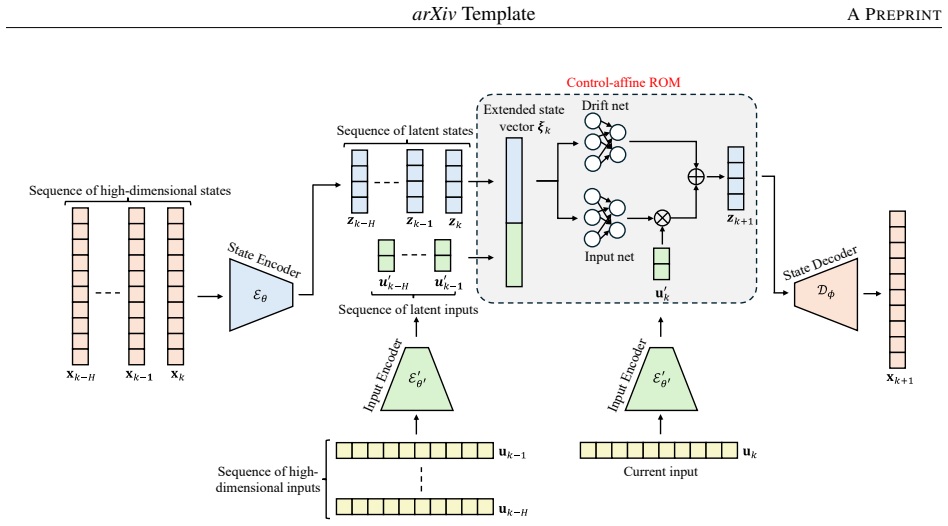
The framework identifies control-affine reduced-order models by using autoencoders to map high-dimensional states and inputs to reduced latent representations, with the autoencoder and state-space model trained simultaneously to preserve the control-affine form. This is extended to sequence-based models that process histories. The approach is motivated by the ability to apply feedback linearization to the resulting models, and is demonstrated on two numerical examples where it outperforms a baseline with linear latent dynamics.
What carries the argument
The joint training of the autoencoder and the control-affine state-space model to discover a latent space preserving the affine input effect.
If this is right
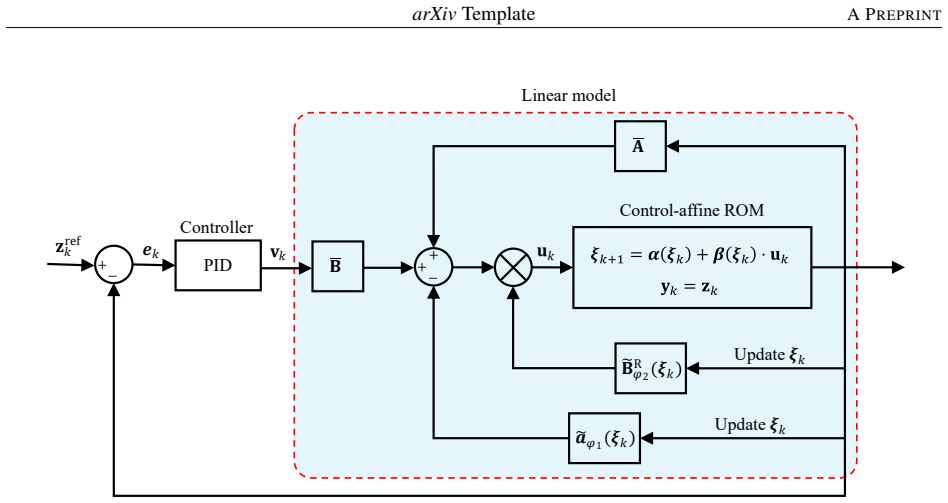
- Feedback linearization can be applied directly to the learned reduced-order models.
- The sequence-based extension improves prediction accuracy without losing the control-affine property.
- The models achieve higher prediction accuracy on test data than baselines with linear state-space dynamics in latent space.
- The framework provides guidelines for efficient use in control applications.
Where Pith is reading between the lines
- This method may generalize to other nonlinear control structures if similar latent representations can be found.
- It could enable model-based control for systems like fluid flows or large mechanical systems where full-order models are too complex.
- Further work might test whether the learned models maintain stability properties from the original system.
Load-bearing premise
A latent representation exists where the input effect on the state remains linear after the nonlinear transformation by the autoencoder.
What would settle it
If applying feedback linearization to the learned reduced model fails to stabilize or track trajectories on the original high-dimensional system, while the full-order model succeeds.
Figures
read the original abstract
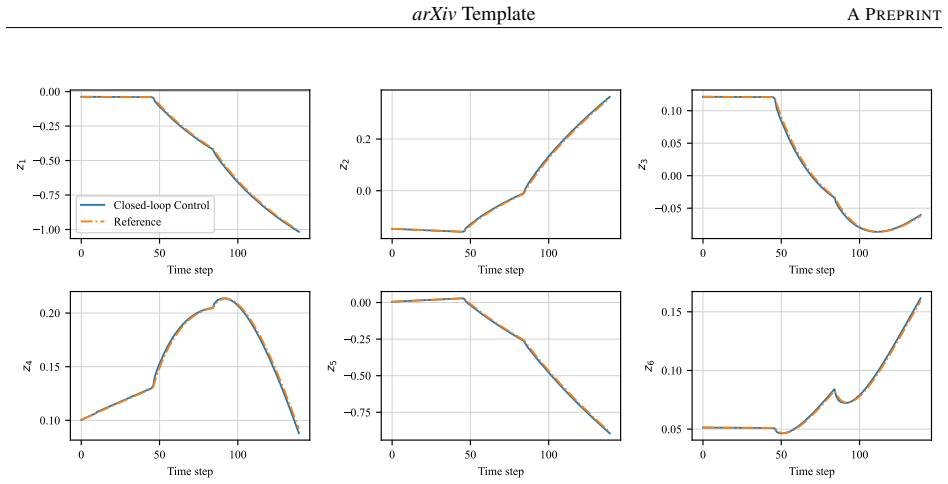
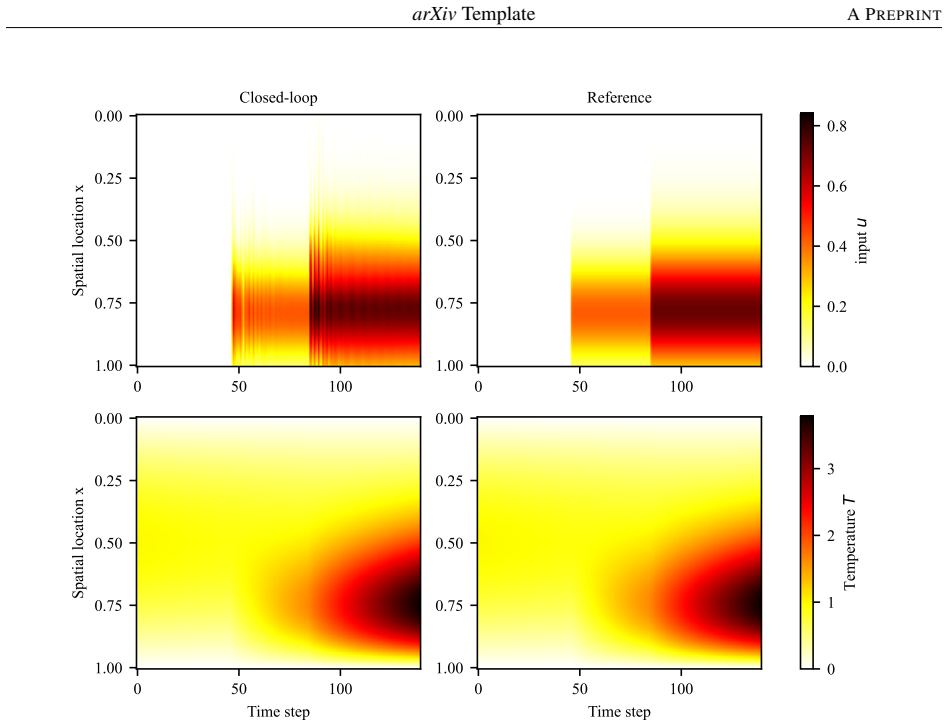
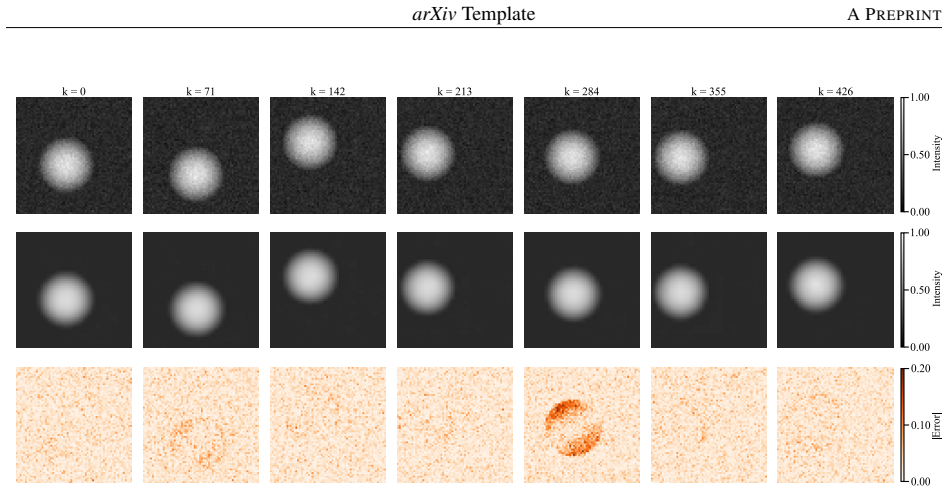
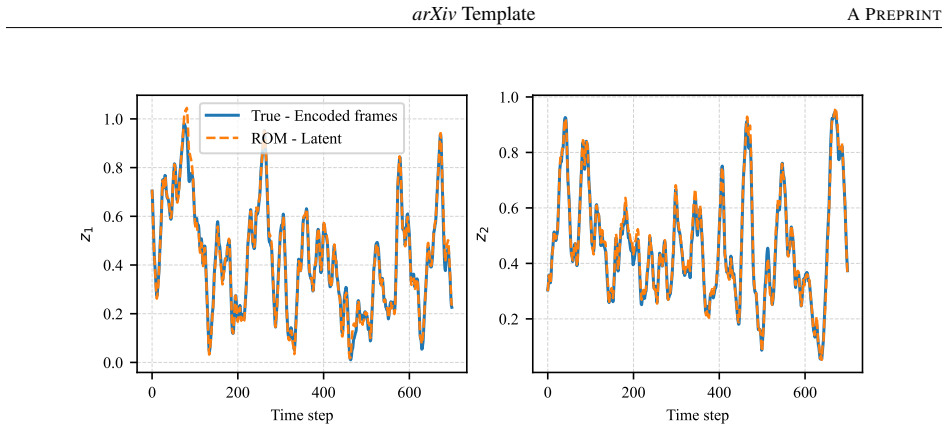
We present in this paper a framework for the identification of control-affine reduced-order models (ROMs). The proposed method utilizes autoencoders (AEs) to transform the high-dimensional states, and potentially the high-dimensional inputs, into reduced latent ones suitable for control-affine state-space dynamics. This is achieved by simultaneous training of the AE and the state-space model. In addition, we extend the discrete ROM formulation to a sequence-based model, which processes state and input histories to improve prediction accuracy while preserving the control-affine structure. We motivate our framework by applying feedback linearization to the derived models, and we present guidelines for its efficient use. The proposed framework is assessed on two numerical examples and its performance is compared to a baseline model, where the AE identifies a latent space with linear state-space dynamics. The assessment involves evaluating the prediction accuracy of the ROM on test data and its effectiveness in controlling the system to a desired state or trajectory.
Editorial analysis
A structured set of objections, weighed in public.
Referee Report
Summary. The manuscript proposes a framework to identify control-affine reduced-order models by jointly training autoencoders that compress high-dimensional states (and optionally inputs) into a latent space together with a control-affine state-space model in that space. It further extends the formulation to a sequence-based model that ingests state and input histories while preserving the affine-in-u structure, motivates the approach via feedback linearization, supplies usage guidelines, and validates the method on two numerical examples by comparing prediction accuracy and closed-loop control performance against a baseline that learns linear latent dynamics.
Significance. If the empirical results hold, the framework offers a data-driven route to reduced models that remain compatible with standard nonlinear control tools such as feedback linearization. The joint training and sequence extension are pragmatic engineering contributions; the fact that control-affine structure is automatically inherited from any differentiable encoder (via the chain rule) means the central modeling choice is imposed rather than discovered, so the value lies in the training procedure and the numerical demonstrations rather than in a new theoretical guarantee.
major comments (2)
- [Numerical examples section] § on numerical examples (the two test cases): the abstract and reader summary indicate that prediction accuracy and control performance are evaluated, yet no quantitative metrics, error bars, or statistical comparisons are supplied in the provided description; without these, it is impossible to verify whether the control-affine ROM meaningfully outperforms the linear baseline or reliably supports feedback linearization.
- [Method / dynamics derivation] The claim that the learned latent dynamics remain control-affine and usable for linearization is load-bearing; because the structure follows immediately from the chain rule for any differentiable encoder E (˙z = DE(x)·(f(x)+g(x)u)), the paper should explicitly state this preservation result (perhaps as a short proposition) rather than present it only as an empirical outcome of joint training.
minor comments (2)
- Clarify whether the input encoder is permitted to be nonlinear or is constrained to remain linear in the latent input; the abstract mentions “potentially the high-dimensional inputs” but does not specify the restriction needed to keep the latent dynamics control-affine.
- Add a short statement on reproducibility (e.g., whether code or trained models will be released) to strengthen the empirical claims.
Simulated Author's Rebuttal
We thank the referee for the positive recommendation of minor revision and for the constructive comments on the numerical examples and theoretical presentation. We address each point below and will incorporate the suggested changes.
read point-by-point responses
-
Referee: [Numerical examples section] § on numerical examples (the two test cases): the abstract and reader summary indicate that prediction accuracy and control performance are evaluated, yet no quantitative metrics, error bars, or statistical comparisons are supplied in the provided description; without these, it is impossible to verify whether the control-affine ROM meaningfully outperforms the linear baseline or reliably supports feedback linearization.
Authors: We agree that explicit quantitative metrics, error bars, and statistical comparisons are necessary to substantiate the performance claims. The numerical examples section reports prediction errors and closed-loop metrics via tables and figures comparing the proposed method to the linear baseline, but we will revise to include error bars from repeated training runs, standard deviations, and additional statistical tests to allow direct verification of the improvements. revision: yes
-
Referee: [Method / dynamics derivation] The claim that the learned latent dynamics remain control-affine and usable for linearization is load-bearing; because the structure follows immediately from the chain rule for any differentiable encoder E (˙z = DE(x)·(f(x)+g(x)u)), the paper should explicitly state this preservation result (perhaps as a short proposition) rather than present it only as an empirical outcome of joint training.
Authors: We agree that an explicit statement of the preservation result improves rigor. While the control-affine structure in latent space follows directly from the chain rule applied to any differentiable encoder (as noted in the derivation), we will add a short proposition in the method section to state and briefly prove this property, clarifying that it holds independently of the joint training. revision: yes
Circularity Check
No significant circularity
full rationale
The paper imposes control-affine structure on the latent dynamics as an explicit modeling choice and trains the autoencoder jointly with the ROM parameters to match data. Preservation of the affine-in-u form under differentiable encoding follows directly from the chain rule and is not claimed as a derived prediction. No self-citations, fitted inputs renamed as predictions, or ansatzes smuggled via prior work appear in the derivation. The method is validated empirically on two examples against a linear baseline; the central claim remains an independent empirical procedure rather than a tautology.
Axiom & Free-Parameter Ledger
free parameters (1)
- latent dimension
axioms (1)
- domain assumption High-dimensional nonlinear dynamics admit a latent representation in which the input matrix remains state-independent (control-affine form).
Reference graph
Works this paper leans on
-
[1]
Frontiers in Handwriting Recognition (ICFHR), 2014 14th International Conference on , pages=
Real-time segmentation of on-line handwritten arabic script , author=. Frontiers in Handwriting Recognition (ICFHR), 2014 14th International Conference on , pages=. 2014 , organization=
2014
-
[2]
Soft Computing and Pattern Recognition (SoCPaR), 2014 6th International Conference of , pages=
Fast classification of handwritten on-line Arabic characters , author=. Soft Computing and Pattern Recognition (SoCPaR), 2014 6th International Conference of , pages=. 2014 , organization=
2014
-
[3]
Estimate and Replace: A Novel Approach to Integrating Deep Neural Networks with Existing Applications , author=. arXiv preprint arXiv:1804.09028 , year=
work page internal anchor Pith review Pith/arXiv arXiv
-
[4]
2012 , publisher=
Turbulence, coherent structures, dynamical systems and symmetry , author=. 2012 , publisher=
2012
-
[5]
PAMM , volume=
Reduced-order modeling framework using two-level neural networks , author=. PAMM , volume=. 2023 , publisher=
2023
-
[6]
Physics of Fluids , volume=
A hierarchical autoencoder and temporal convolutional neural network reduced-order model for the turbulent wake of a three-dimensional bluff body , author=. Physics of Fluids , volume=. 2023 , publisher=
2023
-
[7]
Physics of Fluids , volume=
Reduced-order modeling of fluid flows with transformers , author=. Physics of Fluids , volume=. 2023 , publisher=
2023
-
[8]
1985 , publisher=
Learning internal representations by error propagation , author=. 1985 , publisher=
1985
-
[9]
International conference on machine learning , pages=
Gradnorm: Gradient normalization for adaptive loss balancing in deep multitask networks , author=. International conference on machine learning , pages=. 2018 , organization=
2018
-
[10]
Journal of Computational Physics , volume=
Self-adaptive physics-informed neural networks , author=. Journal of Computational Physics , volume=. 2023 , publisher=
2023
-
[11]
1995 , publisher=
Nonlinear Control Systems , author=. 1995 , publisher=
1995
-
[12]
Adam: A Method for Stochastic Optimization
Kingma, Diederik P. and Ba, Jimmy , keywords =. Adam: A Method for Stochastic Optimization , booktitle =. 2014 , copyright =. doi:10.48550/ARXIV.1412.6980 , url =
work page internal anchor Pith review Pith/arXiv arXiv doi:10.48550/arxiv.1412.6980 2014
-
[13]
Nature communications , volume=
Deep learning for universal linear embeddings of nonlinear dynamics , author=. Nature communications , volume=. 2018 , publisher=
2018
-
[14]
SIAM review , volume=
A survey of projection-based model reduction methods for parametric dynamical systems , author=. SIAM review , volume=. 2015 , publisher=
2015
-
[15]
Journal of Computational Physics , volume=
Model reduction of dynamical systems on nonlinear manifolds using deep convolutional autoencoders , author=. Journal of Computational Physics , volume=. 2020 , publisher=
2020
-
[16]
Physics of Fluids , volume=
Reduced-order modeling of advection-dominated systems with recurrent neural networks and convolutional autoencoders , author=. Physics of Fluids , volume=. 2021 , publisher=
2021
-
[17]
Fluid Dynamics Research , volume=
CNN-LSTM based reduced order modeling of two-dimensional unsteady flows around a circular cylinder at different Reynolds numbers , author=. Fluid Dynamics Research , volume=. 2020 , publisher=
2020
-
[18]
Computer Methods in Applied Mechanics and Engineering , volume=
Data-driven reduced order model with temporal convolutional neural network , author=. Computer Methods in Applied Mechanics and Engineering , volume=. 2020 , publisher=
2020
-
[19]
Physics of Fluids , volume=
Improved neural ordinary differential equation-based reduced model for impinging jet using wall shear stress , author=. Physics of Fluids , volume=. 2024 , publisher=
2024
-
[20]
Nature Communications , volume=
-variational autoencoders and transformers for reduced-order modelling of fluid flows , author=. Nature Communications , volume=. 2024 , publisher=
2024
-
[21]
Chaos: An Interdisciplinary Journal of Nonlinear Science , volume=
Data-driven reduced-order modeling of spatiotemporal chaos with neural ordinary differential equations , author=. Chaos: An Interdisciplinary Journal of Nonlinear Science , volume=. 2022 , publisher=
2022
-
[22]
Nature machine intelligence , volume=
Learning nonlinear operators via DeepONet based on the universal approximation theorem of operators , author=. Nature machine intelligence , volume=. 2021 , publisher=
2021
-
[23]
Automatica , volume=
Learning nonlinear state--space models using autoencoders , author=. Automatica , volume=. 2021 , publisher=
2021
-
[24]
IFAC-PapersOnLine , volume=
Non-linear state-space model identification from video data using deep encoders , author=. IFAC-PapersOnLine , volume=. 2021 , publisher=
2021
-
[25]
IFAC-PapersOnLine , volume=
Learning deep dynamical models from image pixels , author=. IFAC-PapersOnLine , volume=. 2015 , publisher=
2015
-
[26]
SIAM Journal on Applied Dynamical Systems , volume=
Dynamic mode decomposition with control , author=. SIAM Journal on Applied Dynamical Systems , volume=. 2016 , publisher=
2016
-
[27]
Journal of Aircraft , volume=
Reduced-order model with an artificial neural network for aerostructural design optimization , author=. Journal of Aircraft , volume=. 2013 , publisher=
2013
-
[28]
Heliyon , volume=
Estimating flow fields with reduced order models , author=. Heliyon , volume=. 2023 , publisher=
2023
-
[29]
Computer Methods in Applied Mechanics and Engineering , volume=
Latent feedback control of distributed systems in multiple scenarios through deep learning-based reduced order models , author=. Computer Methods in Applied Mechanics and Engineering , volume=. 2025 , publisher=
2025
-
[30]
International Journal for Numerical Methods in Engineering , volume=
Data-driven physics-based digital twins via a library of component-based reduced-order models , author=. International Journal for Numerical Methods in Engineering , volume=. 2022 , publisher=
2022
-
[31]
International Journal of Numerical Methods for Heat & Fluid Flow , volume=
Flow control by a hybrid use of machine learning and control theory , author=. International Journal of Numerical Methods for Heat & Fluid Flow , volume=. 2024 , publisher=
2024
-
[32]
SIAM Journal on Applied Dynamical Systems , volume=
Linearly recurrent autoencoder networks for learning dynamics , author=. SIAM Journal on Applied Dynamical Systems , volume=. 2019 , publisher=
2019
-
[33]
International conference on learning representations , year=
beta-vae: Learning basic visual concepts with a constrained variational framework , author=. International conference on learning representations , year=
-
[34]
arXiv preprint arXiv:2502.14679 , year=
Disentangled Latent Spaces for Reduced Order Models using Deterministic Autoencoders , author=. arXiv preprint arXiv:2502.14679 , year=
-
[35]
Proceedings of the national academy of sciences , volume=
Discovering governing equations from data by sparse identification of nonlinear dynamical systems , author=. Proceedings of the national academy of sciences , volume=. 2016 , publisher=
2016
-
[36]
Proceedings of the National Academy of Sciences , volume=
Data-driven discovery of coordinates and governing equations , author=. Proceedings of the National Academy of Sciences , volume=. 2019 , publisher=
2019
-
[37]
Proceedings of the Royal Society A , volume=
Discovering governing equations from partial measurements with deep delay autoencoders , author=. Proceedings of the Royal Society A , volume=. 2023 , publisher=
2023
-
[38]
Proceedings of the Royal Society A , volume=
Bayesian autoencoders for data-driven discovery of coordinates, governing equations and fundamental constants , author=. Proceedings of the Royal Society A , volume=. 2024 , publisher=
2024
-
[39]
arXiv preprint arXiv:2501.13329 , year=
Sparse identification of nonlinear dynamics and Koopman operators with Shallow Recurrent Decoder Networks , author=. arXiv preprint arXiv:2501.13329 , year=
-
[40]
Advances in neural information processing systems , volume=
Embed to control: A locally linear latent dynamics model for control from raw images , author=. Advances in neural information processing systems , volume=
-
[41]
Annual Review of Control, Robotics, and Autonomous Systems , volume=
Machine learning for sparse nonlinear modeling and control , author=. Annual Review of Control, Robotics, and Autonomous Systems , volume=. 2025 , publisher=
2025
-
[42]
SIAM Journal on Applied Dynamical Systems , volume=
Data-driven model predictive control using interpolated Koopman generators , author=. SIAM Journal on Applied Dynamical Systems , volume=. 2020 , publisher=
2020
-
[43]
arXiv preprint arXiv:2503.19085 , year=
Temporally-Consistent Bilinearly Recurrent Autoencoders for Control Systems , author=. arXiv preprint arXiv:2503.19085 , year=
-
[44]
Press and Saul A
William H. Press and Saul A. Teukolsky and William T. Vetterling and Brian P. Flannery , title =. Numerical Recipes: The Art of Scientific Computing , edition =
-
[45]
International Journal of Applied Mathematics and Computer Science , volume=
Input constraints handling in an MPC/feedback linearization scheme , author=. International Journal of Applied Mathematics and Computer Science , volume=. 2009 , publisher=
2009
-
[46]
arXiv preprint arXiv:2405.01753 , year=
A feedback linearized model predictive control strategy for input-constrained self-driving cars , author=. arXiv preprint arXiv:2405.01753 , year=
discussion (0)
Sign in with ORCID, Apple, or X to comment. Anyone can read and Pith papers without signing in.