Procedural Generation of First Person Shooter Maps using Map-Elites
Pith reviewed 2026-06-29 06:46 UTC · model grok-4.3
The pith
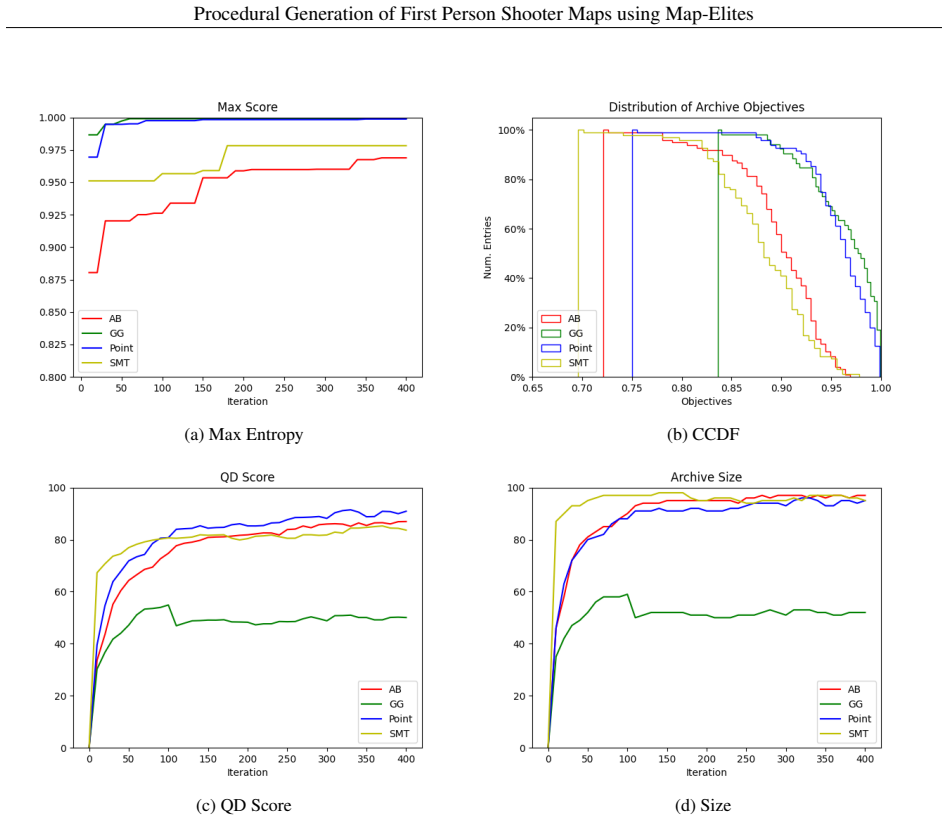
New Point-Line and Spatial-Layout representations let MAP-Elites generate more diverse and higher-quality FPS maps than All-Black or Grid-Graph methods.
A machine-rendered reading of the paper's core claim, the machinery that carries it, and where it could break.
Core claim
When MAP-Elites with Sliding Boundaries is applied to FPS map generation, the Point-Line and Spatial-Layout representations, paired with a screened set of topological and emergent behavioral features, evolve map populations that exhibit measurably higher diversity across the illumination grid and higher scores on the quality metrics than the All-Black and Grid-Graph representations previously used for the same task.
What carries the argument
MAP-Elites with Sliding Boundaries (MESB) whose illumination grid is defined by the best-performing subset of topological layout metrics and emergent gameplay metrics, applied to Point-Line and Spatial-Layout encodings that describe FPS maps more informatively than earlier grid or all-black encodings.
If this is right
- Point-Line and Spatial-Layout encodings produce map populations with higher coverage of the chosen behavioral feature space.
- The same encodings also yield maps that score higher on the selected quality metrics than maps from All-Black or Grid-Graph encodings.
- Screening metrics for suitability before illumination improves the effectiveness of the MAP-Elites run.
- MESB can be used directly as a generator once the feature dimensions and quality functions are fixed.
Where Pith is reading between the lines
- The same metric-screening step could be reused when adapting the method to other game genres whose levels have both geometric and dynamic properties.
- If emergent metrics can be replaced by fast heuristics that still correlate with player experience, the whole pipeline could run without any gameplay simulation.
- The feature-space coverage achieved by the new encodings might serve as a benchmark for future procedural generators that aim for controllable diversity.
- Designers could inspect the final illumination grid to identify under-represented map styles and then bias the search toward those cells.
Load-bearing premise
The chosen topological and emergent metrics, after analysis, are the right features to drive MAP-Elites illumination and that simulated gameplay reliably indicates map quality for players.
What would settle it
Run the same MAP-Elites configurations on a fresh set of maps and collect blind player ratings or logged play statistics; if the new representations no longer show statistically higher diversity or quality scores, the central claim does not hold.
Figures




read the original abstract
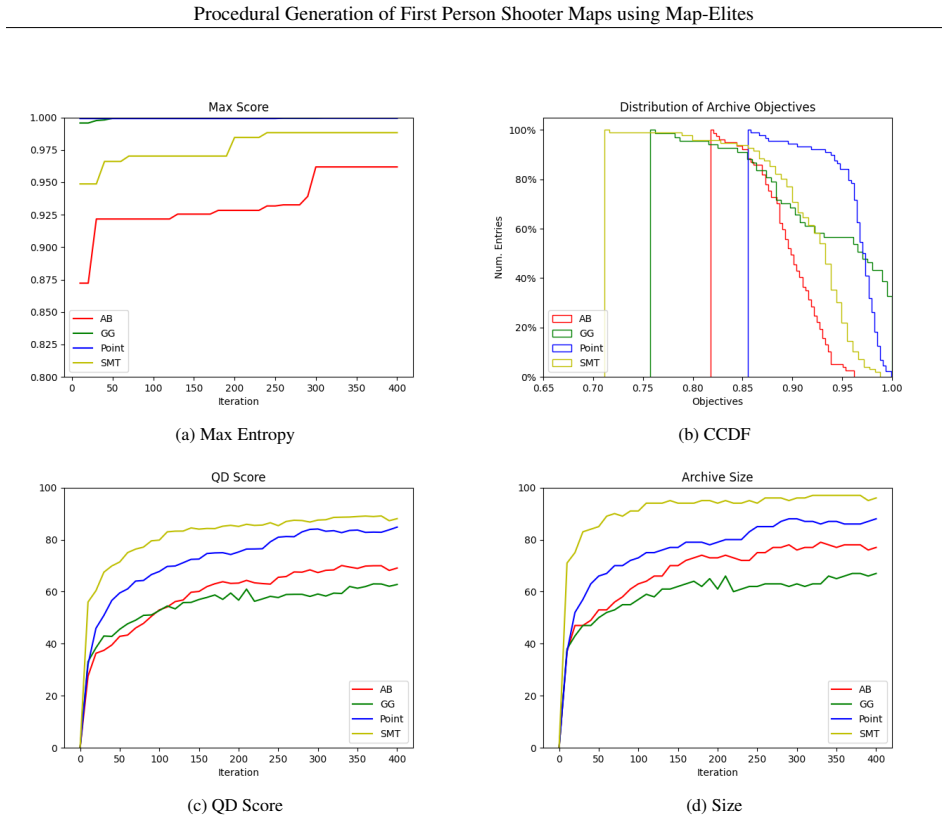
We investigate the application of MAP-Elites (a well-known quality diversity algorithm) to design levels for First-Person Shooter (FPS) games. We consider two well-known map representations (All-Black and Grid-Graph) and introduce two novel representations (Point-Line and Spatial-Layout) that improve the characterization of FPS maps. We define a series of metrics to describe maps' topological properties (which solely depend on maps' layout), and emergent properties (which must be evaluated through actual gameplay). We perform an in-depth analysis to identify the most suitable features to guide MAP-Elites illumination process. We apply MAP-Elites with Sliding Boundaries (MESB) to evolve populations of FPS maps. Our results show that the new representations can generate maps with higher diversity and quality than the representations previously used for evolving FPS maps.
Editorial analysis
A structured set of objections, weighed in public.
Referee Report
Summary. The manuscript applies MAP-Elites with Sliding Boundaries (MESB) to procedural generation of FPS maps. It evaluates two prior representations (All-Black, Grid-Graph) against two new ones (Point-Line, Spatial-Layout), defines topological metrics (layout-dependent) and emergent metrics (gameplay-dependent), performs an in-depth analysis to select illumination features, and claims the new representations produce higher diversity and quality than baselines.
Significance. If the empirical results prove robust and reproducible, the work would advance quality-diversity methods in game content generation by demonstrating improved map representations and the value of combined topological/emergent feature selection. The explicit analysis step for metric choice and the use of gameplay evaluation are positive elements that could support broader adoption in PCG research.
major comments (2)
- Abstract: the central claim that new representations yield higher diversity and quality rests on reported positive results from MESB, yet the text supplies no experimental details, sample sizes, statistical tests, raw data, or quantitative comparisons; this prevents verification of the claim and is load-bearing for the paper's contribution.
- Results (implied by abstract): the assumption that the selected topological and emergent metrics are optimal after in-depth analysis, and that gameplay evaluation reliably captures quality, is stated but not accompanied by the analysis data or validation steps needed to support the metric choice as load-bearing for the illumination process.
Simulated Author's Rebuttal
We thank the referee for the detailed and constructive report. The two major comments correctly identify areas where additional transparency is needed to support the central claims. We address each point below and commit to revisions that will incorporate the requested details without altering the core contributions.
read point-by-point responses
-
Referee: Abstract: the central claim that new representations yield higher diversity and quality rests on reported positive results from MESB, yet the text supplies no experimental details, sample sizes, statistical tests, raw data, or quantitative comparisons; this prevents verification of the claim and is load-bearing for the paper's contribution.
Authors: We agree that the abstract as written does not contain the experimental details needed to make the central claim self-contained. The manuscript body reports the use of MESB with multiple representations and metrics, but does not embed sample sizes, statistical tests, or quantitative comparisons directly in the abstract. We will revise the abstract to include concise quantitative results (e.g., relative improvements in QD-score and coverage) and will ensure the main text explicitly states run counts, statistical procedures, and data availability so the claim can be verified. revision: yes
-
Referee: Results (implied by abstract): the assumption that the selected topological and emergent metrics are optimal after in-depth analysis, and that gameplay evaluation reliably captures quality, is stated but not accompanied by the analysis data or validation steps needed to support the metric choice as load-bearing for the illumination process.
Authors: The manuscript describes performing an in-depth analysis to select illumination features but does not present the supporting data (e.g., correlation tables, ablation results across metric subsets, or validation against gameplay outcomes). We acknowledge this gap and will expand the relevant section to include the full analysis, including the rationale for the chosen topological and emergent metrics and any validation steps performed. This will make the metric-selection process reproducible and directly support its role in the illumination. revision: yes
Circularity Check
No significant circularity detected
full rationale
The paper presents an empirical study applying MAP-Elites with Sliding Boundaries to FPS map generation. It introduces two new representations, defines topological and emergent metrics after explicit in-depth analysis, and compares results against prior All-Black and Grid-Graph baselines. No equations or claims reduce by construction to fitted inputs, self-definitions, or load-bearing self-citations; the central result is a direct experimental outcome from standard QD algorithm application to novel inputs rather than any internal circular reduction.
Axiom & Free-Parameter Ledger
Reference graph
Works this paper leans on
-
[1]
Cardamone, G
L. Cardamone, G. N. Yannakakis, J. Togelius, P. L. Lanzi, Evolving interesting maps for a first person shooter, in: EvoApplications (1), V ol. 6624 of Lecture Notes in Computer Science, Springer, 2011, pp. 63–72
2011
-
[2]
P. L. Lanzi, D. Loiacono, R. Stucchi, Evolving maps for match balancing in first person shooters, in: 2014 IEEE Conference on Computational Intelligence and Games, CIG 2014, Dortmund, Germany, August 26-29, 2014, IEEE, 2014, pp. 1–8.doi:10.1109/CIG.2014.6932901. URLhttps://doi.org/10.1109/CIG.2014.6932901
-
[3]
Cachia, A
W. Cachia, A. Liapis, G. N. Yannakakis, Multi-level evolution of shooter levels, in: A. Jhala, N. R. Sturtevant (Eds.), Proceedings of the Eleventh AAAI Conference on Artificial Intelligence and Interactive Digital Entertainment, AIIDE 2015, November 14-18, 2015, University of California, Santa Cruz, CA, USA, AAAI Press, 2015, pp. 115–121. URLhttp://www.a...
2015
-
[4]
D. Loiacono, L. Arnaboldi, Fight or flight: Evolving maps for cube 2 to foster a fleeing behavior, in: 2017 IEEE Conference on Computational Intelligence and Games (CIG), 2017, pp. 199–206, iSSN: 2325-4289. doi:10.1109/CIG.2017.8080436. URLhttps://ieeexplore.ieee.org/abstract/document/8080436
-
[5]
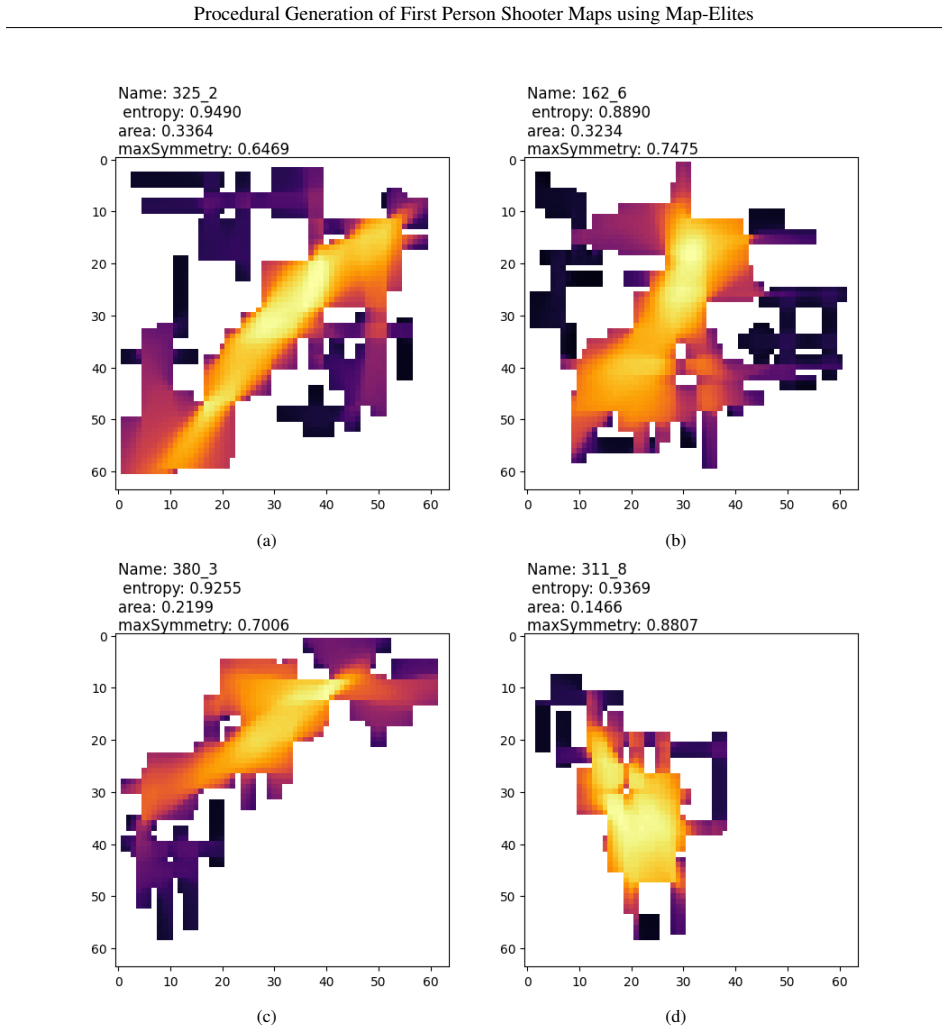
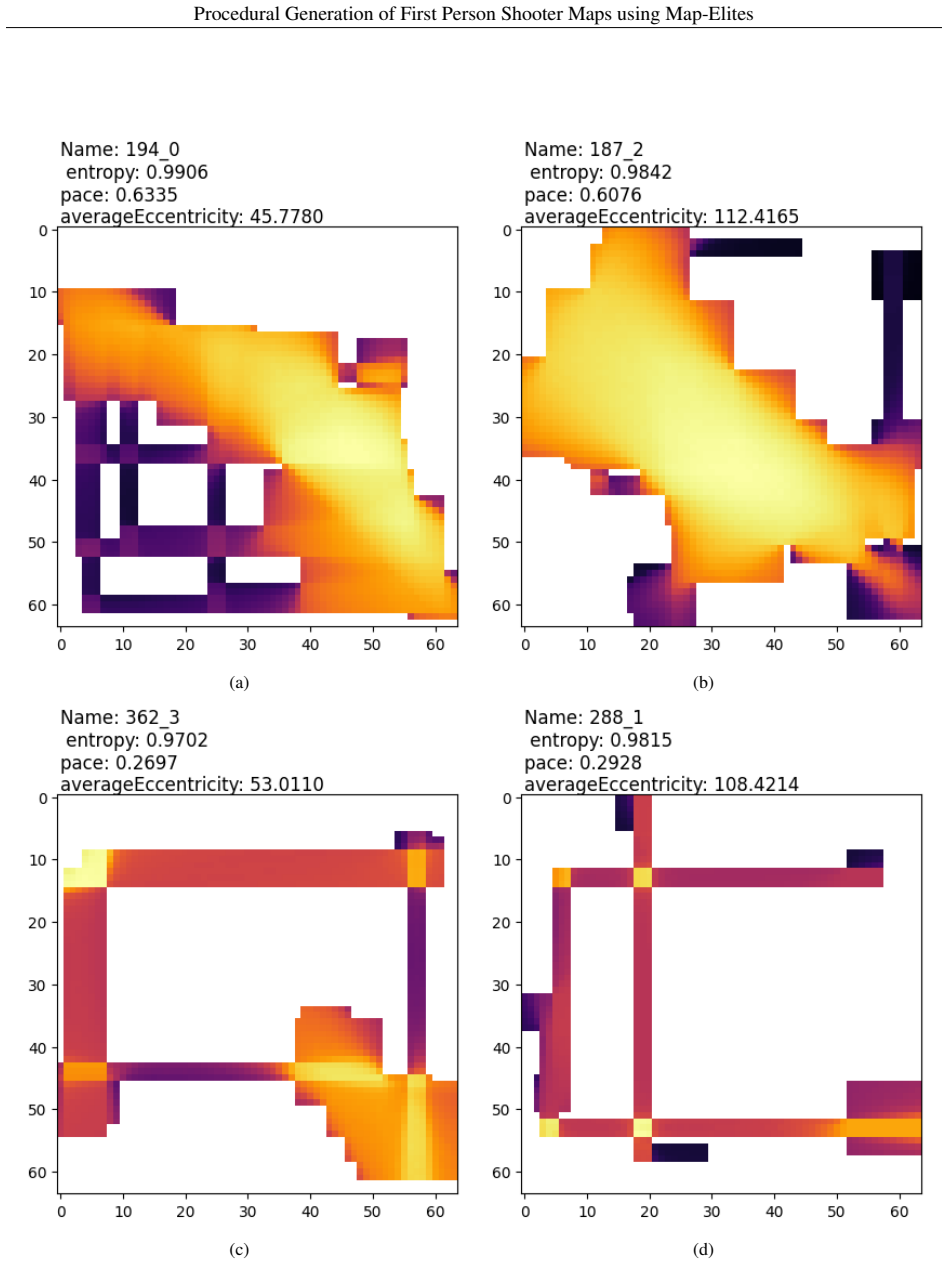
P. T. Ølsted, B. Ma, S. Risi, Interactive evolution of levels for a competitive multiplayer FPS, in: 2015 IEEE Congress on Evolutionary Computation (CEC), 2015, pp. 1527–1534, iSSN: 1941-0026. doi:10.1109/CEC. 12 Procedural Generation of First Person Shooter Maps using Map-Elites (a) (b) (c) (d) Figure 8: Best performing maps in the archive evolved with t...
work page doi:10.1109/cec 2015
-
[6]
Illuminating search spaces by mapping elites
J.-B. Mouret, J. Clune, Illuminating search spaces by mapping elites, arXiv:1504.04909 [cs, q-bio] (Apr. 2015). doi:10.48550/arXiv.1504.04909. URLhttp://arxiv.org/abs/1504.04909
work page internal anchor Pith review Pith/arXiv arXiv doi:10.48550/arxiv.1504.04909 2015
-
[7]
M. C. Fontaine, S. Lee, L. B. Soros, F. De Mesentier Silva, J. Togelius, A. K. Hoover, Mapping hearthstone deck spaces through map-elites with sliding boundaries, in: Proceedings of the Genetic and Evolutionary Computation Conference, GECCO ’19, Association for Computing Machinery, New York, NY , USA, 2019, p. 161–169. doi:10.1145/3321707.3321794. URLhttp...
-
[9]
M. Ballabio, D. Loiacono, Heuristics for placing the spawn points in multiplayer first person shooters, in: IEEE Conference on Games, CoG 2019, London, United Kingdom, August 20-23, 2019, IEEE, 2019, pp. 1–8. doi:10.1109/CIG.2019.8848121. URLhttps://doi.org/10.1109/CIG.2019.8848121
-
[10]
de Donato, Quality diversity in procedural generation of first person shooter maps, Master’s thesis, Politecnico di Milano (Oct
S. de Donato, Quality diversity in procedural generation of first person shooter maps, Master’s thesis, Politecnico di Milano (Oct. 2024)
2024
-
[11]
Ballabio, Project Arena, https://github.com/MarcoBallabio/ProjectArena, [Online; accessed 17- March-2026] (2018)
M. Ballabio, Project Arena, https://github.com/MarcoBallabio/ProjectArena, [Online; accessed 17- March-2026] (2018)
2026
-
[12]
B. Tjanaka, M. C. Fontaine, D. H. Lee, Y . Zhang, N. R. Balam, N. Dennler, S. S. Garlanka, N. D. Klapsis, S. Nikolaidis, pyribs: A Bare-Bones Python Library for Quality Diversity Optimization, arXiv:2303.00191 [cs] (Apr. 2023).doi:10.48550/arXiv.2303.00191. URLhttp://arxiv.org/abs/2303.00191
-
[13]
D. L. Simone de Donato, Pier Luca Lanzi, Quality diversity in procedural generation of first person shooter maps repository, https://github.com/SimoDedo/MAPElites_FPS_Maps, online; accessed 17-March-2026 (2025)
2026
-
[14]
J. Togelius, G. Yannakakis, K. Stanley, C. Browne, Search-Based Procedural Content Generation, 2010, pp. 141–150.doi:10.1007/978-3-642-12239-2\_15
-
[15]
CUBE2: Sauerbraten,http://sauerbraten.org, [Accessed 2025-01-18] (2004)
2025
-
[16]
A. Bhojan, H. W. Wong, ARENA - Dynamic Run-Time Map Generation for Multiplayer Shooters, in: Y . Pisan, N. M. Sgouros, T. Marsh (Eds.), Entertainment Computing – ICEC 2014, Springer, Berlin, Heidelberg, 2014, pp. 149–158.doi:10.1007/978-3-662-45212-7\_19
-
[17]
Wikipedia contributors, Flood fill — Wikipedia, the free encyclopedia, https://en.wikipedia.org/wiki/ Flood_fill, [Online; accessed 24-March-2026] (2024)
2026
-
[18]
Intentional Computational Level Design
A. Khalifa, M. C. Green, G. Barros, J. Togelius, Intentional Computational Level Design, arXiv:1904.08972 [cs] (Apr. 2019).doi:10.48550/arXiv.1904.08972. URLhttp://arxiv.org/abs/1904.08972
work page internal anchor Pith review Pith/arXiv arXiv doi:10.48550/arxiv.1904.08972 1904
-
[19]
V . R. Warriar, C. Ugarte, J. R. Woodward, L. Tokarchuk, PlayMapper: Illuminating Design Spaces of Platform Games, in: 2019 IEEE Conference on Games (CoG), 2019, pp. 1–4, iSSN: 2325-4289. doi:10.1109/CIG.2019. 8848118. URLhttps://ieeexplore.ieee.org/document/8848118
-
[20]
M. C. Fontaine, R. Liu, A. Khalifa, J. Modi, J. Togelius, A. K. Hoover, S. Nikolaidis, Illuminating mario scenes in the latent space of a generative adversarial network, Proceedings of the AAAI Conference on Artificial Intelligence 35 (7) (2021) 5922–5930.doi:10.1609/aaai.v35i7.16740. URLhttps://ojs.aaai.org/index.php/AAAI/article/view/16740
-
[21]
A. Alvarez, S. Dahlskog, J. Font, J. Togelius, Empowering Quality Diversity in Dungeon Design with Interactive Constrained MAP-Elites, in: 2019 IEEE Conference on Games (CoG), 2019, pp. 1–8, arXiv:1906.05175 [cs]. doi:10.1109/CIG.2019.8848022. URLhttp://arxiv.org/abs/1906.05175 16 Procedural Generation of First Person Shooter Maps using Map-Elites
-
[22]
S. O. Kimbrough, G. J. Koehler, M. Lu, D. H. Wood, On a Feasible–Infeasible Two-Population (FI-2Pop) genetic algorithm for constrained optimization: Distance tracing and no free lunch, European Journal of Operational Research 190 (2) (2008) 310–327.doi:10.1016/j.ejor.2007.06.028. URLhttps://www.sciencedirect.com/science/article/pii/S0377221707005668
-
[23]
M. Charity, M. C. Green, A. Khalifa, J. Togelius, Mech-elites: Illuminating the mechanic space of gvg-ai, in: Proceedings of the 15th International Conference on the Foundations of Digital Games, FDG ’20, Association for Computing Machinery, New York, NY , USA, 2020.doi:10.1145/3402942.3402954. URLhttps://doi.org/10.1145/3402942.3402954
-
[24]
D. Perez-Liebana, J. Liu, A. Khalifa, R. D. Gaina, J. Togelius, S. M. Lucas, General Video Game AI: a Multi-Track Framework for Evaluating Agents, Games and Content Generation Algorithms, arXiv:1802.10363 [cs] (Feb. 2019). doi:10.48550/arXiv.1802.10363. URLhttp://arxiv.org/abs/1802.10363
work page internal anchor Pith review Pith/arXiv arXiv doi:10.48550/arxiv.1802.10363 2019
-
[25]
M. González-Duque, R. B. Palm, D. Ha, S. Risi, Finding Game Levels with the Right Difficulty in a Few Trials through Intelligent Trial-and-Error, arXiv:2005.07677 [cs] (Jun. 2020).doi:10.48550/arXiv.2005.07677. URLhttp://arxiv.org/abs/2005.07677
-
[26]
B. M. F. Viana, L. T. Pereira, C. F. M. Toledo, Illuminating the Space of Dungeon Maps, Locked-door Missions and Enemy Placement Through MAP-Elites, arXiv:2202.09301 [cs] (Apr. 2022). doi:10.48550/arXiv.2202. 09301. URLhttp://arxiv.org/abs/2202.09301
-
[27]
M. Charity, A. Khalifa, J. Togelius, Baba is y’all: Collaborative mixed-initiative level design, in: 2020 IEEE Conference on Games (CoG), 2020, pp. 542–549.doi:10.1109/CoG47356.2020.9231807
-
[28]
Talakat: Bullet Hell Generation through Constrained Map-Elites
A. Khalifa, S. Lee, A. Nealen, J. Togelius, Talakat: Bullet Hell Generation through Constrained Map-Elites, arXiv:1806.04718 [cs] (Jun. 2018).doi:10.48550/arXiv.1806.04718. URLhttp://arxiv.org/abs/1806.04718
work page internal anchor Pith review Pith/arXiv arXiv doi:10.48550/arxiv.1806.04718 2018
-
[29]
D. Gravina, A. Liapis, G. N. Yannakakis, Constrained surprise search for content generation, in: IEEE Conference on Computational Intelligence and Games, CIG 2016, Santorini, Greece, September 20-23, 2016, IEEE, 2016, pp. 1–8.doi:10.1109/CIG.2016.7860408. URLhttps://doi.org/10.1109/CIG.2016.7860408
-
[30]
Shaker, J
N. Shaker, J. Togelius, M. J. Nelson, Procedural Content Generation in Games, Springer-Verlag, 2016
2016
-
[31]
org/wiki/Rogue_(video_game), [Online; accessed 9-January-2025] (2024)
Wikipedia contributors, Rogue (video game) — Wikipedia, the free encyclopedia, https://en.wikipedia. org/wiki/Rogue_(video_game), [Online; accessed 9-January-2025] (2024)
2025
-
[32]
J. Whitehead, Spatial Layout of Procedural Dungeons Using Linear Constraints and SMT Solvers, in: Proceedings of the 15th International Conference on the Foundations of Digital Games, FDG ’20, Association for Computing Machinery, New York, NY , USA, 2020, pp. 1–9.doi:10.1145/3402942.3409603. URLhttps://dl.acm.org/doi/10.1145/3402942.3409603
-
[33]
K. Hullett, J. Whitehead, Design patterns in FPS levels, in: Proceedings of the Fifth International Conference on the Foundations of Digital Games, ACM, Monterey California, 2010, pp. 78–85. doi:10.1145/1822348.1822359. URLhttps://dl.acm.org/doi/10.1145/1822348.1822359 17
discussion (0)
Sign in with ORCID, Apple, or X to comment. Anyone can read and Pith papers without signing in.