Preparing thermal states of frustrated quantum spin systems using 139 qubits
Pith reviewed 2026-06-29 21:20 UTC · model grok-4.3
The pith
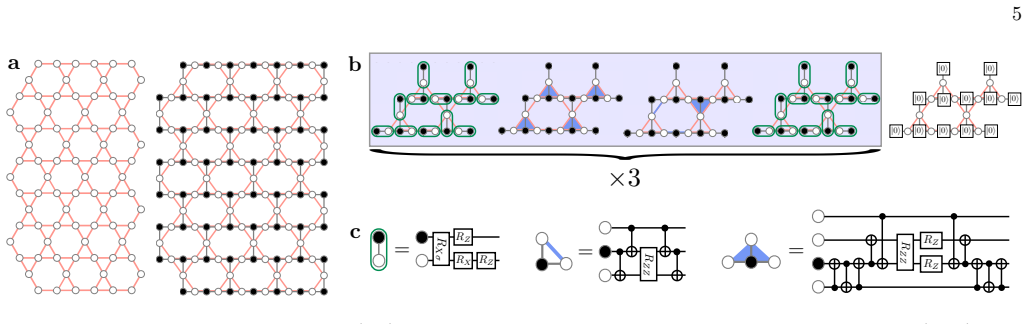
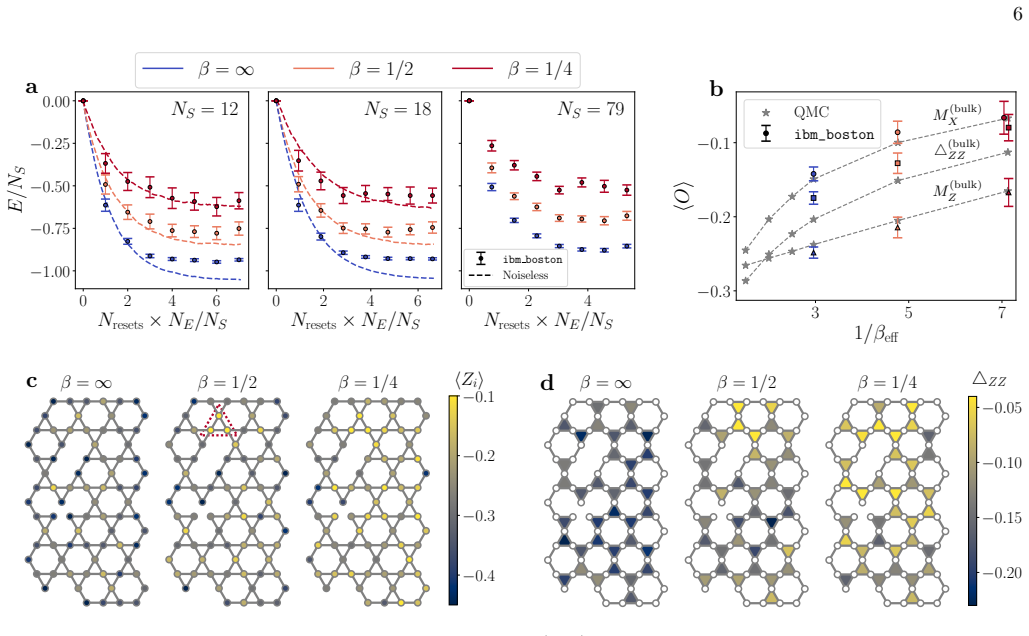
Dissipative coupling prepares approximate thermal states of up to 79-spin kagome antiferromagnets using 139 qubits.
A machine-rendered reading of the paper's core claim, the machinery that carries it, and where it could break.
Core claim
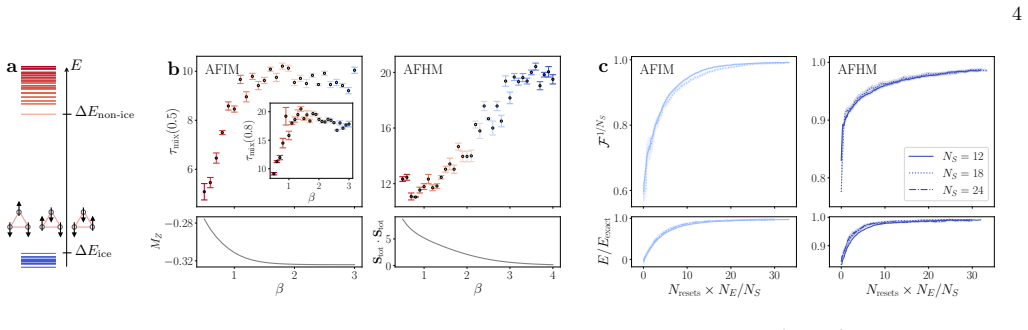
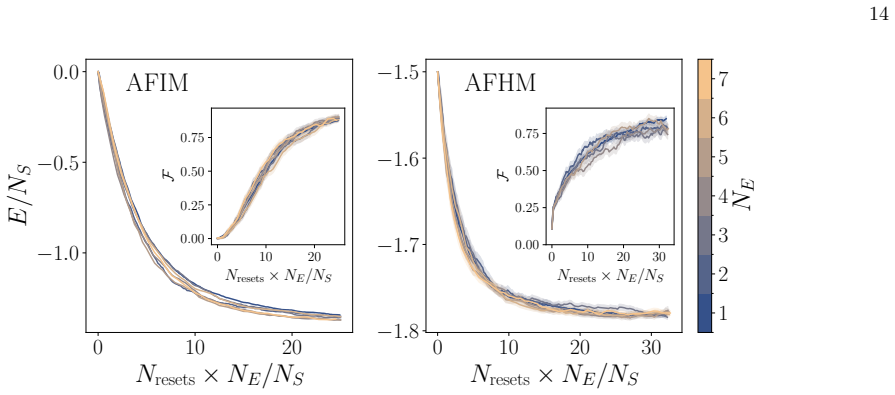
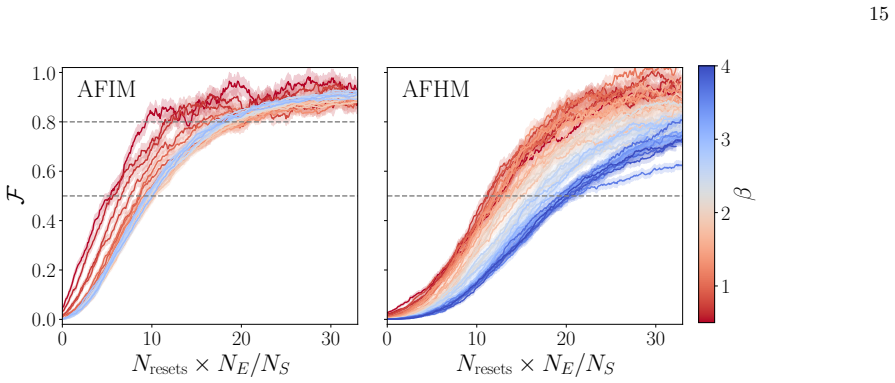
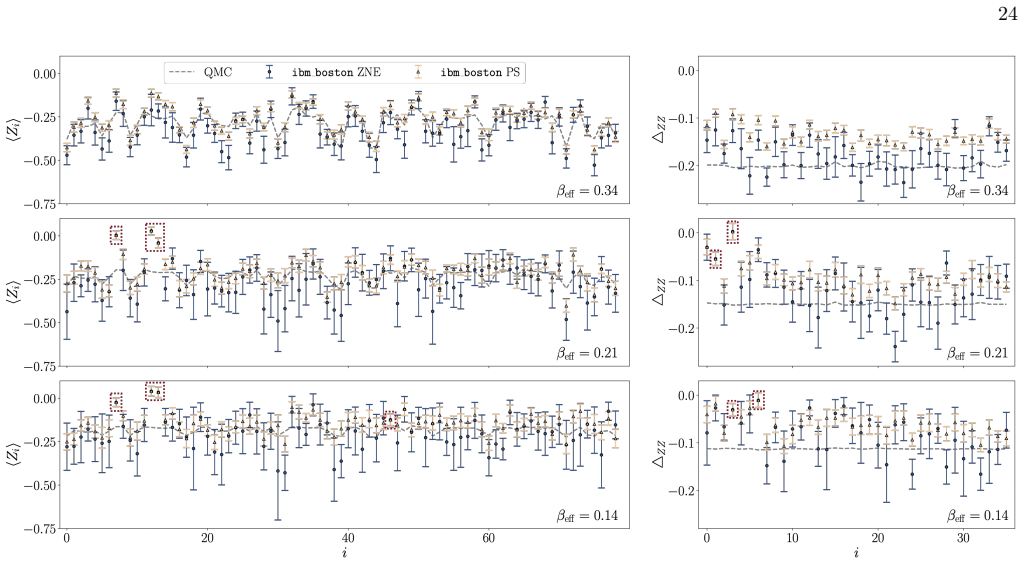
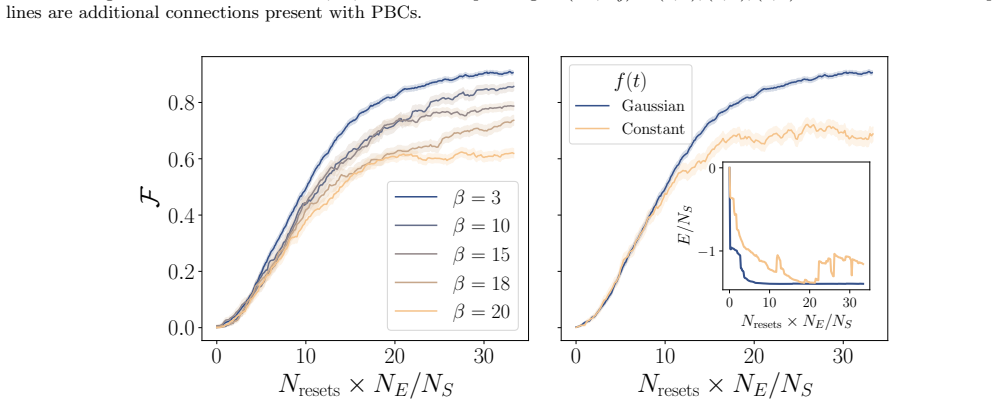
Approximate thermal states of the antiferromagnetic Ising model on kagome lattices are prepared on IBM quantum processors by coupling up to 79 system spins to 60 environment qubits, resulting in a robust steady state with adjustable effective temperature that persists through circuits with over 1000 layers of two-qubit gates. Classical simulations of the protocol for both the Ising and Heisenberg models on lattices up to 24 sites show that the circuit depth to reach equilibrium is independent of system size and grows at most linearly with inverse temperature.
What carries the argument
engineered dissipation via coupling system spins to environment qubits that drives the system toward a tunable thermal steady state
If this is right
- Approximate thermal states for the AFIM benchmark become accessible on present-day quantum hardware with 139 qubits.
- Circuit depth to equilibrium does not grow with system size for lattices up to 24 sites.
- The same protocol applies in principle to the AFHM whose finite-temperature behavior is inaccessible to quantum Monte Carlo.
- Engineered dissipation offers a route to finite-temperature simulation of frustrated matter beyond classical reach.
Where Pith is reading between the lines
- Validation against exact thermal states on small lattices would allow scaling studies of temperature-driven phase transitions in frustrated magnets.
- Lower effective temperatures might be reachable by combining the dissipation protocol with variational optimization of the initial state.
- Size-independent depth suggests the method remains practical as qubit counts increase.
Load-bearing premise
The observed steady state matches the local properties of a true thermal state at the claimed effective temperature rather than reflecting hardware noise or incomplete thermalization.
What would settle it
For a small kagome AFIM instance where exact thermal averages are computable, measure the prepared state's energy or spin correlations and verify agreement with the Boltzmann distribution at the claimed temperature.
Figures





read the original abstract
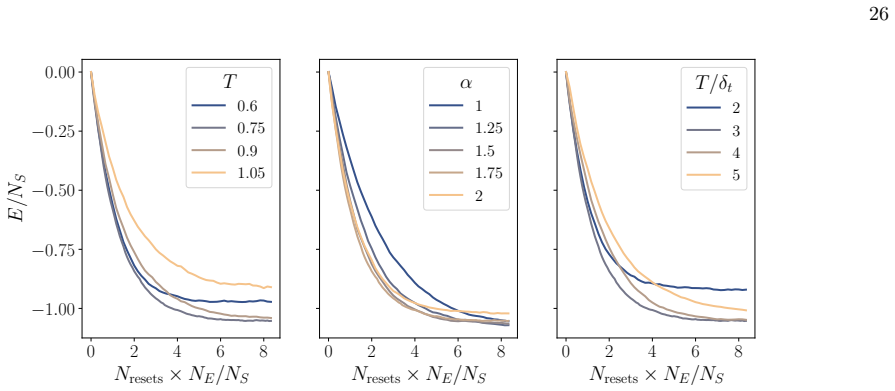
Finite-temperature properties of strongly correlated quantum matter are central to condensed matter, chemistry, and high-energy physics, yet are often inaccessible to classical methods such as quantum Monte Carlo (QMC). Here, we investigate dissipative thermal state preparation of frustrated spin systems using digital quantum computers. We focus on two paradigmatic models on the kagome lattice: the antiferromagnetic Heisenberg model (AFHM), whose finite-temperature properties are inaccessible to QMC due to a severe sign problem, and the antiferromagnetic Ising model (AFIM), which serves as a sign-problem-free benchmark. Using IBM quantum processors, we prepare approximate thermal states of the AFIM on kagome lattices with up to $79$ spins coupled to $60$ environment qubits. We observe the emergence of a robust steady state with an adjustable effective temperature that persists in circuits with over 1000 layers of two-qubit gates. We further study the scalability of the dissipative protocol through classical statevector simulations of the AFIM and AFHM. On lattices with up to 24 sites, we find that the circuit depth to reach thermal equilibrium is independent of system size and grows at most linearly with inverse temperature. These results establish engineered dissipation as a promising approach to finite-temperature quantum simulation of frustrated matter, and point toward regimes where quantum devices may outperform classical methods.
Editorial analysis
A structured set of objections, weighed in public.
Referee Report
Summary. The manuscript claims that a dissipative protocol can prepare approximate thermal states of frustrated spin systems on the kagome lattice. On IBM hardware they realize this for the antiferromagnetic Ising model (AFIM) with up to 79 system spins coupled to 60 environment qubits (139 total), producing a robust steady state whose effective temperature can be adjusted and that survives circuits exceeding 1000 layers of two-qubit gates. Statevector simulations up to 24 sites for both AFIM and the sign-problematic antiferromagnetic Heisenberg model (AFHM) show that the depth required to reach equilibrium is independent of system size and grows at most linearly with inverse temperature.
Significance. If the prepared states are shown to be close to Gibbs states at the reported effective temperatures, the work supplies a concrete route to finite-temperature properties of sign-problematic models that are inaccessible to quantum Monte Carlo. The 139-qubit hardware demonstration and the size-independent depth scaling (at most linear in 1/T) are genuine strengths that could enable quantum devices to reach regimes where classical methods fail. The explicit scaling result for both models is a clear, falsifiable contribution.
major comments (1)
- [Experimental results on AFIM] Experimental AFIM results: the claim that the observed steady state is an approximate thermal state at an adjustable effective temperature is load-bearing. The manuscript must supply quantitative metrics (e.g., deviation of energy, specific heat, or correlation functions from exact thermal values) for the largest (79-spin) instances; without these, it remains possible that the steady state is a non-thermal attractor shaped by hardware noise rather than the target Gibbs state.
minor comments (2)
- [Abstract] Abstract and methods: the procedure used to extract and tune the effective temperature should be stated explicitly, including which observables are fitted and the fitting tolerance.
- [Simulation results] Simulation section: the precise system sizes, number of independent runs, and the functional form of the observed depth-vs-1/T scaling for the AFHM should be tabulated or plotted with error bars.
Simulated Author's Rebuttal
We thank the referee for their positive assessment and constructive feedback. We address the single major comment below.
read point-by-point responses
-
Referee: [Experimental results on AFIM] Experimental AFIM results: the claim that the observed steady state is an approximate thermal state at an adjustable effective temperature is load-bearing. The manuscript must supply quantitative metrics (e.g., deviation of energy, specific heat, or correlation functions from exact thermal values) for the largest (79-spin) instances; without these, it remains possible that the steady state is a non-thermal attractor shaped by hardware noise rather than the target Gibbs state.
Authors: We agree that direct quantitative comparison to exact thermal expectations would strengthen the interpretation. However, exact thermal properties for a 79-spin system are computationally intractable, requiring summation over an exponential number of configurations (2^79). This intractability is the regime the method targets. For the AFIM we have instead validated the protocol via statevector simulations on systems up to 24 sites, where exact comparisons are feasible and confirm that the dissipative dynamics reach the target Gibbs state with depth independent of system size. On hardware, the 79-spin steady state is shown to be robust (persisting beyond 1000 two-qubit layers), independent of initial conditions, and tunable in effective temperature via the engineered dissipation parameters, consistent with the theoretical analysis of the protocol. We will revise the manuscript to expand the discussion of these supporting lines of evidence and to explicitly note the absence of exact benchmarks at the largest size. revision: partial
- Supplying quantitative metrics comparing observables to exact thermal values for the 79-spin hardware instances, as exact computation is intractable at this scale.
Circularity Check
No significant circularity detected
full rationale
The paper's central claims rest on direct experimental observations from IBM quantum processors (up to 79+60 qubits) showing emergence of adjustable-temperature steady states, plus classical statevector simulations (up to 24 sites) confirming size-independent depth scaling linear in 1/T. No load-bearing steps reduce by construction to fitted inputs, self-citations, or ansatzes imported from prior author work; the protocol is validated against external benchmarks via hardware runs and sign-problem-free comparisons rather than internal redefinition.
Axiom & Free-Parameter Ledger
axioms (1)
- standard math Standard quantum mechanics and open quantum system dynamics
Reference graph
Works this paper leans on
-
[1]
QbNhQ5WJ0eFBv0c6UqymbSdole0=
the dynamics generated byLis rapidly mixing, i.e., for any initial stateρ, ∥etL(ρ)−ρ ∞∥1 ≤C e −γt poly(NS),(D12) with constantsC, γ >0independent of system sizeN S. Let ˜L=L+Ebe a perturbation ofLby local termsE= P x Ex where each local perturbation has strength∥E x∥ ≤p 1. and let˜ρ∞ denote the steady state of ˜L. Then for any local observableO A supporte...
1910
-
[2]
mqy0RXK30FvfXpLsx14LtLwNGCI=
Reset-error adjustedβ ∗ One source of error comes from imperfect qubit reset. We will show that this changes the local temperature of each environment qubit resulting in a reset-error adjustedβ ∗ that is lower than the targetβ. Define confusion matrices ˆXR and ˆXM that relate the input ⃗Iand output ⃗Oprobability distributions after reset and measurement ...
-
[3]
Zero noise extrapolation The final step of our error mitigation pipeline is Zero Noise Extrapolation (ZNE) [101, 102], which was also used for circuits with mid-circuit measurements in Ref. [103]. In our implementation, we apply a transformation pass that 23 FIG. 14. The energy densities measured onibm bostonforβ=∞and system sizesN S = 12 (left),N S = 18 ...
-
[4]
Laermann and O
E. Laermann and O. Philipsen, Lattice qcd at finite temperature, Annual Review of Nuclear and Particle Science53, 163 (2003)
2003
-
[5]
Philipsen, Lattice qcd at finite temperature and den- sity, The European Physical Journal Special Topics152, 29 (2007)
O. Philipsen, Lattice qcd at finite temperature and den- sity, The European Physical Journal Special Topics152, 29 (2007)
2007
-
[6]
N. D. Mermin, Thermal properties of the inhomoge- neous electron gas, Phys. Rev.137, A1441 (1965)
1965
-
[7]
Bonitz, T
M. Bonitz, T. Dornheim, Z. A. Moldabekov, S. Zhang, P. Hamann, H. K¨ ahlert, A. Filinov, K. Ramakrishna, and J. Vorberger, Ab initio simulation of warm dense matter, Physics of Plasmas27, 042710 (2020)
2020
-
[8]
Bloch, J
I. Bloch, J. Dalibard, and W. Zwerger, Many-body physics with ultracold gases, Rev. Mod. Phys.80, 885 (2008)
2008
-
[9]
C. Gross and I. Bloch, Quantum simulations with ultra- cold atoms in optical lattices, Science357, 995 (2017), https://www.science.org/doi/pdf/10.1126/science.aal3837
-
[10]
Evolution of Entanglement Entropy in One-Dimensional Systems
P. Calabrese and J. L. Cardy, Evolution of entangle- ment entropy in one-dimensional systems, J. Stat. Mech. 0504, P04010 (2005), arXiv:cond-mat/0503393
work page internal anchor Pith review Pith/arXiv arXiv 2005
-
[12]
R. P. Feynman, Quantum mechanical computers, Found. Phys.16, 507 (1986)
1986
-
[13]
Lloyd, Universal quantum simulators, Science273, 1073 (1996)
S. Lloyd, Universal quantum simulators, Science273, 1073 (1996)
1996
-
[14]
Bertini, F
B. Bertini, F. Heidrich-Meisner, C. Karrasch, T. Prosen, R. Steinigeweg, and M. ˇZnidariˇ c, Finite-temperature transport in one-dimensional quantum lattice models, Reviews of Modern Physics93, 025003 (2021)
2021
-
[15]
McArdle, S
S. McArdle, S. Endo, A. Aspuru-Guzik, S. C. Benjamin, and X. Yuan, Quantum computational chemistry, Re- views of Modern Physics92, 015003 (2020)
2020
-
[16]
von Burg, G
V. von Burg, G. H. Low, T. H¨ aner, D. S. Steiger, M. Rei- her, M. Roetteler, and M. Troyer, Quantum computing enhanced computational catalysis, Physical Review Re- search3, 033055 (2021)
2021
-
[17]
Tsutsui, M
S. Tsutsui, M. Hongo, S. Sato, and T. Sagawa, Quantum hydrodynamics from local thermal pure states, Phys. 29 Rev. Res.4, 033059 (2022)
2022
-
[18]
Computational complexity and fundamental limitations to fermionic quantum Monte Carlo simulations
M. Troyer and U.-J. Wiese, Computational complex- ity and fundamental limitations to fermionic quantum Monte Carlo simulations, Phys. Rev. Lett.94, 170201 (2005), arXiv:cond-mat/0408370
work page internal anchor Pith review Pith/arXiv arXiv 2005
-
[19]
Lacroix, P
C. Lacroix, P. Mendels, and F. Mila,Introduction to Frustrated Magnetism, Vol. 164 (Springer, 2011)
2011
-
[20]
E. Y. Loh, J. E. Gubernatis, R. T. Scalettar, S. R. White, D. J. Scalapino, and R. L. Sugar, Sign problem in the numerical simulation of many-electron systems, Phys. Rev. B41, 9301 (1990)
1990
-
[21]
Nagata, Finite-density lattice QCD and sign prob- lem: Current status and open problems, Prog
K. Nagata, Finite-density lattice QCD and sign prob- lem: Current status and open problems, Prog. Part. Nucl. Phys.127, 103991 (2022), arXiv:2108.12423 [hep- lat]
-
[22]
J. P. F. LeBlanc, A. E. Antipov, F. Becca, I. W. Bu- lik, G. K.-L. Chan, C.-M. Chung, Y. Deng, M. Fer- rero, T. M. Henderson, C. A. Jim´ enez-Hoyos, E. Kozik, X.-W. Liu, A. J. Millis, N. V. Prokof’ev, M. Qin, G. E. Scuseria, H. Shi, B. V. Svistunov, L. F. Tocchio, I. S. Tupitsyn, S. R. White, S. Zhang, B.-X. Zheng, Z. Zhu, and E. Gull (Simons Collaboratio...
2015
-
[23]
M. Stephanov, QCD critical point: Recent de- velopments, EPJ Web Conf.314, 00042 (2024), arXiv:2410.02861 [nucl-th]
-
[24]
G. Baym, T. Hatsuda, T. Kojo, P. D. Powell, Y. Song, and T. Takatsuka, From hadrons to quarks in neutron stars: a review, Rept. Prog. Phys.81, 056902 (2018), arXiv:1707.04966 [astro-ph.HE]
work page internal anchor Pith review Pith/arXiv arXiv 2018
- [25]
-
[26]
J. Jiang and S. Irani, Quantum metropolis sampling via weak measurement, arXiv preprint arXiv:2406.16023 (2024)
-
[27]
C.-F. Chen, M. Kastoryano, F. G. Brand˜ ao, and A. Gily´ en, Efficient quantum thermal simulation, Na- ture646, 561 (2025)
2025
-
[28]
C.-F. Chen, M. J. Kastoryano, F. G. Brand˜ ao, and A. Gily´ en, Quantum thermal state preparation, arXiv preprint arXiv:2303.18224 (2023)
work page internal anchor Pith review Pith/arXiv arXiv 2023
- [29]
-
[30]
J. Lloyd and D. A. Abanin, Quantum thermal state preparation for near-term quantum processors (2025), arXiv:2506.21318 [quant-ph]
-
[31]
H. Chen, Z. Ding, and R. Zhang, Overcoming the lamb shift in system-bath models via kms detailed balance: High-accuracy thermalization with time-bounded inter- actions, arXiv preprint arXiv:2604.15616 (2026)
work page internal anchor Pith review Pith/arXiv arXiv 2026
-
[32]
Consiglio, Variational quantum algorithms for gibbs state preparation, inInternational Conference on Numerical Computations: Theory and Algorithms (Springer, 2023) pp
M. Consiglio, Variational quantum algorithms for gibbs state preparation, inInternational Conference on Numerical Computations: Theory and Algorithms (Springer, 2023) pp. 56–70
2023
-
[33]
R.-H. Li, S. Valgushev, and K. Najafi, Variational Thermal State Preparation on Digital Quantum Pro- cessors Assisted by Matrix Product States (2025), arXiv:2510.23546 [quant-ph]
work page internal anchor Pith review Pith/arXiv arXiv 2025
-
[34]
Motta, C
M. Motta, C. Sun, A. T. Tan, M. J. O’Rourke, E. Ye, A. J. Minnich, F. G. Brandao, and G. K.-L. Chan, De- termining eigenstates and thermal states on a quantum computer using quantum imaginary time evolution, Na- ture Physics16, 205 (2020)
2020
-
[35]
D. Poulin and P. Wocjan, Sampling from the Thermal Quantum Gibbs State and Evaluating Partition Func- tions with a Quantum Computer, Phys. Rev. Lett.103, 220502 (2009), arXiv:0905.2199 [quant-ph]
work page internal anchor Pith review Pith/arXiv arXiv 2009
-
[36]
Thermalization in Nature and on a Quantum Computer
A. Riera, C. Gogolin, and J. Eisert, Thermalization in Nature and on a Quantum Computer, Phys. Rev. Lett. 108, 080402 (2012), arXiv:1102.2389 [quant-ph]
work page internal anchor Pith review Pith/arXiv arXiv 2012
-
[37]
A Quantum-Quantum Metropolis Algorithm
M.-H. Yung and A. Aspuru-Guzik, A quan- tum–quantum Metropolis algorithm, Proc. Nat. Acad. Sci.109, 754 (2012), arXiv:1011.1468 [quant-ph]
work page internal anchor Pith review Pith/arXiv arXiv 2012
-
[38]
K. Temme, T. J. Osborne, K. G. Vollbrecht, D. Poulin, and F. Verstraete, Quantum Metropolis Sampling, Na- ture471, 87 (2011), arXiv:0911.3635 [quant-ph]
work page internal anchor Pith review Pith/arXiv arXiv 2011
- [39]
-
[40]
X. Miet al., Stable quantum-correlated many-body states through engineered dissipation, Science383, adh9932 (2024), arXiv:2304.13878 [quant-ph]
-
[41]
E. Brunner, L. Coopmans, G. Matos, M. Rosenkranz, F. Sauvage, and Y. Kikuchi, Lindblad engineering for quantum Gibbs state preparation under the eigenstate thermalization hypothesis, Quantum9, 1843 (2025), arXiv:2412.17706 [quant-ph]
- [42]
-
[43]
S.-N. Sun, M. Motta, R. N. Tazhigulov, A. T. Tan, G. K.-L. Chan, and A. J. Minnich, Quantum compu- tation of finite-temperature static and dynamical prop- erties of spin systems using quantum imaginary time evolution, PRX Quantum2, 010317 (2021)
2021
-
[44]
Consiglio, J
M. Consiglio, J. Settino, A. Giordano, C. Mastroianni, F. Plastina, S. Lorenzo, S. Maniscalco, J. Goold, and T. J. G. Apollaro, Variational gibbs state preparation on noisy intermediate-scale quantum devices, Phys. Rev. A 110, 012445 (2024)
2024
-
[45]
Adiabatic preparation of thermal states and entropy-noise relation on noisy quantum computers
E. Granet and H. Dreyer, Adiabatic preparation of ther- mal states and entropy-noise relation on noisy quantum computers (2025), arXiv:2509.05206 [quant-ph]
work page internal anchor Pith review Pith/arXiv arXiv 2025
-
[46]
R. Robertson, M. Consiglio, J. Stevens, E. Doucet, T. J. G. Apollaro, and S. Deffner, Variational Gibbs State Preparation on Trapped-Ion Devices (2026), arXiv:2603.03801 [quant-ph]
-
[47]
Balents, Spin liquids in frustrated magnets, Nature 464, 199 (2010)
L. Balents, Spin liquids in frustrated magnets, Nature 464, 199 (2010)
2010
-
[48]
M. Norman, Colloquium: Herbertsmithite and the search for the quantum spin liquid, Reviews of Modern Physics88, 10.1103/revmodphys.88.041002 (2016)
-
[49]
S. Yan, D. A. Huse, and S. R. White, Spin-Liquid Ground State of the S = 1/2 Kagome Heisenberg Anti- ferromagnet, Science332, 1173 (2011), arXiv:1011.6114 [cond-mat.str-el]
work page internal anchor Pith review Pith/arXiv arXiv 2011
-
[51]
Duric, J
T. Duric, J. H. Chung, B. Yang, and P. Sengupta, Spin- 30 1/2 kagome heisenberg antiferromagnet: Machine learn- ing discovery of the spinon pair-density-wave ground state, Phys. Rev. X15, 011047 (2025)
2025
-
[52]
R.-Y. Sun, H.-K. Jin, H.-H. Tu, and Y. Zhou, Possible chiral spin liquid state in the s=1/2 kagome heisenberg model, npj Quantum Materials9, 10.1038/s41535-024- 00627-5 (2024)
-
[53]
P. Narasimhan, S. Humeniuk, A. Roy, and V. Drouin- Touchette, Simulating the transverse-field Ising model on the kagome lattice using a programmable quan- tum annealer, Phys. Rev. B110, 054432 (2024), arXiv:2310.06698 [cond-mat.stat-mech]
-
[54]
M. J. Kastoryano and K. Temme, Quantum logarith- mic sobolev inequalities and rapid mixing, Journal of Mathematical Physics54, 052202 (2013)
2013
-
[55]
Y. Zhan, Z. Ding, J. Huhn, J. Gray, J. Preskill, G. K.-L. Chan, and L. Lin, Rapid quantum ground state prepara- tion via dissipative dynamics, Phys. Rev. X16, 011004 (2026)
2026
-
[56]
L. P. Hughston, R. Jozsa, and W. K. Wootters, A com- plete classification of quantum ensembles having a given density matrix, Physics Letters A183, 14 (1993)
1993
-
[57]
O. Shtanko and R. Movassagh, Preparing thermal states on noiseless and noisy programmable quantum proces- sors, arXiv preprint arXiv:2112.14688 (2021)
-
[58]
M. Hagan and N. Wiebe, The thermodynamic cost of ignorance: Thermal state preparation with one ancilla qubit, arXiv preprint arXiv:2502.03410 (2025)
-
[59]
Rouz´ e, D
C. Rouz´ e, D. S. Fran¸ ca, and´A. M. Alhambra, Efficient thermalization and universal quantum computing with quantum gibbs samplers, inProceedings of the 57th An- nual ACM Symposium on Theory of Computing(2025) pp. 1488–1495
2025
-
[60]
Rouz´ e, D
C. Rouz´ e, D. Stilck Fran¸ ca, and´A. M. Alhambra, Op- timal quantum algorithm for gibbs state preparation, Physical Review Letters136, 060601 (2026)
2026
-
[61]
T. Bergamaschi and C.-F. Chen, Quantum spin chains thermalize at all temperatures, arXiv preprint arXiv:2510.08533 (2025)
-
[62]
Tong and Y
Y. Tong and Y. Zhan, Fast mixing of weakly interacting fermionic systems at any temperature, PRX Quantum 6, 030301 (2025)
2025
-
[63]
ˇSm´ ıd, R
ˇS. ˇSm´ ıd, R. Meister, M. Berta, and R. Bondesan, Polynomial-time quantum gibbs sampling for the weak and strong coupling regime of the fermi-hubbard model at any temperature, Nature Communications16, 10736 (2025)
2025
-
[64]
Rapid Mixing of Quantum Gibbs Samplers for Weakly-Interacting Quantum Systems
ˇS. ˇSm´ ıd, R. Meister, M. Berta, and R. Bondesan, Rapid Mixing of Quantum Gibbs Samplers for Weakly- Interacting Quantum Systems (2025), arXiv:2510.04954 [quant-ph]
work page internal anchor Pith review Pith/arXiv arXiv 2025
-
[65]
Bakshi, A
A. Bakshi, A. Liu, A. Moitra, and E. Tang, High- temperature gibbs states are unentangled and efficiently preparable, in2024 IEEE 65th Annual Symposium on Foundations of Computer Science (FOCS)(IEEE, 2024) pp. 1027–1036
2024
-
[66]
Kuwahara, A
T. Kuwahara, A. M. Alhambra, and A. Anshu, Im- proved thermal area law and quasilinear time algorithm for quantum gibbs states, Phys. Rev. X11, 011047 (2021)
2021
- [67]
-
[68]
Moessner, S
R. Moessner, S. L. Sondhi, and P. Chandra, Two- dimensional periodic frustrated ising models in a trans- verse field, Phys. Rev. Lett.84, 4457 (2000)
2000
-
[69]
Miao, Physical Review A95, 10.1103/phys- reva.95.012103 (2017)
R. Moessner and S. L. Sondhi, Ising models of quan- tum frustration, Physical Review B63, 10.1103/phys- revb.63.224401 (2001)
-
[70]
Kreißelet al., in preparation
T. Kreißelet al., in preparation
-
[71]
First excitations of the spin 1/2 Heisenberg antiferromagnet on the kagom\'e lattice
C. Waldtmann, H.-U. Everts, B. Bernu, C. Lhuillier, P. Sindzingre, P. Lecheminant, and L. Pierre, First ex- citations of the spin 1/2 Heisenberg antiferromagnet on the kagom´ e lattice, European Physical Journal B2, 501 (1998), arXiv:cond-mat/9802168 [cond-mat.stat-mech]
work page internal anchor Pith review Pith/arXiv arXiv 1998
-
[72]
H. Nakano, Numerical-Diagonalization Study of Spin Gap Issue of the Kagome Lattice Heisenberg Antifer- romagnet, Journal of the Physical Society of Japan80, 053704 (2011), arXiv:1103.5829 [cond-mat.mtrl-sci]
work page internal anchor Pith review Pith/arXiv arXiv 2011
- [73]
- [74]
- [75]
-
[76]
J. J. Wallman and J. Emerson, Noise tailoring for scalable quantum computation via randomized compil- ing, Phys. Rev. A94, 052325 (2016), arXiv:1512.01098 [quant-ph]
work page internal anchor Pith review Pith/arXiv arXiv 2016
- [77]
- [78]
-
[79]
L. Katschke, R. C. Farrell, U. Borla, L. Pollet, and J. C. Halimeh, Finite-Temperature Dynamical Phase Diagram of the 2 + 1D Quantum Ising Model (2026), arXiv:2602.16772 [quant-ph]
-
[80]
K. Wang and Z. Ding, Beyond lindblad dynamics: Rig- orous guarantees for thermal and ground state preser- vation under system bath interactions, arXiv preprint arXiv:2512.03457 (2025)
-
[81]
H.-E. Li, Y. Zhan, and L. Lin, Dissipative ground state preparation in ab initio electronic structure theory, npj Quantum Information11, 183 (2025)
2025
-
[82]
Moessner, S
R. Moessner, S. L. Sondhi, and P. Chandra, Phase di- agram of the hexagonal lattice quantum dimer model, Phys. Rev. B64, 144416 (2001)
2001
discussion (0)
Sign in with ORCID, Apple, or X to comment. Anyone can read and Pith papers without signing in.